Marxist Literary Criticism
Historical Context
• began with Karl Marx, 19th century German philosopher
  best known for Das Kapital (1867), the seminal work of the
  communist movement.
• Marx was also the first Marxist literary critic, writing critical
  essays in the 1830s on such writers as Johann Wolfgang von
  Goethe and William Shakespeare.
Definition
• A sociological approach to literature that viewed works of
  literature or art as the products of historical forces that can
  be analyzed by looking at the material conditions in which
  they were formed.
Key Ideas
• What we think of as world view is actually the product of
  the dominant class
• Marxism generally focuses on the clash between the
  dominant and repressed classes
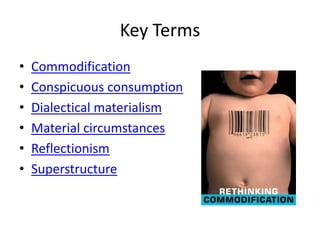
Key Terms
•   Commodification
•   Conspicuous consumption
•   Dialectical materialism
•   Material circumstances
•   Reflectionism
•   Superstructure
Points to consider
• Literature expresses the ideas, beliefs and values of a
  culture
• Literature of any significance actively engages in
  controversy or argument
• Literature reveals power struggles (sexual power, economic
  power, social power, and so on) and how this operates and
  with what consequences
Points to consider
• Literature reveals how the author, reader, and characters
  demonstrate an awareness or lack of awareness of their
  economic and social situations and what oppresses them
• Literature and authors can manipulate readers into
  sympathizing with rather than critiquing the dominant (and
  oppressive) social order.
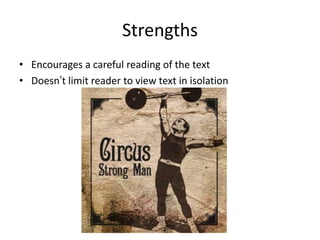
Strengths
• Encourages a careful reading of the text
• Doesn’t limit reader to view text in isolation
Weaknesses
• Only examines limited aspect of text
• Some people feel threatened by the focus on “ideology”
• Dismisses the beauty of writing and does not allow reader
  to simply enjoy tex
Testers
• Huckleberry Finn and Jim need to escape from their homes
  in order to recognize the oppressiveness of their lives
• Three symbols represent youth and immaturity in the story
  “Groom Service” are the drawing, the beaver tail, and the
  eagle feather
Testers
• In David French’s play Leaving Home, Jacob, Mary , and
  Kathy are unable to find true happiness because of the
  limitations of their economic situation
Testers
• The snowball incident at the start of Fifth Business controls
  the lives of Dunstable Ramsay, Percy Boyd Stanton, and
  Paul Dempster
Testers
• Romeo and Juliet might have lived if they had not been
  controlled by various societal pressures.
Applying this to a text
• To what degree does the protagonist or other
  characters believe in and live by the prevailing
  social order?
• At what point(s) do characters recognize the
  oppressiveness of the prevailing social order?
• How do they respond? What affects their options
  for changing things?
• How is social objectification evident and how does
  it operate in the text?
• What are the social forces that affect the author’s
  writing or the text’s marketing and reception?
the attitude of valuing things not for
their utility but for their power to
impress others or for their resale
possibilities
the obvious acquisition of things only for their
sign value and/or exchange value
the theory that history develops neither in a
random fashion nor in a linear one but instead as
struggle between contradictions that ultimately find
resolution in a synthesis of the two sides. For
example, class conflicts lead to new social systems
the economic conditions underlying the society. To understand
social events, one must have a grasp of the material
circumstances and the historical situation in which they occur
a theory that the superstructure of a society mirrors its
economic base and, by extension, that a text reflects
the society that produced it
The social, political, and ideological systems and
institutions--for example, the values, art, and legal
processes of a society--that are generated by the base

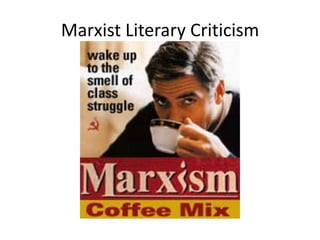
Marxist literary criticism

  • 1.
  • 2.
    Historical Context • beganwith Karl Marx, 19th century German philosopher best known for Das Kapital (1867), the seminal work of the communist movement. • Marx was also the first Marxist literary critic, writing critical essays in the 1830s on such writers as Johann Wolfgang von Goethe and William Shakespeare.
  • 3.
    Definition • A sociologicalapproach to literature that viewed works of literature or art as the products of historical forces that can be analyzed by looking at the material conditions in which they were formed.
  • 4.
    Key Ideas • Whatwe think of as world view is actually the product of the dominant class • Marxism generally focuses on the clash between the dominant and repressed classes
  • 5.
    Key Terms • Commodification • Conspicuous consumption • Dialectical materialism • Material circumstances • Reflectionism • Superstructure
  • 6.
    Points to consider •Literature expresses the ideas, beliefs and values of a culture • Literature of any significance actively engages in controversy or argument • Literature reveals power struggles (sexual power, economic power, social power, and so on) and how this operates and with what consequences
  • 7.
    Points to consider •Literature reveals how the author, reader, and characters demonstrate an awareness or lack of awareness of their economic and social situations and what oppresses them • Literature and authors can manipulate readers into sympathizing with rather than critiquing the dominant (and oppressive) social order.
  • 8.
    Strengths • Encourages acareful reading of the text • Doesn’t limit reader to view text in isolation
  • 9.
    Weaknesses • Only examineslimited aspect of text • Some people feel threatened by the focus on “ideology” • Dismisses the beauty of writing and does not allow reader to simply enjoy tex
  • 10.
    Testers • Huckleberry Finnand Jim need to escape from their homes in order to recognize the oppressiveness of their lives • Three symbols represent youth and immaturity in the story “Groom Service” are the drawing, the beaver tail, and the eagle feather
  • 11.
    Testers • In DavidFrench’s play Leaving Home, Jacob, Mary , and Kathy are unable to find true happiness because of the limitations of their economic situation
  • 12.
    Testers • The snowballincident at the start of Fifth Business controls the lives of Dunstable Ramsay, Percy Boyd Stanton, and Paul Dempster
  • 13.
    Testers • Romeo andJuliet might have lived if they had not been controlled by various societal pressures.
  • 14.
    Applying this toa text • To what degree does the protagonist or other characters believe in and live by the prevailing social order? • At what point(s) do characters recognize the oppressiveness of the prevailing social order? • How do they respond? What affects their options for changing things? • How is social objectification evident and how does it operate in the text? • What are the social forces that affect the author’s writing or the text’s marketing and reception?
  • 15.
    the attitude ofvaluing things not for their utility but for their power to impress others or for their resale possibilities
  • 16.
    the obvious acquisitionof things only for their sign value and/or exchange value
  • 17.
    the theory thathistory develops neither in a random fashion nor in a linear one but instead as struggle between contradictions that ultimately find resolution in a synthesis of the two sides. For example, class conflicts lead to new social systems
  • 18.
    the economic conditionsunderlying the society. To understand social events, one must have a grasp of the material circumstances and the historical situation in which they occur
  • 19.
    a theory thatthe superstructure of a society mirrors its economic base and, by extension, that a text reflects the society that produced it
  • 20.
    The social, political,and ideological systems and institutions--for example, the values, art, and legal processes of a society--that are generated by the base