FORMALISM
WHAT IS LITERARY THEORY?
Literary criticism is the practice of interpreting and writing about literature as
the latter, in turn, strives to make sense of the world. Literary theory is the
study of the principles which inform how critics make sense of literary works.
Purpose Of Studying Literary theory:
• One of the views is likely to affirm your perspective and speak to what you
see in the literature you are studying.
• Studying a view different from yours not to disagree with it, but to
understand it , it helps you understand those who hold that view.
• Studying a work from more than one view gives you a deeper
understanding of the author’s work and a better appreciation for the richness
of it.
A critique
Approach to
Literature + Group work
School Of thought+
Principles + Ideas
Studying Of
Principles Criticism
of Criticism
Formalism
Formalism :
In literary criticism, Formalism refers to a style of inquiry that focuses, almost
exclusively, on features of the literary text itself, to the exclusion of biographical,
historical, or intellectual contexts. The name "Formalism" derives from one of
The central tenets of Formalist thought: That the form of a work of literature is
inherently a part of its content, and that the attempt to separate the two is falla
cious. By focusing on literary form and excluding superfluous contexts,
Formalists believed that it would be possible to trace the evolution and
development of literary forms, and thus, literature itself. Formalism is a
philosophical theory of the foundations of mathematics that had a
spectacular but brief heyday in the 1920s.
Foundations :
The Linguistic Turn (Russian; defamiliarization)
The Cultural Turn (New Criticism; Human liberalism)
A critique
Approach to Literature
+ Group work
School Of thought+
Principles + Ideas
Studying Of Principles
Criticism of Criticism
Formalism
Formalism has advantage of forcing writers to evaluate a
work on its own terms rather to relay on “accepted”
notions of writer work.
Focus on Form, organization, structure, Word choice,
Multiple language
Historical Prospects:
There is no one school of Formalism, and the term groups together a number
of different approaches to literature, many of which seriously diverge from
one another. Formalism, in the broadest sense, was the dominant mode of
academic literary study in the United States and United Kingdom from the
end of the Second World War through the 1970s,and particularly the
Formalism of the "New Critics," including, among others, I.A. Richards,
John Crowe Ransom and T.S Eliot. On the European continent, Formalism
emerged primarily and particularly out of the work of Roman Jackobson,
Boris Eichenbaum, and Viktor Shklovsky. Although the theories Roman
Jackobson of and New Criticism are similar in a number of respects, the two
schools largely developed in isolation from one another, and should not be
conflated or considered identical. In reality, even many of the theories
proposed by critics working within their respective schools often diverged
from one another.
Russian Formalism
Definition
Main Characteristics
Main Figures
Victor Shklovsky
Mikhail M. Bakhtin
Roman Jakobson
Definition of Russian Formalism:
The Russian Formalists were a group of writers who flourished
during the period of the Russian Revolution of 1917.
Main Characteristics:
A new notion of form not as an envelope but viewed as “a
complete thing, something concrete, dynamic, self-contained”
A fundamental formalist distinction between poetic and
practical language.
The Formalists sought to isolate the study of literature from
“secondary, incidental features” that might belong to philosophy,
psychology, or history.
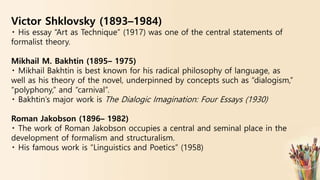
Victor Shklovsky (1893–1984)
His essay “Art as Technique” (1917) was one of the central statements of
formalist theory.
Mikhail M. Bakhtin (1895– 1975)
Mikhail Bakhtin is best known for his radical philosophy of language, as
well as his theory of the novel, underpinned by concepts such as “dialogism,”
“polyphony,” and “carnival”.
Bakhtin’s major work is The Dialogic Imagination: Four Essays (1930)
Roman Jakobson (1896– 1982)
The work of Roman Jakobson occupies a central and seminal place in the
development of formalism and structuralism.
His famous work is “Linguistics and Poetics” (1958)
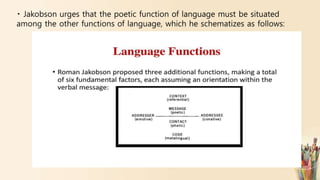
Jakobson urges that the poetic function of language must be situated
among the other functions of language, which he schematizes as follows:
In any act of verbal communication, the “addresser” sends a message to the
“addressee”; the message requires a “context” that is verbal or at least
capable of being verbalized; a “contact” which is a physical channel or
psychological connection between them; and a “code” that is shared by them.
Jakobson explains that each of these factors determines a different function of
language, and that the verbal structure of any given message depends on the
predominant function. In poetry itself, diverse genres employ the other verbal
functions along with the poetic function. For example, epic poetry involves the
referential function; lyric, the emotive.
Here is how Jakobson schematizes the various functions
Defamiliarization
The Russian Formalists’ concept of “Defamiliarization”, proposed by
Viktor Shklovsky in his Art as Technique, refers to the literary device whereby
language is used in such a way that ordinary and familiar objects are made to look
different. It is a process of transformation where language asserts its power to affect
our perception. It is that aspect which differentiates between ordinary usage and
poetic usage of language, and imparts a uniqueness to a literary work. While Roman
Jakobson described the object of study in literary science as the “literariness” of a
work, Jan Mukarovsky emphasized that literariness consists in foregrounding of the
linguistic medium, as Viktor Shklovsky described, is to estrange or defamiliarize, by
medium. The primary aim of literature, in thus foregrounding its linguistics
disrupting the modes of ordinary linguistic discourse, literature strange” the world of
everyday perception, and renews the readers’ lost capacity for fresh sensation. A
similar technique deployed in drama was “alienation effect” introduced by Bertolt
Brecht in his Epic Theatre, to disrupt the passive complacency of the audience and
force them into a critical analysis of art as well as the world.
Although the concept of defamiliarization was earlier advocated by the
Romantic critic Coleridge in his Biographia Literaria (1817), it was conceived
in terms of subject matter and in novelty of expression. The formalists,
however, endorse defamiliarization effected by novelty in the usage of formal
linguistic devices in poetry, such as rhyme, metre, metaphor, image and
symbol. Thus literary language is ordinary language deformed and made
strange. Literature, by forcing us into a dramatic awareness of language,
refreshes our habitual perceptions and renders objects more perceptible.
conclusion:
According to Formalism,
A text is a literary work which is a finished product and nothing can
change its meaning and form.
The form and contents of the text cannot be separated. It creates
meaning as a whole.
A literary text has a fixed meaning. The greatest literary texts are
‘constant’, ‘coherent’, ‘timeless’, and ‘universal’.
Formalism

Formalism

  • 1.
  • 2.
    WHAT IS LITERARYTHEORY? Literary criticism is the practice of interpreting and writing about literature as the latter, in turn, strives to make sense of the world. Literary theory is the study of the principles which inform how critics make sense of literary works. Purpose Of Studying Literary theory: • One of the views is likely to affirm your perspective and speak to what you see in the literature you are studying. • Studying a view different from yours not to disagree with it, but to understand it , it helps you understand those who hold that view. • Studying a work from more than one view gives you a deeper understanding of the author’s work and a better appreciation for the richness of it.
  • 3.
    A critique Approach to Literature+ Group work School Of thought+ Principles + Ideas Studying Of Principles Criticism of Criticism Formalism
  • 4.
    Formalism : In literarycriticism, Formalism refers to a style of inquiry that focuses, almost exclusively, on features of the literary text itself, to the exclusion of biographical, historical, or intellectual contexts. The name "Formalism" derives from one of The central tenets of Formalist thought: That the form of a work of literature is inherently a part of its content, and that the attempt to separate the two is falla cious. By focusing on literary form and excluding superfluous contexts, Formalists believed that it would be possible to trace the evolution and development of literary forms, and thus, literature itself. Formalism is a philosophical theory of the foundations of mathematics that had a spectacular but brief heyday in the 1920s.
  • 5.
    Foundations : The LinguisticTurn (Russian; defamiliarization) The Cultural Turn (New Criticism; Human liberalism) A critique Approach to Literature + Group work School Of thought+ Principles + Ideas Studying Of Principles Criticism of Criticism Formalism Formalism has advantage of forcing writers to evaluate a work on its own terms rather to relay on “accepted” notions of writer work. Focus on Form, organization, structure, Word choice, Multiple language
  • 6.
    Historical Prospects: There isno one school of Formalism, and the term groups together a number of different approaches to literature, many of which seriously diverge from one another. Formalism, in the broadest sense, was the dominant mode of academic literary study in the United States and United Kingdom from the end of the Second World War through the 1970s,and particularly the Formalism of the "New Critics," including, among others, I.A. Richards, John Crowe Ransom and T.S Eliot. On the European continent, Formalism emerged primarily and particularly out of the work of Roman Jackobson, Boris Eichenbaum, and Viktor Shklovsky. Although the theories Roman Jackobson of and New Criticism are similar in a number of respects, the two schools largely developed in isolation from one another, and should not be conflated or considered identical. In reality, even many of the theories proposed by critics working within their respective schools often diverged from one another.
  • 7.
    Russian Formalism Definition Main Characteristics MainFigures Victor Shklovsky Mikhail M. Bakhtin Roman Jakobson
  • 8.
    Definition of RussianFormalism: The Russian Formalists were a group of writers who flourished during the period of the Russian Revolution of 1917. Main Characteristics: A new notion of form not as an envelope but viewed as “a complete thing, something concrete, dynamic, self-contained” A fundamental formalist distinction between poetic and practical language. The Formalists sought to isolate the study of literature from “secondary, incidental features” that might belong to philosophy, psychology, or history.
  • 9.
    Victor Shklovsky (1893–1984) Hisessay “Art as Technique” (1917) was one of the central statements of formalist theory. Mikhail M. Bakhtin (1895– 1975) Mikhail Bakhtin is best known for his radical philosophy of language, as well as his theory of the novel, underpinned by concepts such as “dialogism,” “polyphony,” and “carnival”. Bakhtin’s major work is The Dialogic Imagination: Four Essays (1930) Roman Jakobson (1896– 1982) The work of Roman Jakobson occupies a central and seminal place in the development of formalism and structuralism. His famous work is “Linguistics and Poetics” (1958)
  • 10.
    Jakobson urges thatthe poetic function of language must be situated among the other functions of language, which he schematizes as follows:
  • 11.
    In any actof verbal communication, the “addresser” sends a message to the “addressee”; the message requires a “context” that is verbal or at least capable of being verbalized; a “contact” which is a physical channel or psychological connection between them; and a “code” that is shared by them. Jakobson explains that each of these factors determines a different function of language, and that the verbal structure of any given message depends on the predominant function. In poetry itself, diverse genres employ the other verbal functions along with the poetic function. For example, epic poetry involves the referential function; lyric, the emotive.
  • 12.
    Here is howJakobson schematizes the various functions
  • 13.
    Defamiliarization The Russian Formalists’concept of “Defamiliarization”, proposed by Viktor Shklovsky in his Art as Technique, refers to the literary device whereby language is used in such a way that ordinary and familiar objects are made to look different. It is a process of transformation where language asserts its power to affect our perception. It is that aspect which differentiates between ordinary usage and poetic usage of language, and imparts a uniqueness to a literary work. While Roman Jakobson described the object of study in literary science as the “literariness” of a work, Jan Mukarovsky emphasized that literariness consists in foregrounding of the linguistic medium, as Viktor Shklovsky described, is to estrange or defamiliarize, by medium. The primary aim of literature, in thus foregrounding its linguistics disrupting the modes of ordinary linguistic discourse, literature strange” the world of everyday perception, and renews the readers’ lost capacity for fresh sensation. A similar technique deployed in drama was “alienation effect” introduced by Bertolt Brecht in his Epic Theatre, to disrupt the passive complacency of the audience and force them into a critical analysis of art as well as the world.
  • 14.
    Although the conceptof defamiliarization was earlier advocated by the Romantic critic Coleridge in his Biographia Literaria (1817), it was conceived in terms of subject matter and in novelty of expression. The formalists, however, endorse defamiliarization effected by novelty in the usage of formal linguistic devices in poetry, such as rhyme, metre, metaphor, image and symbol. Thus literary language is ordinary language deformed and made strange. Literature, by forcing us into a dramatic awareness of language, refreshes our habitual perceptions and renders objects more perceptible.
  • 15.
    conclusion: According to Formalism, Atext is a literary work which is a finished product and nothing can change its meaning and form. The form and contents of the text cannot be separated. It creates meaning as a whole. A literary text has a fixed meaning. The greatest literary texts are ‘constant’, ‘coherent’, ‘timeless’, and ‘universal’.