Subject: Literary Theory and Criticism
Unit: 1
Topic: Post Structuralism
Roll No:4
Prepared by: Drashti B. Mehta
Submitted to: Swami Sahajanand College of
Commerce and Management, Bhavnagar
Post-Structuralism:
 Post- Structuralism emerged in France during the
year 1960s.
 Post Structuralism designates a broad variety of
critical perspectives and procedures in the 1970s,
displaced structuralism from its prominence as the
radically innovative way of dealing with language
and other signifying system
 Structuralism a label formulated by American
academics to denote the heterogeneous works of
a series of mid-20th century French and
continental philosophers and critical theorists who
came to international prominence in the 1960s
and 1970s.
Difference between Structuralism
and Post Structuralism:
 Post-structuralism is a
response to
structuralism
 Structuralism was a
fashionable movement
in France in 1950s and
1960s that studied the
underlying structures
inherent in cultural
products, and utilizes
analytical concepts from
linguistics, psychology,
anthropology and other
fields to understand and
 The general assumptions of post-
structuralism derive from critique of
structuralist premises.
 Specifically, post structuralism holds
that the study of underlying,
structures itself culturally
conditioned and therefore subject to
myriad biases and
misinterpretations.
 To understand an object, it is
necessary to study both the object
itself and the systems of knowledge
which were coordinated to produce
the object.
 This way, post structuralism
positions itself as a study of how
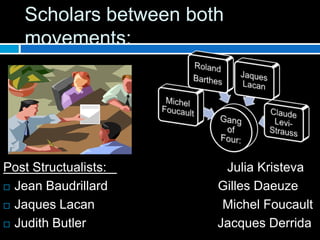
Scholars between both
movements:
Post Structualists: Julia Kristeva
 Jean Baudrillard Gilles Daeuze
 Jaques Lacan Michel Foucault
 Judith Butler Jacques Derrida
 A conspicuous announcement to American
Scholars of the Post Structural point of view
was Jacques Derrida’s paper on “Structure,
Sign and Play in the Discourse of Human
Sciences”, delivered in 1966 to an
international colloquium at John Hopkins
University.
 A major theme of Post Structuralism is
instability in the human sciences.
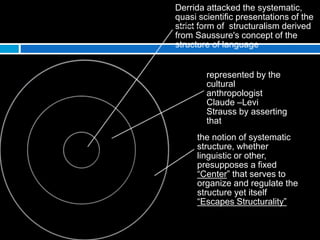
Derrida attacked the systematic,
quasi scientific presentations of the
strict form of structuralism derived
from Saussure's concept of the
structure of language
represented by the
cultural
anthropologist
Claude –Levi
Strauss by asserting
that
the notion of systematic
structure, whether
linguistic or other,
presupposes a fixed
“Center” that serves to
organize and regulate the
structure yet itself
“Escapes Structurality”
 Postmodern is
sometimes used in
place of or
interchangeably
with, post structural.
 Deconstruction
 Binary Opposition
 Often arranged in a
hierarchy, which
structure a given
text
 The only way to
properly understand
these meanings is to
deconstruct the
assumptions and
knowledge system
which produce the
illusion of singular
meaning
Roland Barthes
 Elements of Semiology (1967), concepts of the
Metalanguage
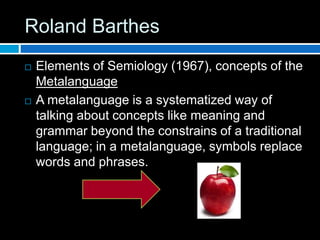
 A metalanguage is a systematized way of
talking about concepts like meaning and
grammar beyond the constrains of a traditional
language; in a metalanguage, symbols replace
words and phrases.
Some of the key assumptions:
 The interpretation of meaning of a text is
therefore dependent on a reader’s own
personal concept of self.
 The author’s intended meaning is secondary
to the meaning that the reader perceives, and
a literary text has no single purpose, meaning
or existence
 It is necessary to utilize a variety of
perspectives to create a multifaceted
interpretation of a text, even if these
interpretations conflict with one another
Salient features or themes are shared by diverse types
of post structural thought and criticism include the
following:
1) The Primacy of theory: The theory of signification was granted
primacy in the additional sense that, when common experience in use or
interpretation of language does not accord with what the theory entails,
such experience is rejected as unjustified and illusory, or else is accounted
an ideologically imposed concealment of the actual operation of signifying
system
2) The decentering of the subject: Derrida delete the structural
linguistic center, had there by also eliminated the possibility of controlling
agency in language leaving the use of language an unregulatable and
undecidable play of purely relational elements
Michel Foucault and Roland Barthes both signalized the
evacuation of the traditional conception of the subject who is an author by
announcing the disappearance of the author, or even more melo-
dramatically the death of the author
3) Reading Texts and Writing:
Decentering or deletion of the author leaves the
reader, or interpreter, as the focal figure in post
structural accounts of signifying practices. This
figure, however like the author, is stripped of the
traditional attributes of purposiveness and initiative
and converted into an impersonal process called
reading.
4) The Concept of Discourse:
In Michel Foucault, discourse- as- such is the central
subject of analytic concern. Foucault conceives that
“Discourse” is to be analyzed as totally anonymous, in
 Many socially oriented analysts of discourse share
with the other post structualists the conviction that
No text means:
what its writer intended to say
 The primacy of the “theory” in post structural criticism has
evoked counter- theoretical challenges, most prominently in an
Essay “Against Theory” by Steven Knapp and Walter Benn.
 Michaels as “the attempts to govern interpretations of particular
texts by appealing to an account of interpretations in general”,
the two authors claim that this is an impossible endeavor “ to
stand outside practice in order to govern practice from without”
asserts that accounts of interpretation in general entails no
consequences for the actual practice of interpretation , and
Post Structuralism

Post Structuralism

  • 1.
    Subject: Literary Theoryand Criticism Unit: 1 Topic: Post Structuralism Roll No:4 Prepared by: Drashti B. Mehta Submitted to: Swami Sahajanand College of Commerce and Management, Bhavnagar
  • 2.
    Post-Structuralism:  Post- Structuralismemerged in France during the year 1960s.  Post Structuralism designates a broad variety of critical perspectives and procedures in the 1970s, displaced structuralism from its prominence as the radically innovative way of dealing with language and other signifying system  Structuralism a label formulated by American academics to denote the heterogeneous works of a series of mid-20th century French and continental philosophers and critical theorists who came to international prominence in the 1960s and 1970s.
  • 3.
    Difference between Structuralism andPost Structuralism:  Post-structuralism is a response to structuralism  Structuralism was a fashionable movement in France in 1950s and 1960s that studied the underlying structures inherent in cultural products, and utilizes analytical concepts from linguistics, psychology, anthropology and other fields to understand and  The general assumptions of post- structuralism derive from critique of structuralist premises.  Specifically, post structuralism holds that the study of underlying, structures itself culturally conditioned and therefore subject to myriad biases and misinterpretations.  To understand an object, it is necessary to study both the object itself and the systems of knowledge which were coordinated to produce the object.  This way, post structuralism positions itself as a study of how
  • 4.
    Scholars between both movements: PostStructualists: Julia Kristeva  Jean Baudrillard Gilles Daeuze  Jaques Lacan Michel Foucault  Judith Butler Jacques Derrida
  • 5.
     A conspicuousannouncement to American Scholars of the Post Structural point of view was Jacques Derrida’s paper on “Structure, Sign and Play in the Discourse of Human Sciences”, delivered in 1966 to an international colloquium at John Hopkins University.  A major theme of Post Structuralism is instability in the human sciences.
  • 6.
    Derrida attacked thesystematic, quasi scientific presentations of the strict form of structuralism derived from Saussure's concept of the structure of language represented by the cultural anthropologist Claude –Levi Strauss by asserting that the notion of systematic structure, whether linguistic or other, presupposes a fixed “Center” that serves to organize and regulate the structure yet itself “Escapes Structurality”
  • 7.
     Postmodern is sometimesused in place of or interchangeably with, post structural.  Deconstruction  Binary Opposition  Often arranged in a hierarchy, which structure a given text  The only way to properly understand these meanings is to deconstruct the assumptions and knowledge system which produce the illusion of singular meaning
  • 8.
    Roland Barthes  Elementsof Semiology (1967), concepts of the Metalanguage  A metalanguage is a systematized way of talking about concepts like meaning and grammar beyond the constrains of a traditional language; in a metalanguage, symbols replace words and phrases.
  • 9.
    Some of thekey assumptions:  The interpretation of meaning of a text is therefore dependent on a reader’s own personal concept of self.  The author’s intended meaning is secondary to the meaning that the reader perceives, and a literary text has no single purpose, meaning or existence  It is necessary to utilize a variety of perspectives to create a multifaceted interpretation of a text, even if these interpretations conflict with one another
  • 10.
    Salient features orthemes are shared by diverse types of post structural thought and criticism include the following: 1) The Primacy of theory: The theory of signification was granted primacy in the additional sense that, when common experience in use or interpretation of language does not accord with what the theory entails, such experience is rejected as unjustified and illusory, or else is accounted an ideologically imposed concealment of the actual operation of signifying system 2) The decentering of the subject: Derrida delete the structural linguistic center, had there by also eliminated the possibility of controlling agency in language leaving the use of language an unregulatable and undecidable play of purely relational elements Michel Foucault and Roland Barthes both signalized the evacuation of the traditional conception of the subject who is an author by announcing the disappearance of the author, or even more melo- dramatically the death of the author
  • 11.
    3) Reading Textsand Writing: Decentering or deletion of the author leaves the reader, or interpreter, as the focal figure in post structural accounts of signifying practices. This figure, however like the author, is stripped of the traditional attributes of purposiveness and initiative and converted into an impersonal process called reading. 4) The Concept of Discourse: In Michel Foucault, discourse- as- such is the central subject of analytic concern. Foucault conceives that “Discourse” is to be analyzed as totally anonymous, in
  • 12.
     Many sociallyoriented analysts of discourse share with the other post structualists the conviction that No text means: what its writer intended to say  The primacy of the “theory” in post structural criticism has evoked counter- theoretical challenges, most prominently in an Essay “Against Theory” by Steven Knapp and Walter Benn.  Michaels as “the attempts to govern interpretations of particular texts by appealing to an account of interpretations in general”, the two authors claim that this is an impossible endeavor “ to stand outside practice in order to govern practice from without” asserts that accounts of interpretation in general entails no consequences for the actual practice of interpretation , and