Central themes : Industrialization - urban jungle- alienation of  the individual . totalitarian systems (dystopias) Psychological control of the human mind . Schizophrenia Virtual reality Fantastic elements in a real world ID vs. social background  Surveillance
Devices: Pastiche (collage) Intertext Short-circuit game Irony/black humor Fragmentation Maxi/mini –malism deconstruction
New kind of literature: Magical realism Techno-gothic Hypertext Lunatic Cyberpunk
Modernism/Postmodernism Continued the fundamental philosophical assumptions of modernism Continued its tendency toward historical discontinuity Continued its preoccupation with alienation Continued to focus on a social individualism
Modernism/postmodernism Modernism relied on  existentialism  -а philosophy that claims that the individual must make decisions concerning right and wrong, or the self without access to universal truths Postmodernism’s tendency to use  solipsism , a  philosophical perspective that holds that one саn only truly know oneself and that all other experiences are potentially false since they are filtered through the senses
Modernism/postmodernism The tendency of the modernists    - to construct intricate forms   - to interweave symbols elaborately   - to create works of art that, although opposed to some established present order, create within themselves an ordered universe All that has given up in postmodern literature
Philosophy of Postmodernism Denial of order Presentation of highly fragmented universes in the created world of art Presentation of critical theories that are а form of  phenomenology
Phenomenology A highly subjective contemporary philosophy which argues that the meaning of an object  is a concept separate from its existence.
Postmodernist Critics Jacques Lacan The members   of the Frankfurt School Michel Foucault Ihab Hassan Jacques Derrida Academically trained in philosophy, used  substantially the works of philosophers such as Friedrich Nietzsche, Каrl Маrх, Martin Heidegger, оr G.W.F. Hegel
Postmodernism as a Name Used in architecture in the 1960s by Frederic Jameson In literature began to be used instead of less satisfactory labels such as "black  humor"  or "fabulism“.Ihab Hassan in his essay “From Postmodernism to Postmodernity”  emphasize some critics who used this word in different contexts:
Postmodernism - etymology 1. Charles Olson (1950 -1960) 2.Harry Levin 1959 , to denote the high modern culture declining. 3. Bernard Smith , 1945 used this term with the meaning of the socialist realism used in picture. Charles Jencks used the word “postmodernism” in his works with the meaning which we have today.
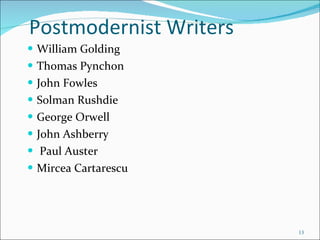
Postmodernist Writers William Golding Thomas Pynchon John Fowles Solman Rushdie George Orwell  John Ashberry Paul Auster Mircea Cartarescu
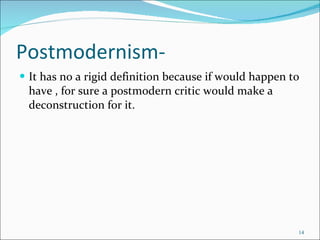
Postmodernism- It has no a rigid definition because if would happen to have , for sure a postmodern critic would make a deconstruction for it.

Postmodernism features

  • 1.
  • 2.
    Central themes :Industrialization - urban jungle- alienation of the individual . totalitarian systems (dystopias) Psychological control of the human mind . Schizophrenia Virtual reality Fantastic elements in a real world ID vs. social background Surveillance
  • 3.
    Devices: Pastiche (collage)Intertext Short-circuit game Irony/black humor Fragmentation Maxi/mini –malism deconstruction
  • 4.
    New kind ofliterature: Magical realism Techno-gothic Hypertext Lunatic Cyberpunk
  • 5.
    Modernism/Postmodernism Continued thefundamental philosophical assumptions of modernism Continued its tendency toward historical discontinuity Continued its preoccupation with alienation Continued to focus on a social individualism
  • 6.
    Modernism/postmodernism Modernism reliedon existentialism -а philosophy that claims that the individual must make decisions concerning right and wrong, or the self without access to universal truths Postmodernism’s tendency to use solipsism , a philosophical perspective that holds that one саn only truly know oneself and that all other experiences are potentially false since they are filtered through the senses
  • 7.
    Modernism/postmodernism The tendencyof the modernists - to construct intricate forms - to interweave symbols elaborately - to create works of art that, although opposed to some established present order, create within themselves an ordered universe All that has given up in postmodern literature
  • 8.
    Philosophy of PostmodernismDenial of order Presentation of highly fragmented universes in the created world of art Presentation of critical theories that are а form of phenomenology
  • 9.
    Phenomenology A highlysubjective contemporary philosophy which argues that the meaning of an object is a concept separate from its existence.
  • 10.
    Postmodernist Critics JacquesLacan The members of the Frankfurt School Michel Foucault Ihab Hassan Jacques Derrida Academically trained in philosophy, used substantially the works of philosophers such as Friedrich Nietzsche, Каrl Маrх, Martin Heidegger, оr G.W.F. Hegel
  • 11.
    Postmodernism as aName Used in architecture in the 1960s by Frederic Jameson In literature began to be used instead of less satisfactory labels such as "black humor" or "fabulism“.Ihab Hassan in his essay “From Postmodernism to Postmodernity” emphasize some critics who used this word in different contexts:
  • 12.
    Postmodernism - etymology1. Charles Olson (1950 -1960) 2.Harry Levin 1959 , to denote the high modern culture declining. 3. Bernard Smith , 1945 used this term with the meaning of the socialist realism used in picture. Charles Jencks used the word “postmodernism” in his works with the meaning which we have today.
  • 13.
    Postmodernist Writers WilliamGolding Thomas Pynchon John Fowles Solman Rushdie George Orwell John Ashberry Paul Auster Mircea Cartarescu
  • 14.
    Postmodernism- It hasno a rigid definition because if would happen to have , for sure a postmodern critic would make a deconstruction for it.