What structures the paths along which people, goods
and ideas flow through the world?
Mark Allen Peterson, PhD
Miami University
WORLD SYSTEMS THEORY
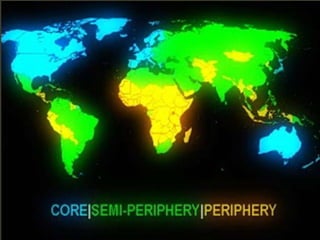
The Modern World System
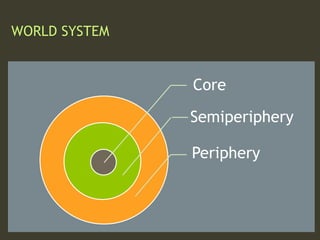
WORLD SYSTEM
Core
Semiperiphery
Periphery
WORLD SYSTEMS THEORY
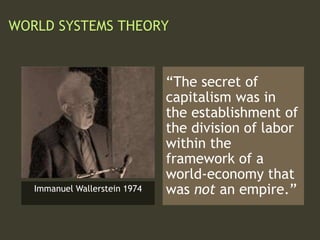
“The secret of
capitalism was in
the establishment of
the division of labor
within the
framework of a
world-economy that
was not an empire.”Immanuel Wallerstein 1974
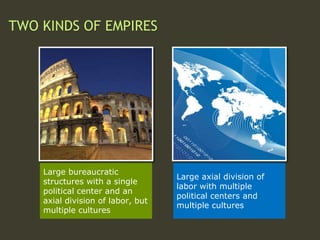
Large axial division of
labor with multiple
political centers and
multiple cultures
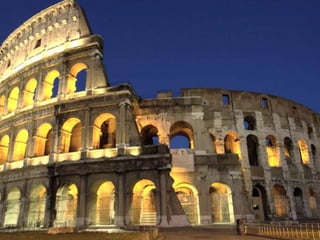
Large bureaucratic
structures with a single
political center and an
axial division of labor, but
multiple cultures
TWO KINDS OF EMPIRES
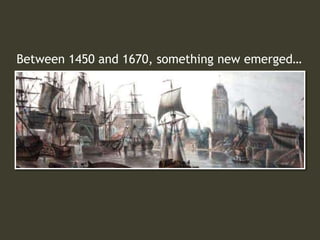
Between 1450 and 1670, something new emerged…
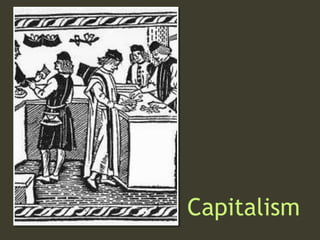
Capitalism
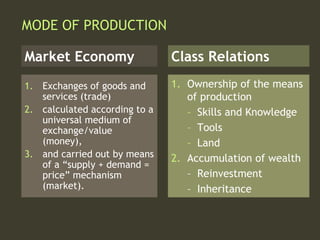
MODE OF PRODUCTION
1. Exchanges of goods and
services (trade)
2. calculated according to a
universal medium of
exchange/value
(money),
3. and carried out by means
of a “supply + demand =
price” mechanism
(market).
1. Ownership of the means
of production
– Skills and Knowledge
– Tools
– Land
2. Accumulation of wealth
– Reinvestment
– Inheritance
Market Economy Class Relations
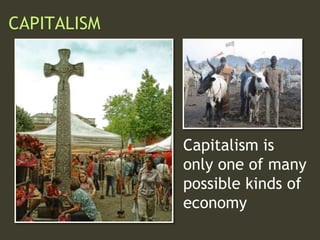
Capitalism is
only one of many
possible kinds of
economy
CAPITALISM
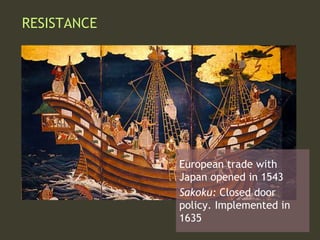
RESISTANCE
European trade with
Japan opened in 1543
Sakoku: Closed door
policy. Implemented in
1635
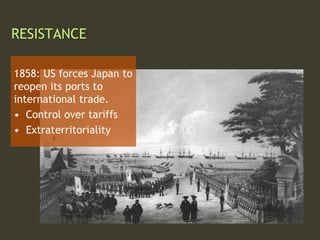
RESISTANCE
1858: US forces Japan to
reopen its ports to
international trade.
• Control over tariffs
• Extraterritoriality
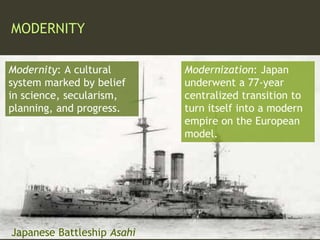
MODERNITY
Modernity: A cultural
system marked by belief
in science, secularism,
planning, and progress.
Modernization: Japan
underwent a 77-year
centralized transition to
turn itself into a modern
empire on the European
model.
Japanese Battleship Asahi
THE WORLD ECONOMY
A world economy “encompasses within its bounds
empires, city-states, and the emerging nation-states.
It is a world economy not because it encompasses the
whole world but because it is larger than any juridical
defined political unit. It is a world-economy because
the basic linkage between the parts of the system is
economic.”
-- Immanuel Wallerstein
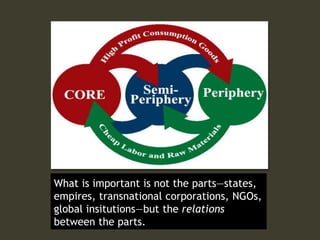
What is important is not the parts—states,
empires, transnational corporations, NGOs,
global insitutions—but the relations
between the parts.
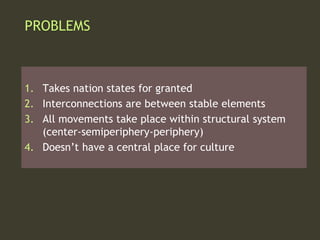
PROBLEMS
1. Takes nation states for granted
2. Interconnections are between stable elements
3. All movements take place within structural system
(center-semiperiphery-periphery)
4. Doesn’t have a central place for culture
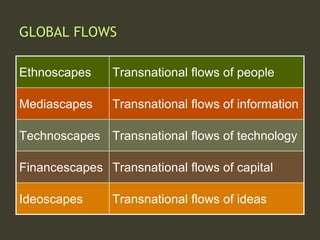
GLOBAL FLOWS
Ethnoscapes Transnational flows of people
Mediascapes Transnational flows of information
Technoscapes Transnational flows of technology
Financescapes Transnational flows of capital
Ideoscapes Transnational flows of ideas
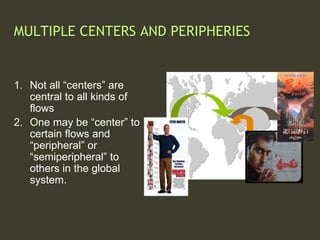
MULTIPLE CENTERS AND PERIPHERIES
1. Not all “centers” are
central to all kinds of
flows
2. One may be “center” to
certain flows and
“peripheral” or
“semiperipheral” to
others in the global
system.
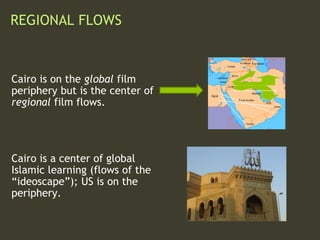
REGIONAL FLOWS
Cairo is on the global film
periphery but is the center of
regional film flows.
Cairo is a center of global
Islamic learning (flows of the
“ideoscape”); US is on the
periphery.
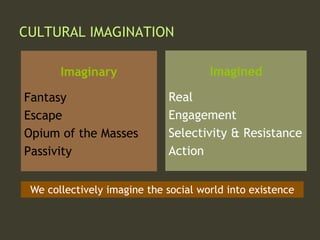
CULTURAL IMAGINATION
Imaginary
Fantasy
Escape
Opium of the Masses
Passivity
Imagined
Real
Engagement
Selectivity & Resistance
Action
We collectively imagine the social world into existence
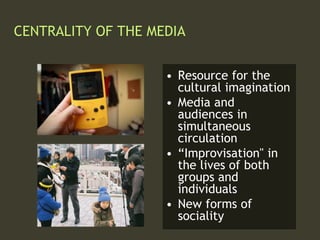
CENTRALITY OF THE MEDIA
• Resource for the
cultural imagination
• Media and
audiences in
simultaneous
circulation
• “Improvisation" in
the lives of both
groups and
individuals
• New forms of
sociality
World systems theory

World systems theory

  • 1.
    What structures thepaths along which people, goods and ideas flow through the world? Mark Allen Peterson, PhD Miami University WORLD SYSTEMS THEORY
  • 2.
  • 3.
  • 4.
    WORLD SYSTEMS THEORY “Thesecret of capitalism was in the establishment of the division of labor within the framework of a world-economy that was not an empire.”Immanuel Wallerstein 1974
  • 5.
    Large axial divisionof labor with multiple political centers and multiple cultures Large bureaucratic structures with a single political center and an axial division of labor, but multiple cultures TWO KINDS OF EMPIRES
  • 8.
    Between 1450 and1670, something new emerged…
  • 9.
  • 10.
    MODE OF PRODUCTION 1.Exchanges of goods and services (trade) 2. calculated according to a universal medium of exchange/value (money), 3. and carried out by means of a “supply + demand = price” mechanism (market). 1. Ownership of the means of production – Skills and Knowledge – Tools – Land 2. Accumulation of wealth – Reinvestment – Inheritance Market Economy Class Relations
  • 11.
    Capitalism is only oneof many possible kinds of economy CAPITALISM
  • 12.
    RESISTANCE European trade with Japanopened in 1543 Sakoku: Closed door policy. Implemented in 1635
  • 13.
    RESISTANCE 1858: US forcesJapan to reopen its ports to international trade. • Control over tariffs • Extraterritoriality
  • 14.
    MODERNITY Modernity: A cultural systemmarked by belief in science, secularism, planning, and progress. Modernization: Japan underwent a 77-year centralized transition to turn itself into a modern empire on the European model. Japanese Battleship Asahi
  • 15.
    THE WORLD ECONOMY Aworld economy “encompasses within its bounds empires, city-states, and the emerging nation-states. It is a world economy not because it encompasses the whole world but because it is larger than any juridical defined political unit. It is a world-economy because the basic linkage between the parts of the system is economic.” -- Immanuel Wallerstein
  • 16.
    What is importantis not the parts—states, empires, transnational corporations, NGOs, global insitutions—but the relations between the parts.
  • 17.
    PROBLEMS 1. Takes nationstates for granted 2. Interconnections are between stable elements 3. All movements take place within structural system (center-semiperiphery-periphery) 4. Doesn’t have a central place for culture
  • 18.
    GLOBAL FLOWS Ethnoscapes Transnationalflows of people Mediascapes Transnational flows of information Technoscapes Transnational flows of technology Financescapes Transnational flows of capital Ideoscapes Transnational flows of ideas
  • 19.
    MULTIPLE CENTERS ANDPERIPHERIES 1. Not all “centers” are central to all kinds of flows 2. One may be “center” to certain flows and “peripheral” or “semiperipheral” to others in the global system.
  • 20.
    REGIONAL FLOWS Cairo ison the global film periphery but is the center of regional film flows. Cairo is a center of global Islamic learning (flows of the “ideoscape”); US is on the periphery.
  • 21.
    CULTURAL IMAGINATION Imaginary Fantasy Escape Opium ofthe Masses Passivity Imagined Real Engagement Selectivity & Resistance Action We collectively imagine the social world into existence
  • 22.
    CENTRALITY OF THEMEDIA • Resource for the cultural imagination • Media and audiences in simultaneous circulation • “Improvisation" in the lives of both groups and individuals • New forms of sociality