I N A R T A N D L I T E R A T U R E
POSTMODERNISM
What is postmodernism?
 Something that comes ’after’ (post) the
’contemporary’ (modern)
 Postmodernism is NOT a literary period
 On the contrary – it wants to se the present in the
past, the future in the present and the present in a
sort of
 NO TIME
Postmodernism is paradoxical
 Will not be defined
 Rejects metalanguage
 Does not consist of coherent beliefs
 Is not set of explanations
 Is mobile
 Fragmented
When and why did postmodernism arise?
Significant Events
• August 6, 1945 - atomic explosion over Hiroshima,
Japan The conclusion of World War II
• The Korean War
• The Cold War of the 1950s
• The Cuban Missile Crisis of 1962
• The assassination of President Kennedy, Nov. 1962
• Identity Movements of the 1960s: Feminism, Civil
Rights/Black Power
• The assassinations, in 1968, of Martin Luther King, Jr.
and Robert F. Kennedy
More significant events
• The Vietnam War
• The killing of four students by the National Guard
at Kent State Univ., 1970
• The resignation of President Nixon in 1974
• The AIDS epidemic
• Identity Movements: Gay, Lesbian, Queer
movements, Postcolonial movements and minority
literature.
• Culture Wars: debates over canonical inclusion
and “great books”
Values? God? Meaning?
 Nietzsche: God is dead
 No absolute Truth
 Only subjective truths
 Ideal is solipsism – we are basically alone
NEW ’VALUES AND TRUTHS’
 Consumerism
 Capitalism
 globalization
Postmodern Art – Breaks away from ’fine art’
Popculture is just as high as high culture
More Warhol, 1969
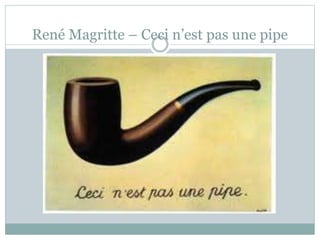
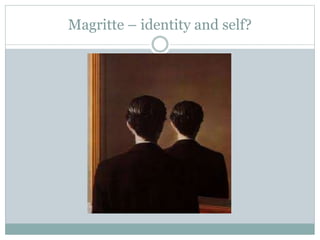
René Magritte – Ceci n’est pas une pipe
Magritte – surrealist (1898-1967)
 Les Amant – the lovers. What does the painting
convey?
Magritte – identity and self?
POSTMODERN WRITERS
 Joseph Heller
- Born May 1, 1923 in
Brooklyn, New York
- Known for his post World
War satires and playwrights
- Catch 22 most well-known
of his works
- Other works include:
Something Happened, Good
as Gold, and Closing Time.
- Also wrote plays: We
Bombed in New Haven,
Catch 22, Clevinger’s Trail
POSTMODERN WRITERS
 Thomas Pynchon
- Born May 8, 1937 in
Glen Cove, New York.
- Known for his
fictional writing over
many different
subjects that include:
science, mathematics,
and history
- Known for his early
works: V, The Crying
of Lot 49, and
Gravity’s Rainbow.
POSTMODERN WRITERS
 Tim O’Brien
- Born October 1, 1946 in Austin,
Minnesota
- His career began with the
release of If I Die in a Combat
Zone, Box Me Up and Ship me
Home. Wrote mainly about his
experiences in the Vietnam
War
- O’Brien uses fiction and reality
and blends them into his own
genre. He labels his works
fiction, however, he uses his
situations he experienced in his
works.
- Most famous work: The Things
They Carried
POSTMODERN?
”By telling stories you
objectify your own
experience. You separate
it from your self. You pin
down certain truths. You
make up others.
”That’s a true story that
never happened
”To generalize about
war is like generalizing
about peace. Almost
everything is true.
Almost nothing is true.
TRUTH?
”War is hell, but that's not the half of it, because war
is mystery and terror and adventure and courage and
discovery and holiness and pity and despair and
longing and love. War is nasty; war is fun. War is
thrilling; war is drudgery. War makes you a
man; war makes you dead. The truths are
contradictory. It can be argued, for instance, that war
is grotesque. But in truth war is also beauty. For all its
horror, you can't help but gape at the awful majesty of
combat.
From ’How To Tell A True Warstory’
THREE MAJOR POSTMODERN IDEAS
1. Anti-essentialism—many of the notions previously regarded
as universal and fixed (gender identity, individual selfhood)
are actually fluid and unstable.
2. Language itself conditions, limits, and predetermines what
we see. Language does not record reality but constructs it.
3. Meaning in texts is jointly constructed by the reader and
writer.
Barry, Peter. Beginning Theory: An Introduction to Literary and Cultural Theory. Second Edition. Manchester, 2002
David Logde about postmodern fiction – can you
relate these to ’The Things They Carried?’
 Permutation: incorporating alternative narrative
lines in the same text
 Discontinuity: disrupting the continuity, unity,
“reality” of the text (by unpredictable swerves of
tone, metafictional asides to the reader, blank
spaces in the text, etc).
 Randomness: discontinuity produced by
composing accord to the logic of the absurd
 Excess: as a method of departing from or testing
the bounds of “reality”
A POSTMODERN VOCABULARY – 9 KEYS
① Undecidability
② The arational
③ Dissemination
④ Little and Grand Narratives
⑤ Simulation
⑥ Depthlessness
⑦ Pastiche
⑧ The unrepresentable
⑨ Decentring
1.UNDECIDABILITY
 Which interpretation is the right one?
 What is the truth?
 Creatan paradox ’I am a liar’ – truth or lie?
 Complete suspension of the law of non-contradiction
 Ambiguities in the text makes literary wholeness
impossible
 No Truth – many truths
 No Meaning – many meanings
 No Reading – many readings
2. THE ARATIONAL
 Nihilism and chaos are preferred to God, national
identity, historical materialism
 Even reason is oppressive! (Eugenics was founded on
rational argumentation)
 NOT a affirmation of the irrational
 But a suspension of the opposition of the rational
and the irrational
Def: adj. ’having no ability to reason’
3. DISSEMINATION
 Resists rationalism
 Fragmentation
 Rejects the idea of originality – everyting consists of
fragments of other works of art or experiences or
historical periods etc.
 Parody and pastiche (making fun of/mocking other
works)
 There is NO origin.
 Scattering of origins and ends, identity and reality
Def.: dissemination (n.) scattering
4. LITTLE AND GRAND NARRATIVES
 Jean-Francois Lyortard’s distinction
 Grand narratives: Christianity, Marxism,
Enlightenment. All claim to explain and to be the
’cure’, the Truth, the Answer
 Little narratives: Present individual ’truths’ or stories
that don’t claim to explain anything. They are
fragmentary, non-totalizing, and don’t have a higher
goal or purpose (non teleological)
5. SIMULATION
 Plato argued that art was an imitation of the real world.
 He said that even a live horse was just an imitation of the
divine idea ’Horse’
 Umberto Eco: ”technology gives us more reality than
nature”
 Simulation/the simulacrum – copies are just copies of
copies of copies… the real does not exist.
 Can you tell a true story? Is reality tv reality? Are your
70s pants from the 70s? Are words copies of reality?
 Disney Land, says Baudrillard, is there to make us feel as
though we return to reality – but the U.S. Is one big copy
6. DEPTHLESSNESS
 Western logic assumes that there is a real behind the
copy, and that there is therefore depth.
 Words would then be able to express the content of
the mind
 Postmodern shakes depth-surface ideas such as
 Psychoanalysis (conscious-unconscious)
 Marxism (ideology – we must see the truth)
 Existentialism – find your authentic (real) self
 Semiotics – words can describe reality
7. PASTICHE
 Borrowing elements
from other times, texts,
cultures, artforms etc.
 To create new expression
that is not typical of any
time or anything
8. The Unrepresentable
 Samuel Beckett’s ’The
Unnamable’:
”I can’t go on. I’ll go on
 There is no origin of
meaning
 Therefore there are
things that words cannot
express
 Words and language are
temporary – they cannot
express essential truths
9. Decentering
 All these traits can be summed up as ’decentring’
 Postmodernism always challenges
 The authority of the Word
 The notion of ’identity’
 The origin of meanings
 The notion of centrality – that meaning can pinned down
 The notion of Truth

Postmodern traits bennett o'brien

  • 1.
    I N AR T A N D L I T E R A T U R E POSTMODERNISM
  • 2.
    What is postmodernism? Something that comes ’after’ (post) the ’contemporary’ (modern)  Postmodernism is NOT a literary period  On the contrary – it wants to se the present in the past, the future in the present and the present in a sort of  NO TIME
  • 3.
    Postmodernism is paradoxical Will not be defined  Rejects metalanguage  Does not consist of coherent beliefs  Is not set of explanations  Is mobile  Fragmented
  • 4.
    When and whydid postmodernism arise? Significant Events • August 6, 1945 - atomic explosion over Hiroshima, Japan The conclusion of World War II • The Korean War • The Cold War of the 1950s • The Cuban Missile Crisis of 1962 • The assassination of President Kennedy, Nov. 1962 • Identity Movements of the 1960s: Feminism, Civil Rights/Black Power • The assassinations, in 1968, of Martin Luther King, Jr. and Robert F. Kennedy
  • 5.
    More significant events •The Vietnam War • The killing of four students by the National Guard at Kent State Univ., 1970 • The resignation of President Nixon in 1974 • The AIDS epidemic • Identity Movements: Gay, Lesbian, Queer movements, Postcolonial movements and minority literature. • Culture Wars: debates over canonical inclusion and “great books”
  • 6.
    Values? God? Meaning? Nietzsche: God is dead  No absolute Truth  Only subjective truths  Ideal is solipsism – we are basically alone NEW ’VALUES AND TRUTHS’  Consumerism  Capitalism  globalization
  • 7.
    Postmodern Art –Breaks away from ’fine art’
  • 8.
    Popculture is justas high as high culture
  • 9.
  • 10.
    René Magritte –Ceci n’est pas une pipe
  • 11.
    Magritte – surrealist(1898-1967)  Les Amant – the lovers. What does the painting convey?
  • 12.
  • 13.
    POSTMODERN WRITERS  JosephHeller - Born May 1, 1923 in Brooklyn, New York - Known for his post World War satires and playwrights - Catch 22 most well-known of his works - Other works include: Something Happened, Good as Gold, and Closing Time. - Also wrote plays: We Bombed in New Haven, Catch 22, Clevinger’s Trail
  • 14.
    POSTMODERN WRITERS  ThomasPynchon - Born May 8, 1937 in Glen Cove, New York. - Known for his fictional writing over many different subjects that include: science, mathematics, and history - Known for his early works: V, The Crying of Lot 49, and Gravity’s Rainbow.
  • 15.
    POSTMODERN WRITERS  TimO’Brien - Born October 1, 1946 in Austin, Minnesota - His career began with the release of If I Die in a Combat Zone, Box Me Up and Ship me Home. Wrote mainly about his experiences in the Vietnam War - O’Brien uses fiction and reality and blends them into his own genre. He labels his works fiction, however, he uses his situations he experienced in his works. - Most famous work: The Things They Carried
  • 16.
    POSTMODERN? ”By telling storiesyou objectify your own experience. You separate it from your self. You pin down certain truths. You make up others. ”That’s a true story that never happened ”To generalize about war is like generalizing about peace. Almost everything is true. Almost nothing is true.
  • 17.
    TRUTH? ”War is hell,but that's not the half of it, because war is mystery and terror and adventure and courage and discovery and holiness and pity and despair and longing and love. War is nasty; war is fun. War is thrilling; war is drudgery. War makes you a man; war makes you dead. The truths are contradictory. It can be argued, for instance, that war is grotesque. But in truth war is also beauty. For all its horror, you can't help but gape at the awful majesty of combat. From ’How To Tell A True Warstory’
  • 18.
    THREE MAJOR POSTMODERNIDEAS 1. Anti-essentialism—many of the notions previously regarded as universal and fixed (gender identity, individual selfhood) are actually fluid and unstable. 2. Language itself conditions, limits, and predetermines what we see. Language does not record reality but constructs it. 3. Meaning in texts is jointly constructed by the reader and writer. Barry, Peter. Beginning Theory: An Introduction to Literary and Cultural Theory. Second Edition. Manchester, 2002
  • 19.
    David Logde aboutpostmodern fiction – can you relate these to ’The Things They Carried?’  Permutation: incorporating alternative narrative lines in the same text  Discontinuity: disrupting the continuity, unity, “reality” of the text (by unpredictable swerves of tone, metafictional asides to the reader, blank spaces in the text, etc).  Randomness: discontinuity produced by composing accord to the logic of the absurd  Excess: as a method of departing from or testing the bounds of “reality”
  • 20.
    A POSTMODERN VOCABULARY– 9 KEYS ① Undecidability ② The arational ③ Dissemination ④ Little and Grand Narratives ⑤ Simulation ⑥ Depthlessness ⑦ Pastiche ⑧ The unrepresentable ⑨ Decentring
  • 21.
    1.UNDECIDABILITY  Which interpretationis the right one?  What is the truth?  Creatan paradox ’I am a liar’ – truth or lie?  Complete suspension of the law of non-contradiction  Ambiguities in the text makes literary wholeness impossible  No Truth – many truths  No Meaning – many meanings  No Reading – many readings
  • 22.
    2. THE ARATIONAL Nihilism and chaos are preferred to God, national identity, historical materialism  Even reason is oppressive! (Eugenics was founded on rational argumentation)  NOT a affirmation of the irrational  But a suspension of the opposition of the rational and the irrational Def: adj. ’having no ability to reason’
  • 23.
    3. DISSEMINATION  Resistsrationalism  Fragmentation  Rejects the idea of originality – everyting consists of fragments of other works of art or experiences or historical periods etc.  Parody and pastiche (making fun of/mocking other works)  There is NO origin.  Scattering of origins and ends, identity and reality Def.: dissemination (n.) scattering
  • 24.
    4. LITTLE ANDGRAND NARRATIVES  Jean-Francois Lyortard’s distinction  Grand narratives: Christianity, Marxism, Enlightenment. All claim to explain and to be the ’cure’, the Truth, the Answer  Little narratives: Present individual ’truths’ or stories that don’t claim to explain anything. They are fragmentary, non-totalizing, and don’t have a higher goal or purpose (non teleological)
  • 25.
    5. SIMULATION  Platoargued that art was an imitation of the real world.  He said that even a live horse was just an imitation of the divine idea ’Horse’  Umberto Eco: ”technology gives us more reality than nature”  Simulation/the simulacrum – copies are just copies of copies of copies… the real does not exist.  Can you tell a true story? Is reality tv reality? Are your 70s pants from the 70s? Are words copies of reality?  Disney Land, says Baudrillard, is there to make us feel as though we return to reality – but the U.S. Is one big copy
  • 26.
    6. DEPTHLESSNESS  Westernlogic assumes that there is a real behind the copy, and that there is therefore depth.  Words would then be able to express the content of the mind  Postmodern shakes depth-surface ideas such as  Psychoanalysis (conscious-unconscious)  Marxism (ideology – we must see the truth)  Existentialism – find your authentic (real) self  Semiotics – words can describe reality
  • 27.
    7. PASTICHE  Borrowingelements from other times, texts, cultures, artforms etc.  To create new expression that is not typical of any time or anything
  • 28.
    8. The Unrepresentable Samuel Beckett’s ’The Unnamable’: ”I can’t go on. I’ll go on  There is no origin of meaning  Therefore there are things that words cannot express  Words and language are temporary – they cannot express essential truths
  • 29.
    9. Decentering  Allthese traits can be summed up as ’decentring’  Postmodernism always challenges  The authority of the Word  The notion of ’identity’  The origin of meanings  The notion of centrality – that meaning can pinned down  The notion of Truth