Literary Theory
• An Introduction
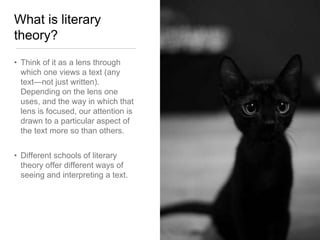
What is literary
theory?
• Think of it as a lens through
which one views a text (any
text—not just written).
Depending on the lens one
uses, and the way in which that
lens is focused, our attention is
drawn to a particular aspect of
the text more so than others.
• Different schools of literary
theory offer different ways of
seeing and interpreting a text.
Read the following statements and think about
the degree to which you AGREE or DISAGREE
with the statements.
The most important thing about a text is the
individual reader’s experience with the text.
When studying a text, you don’t need to
understand what the author originally intended.
The meaning of a text depends on the experience
the reader brings to the text.
There is no right or wrong answer when it comes
to literature.
If you mostly agreed with those statements, you
might be using Reader Response theory to
analyze literature. Read on…
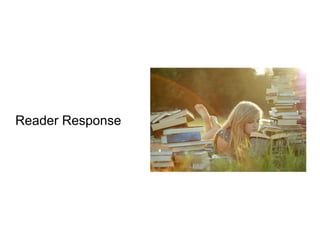
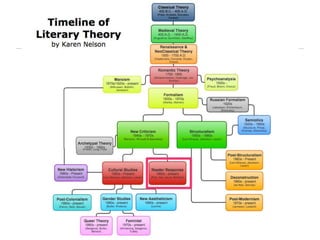
Reader Response
Definition
• A theory that stresses the
importance of the reader's
role in interpreting texts.
Rejecting the idea that there
is a single, fixed meaning
inherent in every literary
work, this theory holds that
the individual creates his or
her own meaning through a
"transaction" with the text
based on personal
associations.
Key Quotations
• "A poem is what the reader lives through under the
guidance of the text and experiences as relevant to the
text." -Louise Rosenblatt
• Any school of criticism that sees a literary work as an
object, claiming to describe what it is and never what it
does, misconstrues the very essence of literature and
reading. Literature exists and signifies when it is
read.,(Paraphrase) -Stanley Fish
How do you do it?
• The text doesn’t have any meaning without the reader.
• When you read the text you approach it with all of your prior knowledge,
experience, culture, world view, etc.. You bring that to the text.
• As you read, you ask yourself, what are you bringing to the text that makes you
interpret the text that way. This is called a “transactional analysis.”
• As you read more and experience the world more your “horizon of
expectations” changes. That means that you may interpret a text in a different
way and this is still a valid interpretation.
• There is no single fixed meaning in any text. That doesn’t mean that any
interpretation is valid though.
Required Reading
• Reader Response Theory:
http://bcs.bedfordstmartins.c
om/virtualit/poetry/critical_de
fine/crit_reader.html
In Summary
• “The Correct Reading” was traditionally the goal of literary criticism.
• Reader response criticism is a reaction to this. How one interprets a text is
subjective and is based on time, place, culture, etc.
Archetypal Literary
Criticism
Definition
• Archetypes determine the form
and function of literary works
• A text's meaning is shaped by
cultural and psychological myths.
What is an archetype?
• Arche “first” and typos “form”
• An original model or pattern
from which copies are made
• Archetypes are the recurring
images, symbols, or patterns
which may include motifs such
as the quest or the heavenly
ascent, recognizable character
types such as the trickster or the
hero, symbols such as the apple
or snake are all laden with
meaning already when
employed in a particular work.
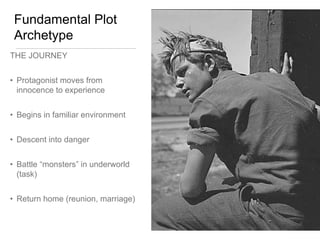
Fundamental Plot
Archetype
THE JOURNEY
• Protagonist moves from
innocence to experience
• Begins in familiar environment
• Descent into danger
• Battle “monsters” in underworld
(task)
• Return home (reunion, marriage)
Common Archetypal Figures
• The Child
• The Hero
• The Great Mother
• The Wise old man
• The Trickster or Fox
How do you do it?
• Look for patterns, images, objects, characters that remind you of patterns,
images, objects, and characters that you’ve seen before (Note: it helps to
have a list of archetypal symbols. You will get that as a resource in the next
slide).
• What did those patterns, images, objects, and characters mean in the other
text you read?
• Apply that to your current text.
• You might ask yourself whether the author intended that meaning, but in
archetypal literary theory, as will all theories that evolved from New Criticism, it
doesn’t matter what the author intended. That does not affect the meaning.
Required Reading
• Northrop Frye’s Theory of
Archetypes:
http://edweb.tusd.k12.az.us/dher
ring/ap/consider/frye/indexfryeov
.htm
• Archetypal Literary Theory note:
https://www.scribd.com/doc/253
907931/Archetypal-Literary-
Criticism
Feminist Literary
Criticism
Definition
• Feminist literary criticism tends to examine the roles of women in literature,
both as writers and subjects within the text. For most of the history of literary
criticism, women’s voices were ignored—mainly because most critics were
men who tended to read and write about their own experiences—not
necessarily out of a conscious desire to exclude women.
How to do it
• As you’re reading a text, try to answer the following questions:
1. What is the protagonist’s attitude toward the male and female characters in the text? How is this
evident and how does it affect your response to the characters?
2. How are women represented in the text?
3. What roles do both men and women play within family, work situations, etc.? (for example, hero,
breadwinner, friend, helper, cook, servant, sex object…)
4. What were the social and historical conditions for women in this period that might help us understand
their roles and desires in the text
5. How do women exercise their power in the text? What are the consequences?
6. How and to what degree are the women’s lives limited or restricted in this text
Required Reading
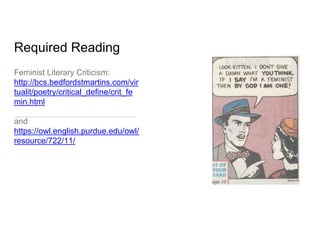
Feminist Literary Criticism:
http://bcs.bedfordstmartins.com/vir
tualit/poetry/critical_define/crit_fe
min.html
and
https://owl.english.purdue.edu/owl/
resource/722/11/
Postcolonial Literary
Criticism
Definition
• Postcolonial criticism usually involves the analysis of literary texts produced in
countries and cultures that have come under the control of European colonial
powers at some point in their history. It can refer to the analysis of texts written
about colonized places by writers hailing from the colonizing culture.
Hegemony
• Pronounced “he-GEM-ony”
• Refers to the domination and control of one country or class of people by
another country or class of people.
• Karl Marx described cultural hegemony that of a ruling class dominating a
culturally diverse society by changing their world view and culture so that their
domination becomes culturally accepted.
Other important ideas
• terms "first-world," "second world," "third world" and "fourth world" nations are
critiqued by post-colonial critics because they reinforce the dominant positions
of western cultures populating first world status. This critique includes the
literary canon and histories written from the perspective of first-world cultures.
How to do it
• How does the literary text, explicitly or
allegorically, represent various aspects of
colonial oppression?
• What does the text reveal about the
problematics of post-colonial identity,
including the relationship between personal
and cultural identity?
• What person(s) or groups does the work
identify as "other" or stranger? How are
such persons/groups described and
treated?
• What does the text reveal about the politics
and/or psychology of anti-colonialist
resistance?
• What does the text reveal about the
operations of cultural difference - the ways
in which race, religion, class, gender,
sexual orientation, cultural beliefs, and
customs combine to form individual identity
- in shaping our perceptions of ourselves,
others, and the world in which we live?
• How does the text respond to or comment
upon the characters, themes, or
assumptions of a canonized (colonialist)
work?
Required reading
• Post-colonial literary theory:
http://bcs.bedfordstmartins.com/virtualit
/poetry/critical_define/crit_post.html
• Wikipedia article on Post-colonialism:
http://en.wikipedia.org/wiki/Postcolonial
ism
Sources
Brewton, Vince. "Literary Theory." Internet Encyclopedia of Philosophy. Web. 21 Feb.
2015.
Brizee, Allen, and J.Case Tompkins. "Literary Theory and Schools of Criticism."The
Purdue OWL. Purdue U Writing Lab, 14 May 2012. Web. 21 Feb. 2015.
<https://owl.english.purdue.edu/owl/resource/722/01/>.
Karen, Nelson. "Gliffy Public Diagram - Timeline of Literary Theory." Timeline of Literary
Theory. Gliffy, 22 Feb. 2013. Web. 21 Feb. 2015.
<http://www.gliffy.com/publish/4334446/>.
"Postcolonialism." Wikipedia. Wikimedia Foundation, 8 Feb. 2015. Web. 21 Feb. 2015.
<http://en.wikipedia.org/wiki/Postcolonialism>.
• All images from Flickr’s Creative Commons image search

Literary Criticism

  • 1.
  • 2.
    What is literary theory? •Think of it as a lens through which one views a text (any text—not just written). Depending on the lens one uses, and the way in which that lens is focused, our attention is drawn to a particular aspect of the text more so than others. • Different schools of literary theory offer different ways of seeing and interpreting a text.
  • 3.
    Read the followingstatements and think about the degree to which you AGREE or DISAGREE with the statements.
  • 4.
    The most importantthing about a text is the individual reader’s experience with the text.
  • 5.
    When studying atext, you don’t need to understand what the author originally intended.
  • 6.
    The meaning ofa text depends on the experience the reader brings to the text.
  • 7.
    There is noright or wrong answer when it comes to literature.
  • 8.
    If you mostlyagreed with those statements, you might be using Reader Response theory to analyze literature. Read on…
  • 9.
  • 11.
    Definition • A theorythat stresses the importance of the reader's role in interpreting texts. Rejecting the idea that there is a single, fixed meaning inherent in every literary work, this theory holds that the individual creates his or her own meaning through a "transaction" with the text based on personal associations.
  • 12.
    Key Quotations • "Apoem is what the reader lives through under the guidance of the text and experiences as relevant to the text." -Louise Rosenblatt • Any school of criticism that sees a literary work as an object, claiming to describe what it is and never what it does, misconstrues the very essence of literature and reading. Literature exists and signifies when it is read.,(Paraphrase) -Stanley Fish
  • 13.
    How do youdo it? • The text doesn’t have any meaning without the reader. • When you read the text you approach it with all of your prior knowledge, experience, culture, world view, etc.. You bring that to the text. • As you read, you ask yourself, what are you bringing to the text that makes you interpret the text that way. This is called a “transactional analysis.” • As you read more and experience the world more your “horizon of expectations” changes. That means that you may interpret a text in a different way and this is still a valid interpretation. • There is no single fixed meaning in any text. That doesn’t mean that any interpretation is valid though.
  • 14.
    Required Reading • ReaderResponse Theory: http://bcs.bedfordstmartins.c om/virtualit/poetry/critical_de fine/crit_reader.html
  • 15.
    In Summary • “TheCorrect Reading” was traditionally the goal of literary criticism. • Reader response criticism is a reaction to this. How one interprets a text is subjective and is based on time, place, culture, etc.
  • 16.
  • 18.
    Definition • Archetypes determinethe form and function of literary works • A text's meaning is shaped by cultural and psychological myths.
  • 19.
    What is anarchetype? • Arche “first” and typos “form” • An original model or pattern from which copies are made • Archetypes are the recurring images, symbols, or patterns which may include motifs such as the quest or the heavenly ascent, recognizable character types such as the trickster or the hero, symbols such as the apple or snake are all laden with meaning already when employed in a particular work.
  • 20.
    Fundamental Plot Archetype THE JOURNEY •Protagonist moves from innocence to experience • Begins in familiar environment • Descent into danger • Battle “monsters” in underworld (task) • Return home (reunion, marriage)
  • 21.
    Common Archetypal Figures •The Child • The Hero • The Great Mother • The Wise old man • The Trickster or Fox
  • 22.
    How do youdo it? • Look for patterns, images, objects, characters that remind you of patterns, images, objects, and characters that you’ve seen before (Note: it helps to have a list of archetypal symbols. You will get that as a resource in the next slide). • What did those patterns, images, objects, and characters mean in the other text you read? • Apply that to your current text. • You might ask yourself whether the author intended that meaning, but in archetypal literary theory, as will all theories that evolved from New Criticism, it doesn’t matter what the author intended. That does not affect the meaning.
  • 23.
    Required Reading • NorthropFrye’s Theory of Archetypes: http://edweb.tusd.k12.az.us/dher ring/ap/consider/frye/indexfryeov .htm • Archetypal Literary Theory note: https://www.scribd.com/doc/253 907931/Archetypal-Literary- Criticism
  • 24.
  • 26.
    Definition • Feminist literarycriticism tends to examine the roles of women in literature, both as writers and subjects within the text. For most of the history of literary criticism, women’s voices were ignored—mainly because most critics were men who tended to read and write about their own experiences—not necessarily out of a conscious desire to exclude women.
  • 27.
    How to doit • As you’re reading a text, try to answer the following questions: 1. What is the protagonist’s attitude toward the male and female characters in the text? How is this evident and how does it affect your response to the characters? 2. How are women represented in the text? 3. What roles do both men and women play within family, work situations, etc.? (for example, hero, breadwinner, friend, helper, cook, servant, sex object…) 4. What were the social and historical conditions for women in this period that might help us understand their roles and desires in the text 5. How do women exercise their power in the text? What are the consequences? 6. How and to what degree are the women’s lives limited or restricted in this text
  • 28.
    Required Reading Feminist LiteraryCriticism: http://bcs.bedfordstmartins.com/vir tualit/poetry/critical_define/crit_fe min.html and https://owl.english.purdue.edu/owl/ resource/722/11/
  • 29.
  • 31.
    Definition • Postcolonial criticismusually involves the analysis of literary texts produced in countries and cultures that have come under the control of European colonial powers at some point in their history. It can refer to the analysis of texts written about colonized places by writers hailing from the colonizing culture.
  • 32.
    Hegemony • Pronounced “he-GEM-ony” •Refers to the domination and control of one country or class of people by another country or class of people. • Karl Marx described cultural hegemony that of a ruling class dominating a culturally diverse society by changing their world view and culture so that their domination becomes culturally accepted.
  • 33.
    Other important ideas •terms "first-world," "second world," "third world" and "fourth world" nations are critiqued by post-colonial critics because they reinforce the dominant positions of western cultures populating first world status. This critique includes the literary canon and histories written from the perspective of first-world cultures.
  • 34.
    How to doit • How does the literary text, explicitly or allegorically, represent various aspects of colonial oppression? • What does the text reveal about the problematics of post-colonial identity, including the relationship between personal and cultural identity? • What person(s) or groups does the work identify as "other" or stranger? How are such persons/groups described and treated? • What does the text reveal about the politics and/or psychology of anti-colonialist resistance? • What does the text reveal about the operations of cultural difference - the ways in which race, religion, class, gender, sexual orientation, cultural beliefs, and customs combine to form individual identity - in shaping our perceptions of ourselves, others, and the world in which we live? • How does the text respond to or comment upon the characters, themes, or assumptions of a canonized (colonialist) work?
  • 35.
    Required reading • Post-colonialliterary theory: http://bcs.bedfordstmartins.com/virtualit /poetry/critical_define/crit_post.html • Wikipedia article on Post-colonialism: http://en.wikipedia.org/wiki/Postcolonial ism
  • 36.
    Sources Brewton, Vince. "LiteraryTheory." Internet Encyclopedia of Philosophy. Web. 21 Feb. 2015. Brizee, Allen, and J.Case Tompkins. "Literary Theory and Schools of Criticism."The Purdue OWL. Purdue U Writing Lab, 14 May 2012. Web. 21 Feb. 2015. <https://owl.english.purdue.edu/owl/resource/722/01/>. Karen, Nelson. "Gliffy Public Diagram - Timeline of Literary Theory." Timeline of Literary Theory. Gliffy, 22 Feb. 2013. Web. 21 Feb. 2015. <http://www.gliffy.com/publish/4334446/>. "Postcolonialism." Wikipedia. Wikimedia Foundation, 8 Feb. 2015. Web. 21 Feb. 2015. <http://en.wikipedia.org/wiki/Postcolonialism>. • All images from Flickr’s Creative Commons image search

Editor's Notes

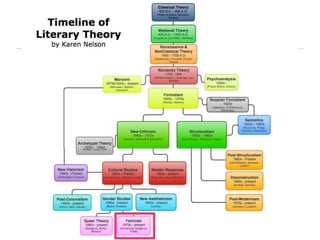
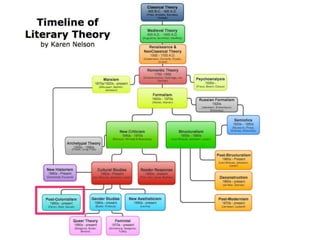
  • #11 New Critics a practice which advocated rigid scholarly detachment in the study of texts and rejected all forms of personal interpretation by the reader. More about that later
  • #12 Because all readers bring their own emotions, concerns, life experiences, and knowledge to their reading, each interpretation is subjective and unique.
  • #13 Horizons of expectations a reader's "expectations" or frame of reference is based on the reader's past experience of literature and what preconceived notions about literature the reader possesses. For a work to be a classic, it needs to exceed the reader’s horizons of expectations Implied reader: a hypothetical reader of a text. The implied reader [according to Iser] "embodies all those predispositions necessary for a literary work to exercise its effect Interpretive communities: that readers within an "interpretive community" share reading strategies, values and interpretive assumptions Transactional analysis: meaning is produced in a transaction of a reader with a text. As an approach, then, the critic would consider "how the reader interprets the text as well as how the text produces a response in her"