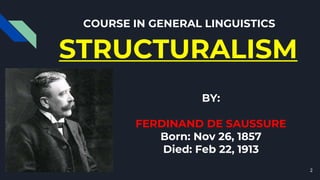
COURSE IN GENERAL LINGUISTICS
STRUCTURALISM
BY:
FERDINAND DE SAUSSURE
Born: Nov 26, 1857
Died: Feb 22, 1913
2
Presentation for the Class:
HISTORY OF MODERN LINGUISTICS
Presented to:
SIR MANZOOR PANHWAR
Presented by:
SADAQAT HUSSAIN
3
STRUCTURALISM : AN INTRODUCTION
● STRUCTURALISM can be defined as; It is about finding the
fundamental basic UNITS or ELEMENTS that make up any
system and discovering the RULES that govern how these
units can be combined?
4
STRUCTURALISM AS A PHILOSOPHICAL STANCE
● Structuralists are interested in the interrelationship between:
UNITS (also called “surface phenomena”)
and
RULES (the ways that units can be put together)
5
● IN LANGUAGE:
Units are words and the rules which are the forms of grammar which order
words. In different languages, the grammar rules are different, as are the
words, but the structure is still the same in all languages; words are put
together within a grammatical system to make meaning.
AN EXAMPLE OF THIS USING LITERATURE
● UNITS:
Princess, Stepmother and Prince
6
● WE CAN SEE THAT:
STEPMOTHER is EVIL,
PRINCESS is VICTIM,
PRINCE & PRINCESS have to marry.
● RULES:
A Princess is persecuted by a stepmother and rescued (and married)
by a Prince.
STRUCTURALIST NOTIONS ON UNITS AND RULES
● Structuralists believe that the underlying structures which
organize UNITS and RULES into meaningful systems are generated
by the human mind itself, and not by sense perception.
● As such, the mind is itself a structuring mechanism which looks
through units and files them according to rules.
● So, Structuralism sees itself as a science of humankind, and works
to uncover all the structures that underlie all the things that
humans do, think, perceive, and feel.
7
STRUCTURALIST ANALYSIS POSITS THESE
SYSTEMS AS UNIVERSAL
● Every human mind in every culture at every point in history ahs used some
sort of structuring principle to organize and understand cultural
phenomena.
● Every human culture has some sort of language, which has the basic
structure of all language; words / phonemes are combined according to a
grammar of rules to produce meaning.
● Every human culture similarly has some sort of social organization.
● All of these organizations are governed, according to structuralists
analyses, by structures which are universal.
8
A MORE FORMAL DEFINITION:
● WHOLENESS:
This means that the system functions as a whole, not just as a collection of
independent parts.
● TRANSFORMATION:
This means that the system is not static, but capable of change. New units can enter
the system, but when they do they’re governed by the rules of the system.
● SELF REGULATION:
This is related to the idea of transformation. You can add elements to the system, but
you can’t change the basic structure of the system no matter what you add to it. The
transformations of a system never lead to anything outside the system.
9
A STRUCTURE IS ANY CONCEPTUAL SYSTEM
THAT HAS THE FOLLOWING THREE PROPERTIES:
SAUSSURE’ IDEAS ON LINGUISTICS
● Language is based on a NAMING process, by which things get
associated with a word or name.
● The linguistic SIGN (a key word) is made of the union of a concept
and a sound image. A more common way to define a linguistic SIGN
is that a SIGN is the combination of a SIGNIFIER and a SIGNIFIED.
Saussure says the sound image is the SIGNIFIER and the concept
the SIGNIFIED.
10
( 1 ) THE NATURE OF THE LINGUISTIC SIGN
The SIGN as union of a SIGNIFIER and a SIGNIFIED,
has two main characteristics:
● The SIGN, as union of a SIGNIFIER and a SIGNIFIED, has two main
characteristics .
This principle dominates all ideas about the STRUCTURE of
language. It makes it possible to separate the signifier and signified,
or to change the relation between them.
● The second characteristic of the SIGN is that the signifier exists in
TIME, and that time can be measured as LINEAR.
11
(ii) LINGUISTIC VALUE
● Thought is a shapeless mass, which is only ordered by language.
One of the questions philosophers have puzzled over for centrueis
is whether ideas can exist at all without language. No Idea preexist
language; language itself gives shape to ideas and makes them
expressible.
● The VALUE of a sign is determined, however, not by what signifiers
get linked to what particular signifieds, but rather by the whole
system of signs used within a community. VALUE is the product of a
system or structure (LANGUE), not the result of individual
relations (PAROLE).
12
LANGUE VS PAROLE
● LANGUE:
* A system, an institution, a set of interpersonal rules and norms is
speech and writing.
* Elements include the system of grammar, spellings, syntax and
punctuation.
* Meaning is created in the arrangements of its elements and the
consequent relationship between these arranged elements.
● PAROLE:
* An actual manifestation of langue.
* The concrete use of the language, the actual utterances.
13
(iii) SYNTAGMATIC AND ASSOCIATIVE RELATIONS
● The most important kind of relation between units in a signifying
system, is a SYNTAGMATIC relation.
This means, basically, a LINEAR relation. In spoken or written
language, words come out one by one, because language is linear, it
forms a chain, by which one unit is linked to the next.
● An example:
“The cat sat on the mat”
“The mat sat on the cat”
English word order : S + V + O
Japanese word order : S + O + V etcetera
14
SYNTAGMS
● Combinations or relations formed by position within a chain are
called SYNTAGMS.
● The terms within a SYNTAGM acquire VALUE only because they
stand in opposition to everything before or after them. Each term is
something because it is NOT something else in the sequence.
● SYNTAGMATIC relations are most crucial in written and spoken
language, in DISCOURSE, where the ideas of time, linearity, and
syntactical meaning are important.
15
ASSOCIATIVE
● Signs are stored in your memory, for example, not in
SYNTAGMATIC links or sentences, but in ASSOCIATIVE groups.
● Education ---- “tion”, education, relation, association.
● Similar association: education, teacher, textbook, college,
expensive.
Random set of linkages: education, baseball, computer games.
● ASSOCIATIVE relations are only in your head, not in the structure
of language itself, whereas SYNTAGMATIC relations are a product
of linguistic structure.
16
CONCLUSION
● The systematic nature of language, where the whole is greater than
the sum of its parts.
● The relational conception of the elements of language, where
linguistic “entities” are defined in relationships of combination and
contrast to one another.
● The arbitrary nature of linguistic elements, where they are defined
in terms of the function and purpose they serve rather than in
terms of their inherent qualities.
17
SAUSSURE’S STRUCTURALISM IS BASED UPON THREE ASSUMPTIONS:
18
* * T h e E n d * *
* * T h a n k Y o u * *

Structuralism theory

  • 2.
    COURSE IN GENERALLINGUISTICS STRUCTURALISM BY: FERDINAND DE SAUSSURE Born: Nov 26, 1857 Died: Feb 22, 1913 2
  • 3.
    Presentation for theClass: HISTORY OF MODERN LINGUISTICS Presented to: SIR MANZOOR PANHWAR Presented by: SADAQAT HUSSAIN 3
  • 4.
    STRUCTURALISM : ANINTRODUCTION ● STRUCTURALISM can be defined as; It is about finding the fundamental basic UNITS or ELEMENTS that make up any system and discovering the RULES that govern how these units can be combined? 4
  • 5.
    STRUCTURALISM AS APHILOSOPHICAL STANCE ● Structuralists are interested in the interrelationship between: UNITS (also called “surface phenomena”) and RULES (the ways that units can be put together) 5 ● IN LANGUAGE: Units are words and the rules which are the forms of grammar which order words. In different languages, the grammar rules are different, as are the words, but the structure is still the same in all languages; words are put together within a grammatical system to make meaning.
  • 6.
    AN EXAMPLE OFTHIS USING LITERATURE ● UNITS: Princess, Stepmother and Prince 6 ● WE CAN SEE THAT: STEPMOTHER is EVIL, PRINCESS is VICTIM, PRINCE & PRINCESS have to marry. ● RULES: A Princess is persecuted by a stepmother and rescued (and married) by a Prince.
  • 7.
    STRUCTURALIST NOTIONS ONUNITS AND RULES ● Structuralists believe that the underlying structures which organize UNITS and RULES into meaningful systems are generated by the human mind itself, and not by sense perception. ● As such, the mind is itself a structuring mechanism which looks through units and files them according to rules. ● So, Structuralism sees itself as a science of humankind, and works to uncover all the structures that underlie all the things that humans do, think, perceive, and feel. 7
  • 8.
    STRUCTURALIST ANALYSIS POSITSTHESE SYSTEMS AS UNIVERSAL ● Every human mind in every culture at every point in history ahs used some sort of structuring principle to organize and understand cultural phenomena. ● Every human culture has some sort of language, which has the basic structure of all language; words / phonemes are combined according to a grammar of rules to produce meaning. ● Every human culture similarly has some sort of social organization. ● All of these organizations are governed, according to structuralists analyses, by structures which are universal. 8
  • 9.
    A MORE FORMALDEFINITION: ● WHOLENESS: This means that the system functions as a whole, not just as a collection of independent parts. ● TRANSFORMATION: This means that the system is not static, but capable of change. New units can enter the system, but when they do they’re governed by the rules of the system. ● SELF REGULATION: This is related to the idea of transformation. You can add elements to the system, but you can’t change the basic structure of the system no matter what you add to it. The transformations of a system never lead to anything outside the system. 9 A STRUCTURE IS ANY CONCEPTUAL SYSTEM THAT HAS THE FOLLOWING THREE PROPERTIES:
  • 10.
    SAUSSURE’ IDEAS ONLINGUISTICS ● Language is based on a NAMING process, by which things get associated with a word or name. ● The linguistic SIGN (a key word) is made of the union of a concept and a sound image. A more common way to define a linguistic SIGN is that a SIGN is the combination of a SIGNIFIER and a SIGNIFIED. Saussure says the sound image is the SIGNIFIER and the concept the SIGNIFIED. 10 ( 1 ) THE NATURE OF THE LINGUISTIC SIGN
  • 11.
    The SIGN asunion of a SIGNIFIER and a SIGNIFIED, has two main characteristics: ● The SIGN, as union of a SIGNIFIER and a SIGNIFIED, has two main characteristics . This principle dominates all ideas about the STRUCTURE of language. It makes it possible to separate the signifier and signified, or to change the relation between them. ● The second characteristic of the SIGN is that the signifier exists in TIME, and that time can be measured as LINEAR. 11
  • 12.
    (ii) LINGUISTIC VALUE ●Thought is a shapeless mass, which is only ordered by language. One of the questions philosophers have puzzled over for centrueis is whether ideas can exist at all without language. No Idea preexist language; language itself gives shape to ideas and makes them expressible. ● The VALUE of a sign is determined, however, not by what signifiers get linked to what particular signifieds, but rather by the whole system of signs used within a community. VALUE is the product of a system or structure (LANGUE), not the result of individual relations (PAROLE). 12
  • 13.
    LANGUE VS PAROLE ●LANGUE: * A system, an institution, a set of interpersonal rules and norms is speech and writing. * Elements include the system of grammar, spellings, syntax and punctuation. * Meaning is created in the arrangements of its elements and the consequent relationship between these arranged elements. ● PAROLE: * An actual manifestation of langue. * The concrete use of the language, the actual utterances. 13
  • 14.
    (iii) SYNTAGMATIC ANDASSOCIATIVE RELATIONS ● The most important kind of relation between units in a signifying system, is a SYNTAGMATIC relation. This means, basically, a LINEAR relation. In spoken or written language, words come out one by one, because language is linear, it forms a chain, by which one unit is linked to the next. ● An example: “The cat sat on the mat” “The mat sat on the cat” English word order : S + V + O Japanese word order : S + O + V etcetera 14
  • 15.
    SYNTAGMS ● Combinations orrelations formed by position within a chain are called SYNTAGMS. ● The terms within a SYNTAGM acquire VALUE only because they stand in opposition to everything before or after them. Each term is something because it is NOT something else in the sequence. ● SYNTAGMATIC relations are most crucial in written and spoken language, in DISCOURSE, where the ideas of time, linearity, and syntactical meaning are important. 15
  • 16.
    ASSOCIATIVE ● Signs arestored in your memory, for example, not in SYNTAGMATIC links or sentences, but in ASSOCIATIVE groups. ● Education ---- “tion”, education, relation, association. ● Similar association: education, teacher, textbook, college, expensive. Random set of linkages: education, baseball, computer games. ● ASSOCIATIVE relations are only in your head, not in the structure of language itself, whereas SYNTAGMATIC relations are a product of linguistic structure. 16
  • 17.
    CONCLUSION ● The systematicnature of language, where the whole is greater than the sum of its parts. ● The relational conception of the elements of language, where linguistic “entities” are defined in relationships of combination and contrast to one another. ● The arbitrary nature of linguistic elements, where they are defined in terms of the function and purpose they serve rather than in terms of their inherent qualities. 17 SAUSSURE’S STRUCTURALISM IS BASED UPON THREE ASSUMPTIONS:
  • 18.
    18 * * Th e E n d * * * * T h a n k Y o u * *