chapter 7 ideology ( modernism & post modernism).pdf
1.
PHILOSOPHY AND CURRENTISSUE
PRESENTED BY SYACHDIVA VALENTINA B (303187)
HAN ZHIHAO (303190)
KAAMILIYAH NAILAH PUTRI (303186)
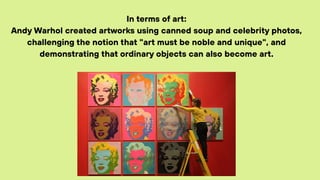
2.
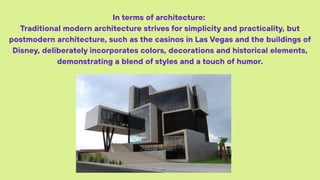
HISTORICAL & INTELLECTUALCONTEXT
Modernism is a broad cultural, artistic, and philosophical movement that emerged
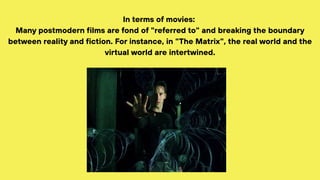
in the late 19th and early 20th centuries. It was a response to rapid changes in the
world—like industrialization, urbanization, scientific discoveries, and the horrors of
World War I. Modernists wanted to break away from traditional ideas, styles, and
institutions and create something new, rational, and modern
Historical & Intellectual Context
• Industrialization & Urbanization
The mass migration into industrial cities, the rise of factories, and new transport (railways,
automobiles) radically altered everyday life.
• Scientific Advances & Secularization
Darwin’s theory of evolution, breakthroughs in physics (e.g. relativity), and growing secular
attitudes undermined traditional religious and moral certainties.
• World War I Trauma
The unprecedented destruction and disillusionment of 1914–1918 shook faith in 19th-century
notions of progress and harmony, prompting artists and thinkers to search for new means of
expression.
3.
1. Rejection ofTradition
• A conscious turning away from Victorian, Romantic or classical forms—whether in art,
literature, music or architecture.
2. Experimentation & Innovation
• Emphasis on new techniques (stream of consciousness, atonality, collage, abstraction) to
capture fragmented modern experience.
3. Belief in Progress (with Ambivalence)
• Faith in science and technology to reshape society, yet often ambivalent or critical about
their human cost.
4. Subjectivity & Inner Reality
• Focus on individual perception, psychological depth and the workings of consciousness
rather than external “objective” reality.
5. Fragmentation & Discontinuity
• Use of non-linear narratives, disjointed imagery, and juxtaposition to mirror the sense of
alienation and complexity of modern life.
4.
Postmodernism is atrend that emerged in the late 20th century.
It rejects the notion of a single truth and emphasizes diversity,
relativity and uncertainty.
It often expresses its questioning of tradition through collage,
satire and breaking of rules.. So, how did it come into being?
POSTMODERNISM
5.
Modernism is anartistic trend that emphasizes rationality, progress and innovation.
However, after experiencing two world wars (modernism believed that innovation would
lead to a better future for humanity, but the two wars showed that technology and
rationality could also bring destruction, such as the atomic bomb), people began to
question the so-called "progress". The colonial system collapsed (the West believed
that it was the "center" and the "representative of civilization", but the colonial
countries gained independence and began to reflect on Western centrism). Mass
consumer culture emerged (the post-war economic prosperity made people addicted to
television, advertisements, fast food and other consumer culture, and art became a
commodity, which challenged the idea of "artistic grandeur"). And the social movements
in the 1960s (such as the feminist movement, the black people's rights movement, the
anti-war movement, the student movement, etc., all challenged traditional authority and
patriarchy, and promoted the questioning of "single truth" and "standard human
experience") were widely questioned.
What led to the emergence of
postmodernism?
6.
In terms ofart:
Andy Warhol created artworks using canned soup and celebrity photos,
challenging the notion that "art must be noble and unique", and
demonstrating that ordinary objects can also become art.
7.
In terms ofarchitecture:
Traditional modern architecture strives for simplicity and practicality, but
postmodern architecture, such as the casinos in Las Vegas and the buildings of
Disney, deliberately incorporates colors, decorations and historical elements,
demonstrating a blend of styles and a touch of humor.
8.
Literature aspect:
Novels areno longer stories with a beginning, a middle and an ending. Instead, they
break the sequence and the author "speaks out", like in Calvino's "If on a Winter's
Night a Traveler". In the book, you are the reader and the story repeatedly
interrupts itself, emphasizing the act of reading itself.
You are aboutto begin reading Italo Calvino's newnovel, Ifon awinter's nightatraveler. Relax.
Concentrate. Dispel everyotherthought. Lettheworld aroundyoufade. Bestto closethe
door;theTVis always on inthe nextroom.Tellthe others rightaway, "No, I don'twanttowatch
TV!" Raiseyourvoice—theywon'thearyou otherwise— "I'm reading! I don'twantto be
disturbed!" Maybetheyhaven'theardyou,with allthatracket; speaklouder,yell: "I'm
beginningto read Italo Calvino's newnovel!" Orifyou prefer, don'tsayanything; justhope
they'll leaveyou alone.la.utexas.edu+2Swarthmore College ComputerSociety
9.
In terms ofmovies:
Many postmodern films are fond of "referred to" and breaking the boundary
between reality and fiction. For instance, in "The Matrix", the real world and the
virtual world are intertwined.
10.
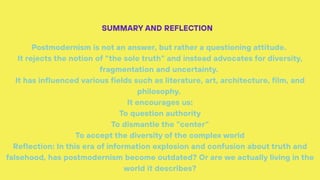
Postmodernism is notan answer, but rather a questioning attitude.
It rejects the notion of "the sole truth" and instead advocates for diversity,
fragmentation and uncertainty.
It has influenced various fields such as literature, art, architecture, film, and
philosophy.
It encourages us:
To question authority
To dismantle the "center"
To accept the diversity of the complex world
Reflection: In this era of information explosion and confusion about truth and
falsehood, has postmodernism become outdated? Or are we actually living in the
world it describes?
SUMMARY AND REFLECTION
11.
nsxjxjsxbsjxjxja
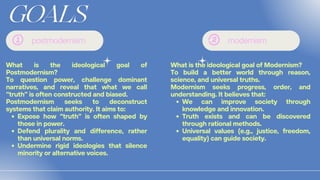
postmodernism
What is theideological goal of
Postmodernism?
To question power, challenge dominant
narratives, and reveal that what we call
“truth” is often constructed and biased.
Postmodernism seeks to deconstruct
systems that claim authority. It aims to:
Expose how “truth” is often shaped by
those in power.
Defend plurality and difference, rather
than universal norms.
Undermine rigid ideologies that silence
minority or alternative voices.
nsxjxjsxbsjxjxja
modernism
What is the ideological goal of Modernism?
To build a better world through reason,
science, and universal truths.
Modernism seeks progress, order, and
understanding. It believes that:
We can improve society through
knowledge and innovation.
Truth exists and can be discovered
through rational methods.
Universal values (e.g., justice, freedom,
equality) can guide society.
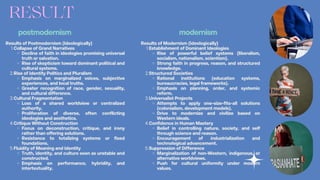
Results of Postmodernism(Ideologically)
1.Collapse of Grand Narratives
Decline of faith in ideologies promising universal
truth or salvation.
Rise of skepticism toward dominant political and
cultural systems.
2.Rise of Identity Politics and Pluralism
Emphasis on marginalized voices, subjective
experiences, and local truths.
Greater recognition of race, gender, sexuality,
and cultural difference.
3.Cultural Fragmentation
Loss of a shared worldview or centralized
authority.
Proliferation of diverse, often conflicting
ideologies and aesthetics.
4.Critique Without Construction
Focus on deconstruction, critique, and irony
rather than offering solutions.
Resistance to totalizing systems or fixed
foundations.
5.Fluidity of Meaning and Identity
Truth, identity, and culture seen as unstable and
constructed.
Emphasis on performance, hybridity, and
intertextuality.
postmodernism modernism
Results of Modernism (Ideologically)
1.Establishment of Dominant Ideologies
Rise of powerful belief systems (liberalism,
socialism, nationalism, scientism).
Strong faith in progress, reason, and structured
knowledge.
2.Structured Societies
Rational institutions (education systems,
bureaucracies, legal frameworks).
Emphasis on planning, order, and systemic
reform.
3.Universalist Projects
Attempts to apply one-size-fits-all solutions
(colonialism, development models).
Drive to modernize and civilize based on
Western ideals.
4.Confidence in Human Mastery
Belief in controlling nature, society, and self
through science and reason.
Encouragement of industrialization and
technological advancement.
5.Suppression of Difference
Marginalization of non-Western, indigenous, or
alternative worldviews.
Push for cultural uniformity under modern
values.
14.
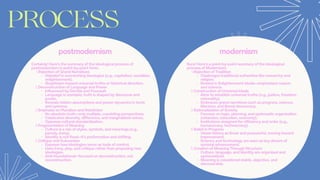
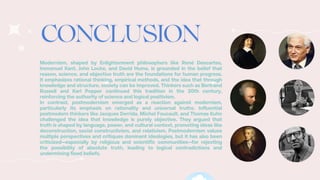
Modernism, shaped byEnlightenment philosophers like René Descartes,
Immanuel Kant, John Locke, and David Hume, is grounded in the belief that
reason, science, and objective truth are the foundations for human progress.
It emphasizes rational thinking, empirical methods, and the idea that through
knowledge and structure, society can be improved. Thinkers such as Bertrand
Russell and Karl Popper continued this tradition in the 20th century,
reinforcing the authority of science and logical positivism.
In contrast, postmodernism emerged as a reaction against modernism,
particularly its emphasis on rationality and universal truths. Influential
postmodern thinkers like Jacques Derrida, Michel Foucault, and Thomas Kuhn
challenged the idea that knowledge is purely objective. They argued that
truth is shaped by language, power, and cultural context, promoting ideas like
deconstruction, social constructivism, and relativism. Postmodernism values
multiple perspectives and critiques dominant ideologies, but it has also been
criticized—especially by religious and scientific communities—for rejecting
the possibility of absolute truth, leading to logical contradictions and
undermining fixed beliefs.
16.
“BE THE CHANGETHAT YOU WISH TO SEE IN THE WORLD.” ―
MAHATMA GANDHI.






![CulturePostmodernism[1].ppt.its the topic](https://cdn.slidesharecdn.com/ss_thumbnails/culturepostmodernism1-250905153747-f1b205cd-thumbnail.jpg?width=640&height=640&fit=bounds)


