By Danika Tipping
About Me 
 English teacher, Central Elgin Collegiate in St.Thomas 
 M.Ed. in Education and digital technologies from 
UOIT 
 Twitter: @danikatipping 
 Web: danikabarker.ca
Background 
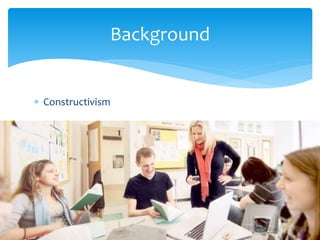
 Constructivism
Background 
 Intrinsic Motivation 
 Student Led 
 Creative 
 Compacted
PowerPoint Sin in 5…4…3…2…1
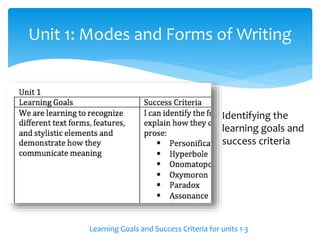
Unit 1: Modes and Forms of Writing 
Identifying the 
learning goals and 
success criteria 
Learning Goals and Success Criteria for units 1-3
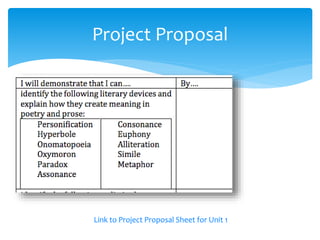
Project Proposal 
Link to Project Proposal Sheet for Unit 1
Options 
 Create a digital or paper text book with 
questions and answer keys for an 
audience of your peers that teaches 
them how to meet the success criteria 
for this unit
Options 
 Create a magazine or website from the point of view 
of your favourite fictional character or real person on 
his or her/favourite topic that demonstrates the 
success criteria for this unit.
Link to Sherlock Blog
Options 
 Create a variety of different types of material 
(posters, pamphlets, stickers, internet memes, blog 
posts, letters) for a social activist campaign on an 
issue that matters to you. Include pieces of writing 
that meet the success criteria for this unit.
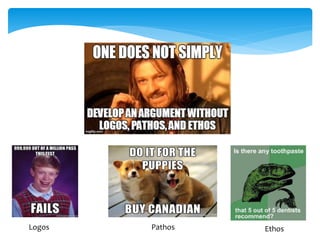
Logos Pathos Ethos
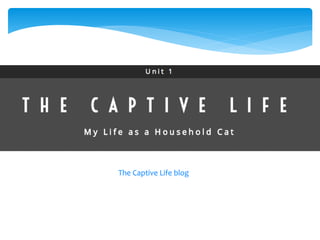
The Captive Life blog
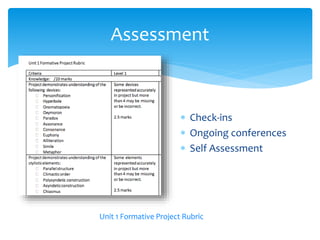
Assessment 
 Check-ins 
 Ongoing conferences 
 Self Assessment 
Unit 1 Formative Project Rubric
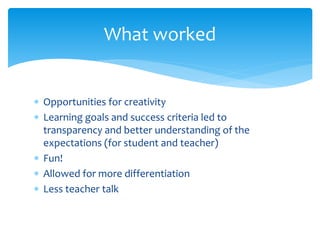
What worked 
 Opportunities for creativity 
 Learning goals and success criteria led to 
transparency and better understanding of the 
expectations (for student and teacher) 
 Fun! 
 Allowed for more differentiation 
 Less teacher talk
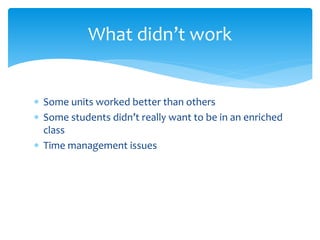
What didn’t work 
 Some units worked better than others 
 Some students didn’t really want to be in an enriched 
class 
 Time management issues
Questions 
 How to streamline the conferencing process? 
 How to streamline the feedback process? 
 How to find a better fit between creativity and 
meeting all the expectations?

Let it go #BIT14

  • 1.
  • 2.
    About Me English teacher, Central Elgin Collegiate in St.Thomas  M.Ed. in Education and digital technologies from UOIT  Twitter: @danikatipping  Web: danikabarker.ca
  • 3.
  • 4.
    Background  IntrinsicMotivation  Student Led  Creative  Compacted
  • 5.
    PowerPoint Sin in5…4…3…2…1
  • 10.
    Unit 1: Modesand Forms of Writing Identifying the learning goals and success criteria Learning Goals and Success Criteria for units 1-3
  • 11.
    Project Proposal Linkto Project Proposal Sheet for Unit 1
  • 12.
    Options  Createa digital or paper text book with questions and answer keys for an audience of your peers that teaches them how to meet the success criteria for this unit
  • 15.
    Options  Createa magazine or website from the point of view of your favourite fictional character or real person on his or her/favourite topic that demonstrates the success criteria for this unit.
  • 16.
  • 17.
    Options  Createa variety of different types of material (posters, pamphlets, stickers, internet memes, blog posts, letters) for a social activist campaign on an issue that matters to you. Include pieces of writing that meet the success criteria for this unit.
  • 18.
  • 19.
  • 37.
    Assessment  Check-ins  Ongoing conferences  Self Assessment Unit 1 Formative Project Rubric
  • 38.
    What worked Opportunities for creativity  Learning goals and success criteria led to transparency and better understanding of the expectations (for student and teacher)  Fun!  Allowed for more differentiation  Less teacher talk
  • 39.
    What didn’t work  Some units worked better than others  Some students didn’t really want to be in an enriched class  Time management issues
  • 40.
    Questions  Howto streamline the conferencing process?  How to streamline the feedback process?  How to find a better fit between creativity and meeting all the expectations?

Editor's Notes

  • #4 Constructivism: A theory that states that people construct their own knowledge and understanding of the world through their experiences with it, and reflecting on these experiences. As we encounter something new, we either build it onto previous knowledge or throw out or modify previous knowledge based on our new experiences. This requires a more active approach to learning. Students need to be actively engaged in problem solving. A constructivist approach is less focused on what students learn (not that that isn’t important), and more on how they learn. This is the educational theory that I wanted to use to design the course. This approach takes a lot of the onus away from the teacher in terms of who is responsible for the learning, which means that there’s a lot of work that needs to be done in the beginning and behind the scenes but not so much in the day-to-day running of the class.
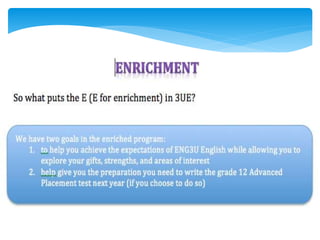
  • #5 This course was “sold” as an enriched grade 11 class. But that couldn’t mean that the course would be harder than the other ENG3U courses at our school because we have parents and kids worried about grades (and that’s a whole different issue for a different day). It also had to meet the same curriculum expectations as the the other ENG3U courses. The course needed to prep students for the AP exam in grade 12 should they choose to write it. Oh and the final exam and all summative projects had to be the same. These were the constraints I had to work under. So given that, I wondered, what would make this course enriched.
  • #6 Putting handouts on a screen is a sin. I know this, but in the interest of saving paper I’m going to do it anyway to show you what I gave my students, so I hope you’ll give me a pass.
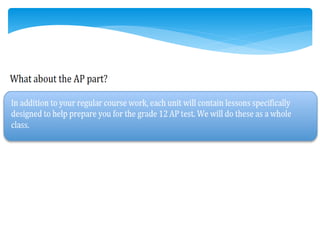
  • #7 So first, I had to figure out what would make this course different from the other 3U classes while keeping in mind the constraints I had to work with and this is what I came up with.
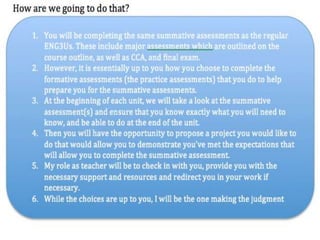
  • #8 Then there’s the how. And this is the handout I gave my students on the first day.
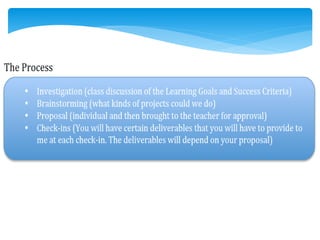
  • #9 The brainstorming process was a bit scary and so to avoid the initial silence, I had students do a think pair share which gave them the chance to discuss with each other first. Then we started to throw ideas up on the board. I did decide for the first unit to offer them a few suggestions but also let them propose something completely different.
  • #10 This was true, but students ended up doing more focused AP prep in May and June, the rest of the course being compacted enough to allow them the time. Where the AP expectations didn’t align with the ENG3U expectations, students were assessed but not graded.
  • #11 First step was identifying the Learning Goals and Success criteria which took the longest amount of time but was critical. I had to know exactly what the students needed to know and be able to do by the end of the unit in order to communicate it to them so they could design their projects. Took a look at existing course, summatives and curriculum expectations. There was a lot of focus in this unit on literary devices, grammar, style, and rhetorical devices which was both good and bad—good in that it wasn’t specific to any genre or form of writing—bad in that it was a bit dry. I put the language in as student “friendly” terms as I could so I could discuss them with the students.
  • #12 Tricky because of course students didn’t know all these terms yet and so they weren’t sure how they could demonstrate that they knew them so we had to have a lot of discussions about what they could do. a textbook that uses memes to teach writing, and a blog where a sullen cat plots his escape while attempting to teach the dog literary devices. I have students a few options to choose from
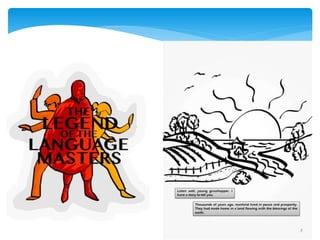
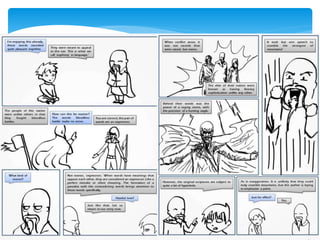
  • #13 This one was kind of boring in my opinion but I also thought it was safe and familiar for a student who was a little disoriented by this class. Some students took this project in a really creative direction like Paolo who wanted to make a comic book where a writing master teaches his young initiate how to be a writing ninja,
  • #16 One of my students is a big Sherlock fan so she did a blog from Sherlock Holmes’ point of view.
  • #17 This project worked really well because Kenzie made extensive used of hyperlinks to demonstrate both her use of and understanding of different literary devices.
  • #18 A number of students chose this option but one really latched onto the idea of memes and chose to create a textbook of memes to teach the different strategies and devices.
  • #19 Nick included explanations along with his memes.
  • #20 This particular student also used hyperlinks to demonstrate her knowledge.
  • #38 Assessment was varied and on-going. Self-assessment was very important because I wanted the students to have a good sense of how well they’d met the expectations without me telling them. So they had to hand in a self-assessment and conference with me about where they thought they were on the rubric and what they felt they still needed to work on. In the past I found students really struggled with this. Even though they may have participated in building the rubric, it was like they didn’t think I actually used the rubric to determine a grade.
  • #40 Unit one was skills based rather than content based. In some ways this made it much easier. Of course the door was so wide open it made it tough for some students to decide what to do. For the Othello unit, students had lots of ideas, but it was less clear how these projects would meet the learning goals and success criteria. Sometimes we had to acknowledge that a project couldn’t meet all the criteria so a student might meet the expectations in a different way. Some students were misplaced. They weren’t really interested in doing any enrichment. Some students had lofty plans that had to be scaled back due to unrealistic expectations while a few others procrastinated, didn’t have anything to show at check-ins and then struggled to have something prepared for their project. They were used to being successful by throwing something together at the last minute and so they really struggled with this concept. Conferencing with every student at least 3 times thoughout the unit may not seem that challenging but it really was!