MODERNISM ANDMODERNISM AND
POSTMODERNISMPOSTMODERNISM
Prepared byPrepared by
sithara kuriansithara kurian
IntroductionIntroduction
• Modernism and postmodernism are two
movements in literature and art; the
distinction between the two is hazy; there
is no well – defined boundary between
them in chronological, aesthetic or political
terms.
MODERNISMMODERNISM
As a literary movement, modernism flourished in Europe
and America in the 1920’s and 1930’s.
Modernist writers experimented with forms, devices and
styles. They made use of the psychoanalytic theories of
Freud and Jung.
Their works reflected a sense of loss, disillusionment
and even despair; writers like T.S.Eliot and James Joyce
saw a fragmented world,but hoped that fragmentation
could be countered through their works.
ModernismModernism
Modernism experimented with a number of literary
endeavors and styles. Modernist works are often called
Avant-garde (i.e. advance-guard).
The modernist writers regarded themselves as alienated
from the established order. Their purpose in writing was
to shock the sensibilities of the conventional reader so
as to lead him in the march ahead.
‘Modern’ and ‘modernist’ are not synonymous. The
former term broadly refers to that which is contemporary
or pertains to the present.
‘Modernist’ refers to the complex of characteristics
shared by those who participate in or follow the
modernist movement. It involves a radical break with
some of the traditional modes.
POSTMODERNISMPOSTMODERNISM
Postmodernism refers to certain radically
experimental works in literature and art.
It is distinguished from modernism in that it is a
term applied to the literature and art after the
Second World War, especially in the wake of the
experience of Nazi totalitarianism and mass
extermination of the Jews.
The postmodernists like the modernists,
experiment with new literary devices, forms and
styles. Their themes are similar to those of the
modernists.
They too view art and literature as a potentially
integrating restorative force.
Postmodernism can be seen to define itself
against modernism.
Postmodernism, according to Peter Brooker,
gives rise to “a mood or condition of radical
indeterminacy”.
It is very difficult to classify postmodernist works;
this is because they combine aspects of diverse
genres.
Their works include such genres as the Abusrd,
the antinovel, concrete poetry ,etc; all of which
challenge the ideological assumptions of
contemporary society.
POSTMODERNIST CRITICALPOSTMODERNIST CRITICAL
SCHOOLSSCHOOLS
Post structuralism
Deconstruction
Poststructuralists undertake to
subvert the foundations of language and show
that its seeming meaningfulness does not result
in the communication of any definitive meaning.
Two prominent postmodernistTwo prominent postmodernist
theoriststheorists
Francois Lyotard
Jean Baudrillard
Both Lyotard and Baudrillard bring the
boundary between high and popular culture,
between fact and fiction .
Francois LyotardFrancois Lyotard
His main work is “The Postmodern Condition”.
To him the postmodernism is undoubtedly part
of the modern.
He defines postmodernism as' incredulity
towards metanarratives(super-narratives) like
Christianity, Marxism or the Myth of scientific
progress.
Lyotard’s point of view is that meta-narratives do
not govern or control mininarratives (individual
postmodernist literary texts) which are the
products of present day culture born out of the
postmodern experience stemming from a
profound sense of existential uncertainty.
Postmodernist novels, plays and poems reflects
this uncertainty, this angst.
The American authors John Barth and Ishmael
Reed,the European writers Italo Calvino and
Umberto Eco and the Indian writer Salman
Rushdie, are examples.
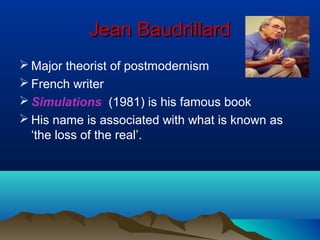
Jean BaudrillardJean Baudrillard
 Major theorist of postmodernism
 French writer
 Simulations (1981) is his famous book
 His name is associated with what is known as
‘the loss of the real’.
 In his essay “Simulacra and Simulations”, he
explains this loss and sets forth his
propositions .
 He speaks of a past era of ‘fullness’; in this era a
sign was a surface indication of the underlying
depth or reality-’an outward sign of inward
grace’.
 He goes on to ask whether a sign can merely be
an index of other signs, and not of an underlying
reality. If so ,the whole system becomes a
simulacrum (i.e. any image or representation of
something or a vague resemblance of
something ).
 He brings in the notion of simulation, and
substitutes it for representation.
 He then speaks of four stages of representation
of reality by means of signs.
The representation of basic reality.
Misrepresentation and disortion of reality.
Disguising the fact of the absence of reality
underneath.
The total lack of relationship of the sign to any reality
at all.
 Baudrillard’s argument leads him to the
conclusion :”within postmodernism, the
distinction between what is real and what is
simulated collapses: everything is a model or an
image, all is surface without depth”. He calls this
“the culture of hyper reality “ in which models
determine yet undermine the real.
Modernism and Postmodernism

Modernism and Postmodernism

  • 1.
    MODERNISM ANDMODERNISM AND POSTMODERNISMPOSTMODERNISM PreparedbyPrepared by sithara kuriansithara kurian
  • 2.
    IntroductionIntroduction • Modernism andpostmodernism are two movements in literature and art; the distinction between the two is hazy; there is no well – defined boundary between them in chronological, aesthetic or political terms.
  • 3.
    MODERNISMMODERNISM As a literarymovement, modernism flourished in Europe and America in the 1920’s and 1930’s. Modernist writers experimented with forms, devices and styles. They made use of the psychoanalytic theories of Freud and Jung. Their works reflected a sense of loss, disillusionment and even despair; writers like T.S.Eliot and James Joyce saw a fragmented world,but hoped that fragmentation could be countered through their works.
  • 4.
    ModernismModernism Modernism experimented witha number of literary endeavors and styles. Modernist works are often called Avant-garde (i.e. advance-guard). The modernist writers regarded themselves as alienated from the established order. Their purpose in writing was to shock the sensibilities of the conventional reader so as to lead him in the march ahead. ‘Modern’ and ‘modernist’ are not synonymous. The former term broadly refers to that which is contemporary or pertains to the present.
  • 5.
    ‘Modernist’ refers tothe complex of characteristics shared by those who participate in or follow the modernist movement. It involves a radical break with some of the traditional modes.
  • 6.
    POSTMODERNISMPOSTMODERNISM Postmodernism refers tocertain radically experimental works in literature and art. It is distinguished from modernism in that it is a term applied to the literature and art after the Second World War, especially in the wake of the experience of Nazi totalitarianism and mass extermination of the Jews.
  • 7.
    The postmodernists likethe modernists, experiment with new literary devices, forms and styles. Their themes are similar to those of the modernists. They too view art and literature as a potentially integrating restorative force. Postmodernism can be seen to define itself against modernism.
  • 8.
    Postmodernism, according toPeter Brooker, gives rise to “a mood or condition of radical indeterminacy”. It is very difficult to classify postmodernist works; this is because they combine aspects of diverse genres. Their works include such genres as the Abusrd, the antinovel, concrete poetry ,etc; all of which challenge the ideological assumptions of contemporary society.
  • 9.
    POSTMODERNIST CRITICALPOSTMODERNIST CRITICAL SCHOOLSSCHOOLS Poststructuralism Deconstruction Poststructuralists undertake to subvert the foundations of language and show that its seeming meaningfulness does not result in the communication of any definitive meaning.
  • 10.
    Two prominent postmodernistTwoprominent postmodernist theoriststheorists Francois Lyotard Jean Baudrillard Both Lyotard and Baudrillard bring the boundary between high and popular culture, between fact and fiction .
  • 11.
    Francois LyotardFrancois Lyotard Hismain work is “The Postmodern Condition”. To him the postmodernism is undoubtedly part of the modern. He defines postmodernism as' incredulity towards metanarratives(super-narratives) like Christianity, Marxism or the Myth of scientific progress.
  • 12.
    Lyotard’s point ofview is that meta-narratives do not govern or control mininarratives (individual postmodernist literary texts) which are the products of present day culture born out of the postmodern experience stemming from a profound sense of existential uncertainty. Postmodernist novels, plays and poems reflects this uncertainty, this angst. The American authors John Barth and Ishmael Reed,the European writers Italo Calvino and Umberto Eco and the Indian writer Salman Rushdie, are examples.
  • 13.
    Jean BaudrillardJean Baudrillard Major theorist of postmodernism  French writer  Simulations (1981) is his famous book  His name is associated with what is known as ‘the loss of the real’.
  • 14.
     In hisessay “Simulacra and Simulations”, he explains this loss and sets forth his propositions .  He speaks of a past era of ‘fullness’; in this era a sign was a surface indication of the underlying depth or reality-’an outward sign of inward grace’.
  • 15.
     He goeson to ask whether a sign can merely be an index of other signs, and not of an underlying reality. If so ,the whole system becomes a simulacrum (i.e. any image or representation of something or a vague resemblance of something ).  He brings in the notion of simulation, and substitutes it for representation.
  • 16.
     He thenspeaks of four stages of representation of reality by means of signs. The representation of basic reality. Misrepresentation and disortion of reality. Disguising the fact of the absence of reality underneath. The total lack of relationship of the sign to any reality at all.
  • 17.
     Baudrillard’s argumentleads him to the conclusion :”within postmodernism, the distinction between what is real and what is simulated collapses: everything is a model or an image, all is surface without depth”. He calls this “the culture of hyper reality “ in which models determine yet undermine the real.