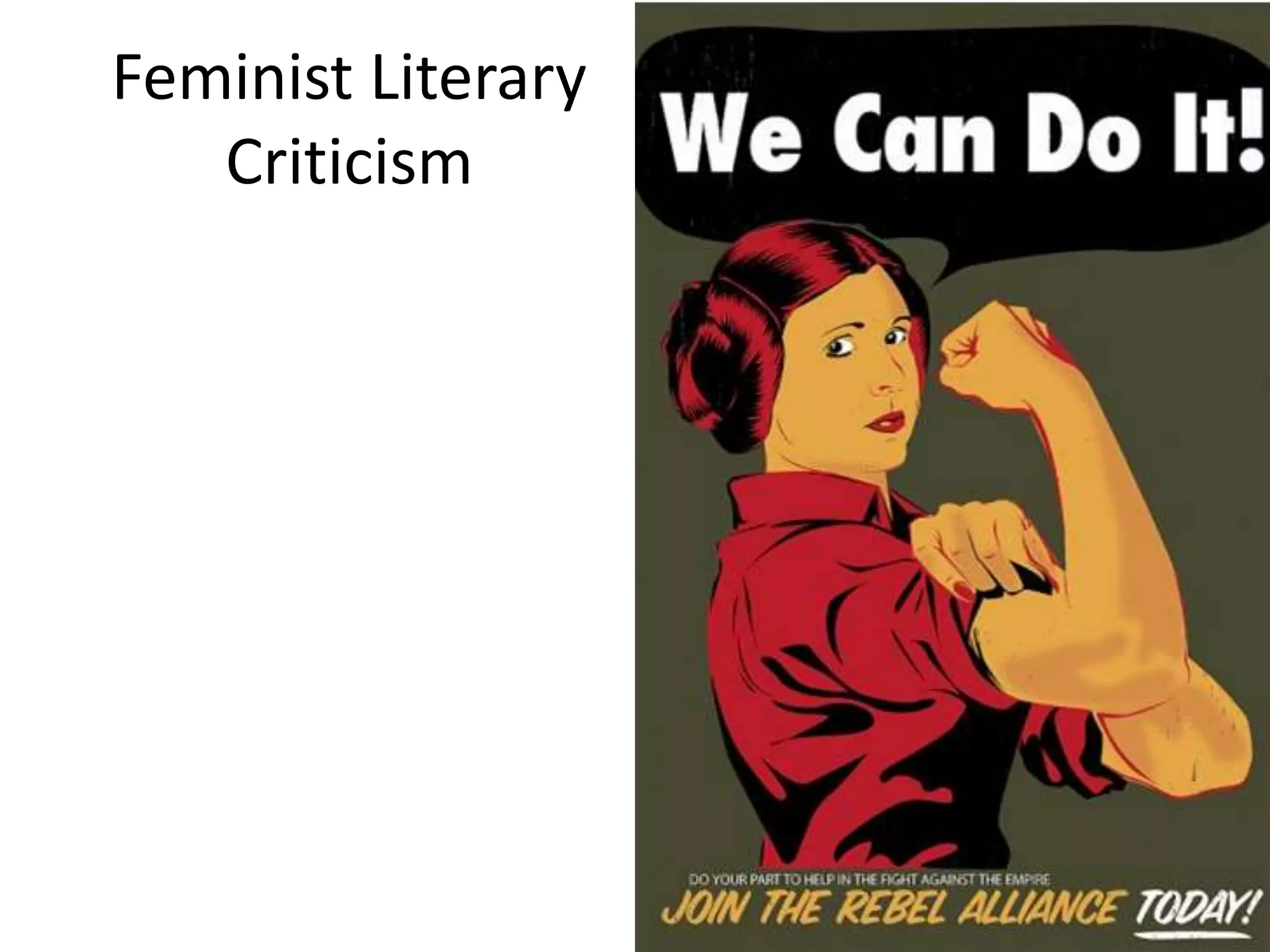
Feminist Literary
Criticism
History
• Launched in the twentieth century with
Virginia Woolf’s A Room of One’s Own
(1929)
• 1969 Kate Millett examined how women are
represented in text by famous men in Sexual
Politics
Basic ideas
Though a number of different approaches exist in feminist
criticism, there exist some areas of commonality.:
• Women are oppressed by patriarchy
economically, politically, socially, and psychologically;
patriarchal ideology is the primary means by which they
are kept so
• In every domain where patriarchy reigns, woman is other:
she is marginalized, defined only by her difference from
male norms and values
• All of western (Anglo-European) civilization is deeply rooted
in patriarchal ideology, for example, in the biblical portrayal
of Eve as the origin of sin and death in the world
Basic Ideas
• While biology determines our sex (male or
female), culture determines our gender
(masculine or feminine)
• All feminist activity, including feminist theory and
literary criticism, has as its ultimate goal to
change the world by prompting gender equality
• Gender issues play a part in every aspect of
human production and experience, including the
production and experience of literature, whether
we are consciously aware of these issues or not.
Feminist critics examine
• How women write their own experiences and
representations
• How women read about themselves
• How to make feminist readings visible to
readers
• How women writers have fared in given eras
• How traditional texts by women are
subversive of the social order
Key terms
• Ideology: dominant values, beliefs, ways of
thinking through which a culture understands
reality
• Patriarchy: male dominated power structures
• Misogyny=hatred of women
• Misandry=hatred of men
• The Other: Woman has often been
categorized as being “other”
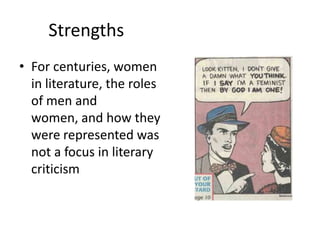
Strengths
• For centuries, women
in literature, the roles
of men and
women, and how they
were represented was
not a focus in literary
criticism
Weaknesses
•If this is the only
theory applied to a
text, it can be very
limiting

Feminist literary criticism

  • 1.
  • 2.
    History • Launched inthe twentieth century with Virginia Woolf’s A Room of One’s Own (1929) • 1969 Kate Millett examined how women are represented in text by famous men in Sexual Politics
  • 3.
    Basic ideas Though anumber of different approaches exist in feminist criticism, there exist some areas of commonality.: • Women are oppressed by patriarchy economically, politically, socially, and psychologically; patriarchal ideology is the primary means by which they are kept so • In every domain where patriarchy reigns, woman is other: she is marginalized, defined only by her difference from male norms and values • All of western (Anglo-European) civilization is deeply rooted in patriarchal ideology, for example, in the biblical portrayal of Eve as the origin of sin and death in the world
  • 4.
    Basic Ideas • Whilebiology determines our sex (male or female), culture determines our gender (masculine or feminine) • All feminist activity, including feminist theory and literary criticism, has as its ultimate goal to change the world by prompting gender equality • Gender issues play a part in every aspect of human production and experience, including the production and experience of literature, whether we are consciously aware of these issues or not.
  • 5.
    Feminist critics examine •How women write their own experiences and representations • How women read about themselves • How to make feminist readings visible to readers • How women writers have fared in given eras • How traditional texts by women are subversive of the social order
  • 6.
    Key terms • Ideology:dominant values, beliefs, ways of thinking through which a culture understands reality • Patriarchy: male dominated power structures • Misogyny=hatred of women • Misandry=hatred of men • The Other: Woman has often been categorized as being “other”
  • 7.
    Strengths • For centuries,women in literature, the roles of men and women, and how they were represented was not a focus in literary criticism
  • 8.
    Weaknesses •If this isthe only theory applied to a text, it can be very limiting