

a late 20th century style and concepts in
the arts, architecture and criticism that
represents a departure from modernism
and has its heart a general distrust of
grand theories and ideologies as well as a
problematical relationship with any notion
of “art”


Postmodernism means a number of trends or
movements in the arts and literature developing in
the 1970s in reaction to or rejection of the dogma
principles or practices of established modernism,
especially a movement in architecture and
influence of the International Style and encouraging
the use of elements from historical informal styles
and often playful illusion, decoration and
complexity.




The term was first used around the 1870s in
various areas. For example, John Watkins Chapman
avowed “ a Postmodern style of painting” to get
beyond French Impressionism. Then J. M. Thompson,
in his 1914s article in The Hibbert Journal used the
term Postmodernism to describe changes in attitudes
and beliefs in the critique of religion.

The term was then applied to a whole host of
movements, many is art, music and literature, that
reacted against a range of tendencies in the
imperialist phase of capitalism called “modernism”,
and are typically marked by revival of historical
elements and techniques.




Postmodern literature is literature
characterized by heavy reliance on techniques
like fragmentation, paradox and questionable
narrators, and is often defined as a style or
trend which emerged in the post World War II
era.
Postmodern works are seen as a reaction
against Enlightenment thinking and Modernist
approaches to literature.








Irony, playfulness and black humor
Pastiche
Intertextuality
Metaficion
Historiographic metafiction
Temporal distortion









Technoculture and hipperreality
Paranoia
Maximalism
Minimalism
Faction
Magical realism
Participation
Modernism







Began in the 1890 until
1945.
Modernism was based
on using rational, logical
means to gain
knowledge.
It was characterized by a
hierarchical and
organized and
determinate nature of
knowledge.
Modernist approach was
objective, theoretical and
analytic.

Postmodernism







Began after world War II.
Postmodernism denied
the application of logical
thinking.
It was based on an
anarchical, non-totalized
and indeterminate state
of knowledge.
Postmodernism approach
was based on
subjectivity.
Modernism







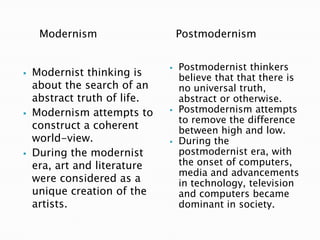
Modernist thinking is
about the search of an
abstract truth of life.
Modernism attempts to
construct a coherent
world-view.
During the modernist
era, art and literature
were considered as a
unique creation of the
artists.

Postmodernism






Postmodernist thinkers
believe that that there is
no universal truth,
abstract or otherwise.
Postmodernism attempts
to remove the difference
between high and low.
During the
postmodernist era, with
the onset of computers,
media and advancements
in technology, television
and computers became
dominant in society.


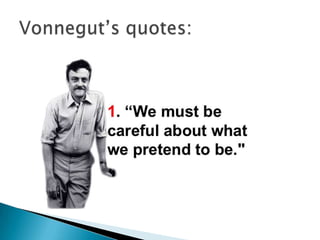
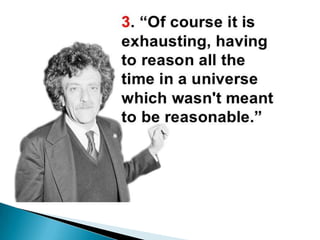
Born in Indianapolis Indiana United States,
in November 11,1922, died April 11, 2007.



Kurt’s family was hit very hard by the
depression.





He unrolled at Cornell University in 1940
and, under the pressure of his father and
his older brother he studied chemistry and
biology.
He enlisted in the U.S army in 1943.








His mother killed herself by overdosing on
sleeping pills in May 1944.
On December 14,1944, Vonnegut was
captured in the Battle of the Bulge. He was
held as a POW in Dresden.
Vonnegut was one of the very few survivors.
May 1945. He returned to the United States
And married Jane Marie Cox, his high school
girlfriend.
Samuel Beckett
Molloy, Malone Dies,
The Unnamable
Kurt Vonnegut
Slaughterhouse
Five
Mark Z. Danieleweski
House of Leaves
Breakfast of Champions
Kurt Vonnegut
Jorge Luis Borges
Labyrinths
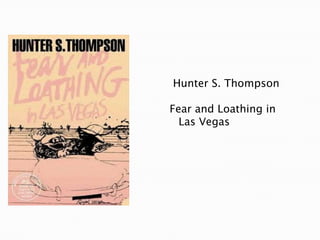
Hunter S. Thompson

Fear and Loathing in
Las Vegas
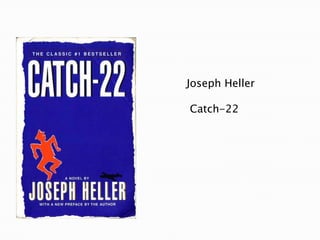
Joseph Heller

Catch-22
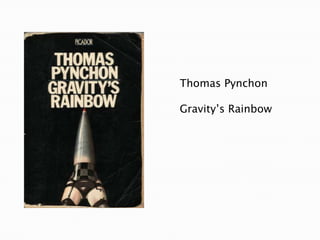
Thomas Pynchon

Gravity’s Rainbow
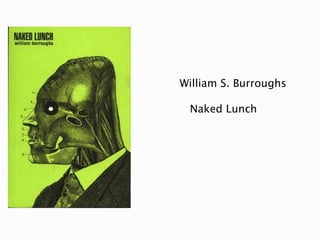
William S. Burroughs

Naked Lunch
David Foster Wallace

Infinite Jest
Bret Easton Ellis

American Psycho

Postmodernism

  • 2.
     a late 20thcentury style and concepts in the arts, architecture and criticism that represents a departure from modernism and has its heart a general distrust of grand theories and ideologies as well as a problematical relationship with any notion of “art”
  • 3.
     Postmodernism means anumber of trends or movements in the arts and literature developing in the 1970s in reaction to or rejection of the dogma principles or practices of established modernism, especially a movement in architecture and influence of the International Style and encouraging the use of elements from historical informal styles and often playful illusion, decoration and complexity.
  • 4.
      The term wasfirst used around the 1870s in various areas. For example, John Watkins Chapman avowed “ a Postmodern style of painting” to get beyond French Impressionism. Then J. M. Thompson, in his 1914s article in The Hibbert Journal used the term Postmodernism to describe changes in attitudes and beliefs in the critique of religion. The term was then applied to a whole host of movements, many is art, music and literature, that reacted against a range of tendencies in the imperialist phase of capitalism called “modernism”, and are typically marked by revival of historical elements and techniques.
  • 5.
      Postmodern literature isliterature characterized by heavy reliance on techniques like fragmentation, paradox and questionable narrators, and is often defined as a style or trend which emerged in the post World War II era. Postmodern works are seen as a reaction against Enlightenment thinking and Modernist approaches to literature.
  • 6.
          Irony, playfulness andblack humor Pastiche Intertextuality Metaficion Historiographic metafiction Temporal distortion
  • 7.
  • 8.
    Modernism     Began in the1890 until 1945. Modernism was based on using rational, logical means to gain knowledge. It was characterized by a hierarchical and organized and determinate nature of knowledge. Modernist approach was objective, theoretical and analytic. Postmodernism     Began after world War II. Postmodernism denied the application of logical thinking. It was based on an anarchical, non-totalized and indeterminate state of knowledge. Postmodernism approach was based on subjectivity.
  • 9.
    Modernism    Modernist thinking is aboutthe search of an abstract truth of life. Modernism attempts to construct a coherent world-view. During the modernist era, art and literature were considered as a unique creation of the artists. Postmodernism    Postmodernist thinkers believe that that there is no universal truth, abstract or otherwise. Postmodernism attempts to remove the difference between high and low. During the postmodernist era, with the onset of computers, media and advancements in technology, television and computers became dominant in society.
  • 11.
     Born in IndianapolisIndiana United States, in November 11,1922, died April 11, 2007.  Kurt’s family was hit very hard by the depression.   He unrolled at Cornell University in 1940 and, under the pressure of his father and his older brother he studied chemistry and biology. He enlisted in the U.S army in 1943.
  • 12.
        His mother killedherself by overdosing on sleeping pills in May 1944. On December 14,1944, Vonnegut was captured in the Battle of the Bulge. He was held as a POW in Dresden. Vonnegut was one of the very few survivors. May 1945. He returned to the United States And married Jane Marie Cox, his high school girlfriend.
  • 16.
    Samuel Beckett Molloy, MaloneDies, The Unnamable
  • 17.
  • 18.
  • 19.
  • 20.
  • 21.
    Hunter S. Thompson Fearand Loathing in Las Vegas
  • 22.
  • 23.
  • 24.
  • 25.
  • 26.