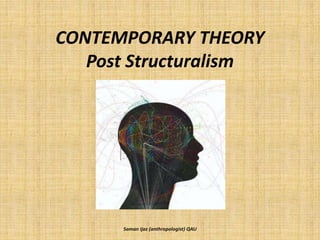
CONTEMPORARY THEORY
Post Structuralism
Saman Ijaz (anthropologist) QAU
Post Structuralism
Introduction
• Structuralism was an intellectual movement in 1950’s and 1960’s.
• Structuralist believes in universal truth. They emphasize logical and
scientific nature of its results. Considered descriptive of present.
• Post Structuralism emerged in France during 1960’s as a movement
critiquing structuralism. P.S. is grounded in the concept of over
determinism.
“Theory is not separate from reality nor reality is separate”
from theory.” PS doubt about the existence of concrete reality. Ideas,
reality depend upon constructed discourse.
Saman Ijaz (anthropologist) QAU
Post Structuralism
• PS reject the notion of single truth. And criticize grand theories that claim
to uncover truth including religion, social science and realism.
• PS are not relativist but they argued that “If universal truth exist, is
UNKOWABLE” because of multiple truth and meanings.
• We live in a de-centered world but do not, cannot know where we are. We
say what it relates to us not to all.
• PS accept the structuralist idea of universals in human thought as
expressed on cultural phenomenon through binary opposition and
subsequently applied as power and relationships that are created in
presence of polarizing forces. PS Cultural phenomenon are fluid and flux.
Saman Ijaz (anthropologist) QAU
Post Structuralism
• PS emphasize the role of knowledge in achieving and sustaining
power. Knowledge is always centered contextual, partial and
fragmentary but is never neural.
• For PS to understand an object it is necessary to understand the
system of knowledge that produced the object. PS emphasize
history (diachronic) to analyze the descriptive(synchronous)
concepts.
• PS as an anthropological theory: Interpret ways through which
power is expressed in societies and culture by central on the notion
that power is relational and thus act as economic agent. They were
interested in economic, social and political aspects of power.
Saman Ijaz (anthropologist) QAU
Post Structuralism
• Social institutions are nothing but texts and
language. High level language (created by
western/dominant class): Low level language,
Primary meanings (Black is a colour): secondary
meanings (sign of sadness, rebellions, etc).
• Power is embedded in language. Language create
discrepancy, certain order.
Saman Ijaz (anthropologist) QAU
Post Structuralism
• Major Work:
Michel Faucault (1926-1984)
Jacques Derrida (1930-2004)
Roland Barthes (1915-1980)
Jean Baudrillard (1929-2007)
Saman Ijaz (anthropologist) QAU
Jacques Derrida
• Jacques Derrida: was a French, Jewish philosopher from Algeria.
• He Developed a critical theory called “Deconstruction Theory” that is
associated with PS.
• He is responsible for more than 40 published books as well as many
articles and speeches.
• He is known as the most difficult philosopher of the 20th century.
• Derrida is known as the father of deconstruction.
• He attacks upon the values of reason.
BOOK→ Grammatology: The scientific study of system.
• Idea behind the deconstruction is to deconstruct the working of strong
nation-states with power full immigration policies etc.
Saman Ijaz (anthropologist) QAU
Jacques Derrida
• Influenced by Heidgger and Nietzsche Derrida accept
the Saussua idea that meaning lies in difference but
add idea that meaning also differ.
“There is nothing outside of the text”
LOGOCENTRICISM
• Knowledge is presented by Western people considered
as universal knowledge. They produced the idea this
one is beautiful this one is standard. Writer is of the
view it is not universal one.
Saman Ijaz (anthropologist) QAU
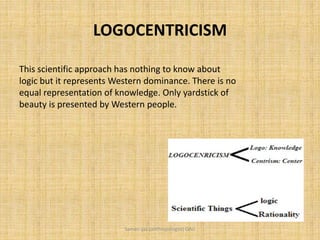
LOGOCENTRICISM
This scientific approach has nothing to know about
logic but it represents Western dominance. There is no
equal representation of knowledge. Only yardstick of
beauty is presented by Western people.
Saman Ijaz (anthropologist) QAU
LOGOCENTRICISM
• Why people accept Logo centrism? It is so called reality,
their knowledge is based on logic, this is only ultimate
knowledge.
• Who will define what is reason, logic?
• Western people define it and said their knowledge is
universal one. While reason is power of your mind to think
on a logical way and in every society pattern of reason is
different. So this rationality is also western dominance.
Derrida challenged that reason, there is no universal
reason. We should not follow intellectual authority as
purpose of these authorities is to access to power,
resources and dominance over others.
Saman Ijaz (anthropologist) QAU
LOGOCENTRICISM
• Derrida is of the view that text is unstable. Meanings we attach with
it is also changeable. Basic purpose is to understand the text
internal meanings. Every meaning has a stratagem due to
suppression and repression. Rationality, reason all should be
destroyed then we will come to know the HIERARCHY. Power is
used here, you intentionally suppress people thinking. They did not
allow people to think outside of the box.
• Text contains several facts and contradictory meanings. Through
deconstruction we can brought meaning to the texts. There is
repression and suppression of idea of people. A person cannot
think outside box that is why paradigm bind him to remain in it.
Writer is of the view once we deconstruct the text we will come to
know the discrepancy. Inside every txt there is a mystery we need
to understand it.
Saman Ijaz (anthropologist) QAU
DECONSTRUCTION
• All cultures are constructs of autonomous self contain words of
meanings. Derrida object on ethnographic research. They always
destroy natives understanding of people by his way of conveying
meanings. It is not humanly possible to explain one cultural
language into other. Derrida is of the view the time you take to
explain in this destroy language.
• He talks about the “THEATER OF CRUELITY”: Writer control whole
drama. He is dictator at the same time shows his ideas like actor act
e.g. hero, director handle it: same is the case in society. Society
should be liberated from these intellectuals. The only way to
liberate you that everyone should be a writer. Every one of us
should be a free thinker. There should not only deconstruction
there should also De-Centrism.
Saman Ijaz (anthropologist) QAU
DE-CENTRISM
• Derrida is of the view that more authority should be
given to actor. Text is actor, let text decide the
meaning. Everyone is open, “Self Reflexivity” is a
process of knowledge creation. Once you have gone
through reflexivity you are free.
• You need certain consciousness, a certain state of
mind. You will then understand how to create
knowledge through writing. There is no future create
your future through writing. Study individual in action,
different things for different people.
Saman Ijaz (anthropologist) QAU
Criticism
• Derrida did not provide any clear direction as
he only focuses on to destroy everything. If
everyone becomes a writer then it can create
more ambiguity in understanding reality, more
ambiguity expected through this.
Saman Ijaz (anthropologist) QAU
Michel Foucault
Post Structuralist
Saman Ijaz (anthropologist) QAU
Basic Intro..
• French Philosopher (1926-1984)
• Studied history, psychology, politics, literature
• He belongs to a rich family
• At age of 20, suffered from depression- which
was due to repressed emotions
• He die due to AIDS
• He was homosexual
Saman Ijaz (anthropologist) QAU
Main Books
• Madness and Civilization (1961)
• Discipline and punishment (1975)
• Archeology of Knowledge (1969)
He disagree s structuralists and said
• No definite structures exists
• Its impossible to survey situation objectively
rather subjectivity always influences
Saman Ijaz (anthropologist) QAU
• He borrowed Saussure concept parole and
langue and call discourse as parole because its
keep on changing
• He said, Discourse should be superior on
cultural grammar
• Social structures never remain same neither
culturally agreed by all
Saman Ijaz (anthropologist) QAU
Foucault on Discourse..
• In Linguistics, Discourse is continuous speech but
according to Foucault discourse is the body of
knowledge used in service of power
• Discourse contain all traditions, norms, values,
text, symbols, words, expressions where
hierarchical power relations are found
• It is the discourse which determines context
(place of subject)
• Production of knowledge/discourse is always
limited or controlled and only socio-political
sanctioned discourse emerges
Saman Ijaz (anthropologist) QAU
• He explains three factors which limit the
expansion of discourse
1. Taboo
2. Madness
3. Institutional Ratification
Saman Ijaz (anthropologist) QAU
Taboo
• Taboo s are banned or unacceptable topics
which are socially looked down e.g. woman
sexuality, incest, homosexuality
• So people don’t talk about such topics
generally so no discourse found- limiting
discourse to spread
Saman Ijaz (anthropologist) QAU
Madness
• Mad people cannot produce discourse and no
one accept their knowledge because its
always irrational
• For example, “Elephants are flying in the air”
such statement has no logic so nobody will
accept this discourse
• The concept of maddness differs from one
society to another but still general idea is
same
Saman Ijaz (anthropologist) QAU
Institutional Ratification
• Different institutions produce discourse like
schools, universities, labs, news agencies, media
etc
• Such institutions regulate knowledge production
and consumption
• For example, “Sun revolves around earth” until
institutions don't ratify or approve above
statement , no one will believe it
• Such discourse is always kept in control which is
harmful for existing power structure
Saman Ijaz (anthropologist) QAU
Shift of Discourse Paradigm
• Knowledge structure keeps on changing with the passage of time
• For example, the concept of homosexuals emerged in 19C.
• Three type of discourses were produce to define the subject(
homosexual) which were
1. Medical ( sick and abnormal)
2. Legal (Illegal)
3. Moral (Immoral and punishable)
• So people were positioned as sick, illegal and should be
punished.
• But in today's era, some of western countries have legalized the
homosexuality so discourse keeps on changing
Saman Ijaz (anthropologist) QAU
The subjective self
• Foucault said, “ we think that we are free agents
but we are historically produced.”
• We have positioned ourselves to pre defined
conceptual map, creating our identities
• For example, for Sara a good woman is the one
who has freedom of action but conceptual map(
dominant discourse) says that good woman is the
one who is well mannered. So Sara rejects her
own concept of independent woman and accepts
the dominant knowledge
Saman Ijaz (anthropologist) QAU
Panopticism
• We have stored self surveillance in our sub conscious and
constantly observing ourselves
• Foucault borrowed concept of Panopticon from benthem
model
• Panopticon is a long watch tower in the centre of prison
from where the prisoners actions were controlled
• No physical force being used rather the fear of observation
was internalized
• Foucault said, “Liberal societies doesn’t need chains to
force people to do something rather panopticon fulfills this
duty.”
• In modern world, best example is social media
Saman Ijaz (anthropologist) QAU
Structuralism Vs Post Structuralism
• Structuralism • Post Structuralism
1. Meaning is stable,
constituted through
under lying structure or
system
2. There is single truth or
meaning
3. There is objective reality
4. They search for
universal truths and
rules that govern
meaning
1. Meaning is not stable,
dependent on interpreter
rather than structure
2. There are multiple truths
and meanings
3. The only reality is
constituted through
language in our minds
4. They are interested in
differences in truth rather
than universal truth
Saman Ijaz (anthropologist) QAU
1. Meaning is not stable,
dependent on interpreter
rather than structure
2. There are multiple truths
and meanings
3. The only reality is
constituted through
language in our minds
4. They are interested in
differences in truth rather
than universal truth
• Focuses more on
speaker/reader operating
within structure
• Recognize the power of
under lying structures to
determine meanings
• Allows individuals to move
within the limits of meaning
Saman Ijaz (anthropologist) QAU
Criticism
• Post structuralism was a controversy, many writers
questioned the legitimacy of this theory.
• Norman Holland argues that post structuslist theory was
flawed due to relying on saussarian model(parole/langue)
which was soon challenged and abandoned by linguistics.
• Derrida talked about deconstructing everything but after
deconstruction what's next, no direction been given.
• As they talked about multiple interpretations and if there
will be multiple meanings then who will decide that which
one is right and which one is wrong.
• Derrida s writings were very hard to understand so mostly
were tough.
Saman Ijaz (anthropologist) QAU
Jean Baudrillard
• He was post structuralist and post modernist.
He discussed language theory of institution
and history as well , he borrowed the idea of
semiotic by Ferdinand de Saussure a linguistic
Saman Ijaz (anthropologist) QAU
• Sign : is anything which is interpreted and have
meaning other than its own meaning we can not
study sign in isolation , but as system in reference
to other sign. Example apple fruit and apple i-
phone it has two sign red or green and juicy and
eatable object grew in trees.
• Example of blue movie. Sign can be interpreted in
many ways sign in isolation get no meaning.
• The reality of society is comprised of sign
popularized by media , technology, fashion
industry and capitalist system.
Saman Ijaz (anthropologist) QAU
• Jean Baudrillard sees fashion as the
absorption of past sign the same way
machines absorb past labor, fashion is more
beautiful, than the beautiful and true than the
true as , a result they are fascinating.
• The media has a special place in the
implosion of meaning.
Saman Ijaz (anthropologist) QAU
• According to a saying: getting information from the
internet is like taking a drink from fire hydrant for
baudrillard , this leads to the destruction of social life.
Media has an ideological affect knowledge of the event
as an aspect of life is prevented creating an
atmosphere of stupidity by mean tv shows from action
films , crime dreams , documentaries camera reality
shows like karton CID , Big Boss , desi kuryan etc
through media we can not reach the real event, but
endless interpretations. Every file of information and
every bit of knowledge required a conversation
medium can be transmitting without changing it to
control people.
Saman Ijaz (anthropologist) QAU
• The such sing to construct reality, the reality is something that can
be copied situation in which a condition is created artificially to
express reality e.g of face book , if reality is what we smell, see ,
taste and touch than reality is electric signal of computer. We are
receiving that which is coming from society. We create artificial
reality for example media tell us how to think, what to think, what
to buy and purchase, what wear, what to eat, what to love and how
to love media create artificial condition and use certain reality
which does not exist in reality. Example beauty cream , hair
shampoos , conditioner, ” Duvet” a brand of blanket , wearing
branded suits khaadi , safina , Rolex nestle product etc .are not
biological need or god given institutions but these are constructed
needs. Previously fatty people were more desirable but media
changed it and now skinny people are consider as more beautiful.
Saman Ijaz (anthropologist) QAU
ECSTASY
• A state of emotion so intense that one is carried
beyond rational thought and self-control.
• e.g Afia Saddique is presented as innocent
daughter of east by media and America is
responsible for all problems , crime and
terrorism. Major Aziz bhatti and all other men did
not receive the award of bravery by genuine
reason but due to favor. General yahya awarded
the Rashid Minhas the award of bravery during
that ceremony he was totally drunk and urinated
in his part.
Saman Ijaz (anthropologist) QAU
• Video games provide us comfort and illusion of achievement that
relatives or friends fail to provide that satisfaction , the reality is
presented in more fascinated way it become more reality. Today
physical presence of people is not required need are not born but
created one .
• We assign four value to any object
1. functional value: what functions an object perform
2. symbolic value: what sign which depict particular relation with
other person. Finger ring relates to engagement or person is
committed.
3. exchange value: its also called economic value can be change
with other value one thing that can exchange with other thing
laptop is equal to may cell phones
4. sign value: it symbolize one status , taste , prestige and social class
there is no reality we are by product of obsession
Saman Ijaz (anthropologist) QAU
JEAN FRANCOIS LYORD
• He was French scholar and was interested in meaning and sign his approach was
semiotic (science of sign ). sign is any thing which can be interpreted the meaning
other than sign, for example chair (he is hungry for chair) there is always
secondary meaning along with primary meaning we can not understand sign in
isolation rather than we can understand sign in systematic way . one sign is in
relationship with other sign , sign is social phenomena.
• SIGN OF MEANING
• Apple green red interpretation of sign is different from person to person. Sign
happen incidentally in our day to day conversation, he was of view that we are
losing thousands of meaning in our day to day to conversation meaning can be
achieved because is discussion no one know actual meaning this basic difference
between post structuralist and post modernist that structuralist say that meaning
is achieved through certain consciousness . reality of society is comprised of these
sign and these signs are popularized by media , fashion designer and capitalist. All
sign are gadget of knowledge and everyone requires a certain medium to convey
the information the information can not be transmitted without changing. He was
of view that reality can be anything which can be copied its artificial created,
reality is copied phenomena.
Saman Ijaz (anthropologist) QAU
• SIMULATION
It’s a situation in that particular set of condition experience
something which exist in reality
• SIMULTRA
There is no reality in human mind its generated through artificial
situation by society but not the reality. Media tell us how to behave
think and even what to think. All thing are artificially created by
media. For example media though advertisement tells to use the
branded clothes like khadi gul ahmed etc they always attract you
towards these things through sign for example Duvet is most
famous brand of blanket. People give value to this brand because
the sign of standard is attached with it otherwise no special
functionality.
Saman Ijaz (anthropologist) QAU
• ASTHETIC SIGN
It is knowledge, which signifies the value of brand to
you through the media, men is manipulated by other
factors because our self is by product of fashion
designer. Media or we given sign to objects we
artificially create the reality which is more real than the
reality and that is hyper reality and that hyper reality
always attract us just like we are living in a real world
but always attract toward jannat hoors and wine.
Fantasy and fear Disney land artificial image jannat
mentioned in bible people are more attract to it .
Saman Ijaz (anthropologist) QAU

Post Structuralism (Derrida, Foucault, Jean)

  • 1.
  • 2.
    Post Structuralism Introduction • Structuralismwas an intellectual movement in 1950’s and 1960’s. • Structuralist believes in universal truth. They emphasize logical and scientific nature of its results. Considered descriptive of present. • Post Structuralism emerged in France during 1960’s as a movement critiquing structuralism. P.S. is grounded in the concept of over determinism. “Theory is not separate from reality nor reality is separate” from theory.” PS doubt about the existence of concrete reality. Ideas, reality depend upon constructed discourse. Saman Ijaz (anthropologist) QAU
  • 3.
    Post Structuralism • PSreject the notion of single truth. And criticize grand theories that claim to uncover truth including religion, social science and realism. • PS are not relativist but they argued that “If universal truth exist, is UNKOWABLE” because of multiple truth and meanings. • We live in a de-centered world but do not, cannot know where we are. We say what it relates to us not to all. • PS accept the structuralist idea of universals in human thought as expressed on cultural phenomenon through binary opposition and subsequently applied as power and relationships that are created in presence of polarizing forces. PS Cultural phenomenon are fluid and flux. Saman Ijaz (anthropologist) QAU
  • 4.
    Post Structuralism • PSemphasize the role of knowledge in achieving and sustaining power. Knowledge is always centered contextual, partial and fragmentary but is never neural. • For PS to understand an object it is necessary to understand the system of knowledge that produced the object. PS emphasize history (diachronic) to analyze the descriptive(synchronous) concepts. • PS as an anthropological theory: Interpret ways through which power is expressed in societies and culture by central on the notion that power is relational and thus act as economic agent. They were interested in economic, social and political aspects of power. Saman Ijaz (anthropologist) QAU
  • 5.
    Post Structuralism • Socialinstitutions are nothing but texts and language. High level language (created by western/dominant class): Low level language, Primary meanings (Black is a colour): secondary meanings (sign of sadness, rebellions, etc). • Power is embedded in language. Language create discrepancy, certain order. Saman Ijaz (anthropologist) QAU
  • 6.
    Post Structuralism • MajorWork: Michel Faucault (1926-1984) Jacques Derrida (1930-2004) Roland Barthes (1915-1980) Jean Baudrillard (1929-2007) Saman Ijaz (anthropologist) QAU
  • 7.
    Jacques Derrida • JacquesDerrida: was a French, Jewish philosopher from Algeria. • He Developed a critical theory called “Deconstruction Theory” that is associated with PS. • He is responsible for more than 40 published books as well as many articles and speeches. • He is known as the most difficult philosopher of the 20th century. • Derrida is known as the father of deconstruction. • He attacks upon the values of reason. BOOK→ Grammatology: The scientific study of system. • Idea behind the deconstruction is to deconstruct the working of strong nation-states with power full immigration policies etc. Saman Ijaz (anthropologist) QAU
  • 8.
    Jacques Derrida • Influencedby Heidgger and Nietzsche Derrida accept the Saussua idea that meaning lies in difference but add idea that meaning also differ. “There is nothing outside of the text” LOGOCENTRICISM • Knowledge is presented by Western people considered as universal knowledge. They produced the idea this one is beautiful this one is standard. Writer is of the view it is not universal one. Saman Ijaz (anthropologist) QAU
  • 9.
    LOGOCENTRICISM This scientific approachhas nothing to know about logic but it represents Western dominance. There is no equal representation of knowledge. Only yardstick of beauty is presented by Western people. Saman Ijaz (anthropologist) QAU
  • 10.
    LOGOCENTRICISM • Why peopleaccept Logo centrism? It is so called reality, their knowledge is based on logic, this is only ultimate knowledge. • Who will define what is reason, logic? • Western people define it and said their knowledge is universal one. While reason is power of your mind to think on a logical way and in every society pattern of reason is different. So this rationality is also western dominance. Derrida challenged that reason, there is no universal reason. We should not follow intellectual authority as purpose of these authorities is to access to power, resources and dominance over others. Saman Ijaz (anthropologist) QAU
  • 11.
    LOGOCENTRICISM • Derrida isof the view that text is unstable. Meanings we attach with it is also changeable. Basic purpose is to understand the text internal meanings. Every meaning has a stratagem due to suppression and repression. Rationality, reason all should be destroyed then we will come to know the HIERARCHY. Power is used here, you intentionally suppress people thinking. They did not allow people to think outside of the box. • Text contains several facts and contradictory meanings. Through deconstruction we can brought meaning to the texts. There is repression and suppression of idea of people. A person cannot think outside box that is why paradigm bind him to remain in it. Writer is of the view once we deconstruct the text we will come to know the discrepancy. Inside every txt there is a mystery we need to understand it. Saman Ijaz (anthropologist) QAU
  • 12.
    DECONSTRUCTION • All culturesare constructs of autonomous self contain words of meanings. Derrida object on ethnographic research. They always destroy natives understanding of people by his way of conveying meanings. It is not humanly possible to explain one cultural language into other. Derrida is of the view the time you take to explain in this destroy language. • He talks about the “THEATER OF CRUELITY”: Writer control whole drama. He is dictator at the same time shows his ideas like actor act e.g. hero, director handle it: same is the case in society. Society should be liberated from these intellectuals. The only way to liberate you that everyone should be a writer. Every one of us should be a free thinker. There should not only deconstruction there should also De-Centrism. Saman Ijaz (anthropologist) QAU
  • 13.
    DE-CENTRISM • Derrida isof the view that more authority should be given to actor. Text is actor, let text decide the meaning. Everyone is open, “Self Reflexivity” is a process of knowledge creation. Once you have gone through reflexivity you are free. • You need certain consciousness, a certain state of mind. You will then understand how to create knowledge through writing. There is no future create your future through writing. Study individual in action, different things for different people. Saman Ijaz (anthropologist) QAU
  • 14.
    Criticism • Derrida didnot provide any clear direction as he only focuses on to destroy everything. If everyone becomes a writer then it can create more ambiguity in understanding reality, more ambiguity expected through this. Saman Ijaz (anthropologist) QAU
  • 15.
  • 16.
    Basic Intro.. • FrenchPhilosopher (1926-1984) • Studied history, psychology, politics, literature • He belongs to a rich family • At age of 20, suffered from depression- which was due to repressed emotions • He die due to AIDS • He was homosexual Saman Ijaz (anthropologist) QAU
  • 17.
    Main Books • Madnessand Civilization (1961) • Discipline and punishment (1975) • Archeology of Knowledge (1969) He disagree s structuralists and said • No definite structures exists • Its impossible to survey situation objectively rather subjectivity always influences Saman Ijaz (anthropologist) QAU
  • 18.
    • He borrowedSaussure concept parole and langue and call discourse as parole because its keep on changing • He said, Discourse should be superior on cultural grammar • Social structures never remain same neither culturally agreed by all Saman Ijaz (anthropologist) QAU
  • 19.
    Foucault on Discourse.. •In Linguistics, Discourse is continuous speech but according to Foucault discourse is the body of knowledge used in service of power • Discourse contain all traditions, norms, values, text, symbols, words, expressions where hierarchical power relations are found • It is the discourse which determines context (place of subject) • Production of knowledge/discourse is always limited or controlled and only socio-political sanctioned discourse emerges Saman Ijaz (anthropologist) QAU
  • 20.
    • He explainsthree factors which limit the expansion of discourse 1. Taboo 2. Madness 3. Institutional Ratification Saman Ijaz (anthropologist) QAU
  • 21.
    Taboo • Taboo sare banned or unacceptable topics which are socially looked down e.g. woman sexuality, incest, homosexuality • So people don’t talk about such topics generally so no discourse found- limiting discourse to spread Saman Ijaz (anthropologist) QAU
  • 22.
    Madness • Mad peoplecannot produce discourse and no one accept their knowledge because its always irrational • For example, “Elephants are flying in the air” such statement has no logic so nobody will accept this discourse • The concept of maddness differs from one society to another but still general idea is same Saman Ijaz (anthropologist) QAU
  • 23.
    Institutional Ratification • Differentinstitutions produce discourse like schools, universities, labs, news agencies, media etc • Such institutions regulate knowledge production and consumption • For example, “Sun revolves around earth” until institutions don't ratify or approve above statement , no one will believe it • Such discourse is always kept in control which is harmful for existing power structure Saman Ijaz (anthropologist) QAU
  • 24.
    Shift of DiscourseParadigm • Knowledge structure keeps on changing with the passage of time • For example, the concept of homosexuals emerged in 19C. • Three type of discourses were produce to define the subject( homosexual) which were 1. Medical ( sick and abnormal) 2. Legal (Illegal) 3. Moral (Immoral and punishable) • So people were positioned as sick, illegal and should be punished. • But in today's era, some of western countries have legalized the homosexuality so discourse keeps on changing Saman Ijaz (anthropologist) QAU
  • 25.
    The subjective self •Foucault said, “ we think that we are free agents but we are historically produced.” • We have positioned ourselves to pre defined conceptual map, creating our identities • For example, for Sara a good woman is the one who has freedom of action but conceptual map( dominant discourse) says that good woman is the one who is well mannered. So Sara rejects her own concept of independent woman and accepts the dominant knowledge Saman Ijaz (anthropologist) QAU
  • 26.
    Panopticism • We havestored self surveillance in our sub conscious and constantly observing ourselves • Foucault borrowed concept of Panopticon from benthem model • Panopticon is a long watch tower in the centre of prison from where the prisoners actions were controlled • No physical force being used rather the fear of observation was internalized • Foucault said, “Liberal societies doesn’t need chains to force people to do something rather panopticon fulfills this duty.” • In modern world, best example is social media Saman Ijaz (anthropologist) QAU
  • 27.
    Structuralism Vs PostStructuralism • Structuralism • Post Structuralism 1. Meaning is stable, constituted through under lying structure or system 2. There is single truth or meaning 3. There is objective reality 4. They search for universal truths and rules that govern meaning 1. Meaning is not stable, dependent on interpreter rather than structure 2. There are multiple truths and meanings 3. The only reality is constituted through language in our minds 4. They are interested in differences in truth rather than universal truth Saman Ijaz (anthropologist) QAU
  • 28.
    1. Meaning isnot stable, dependent on interpreter rather than structure 2. There are multiple truths and meanings 3. The only reality is constituted through language in our minds 4. They are interested in differences in truth rather than universal truth • Focuses more on speaker/reader operating within structure • Recognize the power of under lying structures to determine meanings • Allows individuals to move within the limits of meaning Saman Ijaz (anthropologist) QAU
  • 29.
    Criticism • Post structuralismwas a controversy, many writers questioned the legitimacy of this theory. • Norman Holland argues that post structuslist theory was flawed due to relying on saussarian model(parole/langue) which was soon challenged and abandoned by linguistics. • Derrida talked about deconstructing everything but after deconstruction what's next, no direction been given. • As they talked about multiple interpretations and if there will be multiple meanings then who will decide that which one is right and which one is wrong. • Derrida s writings were very hard to understand so mostly were tough. Saman Ijaz (anthropologist) QAU
  • 30.
    Jean Baudrillard • Hewas post structuralist and post modernist. He discussed language theory of institution and history as well , he borrowed the idea of semiotic by Ferdinand de Saussure a linguistic Saman Ijaz (anthropologist) QAU
  • 31.
    • Sign :is anything which is interpreted and have meaning other than its own meaning we can not study sign in isolation , but as system in reference to other sign. Example apple fruit and apple i- phone it has two sign red or green and juicy and eatable object grew in trees. • Example of blue movie. Sign can be interpreted in many ways sign in isolation get no meaning. • The reality of society is comprised of sign popularized by media , technology, fashion industry and capitalist system. Saman Ijaz (anthropologist) QAU
  • 32.
    • Jean Baudrillardsees fashion as the absorption of past sign the same way machines absorb past labor, fashion is more beautiful, than the beautiful and true than the true as , a result they are fascinating. • The media has a special place in the implosion of meaning. Saman Ijaz (anthropologist) QAU
  • 33.
    • According toa saying: getting information from the internet is like taking a drink from fire hydrant for baudrillard , this leads to the destruction of social life. Media has an ideological affect knowledge of the event as an aspect of life is prevented creating an atmosphere of stupidity by mean tv shows from action films , crime dreams , documentaries camera reality shows like karton CID , Big Boss , desi kuryan etc through media we can not reach the real event, but endless interpretations. Every file of information and every bit of knowledge required a conversation medium can be transmitting without changing it to control people. Saman Ijaz (anthropologist) QAU
  • 34.
    • The suchsing to construct reality, the reality is something that can be copied situation in which a condition is created artificially to express reality e.g of face book , if reality is what we smell, see , taste and touch than reality is electric signal of computer. We are receiving that which is coming from society. We create artificial reality for example media tell us how to think, what to think, what to buy and purchase, what wear, what to eat, what to love and how to love media create artificial condition and use certain reality which does not exist in reality. Example beauty cream , hair shampoos , conditioner, ” Duvet” a brand of blanket , wearing branded suits khaadi , safina , Rolex nestle product etc .are not biological need or god given institutions but these are constructed needs. Previously fatty people were more desirable but media changed it and now skinny people are consider as more beautiful. Saman Ijaz (anthropologist) QAU
  • 35.
    ECSTASY • A stateof emotion so intense that one is carried beyond rational thought and self-control. • e.g Afia Saddique is presented as innocent daughter of east by media and America is responsible for all problems , crime and terrorism. Major Aziz bhatti and all other men did not receive the award of bravery by genuine reason but due to favor. General yahya awarded the Rashid Minhas the award of bravery during that ceremony he was totally drunk and urinated in his part. Saman Ijaz (anthropologist) QAU
  • 36.
    • Video gamesprovide us comfort and illusion of achievement that relatives or friends fail to provide that satisfaction , the reality is presented in more fascinated way it become more reality. Today physical presence of people is not required need are not born but created one . • We assign four value to any object 1. functional value: what functions an object perform 2. symbolic value: what sign which depict particular relation with other person. Finger ring relates to engagement or person is committed. 3. exchange value: its also called economic value can be change with other value one thing that can exchange with other thing laptop is equal to may cell phones 4. sign value: it symbolize one status , taste , prestige and social class there is no reality we are by product of obsession Saman Ijaz (anthropologist) QAU
  • 37.
    JEAN FRANCOIS LYORD •He was French scholar and was interested in meaning and sign his approach was semiotic (science of sign ). sign is any thing which can be interpreted the meaning other than sign, for example chair (he is hungry for chair) there is always secondary meaning along with primary meaning we can not understand sign in isolation rather than we can understand sign in systematic way . one sign is in relationship with other sign , sign is social phenomena. • SIGN OF MEANING • Apple green red interpretation of sign is different from person to person. Sign happen incidentally in our day to day conversation, he was of view that we are losing thousands of meaning in our day to day to conversation meaning can be achieved because is discussion no one know actual meaning this basic difference between post structuralist and post modernist that structuralist say that meaning is achieved through certain consciousness . reality of society is comprised of these sign and these signs are popularized by media , fashion designer and capitalist. All sign are gadget of knowledge and everyone requires a certain medium to convey the information the information can not be transmitted without changing. He was of view that reality can be anything which can be copied its artificial created, reality is copied phenomena. Saman Ijaz (anthropologist) QAU
  • 38.
    • SIMULATION It’s asituation in that particular set of condition experience something which exist in reality • SIMULTRA There is no reality in human mind its generated through artificial situation by society but not the reality. Media tell us how to behave think and even what to think. All thing are artificially created by media. For example media though advertisement tells to use the branded clothes like khadi gul ahmed etc they always attract you towards these things through sign for example Duvet is most famous brand of blanket. People give value to this brand because the sign of standard is attached with it otherwise no special functionality. Saman Ijaz (anthropologist) QAU
  • 39.
    • ASTHETIC SIGN Itis knowledge, which signifies the value of brand to you through the media, men is manipulated by other factors because our self is by product of fashion designer. Media or we given sign to objects we artificially create the reality which is more real than the reality and that is hyper reality and that hyper reality always attract us just like we are living in a real world but always attract toward jannat hoors and wine. Fantasy and fear Disney land artificial image jannat mentioned in bible people are more attract to it . Saman Ijaz (anthropologist) QAU