POLIOMYELITIS
Presentation by- ABHIJIT MONDAL
INTRODUCTION
Poliomyelitis is a crippling and potentially deadly
infectious disease caused by poliovirus. This starts as
primary infection of the human alimentary tract. This
virus spreads from person to person, infects brain and
spinal cord leading to paralysis.
DEFINITION
Polio or poliomyelitis, is a disabling and life threatening
disease caused by the poliovirus. The virus spreads
from person to person and can infect a person's spinal
cord, causing paralysis.
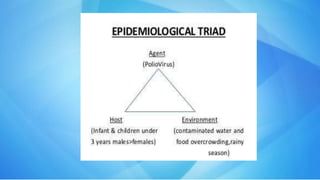
CAUSATIVE AGENT
 Poliomyelitis is an acute viral infection caused by poliovirus.
Though it has three serotypes 1,2 and 3 most outbreaks occur due
to type 1 virus
 Man is the only known reservoir of infection.
 The poliovirus can be inactivated by auto cleaning and different
physical and chemical method
 The virus is found in the feces and oropharyngeal secretions of an
infected person
 The cases are most infectious 7-10 days before and after the onset
of symptoms
HOST FACTORS
 All ages groups can be affected. However, children are
more susceptible than the adults
 Polio incidence varies between male and females with
the ratio of 3 males to 1 female
 The risk factors to provoke the disease in individuals
already infected with the virus.
 Maternal immunity received from mother will be lost
during first 6 months of life
ENVIRONMENTAL FACTORS
 Most often occur during rainy season
 Sources of infection are contaminated water, food and files.
 Poliovirus survives for a long time in a cold environment.
 Overcrowding and poor sanitation facilate infection
TRANSMISSION
 Fecal oral route: The main route of spread of directly through
contaminated fingers or indirectly through contaminated water, food,
milk,flies and articles of daily use.
 Droplet Infection: close personal contact during the acute phase of
the disease facilitates transmission through droplet infection.
 Incubation period: 7-14 days(ranges from 3 to 35 days)
SYMPTOMS
 Sore throat
 Fever
 Tiredness
 Anorexia
 Nausea and vomiting
 Headache
 Abdominal pain
 Constipation
Stiffness of neck and back muscles
 Weak or diminished tendon reflexes before the onset of paralysis
 The paralysis starts at the hip and descending to the distal parts
 Weakness or loss of voice
PREVENTIVE MEASURE
Immunization
There are two types of vaccination available:
1. Inactivated polio vaccine
2. Oral polio vaccine
Inactivated polio vaccine
Dr Jonas Salk introduced inactivated polio vaccine in 1995 and it also called"
sall vaccine". IPV has all three strains of inactivated polio virus types. It
administered by intramuscular injection and requires a trained health
personnel to administer the vaccine.
Advantages
 IPV does not have a risk of vaccine associated polio paralysis since it is not
alive vaccine.
 IPV develops an exceptional protective immune response is most people
DISADVANTAGES
 IPV induces very low levels of immunity in the intestine. As a
result, when a person immunized with IPV is infected with mild
poliovirus, the virus can still multiply inside the intestine and be
shed in the faces, risking continue circulation
 IPV is costly. This costs five times more than oral polio vaccine.
Administering the vaccine requires well trained health worker,
sterile equipment and strict compliance to sterile technique
throughout the procedure.
ORAL POLIO VACCINE
In 1961 Albert Sabin developed the oral polio vaccine and also called
"Trivalent oral polio vaccine". OPV has a mixture of live , attenuated
poliovirus strains of all three o
Poliovirus types OPV tends to produce antibodies in the blood to all
three types polio virus . When a child contact infection these
antibodies protect against paralysis by preventing the transmission
of poliovirus to the nervous system. OPV triggers local, mucosal
immune response in the mucous membrane of the intestine.This
intestinal immune response to OPV is considered to be the major
reason for mass campaigns with OPV can quickly stop person to
person transmission of poliovirus.
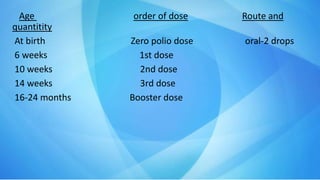
Age order of dose Route and
quantitity
At birth Zero polio dose oral-2 drops
6 weeks 1st dose
10 weeks 2nd dose
14 weeks 3rd dose
16-24 months Booster dose
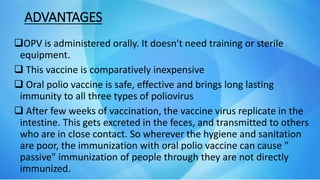
ADVANTAGES
OPV is administered orally. It doesn't need training or sterile
equipment.
 This vaccine is comparatively inexpensive
 Oral polio vaccine is safe, effective and brings long lasting
immunity to all three types of poliovirus
 After few weeks of vaccination, the vaccine virus replicate in the
intestine. This gets excreted in the feces, and transmitted to others
who are in close contact. So wherever the hygiene and sanitation
are poor, the immunization with oral polio vaccine can cause "
passive" immunization of people through they are not directly
immunized.
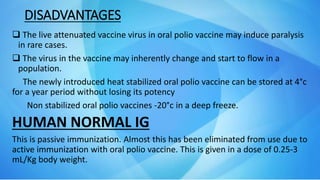
DISADVANTAGES
 The live attenuated vaccine virus in oral polio vaccine may induce paralysis
in rare cases.
 The virus in the vaccine may inherently change and start to flow in a
population.
The newly introduced heat stabilized oral polio vaccine can be stored at 4°c
for a year period without losing its potency
Non stabilized oral polio vaccines -20°c in a deep freeze.
HUMAN NORMAL IG
This is passive immunization. Almost this has been eliminated from use due to
active immunization with oral polio vaccine. This is given in a dose of 0.25-3
mL/Kg body weight.
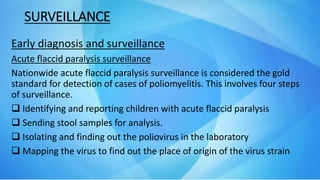
SURVEILLANCE
Early diagnosis and surveillance
Acute flaccid paralysis surveillance
Nationwide acute flaccid paralysis surveillance is considered the gold
standard for detection of cases of poliomyelitis. This involves four steps
of surveillance.
 Identifying and reporting children with acute flaccid paralysis
 Sending stool samples for analysis.
 Isolating and finding out the poliovirus in the laboratory
 Mapping the virus to find out the place of origin of the virus strain
AFP REPORTING PROCEDURE
 Immediate reporting of AFP cases below 15 years of age and paralytic
illness in suspected age for polio attack. This should be investigated within
48 hours.
 Collect two stool specimens 24-48 hours apart and within 14 days of the
onset of paralysis.
ENVIRONMENTAL SURVEILLANCE
Testing sewage and other environmental samples for the presence of
poliovirus are the vital measures of environmental surveillance.
Generally environmental surveillance most often helps in identifying
poliovirus infections in the absence of cases of paralysis.systematic
environmental sampling provides important supplementary surveillance
Ad- non environmental surveillance provides in sights into the
international spread of poliovirus.
PULSE POLIO IMMUNIZATION
PROGRAM
India began its pulse polio immunization program in 1995. All the
children in the age of 0-5 years are administered polio drops under
national immunization round every year. About 172 million of
children are immunized during each National Immunization
Day(NID).WHO on 24th February 2012 removed India from the list
of countries with active endemic wild poliovirus transmission.
Poliomyelitis has type 1,2 and 3 viruses. In India, type 2 polio virus
was eliminated around sixteen years ago itself; following which 3
and then type 1 polio viruses were eleminated from the human
CONCLUSION
It is apparent that the patient developing paralytic
poliomyelitis is exposed to many hazards, of which wasting
and paralysis are by no means the only ones. With active
immunization on an unprecedented scale, it is not unlikely
that scourage of mankind may become a relic of the past.

POLIOMYELITIS.pptx

  • 1.
  • 2.
    INTRODUCTION Poliomyelitis is acrippling and potentially deadly infectious disease caused by poliovirus. This starts as primary infection of the human alimentary tract. This virus spreads from person to person, infects brain and spinal cord leading to paralysis.
  • 3.
    DEFINITION Polio or poliomyelitis,is a disabling and life threatening disease caused by the poliovirus. The virus spreads from person to person and can infect a person's spinal cord, causing paralysis.
  • 5.
    CAUSATIVE AGENT  Poliomyelitisis an acute viral infection caused by poliovirus. Though it has three serotypes 1,2 and 3 most outbreaks occur due to type 1 virus  Man is the only known reservoir of infection.  The poliovirus can be inactivated by auto cleaning and different physical and chemical method  The virus is found in the feces and oropharyngeal secretions of an infected person  The cases are most infectious 7-10 days before and after the onset of symptoms
  • 6.
    HOST FACTORS  Allages groups can be affected. However, children are more susceptible than the adults  Polio incidence varies between male and females with the ratio of 3 males to 1 female  The risk factors to provoke the disease in individuals already infected with the virus.  Maternal immunity received from mother will be lost during first 6 months of life
  • 7.
    ENVIRONMENTAL FACTORS  Mostoften occur during rainy season  Sources of infection are contaminated water, food and files.  Poliovirus survives for a long time in a cold environment.  Overcrowding and poor sanitation facilate infection TRANSMISSION  Fecal oral route: The main route of spread of directly through contaminated fingers or indirectly through contaminated water, food, milk,flies and articles of daily use.  Droplet Infection: close personal contact during the acute phase of the disease facilitates transmission through droplet infection.  Incubation period: 7-14 days(ranges from 3 to 35 days)
  • 8.
    SYMPTOMS  Sore throat Fever  Tiredness  Anorexia  Nausea and vomiting  Headache  Abdominal pain  Constipation Stiffness of neck and back muscles  Weak or diminished tendon reflexes before the onset of paralysis  The paralysis starts at the hip and descending to the distal parts  Weakness or loss of voice
  • 9.
    PREVENTIVE MEASURE Immunization There aretwo types of vaccination available: 1. Inactivated polio vaccine 2. Oral polio vaccine Inactivated polio vaccine Dr Jonas Salk introduced inactivated polio vaccine in 1995 and it also called" sall vaccine". IPV has all three strains of inactivated polio virus types. It administered by intramuscular injection and requires a trained health personnel to administer the vaccine. Advantages  IPV does not have a risk of vaccine associated polio paralysis since it is not alive vaccine.  IPV develops an exceptional protective immune response is most people
  • 10.
    DISADVANTAGES  IPV inducesvery low levels of immunity in the intestine. As a result, when a person immunized with IPV is infected with mild poliovirus, the virus can still multiply inside the intestine and be shed in the faces, risking continue circulation  IPV is costly. This costs five times more than oral polio vaccine. Administering the vaccine requires well trained health worker, sterile equipment and strict compliance to sterile technique throughout the procedure.
  • 11.
    ORAL POLIO VACCINE In1961 Albert Sabin developed the oral polio vaccine and also called "Trivalent oral polio vaccine". OPV has a mixture of live , attenuated poliovirus strains of all three o Poliovirus types OPV tends to produce antibodies in the blood to all three types polio virus . When a child contact infection these antibodies protect against paralysis by preventing the transmission of poliovirus to the nervous system. OPV triggers local, mucosal immune response in the mucous membrane of the intestine.This intestinal immune response to OPV is considered to be the major reason for mass campaigns with OPV can quickly stop person to person transmission of poliovirus.
  • 12.
    Age order ofdose Route and quantitity At birth Zero polio dose oral-2 drops 6 weeks 1st dose 10 weeks 2nd dose 14 weeks 3rd dose 16-24 months Booster dose
  • 13.
    ADVANTAGES OPV is administeredorally. It doesn't need training or sterile equipment.  This vaccine is comparatively inexpensive  Oral polio vaccine is safe, effective and brings long lasting immunity to all three types of poliovirus  After few weeks of vaccination, the vaccine virus replicate in the intestine. This gets excreted in the feces, and transmitted to others who are in close contact. So wherever the hygiene and sanitation are poor, the immunization with oral polio vaccine can cause " passive" immunization of people through they are not directly immunized.
  • 14.
    DISADVANTAGES  The liveattenuated vaccine virus in oral polio vaccine may induce paralysis in rare cases.  The virus in the vaccine may inherently change and start to flow in a population. The newly introduced heat stabilized oral polio vaccine can be stored at 4°c for a year period without losing its potency Non stabilized oral polio vaccines -20°c in a deep freeze. HUMAN NORMAL IG This is passive immunization. Almost this has been eliminated from use due to active immunization with oral polio vaccine. This is given in a dose of 0.25-3 mL/Kg body weight.
  • 15.
    SURVEILLANCE Early diagnosis andsurveillance Acute flaccid paralysis surveillance Nationwide acute flaccid paralysis surveillance is considered the gold standard for detection of cases of poliomyelitis. This involves four steps of surveillance.  Identifying and reporting children with acute flaccid paralysis  Sending stool samples for analysis.  Isolating and finding out the poliovirus in the laboratory  Mapping the virus to find out the place of origin of the virus strain
  • 16.
    AFP REPORTING PROCEDURE Immediate reporting of AFP cases below 15 years of age and paralytic illness in suspected age for polio attack. This should be investigated within 48 hours.  Collect two stool specimens 24-48 hours apart and within 14 days of the onset of paralysis. ENVIRONMENTAL SURVEILLANCE Testing sewage and other environmental samples for the presence of poliovirus are the vital measures of environmental surveillance. Generally environmental surveillance most often helps in identifying poliovirus infections in the absence of cases of paralysis.systematic environmental sampling provides important supplementary surveillance
  • 17.
    Ad- non environmentalsurveillance provides in sights into the international spread of poliovirus. PULSE POLIO IMMUNIZATION PROGRAM India began its pulse polio immunization program in 1995. All the children in the age of 0-5 years are administered polio drops under national immunization round every year. About 172 million of children are immunized during each National Immunization Day(NID).WHO on 24th February 2012 removed India from the list of countries with active endemic wild poliovirus transmission. Poliomyelitis has type 1,2 and 3 viruses. In India, type 2 polio virus was eliminated around sixteen years ago itself; following which 3 and then type 1 polio viruses were eleminated from the human
  • 18.
    CONCLUSION It is apparentthat the patient developing paralytic poliomyelitis is exposed to many hazards, of which wasting and paralysis are by no means the only ones. With active immunization on an unprecedented scale, it is not unlikely that scourage of mankind may become a relic of the past.