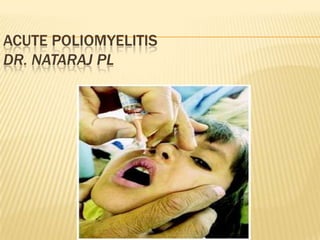
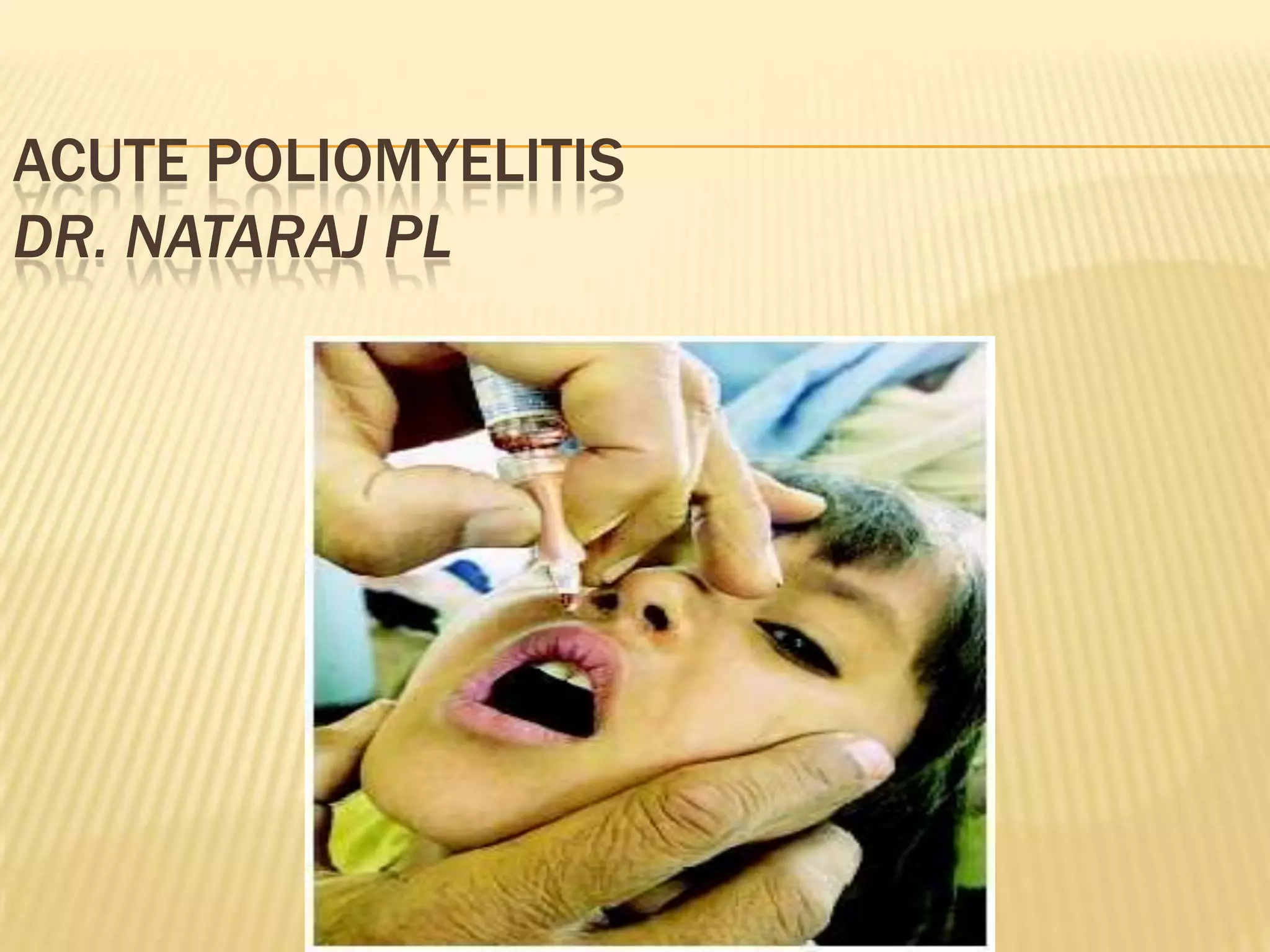
ACUTE POLIOMYELITIS DR. NATARAJ PL
Clinical Diagnosis (WHO case definition)“ A case of poliomyelitis is defined as any child under fifteen years of age with acute flaccid paralysis or any person with paralytic illness at any age when polio is suspected”
Cycle of infectionAgentPoliovirus : three serotypes (P1, P2, P3) with different antigenicity
The virus can live in water for three months and in the faeces for six months.
The poliovirus is rapidly inactivated by heat, formaldehyde, chlorine and ultraviolet light.            Reservoir Cases : clinical & subclinical plays a role in the spread of infectionCarriers: faecal temporary. There is no chronic carrier.Source of infection:Faeces  and pharyngeal secretions of the infected person
PersonAge and sex:In  developing countries Poliomyelitis is a disease of young children and adolescentsIn developed countries adults were affected more commonly than children  with increased both the disease severity and deaths.Sex difference have been noticed in the ratio of three male to one female
TimePoliovirus infection typically peaks in the summer months. Man is the only reservoir
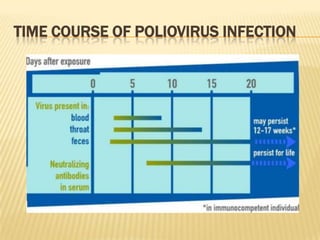
Time course of poliovirus infection
Mode of transmission1-Feaces (feco-oral):  in areas with lack of personal hygiene especially in young children in developing countries. It results in infection not paralysis.2-Droplet:in developed countries with high standard of sanitation, droplet is common mode of transmission during the acute phase of the disease when the virus is in the throat.3-Direct contact with respiratory discharge4- Common vehicle: ingestion of food or drink contaminated with faeces5- Indirect contact with articles contaminated with pharyngeal discharge of infected person.   InletThe mouth and nose
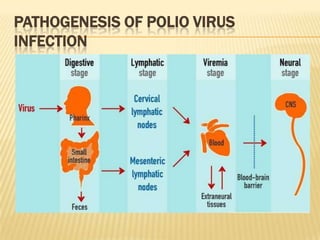
Pathogenesis of Polio Virus Infection
Immunity in PolioTransplacentally acquired passive immunityAfter natural infectionAfter immunisationLocal immunity
Immunity to Poliovirus InfectionExposure to poliovirus initiates a complex process that eventually results in both humoral (systemic) and mucosal (local) immunity. Poliovirus infection provides lifelong immunity against the disease, but this protection is limited to the particular type of poliovirus involved (Type 1, 2, or 3) Thus, infection with one type does not protect an individual against infection of the other two types. IgMand IgG antibodies are detected in the serum as early as 1-3 days following natural infection but disappears after 2-3 months.
Poliomyelitis: Risk FactorsImmune deficiencyPregnancyPoor sanitation and hygiene Poverty Unimmunized status, especially if <5 yearsTonsillectomy: a risk factor for bulbar paralysis.Intramuscular injections or truamaGenetics:No genetic susceptibility has been identified.
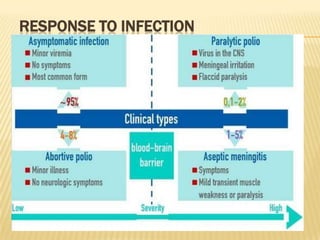
Response to Infection
Abortive poliomyelitis5% casesInfluenza like symptoms 1-2 weeks laterLasts only for 2-3 daysClinical examination unremarkableComplete recovery
Non paralytic poliomyelitis1% casesInitial minor illness-headache, nausea, vomiting, soreness and stiffness of neck muscles, fleeting paralysis of bladder and constipationShort symptom free interludeMajor illness
Non paralytic poliomyelitisNuchal and spinal rigidity are hallmarkTripod sign, Kiss the kneeNeck rigidity, Kernigs signHead dropReflexes usually normalChanges in reflex indicate impending paralysis
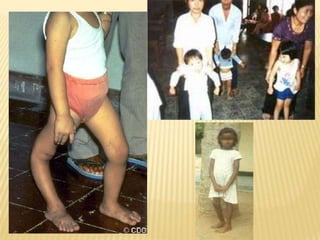
Paralytic poliomyelitis-spinal2nd phase of the illnessSpotty paralysisAsymmetric flaccid paralysisOne leg most common followed by one armAbsent DTRs
Paralytic poliomyelitis-spinalAbsent DTRsNo sensory deficitsFull picture by 3 days. Usually no further progressionBowel and bladder dysfunctionOlder age and provocation paralysis the biphasic illness is not seen
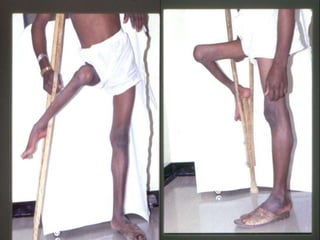
Paralytic poliomyelitis-spinalRecovery is slow starting after several weeks of the disease, but usually within 6 monthsIf not then residual paralysisRecovery may continue for as long as 18 monthsAtrophy, deformity and failure to grow
Paralytic poliomyelitis-BulbarNasal twang to voice and nasal regurgitation of foodInability to swallow and pooling of oral secretionsPalatal and tongue involvementVocal cord palsy
Paralytic poliomyelitis-BulbarVital centers in medulla being involvedAscending paralysisAutonomic disturbancesRecovery is variable
Paralytic poliomyelitis-EncephalitisInvolvement of higher centersSeizures,coma,spastic paralysisPeripheral & cranial nerve palsiesRespiratory paralysis-due to variety of possibilities
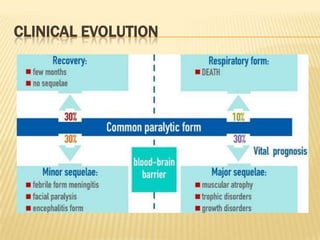
Clinical Evolution
Poliomyelitis: ComplicationsUrinary tract infectionSkin ulcersTraumatic injuries to affected limb(s)Atelectasis & PneumoniaMyocarditisPostpoliomyelitis progressive muscular atrophy.Postpoliomyelitis motor neuron disease.Respiratory muscle involvement and death
Poliomyelitis: Diagnosis Based on the clinical presentation.Cerebrospinal Fluid:          Leukocytosis, Increased protein, Normal glucose.                Virus recovery from stool, throat washing, blood.Virus recovery from stool is essential to diagnosis.
Obtain stool, blood and throat samples for viral serology, demonstrating a four fold rise in IgG is helpful but not always easy.
 Positive IgM is diagnostic. Polymerase chain reaction amplification of poliovirus RNA from CSF or serologically, by comparing viral titers in acute and convalescent sera.
Diagnosis…cont Electrodiagnostic investigations reveal normal sensory nerve studies. Motor nerve studies:         show normal to mildly slowed conduction velocities and low to normal amplitudes. MRI may be helpful to evaluate involvement of anterior horn of the spinal cord or other findings.
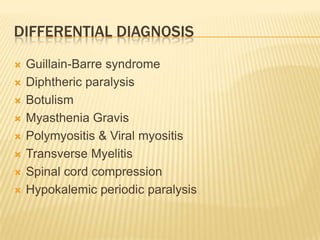
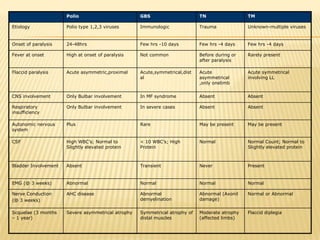
Differential diagnosisGuillain-Barre syndromeDiphtheric paralysisBotulismMyasthenia GravisPolymyositis & Viral myositisTransverse MyelitisSpinal cord compressionHypokalemic periodic paralysis
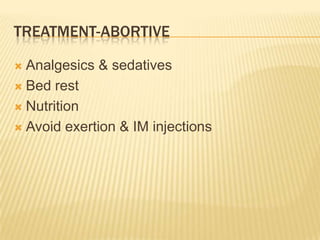
Treatment-AbortiveAnalgesics & sedativesBed restNutritionAvoid exertion & IM injections
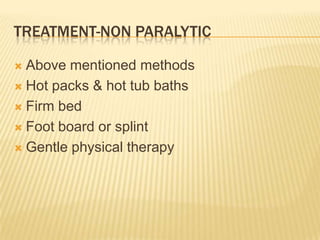
Treatment-non paralyticAbove mentioned methodsHot packs & hot tub bathsFirm bedFoot board or splintGentle physical therapy
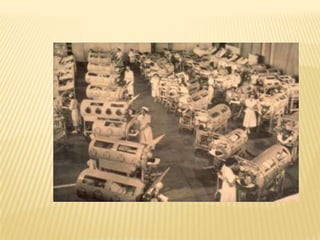
Treatment-ParalyticCare of bowel & bladderIncreased fluid intakeCare of airway & secretionsMonitor vital signsVentilationTracheostomy
Outcome Complete recovery in abortive & non paralytic polio60% mortality in bulbar polio & 5% in spinal polioRecovery beyond 6 months is unlikely
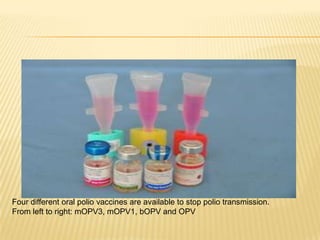
Four different oral polio vaccines are available to stop polio transmission. From left to right: mOPV3, mOPV1, bOPV and OPV
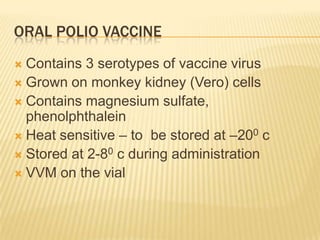
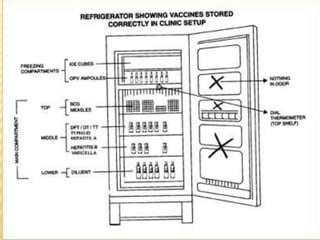
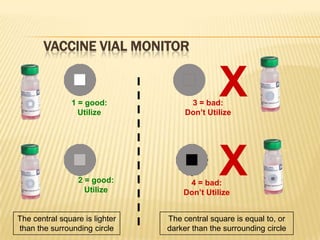
Oral polio vaccineContains 3 serotypes of vaccine virus Grown on monkey kidney (Vero) cellsContains magnesium sulfate, phenolphthaleinHeat sensitive – to  be stored at –200 cStored at 2-80 c during administration VVM on the vial
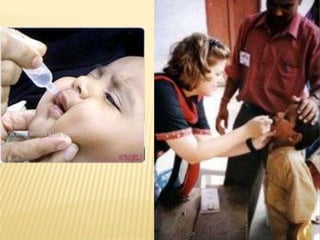
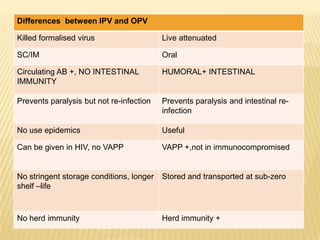
Oral polio vaccineShed in stool for up to 6 weeks following vaccination – Herd immunitySeroconversion rates of 73%, 90% and 70% for 1, 2, 3 serotypes after 3 doses4 doses in the first year of life and boosters-IAP recommendationType 2 serotype disappears first with immunisationUsed in pulse polio programme
Oral polio vaccine-Adverse reactionsVaccine associated paralytic poliomyelitis(VAPP)-250 to 800 cases annually-1/5 million dosesMost common by type2 (type 3 as per Nelson and Park)Circulating vaccine derived polio viruses (cVDPV)-out breaks of paralytic polio
VACCINE VIAL MONITORX3 = bad:Don’t Utilize1 = good:UtilizeX2 = good:Utilize4 = bad:Don’t UtilizeThe central square is equal to, or darker than the surrounding circleThe central square is lighter than the surrounding circle
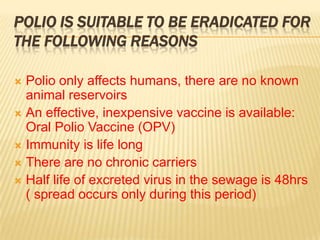
Polio is suitable to be eradicated for the following reasonsPolio only affects humans, there are no known animal reservoirsAn effective, inexpensive vaccine is available: Oral Polio Vaccine (OPV) Immunity is life long There are no chronic carriersHalf life of excreted virus in the sewage is 48hrs ( spread occurs only during this period)
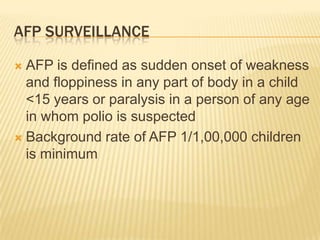
AFP surveillanceAFP is defined as sudden onset of weakness and floppiness in any part of body in a child <15 years or paralysis in a person of any age in whom polio is suspectedBackground rate of AFP 1/1,00,000 children is minimum
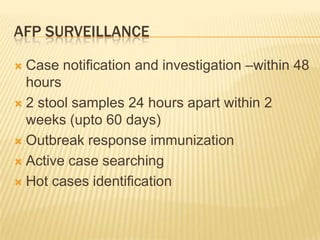
AFP surveillanceCase notification and investigation –within 48 hours2 stool samples 24 hours apart within 2 weeks (upto 60 days)Outbreak response immunizationActive case searchingHot cases identification
AFP surveillanceCollection of stool samplesTransportation Eight national laboratories60 day follow up
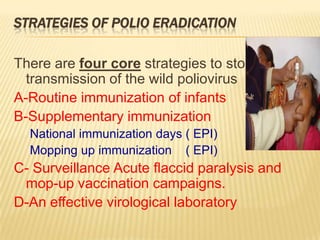
AFP surveillance – strategiesHigh coverage of routine immunizationSupplemental doses of OPVSurveillance of AFP casesConducting mop-up vaccination campaigns
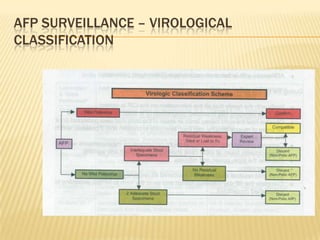
AFP surveillance – virological classification
Before a WHO region can be certified polio-free, three conditions must be satisfied:There are at least three years of zero polio cases due to wild poliovirus;Disease surveillance efforts in countries meet international standards; andEach country must illustrate the capacity to detect, report and respond to “imported” polio cases
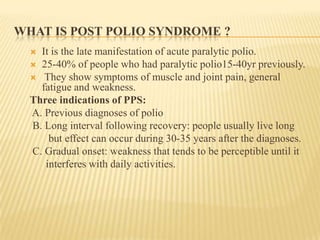
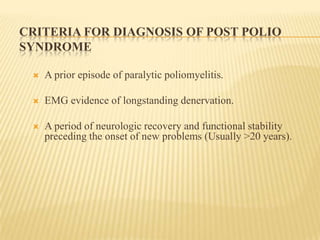
What is Post Polio Syndrome ?It is the late manifestation of acute paralytic polio.25-40% of people who had paralytic polio15-40yr previously. They show symptoms of muscle and joint pain, general fatigue and weakness. Three indications of PPS: A. Previous diagnoses of polio B. Long interval following recovery: people usually live long       but effect can occur during 30-35 years after the diagnoses.                         C. Gradual onset: weakness that tends to be perceptible until it      interferes with daily activities.

Acute poliomyelitis

  • 1.
  • 3.
    Clinical Diagnosis (WHOcase definition)“ A case of poliomyelitis is defined as any child under fifteen years of age with acute flaccid paralysis or any person with paralytic illness at any age when polio is suspected”
  • 4.
    Cycle of infectionAgentPoliovirus: three serotypes (P1, P2, P3) with different antigenicity
  • 5.
    The virus canlive in water for three months and in the faeces for six months.
  • 6.
    The poliovirus israpidly inactivated by heat, formaldehyde, chlorine and ultraviolet light. Reservoir Cases : clinical & subclinical plays a role in the spread of infectionCarriers: faecal temporary. There is no chronic carrier.Source of infection:Faeces and pharyngeal secretions of the infected person
  • 7.
    PersonAge and sex:In developing countries Poliomyelitis is a disease of young children and adolescentsIn developed countries adults were affected more commonly than children with increased both the disease severity and deaths.Sex difference have been noticed in the ratio of three male to one female
  • 8.
    TimePoliovirus infection typicallypeaks in the summer months. Man is the only reservoir
  • 9.
    Time course ofpoliovirus infection
  • 10.
    Mode of transmission1-Feaces(feco-oral): in areas with lack of personal hygiene especially in young children in developing countries. It results in infection not paralysis.2-Droplet:in developed countries with high standard of sanitation, droplet is common mode of transmission during the acute phase of the disease when the virus is in the throat.3-Direct contact with respiratory discharge4- Common vehicle: ingestion of food or drink contaminated with faeces5- Indirect contact with articles contaminated with pharyngeal discharge of infected person. InletThe mouth and nose
  • 11.
    Pathogenesis of PolioVirus Infection
  • 12.
    Immunity in PolioTransplacentallyacquired passive immunityAfter natural infectionAfter immunisationLocal immunity
  • 13.
    Immunity to PoliovirusInfectionExposure to poliovirus initiates a complex process that eventually results in both humoral (systemic) and mucosal (local) immunity. Poliovirus infection provides lifelong immunity against the disease, but this protection is limited to the particular type of poliovirus involved (Type 1, 2, or 3) Thus, infection with one type does not protect an individual against infection of the other two types. IgMand IgG antibodies are detected in the serum as early as 1-3 days following natural infection but disappears after 2-3 months.
  • 14.
    Poliomyelitis: Risk FactorsImmunedeficiencyPregnancyPoor sanitation and hygiene Poverty Unimmunized status, especially if <5 yearsTonsillectomy: a risk factor for bulbar paralysis.Intramuscular injections or truamaGenetics:No genetic susceptibility has been identified.
  • 15.
  • 16.
    Abortive poliomyelitis5% casesInfluenzalike symptoms 1-2 weeks laterLasts only for 2-3 daysClinical examination unremarkableComplete recovery
  • 17.
    Non paralytic poliomyelitis1%casesInitial minor illness-headache, nausea, vomiting, soreness and stiffness of neck muscles, fleeting paralysis of bladder and constipationShort symptom free interludeMajor illness
  • 18.
    Non paralytic poliomyelitisNuchaland spinal rigidity are hallmarkTripod sign, Kiss the kneeNeck rigidity, Kernigs signHead dropReflexes usually normalChanges in reflex indicate impending paralysis
  • 19.
    Paralytic poliomyelitis-spinal2nd phaseof the illnessSpotty paralysisAsymmetric flaccid paralysisOne leg most common followed by one armAbsent DTRs
  • 20.
    Paralytic poliomyelitis-spinalAbsent DTRsNosensory deficitsFull picture by 3 days. Usually no further progressionBowel and bladder dysfunctionOlder age and provocation paralysis the biphasic illness is not seen
  • 21.
    Paralytic poliomyelitis-spinalRecovery isslow starting after several weeks of the disease, but usually within 6 monthsIf not then residual paralysisRecovery may continue for as long as 18 monthsAtrophy, deformity and failure to grow
  • 22.
    Paralytic poliomyelitis-BulbarNasal twangto voice and nasal regurgitation of foodInability to swallow and pooling of oral secretionsPalatal and tongue involvementVocal cord palsy
  • 23.
    Paralytic poliomyelitis-BulbarVital centersin medulla being involvedAscending paralysisAutonomic disturbancesRecovery is variable
  • 24.
    Paralytic poliomyelitis-EncephalitisInvolvement ofhigher centersSeizures,coma,spastic paralysisPeripheral & cranial nerve palsiesRespiratory paralysis-due to variety of possibilities
  • 26.
  • 27.
    Poliomyelitis: ComplicationsUrinary tractinfectionSkin ulcersTraumatic injuries to affected limb(s)Atelectasis & PneumoniaMyocarditisPostpoliomyelitis progressive muscular atrophy.Postpoliomyelitis motor neuron disease.Respiratory muscle involvement and death
  • 28.
    Poliomyelitis: Diagnosis Based onthe clinical presentation.Cerebrospinal Fluid: Leukocytosis, Increased protein, Normal glucose. Virus recovery from stool, throat washing, blood.Virus recovery from stool is essential to diagnosis.
  • 29.
    Obtain stool, bloodand throat samples for viral serology, demonstrating a four fold rise in IgG is helpful but not always easy.
  • 30.
    Positive IgMis diagnostic. Polymerase chain reaction amplification of poliovirus RNA from CSF or serologically, by comparing viral titers in acute and convalescent sera.
  • 31.
    Diagnosis…cont Electrodiagnostic investigations revealnormal sensory nerve studies. Motor nerve studies: show normal to mildly slowed conduction velocities and low to normal amplitudes. MRI may be helpful to evaluate involvement of anterior horn of the spinal cord or other findings.
  • 32.
    Differential diagnosisGuillain-Barre syndromeDiphthericparalysisBotulismMyasthenia GravisPolymyositis & Viral myositisTransverse MyelitisSpinal cord compressionHypokalemic periodic paralysis
  • 34.
    Treatment-AbortiveAnalgesics & sedativesBedrestNutritionAvoid exertion & IM injections
  • 35.
    Treatment-non paralyticAbove mentionedmethodsHot packs & hot tub bathsFirm bedFoot board or splintGentle physical therapy
  • 36.
    Treatment-ParalyticCare of bowel& bladderIncreased fluid intakeCare of airway & secretionsMonitor vital signsVentilationTracheostomy
  • 38.
    Outcome Complete recoveryin abortive & non paralytic polio60% mortality in bulbar polio & 5% in spinal polioRecovery beyond 6 months is unlikely
  • 39.
    Four different oralpolio vaccines are available to stop polio transmission. From left to right: mOPV3, mOPV1, bOPV and OPV
  • 40.
    Oral polio vaccineContains3 serotypes of vaccine virus Grown on monkey kidney (Vero) cellsContains magnesium sulfate, phenolphthaleinHeat sensitive – to be stored at –200 cStored at 2-80 c during administration VVM on the vial
  • 41.
    Oral polio vaccineShedin stool for up to 6 weeks following vaccination – Herd immunitySeroconversion rates of 73%, 90% and 70% for 1, 2, 3 serotypes after 3 doses4 doses in the first year of life and boosters-IAP recommendationType 2 serotype disappears first with immunisationUsed in pulse polio programme
  • 42.
    Oral polio vaccine-AdversereactionsVaccine associated paralytic poliomyelitis(VAPP)-250 to 800 cases annually-1/5 million dosesMost common by type2 (type 3 as per Nelson and Park)Circulating vaccine derived polio viruses (cVDPV)-out breaks of paralytic polio
  • 46.
    VACCINE VIAL MONITORX3= bad:Don’t Utilize1 = good:UtilizeX2 = good:Utilize4 = bad:Don’t UtilizeThe central square is equal to, or darker than the surrounding circleThe central square is lighter than the surrounding circle
  • 47.
    Polio is suitableto be eradicated for the following reasonsPolio only affects humans, there are no known animal reservoirsAn effective, inexpensive vaccine is available: Oral Polio Vaccine (OPV) Immunity is life long There are no chronic carriersHalf life of excreted virus in the sewage is 48hrs ( spread occurs only during this period)
  • 48.
    AFP surveillanceAFP isdefined as sudden onset of weakness and floppiness in any part of body in a child <15 years or paralysis in a person of any age in whom polio is suspectedBackground rate of AFP 1/1,00,000 children is minimum
  • 49.
    AFP surveillanceCase notificationand investigation –within 48 hours2 stool samples 24 hours apart within 2 weeks (upto 60 days)Outbreak response immunizationActive case searchingHot cases identification
  • 50.
    AFP surveillanceCollection ofstool samplesTransportation Eight national laboratories60 day follow up
  • 51.
    AFP surveillance –strategiesHigh coverage of routine immunizationSupplemental doses of OPVSurveillance of AFP casesConducting mop-up vaccination campaigns
  • 52.
    AFP surveillance –virological classification
  • 53.
    Before a WHOregion can be certified polio-free, three conditions must be satisfied:There are at least three years of zero polio cases due to wild poliovirus;Disease surveillance efforts in countries meet international standards; andEach country must illustrate the capacity to detect, report and respond to “imported” polio cases
  • 54.
    What is PostPolio Syndrome ?It is the late manifestation of acute paralytic polio.25-40% of people who had paralytic polio15-40yr previously. They show symptoms of muscle and joint pain, general fatigue and weakness. Three indications of PPS: A. Previous diagnoses of polio B. Long interval following recovery: people usually live long but effect can occur during 30-35 years after the diagnoses. C. Gradual onset: weakness that tends to be perceptible until it interferes with daily activities.