MEASLES


                            Fen Hua Chen, M.D.,PhD.
Department of Pediatrics, The Third Affiliated Hospital
                               Sun Yat-sen University
DEFINITION
           Measles is…

an acute viral infection characterized by a
maculopapular rash erupting successively
over the neck, face, body, and extremitis
and accompanied by a high fever.
ETIOLOGY
Measles virus
 An RNA virus of the genus Morbillivirus in the family of
 Paramyxoviridae
 One serotype, human’s only host
 Stable antigenicity
 Rapidly inactivated by heat and light
 Survival in low temperature.
EPIDEMIOLOGY
Infection sources
   Patients of acute stage and viral carriers of atypical
    measles
Transmission
   Highly contagious, approximately 90% of susceptible
    contacts acquire the disease.
   Respiratory secretions: maximal dissemination of virus
    occurs by droplet spray during the prodromal period
    (catarrhal stage).
   Contagious from 5 days before symptoms, 5 days after
    onset of rash
   Seasons: in the spring, peak in Feb-May
PATHOGENESIS AND
                               PATHOLOGY
  Portal of entry
      Respiratory tract and regional lymph nodes
      Enters bloodstream (primary viraemia)  monocyte –
       phagocyte system  target organs (secondary viraemia)
  Target organs
      The skin; the mucous membranes of the nasopharynx,
       bronchi, and intestinal tract; and in the conjunctivae, ect
Resulting In-----

1) Koplik spots and skin rash: serous exudation and proliferation
   of endothelial cells around the capillaries
2) Conjunctivis
PATHOGENESIS AND
                            PATHOLOGY
3) Laryngitis, croup, bronchitis :general inflammatory reaction
4) Hyperplasia of lymphoid tissue: multinucleated giant cells
   (Warthin-Finkeldey giant cells) may be found
5) Interstitial pneumonitis: Hecht giant cell pneumonia.
6) Bronchopneumonia: due to secondary bacterial infections
7) Encephalomyelitis: perivascular demyelinization occurs in
   areas of the brain and spinal cord.
8) Subacute sclerosing panencephalitis(SSPE):
   degeneration of the cortex and white matter with intranuclear
   and intracytoplasmic inclusion bodies
CLINICAL MANIFESTATION
Typical Manifestation:

  patients havn’t had measles immunization, or vaccine failure
  with normal immunity or those havn’t used immune globulin

1. Incubation period (infection to symptoms) :
    6-18days (average 10 days)

2. Prodromal period:
       3-4 days
       Non-specific symptoms: fever, malaise, anorexia,
        headache
       Classical triad: cough, coryza, conjunctivitis (with
        photophobia, lacrimation)
CLINICAL MANIFESTATION
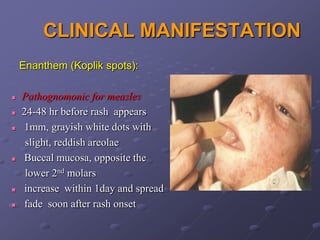
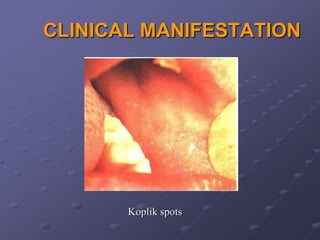
    Enanthem (Koplik spots):

   Pathognomonic for measles
   24-48 hr before rash appears
   1mm, grayish white dots with
     slight, reddish areolae
   Buccal mucosa, opposite the
     lower 2nd molars
   increase within 1day and spread
   fade soon after rash onset
CLINICAL MANIFESTATION


       Koplik spots
CLINICAL MANIFESTATION
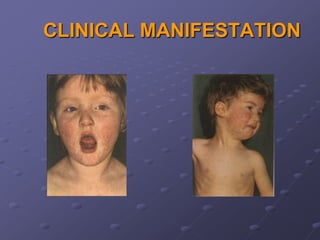
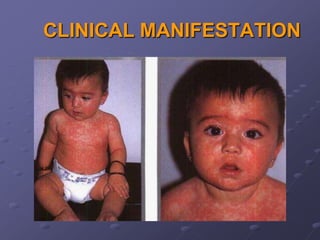
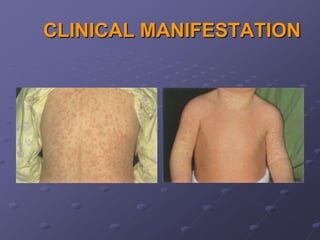
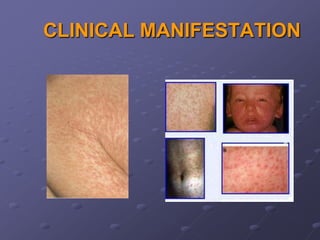
3. Rash period
    3-4days
    Exanthem:
    Erythematous, non-pruritic, maculopapular
     Upper lateral of the neck, behind ears, hairline,
      face  trunk  arms and legs feet

     The severity of the disease is directly related to
      the extent and confluence of the rash
,
CLINICAL MANIFESTATION
    Temperature:
    Rises abruptly as the rash appears
    Reaches 40℃ or higher
    Settles after 4-5 days – if persists, suspect secondary
     infection
    Coryza, fever, and cough:
    Increasingly severe up to the time the rash has covered the
     body
    Lymphadenopathy (posterior cervical region, mesenteric)
    splenomegaly, diarrhoea, vomiting
    Chest X ray:
   May be abnormal, even in uncomplicated cases
CLINICAL MANIFESTATION
4. Recovery period
    3-4days
    Exanthem:
     Fades in order of appearance
     Branny desquamation and brownish discoloration

    Entire illness – 10 days
CLINICAL MANIFESTATION
Atypical Manifestation:

1. Mild measles
   In patients: administered immune globulin products
    during the incubation period and immunized against
    measles; in infants <8mo
   Long incubation period and short prodromal phase
   Mild symptom
   No Koplik spot
   The rash tends to be faint, less macular, pinpoint
   No branny desquamation and brownish discoloration
    occur as the rash fades
   No complications and short course
CLINICAL MANIFESTATION
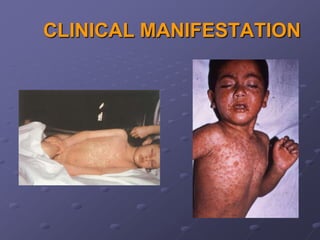
2. Severe measles:
   In cases with malnutrition, hypoimmunity and secondary
    infection
   Persistent hyperpyrexia, sometimes with convulsions and even

    coma
    Exanthem:
    Completely covered the skin
    Confluent, petechiae, ecchymoses
    The hemorrhagic type of measles (black measles), bleeding
     may occur from the mouth, nose, or bowel. disseminated
     intravascular coagulation (DIC)
CLINICAL MANIFESTATION
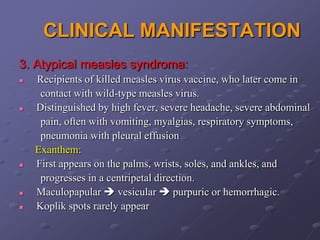
3. Atypical measles syndroma:
   Recipients of killed measles virus vaccine, who later come in
     contact with wild-type measles virus.
   Distinguished by high fever, severe headache, severe abdominal
     pain, often with vomiting, myalgias, respiratory symptoms,
     pneumonia with pleural effusion
    Exanthem:
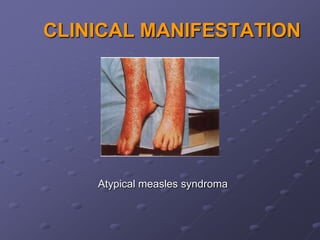
   First appears on the palms, wrists, soles, and ankles, and
     progresses in a centripetal direction.
   Maculopapular  vesicular  purpuric or hemorrhagic.
   Koplik spots rarely appear
CLINICAL MANIFESTATION


    Atypical measles syndroma
CLINICAL MANIFESTATION
4. Measles absent of rush
   Immunodepressed, or passive immunized recently cases and
    occasionally in infants <9mo who have appreciable levels
    of maternal antibody
   Non-specificity
   Difficult to diagnosis
COMPLICATIONS
1. Respiratory Tract
    Laryngitis, tracheitis, bronchitis – due to measles
    itself
    Laryngotrachobronchitis (croup) –cause airway
    obstruction to require tracheostomy
    Secondary pneumonia – immunocompromised,
    malnourished patients. pneumococcus, group A
    Streptococcus, Staphylococcus aureus and
    Haemophilus influenzae type B.
    Exacerbation of TB
COMPLICATIONS


2. Myocarditis

3. Malnutrition and Vitamin A deficiency
COMPLICATIONS
4. CNS
The incidence of encephalomyelitis is 1-2/l,000 cases of
measles
Onset occurs 2-5 days after the appearance of the rash
No correlation between the severity of the rash illness and
 that of the neurologic involvement
    Earlier - direct viral effect in CNS
    Later – immune response causing demyelination
    Significant morbidity, permanent sequelae – mental
     retardation and paralysis
Subacute sclerosing panencephalitis (SSPE): extremely rare,
6-10 years after infection. Progressive dementia, fatal.
Interaction of host with defective form of virus
LABORATORY EXAMINATION
Isolation of measles virus from a clinical specimen (e.g.,
nasopharynx, urine)
Significant rise in measles IgG by any standard serologic assay
Positive serologic test for measles IgM antibody
Immunofluorescence detects Measles antigens
Multinucleated giant cells in smears of nasal mucosa

Low white blood cell count and a relative lymphocytosis in PB
Measles encephalitis – raised protein, lymphocytes in CSF
DIAGNOSIS

characteristic clinical picture:
  Measles contact
  Koplik spot
  Features of the skin rash
  The relation between the eruption and fever


  Laboratory confirmation is rarely needed
DIFFERENTIAL DIAGNOSIS
The rash of measles must be differentiated from that of
rubella;
roseola intantum;
enteroviral infections;
scarlet fever;
and drug rashes.
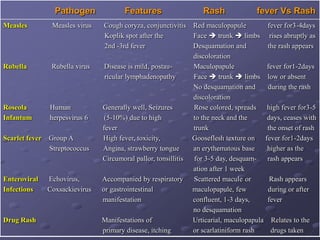
Pathogen               Features                    Rash              fever Vs Rash
Measles          Measles virus   Cough coryza, conjunctivitis     Red maculopapule         fever for3-4days
                                 Koplik spot after the            Face  trunk  limbs rises abruptly as
                                 2nd -3rd fever                   Desquamation and         the rash appears
                                                                  discoloration
Rubella          Rubella virus   Disease is mild, postau-         Maculopapule            fever for1-2days
                                 ricular lymphadenopathy          Face  trunk  limbs low or absent
                                                                  No desquamation and      during the rash
                                                                  discoloration
Roseola         Human            Generally well, Seizures         Rose colored, spreads   high fever for3-5
Infantum        herpesvirus 6     (5-10%) due to high             to the neck and the     days, ceases with
                                 fever                            trunk                    the onset of rash
Scarlet fever   Group A          High fever, toxicity,            Gooseflesh texture on fever for1-2days
                Streptococcus    Angina, strawberry tongue        an erythematous base    higher as the
                                 Circumoral pallor, tonsillitis   for 3-5 day, desquam-    rash appears
                                                                  ation after 1 week
Enteroviral     Echovirus,       Accompanied by respiratory       Scattered macule or       Rash appears
Infections      Coxsackievirus   or gastrointestinal              maculopapule, few        during or after
                                 manifestation                    confluent, 1-3 days,     fever
                                                                  no desquamation
Drug Rash                        Manifestations of                Urticarial, maculopapula Relates to the
                                 primary disease, itching         or scarlatiniform rash    drugs taken
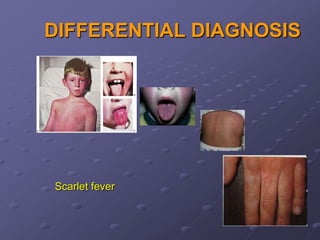
DIFFERENTIAL DIAGNOSIS


Scarlet fever
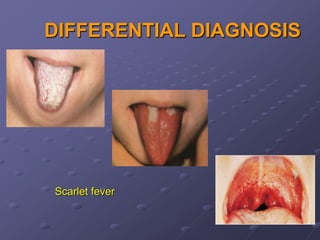
DIFFERENTIAL DIAGNOSIS


Scarlet fever
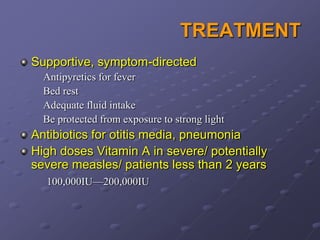
TREATMENT
Supportive, symptom-directed
  Antipyretics for fever
  Bed rest
  Adequate fluid intake
  Be protected from exposure to strong light
Antibiotics for otitis media, pneumonia
High doses Vitamin A in severe/ potentially
severe measles/ patients less than 2 years
  100,000IU—200,000IU
PREVENTION
1. Quarantine period
 5 days after rash appears, longer for complicated measles
2. Vaccine
 The initial measles immunization is recommended at 8mo of
 age
 A second immunization is recommended routinely at 7yr of
 age
3. Postexposure Prophylaxis
  Passive immunization with immune globulin (0.25mL/kg)
  is effective for prevention and attenuation of measles within
  5 days of exposure.
THANK YOU

8 measles

  • 1.
    MEASLES Fen Hua Chen, M.D.,PhD. Department of Pediatrics, The Third Affiliated Hospital Sun Yat-sen University
  • 2.
    DEFINITION Measles is… an acute viral infection characterized by a maculopapular rash erupting successively over the neck, face, body, and extremitis and accompanied by a high fever.
  • 3.
    ETIOLOGY Measles virus AnRNA virus of the genus Morbillivirus in the family of Paramyxoviridae One serotype, human’s only host Stable antigenicity Rapidly inactivated by heat and light Survival in low temperature.
  • 4.
    EPIDEMIOLOGY Infection sources  Patients of acute stage and viral carriers of atypical measles Transmission  Highly contagious, approximately 90% of susceptible contacts acquire the disease.  Respiratory secretions: maximal dissemination of virus occurs by droplet spray during the prodromal period (catarrhal stage).  Contagious from 5 days before symptoms, 5 days after onset of rash  Seasons: in the spring, peak in Feb-May
  • 5.
    PATHOGENESIS AND PATHOLOGY Portal of entry  Respiratory tract and regional lymph nodes  Enters bloodstream (primary viraemia)  monocyte – phagocyte system  target organs (secondary viraemia) Target organs  The skin; the mucous membranes of the nasopharynx, bronchi, and intestinal tract; and in the conjunctivae, ect Resulting In----- 1) Koplik spots and skin rash: serous exudation and proliferation of endothelial cells around the capillaries 2) Conjunctivis
  • 6.
    PATHOGENESIS AND PATHOLOGY 3) Laryngitis, croup, bronchitis :general inflammatory reaction 4) Hyperplasia of lymphoid tissue: multinucleated giant cells (Warthin-Finkeldey giant cells) may be found 5) Interstitial pneumonitis: Hecht giant cell pneumonia. 6) Bronchopneumonia: due to secondary bacterial infections 7) Encephalomyelitis: perivascular demyelinization occurs in areas of the brain and spinal cord. 8) Subacute sclerosing panencephalitis(SSPE): degeneration of the cortex and white matter with intranuclear and intracytoplasmic inclusion bodies
  • 7.
    CLINICAL MANIFESTATION Typical Manifestation: patients havn’t had measles immunization, or vaccine failure with normal immunity or those havn’t used immune globulin 1. Incubation period (infection to symptoms) : 6-18days (average 10 days) 2. Prodromal period:  3-4 days  Non-specific symptoms: fever, malaise, anorexia, headache  Classical triad: cough, coryza, conjunctivitis (with photophobia, lacrimation)
  • 8.
    CLINICAL MANIFESTATION Enanthem (Koplik spots):  Pathognomonic for measles  24-48 hr before rash appears  1mm, grayish white dots with slight, reddish areolae  Buccal mucosa, opposite the lower 2nd molars  increase within 1day and spread  fade soon after rash onset
  • 9.
  • 10.
    CLINICAL MANIFESTATION 3. Rashperiod 3-4days Exanthem: Erythematous, non-pruritic, maculopapular  Upper lateral of the neck, behind ears, hairline, face  trunk  arms and legs feet  The severity of the disease is directly related to the extent and confluence of the rash ,
  • 11.
  • 12.
  • 13.
  • 14.
    CLINICAL MANIFESTATION Temperature:  Rises abruptly as the rash appears  Reaches 40℃ or higher  Settles after 4-5 days – if persists, suspect secondary infection Coryza, fever, and cough:  Increasingly severe up to the time the rash has covered the body Lymphadenopathy (posterior cervical region, mesenteric) splenomegaly, diarrhoea, vomiting Chest X ray:  May be abnormal, even in uncomplicated cases
  • 15.
    CLINICAL MANIFESTATION 4. Recoveryperiod 3-4days Exanthem:  Fades in order of appearance  Branny desquamation and brownish discoloration Entire illness – 10 days
  • 16.
  • 17.
    CLINICAL MANIFESTATION Atypical Manifestation: 1.Mild measles  In patients: administered immune globulin products during the incubation period and immunized against measles; in infants <8mo  Long incubation period and short prodromal phase  Mild symptom  No Koplik spot  The rash tends to be faint, less macular, pinpoint  No branny desquamation and brownish discoloration occur as the rash fades  No complications and short course
  • 18.
    CLINICAL MANIFESTATION 2. Severemeasles:  In cases with malnutrition, hypoimmunity and secondary infection  Persistent hyperpyrexia, sometimes with convulsions and even coma Exanthem:  Completely covered the skin  Confluent, petechiae, ecchymoses  The hemorrhagic type of measles (black measles), bleeding may occur from the mouth, nose, or bowel. disseminated intravascular coagulation (DIC)
  • 19.
  • 20.
    CLINICAL MANIFESTATION 3. Atypicalmeasles syndroma:  Recipients of killed measles virus vaccine, who later come in contact with wild-type measles virus.  Distinguished by high fever, severe headache, severe abdominal pain, often with vomiting, myalgias, respiratory symptoms, pneumonia with pleural effusion Exanthem:  First appears on the palms, wrists, soles, and ankles, and progresses in a centripetal direction.  Maculopapular  vesicular  purpuric or hemorrhagic.  Koplik spots rarely appear
  • 21.
    CLINICAL MANIFESTATION Atypical measles syndroma
  • 22.
    CLINICAL MANIFESTATION 4. Measlesabsent of rush  Immunodepressed, or passive immunized recently cases and occasionally in infants <9mo who have appreciable levels of maternal antibody  Non-specificity  Difficult to diagnosis
  • 23.
    COMPLICATIONS 1. Respiratory Tract Laryngitis, tracheitis, bronchitis – due to measles itself Laryngotrachobronchitis (croup) –cause airway obstruction to require tracheostomy Secondary pneumonia – immunocompromised, malnourished patients. pneumococcus, group A Streptococcus, Staphylococcus aureus and Haemophilus influenzae type B. Exacerbation of TB
  • 24.
  • 25.
    COMPLICATIONS 4. CNS The incidenceof encephalomyelitis is 1-2/l,000 cases of measles Onset occurs 2-5 days after the appearance of the rash No correlation between the severity of the rash illness and that of the neurologic involvement  Earlier - direct viral effect in CNS  Later – immune response causing demyelination  Significant morbidity, permanent sequelae – mental retardation and paralysis Subacute sclerosing panencephalitis (SSPE): extremely rare, 6-10 years after infection. Progressive dementia, fatal. Interaction of host with defective form of virus
  • 26.
    LABORATORY EXAMINATION Isolation ofmeasles virus from a clinical specimen (e.g., nasopharynx, urine) Significant rise in measles IgG by any standard serologic assay Positive serologic test for measles IgM antibody Immunofluorescence detects Measles antigens Multinucleated giant cells in smears of nasal mucosa Low white blood cell count and a relative lymphocytosis in PB Measles encephalitis – raised protein, lymphocytes in CSF
  • 27.
    DIAGNOSIS characteristic clinical picture: Measles contact Koplik spot Features of the skin rash The relation between the eruption and fever Laboratory confirmation is rarely needed
  • 28.
    DIFFERENTIAL DIAGNOSIS The rashof measles must be differentiated from that of rubella; roseola intantum; enteroviral infections; scarlet fever; and drug rashes.
  • 29.
    Pathogen Features Rash fever Vs Rash Measles Measles virus Cough coryza, conjunctivitis Red maculopapule fever for3-4days Koplik spot after the Face  trunk  limbs rises abruptly as 2nd -3rd fever Desquamation and the rash appears discoloration Rubella Rubella virus Disease is mild, postau- Maculopapule fever for1-2days ricular lymphadenopathy Face  trunk  limbs low or absent No desquamation and during the rash discoloration Roseola Human Generally well, Seizures Rose colored, spreads high fever for3-5 Infantum herpesvirus 6 (5-10%) due to high to the neck and the days, ceases with fever trunk the onset of rash Scarlet fever Group A High fever, toxicity, Gooseflesh texture on fever for1-2days Streptococcus Angina, strawberry tongue an erythematous base higher as the Circumoral pallor, tonsillitis for 3-5 day, desquam- rash appears ation after 1 week Enteroviral Echovirus, Accompanied by respiratory Scattered macule or Rash appears Infections Coxsackievirus or gastrointestinal maculopapule, few during or after manifestation confluent, 1-3 days, fever no desquamation Drug Rash Manifestations of Urticarial, maculopapula Relates to the primary disease, itching or scarlatiniform rash drugs taken
  • 30.
  • 31.
  • 32.
    TREATMENT Supportive, symptom-directed Antipyretics for fever Bed rest Adequate fluid intake Be protected from exposure to strong light Antibiotics for otitis media, pneumonia High doses Vitamin A in severe/ potentially severe measles/ patients less than 2 years 100,000IU—200,000IU
  • 33.
    PREVENTION 1. Quarantine period 5 days after rash appears, longer for complicated measles 2. Vaccine The initial measles immunization is recommended at 8mo of age A second immunization is recommended routinely at 7yr of age 3. Postexposure Prophylaxis Passive immunization with immune globulin (0.25mL/kg) is effective for prevention and attenuation of measles within 5 days of exposure.
  • 34.