Poliomyelitis

Often called polio or infantile paralysis, is an
infectious disease caused by a virus.
This virus is a member of the enterovirus
subgroup of the Picornaviridae family
and has three serotypes: PV1, PV2 and PV3.
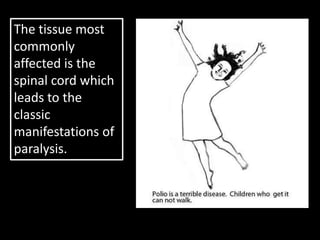
The tissue most
commonly
affected is the
spinal cord which
leads to the
classic
manifestations of
paralysis.
Epidemiology
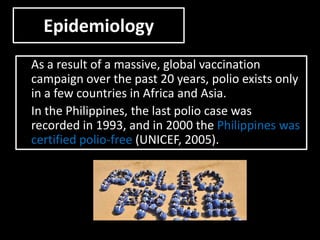
As a result of a massive, global vaccination
campaign over the past 20 years, polio exists only
in a few countries in Africa and Asia.
In the Philippines, the last polio case was
recorded in 1993, and in 2000 the Philippines was
certified polio-free (UNICEF, 2005).
Transmission

Person-to-person spread of poliovirus via the
fecal-oral route is the most important route of
transmission, although the oral-oral route may
account for some cases.
Risk Factors
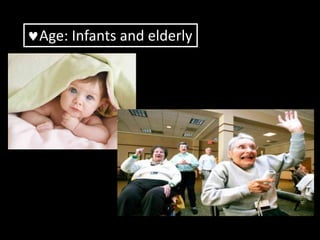
Age: Infants and elderly
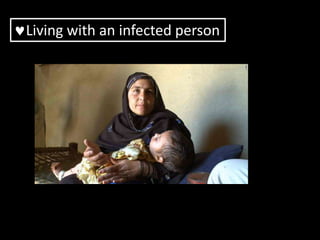
Living with an infected person
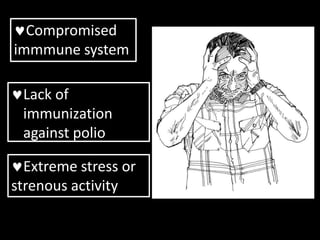
Compromised
immmune system

 Lack of
 immunization
 against polio

  Extreme stress or
strenous activity
Travel to an area that has
experienced a polio outbreak
Pathogenesis
The mouth is the portal of entry of the virus and
primary multiplication of the virus occurs at the site of
implantation in the pharynx and gastrointestinal tract.
The virus is usually present in the throat and in the
stools before the onset of illness. One week after onset
there is little virus in the throat, but virus continues to
be excreted in the stools for several weeks. The virus
invades local lymphoid tissue, enters the blood stream,
and then may infect cells of the central nervous
system. Replication of poliovirus in motor neurons of
the anterior horn and brain stem results in cell
destruction and causes the typical manifestations of
poliomyelitis.
Paralytic polio is classified into three types...

 Spinal polio - the most common, and accounted
 for 79% of paralytic cases from 1969-1979. It is
 characterized by asymmetric paralysis that most
 often involves the legs.
Bulbar polio - accounts for 2% of cases and leads
to weakness of muscles innervated by cranial
nerves.
Bulbospinal polio - it accounts for 19% of cases
and is a combination of bulbar and spinal
paralysis.
Clinical Features
 The incubation period for poliomyelitis is
 commonly 6 to 20 days with a range from 3 to
 35 days. The response to poliovirus infection is
 highly variable and has been categorized based
 on the severity of clinical presentation.
PATHOGNOMONIC SIGN


flaccid paralysis, weakness or paralysis and
reduced muscle tone.
• PATHOGNOMONIC SIGN
• flaccid paralysis, weakness or paralysis and
  reduced muscle tone.
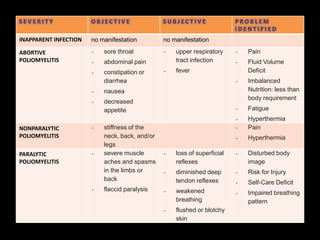
ASSESSMENT
INAPPARENT INFECTION   no manifestation         no manifestation

ABORTIVE               •   sore throat          •   upper respiratory     •   Pain
POLIOMYELITIS          •   abdominal pain           tract infection       •   Fluid Volume
                       •   constipation or      •   fever                     Deficit
                           diarrhea                                       •   Imbalanced
                       •   nausea                                             Nutrition: less than
                                                                              body requirement
                       •   decreased
                           appetite                                       •   Fatigue
                                                                          •   Hyperthermia
NONPARALYTIC           •   stiffness of the                               •   Pain
POLIOMYELITIS              neck, back, and/or                             •   Hyperthermia
                           legs
PARALYTIC              •   severe muscle        •   loss of superficial   •   Disturbed body
POLIOMYELITIS              aches and spasms         reflexes                  image
                           in the limbs or      •   diminished deep       •   Risk for Injury
                           back                     tendon reflexes       •   Self-Care Deficit
                       •   flaccid paralysis    •   weakened              •   Impaired breathing
                                                    breathing                 pattern
                                                •   flushed or blotchy
                                                    skin
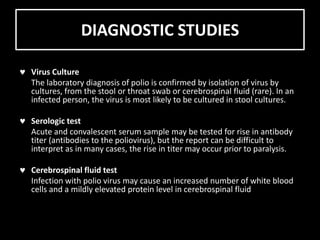
DIAGNOSTIC STUDIES

Virus Culture
The laboratory diagnosis of polio is confirmed by isolation of virus by
cultures, from the stool or throat swab or cerebrospinal fluid (rare). In an
infected person, the virus is most likely to be cultured in stool cultures.

Serologic test
Acute and convalescent serum sample may be tested for rise in antibody
titer (antibodies to the poliovirus), but the report can be difficult to
interpret as in many cases, the rise in titer may occur prior to paralysis.

Cerebrospinal fluid test
Infection with polio virus may cause an increased number of white blood
cells and a mildly elevated protein level in cerebrospinal fluid
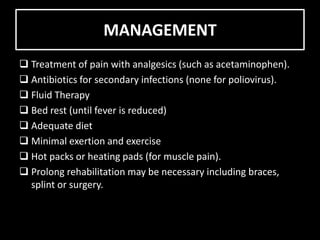
MANAGEMENT
 Treatment of pain with analgesics (such as acetaminophen).
 Antibiotics for secondary infections (none for poliovirus).
 Fluid Therapy
 Bed rest (until fever is reduced)
 Adequate diet
 Minimal exertion and exercise
 Hot packs or heating pads (for muscle pain).
 Prolong rehabilitation may be necessary including braces,
  splint or surgery.
MANAGEMENT
Hospitalization (may be required for those
 individuals who develop paralytic poliomyelitis).
If the respiratory is involved, LONG-TERM
 VENTILATION is necessary.
Physiotherapy may be necessary.
Place the child on firm mattress with support for
 feet, change position frequently.
Encourage oral intake of food and fluid.
Catheterization of distended bladder may be
 necessary.
PREVENTION
• The best preventive measure for poliomyelitis
  is ensuring hygiene and encouraging good
  sanitation practices. But, polio prevention
  begins with polio vaccination. Polio vaccine
  has been developed against all 3 subtypes of
  the poliovirus and is very effective in
  producing protective antibodies that induces
  immunity against the poliovirus and provides
  protection from paralytic polio.
Two types of vaccine are available:
 an inactivated (killed) polio vaccine (IPV) and
 a live attenuated (weakened) oral polio
  vaccine (OPV).
ADVANTAGES                        DISADVANTAGES
Inactivated Polio Vaccine   It is inactivated, so it cannot   Requires injection
                            replicate, and cannot be          More expensive
                            shed in the stool of a            Produces less local
                            vaccinated person.                gastrointestinal immunity
                            It cannot cause vaccine           Recipients could become
                            associated paralysis, and is      infected with wild polio
                            safe to use in                    virus
                            immunodeficient persons
                            or in household contacts of
                            immunodeficient persons.


Oral Polio Vaccine          It is very easy to administer     May cause vaccine-
                            Less expensive                    associated paralytic polio
                            Produces excellent
                            intestinal immunity which
                            helps
                            Prevent infection with wild
                            virus
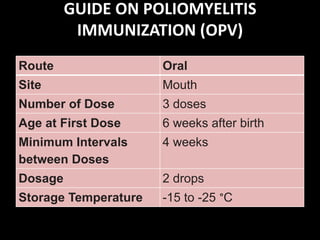
GUIDE ON POLIOMYELITIS
          IMMUNIZATION (OPV)
Route                 Oral
Site                  Mouth
Number of Dose        3 doses
Age at First Dose     6 weeks after birth
Minimum Intervals     4 weeks
between Doses
Dosage                2 drops
Storage Temperature   -15 to -25 °C
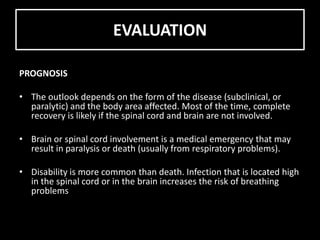
EVALUATION

PROGNOSIS

• The outlook depends on the form of the disease (subclinical, or
  paralytic) and the body area affected. Most of the time, complete
  recovery is likely if the spinal cord and brain are not involved.

• Brain or spinal cord involvement is a medical emergency that may
  result in paralysis or death (usually from respiratory problems).

• Disability is more common than death. Infection that is located high
  in the spinal cord or in the brain increases the risk of breathing
  problems

Poliomyelitis

  • 2.
    Poliomyelitis Often called polioor infantile paralysis, is an infectious disease caused by a virus.
  • 3.
    This virus isa member of the enterovirus subgroup of the Picornaviridae family and has three serotypes: PV1, PV2 and PV3.
  • 4.
    The tissue most commonly affectedis the spinal cord which leads to the classic manifestations of paralysis.
  • 5.
    Epidemiology As a resultof a massive, global vaccination campaign over the past 20 years, polio exists only in a few countries in Africa and Asia. In the Philippines, the last polio case was recorded in 1993, and in 2000 the Philippines was certified polio-free (UNICEF, 2005).
  • 6.
    Transmission Person-to-person spread ofpoliovirus via the fecal-oral route is the most important route of transmission, although the oral-oral route may account for some cases.
  • 7.
  • 8.
  • 9.
    Living with aninfected person
  • 10.
    Compromised immmune system Lackof immunization against polio Extreme stress or strenous activity
  • 11.
    Travel to anarea that has experienced a polio outbreak
  • 12.
    Pathogenesis The mouth isthe portal of entry of the virus and primary multiplication of the virus occurs at the site of implantation in the pharynx and gastrointestinal tract. The virus is usually present in the throat and in the stools before the onset of illness. One week after onset there is little virus in the throat, but virus continues to be excreted in the stools for several weeks. The virus invades local lymphoid tissue, enters the blood stream, and then may infect cells of the central nervous system. Replication of poliovirus in motor neurons of the anterior horn and brain stem results in cell destruction and causes the typical manifestations of poliomyelitis.
  • 13.
    Paralytic polio isclassified into three types... Spinal polio - the most common, and accounted for 79% of paralytic cases from 1969-1979. It is characterized by asymmetric paralysis that most often involves the legs. Bulbar polio - accounts for 2% of cases and leads to weakness of muscles innervated by cranial nerves. Bulbospinal polio - it accounts for 19% of cases and is a combination of bulbar and spinal paralysis.
  • 14.
    Clinical Features Theincubation period for poliomyelitis is commonly 6 to 20 days with a range from 3 to 35 days. The response to poliovirus infection is highly variable and has been categorized based on the severity of clinical presentation.
  • 15.
    PATHOGNOMONIC SIGN flaccid paralysis,weakness or paralysis and reduced muscle tone.
  • 16.
    • PATHOGNOMONIC SIGN •flaccid paralysis, weakness or paralysis and reduced muscle tone.
  • 17.
  • 18.
    INAPPARENT INFECTION no manifestation no manifestation ABORTIVE • sore throat • upper respiratory • Pain POLIOMYELITIS • abdominal pain tract infection • Fluid Volume • constipation or • fever Deficit diarrhea • Imbalanced • nausea Nutrition: less than body requirement • decreased appetite • Fatigue • Hyperthermia NONPARALYTIC • stiffness of the • Pain POLIOMYELITIS neck, back, and/or • Hyperthermia legs PARALYTIC • severe muscle • loss of superficial • Disturbed body POLIOMYELITIS aches and spasms reflexes image in the limbs or • diminished deep • Risk for Injury back tendon reflexes • Self-Care Deficit • flaccid paralysis • weakened • Impaired breathing breathing pattern • flushed or blotchy skin
  • 19.
    DIAGNOSTIC STUDIES Virus Culture Thelaboratory diagnosis of polio is confirmed by isolation of virus by cultures, from the stool or throat swab or cerebrospinal fluid (rare). In an infected person, the virus is most likely to be cultured in stool cultures. Serologic test Acute and convalescent serum sample may be tested for rise in antibody titer (antibodies to the poliovirus), but the report can be difficult to interpret as in many cases, the rise in titer may occur prior to paralysis. Cerebrospinal fluid test Infection with polio virus may cause an increased number of white blood cells and a mildly elevated protein level in cerebrospinal fluid
  • 20.
    MANAGEMENT  Treatment ofpain with analgesics (such as acetaminophen).  Antibiotics for secondary infections (none for poliovirus).  Fluid Therapy  Bed rest (until fever is reduced)  Adequate diet  Minimal exertion and exercise  Hot packs or heating pads (for muscle pain).  Prolong rehabilitation may be necessary including braces, splint or surgery.
  • 21.
    MANAGEMENT Hospitalization (may berequired for those individuals who develop paralytic poliomyelitis). If the respiratory is involved, LONG-TERM VENTILATION is necessary. Physiotherapy may be necessary. Place the child on firm mattress with support for feet, change position frequently. Encourage oral intake of food and fluid. Catheterization of distended bladder may be necessary.
  • 22.
    PREVENTION • The bestpreventive measure for poliomyelitis is ensuring hygiene and encouraging good sanitation practices. But, polio prevention begins with polio vaccination. Polio vaccine has been developed against all 3 subtypes of the poliovirus and is very effective in producing protective antibodies that induces immunity against the poliovirus and provides protection from paralytic polio.
  • 23.
    Two types ofvaccine are available:  an inactivated (killed) polio vaccine (IPV) and  a live attenuated (weakened) oral polio vaccine (OPV).
  • 24.
    ADVANTAGES DISADVANTAGES Inactivated Polio Vaccine It is inactivated, so it cannot Requires injection replicate, and cannot be More expensive shed in the stool of a Produces less local vaccinated person. gastrointestinal immunity It cannot cause vaccine Recipients could become associated paralysis, and is infected with wild polio safe to use in virus immunodeficient persons or in household contacts of immunodeficient persons. Oral Polio Vaccine It is very easy to administer May cause vaccine- Less expensive associated paralytic polio Produces excellent intestinal immunity which helps Prevent infection with wild virus
  • 25.
    GUIDE ON POLIOMYELITIS IMMUNIZATION (OPV) Route Oral Site Mouth Number of Dose 3 doses Age at First Dose 6 weeks after birth Minimum Intervals 4 weeks between Doses Dosage 2 drops Storage Temperature -15 to -25 °C
  • 26.
    EVALUATION PROGNOSIS • The outlookdepends on the form of the disease (subclinical, or paralytic) and the body area affected. Most of the time, complete recovery is likely if the spinal cord and brain are not involved. • Brain or spinal cord involvement is a medical emergency that may result in paralysis or death (usually from respiratory problems). • Disability is more common than death. Infection that is located high in the spinal cord or in the brain increases the risk of breathing problems