IMMUNISATION
PROGRAM IN INDIA
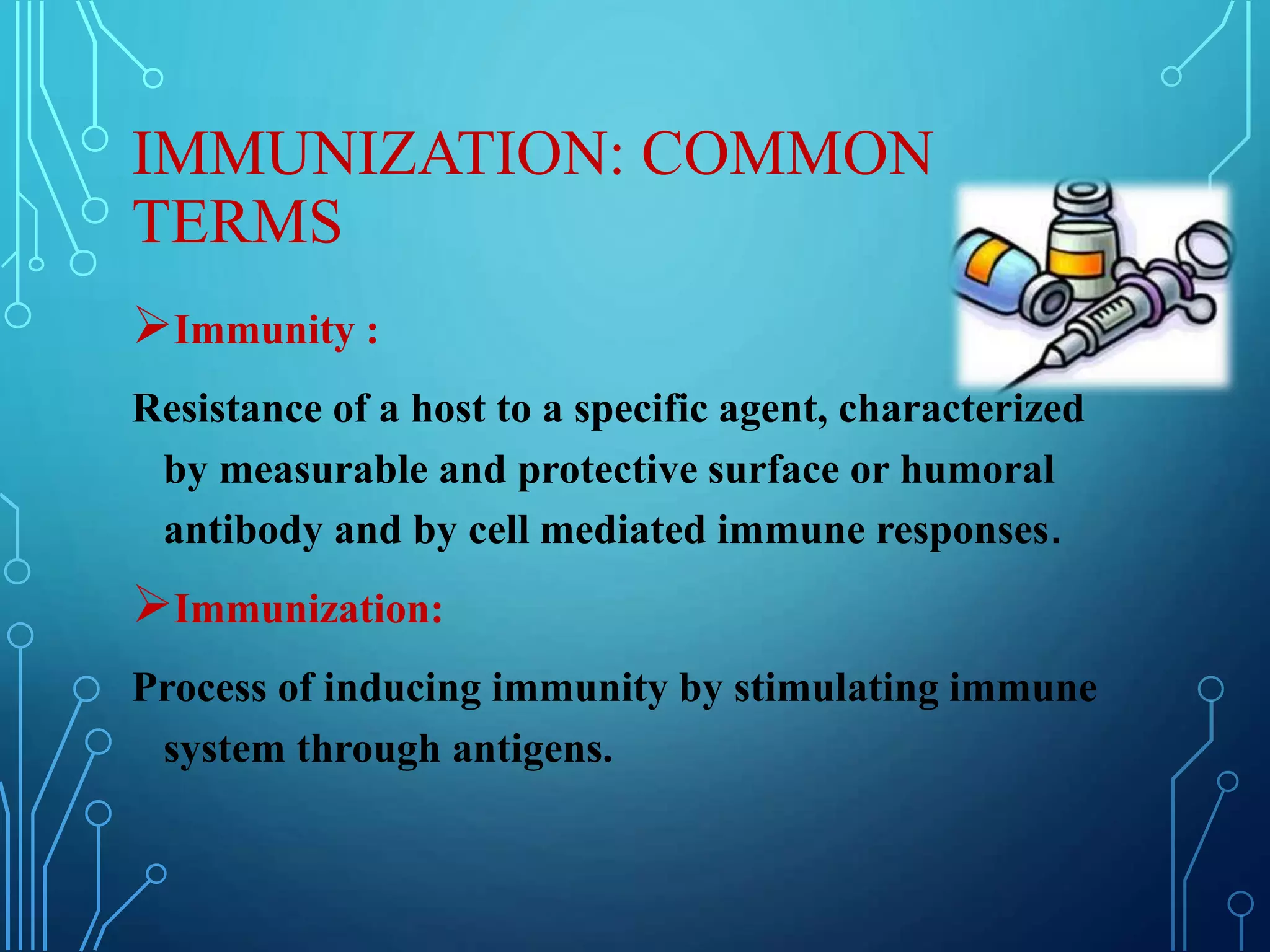
IMMUNIZATION: COMMON
TERMS
Immunity :
Resistance of a host to a specific agent, characterized
by measurable and protective surface or humoral
antibody and by cell mediated immune responses.
Immunization:
Process of inducing immunity by stimulating immune
system through antigens.
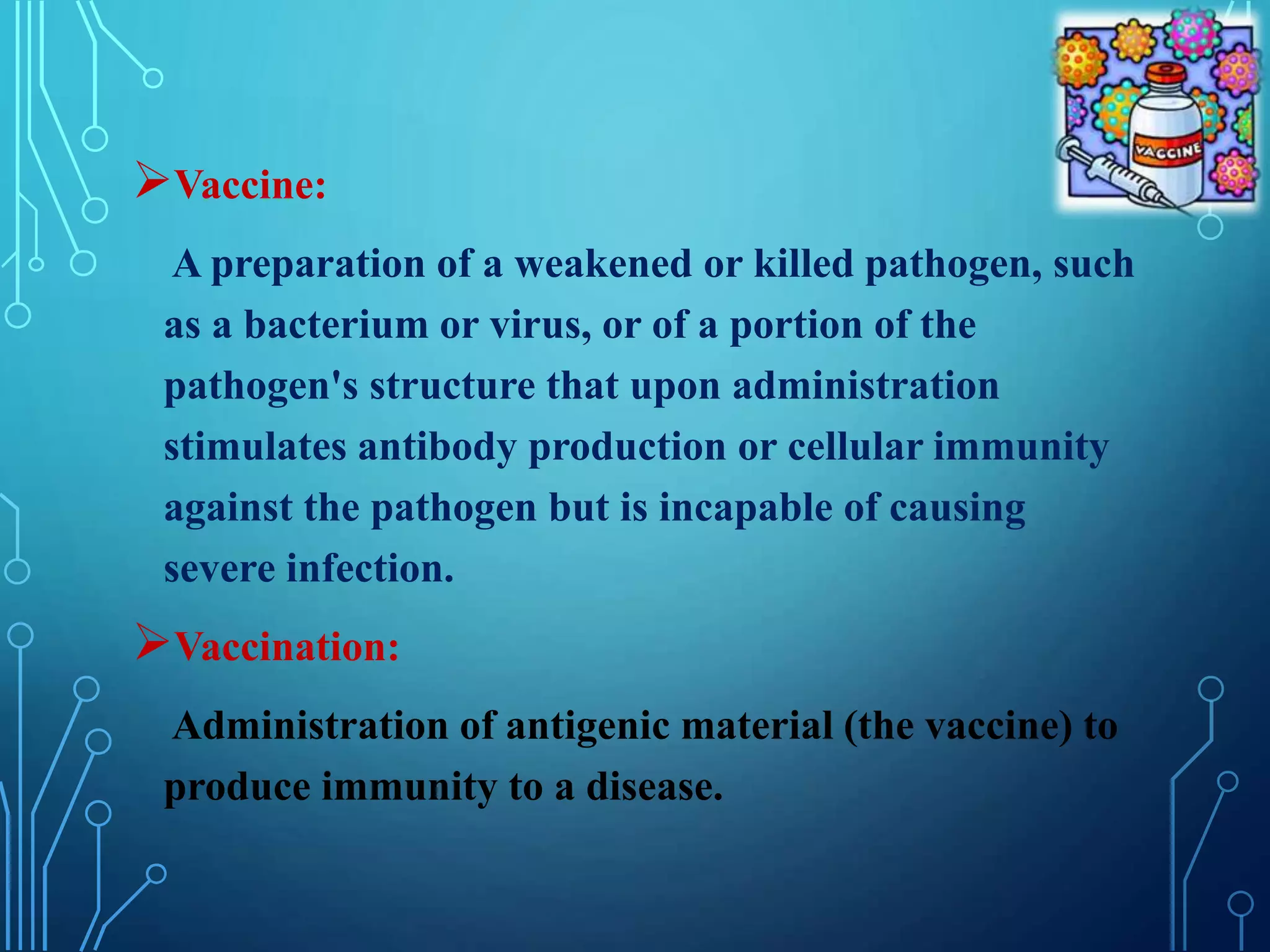
Vaccine:
A preparation of a weakened or killed pathogen, such
as a bacterium or virus, or of a portion of the
pathogen's structure that upon administration
stimulates antibody production or cellular immunity
against the pathogen but is incapable of causing
severe infection.
Vaccination:
Administration of antigenic material (the vaccine) to
produce immunity to a disease.
Ring immunization:
Vaccination of people in close contact with an
isolated infected patient.
Catch up rounds:
Additional effort besides routine immunization to
cover left outs
Mop-up rounds:
When the final pockets of polio virus transmission
have been identified through standard surveillance,
door-to-door immunization in high-risk districts.
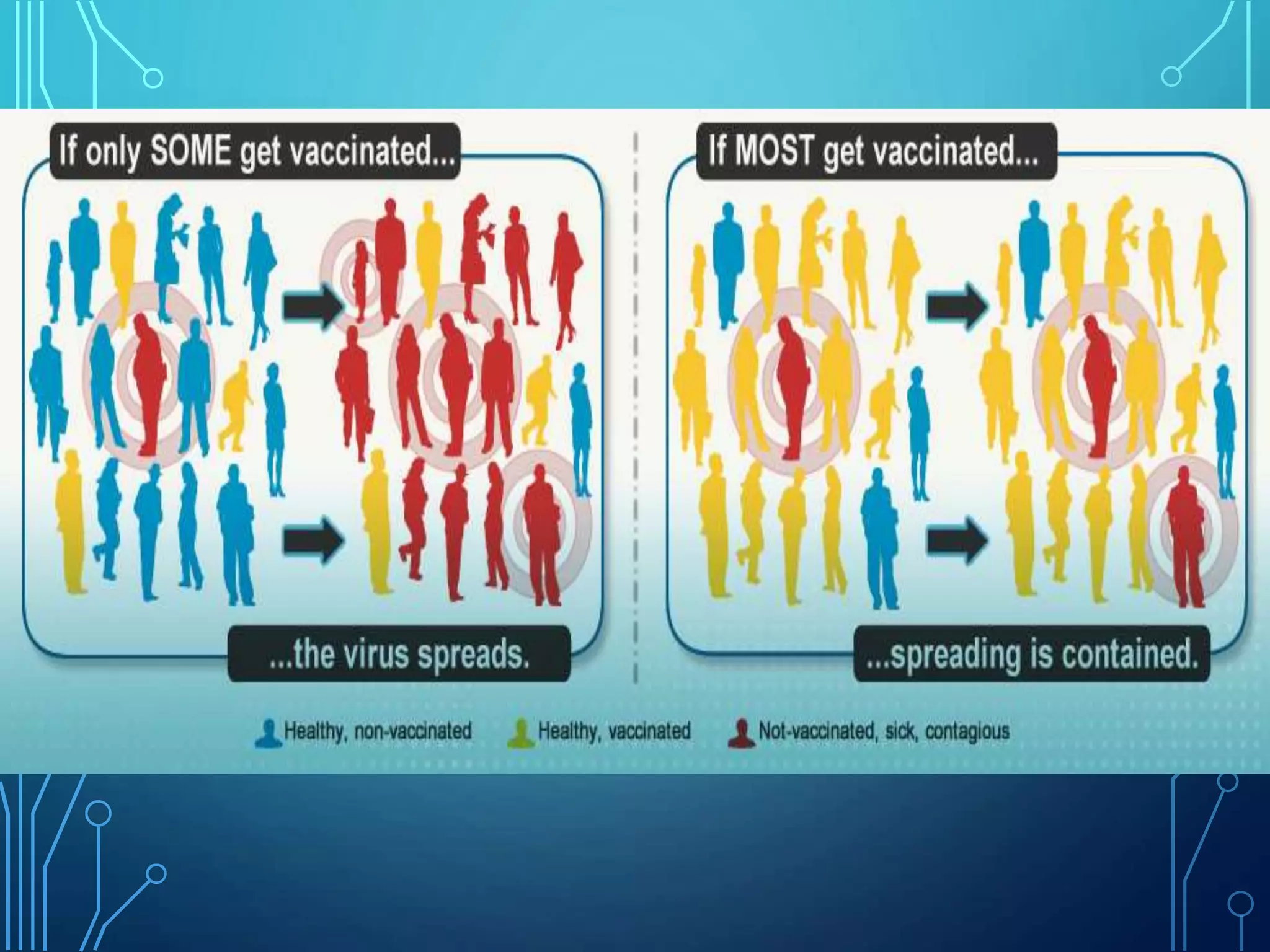
HERD IMMUNITY?
Resistance to spread of infectious disease in a group
because of few susceptible members, making
transmission unlikely.
The immunologic status of a population, determined
by the ratio of resistant to susceptible members and
their distribution.
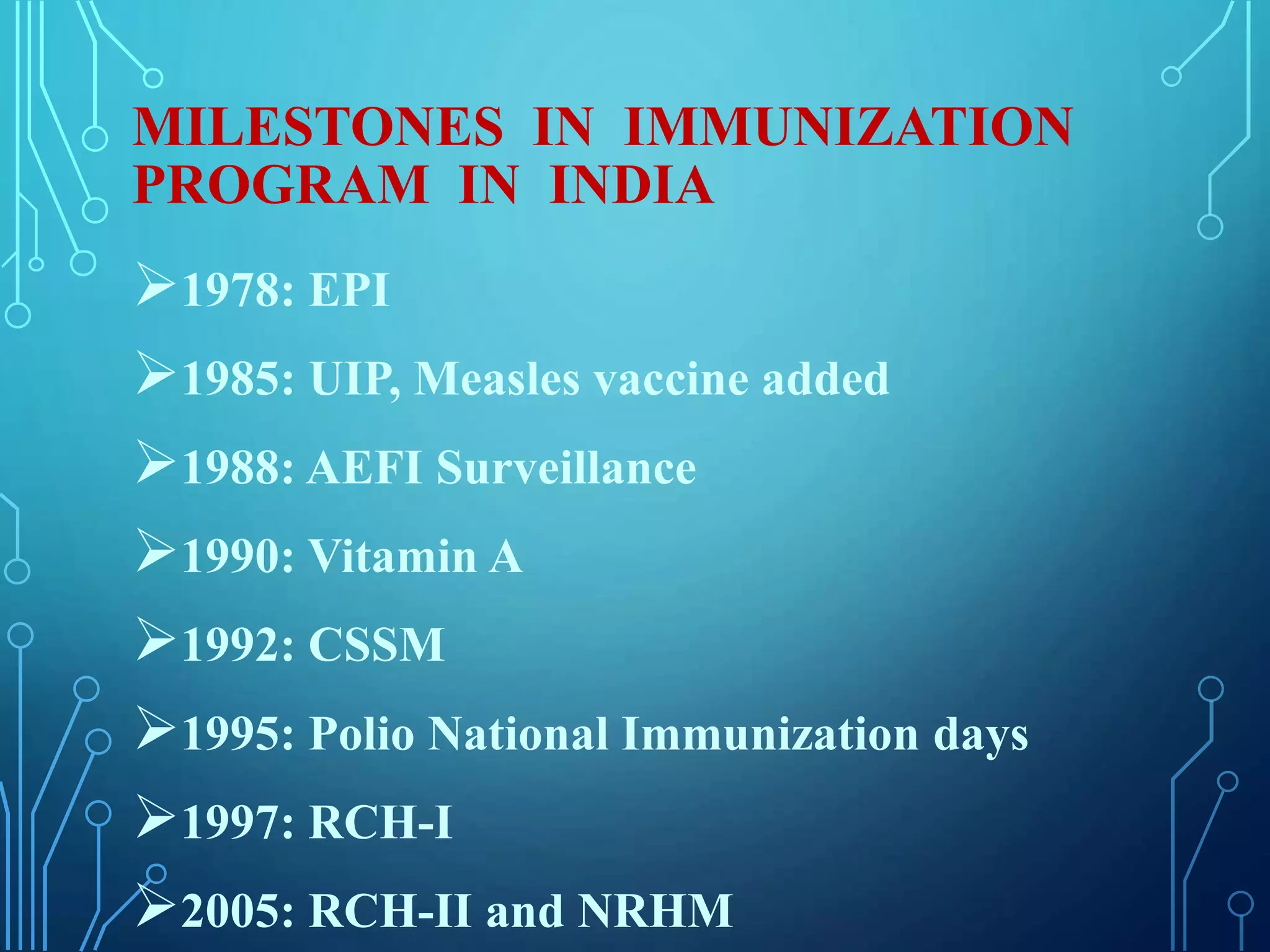
MILESTONES IN IMMUNIZATION
PROGRAM IN INDIA
1978: EPI
1985: UIP, Measles vaccine added
1988: AEFI Surveillance
1990: Vitamin A
1992: CSSM
1995: Polio National Immunization days
1997: RCH-I
2005: RCH-II and NRHM
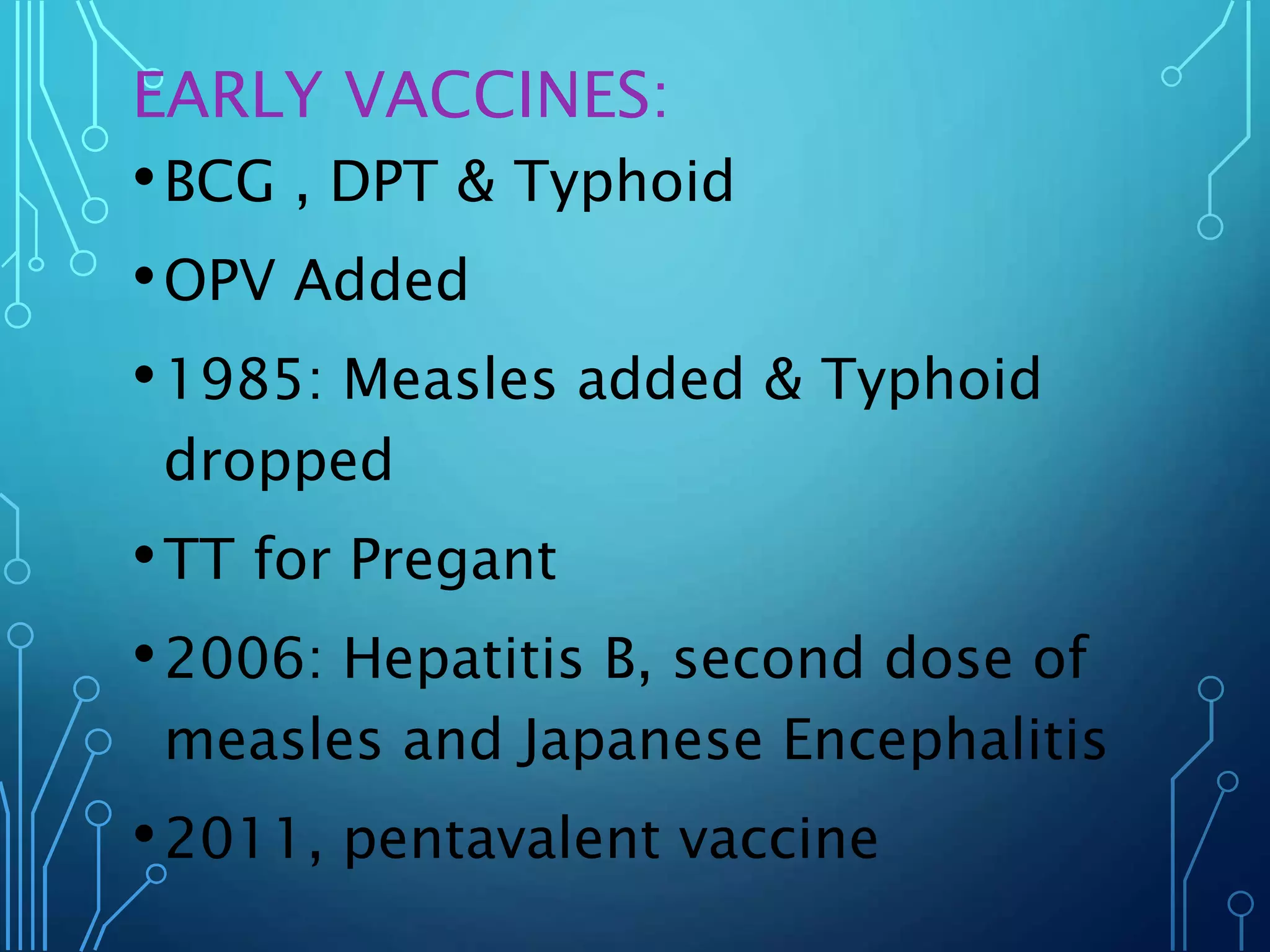
EARLY VACCINES:
•BCG , DPT & Typhoid
•OPV Added
•1985: Measles added & Typhoid
dropped
•TT for Pregant
•2006: Hepatitis B, second dose of
measles and Japanese Encephalitis
•2011, pentavalent vaccine
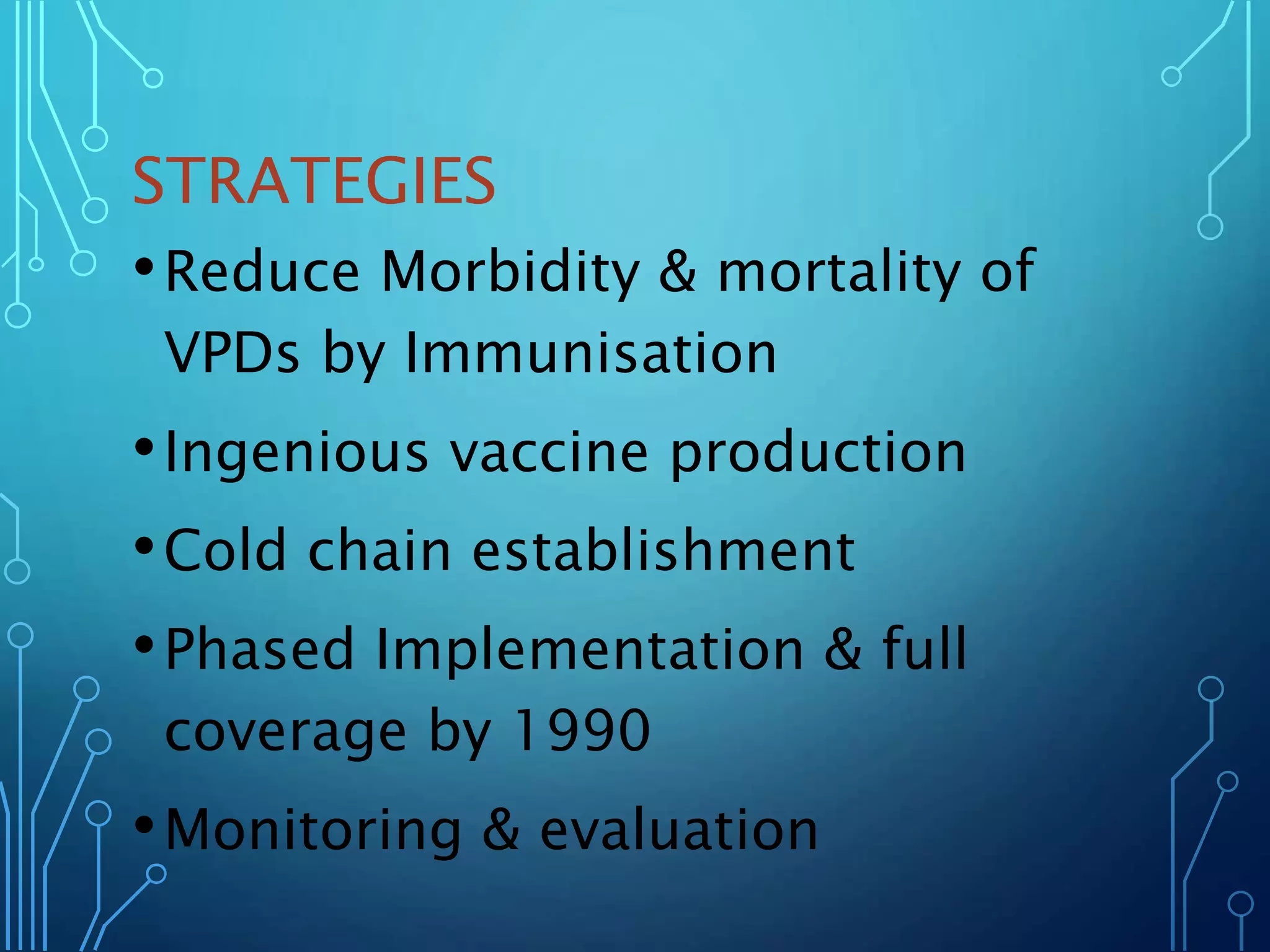
STRATEGIES
•Reduce Morbidity & mortality of
VPDs by Immunisation
•Ingenious vaccine production
•Cold chain establishment
•Phased Implementation & full
coverage by 1990
•Monitoring & evaluation
NATIONAL IMMUNISATION
SCHEDULE
EXERCISE FOR STUDENTS
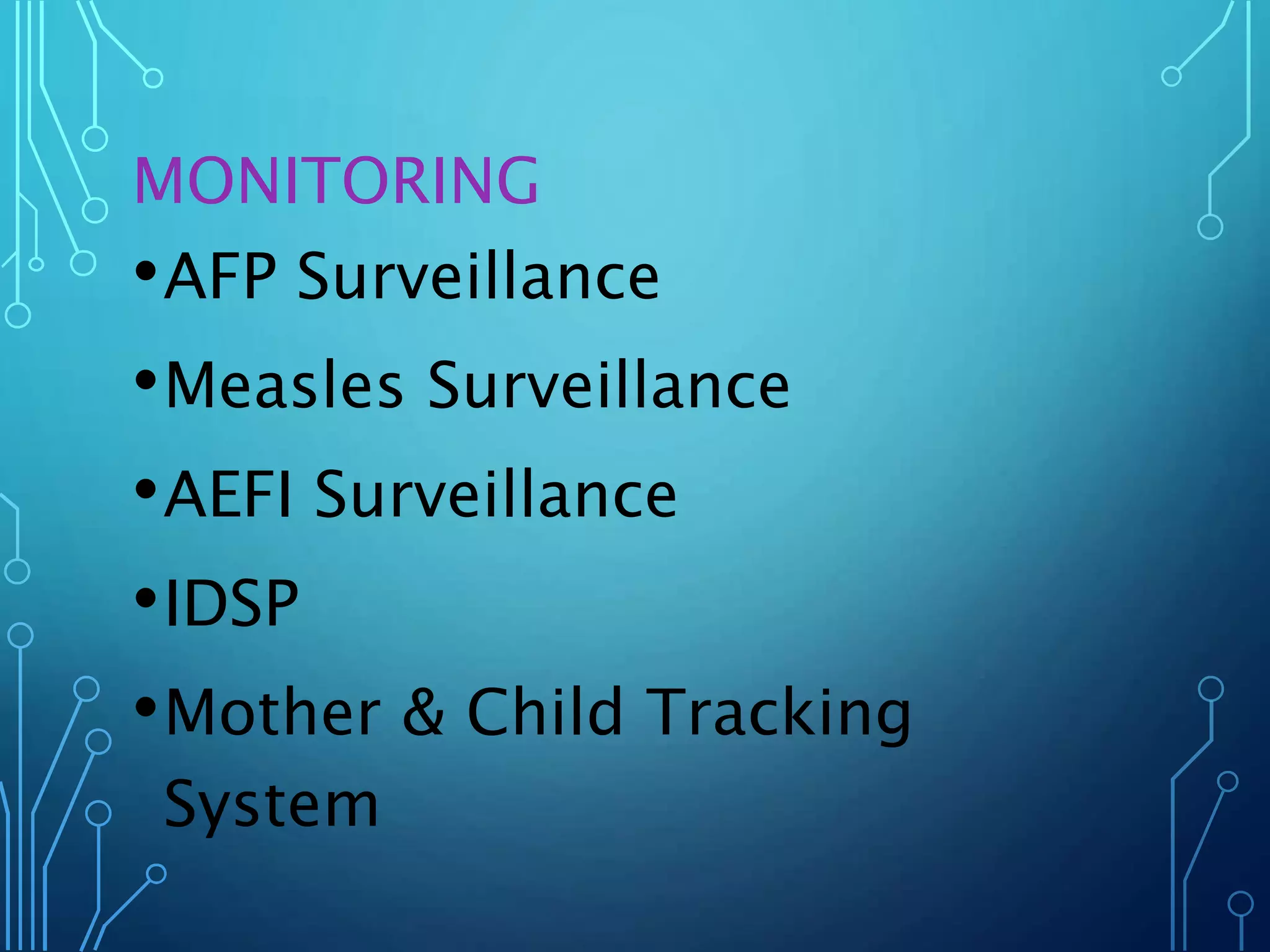
MONITORING
•AFP Surveillance
•Measles Surveillance
•AEFI Surveillance
•IDSP
•Mother & Child Tracking
System
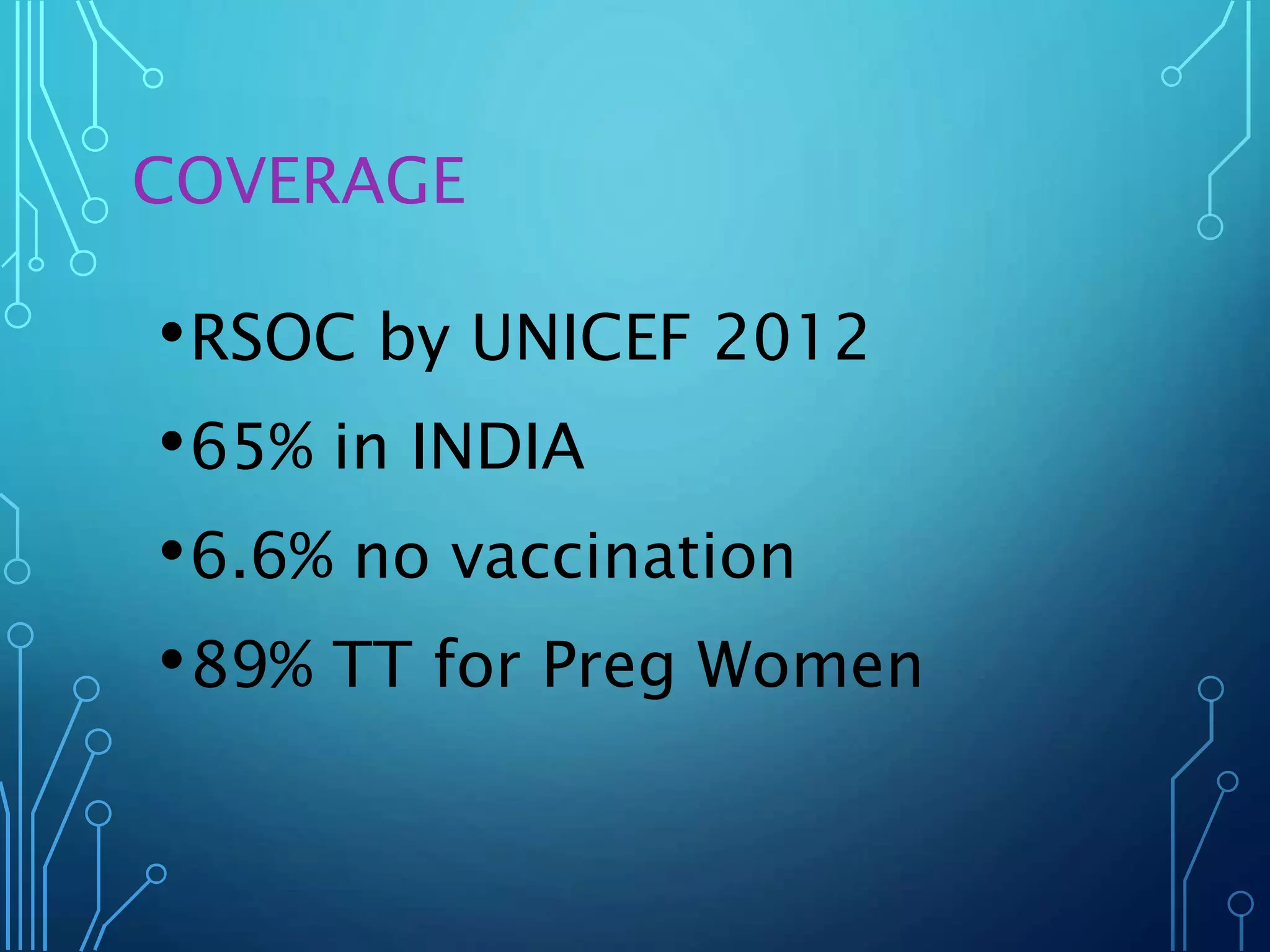
COVERAGE
•RSOC by UNICEF 2012
•65% in INDIA
•6.6% no vaccination
•89% TT for Preg Women
COLD CHAIN
COLD CHAIN
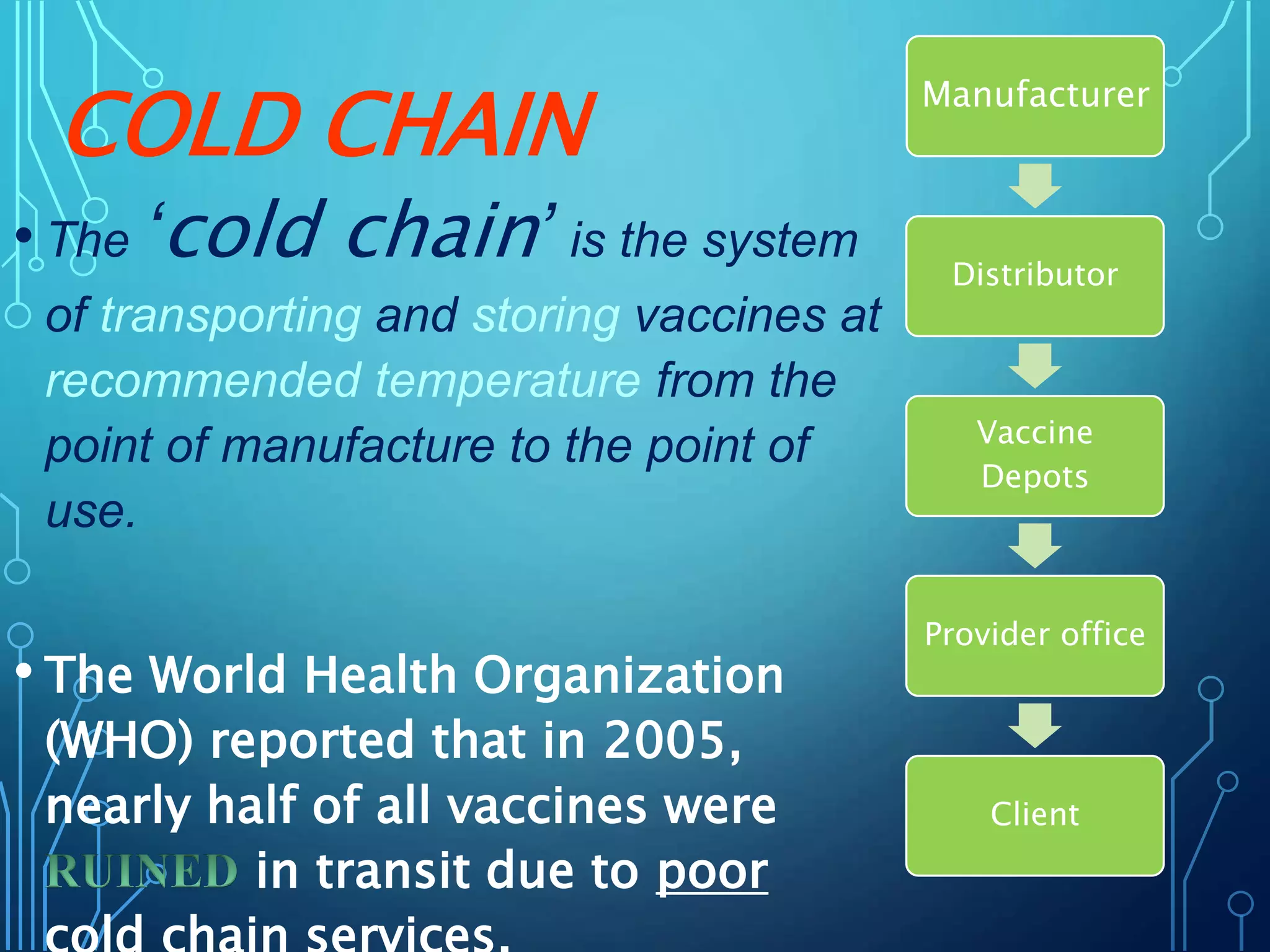
• The ‘cold chain’ is the system
of transporting and storing vaccines at
recommended temperature from the
point of manufacture to the point of
use.
• The World Health Organization
(WHO) reported that in 2005,
nearly half of all vaccines were
in transit due to poor
Manufacturer
Distributor
Vaccine
Depots
Provider office
Client
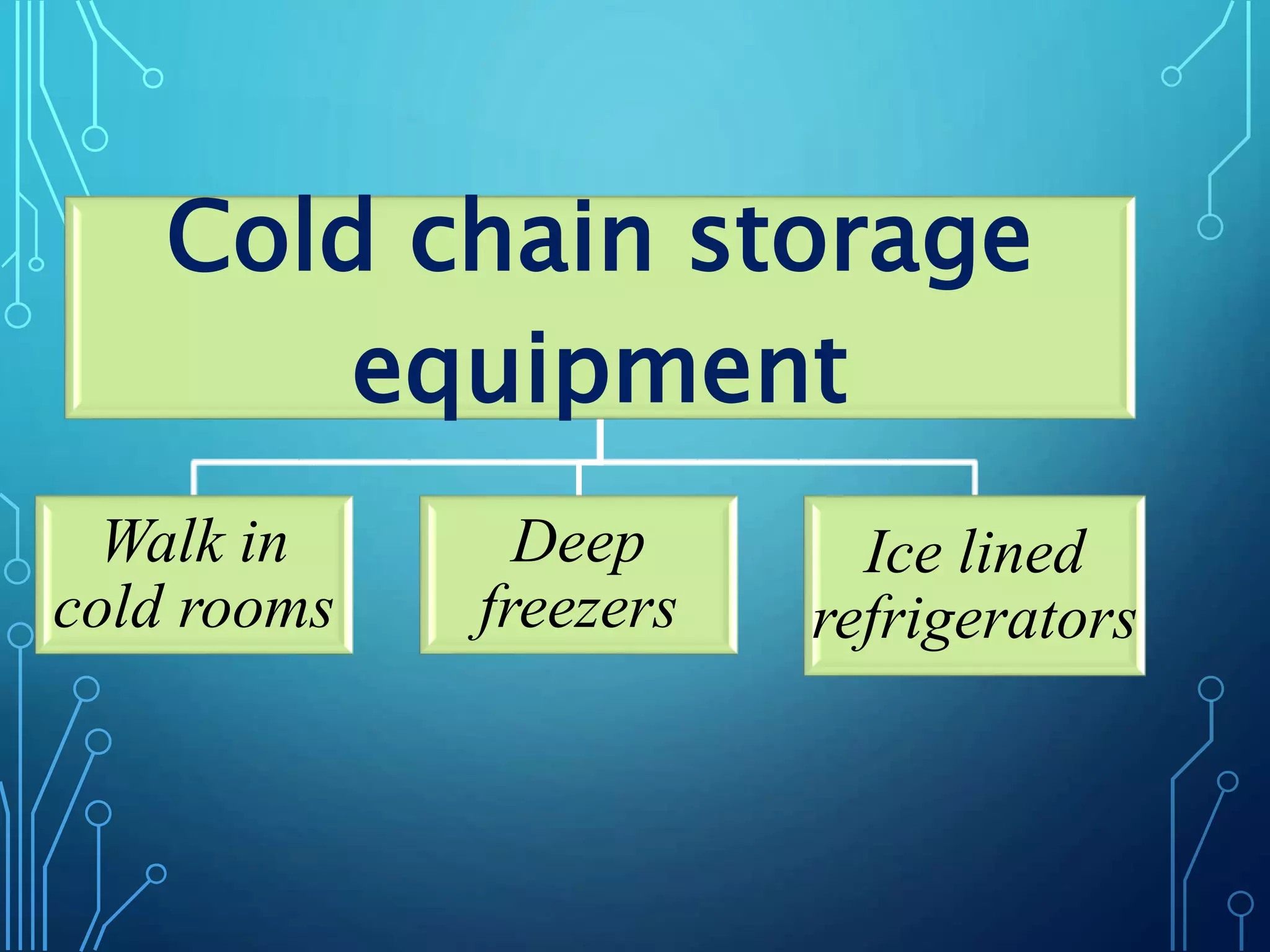
Cold chain storage
equipment
Walk in
cold rooms
Deep
freezers
Ice lined
refrigerators
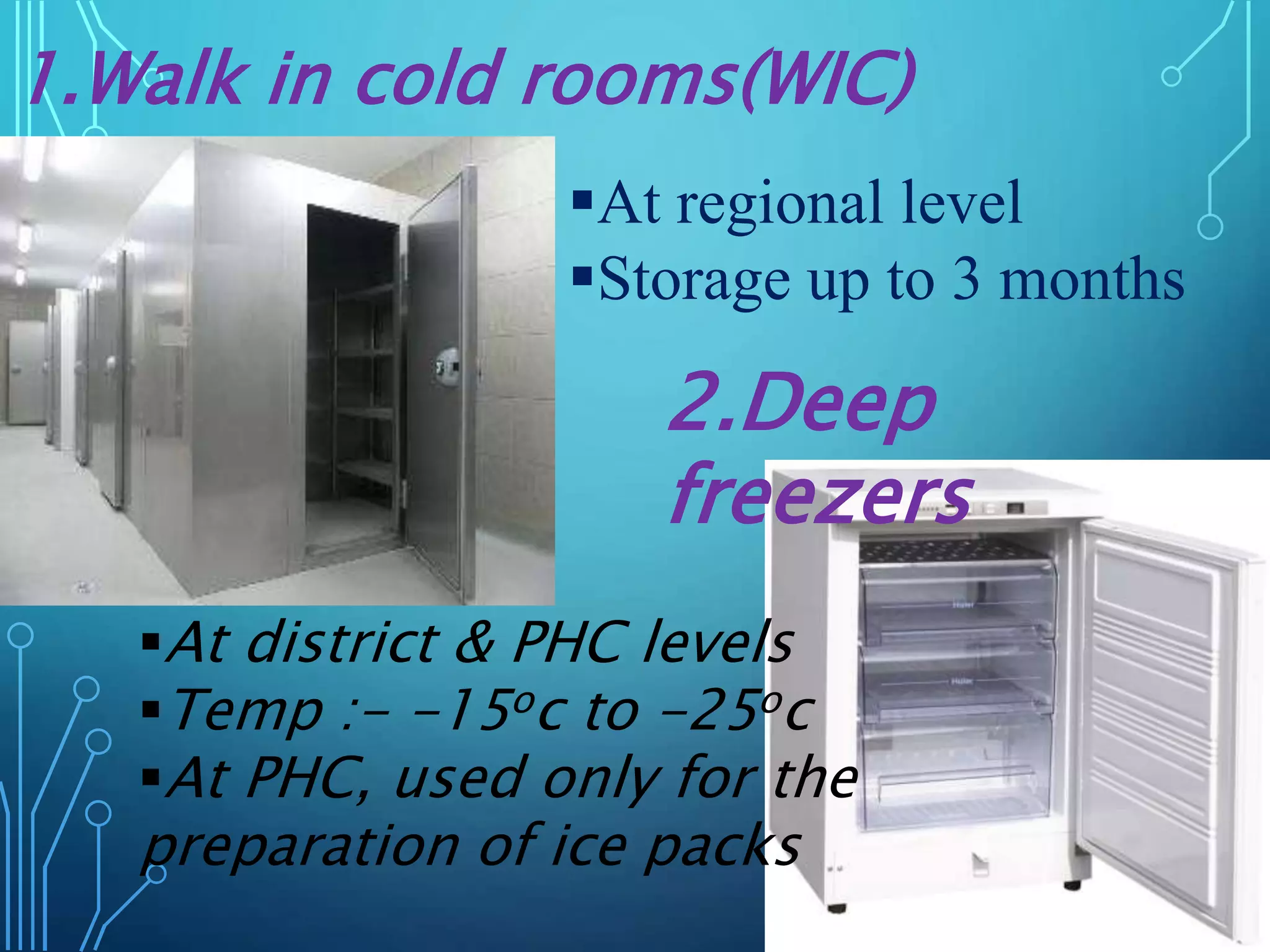
1.Walk in cold rooms(WIC)
At regional level
Storage up to 3 months
At district & PHC levels
Temp :- -15oc to -25oc
At PHC, used only for the
preparation of ice packs
2.Deep
freezers
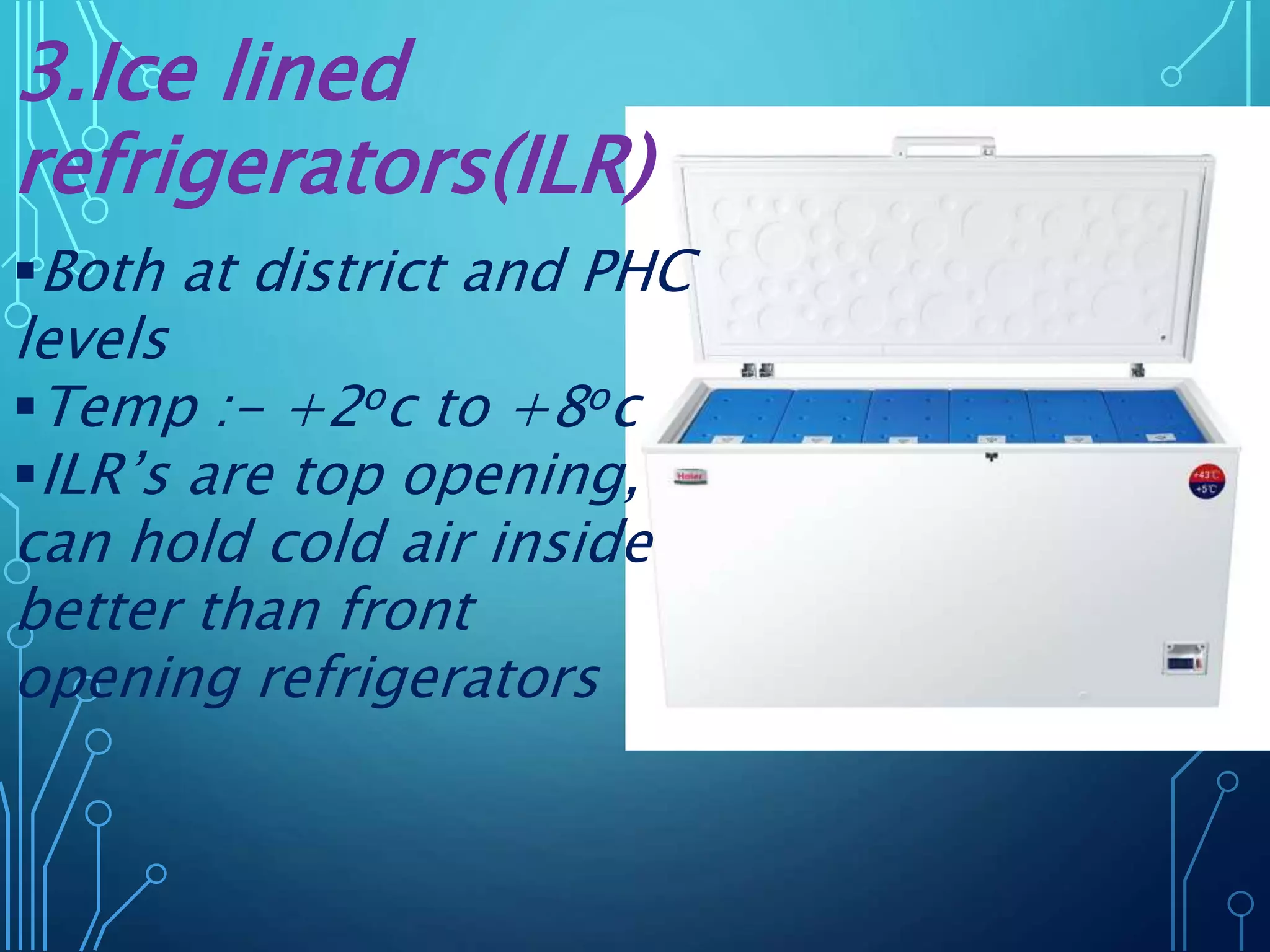
3.Ice lined
refrigerators(ILR)
Both at district and PHC
levels
Temp :- +2oc to +8oc
ILR’s are top opening,
can hold cold air inside
better than front
opening refrigerators
VACCINE
SENSITIVITY
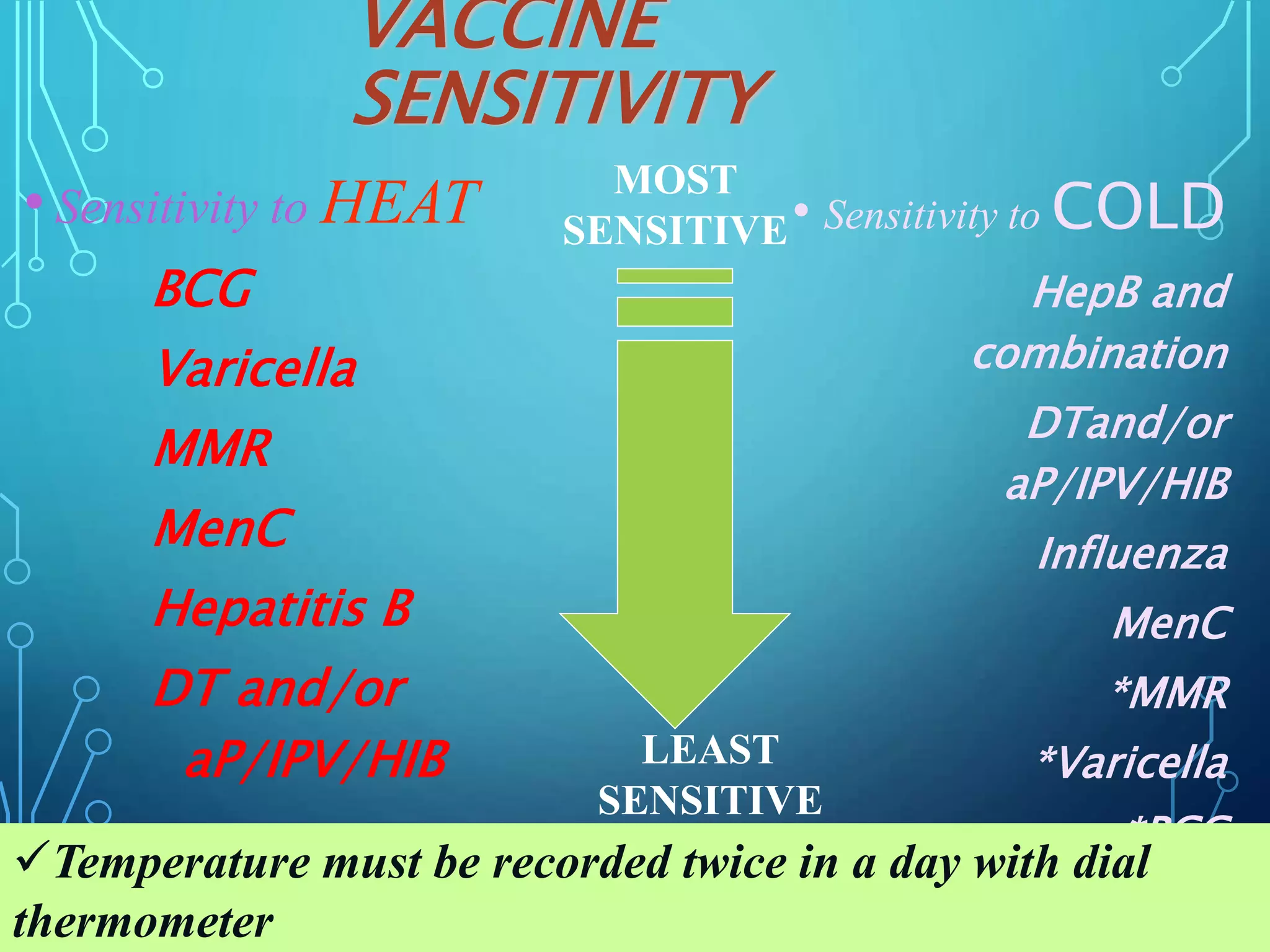
• Sensitivity to HEAT
BCG
Varicella
MMR
MenC
Hepatitis B
DT and/or
aP/IPV/HIB
• Sensitivity to COLD
HepB and
combination
DTand/or
aP/IPV/HIB
Influenza
MenC
*MMR
*Varicella
*BCG
(*Freeze
MOST
SENSITIVE
Temperature must be recorded twice in a day with dial
thermometer
LEAST
SENSITIVE
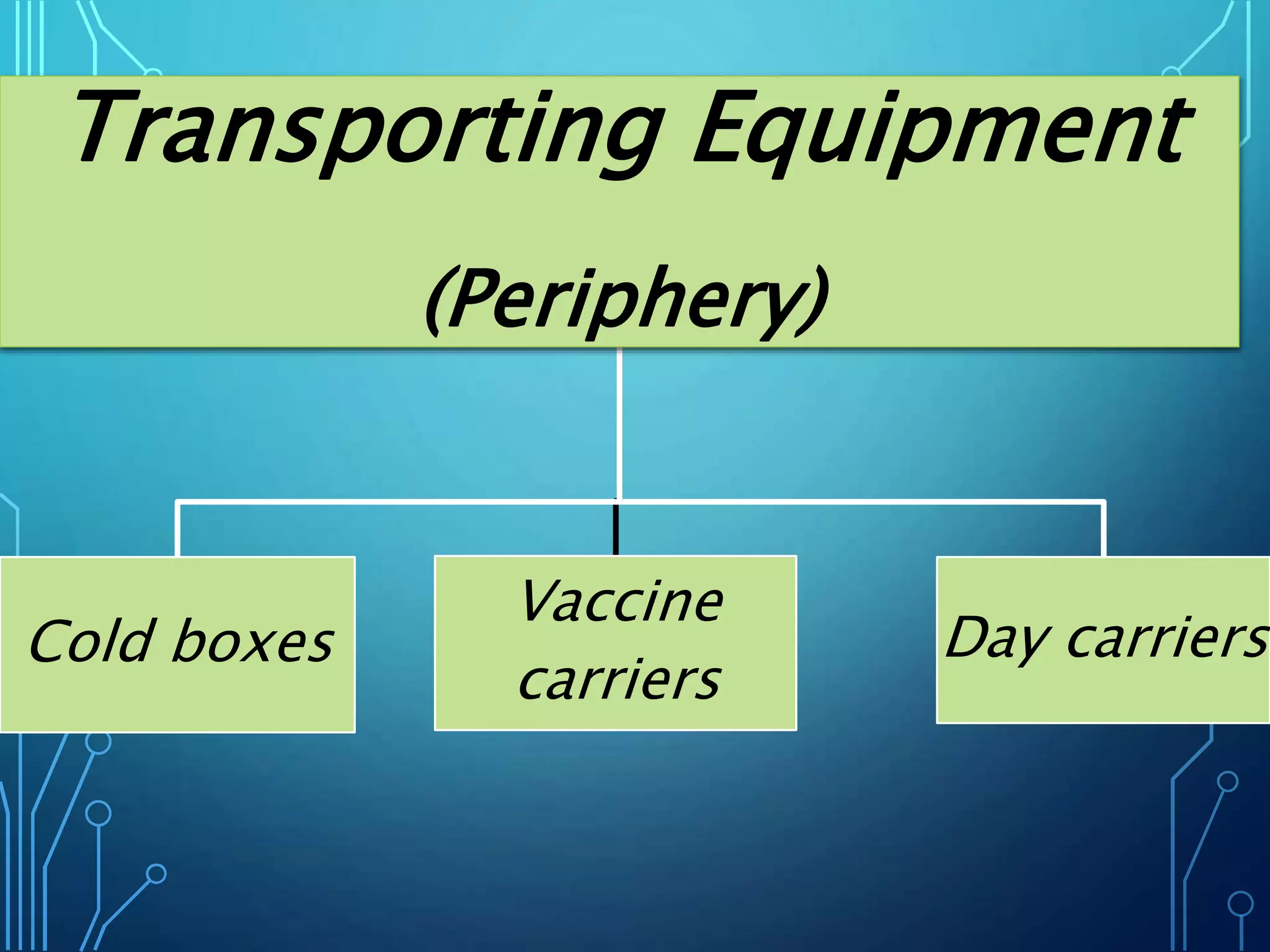
Transporting Equipment
(Periphery)
Cold boxes
Vaccine
carriers
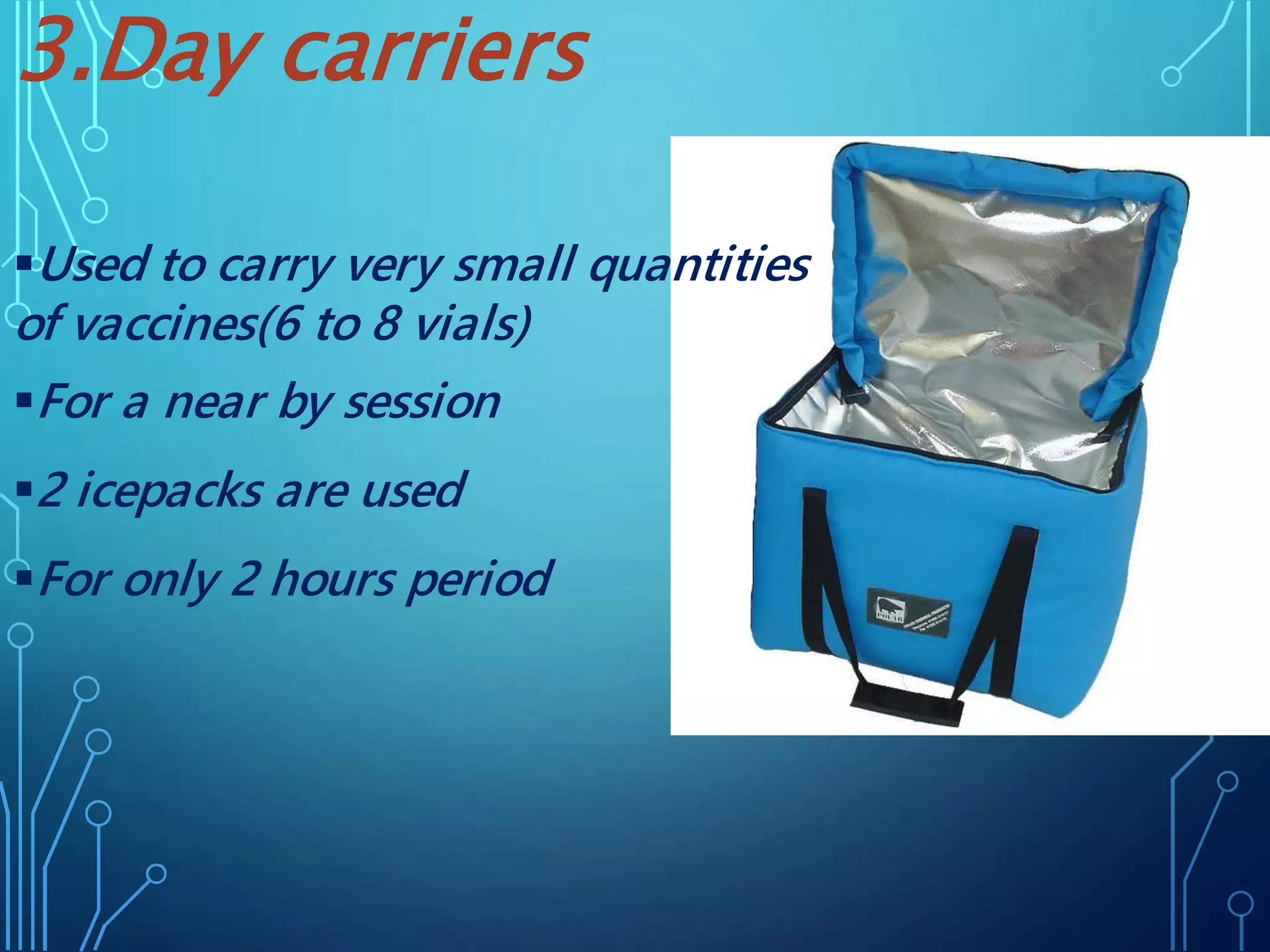
Day carriers
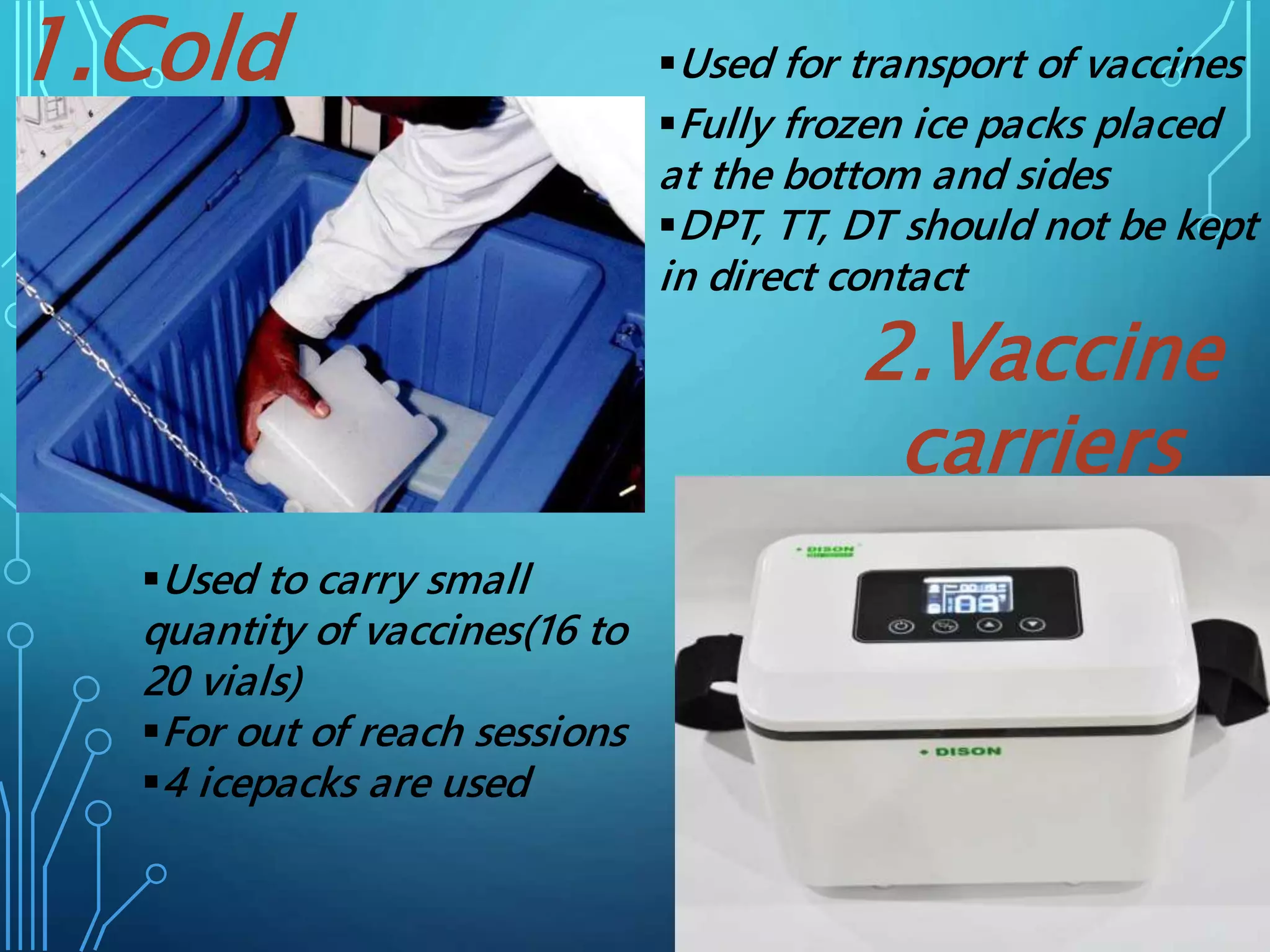
Used for transport of vaccines
Fully frozen ice packs placed
at the bottom and sides
DPT, TT, DT should not be kept
in direct contact
1.Cold
boxes
Used to carry small
quantity of vaccines(16 to
20 vials)
For out of reach sessions
4 icepacks are used
2.Vaccine
carriers
3.Day carriers
Used to carry very small quantities
of vaccines(6 to 8 vials)
For a near by session
2 icepacks are used
For only 2 hours period
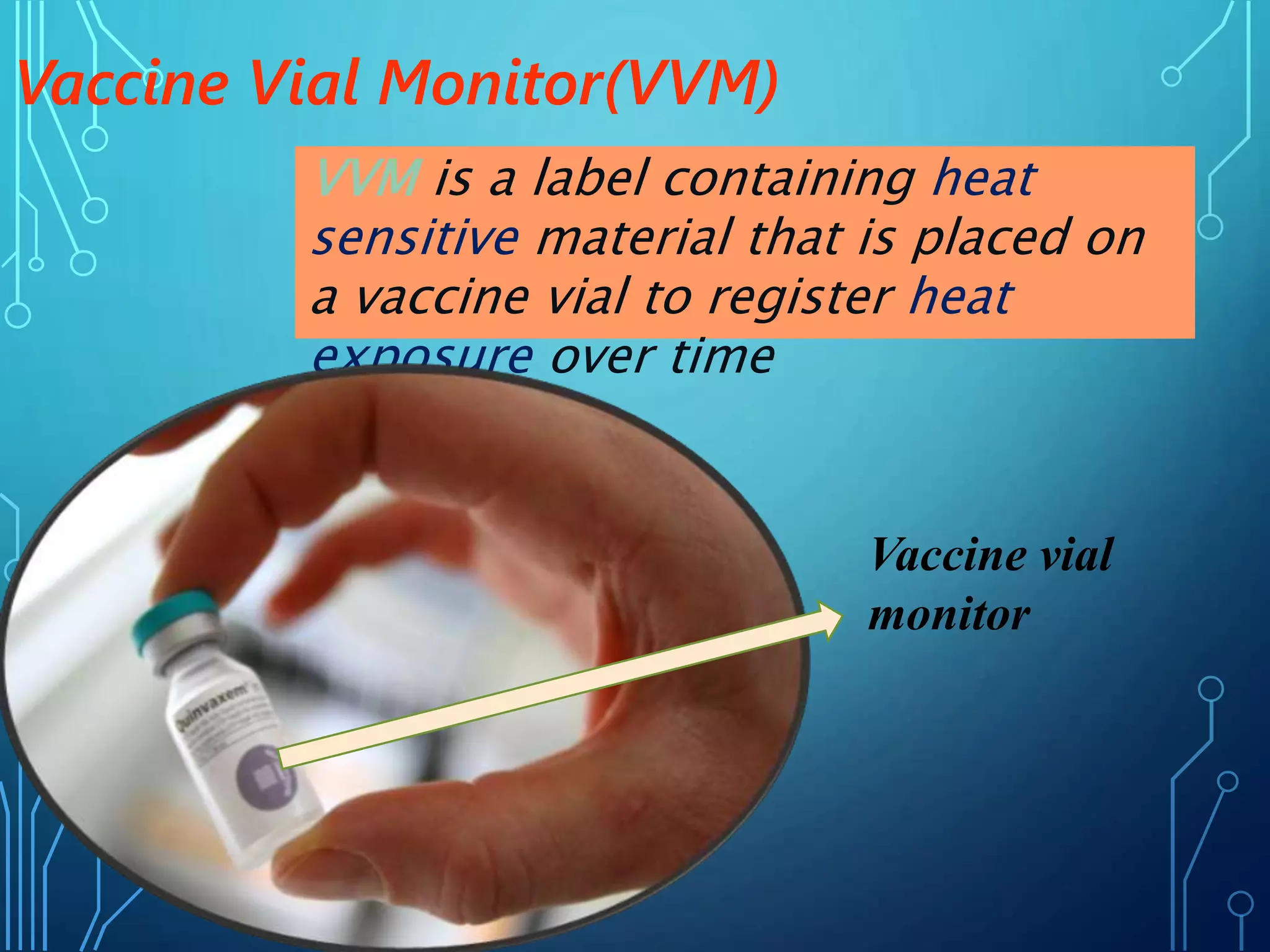
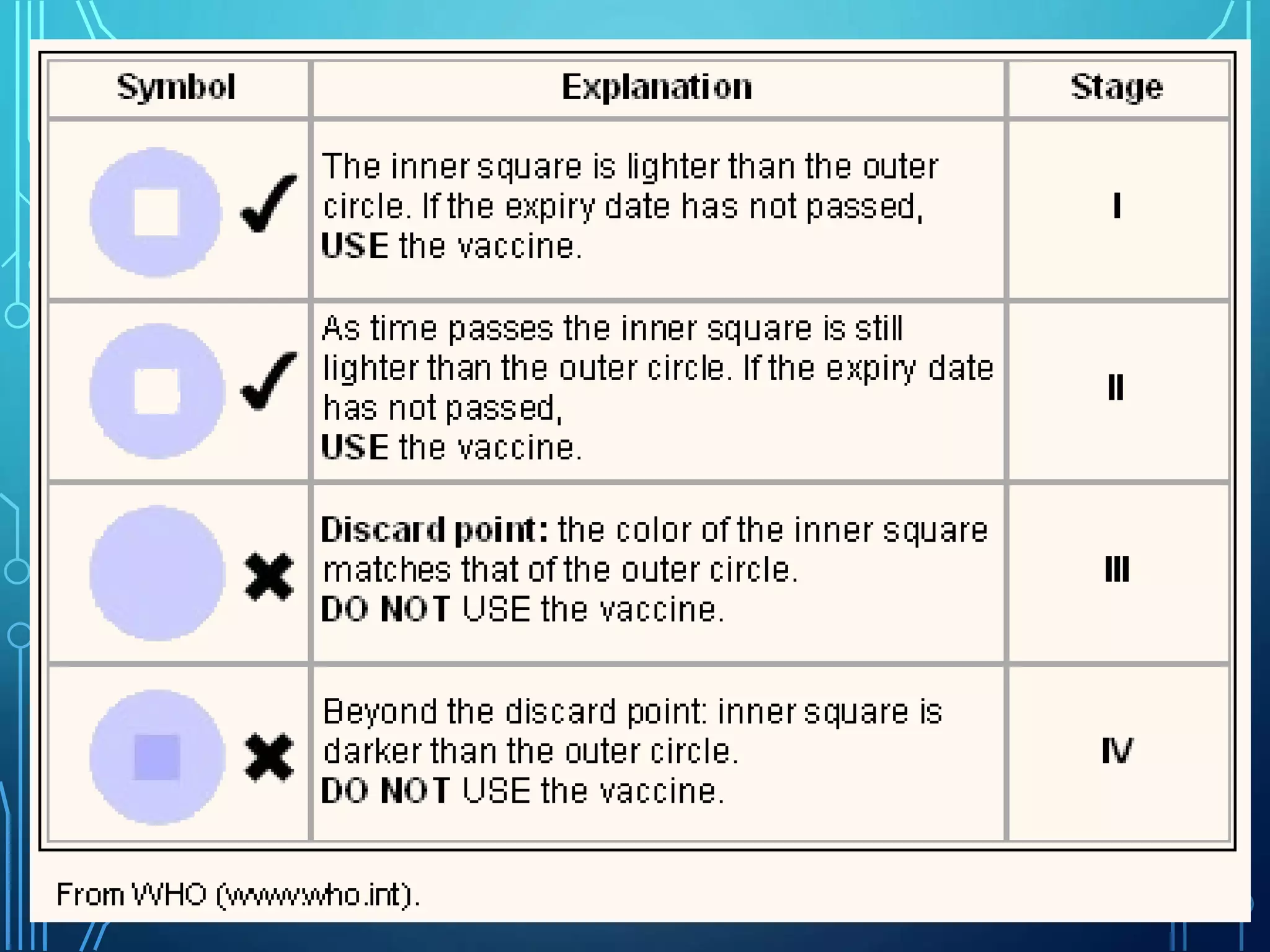
Vaccine Vial Monitor(VVM)
VVM is a label containing heat
sensitive material that is placed on
a vaccine vial to register heat
exposure over time
Vaccine vial
monitor
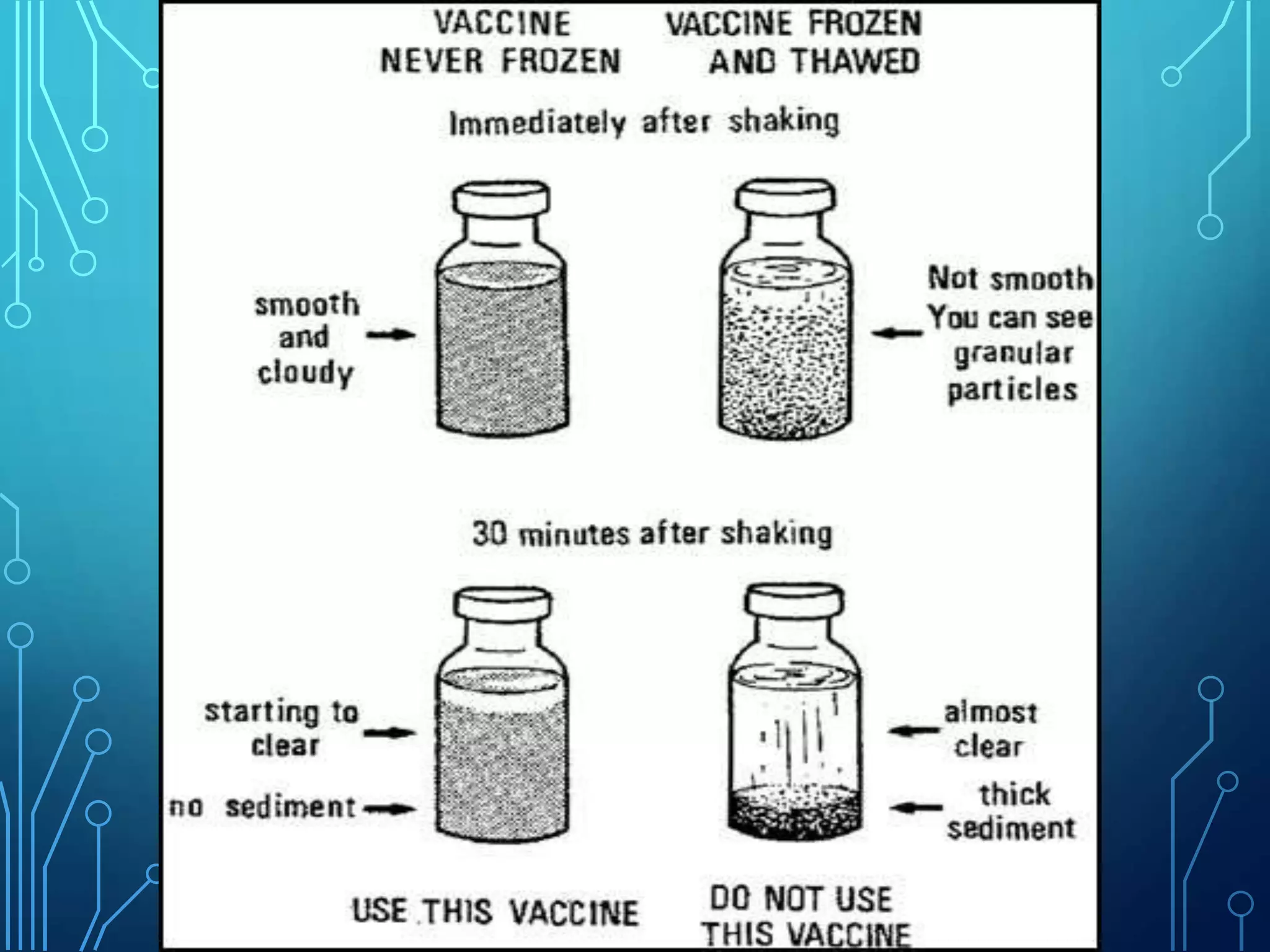
SHAKE TEST
FOR COLD INJURY
CONCLUSION
• The Immunization program started in 1978 has
undergone various transition over the decades.
More & more vaccines are being added.
• But at its core it continues to have the same
objective. Protect the children against the most
prevalent and serious diseases through universal
coverage.
• A proper monitoring system is essential to realise
this objective.
• Quality of the vaccine is more important than
quantity as universal coverage without proper
immune response is a waste.

Immunisation program in india

  • 1.
  • 2.
    IMMUNIZATION: COMMON TERMS Immunity : Resistanceof a host to a specific agent, characterized by measurable and protective surface or humoral antibody and by cell mediated immune responses. Immunization: Process of inducing immunity by stimulating immune system through antigens.
  • 3.
    Vaccine: A preparation ofa weakened or killed pathogen, such as a bacterium or virus, or of a portion of the pathogen's structure that upon administration stimulates antibody production or cellular immunity against the pathogen but is incapable of causing severe infection. Vaccination: Administration of antigenic material (the vaccine) to produce immunity to a disease.
  • 4.
    Ring immunization: Vaccination ofpeople in close contact with an isolated infected patient. Catch up rounds: Additional effort besides routine immunization to cover left outs Mop-up rounds: When the final pockets of polio virus transmission have been identified through standard surveillance, door-to-door immunization in high-risk districts.
  • 5.
    HERD IMMUNITY? Resistance tospread of infectious disease in a group because of few susceptible members, making transmission unlikely. The immunologic status of a population, determined by the ratio of resistant to susceptible members and their distribution.
  • 7.
    MILESTONES IN IMMUNIZATION PROGRAMIN INDIA 1978: EPI 1985: UIP, Measles vaccine added 1988: AEFI Surveillance 1990: Vitamin A 1992: CSSM 1995: Polio National Immunization days 1997: RCH-I 2005: RCH-II and NRHM
  • 8.
    EARLY VACCINES: •BCG ,DPT & Typhoid •OPV Added •1985: Measles added & Typhoid dropped •TT for Pregant •2006: Hepatitis B, second dose of measles and Japanese Encephalitis •2011, pentavalent vaccine
  • 9.
    STRATEGIES •Reduce Morbidity &mortality of VPDs by Immunisation •Ingenious vaccine production •Cold chain establishment •Phased Implementation & full coverage by 1990 •Monitoring & evaluation
  • 10.
  • 11.
    MONITORING •AFP Surveillance •Measles Surveillance •AEFISurveillance •IDSP •Mother & Child Tracking System
  • 12.
    COVERAGE •RSOC by UNICEF2012 •65% in INDIA •6.6% no vaccination •89% TT for Preg Women
  • 13.
  • 14.
    COLD CHAIN • The‘cold chain’ is the system of transporting and storing vaccines at recommended temperature from the point of manufacture to the point of use. • The World Health Organization (WHO) reported that in 2005, nearly half of all vaccines were in transit due to poor Manufacturer Distributor Vaccine Depots Provider office Client
  • 15.
    Cold chain storage equipment Walkin cold rooms Deep freezers Ice lined refrigerators
  • 16.
    1.Walk in coldrooms(WIC) At regional level Storage up to 3 months At district & PHC levels Temp :- -15oc to -25oc At PHC, used only for the preparation of ice packs 2.Deep freezers
  • 17.
    3.Ice lined refrigerators(ILR) Both atdistrict and PHC levels Temp :- +2oc to +8oc ILR’s are top opening, can hold cold air inside better than front opening refrigerators
  • 18.
    VACCINE SENSITIVITY • Sensitivity toHEAT BCG Varicella MMR MenC Hepatitis B DT and/or aP/IPV/HIB • Sensitivity to COLD HepB and combination DTand/or aP/IPV/HIB Influenza MenC *MMR *Varicella *BCG (*Freeze MOST SENSITIVE Temperature must be recorded twice in a day with dial thermometer LEAST SENSITIVE
  • 19.
  • 20.
    Used for transportof vaccines Fully frozen ice packs placed at the bottom and sides DPT, TT, DT should not be kept in direct contact 1.Cold boxes Used to carry small quantity of vaccines(16 to 20 vials) For out of reach sessions 4 icepacks are used 2.Vaccine carriers
  • 21.
    3.Day carriers Used tocarry very small quantities of vaccines(6 to 8 vials) For a near by session 2 icepacks are used For only 2 hours period
  • 22.
    Vaccine Vial Monitor(VVM) VVMis a label containing heat sensitive material that is placed on a vaccine vial to register heat exposure over time Vaccine vial monitor
  • 24.
  • 26.
    CONCLUSION • The Immunizationprogram started in 1978 has undergone various transition over the decades. More & more vaccines are being added. • But at its core it continues to have the same objective. Protect the children against the most prevalent and serious diseases through universal coverage. • A proper monitoring system is essential to realise this objective. • Quality of the vaccine is more important than quantity as universal coverage without proper immune response is a waste.