POLIO IMMUNIZATION
PROGRAMME IN INDIA
By
Bhagya Vijayan
PALB:3120
Dept:of Agril.Extension
Immunisationcampaign - by the GO I in 1995-96
To eradicate poliomyelitis (polio) in India by vaccinating all children under the age of 5 yr
Large scale immunisation programme, co-operating with various international institutions, state
governments and Non Governmental Organisations.
vaccination against Polio started in 1978 with Expanded Program in Immunisation (EPI).
1984- was successful in covering around 40% of all infants, giving 3 doses of OPV
1985, the Universal Immunisation Program (UIP) was launched to cover all the districts of the country.
UIP became a part of child safe and survical motherland program (CSSM) in 1992 and Reproductive and
Child Health Program (RCH) in 1997(coverage 95%).
1995, following the Polio Eradication Initiative of World Health Organization (1988), India launched Pulse
Polio Immunisation Program along with Universal Immunisation Program which aimed at 100% coverage.
2012, India was declared free of polio by WHO.
A peep into the history................
2
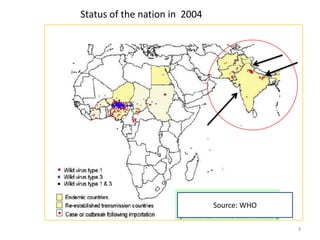
Status of the nation in 2004
• 83% of all new polio cases were found in india
Source: WHO
3
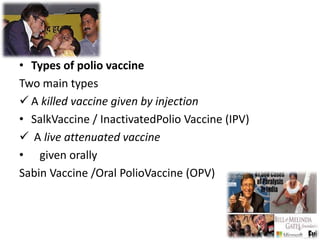
• Types of polio vaccine
Two main types
 A killed vaccine given by injection
• SalkVaccine / InactivatedPolio Vaccine (IPV)
 A live attenuated vaccine
• given orally
Sabin Vaccine /Oral PolioVaccine (OPV)
4
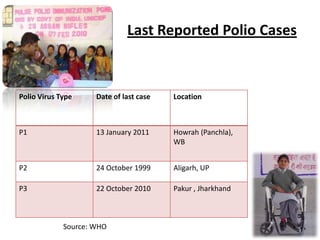
Last Reported Polio Cases
Polio Virus Type Date of last case Location
P1 13 January 2011 Howrah (Panchla),
WB
P2 24 October 1999 Aligarh, UP
P3 22 October 2010 Pakur , Jharkhand
Source: WHO 5
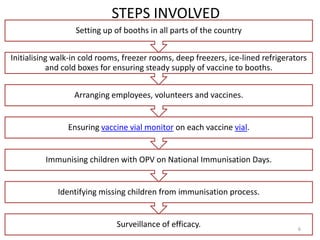
STEPS INVOLVED
Surveillance of efficacy.
Identifying missing children from immunisation process.
Immunising children with OPV on National Immunisation Days.
Ensuring vaccine vial monitor on each vaccine vial.
Arranging employees, volunteers and vaccines.
Initialising walk-in cold rooms, freezer rooms, deep freezers, ice-lined refrigerators
and cold boxes for ensuring steady supply of vaccine to booths.
Setting up of booths in all parts of the country
6
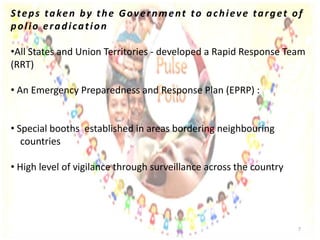
Steps taken by the Government to achieve target of
polio eradication
•All States and Union Territories - developed a Rapid Response Team
(RRT)
• An Emergency Preparedness and Response Plan (EPRP) :
• Special booths established in areas bordering neighbouring
countries
• High level of vigilance through surveillance across the country
7
•A rolling emergency stock of OPV is being
maintained
• An expert sub-group will be established to discuss
issues related to OPV
•Government of India has identified 107 High risk
blocks
•Migratory populations are identified
8
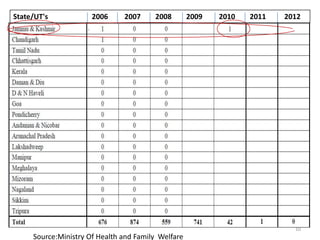
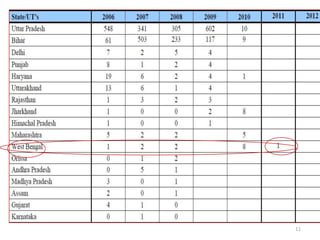
Number of Polio Cases by States,
2006-2012
9
State/UT's 2006 2007 2008 2009 2010 2011 2012
Source:Ministry Of Health and Family Welfare
10
11
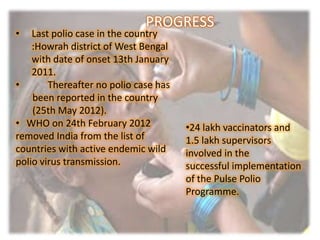
• Last polio case in the country
:Howrah district of West Bengal
with date of onset 13th January
2011.
• Thereafter no polio case has
been reported in the country
(25th May 2012).
• WHO on 24th February 2012
removed India from the list of
countries with active endemic wild
polio virus transmission.
•24 lakh vaccinators and
1.5 lakh supervisors
involved in the
successful implementation
of the Pulse Polio
Programme.
PROGRESS
12
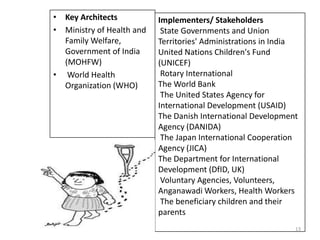
• Key Architects
• Ministry of Health and
Family Welfare,
Government of India
(MOHFW)
• World Health
Organization (WHO)
Implementers/ Stakeholders
State Governments and Union
Territories' Administrations in India
United Nations Children's Fund
(UNICEF)
Rotary International
The World Bank
The United States Agency for
International Development (USAID)
The Danish International Development
Agency (DANIDA)
The Japan International Cooperation
Agency (JICA)
The Department for International
Development (DfID, UK)
Voluntary Agencies, Volunteers,
Anganawadi Workers, Health Workers
The beneficiary children and their
parents
13
THANK YOU
14

pulse polio immunization programme:an overview

  • 1.
    POLIO IMMUNIZATION PROGRAMME ININDIA By Bhagya Vijayan PALB:3120 Dept:of Agril.Extension
  • 2.
    Immunisationcampaign - bythe GO I in 1995-96 To eradicate poliomyelitis (polio) in India by vaccinating all children under the age of 5 yr Large scale immunisation programme, co-operating with various international institutions, state governments and Non Governmental Organisations. vaccination against Polio started in 1978 with Expanded Program in Immunisation (EPI). 1984- was successful in covering around 40% of all infants, giving 3 doses of OPV 1985, the Universal Immunisation Program (UIP) was launched to cover all the districts of the country. UIP became a part of child safe and survical motherland program (CSSM) in 1992 and Reproductive and Child Health Program (RCH) in 1997(coverage 95%). 1995, following the Polio Eradication Initiative of World Health Organization (1988), India launched Pulse Polio Immunisation Program along with Universal Immunisation Program which aimed at 100% coverage. 2012, India was declared free of polio by WHO. A peep into the history................ 2
  • 3.
    Status of thenation in 2004 • 83% of all new polio cases were found in india Source: WHO 3
  • 4.
    • Types ofpolio vaccine Two main types  A killed vaccine given by injection • SalkVaccine / InactivatedPolio Vaccine (IPV)  A live attenuated vaccine • given orally Sabin Vaccine /Oral PolioVaccine (OPV) 4
  • 5.
    Last Reported PolioCases Polio Virus Type Date of last case Location P1 13 January 2011 Howrah (Panchla), WB P2 24 October 1999 Aligarh, UP P3 22 October 2010 Pakur , Jharkhand Source: WHO 5
  • 6.
    STEPS INVOLVED Surveillance ofefficacy. Identifying missing children from immunisation process. Immunising children with OPV on National Immunisation Days. Ensuring vaccine vial monitor on each vaccine vial. Arranging employees, volunteers and vaccines. Initialising walk-in cold rooms, freezer rooms, deep freezers, ice-lined refrigerators and cold boxes for ensuring steady supply of vaccine to booths. Setting up of booths in all parts of the country 6
  • 7.
    Steps taken bythe Government to achieve target of polio eradication •All States and Union Territories - developed a Rapid Response Team (RRT) • An Emergency Preparedness and Response Plan (EPRP) : • Special booths established in areas bordering neighbouring countries • High level of vigilance through surveillance across the country 7
  • 8.
    •A rolling emergencystock of OPV is being maintained • An expert sub-group will be established to discuss issues related to OPV •Government of India has identified 107 High risk blocks •Migratory populations are identified 8
  • 9.
    Number of PolioCases by States, 2006-2012 9
  • 10.
    State/UT's 2006 20072008 2009 2010 2011 2012 Source:Ministry Of Health and Family Welfare 10
  • 11.
  • 12.
    • Last poliocase in the country :Howrah district of West Bengal with date of onset 13th January 2011. • Thereafter no polio case has been reported in the country (25th May 2012). • WHO on 24th February 2012 removed India from the list of countries with active endemic wild polio virus transmission. •24 lakh vaccinators and 1.5 lakh supervisors involved in the successful implementation of the Pulse Polio Programme. PROGRESS 12
  • 13.
    • Key Architects •Ministry of Health and Family Welfare, Government of India (MOHFW) • World Health Organization (WHO) Implementers/ Stakeholders State Governments and Union Territories' Administrations in India United Nations Children's Fund (UNICEF) Rotary International The World Bank The United States Agency for International Development (USAID) The Danish International Development Agency (DANIDA) The Japan International Cooperation Agency (JICA) The Department for International Development (DfID, UK) Voluntary Agencies, Volunteers, Anganawadi Workers, Health Workers The beneficiary children and their parents 13
  • 14.