Presented By:
Krishna Bharat Patil
M.Pharmacy 1st year [Pharmacology]
SNJB's SSDJ College of Pharmacy,
Chandwad.
1
2
Objectives:
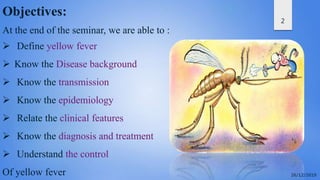
At the end of the seminar, we are able to :
 Define yellow fever
 Know the Disease background
 Know the transmission
 Know the epidemiology
 Relate the clinical features
 Know the diagnosis and treatment
 Understand the control
Of yellow fever
3
Introduction:
 Yellow fever is an acute viral haemorrhagic disease transmitted by infected
female mosquitoes
 Caused by :
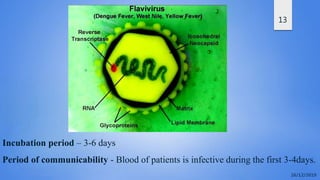
Yellow fever virus which is an arbovirus of the flavivirus gene
 Also named yellow as it causes jaundice at later stage
Yellow fever is the disease that currently re-emerging and poses serious harm in
Africa, south America, and central America, with and annual estimate of series
84,000 to 170,000 and about 29,000 to 60,000 deaths.
4
Disease Background:
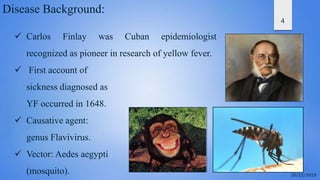
 Carlos Finlay was Cuban epidemiologist
recognized as pioneer in research of yellow fever.
 First account of
sickness diagnosed as
YF occurred in 1648.
 Causative agent:
genus Flavivirus.
 Vector: Aedes aegypti
(mosquito).
5
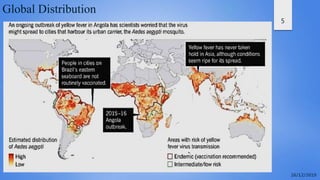
Global Distribution
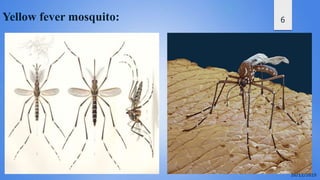
6Yellow fever mosquito:
7
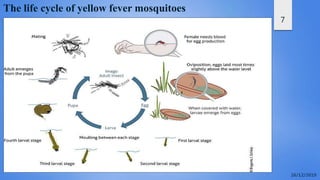
The life cycle of yellow fever mosquitoes
8
TRANSMISSION:
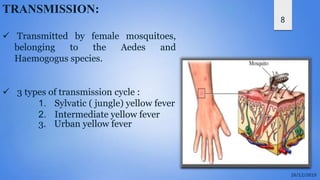
 Transmitted by female mosquitoes,
belonging to the Aedes and
Haemogogus species.
 3 types of transmission cycle :
1. Sylvatic ( jungle) yellow fever
2. Intermediate yellow fever
3. Urban yellow fever
9
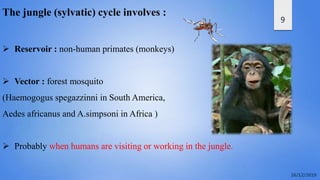
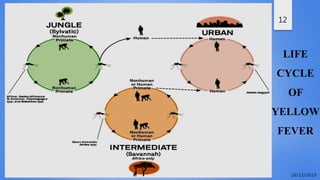
The jungle (sylvatic) cycle involves :
 Reservoir : non-human primates (monkeys)
 Vector : forest mosquito
(Haemogogus spegazzinni in South America,
Aedes africanus and A.simpsoni in Africa )
 Probably when humans are visiting or working in the jungle.
10
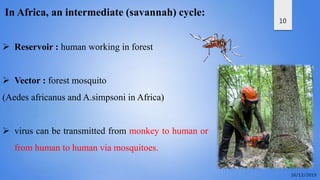
In Africa, an intermediate (savannah) cycle:
 Reservoir : human working in forest
 Vector : forest mosquito
(Aedes africanus and A.simpsoni in Africa)
 virus can be transmitted from monkey to human or
from human to human via mosquitoes.
11
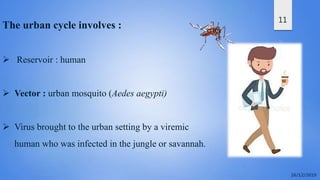
The urban cycle involves :
 Reservoir : human
 Vector : urban mosquito (Aedes aegypti)
 Virus brought to the urban setting by a viremic
human who was infected in the jungle or savannah.
12
LIFE
CYCLE
OF
YELLOW
FEVER
13
Incubation period – 3-6 days
Period of communicability - Blood of patients is infective during the first 3-4days.
14
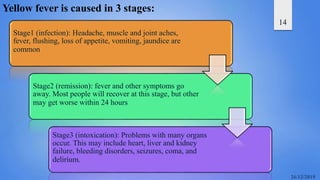
Stage1 (infection): Headache, muscle and joint aches,
fever, flushing, loss of appetite, vomiting, jaundice are
common
Stage2 (remission): fever and other symptoms go
away. Most people will recover at this stage, but other
may get worse within 24 hours
Stage3 (intoxication): Problems with many organs
occur. This may include heart, liver and kidney
failure, bleeding disorders, seizures, coma, and
delirium.
Yellow fever is caused in 3 stages:
15
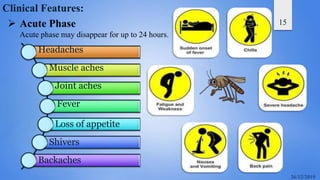
Clinical Features:
 Acute Phase
Acute phase may disappear for up to 24 hours.
Headaches
Muscle aches
Joint aches
Fever
Loss of appetite
Shivers
Backaches
16
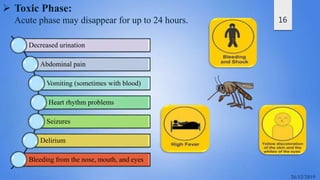
 Toxic Phase:
Acute phase may disappear for up to 24 hours.
Decreased urination
Abdominal pain
Vomiting (sometimes with blood)
Heart rhythm problems
Seizures
Delirium
Bleeding from the nose, mouth, and eyes
17
18
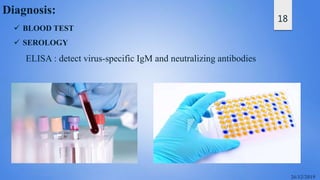
Diagnosis:
 BLOOD TEST
 SEROLOGY
ELISA : detect virus-specific IgM and neutralizing antibodies
19
TREATMENT:
1) Symptomatic.
2) Rest, fluids, and use of pain relievers
3) Medication to reduce fever may relieve symptoms of aching and fever.
4) Avoid certain medications, which may increase the risk of bleeding.
(e.g. ibuprofen, naproxen)
20
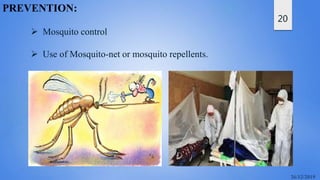
PREVENTION:
 Mosquito control
 Use of Mosquito-net or mosquito repellents.
21
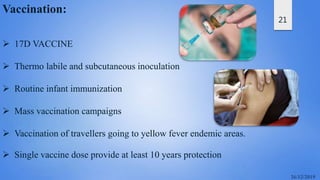
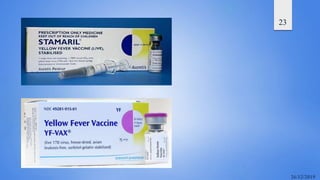
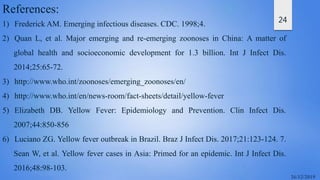
Vaccination:
 17D VACCINE
 Thermo labile and subcutaneous inoculation
 Routine infant immunization
 Mass vaccination campaigns
 Vaccination of travellers going to yellow fever endemic areas.
 Single vaccine dose provide at least 10 years protection
22
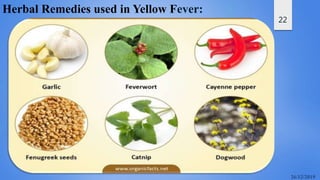
Herbal Remedies used in Yellow Fever:
23
24
References:
1) Frederick AM. Emerging infectious diseases. CDC. 1998;4.
2) Quan L, et al. Major emerging and re-emerging zoonoses in China: A matter of
global health and socioeconomic development for 1.3 billion. Int J Infect Dis.
2014;25:65-72.
3) http://www.who.int/zoonoses/emerging_zoonoses/en/
4) http://www.who.int/en/news-room/fact-sheets/detail/yellow-fever
5) Elizabeth DB. Yellow Fever: Epidemiology and Prevention. Clin Infect Dis.
2007;44:850-856
6) Luciano ZG. Yellow fever outbreak in Brazil. Braz J Infect Dis. 2017;21:123-124. 7.
Sean W, et al. Yellow fever cases in Asia: Primed for an epidemic. Int J Infect Dis.
2016;48:98-103.
25
10)Christina LG, et al. Yellow Fever: A Reemerging Threat. Clin Lab Med.
2010;30:237-260.
11) Emile F, et al. Advances and controversies in yellow fever vaccination. Ther
Adv Vacc. 2013;1:144-152.
12)Catharine IP, et al. Yellow Fever: Once Again on the Radar Screen in the
Americas. N Engl J Med. 2018;376:1397-1399.
13)Moritz UGK, et al. Spread of yellow fever virus outbreak in Angola and the
Democratic Republic of the Congo 2015-16: A modelling study. Lancet Infect
Dis. 2017;17:330-338.
14)James MN, et al. Fenner's Veterinary Virology. Elsevier Inc. 2011;4.
15)Brain RS, et al. Deadly Diseases and Epidemics: Yellow fever. 2010.
16)Kotar SL, et al. Yellow Fever: A World Wide History. 2017.
26

Yellow fever

  • 1.
    Presented By: Krishna BharatPatil M.Pharmacy 1st year [Pharmacology] SNJB's SSDJ College of Pharmacy, Chandwad. 1
  • 2.
    2 Objectives: At the endof the seminar, we are able to :  Define yellow fever  Know the Disease background  Know the transmission  Know the epidemiology  Relate the clinical features  Know the diagnosis and treatment  Understand the control Of yellow fever
  • 3.
    3 Introduction:  Yellow feveris an acute viral haemorrhagic disease transmitted by infected female mosquitoes  Caused by : Yellow fever virus which is an arbovirus of the flavivirus gene  Also named yellow as it causes jaundice at later stage Yellow fever is the disease that currently re-emerging and poses serious harm in Africa, south America, and central America, with and annual estimate of series 84,000 to 170,000 and about 29,000 to 60,000 deaths.
  • 4.
    4 Disease Background:  CarlosFinlay was Cuban epidemiologist recognized as pioneer in research of yellow fever.  First account of sickness diagnosed as YF occurred in 1648.  Causative agent: genus Flavivirus.  Vector: Aedes aegypti (mosquito).
  • 5.
  • 6.
  • 7.
    7 The life cycleof yellow fever mosquitoes
  • 8.
    8 TRANSMISSION:  Transmitted byfemale mosquitoes, belonging to the Aedes and Haemogogus species.  3 types of transmission cycle : 1. Sylvatic ( jungle) yellow fever 2. Intermediate yellow fever 3. Urban yellow fever
  • 9.
    9 The jungle (sylvatic)cycle involves :  Reservoir : non-human primates (monkeys)  Vector : forest mosquito (Haemogogus spegazzinni in South America, Aedes africanus and A.simpsoni in Africa )  Probably when humans are visiting or working in the jungle.
  • 10.
    10 In Africa, anintermediate (savannah) cycle:  Reservoir : human working in forest  Vector : forest mosquito (Aedes africanus and A.simpsoni in Africa)  virus can be transmitted from monkey to human or from human to human via mosquitoes.
  • 11.
    11 The urban cycleinvolves :  Reservoir : human  Vector : urban mosquito (Aedes aegypti)  Virus brought to the urban setting by a viremic human who was infected in the jungle or savannah.
  • 12.
  • 13.
    13 Incubation period –3-6 days Period of communicability - Blood of patients is infective during the first 3-4days.
  • 14.
    14 Stage1 (infection): Headache,muscle and joint aches, fever, flushing, loss of appetite, vomiting, jaundice are common Stage2 (remission): fever and other symptoms go away. Most people will recover at this stage, but other may get worse within 24 hours Stage3 (intoxication): Problems with many organs occur. This may include heart, liver and kidney failure, bleeding disorders, seizures, coma, and delirium. Yellow fever is caused in 3 stages:
  • 15.
    15 Clinical Features:  AcutePhase Acute phase may disappear for up to 24 hours. Headaches Muscle aches Joint aches Fever Loss of appetite Shivers Backaches
  • 16.
    16  Toxic Phase: Acutephase may disappear for up to 24 hours. Decreased urination Abdominal pain Vomiting (sometimes with blood) Heart rhythm problems Seizures Delirium Bleeding from the nose, mouth, and eyes
  • 17.
  • 18.
    18 Diagnosis:  BLOOD TEST SEROLOGY ELISA : detect virus-specific IgM and neutralizing antibodies
  • 19.
    19 TREATMENT: 1) Symptomatic. 2) Rest,fluids, and use of pain relievers 3) Medication to reduce fever may relieve symptoms of aching and fever. 4) Avoid certain medications, which may increase the risk of bleeding. (e.g. ibuprofen, naproxen)
  • 20.
    20 PREVENTION:  Mosquito control Use of Mosquito-net or mosquito repellents.
  • 21.
    21 Vaccination:  17D VACCINE Thermo labile and subcutaneous inoculation  Routine infant immunization  Mass vaccination campaigns  Vaccination of travellers going to yellow fever endemic areas.  Single vaccine dose provide at least 10 years protection
  • 22.
    22 Herbal Remedies usedin Yellow Fever:
  • 23.
  • 24.
    24 References: 1) Frederick AM.Emerging infectious diseases. CDC. 1998;4. 2) Quan L, et al. Major emerging and re-emerging zoonoses in China: A matter of global health and socioeconomic development for 1.3 billion. Int J Infect Dis. 2014;25:65-72. 3) http://www.who.int/zoonoses/emerging_zoonoses/en/ 4) http://www.who.int/en/news-room/fact-sheets/detail/yellow-fever 5) Elizabeth DB. Yellow Fever: Epidemiology and Prevention. Clin Infect Dis. 2007;44:850-856 6) Luciano ZG. Yellow fever outbreak in Brazil. Braz J Infect Dis. 2017;21:123-124. 7. Sean W, et al. Yellow fever cases in Asia: Primed for an epidemic. Int J Infect Dis. 2016;48:98-103.
  • 25.
    25 10)Christina LG, etal. Yellow Fever: A Reemerging Threat. Clin Lab Med. 2010;30:237-260. 11) Emile F, et al. Advances and controversies in yellow fever vaccination. Ther Adv Vacc. 2013;1:144-152. 12)Catharine IP, et al. Yellow Fever: Once Again on the Radar Screen in the Americas. N Engl J Med. 2018;376:1397-1399. 13)Moritz UGK, et al. Spread of yellow fever virus outbreak in Angola and the Democratic Republic of the Congo 2015-16: A modelling study. Lancet Infect Dis. 2017;17:330-338. 14)James MN, et al. Fenner's Veterinary Virology. Elsevier Inc. 2011;4. 15)Brain RS, et al. Deadly Diseases and Epidemics: Yellow fever. 2010. 16)Kotar SL, et al. Yellow Fever: A World Wide History. 2017.
  • 26.