BY: MOHAMMED NAYEEMUDDIN
MODERATOR :DR. GIRISH KERI
Infectious disease characterized by
Asymmetric flaccid motor paralysis
 Clinical manifestations:
1. asymptomatic infection (90-95%)
2. abortive poliomyelitis
3. non paralytic polio myelitis
4. paralytic polio myelitis (1%)
 Three stages:
 acute stage
 convalescent stage
 chronic stage
 Lower limb 92 %
 Trunk + LL 4 %
 LL + UL 1.33 %
 Bilateral UL 0.67 %
 Trunk + UL + LL 2 %
INTRODUCTION
 As the convalescent phase of poliomyelitis
ends residual phase starts
 Even with intensive exercise programs it may
not be possible to restore the muscle power.
 Best can be achieved by elevation of grade of
muscle power
 Therefore training individual for making good
use of muscle at the sub fatigue level is of
importance.
 Inaccessibility to medical care to majority of
childrens have led to large number of people
with moderate to severe deformalities.
CAUSES OF PROGRESSIVE DEFORMITY
 MUSCLE IMBALANCE –
Flaccid paralysis is the main cause of
functional loss and muscle imbalance .when
a muscle or a group of muscle is
paralysed,the opponent strong muscle pull
the joints to their side.
 UNRELIEVED MUSCLE SPASM
Contractures of the paralysed muscles have a
tendency for deforming the joint in the direction of
contracture. This can be prevented by passive
stretching and splinting.
 GROWTH
Bony growth depends upon the stimulus by active
healthy stretching around the growth plate , which
is lacking in case of polio affected childrens
causing limb length inequality , attenuation of
blood vessels and reduced blood supply leading to
reduced growth of the bone.
 GRAVITY AND POSTURE
- Gravity plays an important role in maintaining the
posture and deformity.
- Paralysed group of muscles are not in a position
to maintain posture.
 Paralysis (muscle weakness):
 usually begins when the child is small, often during an
illness like a bad cold with fever and sometimes
diarrhea
 Paralysis may affect any muscles of the body, but is
most common in the legs. Muscles most often affected
are described in following slides.
 Paralysis is of the ‘floppy’ type (not stiff). Some
muscles may be only partly weakened, others limp or
floppy
 In time the affected limb may not be able to
straighten all the way, due to shortening, or
‘contractures’, of certain muscles.
 The muscles and bones of the affected limb
become thinner than the other limb. The
affected limb does not grow as fast, and so is
shorter.
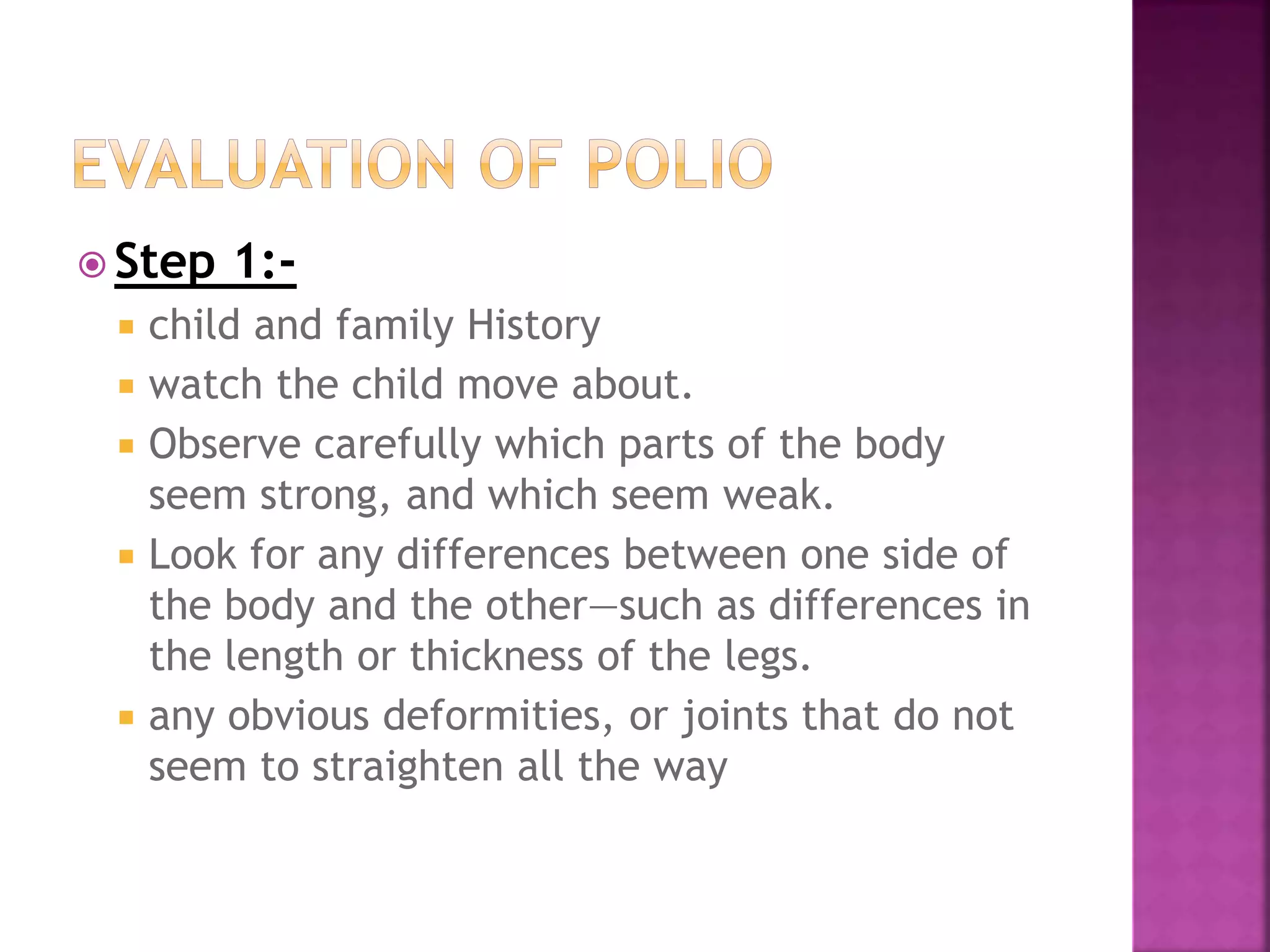
 Unaffected arms or legs often become extra
strong to make up for parts that are weak.
 Knee jerks and other tendon reflexes in the
affected limb are reduced or absent
 By secondary problems, we mean further
disabilities or complications that can appear
after, and because of, the original disability.
 The paralysis does not get worse with time.
However, secondary problems like contractures,
curve of the backbone and dislocations may
occur
 Weight bearing (supporting the body’s weight) on
weak joints can cause deformities.
 Step 1:-
 child and family History
 watch the child move about.
 Observe carefully which parts of the body
seem strong, and which seem weak.
 Look for any differences between one side of
the body and the other—such as differences in
the length or thickness of the legs.
 any obvious deformities, or joints that do not
seem to straighten all the way
 If the child walks, what is unusual about
the way child does it?
 Does child dip forward or to one side
 Does child help support one leg with hand
 Is one hip lower than the other Or one shoulder
 Does child have a hump back, a sway
back, or a sideways curve of the back.
 Step 2:-
 Range-of-motion testing
 Muscle testing
 Check for deformities:
 Contractures,dislocations (hip, knee, foot, shoulder,
elbow); difference in leg length; tilt of hips; and
curve or abnormal shape of the back.
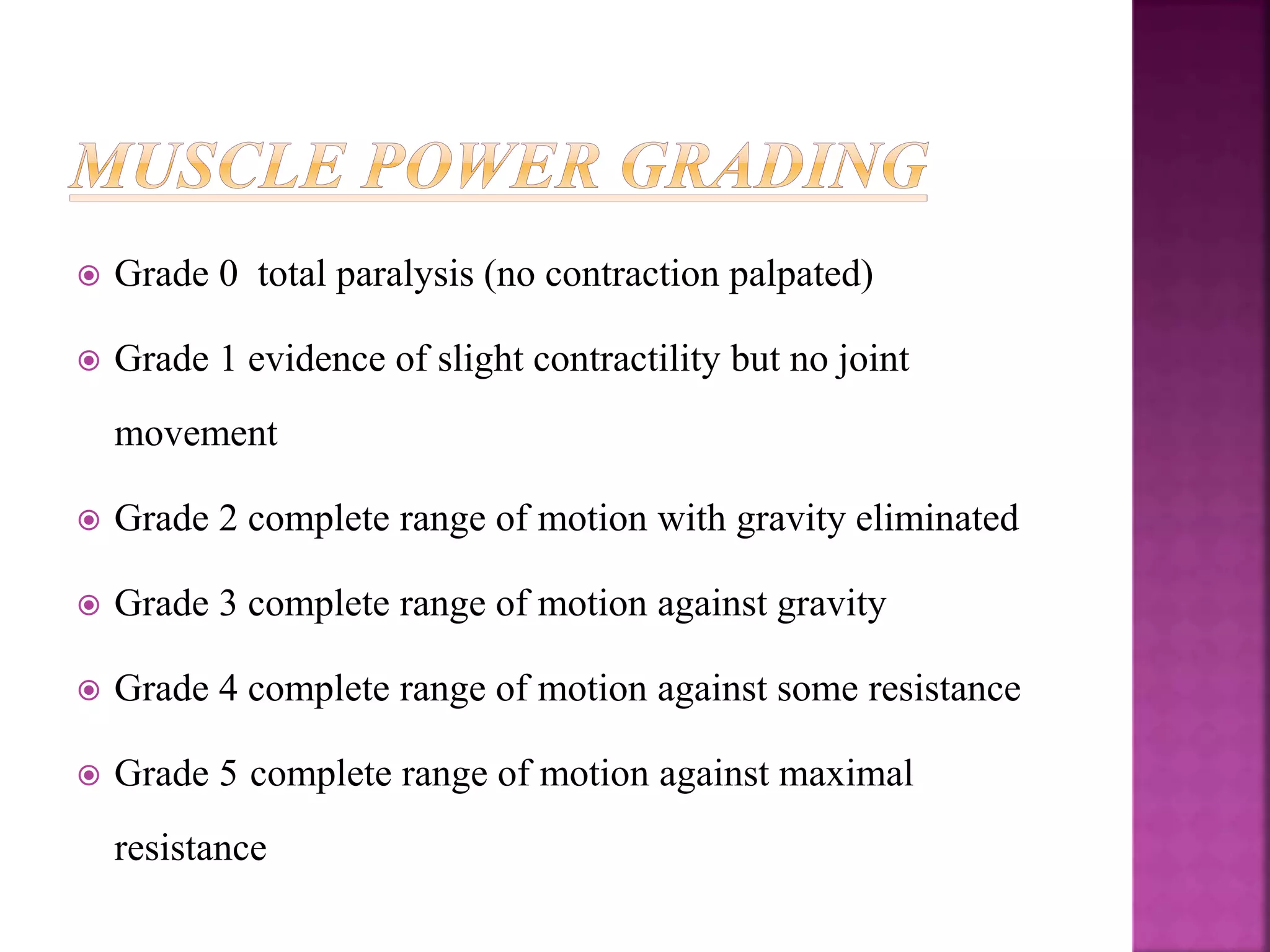
 Grade 0 total paralysis (no contraction palpated)
 Grade 1 evidence of slight contractility but no joint
movement
 Grade 2 complete range of motion with gravity eliminated
 Grade 3 complete range of motion against gravity
 Grade 4 complete range of motion against some resistance
 Grade 5 complete range of motion against maximal
resistance
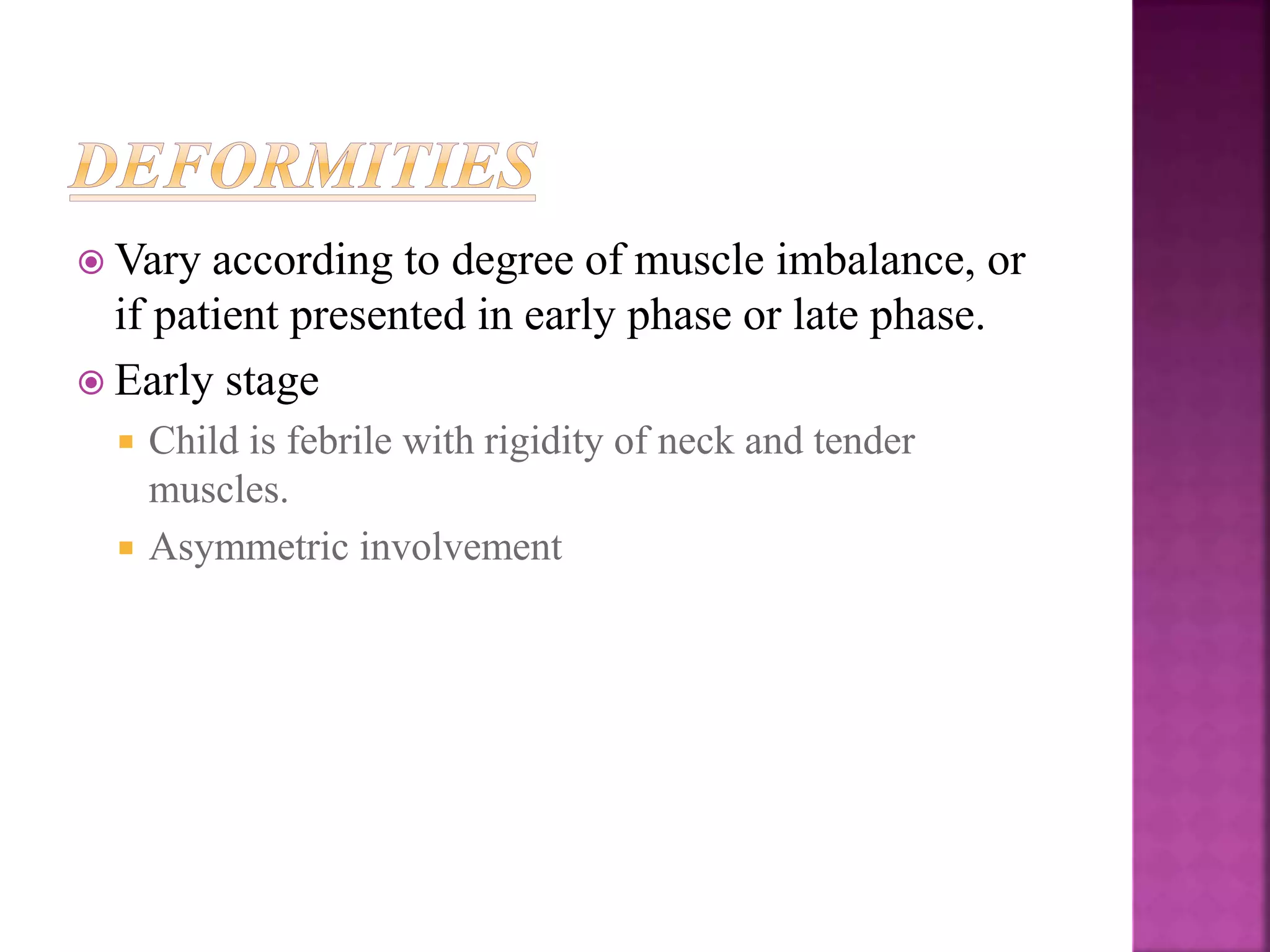
 Vary according to degree of muscle imbalance, or
if patient presented in early phase or late phase.
 Early stage
 Child is febrile with rigidity of neck and tender
muscles.
 Asymmetric involvement
 Most Severely Paralysed Muscle
- Tibialis Anterior
 Most common muscle Paralysed -
- Quadriceps femoris
 Most commonly involved muscles in Upper
Limb
- Deltoid
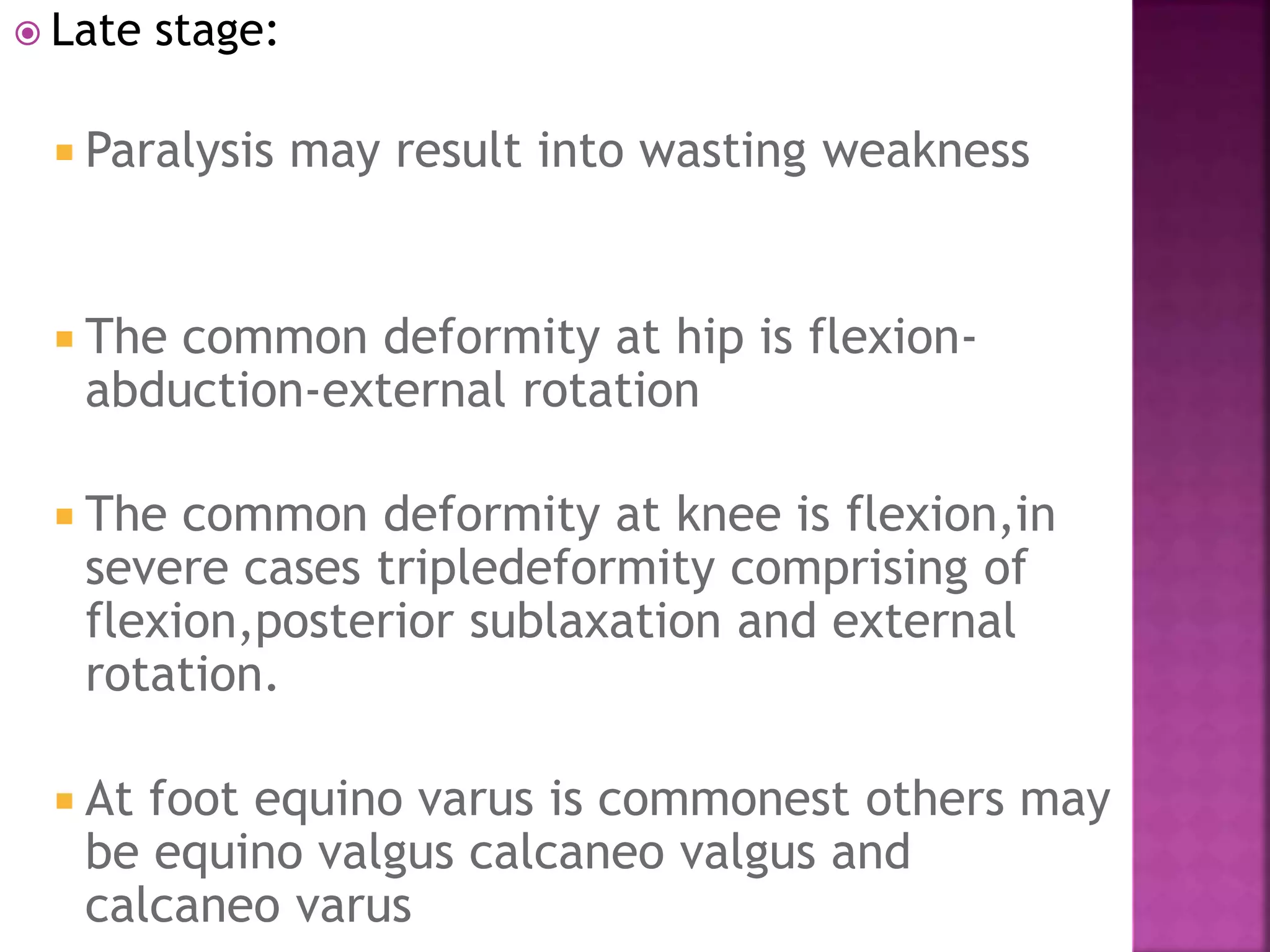
 Late stage:
 Paralysis may result into wasting weakness
 The common deformity at hip is flexion-
abduction-external rotation
 The common deformity at knee is flexion,in
severe cases tripledeformity comprising of
flexion,posterior sublaxation and external
rotation.
 At foot equino varus is commonest others may
be equino valgus calcaneo valgus and
calcaneo varus
 The limbs may become short.
 With time deformities becomes permanent
due to contracture of soft tissue
 Mal development of bones in deformed
position
 Management starts with diagnosis & accurate
muscle charting (assessing power &
deformities)
 Discussion of expectations
 Assessment resources
 Family support
 Mainly lower limb
 Aim for walking with or without orthosis by
getting straight limb with plantigrade foot
 Methods
 Reconstructive surgery
 Physiotherapy
 Orthosis
 Correction of deformities
 Improving the function (transfer of a tendon or
muscle, removal of deforming force)
 Stabilizing paralyzed joints (arthrodesis)
 Balancing of power
 Stabilization of joints
 Correction of deformities
 Limb lengthening
 Tendon transfers are indicated when dynamic
muscle imbalance results in a deformity
 Surgery should be delayed until the maximal
returns of the expected muscle strength has
been achieved
 Objectives of tendon transfer
 To provide active motor power
 To eliminate the deforming effect of a muscle
 To improve stability by improving muscle balance
 Muscle to be transferred must be strong enough
 Free end of transferred tendon should be attached as
close as possible to the insertion of paralised tendon
 A transferred tendon should be retained in its own
sheath or should be inserted in the sheath of another
tendon or it should be passed through the subcutaneous
fat
 Nerve supply and blood supply of transferred muscle
must not be impaired
 Joint must be in satisfactory position
 Contracture must be released before tendon transfer
 Transferred tendon must be securely attached to bone
under tension slightly greater than normal
 Agonists muscles are preferable to antagonists
 Most efficient method for permanent
stabilization of a joint
 A relaxed or flail joint is stabilized by restricting
its range of motion.
 Bony procedures can be delayed until skeletal
growth is complete
 When the tendon transfer and arthrodesis is
combined in the same operation the arthrodesis
is performed first
 wait for atleast 1 1/2 years after paralytic attack
 Tendon transfers done in skeletally immature
 Extra articular arthrodesis 3-8 years
 Tendon transfer around ankle and foot after 10yr
of age can be supplimented by arthrodesis to
correct the deformity
 Triple arthrodesis >10-11 years
 Ankle arthrodesis >18 years
 Paralysis of the muscles around the hip can
cause severe impairment
 Flexion and abduction contractures of the hip.
 Paralysis of the gluteus maximus and medius muscles.
 Paralytic hip dislocation
 The iliotibial band contracture produces flexion
deformities of the hip and knee on the same
side.
 Spasm of the hamstrings, hip flexors, tensor
fasciae latae,and hip abductors is common
during the acute and convalescent stages of
poliomyelitis.
 Straight-leg raising usually is limited.
 The patient assumes the frog position, with the
knees and hips flexed and the extremities
completely externally rotated. When this
position is maintained for even a few weeks,
secondary soft tissue contractures occur; a
permanent deformity develops
• Flexion, abduction, and external rotation
contracture of the hip.
 The iliotibial band lies lateral and anterior to the hip
joint, and its contracture can cause flexion and
abduction deformity. The hip is externally rotated for
comfort and, if not corrected, the external rotators of
the hip contract and contribute to a fixed deformity
 Genu valgum and flexion contracture of
the knee:
 With growth, the contracted iliotibial band
acts as a taut bowstring across the knee joint
and gradually abducts and flexes the tibia
 Limb-length discrepancy:
 Although the exact mechanism has not been
clearly defined and may be related more to
the loss of neurological and muscle function, a
contracted iliotibial band on one side may be
associated with considerable shortening of that
extremity after years of growth.
 External tibial torsion, with or without knee
joint subluxation:
 Because of its lateral attachment distally, the
iliotibial band gradually rotates the tibia and
fibula externally on the femur; this rotation
may be increased if the short head of the
biceps is strong. When the deformity becomes
extreme, the lateral tibial condyle subluxates
on the lateral femoral condyle and the head of
the fibula lies in the popliteal space.
 Secondary ankle and foot deformities:
 With external torsion of the tibia, the axes of
the ankle and knee joints are malaligned,
causing structural changes that may require
surgical correction.
 Pelvic obliquity:
 When the iliotibial band is contracted, and the
patient is supine with the hip in abduction and
flexion, the pelvis may remain at a right angle
to the long axis of the spine
 When the patient stands,the affected
extremity is brought into the weight-bearing
position (parallel to the vertical axis of the
trunk), the pelvis assumes an oblique position
The iliac crest is low on the contracted side
and high on the opposite side.
 The trunk muscles on the affected side lengthen,
and the muscles on the opposite side contract.
An associated lumbar scoliosis can develop. If
not corrected, the two contralateral
contractures (the band on the affected side and
the trunk muscles on the unaffected side) hold
the pelvis in this oblique position until skeletal
changes fix the deformity
 Increased lumbar lordosis:
 Bilateral flexion contractures of the hip pull
the proximal part of the pelvis anteriorly; for
the trunk to assume an upright position, a
compensatory increase in lumbar lordosis must
develop.
 It can be minimized or prevented in the early
convalescent stage of poliomyelitis
 The patient should be placed in bed with the
hips in neutral rotation,slight abduction,and no
flexion
 All joints must be carried through a full range of
passive motion several times daily.
 The hips must be stretched in extension,
adduction, and internal rotation.
 knee roll is used to prevent a genu recurvatum
deformity
 For abduction and external rotation
contractures, a complete release of the hip
muscles (Ober-Yount procedure) is indicated
 Iliopsoas tendon, sartorius, rectus femorus,
tensor fasciae latae, gluteus medius and minimus
 Paralysis result in unstable hip and an unsightly
and fatiguing limp.
 During weight bearing on the affected side when
the gluteus medius alone is paralyzed, the trunk
sways toward the affected side and the pelvis
elevates on the opposite side (the
“compensated” Trendelenburg gait).
 When the gluteus maximus alone is paralyzed,
the body lurches backward
 When a normal person bears weight on one
extremity and flexes the other at the hip, the
pelvis is held on a horizontal plane and the
gluteal folds are on the same level
 when the gluteal muscles are impaired, and
weight is borne on the affected side, the level of
the pelvis on the normal side drops lower than
that on the affected side.
 when the gluteal paralysis is severe, the test
cannot be made because balance on the disabled
extremity is impossible
 POSTERIOR TRANSFER OF THE ILIOPSOAS FOR
PARALYSIS OF THE GLUTEUS MEDIUS AND
MAXIMUS MUSCLES
 If a child contracts limbs in poliomyelitis before
age of 2 years, and the gluteal muscles become
paralyzed but the flexors and adductors of the
hip do not, the child may develop a paralytic
dislocation of hip
 Dislocation also can develop because of fixed
pelvic obliquity,in which the contralateral hip is
held in marked abduction,usually by a tight
iliotibial band or a structural scoliosis
 Reduction of the hip in young children often can
be achieved by simple abduction, sometimes
aided by open adductor tenotomy and traction
 If the hip cannot be reduced by traction, open
reduction and adductor tenotomy may be
required,
 In combination with primary femoral shortening,
varus derotation osteotomy of the femur, and
appropriate acetabular reconstructions
 The disabilities caused by paralysis of the
muscles acting across the knee joint
 Flexion contracture of the knee
 Quadriceps paralysis.
 Genu recurvatum
 Flail knee
Flexion contracture of the knee
 Flexion contracture of the knee can be caused
by a contracture of the iliotibial band.
 Iliotibial band also causes genu valgum and an
external rotation deformity of the tibia on the
femur.
 Flexion contracture also can be caused by
paralysis of the quadriceps muscle when the
hamstrings are normal or only partially
paralyzed.
 <15 – 20* contracture:
 Posterior hamstring lengthening and
capsulotomy.
 20-70* contracture:
 supracondylar extension osteotomy of the
femur
 >70* knee flexion contracture:
 Division of the iliotibial band and hamstring
tendons,combined with posterior capsulotomy.
 Skeletal traction after surgery is maintained
through a pin in the distal tibia; a second pin
in the proximal tibia pulls anteriorly to avoid
posterior subluxation of the tibia.
 Long-term use of a long-leg brace may be
required to allow the joint to remodel.
 Set of four muscles rectus femorus along with 3
vastus muscles.
 Quadriceps act as the great extensor muscle of
the knee.
 Paralysis of the quadriceps muscle causes severe
disability of knee.
 The knee may be extremely unstable especially
if there is even a mild fixed flexion contracture.
 TRANSFER OF BICEPS FEMORIS AND
SEMITENDINOSUS TENDONS
 In genu recurvatum the knee is hyperextended
 Genu recurvatum from poliomyelitis is of two
types
 Lack of power in the quadriceps
 The hamstrings and the gastrocnemius-soleus
muscles weakness.
• Lack of power in the quadriceps:
 The quadriceps lacks the power to lock the
knee in extension; the hamstrings and
gastrocnemiussoleus usually are normal
 The hamstrings and the gastrocnemius-soleus
muscles weakness:
 These muscle weakness causes hyperextension
of the knee often followed by stretching of the
posterior capsular ligament.
 The pressures of weight bearing and gravity cause
changes in the tibial condyles and in the proximal third
of the tibial shaft.
 The condyles become elongated posteriorly
 Their anterior margins are depressed compared with
their posterior margins
 The angle of their articular surfaces to the long axis of
the tibia which is normally 90 degrees becomes more
acute.
 The angle of their articular surfaces to the long
axis of the tibia which is normally 90 degrees
becomes more acute.
 The proximal third of the tibial shaft bows
posteriorly
 Partial subluxation of the tibia may gradually
occur.
 Closing wedge osteotomy for genu recurvatum.
 TRIPLE TENODESIS FOR GENU RECURVATUM
 The knee is unstable in all directions.
 Muscle power sufficient to overcome this
instability is unavailable for tendon transfer.
 Treatment :
 Locking knee long leg knee brace.
 Knee arthrodesis
 Most dependent parts of the body subjected to
significant amount of deforming forces.
 Deformities includes:-
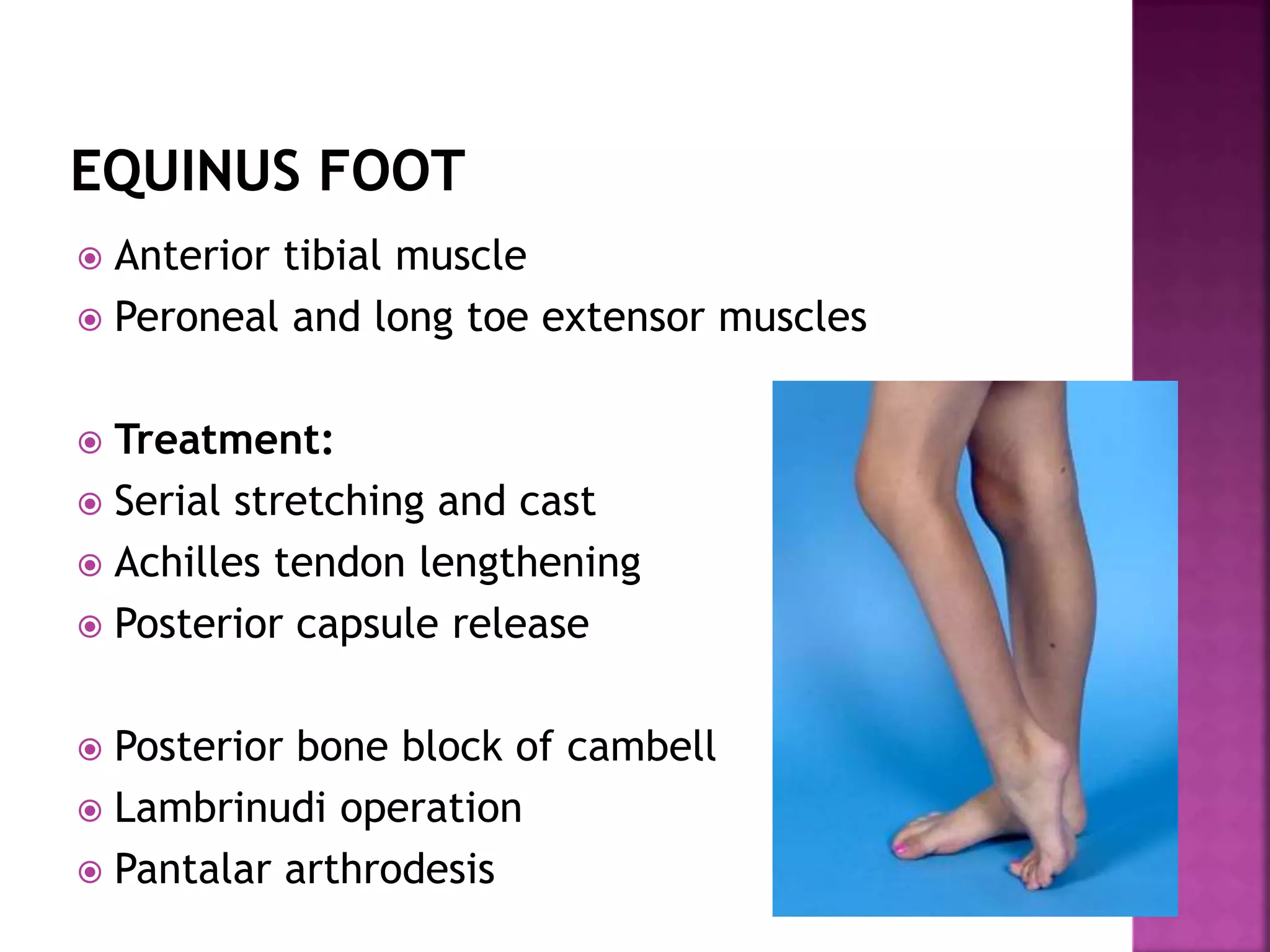
- equinus
- equino varus
- equino valgus
- calcaneous
- cavovarus
- claw toes
- dorsal bunion
 Anterior tibial muscle
 Peroneal and long toe extensor muscles
 Treatment:
 Serial stretching and cast
 Achilles tendon lengthening
 Posterior capsule release
 Posterior bone block of cambell
 Lambrinudi operation
 Pantalar arthrodesis
 Tibialis anterior muscle
 Long toe extensors and peroneal muscle
 Treatment:
 Young children4-8 yrs:
 Stretching of plantar fascia and posterior ankle
structure with wedging casting
 TA lengthening
 Posterior capsulotomy
 Anterior transfer of tibialis posterior or
 Split transfer of tibialis anterior to insertion of p.brevis
(if tibialis posterior is weak)
 Children >8yrs:
 Triple arthrodesis
 Anterior transfer of tibialis posterior
 Modified jones procedure
 Anterior and posterior muscle weakness with
strong peroneals and gastroconemius-soleus
muscle
 Treatment:
 Skeletally immature:
 Repeated stretching and wedging cast
 TA lengthening
 Anterior transfer of peroneals
 Subtalar arthrodesis and anterior transfer of peroneals
(Grice and green arthrodesis)
 Skeletally mature :
 TA lengthening
 Triple arthrodesis followed by anterior transfer of peroneals
 Seen due to imbalance of extrinsic muscles or by
unopposed short toe flexors and other intrinsic
muscle
 Treatment:
 Plantar fasciotomy , Release of intrinsic muscles and
resecting motor branch of medial and lateral plantar
nerves before tendon surgery
 Peroneus longus is transferred to the base of the
second MT
 Extensor hallucis longus is transferred to the neck
ofneck of 1st MT
 Hyperextension of MTP and flexion of IP
 Seen when long toe extensors are used to
substitute dorsiflexion of ankle
Treatment:
For lateral toes:
division of extensor tendon by z-plasty
incision,dorsal capsulotomy of MTP
For great toe:
FHL transferred to prox.phalanx,IP joint
arthrodesis
(or)
division of EHL ,proximal slip attached to
neck of 1st MT,distal slip to soft tissues+ IP arthrodesis
 All muscles paralised distal to the knee
 Equinus deformity results because passive
plantar flexion and cavoequinus deformity
because – intrinsic muscle may retain some
function
 Treatment:
 Radical plantar release
 Tenodesis
 In older pt mid foot wedge resection may be
required
 ANKLE ARTHRODESIS
post polio residual paralysis

post polio residual paralysis

  • 1.
  • 2.
    Infectious disease characterizedby Asymmetric flaccid motor paralysis  Clinical manifestations: 1. asymptomatic infection (90-95%) 2. abortive poliomyelitis 3. non paralytic polio myelitis 4. paralytic polio myelitis (1%)
  • 3.
     Three stages: acute stage  convalescent stage  chronic stage
  • 4.
     Lower limb92 %  Trunk + LL 4 %  LL + UL 1.33 %  Bilateral UL 0.67 %  Trunk + UL + LL 2 %
  • 5.
    INTRODUCTION  As theconvalescent phase of poliomyelitis ends residual phase starts  Even with intensive exercise programs it may not be possible to restore the muscle power.  Best can be achieved by elevation of grade of muscle power  Therefore training individual for making good use of muscle at the sub fatigue level is of importance.
  • 6.
     Inaccessibility tomedical care to majority of childrens have led to large number of people with moderate to severe deformalities. CAUSES OF PROGRESSIVE DEFORMITY  MUSCLE IMBALANCE – Flaccid paralysis is the main cause of functional loss and muscle imbalance .when a muscle or a group of muscle is paralysed,the opponent strong muscle pull the joints to their side.
  • 7.
     UNRELIEVED MUSCLESPASM Contractures of the paralysed muscles have a tendency for deforming the joint in the direction of contracture. This can be prevented by passive stretching and splinting.  GROWTH Bony growth depends upon the stimulus by active healthy stretching around the growth plate , which is lacking in case of polio affected childrens causing limb length inequality , attenuation of blood vessels and reduced blood supply leading to reduced growth of the bone.  GRAVITY AND POSTURE - Gravity plays an important role in maintaining the posture and deformity. - Paralysed group of muscles are not in a position to maintain posture.
  • 8.
     Paralysis (muscleweakness):  usually begins when the child is small, often during an illness like a bad cold with fever and sometimes diarrhea  Paralysis may affect any muscles of the body, but is most common in the legs. Muscles most often affected are described in following slides.  Paralysis is of the ‘floppy’ type (not stiff). Some muscles may be only partly weakened, others limp or floppy
  • 9.
     In timethe affected limb may not be able to straighten all the way, due to shortening, or ‘contractures’, of certain muscles.  The muscles and bones of the affected limb become thinner than the other limb. The affected limb does not grow as fast, and so is shorter.
  • 10.
     Unaffected armsor legs often become extra strong to make up for parts that are weak.  Knee jerks and other tendon reflexes in the affected limb are reduced or absent
  • 12.
     By secondaryproblems, we mean further disabilities or complications that can appear after, and because of, the original disability.  The paralysis does not get worse with time. However, secondary problems like contractures, curve of the backbone and dislocations may occur
  • 14.
     Weight bearing(supporting the body’s weight) on weak joints can cause deformities.
  • 16.
     Step 1:- child and family History  watch the child move about.  Observe carefully which parts of the body seem strong, and which seem weak.  Look for any differences between one side of the body and the other—such as differences in the length or thickness of the legs.  any obvious deformities, or joints that do not seem to straighten all the way
  • 17.
     If thechild walks, what is unusual about the way child does it?  Does child dip forward or to one side  Does child help support one leg with hand  Is one hip lower than the other Or one shoulder  Does child have a hump back, a sway back, or a sideways curve of the back.
  • 18.
     Step 2:- Range-of-motion testing  Muscle testing  Check for deformities:  Contractures,dislocations (hip, knee, foot, shoulder, elbow); difference in leg length; tilt of hips; and curve or abnormal shape of the back.
  • 19.
     Grade 0total paralysis (no contraction palpated)  Grade 1 evidence of slight contractility but no joint movement  Grade 2 complete range of motion with gravity eliminated  Grade 3 complete range of motion against gravity  Grade 4 complete range of motion against some resistance  Grade 5 complete range of motion against maximal resistance
  • 22.
     Vary accordingto degree of muscle imbalance, or if patient presented in early phase or late phase.  Early stage  Child is febrile with rigidity of neck and tender muscles.  Asymmetric involvement
  • 23.
     Most SeverelyParalysed Muscle - Tibialis Anterior  Most common muscle Paralysed - - Quadriceps femoris  Most commonly involved muscles in Upper Limb - Deltoid
  • 24.
     Late stage: Paralysis may result into wasting weakness  The common deformity at hip is flexion- abduction-external rotation  The common deformity at knee is flexion,in severe cases tripledeformity comprising of flexion,posterior sublaxation and external rotation.  At foot equino varus is commonest others may be equino valgus calcaneo valgus and calcaneo varus
  • 25.
     The limbsmay become short.  With time deformities becomes permanent due to contracture of soft tissue  Mal development of bones in deformed position
  • 27.
     Management startswith diagnosis & accurate muscle charting (assessing power & deformities)  Discussion of expectations  Assessment resources  Family support
  • 28.
     Mainly lowerlimb  Aim for walking with or without orthosis by getting straight limb with plantigrade foot  Methods  Reconstructive surgery  Physiotherapy  Orthosis
  • 30.
     Correction ofdeformities  Improving the function (transfer of a tendon or muscle, removal of deforming force)  Stabilizing paralyzed joints (arthrodesis)
  • 31.
     Balancing ofpower  Stabilization of joints  Correction of deformities  Limb lengthening
  • 32.
     Tendon transfersare indicated when dynamic muscle imbalance results in a deformity  Surgery should be delayed until the maximal returns of the expected muscle strength has been achieved  Objectives of tendon transfer  To provide active motor power  To eliminate the deforming effect of a muscle  To improve stability by improving muscle balance
  • 33.
     Muscle tobe transferred must be strong enough  Free end of transferred tendon should be attached as close as possible to the insertion of paralised tendon  A transferred tendon should be retained in its own sheath or should be inserted in the sheath of another tendon or it should be passed through the subcutaneous fat
  • 34.
     Nerve supplyand blood supply of transferred muscle must not be impaired  Joint must be in satisfactory position  Contracture must be released before tendon transfer  Transferred tendon must be securely attached to bone under tension slightly greater than normal  Agonists muscles are preferable to antagonists
  • 35.
     Most efficientmethod for permanent stabilization of a joint  A relaxed or flail joint is stabilized by restricting its range of motion.  Bony procedures can be delayed until skeletal growth is complete  When the tendon transfer and arthrodesis is combined in the same operation the arthrodesis is performed first
  • 36.
     wait foratleast 1 1/2 years after paralytic attack  Tendon transfers done in skeletally immature  Extra articular arthrodesis 3-8 years  Tendon transfer around ankle and foot after 10yr of age can be supplimented by arthrodesis to correct the deformity  Triple arthrodesis >10-11 years  Ankle arthrodesis >18 years
  • 37.
     Paralysis ofthe muscles around the hip can cause severe impairment  Flexion and abduction contractures of the hip.  Paralysis of the gluteus maximus and medius muscles.  Paralytic hip dislocation
  • 38.
     The iliotibialband contracture produces flexion deformities of the hip and knee on the same side.  Spasm of the hamstrings, hip flexors, tensor fasciae latae,and hip abductors is common during the acute and convalescent stages of poliomyelitis.
  • 39.
     Straight-leg raisingusually is limited.  The patient assumes the frog position, with the knees and hips flexed and the extremities completely externally rotated. When this position is maintained for even a few weeks, secondary soft tissue contractures occur; a permanent deformity develops
  • 40.
    • Flexion, abduction,and external rotation contracture of the hip.  The iliotibial band lies lateral and anterior to the hip joint, and its contracture can cause flexion and abduction deformity. The hip is externally rotated for comfort and, if not corrected, the external rotators of the hip contract and contribute to a fixed deformity
  • 41.
     Genu valgumand flexion contracture of the knee:  With growth, the contracted iliotibial band acts as a taut bowstring across the knee joint and gradually abducts and flexes the tibia
  • 42.
     Limb-length discrepancy: Although the exact mechanism has not been clearly defined and may be related more to the loss of neurological and muscle function, a contracted iliotibial band on one side may be associated with considerable shortening of that extremity after years of growth.
  • 43.
     External tibialtorsion, with or without knee joint subluxation:  Because of its lateral attachment distally, the iliotibial band gradually rotates the tibia and fibula externally on the femur; this rotation may be increased if the short head of the biceps is strong. When the deformity becomes extreme, the lateral tibial condyle subluxates on the lateral femoral condyle and the head of the fibula lies in the popliteal space.
  • 44.
     Secondary ankleand foot deformities:  With external torsion of the tibia, the axes of the ankle and knee joints are malaligned, causing structural changes that may require surgical correction.
  • 45.
     Pelvic obliquity: When the iliotibial band is contracted, and the patient is supine with the hip in abduction and flexion, the pelvis may remain at a right angle to the long axis of the spine  When the patient stands,the affected extremity is brought into the weight-bearing position (parallel to the vertical axis of the trunk), the pelvis assumes an oblique position The iliac crest is low on the contracted side and high on the opposite side.
  • 46.
     The trunkmuscles on the affected side lengthen, and the muscles on the opposite side contract. An associated lumbar scoliosis can develop. If not corrected, the two contralateral contractures (the band on the affected side and the trunk muscles on the unaffected side) hold the pelvis in this oblique position until skeletal changes fix the deformity
  • 47.
     Increased lumbarlordosis:  Bilateral flexion contractures of the hip pull the proximal part of the pelvis anteriorly; for the trunk to assume an upright position, a compensatory increase in lumbar lordosis must develop.
  • 48.
     It canbe minimized or prevented in the early convalescent stage of poliomyelitis  The patient should be placed in bed with the hips in neutral rotation,slight abduction,and no flexion  All joints must be carried through a full range of passive motion several times daily.  The hips must be stretched in extension, adduction, and internal rotation.  knee roll is used to prevent a genu recurvatum deformity
  • 49.
     For abductionand external rotation contractures, a complete release of the hip muscles (Ober-Yount procedure) is indicated
  • 50.
     Iliopsoas tendon,sartorius, rectus femorus, tensor fasciae latae, gluteus medius and minimus
  • 52.
     Paralysis resultin unstable hip and an unsightly and fatiguing limp.  During weight bearing on the affected side when the gluteus medius alone is paralyzed, the trunk sways toward the affected side and the pelvis elevates on the opposite side (the “compensated” Trendelenburg gait).  When the gluteus maximus alone is paralyzed, the body lurches backward
  • 53.
     When anormal person bears weight on one extremity and flexes the other at the hip, the pelvis is held on a horizontal plane and the gluteal folds are on the same level  when the gluteal muscles are impaired, and weight is borne on the affected side, the level of the pelvis on the normal side drops lower than that on the affected side.  when the gluteal paralysis is severe, the test cannot be made because balance on the disabled extremity is impossible
  • 54.
     POSTERIOR TRANSFEROF THE ILIOPSOAS FOR PARALYSIS OF THE GLUTEUS MEDIUS AND MAXIMUS MUSCLES
  • 56.
     If achild contracts limbs in poliomyelitis before age of 2 years, and the gluteal muscles become paralyzed but the flexors and adductors of the hip do not, the child may develop a paralytic dislocation of hip  Dislocation also can develop because of fixed pelvic obliquity,in which the contralateral hip is held in marked abduction,usually by a tight iliotibial band or a structural scoliosis
  • 57.
     Reduction ofthe hip in young children often can be achieved by simple abduction, sometimes aided by open adductor tenotomy and traction  If the hip cannot be reduced by traction, open reduction and adductor tenotomy may be required,  In combination with primary femoral shortening, varus derotation osteotomy of the femur, and appropriate acetabular reconstructions
  • 58.
     The disabilitiescaused by paralysis of the muscles acting across the knee joint  Flexion contracture of the knee  Quadriceps paralysis.  Genu recurvatum  Flail knee
  • 59.
    Flexion contracture ofthe knee  Flexion contracture of the knee can be caused by a contracture of the iliotibial band.  Iliotibial band also causes genu valgum and an external rotation deformity of the tibia on the femur.  Flexion contracture also can be caused by paralysis of the quadriceps muscle when the hamstrings are normal or only partially paralyzed.
  • 60.
     <15 –20* contracture:  Posterior hamstring lengthening and capsulotomy.  20-70* contracture:  supracondylar extension osteotomy of the femur
  • 61.
     >70* kneeflexion contracture:  Division of the iliotibial band and hamstring tendons,combined with posterior capsulotomy.  Skeletal traction after surgery is maintained through a pin in the distal tibia; a second pin in the proximal tibia pulls anteriorly to avoid posterior subluxation of the tibia.  Long-term use of a long-leg brace may be required to allow the joint to remodel.
  • 62.
     Set offour muscles rectus femorus along with 3 vastus muscles.  Quadriceps act as the great extensor muscle of the knee.  Paralysis of the quadriceps muscle causes severe disability of knee.  The knee may be extremely unstable especially if there is even a mild fixed flexion contracture.
  • 63.
     TRANSFER OFBICEPS FEMORIS AND SEMITENDINOSUS TENDONS
  • 64.
     In genurecurvatum the knee is hyperextended  Genu recurvatum from poliomyelitis is of two types  Lack of power in the quadriceps  The hamstrings and the gastrocnemius-soleus muscles weakness.
  • 65.
    • Lack ofpower in the quadriceps:  The quadriceps lacks the power to lock the knee in extension; the hamstrings and gastrocnemiussoleus usually are normal  The hamstrings and the gastrocnemius-soleus muscles weakness:  These muscle weakness causes hyperextension of the knee often followed by stretching of the posterior capsular ligament.
  • 66.
     The pressuresof weight bearing and gravity cause changes in the tibial condyles and in the proximal third of the tibial shaft.  The condyles become elongated posteriorly  Their anterior margins are depressed compared with their posterior margins  The angle of their articular surfaces to the long axis of the tibia which is normally 90 degrees becomes more acute.
  • 67.
     The angleof their articular surfaces to the long axis of the tibia which is normally 90 degrees becomes more acute.  The proximal third of the tibial shaft bows posteriorly  Partial subluxation of the tibia may gradually occur.
  • 68.
     Closing wedgeosteotomy for genu recurvatum.
  • 69.
     TRIPLE TENODESISFOR GENU RECURVATUM
  • 70.
     The kneeis unstable in all directions.  Muscle power sufficient to overcome this instability is unavailable for tendon transfer.  Treatment :  Locking knee long leg knee brace.  Knee arthrodesis
  • 71.
     Most dependentparts of the body subjected to significant amount of deforming forces.  Deformities includes:- - equinus - equino varus - equino valgus - calcaneous - cavovarus - claw toes - dorsal bunion
  • 72.
     Anterior tibialmuscle  Peroneal and long toe extensor muscles  Treatment:  Serial stretching and cast  Achilles tendon lengthening  Posterior capsule release  Posterior bone block of cambell  Lambrinudi operation  Pantalar arthrodesis
  • 73.
     Tibialis anteriormuscle  Long toe extensors and peroneal muscle
  • 74.
     Treatment:  Youngchildren4-8 yrs:  Stretching of plantar fascia and posterior ankle structure with wedging casting  TA lengthening  Posterior capsulotomy  Anterior transfer of tibialis posterior or  Split transfer of tibialis anterior to insertion of p.brevis (if tibialis posterior is weak)  Children >8yrs:  Triple arthrodesis  Anterior transfer of tibialis posterior  Modified jones procedure
  • 75.
     Anterior andposterior muscle weakness with strong peroneals and gastroconemius-soleus muscle
  • 76.
     Treatment:  Skeletallyimmature:  Repeated stretching and wedging cast  TA lengthening  Anterior transfer of peroneals  Subtalar arthrodesis and anterior transfer of peroneals (Grice and green arthrodesis)  Skeletally mature :  TA lengthening  Triple arthrodesis followed by anterior transfer of peroneals
  • 77.
     Seen dueto imbalance of extrinsic muscles or by unopposed short toe flexors and other intrinsic muscle
  • 78.
     Treatment:  Plantarfasciotomy , Release of intrinsic muscles and resecting motor branch of medial and lateral plantar nerves before tendon surgery  Peroneus longus is transferred to the base of the second MT  Extensor hallucis longus is transferred to the neck ofneck of 1st MT
  • 79.
     Hyperextension ofMTP and flexion of IP  Seen when long toe extensors are used to substitute dorsiflexion of ankle
  • 80.
    Treatment: For lateral toes: divisionof extensor tendon by z-plasty incision,dorsal capsulotomy of MTP For great toe: FHL transferred to prox.phalanx,IP joint arthrodesis (or) division of EHL ,proximal slip attached to neck of 1st MT,distal slip to soft tissues+ IP arthrodesis
  • 81.
     All musclesparalised distal to the knee  Equinus deformity results because passive plantar flexion and cavoequinus deformity because – intrinsic muscle may retain some function  Treatment:  Radical plantar release  Tenodesis  In older pt mid foot wedge resection may be required  ANKLE ARTHRODESIS