BLOOD COAGULATION
PRESENTER: DR PASHI V
MODERATOR: DR ZULU R
SCOPE
• HAEMOSTASIS OVERVIEW
• PLATELETS
• PLATELET PLUG FORMATION
• BLOOD COAGULATION
• HEMOSTATIC FUNCTION TESTS
• DISORDERS OF COAGULATION
• ANTICOAGULANTS
HEMOSTASIS OVERVIEW
• DEFINITION
- Heme = blood
- stasis = to halt
• It is the process of forming clots in the wall of
damaged blood vessels & preventing blood loss
while maintaining blood in a fluid state with in
the vascular system.
• Spontaneous arrest of bleeding by
physiological process.
4
Mechanism
Haemostasis involves 4 main steps:
1. Vascular spasm
2. Platelets reaction
3. Formation of platelet plug
4. Blood coagulation
5
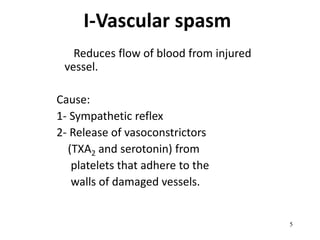
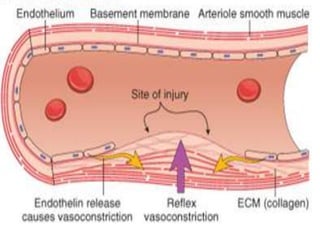
I-Vascular spasm
Reduces flow of blood from injured
vessel.
Cause:
1- Sympathetic reflex
2- Release of vasoconstrictors
(TXA2 and serotonin) from
platelets that adhere to the
walls of damaged vessels.
7
II- Platelet plug formation
Mechanism:
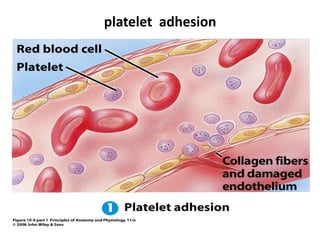
Platelet adherence
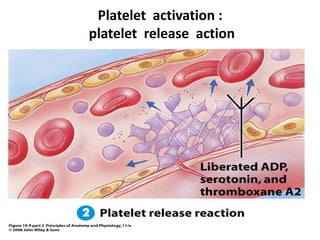
Platelet activation
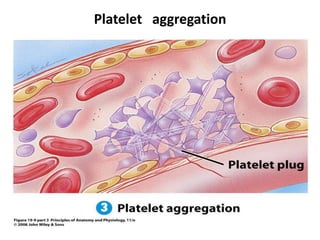
Platelet aggregation
platelet adhesion
platelet adhesion
Platelet activation :
platelet release action
Platelet aggregation
12
Platelets
• Produced in the bone marrow by fragmentation of the
cytoplasm of megakaryocytes (1000-5000/cell).
• 1/3 of marrow output of platelets is trapped in spleen
(splenectomy?)
• Normal count: 150,000-400,000/µL (250,000)
• Life span 7-10 days.
• Removed from circulation by tissue macrophage system
mainly in spleen.
• Thrombopoietin: major regulator of platelet production
(produced by liver and kidney).
• It increases no. & rate of maturation of megakaryocytes.
13
Functional characteristics of
platelets
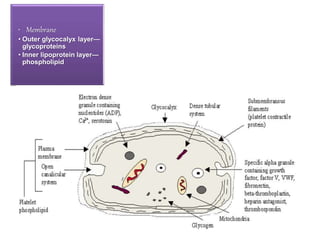
• The cell membrane of platelets contains:
– A coat of glycoprotein (receptors) that cause
adherence to injured endothelial cells and
exposed collagen.
– Phospholipids, that play an important role in
blood clotting.
• Membrane
• Outer glycocalyx layer—
glycoproteins
• Inner lipoprotein layer—
phospholipid
15
• Their cytoplasm :
 Contains:
 contractile proteins (actin & myosin).
 Dense granules, which contain substances that are
secreted in response to platelet activation
including serotonin & ADP.
 α-granules, which contain secreted proteins e.g.
platelet-derived growth factor (PDGF) which
stimulates wound healing, fibrin stabilizing factor
(factor XIII) and other clotting factors.
 Can store large quantities of Ca++.
platelet adhesion
17
Mechanism of platelet plug formation
* Platelet adhesion: When a blood vessel
wall is injured, platelets adhere to the
exposed collagen and von Willebrand
factor in the wall via platelet receptors →
Platelet activation.
*Activated platelets release the contents of their
granules including ADP and secrete TXA2 →
activates nearby platelets to
produce further accumulation of more
platelets (platelet aggregation) and forming
a platelet plug.
181818
19
Secondary hemostasis
• “Cascade of reactions” by Macfarlane,
R.G.,1967
It states that ‘inactive’ enzymes are activated, and the
‘activated’ enzymes in turn activates other inactive
enzymes until final step is reached.
21
Blood Coagulation
The clotting mechanism involves a cascade of reactions in
which clotting factors are activated.
Most of them are plasma proteins synthesized by the liver
(vitamin K is needed for the synthesis of factor II, VII, IX and
X).
They are always present in the plasma in an inactive form.
When activated they act as proteolytic enzymes which activate
other inactive enzymes.
Several of these steps require Ca++ and platelet phospholipid.
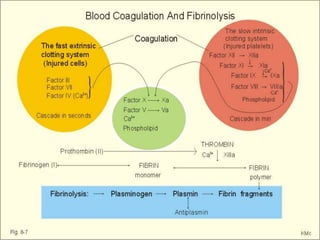
ENZYME CASCADE SEQUENCE
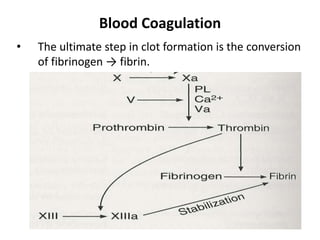
STAGE 1: FORMATION OF PROTHROMBIN ACTIVATOR
STAGE 2: CONVERSION OF PROTHROMBIN INTO THROMBIN
STAGE3: CONVERSION OF FIBRINOGEN INTO FIBRIN
25
Blood Coagulation
• The ultimate step in clot formation is the conversion
of fibrinogen → fibrin.
Factor X can be activated by
reactions in either of 2 systems:
An Intrinsic system.
An Extrinsic system
26
27
Intrinsic pathway
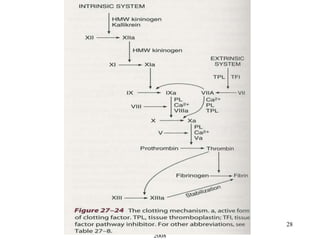
The initial reaction is the conversion of inactive
factor XII to active factor XIIa.
Factor XII is activated in vitro by exposing blood
to foreign surface (glass test tube).
Activation in vivo occurs when blood is exposed
to collagen fibers underlying the endothelium
in the blood vessels.
2nd Year Physiotherapy- November
2008
28
29
Extrinsic pathway
Requires contact with tissue factors external to
blood.
This occurs when there is trauma to the vascular
wall and surrounding tissues.
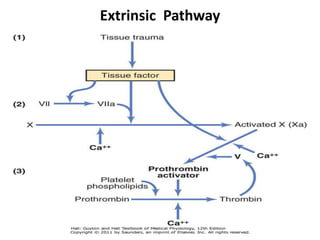
The extrinsic system is triggered by the release of
tissue factor (thromboplastin from damaged
tissue), that activates factor VII.
The tissue thromboplastin and factor VII activate
factor X.
Extrinsic Pathway
31
Clot retraction
Clot formation is fully developed in 3-6 min
Contraction of platelets trapped within the
clot shrinks the fibrin meshwork pulling the
edges of the damaged vessel closer
together.
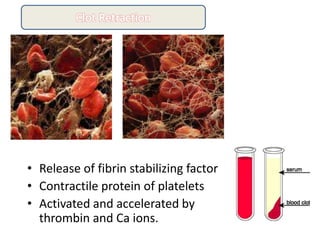
During clot retraction serum is squeezed from
the clot.
• Release of fibrin stabilizing factor
• Contractile protein of platelets
• Activated and accelerated by
thrombin and Ca ions.
WHY BLOOD DOES NOT CLOT IN CIRCULATION
?
• Endothelial surface factor
-smoothness
-layer of glycocalyx
-Negatively charged
• Velocity of circulation
• Natural anticoagulants
• Activation of Fibrinolytic system
• Liver removes activated clotting factors
METHOD OF STUDY
• HEMOSTATIC FUNCTION TESTS
-Bleeding time
-Clotting time
-Prothrombin time
BLEEDING TIME (B.T)
Definition ;
- time interval between the skin puncture and
spontaneous , unassisted stoppage of bleeding.
Method ; “Duke’s method”
Other methods ; “ivy” Bleeding time
Normal bleeding time ; 1 – 5 min.
35
CLOTTING TIME ( C.T )
 Definition ;
- time interval between entry of blood into glass capillary tube, or a
syringe, and formation of fibrin threads.
 Method ; Wright’s capillary glass tube
 Other Methods ; Duke’s Drop method, Lee and White test-
tube method
 Normal Clotting Time ; 3 – 6 min.
PROTHROMBIN TIME (P.T)
Normal P.T ; 15 – 20 sec.
Clinical Significance ; bleeding tendency occurs
below 20% (Normal plasma prothrombin = 30- 40 mg/dl)
Low prothrombin suggest Vit. K def. and liver and
biliary diseases.
Prolonged suggests deficiency of factor II, V, VII,
and X.
37
INR
• A PT test may also be called an INR test.
• INR (international normalized ratio) stands for
a way of standardizing the results of
prothrombin time tests.
• Normal is 0.9 – 1.3 but therapeutic values
ranges from 2.0 – 4.0
• An INR of 1.0 means that the patient PT is
normal.
• An INR greater than 1.0 means the clotting
time is elevated.
• INR of greater than 5 or 5.5 = unacceptable
high risk of bleeding, whereas if the INR=0.5
then there is a high chance of having a clot.
• Normal range for a healthy person is 0.9–1.3,
and for people on warfarin therapy, 2.0–3.0,
although the target INR may be higher in
particular situations, such as for those with a
mechanical heart valve.
DISORDERS OF COAGULATION
• Defective blood clotting
- deficiency of clotting factors (I, II, V, VIII, IX, X)
- deficiency of Vit- K
-von Willebrand disease
- anticoagulant overdose
• Defective capillary contractility
- Purpura
• Thrombosis
DEFICIENCY OF FACTORS
Hemophilia – B
( Christmas disease)
Factor – IX deficiency
Hemophilia - C
Factor – XI
(Plasma thromboplastin anticedent)
deficiency.
Hemophilia - D
Factor – XII
( Hageman factor) deficiency
44
Hemophilia
• Factor – VIII deficiency
• Inheritance – Sex linked,
-X-chromosome, females are carrier
• Diagnosis - CT increased, BT- normal
• Treatment
- Fresh blood transfusion
- Injecting factor – VIII and IX
- Injecting thrombin or thromboplastin
Purpura
• Purple coloured petechial hemorrhages and bruises
in the skin.
• Characterized by spontaneous hemorrhages
beneath the skin, mucous membrane and internal
organ.
• Capillary abnormality
• Types
- Primary (Idiopathic) –congenital or heriditary ,
seen in children
- Secondary (Symptomatic)
- allergies, infections, drugs, cancer
• VON WILLEBRAND’S DISEASE
• Deficiency of VWF & amount of Factor VIII
• Factor VIII is bound to vWF while inactive in circulation;
Factor VIII degrades rapidly when not bound to vWF
• Lab Results - Prolonged BT, PTT
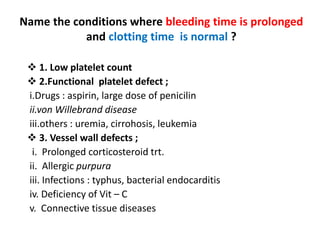
Name the conditions where bleeding time is prolonged
and clotting time is normal ?
 1. Low platelet count
 2.Functional platelet defect ;
i.Drugs : aspirin, large dose of penicilin
ii.von Willebrand disease
iii.others : uremia, cirrohosis, leukemia
 3. Vessel wall defects ;
i. Prolonged corticosteroid trt.
ii. Allergic purpura
iii. Infections : typhus, bacterial endocarditis
iv. Deficiency of Vit – C
v. Connective tissue diseases
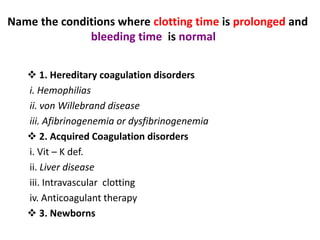
Name the conditions where clotting time is prolonged and
bleeding time is normal ?
 1. Hereditary coagulation disorders
i. Hemophilias
ii. von Willebrand disease
iii. Afibrinogenemia or dysfibrinogenemia
 2. Acquired Coagulation disorders
i. Vit – K def.
ii. Liver disease
iii. Intravascular clotting
iv. Anticoagulant therapy
 3. Newborns
ANTICOAGULANTS
 Natural Anticoagulants
 Heparin
 Antithrombin or Heparin co-factors
 Protein C
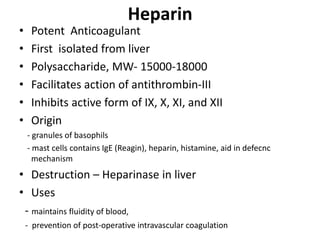
Heparin
• Potent Anticoagulant
• First isolated from liver
• Polysaccharide, MW- 15000-18000
• Facilitates action of antithrombin-III
• Inhibits active form of IX, X, XI, and XII
• Origin
- granules of basophils
- mast cells contains IgE (Reagin), heparin, histamine, aid in defecnc
mechanism
• Destruction – Heparinase in liver
• Uses
- maintains fluidity of blood,
- prevention of post-operative intravascular coagulation
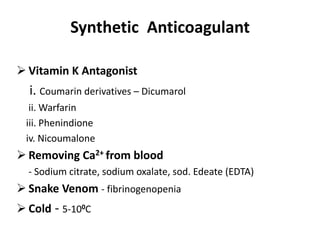
Synthetic Anticoagulant
 Vitamin K Antagonist
i. Coumarin derivatives – Dicumarol
ii. Warfarin
iii. Phenindione
iv. Nicoumalone
 Removing Ca2+ from blood
- Sodium citrate, sodium oxalate, sod. Edeate (EDTA)
 Snake Venom - fibrinogenopenia
 Cold - 5-100C
REFFERENCES
• Barret, K.E, etal(2010), Ganong’s Review of
Medical Physiology, 23rd edition, McGraw
Company, USA
• Raftery, A.T(2008), Applied Basic Science for
Basic Surgical Training, 2nd edition, Elsevier,
USA.
• Guyton AC, Hall JE : Textbook of Medical
Physiology, 11th Edition, Elsevier Saunders,
2006

Blood coagulation

  • 1.
    BLOOD COAGULATION PRESENTER: DRPASHI V MODERATOR: DR ZULU R
  • 2.
    SCOPE • HAEMOSTASIS OVERVIEW •PLATELETS • PLATELET PLUG FORMATION • BLOOD COAGULATION • HEMOSTATIC FUNCTION TESTS • DISORDERS OF COAGULATION • ANTICOAGULANTS
  • 3.
    HEMOSTASIS OVERVIEW • DEFINITION -Heme = blood - stasis = to halt • It is the process of forming clots in the wall of damaged blood vessels & preventing blood loss while maintaining blood in a fluid state with in the vascular system. • Spontaneous arrest of bleeding by physiological process.
  • 4.
    4 Mechanism Haemostasis involves 4main steps: 1. Vascular spasm 2. Platelets reaction 3. Formation of platelet plug 4. Blood coagulation
  • 5.
    5 I-Vascular spasm Reduces flowof blood from injured vessel. Cause: 1- Sympathetic reflex 2- Release of vasoconstrictors (TXA2 and serotonin) from platelets that adhere to the walls of damaged vessels.
  • 7.
    7 II- Platelet plugformation Mechanism: Platelet adherence Platelet activation Platelet aggregation
  • 8.
  • 9.
  • 10.
  • 11.
  • 12.
    12 Platelets • Produced inthe bone marrow by fragmentation of the cytoplasm of megakaryocytes (1000-5000/cell). • 1/3 of marrow output of platelets is trapped in spleen (splenectomy?) • Normal count: 150,000-400,000/µL (250,000) • Life span 7-10 days. • Removed from circulation by tissue macrophage system mainly in spleen. • Thrombopoietin: major regulator of platelet production (produced by liver and kidney). • It increases no. & rate of maturation of megakaryocytes.
  • 13.
    13 Functional characteristics of platelets •The cell membrane of platelets contains: – A coat of glycoprotein (receptors) that cause adherence to injured endothelial cells and exposed collagen. – Phospholipids, that play an important role in blood clotting.
  • 14.
    • Membrane • Outerglycocalyx layer— glycoproteins • Inner lipoprotein layer— phospholipid
  • 15.
    15 • Their cytoplasm:  Contains:  contractile proteins (actin & myosin).  Dense granules, which contain substances that are secreted in response to platelet activation including serotonin & ADP.  α-granules, which contain secreted proteins e.g. platelet-derived growth factor (PDGF) which stimulates wound healing, fibrin stabilizing factor (factor XIII) and other clotting factors.  Can store large quantities of Ca++.
  • 16.
  • 17.
    17 Mechanism of plateletplug formation * Platelet adhesion: When a blood vessel wall is injured, platelets adhere to the exposed collagen and von Willebrand factor in the wall via platelet receptors → Platelet activation. *Activated platelets release the contents of their granules including ADP and secrete TXA2 → activates nearby platelets to produce further accumulation of more platelets (platelet aggregation) and forming a platelet plug.
  • 18.
  • 19.
  • 20.
    Secondary hemostasis • “Cascadeof reactions” by Macfarlane, R.G.,1967 It states that ‘inactive’ enzymes are activated, and the ‘activated’ enzymes in turn activates other inactive enzymes until final step is reached.
  • 21.
    21 Blood Coagulation The clottingmechanism involves a cascade of reactions in which clotting factors are activated. Most of them are plasma proteins synthesized by the liver (vitamin K is needed for the synthesis of factor II, VII, IX and X). They are always present in the plasma in an inactive form. When activated they act as proteolytic enzymes which activate other inactive enzymes. Several of these steps require Ca++ and platelet phospholipid.
  • 23.
    ENZYME CASCADE SEQUENCE STAGE1: FORMATION OF PROTHROMBIN ACTIVATOR STAGE 2: CONVERSION OF PROTHROMBIN INTO THROMBIN STAGE3: CONVERSION OF FIBRINOGEN INTO FIBRIN
  • 25.
    25 Blood Coagulation • Theultimate step in clot formation is the conversion of fibrinogen → fibrin.
  • 26.
    Factor X canbe activated by reactions in either of 2 systems: An Intrinsic system. An Extrinsic system 26
  • 27.
    27 Intrinsic pathway The initialreaction is the conversion of inactive factor XII to active factor XIIa. Factor XII is activated in vitro by exposing blood to foreign surface (glass test tube). Activation in vivo occurs when blood is exposed to collagen fibers underlying the endothelium in the blood vessels.
  • 28.
    2nd Year Physiotherapy-November 2008 28
  • 29.
    29 Extrinsic pathway Requires contactwith tissue factors external to blood. This occurs when there is trauma to the vascular wall and surrounding tissues. The extrinsic system is triggered by the release of tissue factor (thromboplastin from damaged tissue), that activates factor VII. The tissue thromboplastin and factor VII activate factor X.
  • 30.
  • 31.
    31 Clot retraction Clot formationis fully developed in 3-6 min Contraction of platelets trapped within the clot shrinks the fibrin meshwork pulling the edges of the damaged vessel closer together. During clot retraction serum is squeezed from the clot.
  • 32.
    • Release offibrin stabilizing factor • Contractile protein of platelets • Activated and accelerated by thrombin and Ca ions.
  • 33.
    WHY BLOOD DOESNOT CLOT IN CIRCULATION ? • Endothelial surface factor -smoothness -layer of glycocalyx -Negatively charged • Velocity of circulation • Natural anticoagulants • Activation of Fibrinolytic system • Liver removes activated clotting factors
  • 34.
    METHOD OF STUDY •HEMOSTATIC FUNCTION TESTS -Bleeding time -Clotting time -Prothrombin time
  • 35.
    BLEEDING TIME (B.T) Definition; - time interval between the skin puncture and spontaneous , unassisted stoppage of bleeding. Method ; “Duke’s method” Other methods ; “ivy” Bleeding time Normal bleeding time ; 1 – 5 min. 35
  • 36.
    CLOTTING TIME (C.T )  Definition ; - time interval between entry of blood into glass capillary tube, or a syringe, and formation of fibrin threads.  Method ; Wright’s capillary glass tube  Other Methods ; Duke’s Drop method, Lee and White test- tube method  Normal Clotting Time ; 3 – 6 min.
  • 37.
    PROTHROMBIN TIME (P.T) NormalP.T ; 15 – 20 sec. Clinical Significance ; bleeding tendency occurs below 20% (Normal plasma prothrombin = 30- 40 mg/dl) Low prothrombin suggest Vit. K def. and liver and biliary diseases. Prolonged suggests deficiency of factor II, V, VII, and X. 37
  • 38.
    INR • A PTtest may also be called an INR test. • INR (international normalized ratio) stands for a way of standardizing the results of prothrombin time tests. • Normal is 0.9 – 1.3 but therapeutic values ranges from 2.0 – 4.0
  • 39.
    • An INRof 1.0 means that the patient PT is normal. • An INR greater than 1.0 means the clotting time is elevated. • INR of greater than 5 or 5.5 = unacceptable high risk of bleeding, whereas if the INR=0.5 then there is a high chance of having a clot. • Normal range for a healthy person is 0.9–1.3, and for people on warfarin therapy, 2.0–3.0, although the target INR may be higher in particular situations, such as for those with a mechanical heart valve.
  • 40.
    DISORDERS OF COAGULATION •Defective blood clotting - deficiency of clotting factors (I, II, V, VIII, IX, X) - deficiency of Vit- K -von Willebrand disease - anticoagulant overdose • Defective capillary contractility - Purpura • Thrombosis
  • 41.
  • 42.
    Hemophilia – B (Christmas disease) Factor – IX deficiency
  • 43.
    Hemophilia - C Factor– XI (Plasma thromboplastin anticedent) deficiency.
  • 44.
    Hemophilia - D Factor– XII ( Hageman factor) deficiency 44
  • 45.
    Hemophilia • Factor –VIII deficiency • Inheritance – Sex linked, -X-chromosome, females are carrier • Diagnosis - CT increased, BT- normal • Treatment - Fresh blood transfusion - Injecting factor – VIII and IX - Injecting thrombin or thromboplastin
  • 46.
    Purpura • Purple colouredpetechial hemorrhages and bruises in the skin. • Characterized by spontaneous hemorrhages beneath the skin, mucous membrane and internal organ. • Capillary abnormality • Types - Primary (Idiopathic) –congenital or heriditary , seen in children - Secondary (Symptomatic) - allergies, infections, drugs, cancer
  • 47.
    • VON WILLEBRAND’SDISEASE • Deficiency of VWF & amount of Factor VIII • Factor VIII is bound to vWF while inactive in circulation; Factor VIII degrades rapidly when not bound to vWF • Lab Results - Prolonged BT, PTT
  • 48.
    Name the conditionswhere bleeding time is prolonged and clotting time is normal ?  1. Low platelet count  2.Functional platelet defect ; i.Drugs : aspirin, large dose of penicilin ii.von Willebrand disease iii.others : uremia, cirrohosis, leukemia  3. Vessel wall defects ; i. Prolonged corticosteroid trt. ii. Allergic purpura iii. Infections : typhus, bacterial endocarditis iv. Deficiency of Vit – C v. Connective tissue diseases
  • 49.
    Name the conditionswhere clotting time is prolonged and bleeding time is normal ?  1. Hereditary coagulation disorders i. Hemophilias ii. von Willebrand disease iii. Afibrinogenemia or dysfibrinogenemia  2. Acquired Coagulation disorders i. Vit – K def. ii. Liver disease iii. Intravascular clotting iv. Anticoagulant therapy  3. Newborns
  • 50.
    ANTICOAGULANTS  Natural Anticoagulants Heparin  Antithrombin or Heparin co-factors  Protein C
  • 51.
    Heparin • Potent Anticoagulant •First isolated from liver • Polysaccharide, MW- 15000-18000 • Facilitates action of antithrombin-III • Inhibits active form of IX, X, XI, and XII • Origin - granules of basophils - mast cells contains IgE (Reagin), heparin, histamine, aid in defecnc mechanism • Destruction – Heparinase in liver • Uses - maintains fluidity of blood, - prevention of post-operative intravascular coagulation
  • 52.
    Synthetic Anticoagulant  VitaminK Antagonist i. Coumarin derivatives – Dicumarol ii. Warfarin iii. Phenindione iv. Nicoumalone  Removing Ca2+ from blood - Sodium citrate, sodium oxalate, sod. Edeate (EDTA)  Snake Venom - fibrinogenopenia  Cold - 5-100C
  • 53.
    REFFERENCES • Barret, K.E,etal(2010), Ganong’s Review of Medical Physiology, 23rd edition, McGraw Company, USA • Raftery, A.T(2008), Applied Basic Science for Basic Surgical Training, 2nd edition, Elsevier, USA. • Guyton AC, Hall JE : Textbook of Medical Physiology, 11th Edition, Elsevier Saunders, 2006