pcDuino
A New Way To Innovate

www.pcduino.com
learn.linksprite.com
Agenda



pcDuino: a platform open source software meets open source
hardware
Programming under Ubuntu (linux)







Programming under Android ICS





Arduino style programming ( C ) for pcDuino
Python programming for pcDuino
Java programming for pcDuino
Cloud 9 IDE

Command line programming
QT GUI

Friends help Friends Program




Friends help Friends - PCB
Friends help Friends - Assembly
Friends help Friends -Distribution
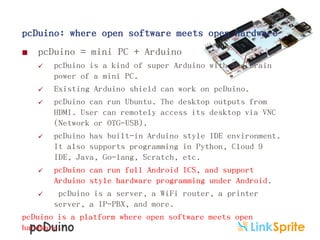
pcDuino: where open software meets open hardware


pcDuino = mini PC + Arduino

pcDuino is a kind of super Arduino with the brain
power of a mini PC.

Existing Arduino shield can work on pcDuino.

pcDuino can run Ubuntu. The desktop outputs from
HDMI. User can remotely access its desktop via VNC
(Network or OTG-USB).

pcDuino has built-in Arduino style IDE environment.
It also supports programming in Python, Cloud 9
IDE, Java, Go-lang, Scratch, etc.

pcDuino can run full Android ICS, and support
Arduino style hardware programming under Android.

pcDuino is a server, a WiFi router, a printer
server, a IP-PBX, and more.
pcDuino is a platform where open software meets open
hardware.

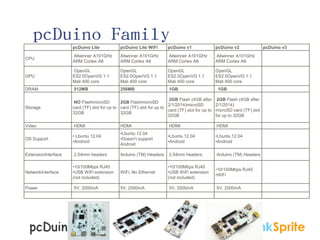
pcDuino Family
pcDuino Lite

pcDuino Lite WiFi

pcDuino v1

pcDuino v2

CPU

Allwinner A101GHz
ARM Cortex A8

Allwinner A101GHz
ARM Cortex A8

Allwinner A101GHz
ARM Cortex A8

Allwinner A101GHz
ARM Cortex A8

GPU

OpenGL
ES2.0OpenVG 1.1
Mali 400 core

OpenGL
ES2.0OpenVG 1.1
Mali 400 core

OpenGL
ES2.0OpenVG 1.1
Mali 400 core

OpenGL
ES2.0OpenVG 1.1
Mali 400 core

DRAM

512MB

256MB

1GB

Storage

2GB Flash (4GB after 2GB Flash (4GB after
NO FlashmicroSD
2GB FlashmicroSD
2/1/2014)microSD
2/1/2014)
card (TF) slot for up to card (TF) slot for up to
card (TF) slot for up to microSD card (TF) slot
32GB
32GB
32GB
for up to 32GB

Video

HDMI

HDMI

HDMI

HDMI

OS Support

• Lbuntu 12.04
•Android

•Lbuntu 12.04
•Doesn’t support
Android

•Lbuntu 12.04
•Android

•Lbuntu 12.04
•Android

ExtensionInterface

2.54mm headers

Arduino (TM) Headers

2.54mm headers

Arduino (TM) Headers

NetworkInterface

•10/100Mbps RJ45
•USB WiFi extension
(not included)

WiFi, No Ethernet

•10/100Mbps RJ45
•USB WiFi extension
(not included)

•10/100Mbps RJ45
•WiFi

Power

5V, 2000mA

5V, 2000mA

5V, 2000mA

5V, 2000mA

1GB

pcDuino v3
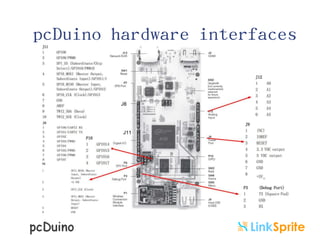
pcDuino hardware interfaces
pcDuino boot modes




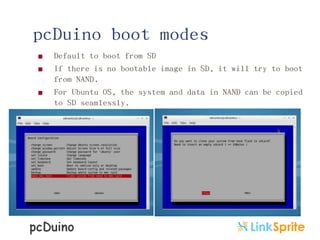
Default to boot from SD
If there is no bootable image in SD, it will try to boot
from NAND.
For Ubuntu OS, the system and data in NAND can be copied
to SD seamlessly.
Programming under Ubuntu (linux)
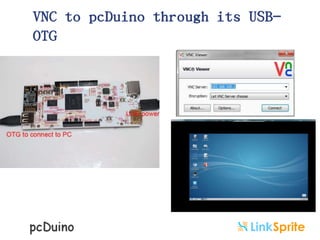
VNC to pcDuino through its USBOTG
Arduino style programming ( C )


Two flavors



Command line
IDE
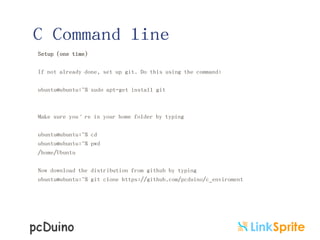
C Command line
Setup (one time)
If not already done, set up git. Do this using the command:
ubuntu@ubuntu:~$ sudo apt-get install git

Make sure you’re in your home folder by typing
ubuntu@ubuntu:~$ cd
ubuntu@ubuntu:~$ pwd
/home/Ubuntu
Now download the distribution from github by typing
ubuntu@ubuntu:~$ git clone https://github.com/pcduino/c_enviroment
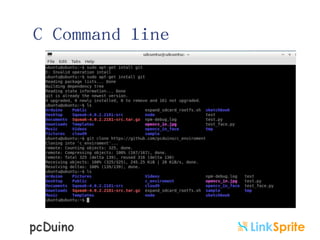
C Command line
C Command line
Change into the c_enviroment folder:

ubuntu@ubuntu:~$ cd c_enviroment
ubuntu@ubuntu:~/c_enviroment$ ls
Makefile hardware libraries output sample
Now run make to make the libraries and the examples with the following command:
ubuntu@ubuntu:~/c_enviroment$ make
Make[1]: Leaving directory `/home/ubuntu/c_enviroment/sample'
The resulting binary files are found in the output/test folder
ubuntu@ubuntu:~/c_enviroment$ cd output/test
ubuntu@ubuntu:~/c_enviroment/output/test$ ll
total 660
drwxrwxr-x 2 ubuntu ubuntu 4096 Apr 27 06:59 ./
drwxrwxr-x 3 ubuntu ubuntu 4096 Apr 27 06:49 ../
-rwxrwxr-x 1 ubuntu ubuntu 13868 Apr 27 06:58 adc_test*
-rwxrwxr-x 1 ubuntu ubuntu 28284 Apr 27 06:58 adxl345_test*
-rwxrwxr-x 1 ubuntu ubuntu 14209 Apr 27 06:58 interrupt_test*
-rwxrwxr-x 1 ubuntu ubuntu 13726 Apr 27 06:58 io_test*
-rwxrwxr-x 1 ubuntu ubuntu 13712 Apr 27 06:59 linker_button_test*
-rwxrwxr-x 1 ubuntu ubuntu 13907 Apr 27 06:59 linker_buzzer_test*
-rwxrwxr-x 1 ubuntu ubuntu 13689 Apr 27 06:59 linker_hall_sensor_test*
-rwxrwxr-x 1 ubuntu ubuntu 13760 Apr 27 06:59 linker_joystick_test*
-rwxrwxr-x 1 ubuntu ubuntu 13769 Apr 27 06:59 linker_led_bar_test*
-rwxrwxr-x 1 ubuntu ubuntu 13690 Apr 27 06:59 linker_led_test*
-rwxrwxr-x 1 ubuntu ubuntu 14290 Apr 27 06:59 linker_light_sensor_test*
““
C Command line
To view the contents of a sample sketch, (this
example we’ll look at the contents of
linker_led_test.c) type:
ubuntu@ubuntu:~/c_enviroment/sample$ cat
linker_led_test.c
/*
* LED test program
*/
#include <core.h>
int led_pin = 1;
void setup()
{
if(argc != 2){
goto _help;
}
led_pin = atoi(argv[1]);
if((led_pin < 0) || (led_pin > 13)){
goto _help;
}
pinMode(led_pin, OUTPUT);
return;
_help:
printf("Usage %s LED_PIN_NUM(0-13)n", argv[0]);
exit(-1);
}

void loop()
{
digitalWrite(led_pin, HIGH); // set the LED
on
delay(1000); // wait for a second
digitalWrite(led_pin, LOW); // set the LED
off
delay(1000); // wait for a second
}
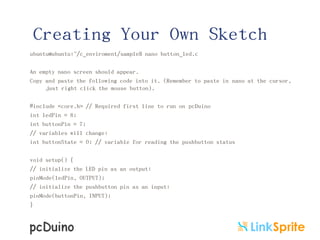
Creating Your Own Sketch
ubuntu@ubuntu:~/c_enviroment/sample$ nano button_led.c
An empty nano screen should appear.
Copy and paste the following code into it. (Remember to paste in nano at the cursor,
just right click the mouse button).
#include <core.h> // Required first line to run on pcDuino
int ledPin = 8;
int buttonPin = 7;
// variables will change:
int buttonState = 0; // variable for reading the pushbutton status
void setup() {
// initialize the LED pin as an output:
pinMode(ledPin, OUTPUT);
// initialize the pushbutton pin as an input:
pinMode(buttonPin, INPUT);
}
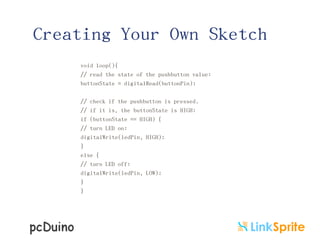
Creating Your Own Sketch
void loop(){
// read the state of the pushbutton value:
buttonState = digitalRead(buttonPin);
// check if the pushbutton is pressed.
// if it is, the buttonState is HIGH:
if (buttonState == HIGH) {
// turn LED on:
digitalWrite(ledPin, HIGH);
}
else {
// turn LED off:
digitalWrite(ledPin, LOW);
}
}
Creating Your Own Sketch
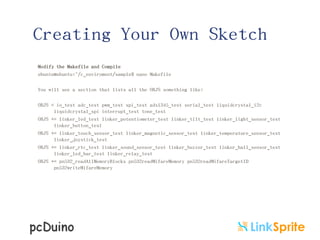
Modify the Makefile and Compile
ubuntu@ubuntu:~/c_enviroment/sample$ nano Makefile
You will see a section that lists all the OBJS something like:
OBJS = io_test adc_test pwm_test spi_test adxl345_test serial_test liquidcrystal_i2c
liquidcrystal_spi interrupt_test tone_test
OBJS += linker_led_test linker_potentiometer_test linker_tilt_test linker_light_sensor_test
linker_button_test
OBJS += linker_touch_sensor_test linker_magnetic_sensor_test linker_temperature_sensor_test
linker_joystick_test
OBJS += linker_rtc_test linker_sound_sensor_test linker_buzzer_test linker_hall_sensor_test
linker_led_bar_test linker_relay_test
OBJS += pn532_readAllMemoryBlocks pn532readMifareMemory pn532readMifareTargetID
pn532writeMifareMemory
Creating Your Own Sketch

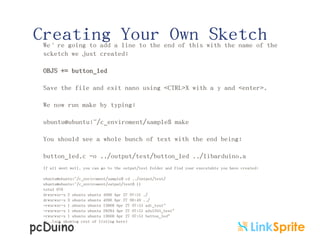
We’re going to add a line to the end of this with the name of the
scketch we just created:
OBJS += button_led
Save the file and exit nano using <CTRL>X with a y and <enter>.
We now run make by typing:
ubuntu@ubuntu:~/c_enviroment/sample$ make
You should see a whole bunch of text with the end being:
button_led.c -o ../output/test/button_led ../libarduino.a
If all went well, you can go to the output/test folder and find your executable you have created:
ubuntu@ubuntu:~/c_enviroment/sample$ cd ../output/test/
ubuntu@ubuntu:~/c_enviroment/output/test$ ll
total 676
drwxrwxr-x 2 ubuntu ubuntu 4096 Apr 27 07:51 ./
drwxrwxr-x 3 ubuntu ubuntu 4096 Apr 27 06:49 ../
-rwxrwxr-x 1 ubuntu ubuntu 13868 Apr 27 07:51 adc_test*
-rwxrwxr-x 1 ubuntu ubuntu 28284 Apr 27 07:51 adxl345_test*
-rwxrwxr-x 1 ubuntu ubuntu 13668 Apr 27 07:51 button_led*
“..(not showing rest of listing here)
Creating Your Own Sketch

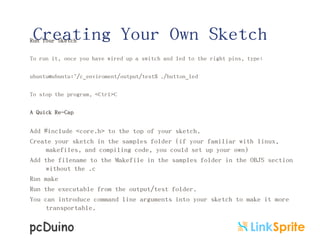
Run Your Sketch

To run it, once you have wired up a switch and led to the right pins, type:
ubuntu@ubuntu:~/c_enviroment/output/test$ ./button_led
To stop the program, <Ctrl>C
A Quick Re-Cap

Add #include <core.h> to the top of your sketch.
Create your sketch in the samples folder (if your familiar with linux,
makefiles, and compiling code, you could set up your own)
Add the filename to the Makefile in the samples folder in the OBJS section
without the .c
Run make
Run the executable from the output/test folder.
You can introduce command line arguments into your sketch to make it more
transportable.
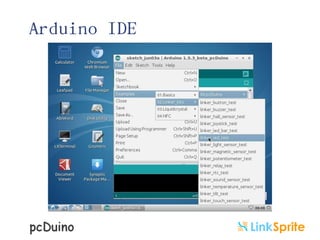
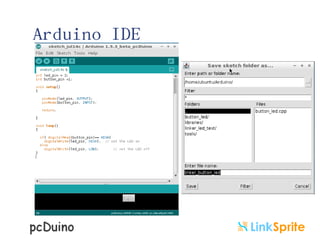
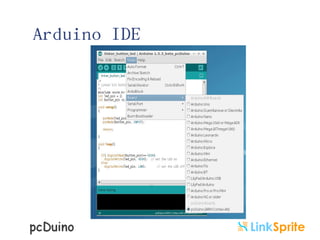
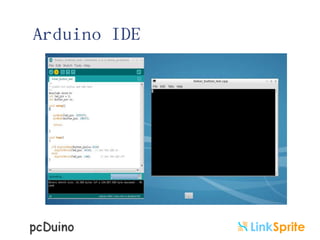
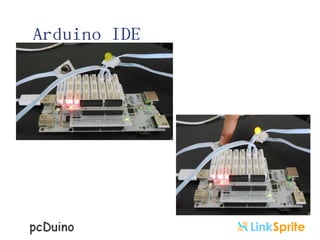
Arduino IDE
Arduino IDE
Arduino IDE
Arduino IDE
Arduino IDE
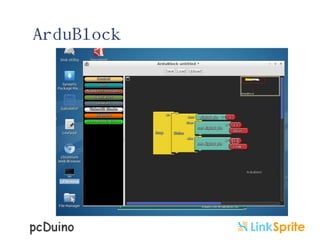
ArduBlock
pcDuino
Hardware Experiments
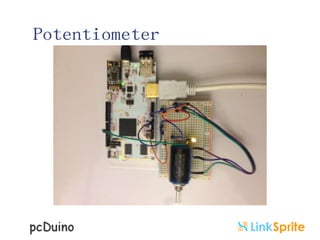
Potentiometer
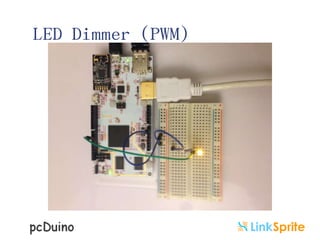
LED Dimmer (PWM)
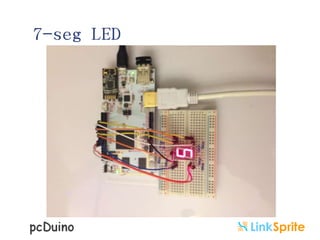
7-seg LED
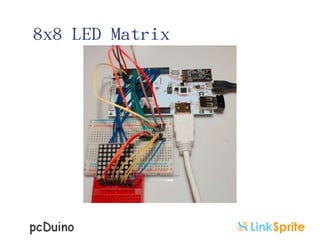
8x8 LED Matrix
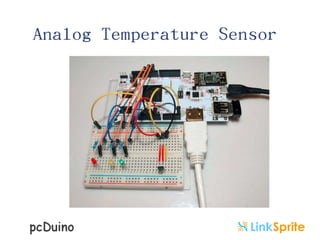
Analog Temperature Sensor
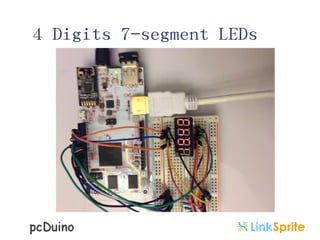
4 Digits 7-segment LEDs
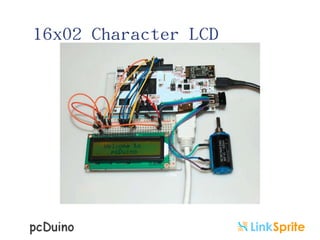
16x02 Character LCD
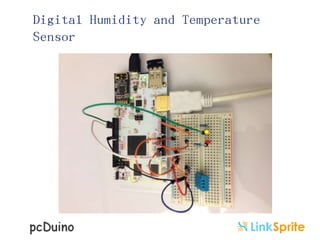
Digital Humidity and Temperature
Sensor
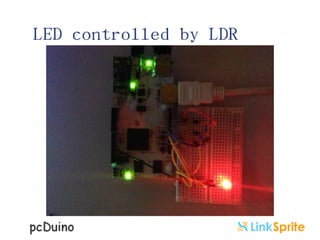
LED controlled by LDR
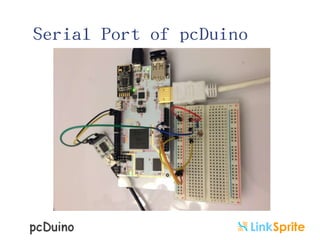
Serial Port of pcDuino
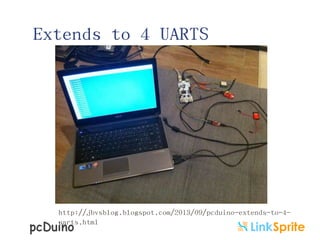
Extends to 4 UARTS

http://jbvsblog.blogspot.com/2013/09/pcduino-extends-to-4uarts.html
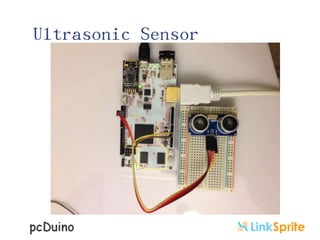
Ultrasonic Sensor
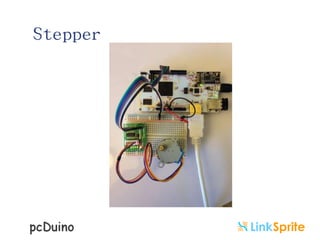
Stepper
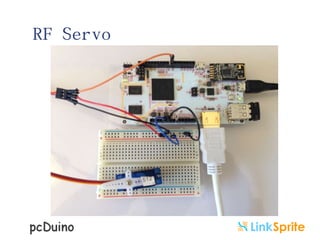
RF Servo
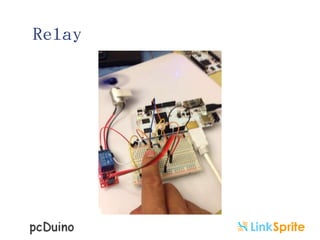
Relay
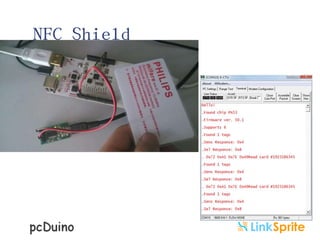
NFC Shield
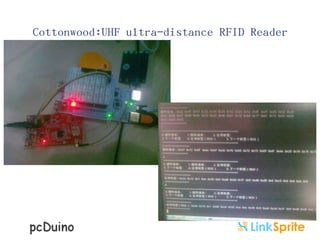
Cottonwood:UHF ultra-distance RFID Reader
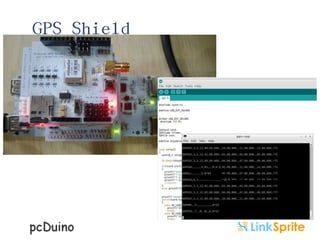
GPS Shield
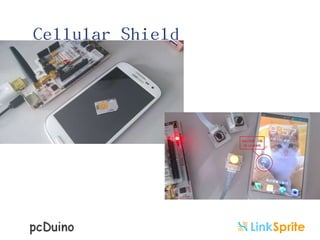
Cellular Shield
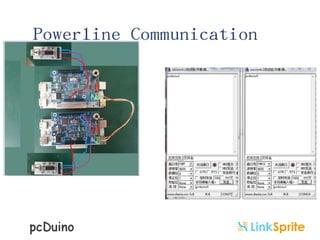
Powerline Communication
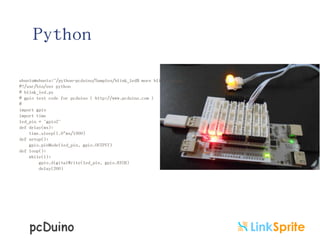
Python
ubuntu@ubuntu:~/python-pcduino/Samples/blink_led$ more blink_led.py
#!/usr/bin/env python
# blink_led.py
# gpio test code for pcduino ( http://www.pcduino.com )
#
import gpio
import time
led_pin = "gpio2"
def delay(ms):
time.sleep(1.0*ms/1000)
def setup():
gpio.pinMode(led_pin, gpio.OUTPUT)
def loop():
while(1):
gpio.digitalWrite(led_pin, gpio.HIGH)
delay(200)
OpenCV
OpenCV
def process(infile):
image = cv.LoadImage(infile);
if image:
faces = detect_object(image)
im = Image.open(infile)
path = os.path.abspath(infile)
save_path = os.path.splitext(path)[0]+"_face"
try:
os.mkdir(save_path)
except:
pass
if faces:
draw = ImageDraw.Draw(im)
count = 0
for f in faces:
count += 1
draw.rectangle(f, outline=(255, 0, 0))
a = im.crop(f)
file_name =
os.path.join(save_path,str(count)+".jpg")
#
print file_name
a.save(file_name)
drow_save_path =
os.path.join(save_path,"out.jpg")
im.save(drow_save_path, "JPEG", quality=80)
else:
print "Error: cannot detect faces on %s" %
infile
if __name__ == "__main__":
process("./opencv_in.jpg")
OpenCV
#!/usr/bin/env python
#coding=utf-8
import os
from PIL import Image, ImageDraw
import cv
def detect_object(image):
grayscale = cv.CreateImage((image.width, image.height), 8, 1)
cv.CvtColor(image, grayscale, cv.CV_BGR2GRAY)
cascade = cv.Load("/usr/share/opencv/haarcascades/haarcascade_frontalface_alt_tree.xml")
rect = cv.HaarDetectObjects(grayscale, cascade, cv.CreateMemStorage(), 1.1, 2,
cv.CV_HAAR_DO_CANNY_PRUNING, (20,20))
result = []
for r in rect:
result.append((r[0][0], r[0][1], r[0][0]+r[0][2], r[0][1]+r[0][3]))
return result
Cloud 9 IDE




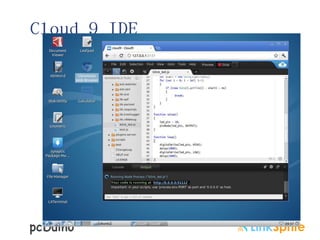
Cloud9 IDE is an online development environment
for Javascript and Node.js applications as well
as HTML, CSS, PHP, Java, Ruby and 23 other
languages.
You're programming for the web, on the web.
Teams can collaborate on projects and run them
within the browser. When you're finished,
deploy it—and you're done!
Cloud 9 IDE
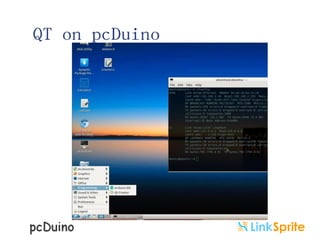
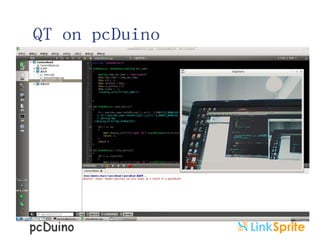
QT on pcDuino
QT on pcDuino
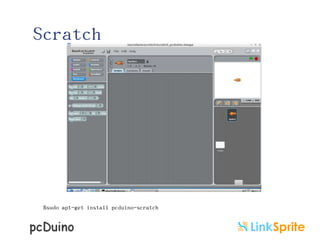
Scratch

$sudo apt-get install pcduino-scratch
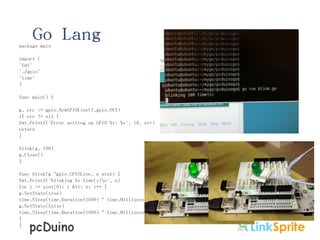
Go Lang

package main
import (
"fmt"
"./gpio"
"time"
)

func main() {
g, err := gpio.NewGPIOLine(7,gpio.OUT)
if err != nil {
fmt.Printf("Error setting up GPIO %v: %v", 18, err)
return
}
blink(g, 100)
g.Close()
}
func blink(g *gpio.GPIOLine, n uint) {
fmt.Printf("blinking %v time(s)n", n)
for i := uint(0); i &lt; n; i++ {
g.SetState(true)
time.Sleep(time.Duration(1000) * time.Millisecond)
g.SetState(false)
time.Sleep(time.Duration(1000) * time.Millisecond)
}
}
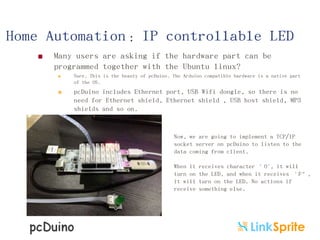
Home Automation:IP controllable LED


Many users are asking if the hardware part can be
programmed together with the Ubuntu linux?


Sure. This is the beauty of pcDuino. The Arduino compatible hardware is a native part
of the OS.



pcDuino includes Ethernet port, USB Wifi dongle, so there is no
need for Ethernet shield, Ethernet shield , USB host shield, MP3
shields and so on.

Now, we are going to implement a TCP/IP
socket server on pcDuino to listen to the
data coming from client.
When it
turn on
it will
receive

receives character ’O', it will
the LED, and when it receives ‘F‛,
turn on the LED. No actions if
something else.
Home Automation:IP controllable LED
#include ‚sys/socket.h‛
#include ‚netinet/in.h‛
#include ‚arpa/inet.h‛
#include
‚sys/types.h‛

void loop()
{
n = read(connfd, sendBuff, strlen(sendBuff) );

int led_pin = 2;
int listenfd = 0, connfd = 0;
int n;
struct sockaddr_in serv_addr;
char sendBuff[1025];
time_t ticks;

if(n>0)
{
if(sendBuff[0]=='O') digitalWrite(led_pin,
HIGH); // set the LED on
if(sendBuff[0]=='F') digitalWrite(led_pin,LOW);
// set the LED off
}
}

void setup()
{
led_pin = 2;
pinMode(led_pin, OUTPUT);
listenfd = socket(AF_INET, SOCK_STREAM, 0);
memset(serv_addr, '0', sizeof(serv_addr));
memset(sendBuff, '0', sizeof(sendBuff));
serv_addr.sin_family = AF_INET;
serv_addr.sin_addr.s_addr = htonl(INADDR_ANY);
serv_addr.sin_port = htons(5000);

bind(listenfd, (struct sockaddr*) serv_addr, sizeof(serv_addr));
listen(listenfd, 10);
connfd = accept(listenfd, (struct sockaddr*)NULL, NULL);
}
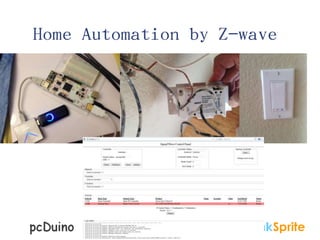
Home Automation by Z-wave
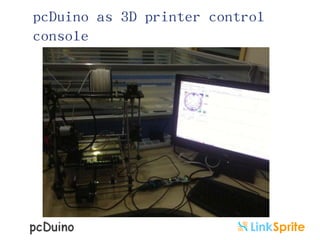
pcDuino as 3D printer control
console
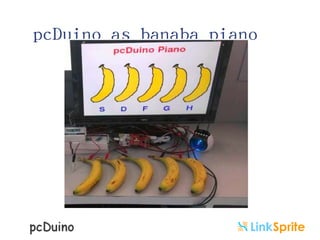
pcDuino as banaba piano
Programming under Android ICS
Two flavors to program under Android


There are two flavors to program under
Android:



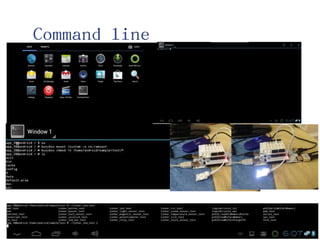
Command line
QT5 GUI
Command line
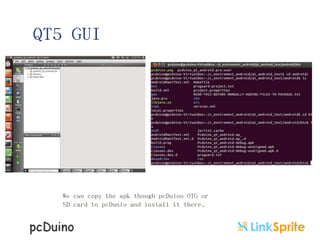
QT5 GUI

We can copy the apk though pcDuino OTG or
SD card to pcDunio and install it there.
Friends help Friends





Friends help Friends - PCB
Friends help Friends - Assembly
Friends help Friends -Distribution

Leverage LinkSprite Manufacturing Facility in
Shenzhen, China, and distribution channel
worldwide.
Connect with pcDuino

Facebook.com/linksprit
e

Introduction to pcDuino

  • 1.
    pcDuino A New WayTo Innovate www.pcduino.com learn.linksprite.com
  • 2.
    Agenda   pcDuino: a platformopen source software meets open source hardware Programming under Ubuntu (linux)      Programming under Android ICS    Arduino style programming ( C ) for pcDuino Python programming for pcDuino Java programming for pcDuino Cloud 9 IDE Command line programming QT GUI Friends help Friends Program    Friends help Friends - PCB Friends help Friends - Assembly Friends help Friends -Distribution
  • 3.
    pcDuino: where opensoftware meets open hardware  pcDuino = mini PC + Arduino pcDuino is a kind of super Arduino with the brain power of a mini PC.  Existing Arduino shield can work on pcDuino.  pcDuino can run Ubuntu. The desktop outputs from HDMI. User can remotely access its desktop via VNC (Network or OTG-USB).  pcDuino has built-in Arduino style IDE environment. It also supports programming in Python, Cloud 9 IDE, Java, Go-lang, Scratch, etc.  pcDuino can run full Android ICS, and support Arduino style hardware programming under Android.  pcDuino is a server, a WiFi router, a printer server, a IP-PBX, and more. pcDuino is a platform where open software meets open hardware. 
  • 4.
    pcDuino Family pcDuino Lite pcDuinoLite WiFi pcDuino v1 pcDuino v2 CPU Allwinner A101GHz ARM Cortex A8 Allwinner A101GHz ARM Cortex A8 Allwinner A101GHz ARM Cortex A8 Allwinner A101GHz ARM Cortex A8 GPU OpenGL ES2.0OpenVG 1.1 Mali 400 core OpenGL ES2.0OpenVG 1.1 Mali 400 core OpenGL ES2.0OpenVG 1.1 Mali 400 core OpenGL ES2.0OpenVG 1.1 Mali 400 core DRAM 512MB 256MB 1GB Storage 2GB Flash (4GB after 2GB Flash (4GB after NO FlashmicroSD 2GB FlashmicroSD 2/1/2014)microSD 2/1/2014) card (TF) slot for up to card (TF) slot for up to card (TF) slot for up to microSD card (TF) slot 32GB 32GB 32GB for up to 32GB Video HDMI HDMI HDMI HDMI OS Support • Lbuntu 12.04 •Android •Lbuntu 12.04 •Doesn’t support Android •Lbuntu 12.04 •Android •Lbuntu 12.04 •Android ExtensionInterface 2.54mm headers Arduino (TM) Headers 2.54mm headers Arduino (TM) Headers NetworkInterface •10/100Mbps RJ45 •USB WiFi extension (not included) WiFi, No Ethernet •10/100Mbps RJ45 •USB WiFi extension (not included) •10/100Mbps RJ45 •WiFi Power 5V, 2000mA 5V, 2000mA 5V, 2000mA 5V, 2000mA 1GB pcDuino v3
  • 5.
  • 6.
    pcDuino boot modes    Defaultto boot from SD If there is no bootable image in SD, it will try to boot from NAND. For Ubuntu OS, the system and data in NAND can be copied to SD seamlessly.
  • 7.
  • 8.
    VNC to pcDuinothrough its USBOTG
  • 9.
    Arduino style programming( C )  Two flavors   Command line IDE
  • 10.
    C Command line Setup(one time) If not already done, set up git. Do this using the command: ubuntu@ubuntu:~$ sudo apt-get install git Make sure you’re in your home folder by typing ubuntu@ubuntu:~$ cd ubuntu@ubuntu:~$ pwd /home/Ubuntu Now download the distribution from github by typing ubuntu@ubuntu:~$ git clone https://github.com/pcduino/c_enviroment
  • 11.
  • 12.
    C Command line Changeinto the c_enviroment folder: ubuntu@ubuntu:~$ cd c_enviroment ubuntu@ubuntu:~/c_enviroment$ ls Makefile hardware libraries output sample Now run make to make the libraries and the examples with the following command: ubuntu@ubuntu:~/c_enviroment$ make Make[1]: Leaving directory `/home/ubuntu/c_enviroment/sample' The resulting binary files are found in the output/test folder ubuntu@ubuntu:~/c_enviroment$ cd output/test ubuntu@ubuntu:~/c_enviroment/output/test$ ll total 660 drwxrwxr-x 2 ubuntu ubuntu 4096 Apr 27 06:59 ./ drwxrwxr-x 3 ubuntu ubuntu 4096 Apr 27 06:49 ../ -rwxrwxr-x 1 ubuntu ubuntu 13868 Apr 27 06:58 adc_test* -rwxrwxr-x 1 ubuntu ubuntu 28284 Apr 27 06:58 adxl345_test* -rwxrwxr-x 1 ubuntu ubuntu 14209 Apr 27 06:58 interrupt_test* -rwxrwxr-x 1 ubuntu ubuntu 13726 Apr 27 06:58 io_test* -rwxrwxr-x 1 ubuntu ubuntu 13712 Apr 27 06:59 linker_button_test* -rwxrwxr-x 1 ubuntu ubuntu 13907 Apr 27 06:59 linker_buzzer_test* -rwxrwxr-x 1 ubuntu ubuntu 13689 Apr 27 06:59 linker_hall_sensor_test* -rwxrwxr-x 1 ubuntu ubuntu 13760 Apr 27 06:59 linker_joystick_test* -rwxrwxr-x 1 ubuntu ubuntu 13769 Apr 27 06:59 linker_led_bar_test* -rwxrwxr-x 1 ubuntu ubuntu 13690 Apr 27 06:59 linker_led_test* -rwxrwxr-x 1 ubuntu ubuntu 14290 Apr 27 06:59 linker_light_sensor_test* ““
  • 13.
    C Command line Toview the contents of a sample sketch, (this example we’ll look at the contents of linker_led_test.c) type: ubuntu@ubuntu:~/c_enviroment/sample$ cat linker_led_test.c /* * LED test program */ #include <core.h> int led_pin = 1; void setup() { if(argc != 2){ goto _help; } led_pin = atoi(argv[1]); if((led_pin < 0) || (led_pin > 13)){ goto _help; } pinMode(led_pin, OUTPUT); return; _help: printf("Usage %s LED_PIN_NUM(0-13)n", argv[0]); exit(-1); } void loop() { digitalWrite(led_pin, HIGH); // set the LED on delay(1000); // wait for a second digitalWrite(led_pin, LOW); // set the LED off delay(1000); // wait for a second }
  • 14.
    Creating Your OwnSketch ubuntu@ubuntu:~/c_enviroment/sample$ nano button_led.c An empty nano screen should appear. Copy and paste the following code into it. (Remember to paste in nano at the cursor, just right click the mouse button). #include <core.h> // Required first line to run on pcDuino int ledPin = 8; int buttonPin = 7; // variables will change: int buttonState = 0; // variable for reading the pushbutton status void setup() { // initialize the LED pin as an output: pinMode(ledPin, OUTPUT); // initialize the pushbutton pin as an input: pinMode(buttonPin, INPUT); }
  • 15.
    Creating Your OwnSketch void loop(){ // read the state of the pushbutton value: buttonState = digitalRead(buttonPin); // check if the pushbutton is pressed. // if it is, the buttonState is HIGH: if (buttonState == HIGH) { // turn LED on: digitalWrite(ledPin, HIGH); } else { // turn LED off: digitalWrite(ledPin, LOW); } }
  • 16.
    Creating Your OwnSketch Modify the Makefile and Compile ubuntu@ubuntu:~/c_enviroment/sample$ nano Makefile You will see a section that lists all the OBJS something like: OBJS = io_test adc_test pwm_test spi_test adxl345_test serial_test liquidcrystal_i2c liquidcrystal_spi interrupt_test tone_test OBJS += linker_led_test linker_potentiometer_test linker_tilt_test linker_light_sensor_test linker_button_test OBJS += linker_touch_sensor_test linker_magnetic_sensor_test linker_temperature_sensor_test linker_joystick_test OBJS += linker_rtc_test linker_sound_sensor_test linker_buzzer_test linker_hall_sensor_test linker_led_bar_test linker_relay_test OBJS += pn532_readAllMemoryBlocks pn532readMifareMemory pn532readMifareTargetID pn532writeMifareMemory
  • 17.
    Creating Your OwnSketch We’re going to add a line to the end of this with the name of the scketch we just created: OBJS += button_led Save the file and exit nano using <CTRL>X with a y and <enter>. We now run make by typing: ubuntu@ubuntu:~/c_enviroment/sample$ make You should see a whole bunch of text with the end being: button_led.c -o ../output/test/button_led ../libarduino.a If all went well, you can go to the output/test folder and find your executable you have created: ubuntu@ubuntu:~/c_enviroment/sample$ cd ../output/test/ ubuntu@ubuntu:~/c_enviroment/output/test$ ll total 676 drwxrwxr-x 2 ubuntu ubuntu 4096 Apr 27 07:51 ./ drwxrwxr-x 3 ubuntu ubuntu 4096 Apr 27 06:49 ../ -rwxrwxr-x 1 ubuntu ubuntu 13868 Apr 27 07:51 adc_test* -rwxrwxr-x 1 ubuntu ubuntu 28284 Apr 27 07:51 adxl345_test* -rwxrwxr-x 1 ubuntu ubuntu 13668 Apr 27 07:51 button_led* “..(not showing rest of listing here)
  • 18.
    Creating Your OwnSketch Run Your Sketch To run it, once you have wired up a switch and led to the right pins, type: ubuntu@ubuntu:~/c_enviroment/output/test$ ./button_led To stop the program, <Ctrl>C A Quick Re-Cap Add #include <core.h> to the top of your sketch. Create your sketch in the samples folder (if your familiar with linux, makefiles, and compiling code, you could set up your own) Add the filename to the Makefile in the samples folder in the OBJS section without the .c Run make Run the executable from the output/test folder. You can introduce command line arguments into your sketch to make it more transportable.
  • 19.
  • 20.
  • 21.
  • 22.
  • 23.
  • 24.
  • 25.
  • 26.
  • 27.
  • 28.
  • 29.
  • 30.
  • 31.
  • 32.
  • 33.
    Digital Humidity andTemperature Sensor
  • 34.
  • 35.
  • 36.
    Extends to 4UARTS http://jbvsblog.blogspot.com/2013/09/pcduino-extends-to-4uarts.html
  • 37.
  • 38.
  • 39.
  • 40.
  • 41.
  • 42.
  • 43.
  • 44.
  • 45.
  • 46.
    Python ubuntu@ubuntu:~/python-pcduino/Samples/blink_led$ more blink_led.py #!/usr/bin/envpython # blink_led.py # gpio test code for pcduino ( http://www.pcduino.com ) # import gpio import time led_pin = "gpio2" def delay(ms): time.sleep(1.0*ms/1000) def setup(): gpio.pinMode(led_pin, gpio.OUTPUT) def loop(): while(1): gpio.digitalWrite(led_pin, gpio.HIGH) delay(200)
  • 47.
  • 48.
    OpenCV def process(infile): image =cv.LoadImage(infile); if image: faces = detect_object(image) im = Image.open(infile) path = os.path.abspath(infile) save_path = os.path.splitext(path)[0]+"_face" try: os.mkdir(save_path) except: pass if faces: draw = ImageDraw.Draw(im) count = 0 for f in faces: count += 1 draw.rectangle(f, outline=(255, 0, 0)) a = im.crop(f) file_name = os.path.join(save_path,str(count)+".jpg") # print file_name a.save(file_name) drow_save_path = os.path.join(save_path,"out.jpg") im.save(drow_save_path, "JPEG", quality=80) else: print "Error: cannot detect faces on %s" % infile if __name__ == "__main__": process("./opencv_in.jpg")
  • 49.
    OpenCV #!/usr/bin/env python #coding=utf-8 import os fromPIL import Image, ImageDraw import cv def detect_object(image): grayscale = cv.CreateImage((image.width, image.height), 8, 1) cv.CvtColor(image, grayscale, cv.CV_BGR2GRAY) cascade = cv.Load("/usr/share/opencv/haarcascades/haarcascade_frontalface_alt_tree.xml") rect = cv.HaarDetectObjects(grayscale, cascade, cv.CreateMemStorage(), 1.1, 2, cv.CV_HAAR_DO_CANNY_PRUNING, (20,20)) result = [] for r in rect: result.append((r[0][0], r[0][1], r[0][0]+r[0][2], r[0][1]+r[0][3])) return result
  • 50.
    Cloud 9 IDE   Cloud9IDE is an online development environment for Javascript and Node.js applications as well as HTML, CSS, PHP, Java, Ruby and 23 other languages. You're programming for the web, on the web. Teams can collaborate on projects and run them within the browser. When you're finished, deploy it—and you're done!
  • 51.
  • 52.
  • 53.
  • 54.
  • 55.
    Go Lang package main import( "fmt" "./gpio" "time" ) func main() { g, err := gpio.NewGPIOLine(7,gpio.OUT) if err != nil { fmt.Printf("Error setting up GPIO %v: %v", 18, err) return } blink(g, 100) g.Close() } func blink(g *gpio.GPIOLine, n uint) { fmt.Printf("blinking %v time(s)n", n) for i := uint(0); i &lt; n; i++ { g.SetState(true) time.Sleep(time.Duration(1000) * time.Millisecond) g.SetState(false) time.Sleep(time.Duration(1000) * time.Millisecond) } }
  • 56.
    Home Automation:IP controllableLED  Many users are asking if the hardware part can be programmed together with the Ubuntu linux?  Sure. This is the beauty of pcDuino. The Arduino compatible hardware is a native part of the OS.  pcDuino includes Ethernet port, USB Wifi dongle, so there is no need for Ethernet shield, Ethernet shield , USB host shield, MP3 shields and so on. Now, we are going to implement a TCP/IP socket server on pcDuino to listen to the data coming from client. When it turn on it will receive receives character ’O', it will the LED, and when it receives ‘F‛, turn on the LED. No actions if something else.
  • 57.
    Home Automation:IP controllableLED #include ‚sys/socket.h‛ #include ‚netinet/in.h‛ #include ‚arpa/inet.h‛ #include ‚sys/types.h‛ void loop() { n = read(connfd, sendBuff, strlen(sendBuff) ); int led_pin = 2; int listenfd = 0, connfd = 0; int n; struct sockaddr_in serv_addr; char sendBuff[1025]; time_t ticks; if(n>0) { if(sendBuff[0]=='O') digitalWrite(led_pin, HIGH); // set the LED on if(sendBuff[0]=='F') digitalWrite(led_pin,LOW); // set the LED off } } void setup() { led_pin = 2; pinMode(led_pin, OUTPUT); listenfd = socket(AF_INET, SOCK_STREAM, 0); memset(serv_addr, '0', sizeof(serv_addr)); memset(sendBuff, '0', sizeof(sendBuff)); serv_addr.sin_family = AF_INET; serv_addr.sin_addr.s_addr = htonl(INADDR_ANY); serv_addr.sin_port = htons(5000); bind(listenfd, (struct sockaddr*) serv_addr, sizeof(serv_addr)); listen(listenfd, 10); connfd = accept(listenfd, (struct sockaddr*)NULL, NULL); }
  • 58.
  • 59.
    pcDuino as 3Dprinter control console
  • 60.
  • 61.
  • 62.
    Two flavors toprogram under Android  There are two flavors to program under Android:   Command line QT5 GUI
  • 63.
  • 64.
    QT5 GUI We cancopy the apk though pcDuino OTG or SD card to pcDunio and install it there.
  • 66.
    Friends help Friends    Friendshelp Friends - PCB Friends help Friends - Assembly Friends help Friends -Distribution Leverage LinkSprite Manufacturing Facility in Shenzhen, China, and distribution channel worldwide.
  • 67.