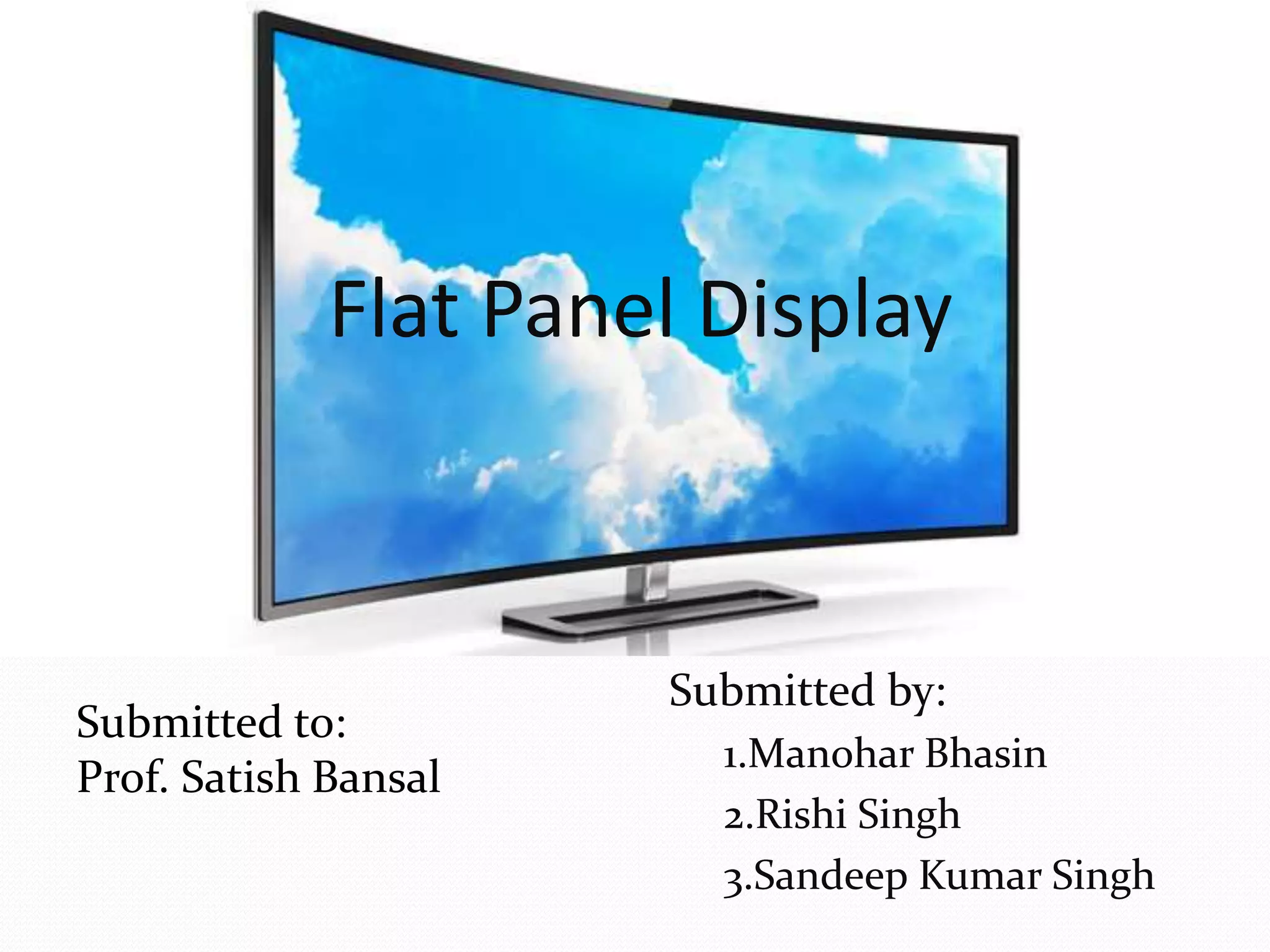

Flat Panel Display
Submitted by:
1.Manohar Bhasin
2.Rishi Singh
3.Sandeep Kumar Singh
Submitted to:
Prof. Satish Bansal
 Introduction
 Types of flat panel displays
 Applications of flat panel displays
 Advantages of flat panel displays and disadvantages
of flat panel display
 Difference between flat panel displays and crt
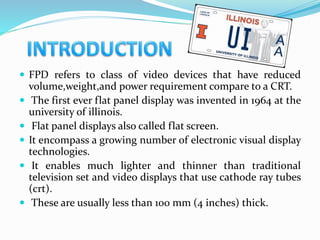
 FPD refers to class of video devices that have reduced
volume,weight,and power requirement compare to a CRT.
 The first ever flat panel display was invented in 1964 at the
university of illinois.
 Flat panel displays also called flat screen.
 It encompass a growing number of electronic visual display
technologies.
 It enables much lighter and thinner than traditional
television set and video displays that use cathode ray tubes
(crt).
 These are usually less than 100 mm (4 inches) thick.
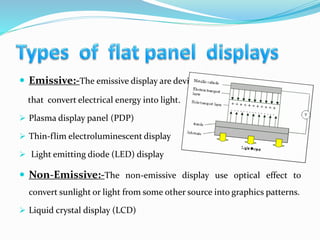
 Emissive:-The emissive display are devices
that convert electrical energy into light.
 Plasma display panel (PDP)
 Thin-flim electroluminescent display
 Light emitting diode (LED) display
 Non-Emissive:-The non-emissive display use optical effect to
convert sunlight or light from some other source into graphics patterns.
 Liquid crystal display (LCD)
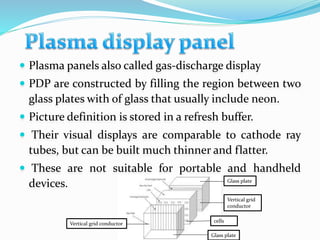
 Plasma panels also called gas-discharge display
 PDP are constructed by filling the region between two
glass plates with of glass that usually include neon.
 Picture definition is stored in a refresh buffer.
 Their visual displays are comparable to cathode ray
tubes, but can be built much thinner and flatter.
 These are not suitable for portable and handheld
devices. Glass plate
Vertical grid
conductor
cells
Vertical grid conductor
Glass plate
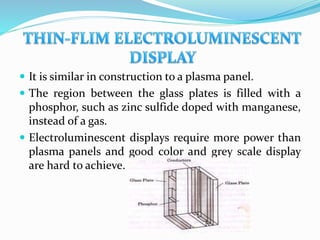
 It is similar in construction to a plasma panel.
 The region between the glass plates is filled with a
phosphor, such as zinc sulfide doped with manganese,
instead of a gas.
 Electroluminescent displays require more power than
plasma panels and good color and grey scale display
are hard to achieve.
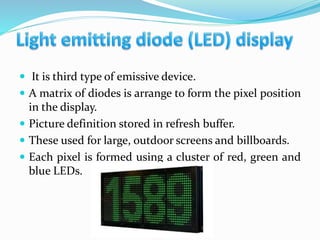
 It is third type of emissive device.
 A matrix of diodes is arrange to form the pixel position
in the display.
 Picture definition stored in refresh buffer.
 These used for large, outdoor screens and billboards.
 Each pixel is formed using a cluster of red, green and
blue LEDs.
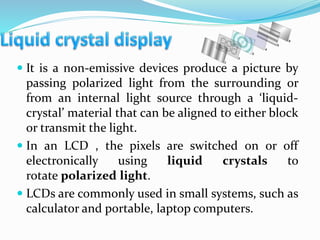
 It is a non-emissive devices produce a picture by
passing polarized light from the surrounding or
from an internal light source through a ‘liquid-
crystal’ material that can be aligned to either block
or transmit the light.
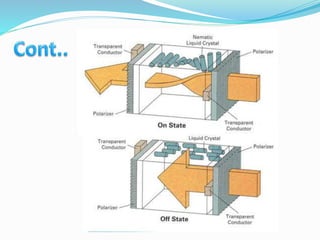
 In an LCD , the pixels are switched on or off
electronically using liquid crystals to
rotate polarized light.
 LCDs are commonly used in small systems, such as
calculator and portable, laptop computers.
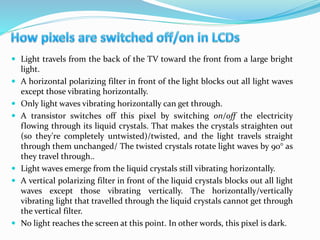
 Light travels from the back of the TV toward the front from a large bright
light.
 A horizontal polarizing filter in front of the light blocks out all light waves
except those vibrating horizontally.
 Only light waves vibrating horizontally can get through.
 A transistor switches off this pixel by switching on/off the electricity
flowing through its liquid crystals. That makes the crystals straighten out
(so they're completely untwisted)/twisted, and the light travels straight
through them unchanged/ The twisted crystals rotate light waves by 90° as
they travel through..
 Light waves emerge from the liquid crystals still vibrating horizontally.
 A vertical polarizing filter in front of the liquid crystals blocks out all light
waves except those vibrating vertically. The horizontally/vertically
vibrating light that travelled through the liquid crystals cannot get through
the vertical filter.
 No light reaches the screen at this point. In other words, this pixel is dark.
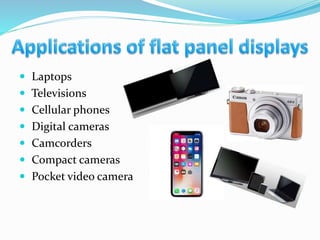
 Laptops
 Televisions
 Cellular phones
 Digital cameras
 Camcorders
 Compact cameras
 Pocket video camera
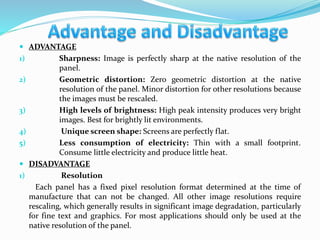
 ADVANTAGE
1) Sharpness: Image is perfectly sharp at the native resolution of the
panel.
2) Geometric distortion: Zero geometric distortion at the native
resolution of the panel. Minor distortion for other resolutions because
the images must be rescaled.
3) High levels of brightness: High peak intensity produces very bright
images. Best for brightly lit environments.
4) Unique screen shape: Screens are perfectly flat.
5) Less consumption of electricity: Thin with a small footprint.
Consume little electricity and produce little heat.
 DISADVANTAGE
1) Resolution
Each panel has a fixed pixel resolution format determined at the time of
manufacture that can not be changed. All other image resolutions require
rescaling, which generally results in significant image degradation, particularly
for fine text and graphics. For most applications should only be used at the
native resolution of the panel.
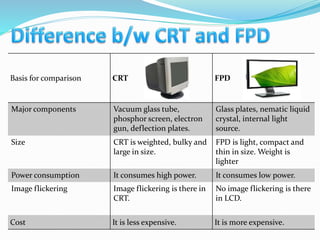
Basis for comparison CRT FPD
Major components Vacuum glass tube,
phosphor screen, electron
gun, deflection plates.
Glass plates, nematic liquid
crystal, internal light
source.
Size CRT is weighted, bulky and
large in size.
FPD is light, compact and
thin in size. Weight is
lighter
Power consumption It consumes high power. It consumes low power.
Image flickering Image flickering is there in
CRT.
No image flickering is there
in LCD.
Cost It is less expensive. It is more expensive.
skin
gh

Flat panel display

  • 1.
    Flat Panel Display Submittedby: 1.Manohar Bhasin 2.Rishi Singh 3.Sandeep Kumar Singh Submitted to: Prof. Satish Bansal
  • 2.
     Introduction  Typesof flat panel displays  Applications of flat panel displays  Advantages of flat panel displays and disadvantages of flat panel display  Difference between flat panel displays and crt
  • 3.
     FPD refersto class of video devices that have reduced volume,weight,and power requirement compare to a CRT.  The first ever flat panel display was invented in 1964 at the university of illinois.  Flat panel displays also called flat screen.  It encompass a growing number of electronic visual display technologies.  It enables much lighter and thinner than traditional television set and video displays that use cathode ray tubes (crt).  These are usually less than 100 mm (4 inches) thick.
  • 4.
     Emissive:-The emissivedisplay are devices that convert electrical energy into light.  Plasma display panel (PDP)  Thin-flim electroluminescent display  Light emitting diode (LED) display  Non-Emissive:-The non-emissive display use optical effect to convert sunlight or light from some other source into graphics patterns.  Liquid crystal display (LCD)
  • 5.
     Plasma panelsalso called gas-discharge display  PDP are constructed by filling the region between two glass plates with of glass that usually include neon.  Picture definition is stored in a refresh buffer.  Their visual displays are comparable to cathode ray tubes, but can be built much thinner and flatter.  These are not suitable for portable and handheld devices. Glass plate Vertical grid conductor cells Vertical grid conductor Glass plate
  • 6.
     It issimilar in construction to a plasma panel.  The region between the glass plates is filled with a phosphor, such as zinc sulfide doped with manganese, instead of a gas.  Electroluminescent displays require more power than plasma panels and good color and grey scale display are hard to achieve.
  • 7.
     It isthird type of emissive device.  A matrix of diodes is arrange to form the pixel position in the display.  Picture definition stored in refresh buffer.  These used for large, outdoor screens and billboards.  Each pixel is formed using a cluster of red, green and blue LEDs.
  • 8.
     It isa non-emissive devices produce a picture by passing polarized light from the surrounding or from an internal light source through a ‘liquid- crystal’ material that can be aligned to either block or transmit the light.  In an LCD , the pixels are switched on or off electronically using liquid crystals to rotate polarized light.  LCDs are commonly used in small systems, such as calculator and portable, laptop computers.
  • 9.
     Light travelsfrom the back of the TV toward the front from a large bright light.  A horizontal polarizing filter in front of the light blocks out all light waves except those vibrating horizontally.  Only light waves vibrating horizontally can get through.  A transistor switches off this pixel by switching on/off the electricity flowing through its liquid crystals. That makes the crystals straighten out (so they're completely untwisted)/twisted, and the light travels straight through them unchanged/ The twisted crystals rotate light waves by 90° as they travel through..  Light waves emerge from the liquid crystals still vibrating horizontally.  A vertical polarizing filter in front of the liquid crystals blocks out all light waves except those vibrating vertically. The horizontally/vertically vibrating light that travelled through the liquid crystals cannot get through the vertical filter.  No light reaches the screen at this point. In other words, this pixel is dark.
  • 11.
     Laptops  Televisions Cellular phones  Digital cameras  Camcorders  Compact cameras  Pocket video camera
  • 12.
     ADVANTAGE 1) Sharpness:Image is perfectly sharp at the native resolution of the panel. 2) Geometric distortion: Zero geometric distortion at the native resolution of the panel. Minor distortion for other resolutions because the images must be rescaled. 3) High levels of brightness: High peak intensity produces very bright images. Best for brightly lit environments. 4) Unique screen shape: Screens are perfectly flat. 5) Less consumption of electricity: Thin with a small footprint. Consume little electricity and produce little heat.  DISADVANTAGE 1) Resolution Each panel has a fixed pixel resolution format determined at the time of manufacture that can not be changed. All other image resolutions require rescaling, which generally results in significant image degradation, particularly for fine text and graphics. For most applications should only be used at the native resolution of the panel.
  • 13.
    Basis for comparisonCRT FPD Major components Vacuum glass tube, phosphor screen, electron gun, deflection plates. Glass plates, nematic liquid crystal, internal light source. Size CRT is weighted, bulky and large in size. FPD is light, compact and thin in size. Weight is lighter Power consumption It consumes high power. It consumes low power. Image flickering Image flickering is there in CRT. No image flickering is there in LCD. Cost It is less expensive. It is more expensive.
  • 14.