Plasma Dyeing
Technology
Swaraz Mollick
BSc in Textile Engineering (WPE)
Khulna University of Engineering & Technology (KUET)
What is Plasma?
Plasma is defined as a state of matter in which a significant number of
atom and/or molecules are electrically charged or ionized.
The components present will include ions, free electrons, photons,
neutral atoms and molecules in ground and excited states and there is a
high likelihood of surface interaction with organic substrates. In order
to maintain a steady state, it is necessary to apply an electric field to the
gas plasma, which is generated in a chamber at low pressure.
How to generate Plasma?
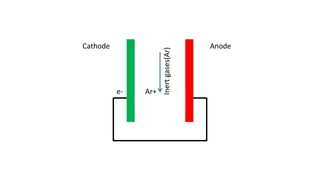
Plasma can be created by applying an electric field to a low-pressure gas, as in
neon or fluorescent tubes. Plasma can also be created by heating a neutral gas
to very high temperatures. Usually the required temperatures are too high to be
applied externally, and the gas is heated internally by the injection of high-
speed ions or electrons that collide with the gas particles, increasing their
thermal energy. The electrons in the gas can also be accelerated by external
electric fields. Ions from such plasmas are used in the semiconductor industry
for etching surfaces and otherwise altering the properties of materials. Here,
electric current is passed through a gas and electrons from the electrical current
become part of the gas causing the gas atoms and molecules to become ionized,
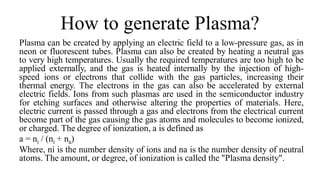
or charged. The degree of ionization, a is defined as
a = ni / (ni + na)
Where, ni is the number density of ions and na is the number density of neutral
atoms. The amount, or degree, of ionization is called the "Plasma density".
Cathode Anode
Inertgases(Ar)
e- Ar+
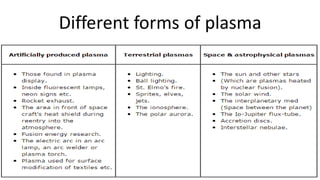
Different forms of plasma
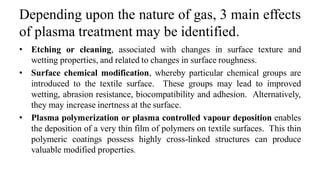
Depending upon the nature of gas, 3 main effects
of plasma treatment may be identified.
• Etching or cleaning, associated with changes in surface texture and
wetting properties, and related to changes in surface roughness.
• Surface chemical modification, whereby particular chemical groups are
introduced to the textile surface. These groups may lead to improved
wetting, abrasion resistance, biocompatibility and adhesion. Alternatively,
they may increase inertness at the surface.
• Plasma polymerization or plasma controlled vapour deposition enables
the deposition of a very thin film of polymers on textile surfaces. This thin
polymeric coatings possess highly cross-linked structures can produce
valuable modified properties.
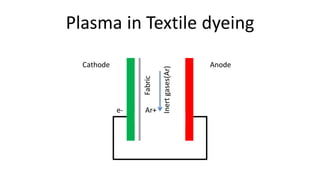
Plasma in Textile dyeing
Cathode Anode
Inertgases(Ar)
e- Ar+
Fabric
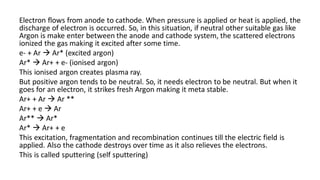
Electron flows from anode to cathode. When pressure is applied or heat is applied, the
discharge of electron is occurred. So, in this situation, if neutral other suitable gas like
Argon is make enter between the anode and cathode system, the scattered electrons
ionized the gas making it excited after some time.
e- + Ar  Ar* (excited argon)
Ar*  Ar+ + e- (ionised argon)
This ionised argon creates plasma ray.
But positive argon tends to be neutral. So, it needs electron to be neutral. But when it
goes for an electron, it strikes fresh Argon making it meta stable.
Ar+ + Ar  Ar **
Ar+ + e  Ar
Ar**  Ar*
Ar*  Ar+ + e
This excitation, fragmentation and recombination continues till the electric field is
applied. Also the cathode destroys over time as it also relieves the electrons.
This is called sputtering (self sputtering)
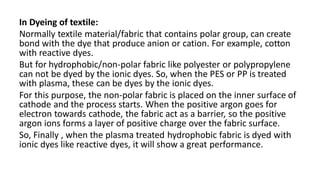
In Dyeing of textile:
Normally textile material/fabric that contains polar group, can create
bond with the dye that produce anion or cation. For example, cotton
with reactive dyes.
But for hydrophobic/non-polar fabric like polyester or polypropylene
can not be dyed by the ionic dyes. So, when the PES or PP is treated
with plasma, these can be dyes by the ionic dyes.
For this purpose, the non-polar fabric is placed on the inner surface of
cathode and the process starts. When the positive argon goes for
electron towards cathode, the fabric act as a barrier, so the positive
argon ions forms a layer of positive charge over the fabric surface.
So, Finally , when the plasma treated hydrophobic fabric is dyed with
ionic dyes like reactive dyes, it will show a great performance.
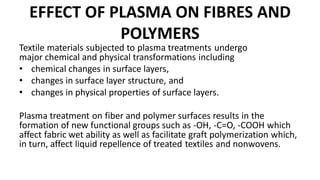
EFFECT OF PLASMA ON FIBRES AND
POLYMERS
Textile materials subjected to plasma treatments undergo
major chemical and physical transformations including
• chemical changes in surface layers,
• changes in surface layer structure, and
• changes in physical properties of surface layers.
Plasma treatment on fiber and polymer surfaces results in the
formation of new functional groups such as -OH, -C=O, -COOH which
affect fabric wet ability as well as facilitate graft polymerization which,
in turn, affect liquid repellence of treated textiles and nonwovens.
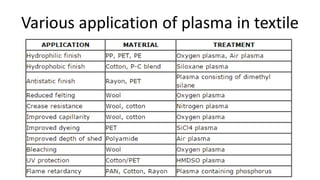
Various application of plasma in textile
Various plasma technologies used in
textile
There are many different ways to induce the
ionization of gases.
• Glow discharge
• Corona discharge
• Dielectric Barrier discharge
• Atmospheric pressure plasma technique.
Glow Discharge:
It is the oldest type of plasma technique. It is produced at
reduced pressure (low-pressure plasma technique) and
provides the highest possible uniformity and flexibility of
any plasma treatment. The plasma is formed by applying
a DC, low frequency (50 Hz) or radio frequency (40 kHz,
13.56 MHz) voltage over a pair or a series of electrodes.
(Figure A, B, C) Alternatively, a vacuum glow discharge
can be made by using microwave (GHz) power supply.
Corona Discharge:
It is formed at atmospheric pressure by applying a low
frequency or pulsed high voltage over an electrode pair,
the configuration of which can be one of many types.
Typically, both electrodes have a large difference in size
(Figure shown below). The corona consists of a series of
small lightning-type discharges; their in homogeneity and
the high local energy levels make the classical corona
treatment of textiles problematic in many cases.
Dielectric-Barrier Discharge:
DBD is formed by applying a pulsed voltage over an
electrode pair of which at least one is covered by a
dielectric material (Figure shown below). Though
also here lightning-type discharges are created, a
major advantage over corona discharges is the
improved textile treatment uniformity.
Atmospheric pressure plasma
As discussed earlier, there are various forms of plasma depending on
the range of temperature and electron density. Generally, high plasma
densities are desirable, because electrons impact gas molecules and
create the excited-state species used for textile treatment. Having
more electrons generally equates to faster treatment time. However,
very high plasma densities (greater than 1013 electrons cm-3) can only
exist with very high gas temperature (Thermal Plasma). This extremely
high level of plasma density is unsuitable for textile treatment,
because the plasma's energy will burn almost any material. Hence for
textile processing, the plasma needs to do their job at room
temperature, thus the name 'cold plasma'.
GENERIC SURFACE ENGG. PROCESS
Four types of surface engg. Process:-
• Etching/Cleaning
• Activation
• Grafting
• Polymerization
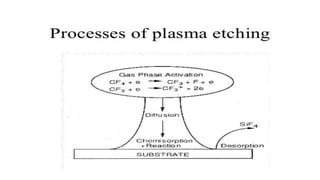
Etching/Cleaning
For such a phenomenon to occur, inert gases (Ar,
He, etc.),nitrogen or oxygen plasmas are typically
used. The bombardment of the substrate with the
plasma species causes the breakdown of covalent
bonds. As a consequence, detachment of low
molecular weight species (ablation) takes place. In
this way, contaminants or even thin layers of the
substrate are removed, producing extremely clean
surfaces
Activation
Interaction with plasma may induce the formation
of active sites on the textile surface (radicals or
other active groups, such as hydroxyl, carboxyl,
carbonyl, amine groups), which can give rise to
chemical reactions, not typical of the untreated
material, with substance brought in contact with
the material after plasma processing.
Grafting
Radical species present in the plasma may be
directly grafted onto the polymer surface
Polymerization
By using specific molecules, a process known as plasma-
enhanced chemical vapor deposition (PECVD) may occur.
These molecules, activated in the plasma, may react with
themselves forming a polymer directly on the surface
of the substrate. Depending on the different experimental
conditions, chemically unique, nano-metric polymeric
coatings are obtained and chemical, permeation,
adhesion and other properties of the starting material
can be dramatically modified.
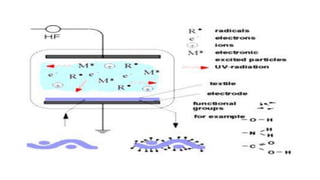
PRINCIPLE OF PLASMA PROCESSING
Plasma technology is a surface-sensitive method that allows
selective modification in the nm-range. By introducing energy
into a gas, quasi-neutral plasma can be generated consisting
of neutral particles, electrically charged particles and highly
reactive radicals. If a textile to be functionalized is placed in a
reaction chamber with any gas and the plasma is then ignited,
the generated particles interact with the surface of the textile.
In this way the surface is specifically structured, chemically
functionalized or even coated with nm-thin film depending on
the type of gas
Plasma Dyeing Technology

Plasma Dyeing Technology

  • 1.
    Plasma Dyeing Technology Swaraz Mollick BScin Textile Engineering (WPE) Khulna University of Engineering & Technology (KUET)
  • 2.
    What is Plasma? Plasmais defined as a state of matter in which a significant number of atom and/or molecules are electrically charged or ionized. The components present will include ions, free electrons, photons, neutral atoms and molecules in ground and excited states and there is a high likelihood of surface interaction with organic substrates. In order to maintain a steady state, it is necessary to apply an electric field to the gas plasma, which is generated in a chamber at low pressure.
  • 3.
    How to generatePlasma? Plasma can be created by applying an electric field to a low-pressure gas, as in neon or fluorescent tubes. Plasma can also be created by heating a neutral gas to very high temperatures. Usually the required temperatures are too high to be applied externally, and the gas is heated internally by the injection of high- speed ions or electrons that collide with the gas particles, increasing their thermal energy. The electrons in the gas can also be accelerated by external electric fields. Ions from such plasmas are used in the semiconductor industry for etching surfaces and otherwise altering the properties of materials. Here, electric current is passed through a gas and electrons from the electrical current become part of the gas causing the gas atoms and molecules to become ionized, or charged. The degree of ionization, a is defined as a = ni / (ni + na) Where, ni is the number density of ions and na is the number density of neutral atoms. The amount, or degree, of ionization is called the "Plasma density".
  • 4.
  • 5.
  • 6.
    Depending upon thenature of gas, 3 main effects of plasma treatment may be identified. • Etching or cleaning, associated with changes in surface texture and wetting properties, and related to changes in surface roughness. • Surface chemical modification, whereby particular chemical groups are introduced to the textile surface. These groups may lead to improved wetting, abrasion resistance, biocompatibility and adhesion. Alternatively, they may increase inertness at the surface. • Plasma polymerization or plasma controlled vapour deposition enables the deposition of a very thin film of polymers on textile surfaces. This thin polymeric coatings possess highly cross-linked structures can produce valuable modified properties.
  • 7.
    Plasma in Textiledyeing Cathode Anode Inertgases(Ar) e- Ar+ Fabric
  • 8.
    Electron flows fromanode to cathode. When pressure is applied or heat is applied, the discharge of electron is occurred. So, in this situation, if neutral other suitable gas like Argon is make enter between the anode and cathode system, the scattered electrons ionized the gas making it excited after some time. e- + Ar  Ar* (excited argon) Ar*  Ar+ + e- (ionised argon) This ionised argon creates plasma ray. But positive argon tends to be neutral. So, it needs electron to be neutral. But when it goes for an electron, it strikes fresh Argon making it meta stable. Ar+ + Ar  Ar ** Ar+ + e  Ar Ar**  Ar* Ar*  Ar+ + e This excitation, fragmentation and recombination continues till the electric field is applied. Also the cathode destroys over time as it also relieves the electrons. This is called sputtering (self sputtering)
  • 9.
    In Dyeing oftextile: Normally textile material/fabric that contains polar group, can create bond with the dye that produce anion or cation. For example, cotton with reactive dyes. But for hydrophobic/non-polar fabric like polyester or polypropylene can not be dyed by the ionic dyes. So, when the PES or PP is treated with plasma, these can be dyes by the ionic dyes. For this purpose, the non-polar fabric is placed on the inner surface of cathode and the process starts. When the positive argon goes for electron towards cathode, the fabric act as a barrier, so the positive argon ions forms a layer of positive charge over the fabric surface. So, Finally , when the plasma treated hydrophobic fabric is dyed with ionic dyes like reactive dyes, it will show a great performance.
  • 10.
    EFFECT OF PLASMAON FIBRES AND POLYMERS Textile materials subjected to plasma treatments undergo major chemical and physical transformations including • chemical changes in surface layers, • changes in surface layer structure, and • changes in physical properties of surface layers. Plasma treatment on fiber and polymer surfaces results in the formation of new functional groups such as -OH, -C=O, -COOH which affect fabric wet ability as well as facilitate graft polymerization which, in turn, affect liquid repellence of treated textiles and nonwovens.
  • 11.
    Various application ofplasma in textile
  • 12.
    Various plasma technologiesused in textile There are many different ways to induce the ionization of gases. • Glow discharge • Corona discharge • Dielectric Barrier discharge • Atmospheric pressure plasma technique.
  • 13.
    Glow Discharge: It isthe oldest type of plasma technique. It is produced at reduced pressure (low-pressure plasma technique) and provides the highest possible uniformity and flexibility of any plasma treatment. The plasma is formed by applying a DC, low frequency (50 Hz) or radio frequency (40 kHz, 13.56 MHz) voltage over a pair or a series of electrodes. (Figure A, B, C) Alternatively, a vacuum glow discharge can be made by using microwave (GHz) power supply.
  • 14.
    Corona Discharge: It isformed at atmospheric pressure by applying a low frequency or pulsed high voltage over an electrode pair, the configuration of which can be one of many types. Typically, both electrodes have a large difference in size (Figure shown below). The corona consists of a series of small lightning-type discharges; their in homogeneity and the high local energy levels make the classical corona treatment of textiles problematic in many cases.
  • 15.
    Dielectric-Barrier Discharge: DBD isformed by applying a pulsed voltage over an electrode pair of which at least one is covered by a dielectric material (Figure shown below). Though also here lightning-type discharges are created, a major advantage over corona discharges is the improved textile treatment uniformity.
  • 16.
    Atmospheric pressure plasma Asdiscussed earlier, there are various forms of plasma depending on the range of temperature and electron density. Generally, high plasma densities are desirable, because electrons impact gas molecules and create the excited-state species used for textile treatment. Having more electrons generally equates to faster treatment time. However, very high plasma densities (greater than 1013 electrons cm-3) can only exist with very high gas temperature (Thermal Plasma). This extremely high level of plasma density is unsuitable for textile treatment, because the plasma's energy will burn almost any material. Hence for textile processing, the plasma needs to do their job at room temperature, thus the name 'cold plasma'.
  • 17.
    GENERIC SURFACE ENGG.PROCESS Four types of surface engg. Process:- • Etching/Cleaning • Activation • Grafting • Polymerization
  • 18.
    Etching/Cleaning For such aphenomenon to occur, inert gases (Ar, He, etc.),nitrogen or oxygen plasmas are typically used. The bombardment of the substrate with the plasma species causes the breakdown of covalent bonds. As a consequence, detachment of low molecular weight species (ablation) takes place. In this way, contaminants or even thin layers of the substrate are removed, producing extremely clean surfaces
  • 20.
    Activation Interaction with plasmamay induce the formation of active sites on the textile surface (radicals or other active groups, such as hydroxyl, carboxyl, carbonyl, amine groups), which can give rise to chemical reactions, not typical of the untreated material, with substance brought in contact with the material after plasma processing.
  • 21.
    Grafting Radical species presentin the plasma may be directly grafted onto the polymer surface
  • 22.
    Polymerization By using specificmolecules, a process known as plasma- enhanced chemical vapor deposition (PECVD) may occur. These molecules, activated in the plasma, may react with themselves forming a polymer directly on the surface of the substrate. Depending on the different experimental conditions, chemically unique, nano-metric polymeric coatings are obtained and chemical, permeation, adhesion and other properties of the starting material can be dramatically modified.
  • 23.
    PRINCIPLE OF PLASMAPROCESSING Plasma technology is a surface-sensitive method that allows selective modification in the nm-range. By introducing energy into a gas, quasi-neutral plasma can be generated consisting of neutral particles, electrically charged particles and highly reactive radicals. If a textile to be functionalized is placed in a reaction chamber with any gas and the plasma is then ignited, the generated particles interact with the surface of the textile. In this way the surface is specifically structured, chemically functionalized or even coated with nm-thin film depending on the type of gas