PLASMA DISPLAY
INTRODUCTION
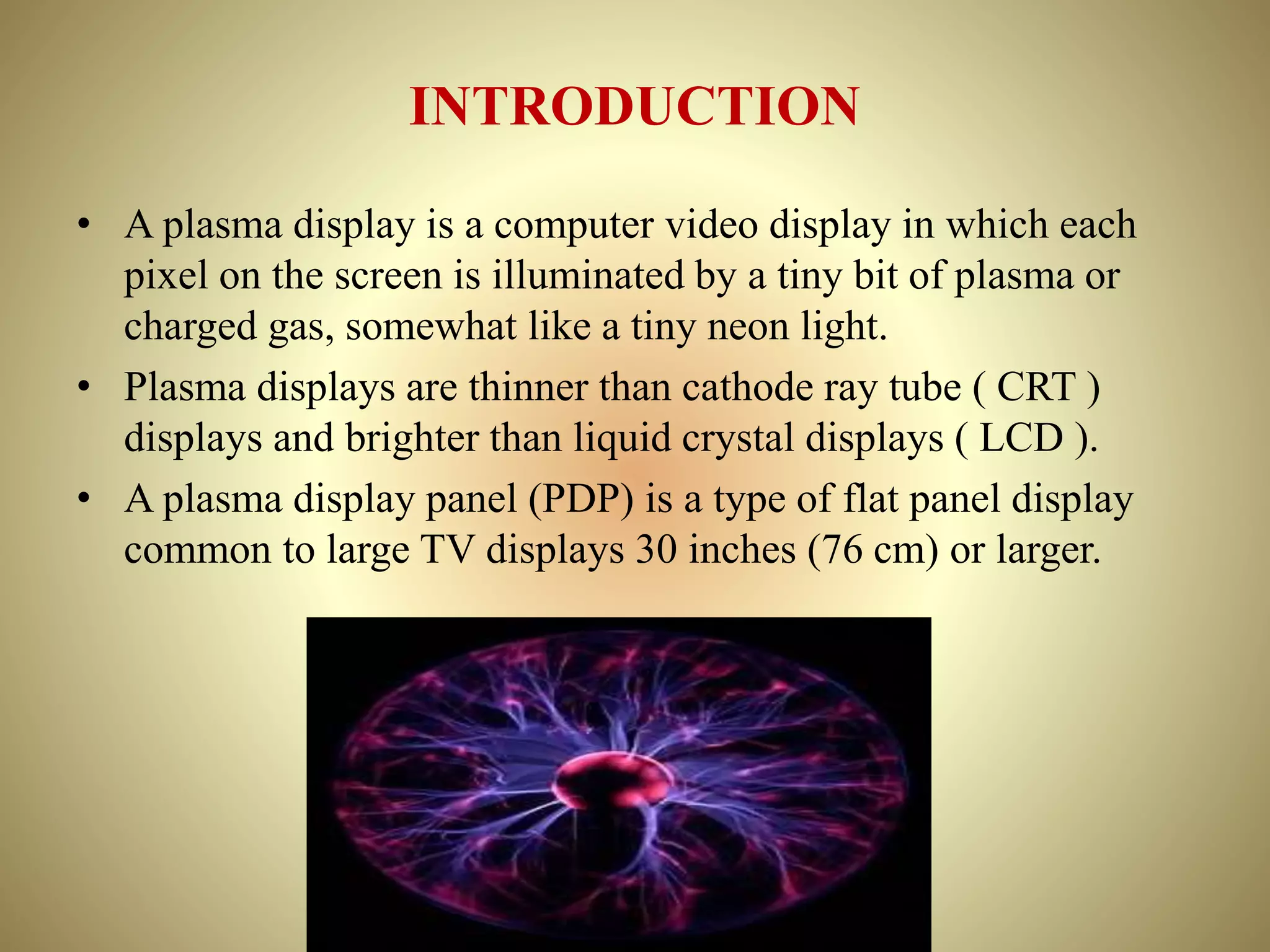
• A plasma display is a computer video display in which each
pixel on the screen is illuminated by a tiny bit of plasma or
charged gas, somewhat like a tiny neon light.
• Plasma displays are thinner than cathode ray tube ( CRT )
displays and brighter than liquid crystal displays ( LCD ).
• A plasma display panel (PDP) is a type of flat panel display
common to large TV displays 30 inches (76 cm) or larger.
They are called "plasma" displays because the technology
utilizes small cells containing electrically charged ionized
gases, or what are in essence chambers more commonly
known as fluorescent lamps.
103" plasma display panel by Panasonic
PRINCIPLE OF PLASMA DISPLAY PANELS
• In plasma display panels the light of each picture element is
emitted from plasma created by an electric discharge.
• The dimensions of the discharge are in the 100 micro-meters
range at a pressure of a few hundred torrs, and the voltage
applied between electrodes is in the 100-200 V range.
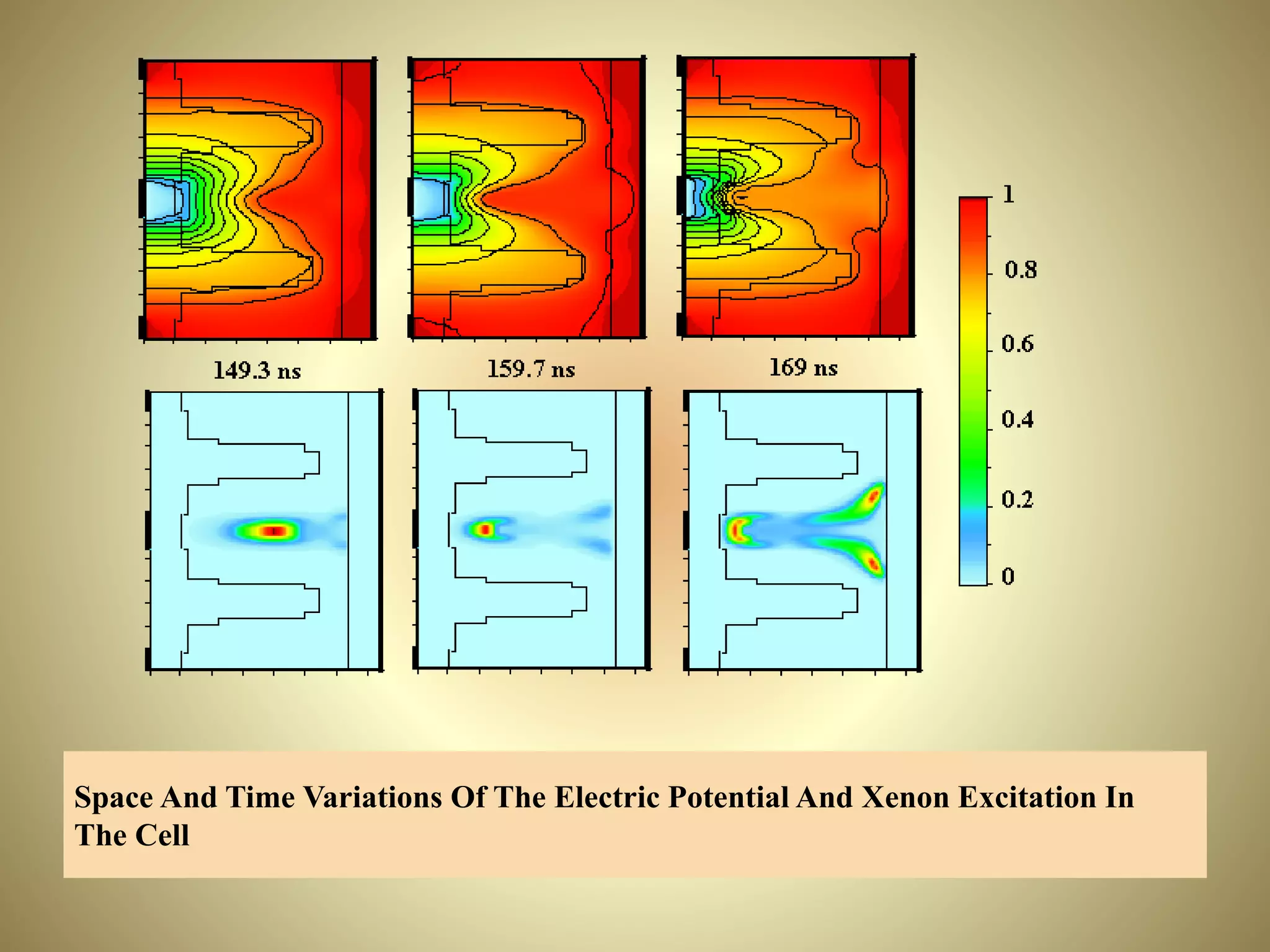
Simulated domain including one cell and two half cells
Space And Time Variations Of The Electric Potential And Xenon Excitation In
The Cell
GENERAL CHARACTERISTICS
• Plasma displays are bright (1,000 lux or higher for the module).
• They have a wide color range.
• They can be produced in fairly large sizes up to 3.8 meters (150 in)
diagonally.
• They have a very low-luminance "dark-room" black level compared
with the lighter grey of the unilluminated parts of an LCD screen
(i.e. the blacks are blacker on plasmas and greyer on LCDs).
• The display panel itself is about 6 cm (2.4 in) thick, generally the
device's total thickness (including electronics) to be less than 10 cm
(3.9 in).
• Power consumption is 400 watts for a 127 cm (50 in) screen.
• 200 to 310 watts for a 127 cm (50 in) display when set to cinema
mode.
• Most screens are set to "shop" mode by default, which draws at least
twice the power (around 500–700 watts) of a "home" setting of less
extreme brightness.
Native Resolutions
Plasma TVs scale the video image of each incoming signal
to the native resolution of the display panel.
ED Resolutions
• 840×480
• 853×480
HD Resolutions
• 1024×1024 (discontinued)
• 1024×768
• 1280×768
• 1366×768
• 1280×1080
• 1920×1080
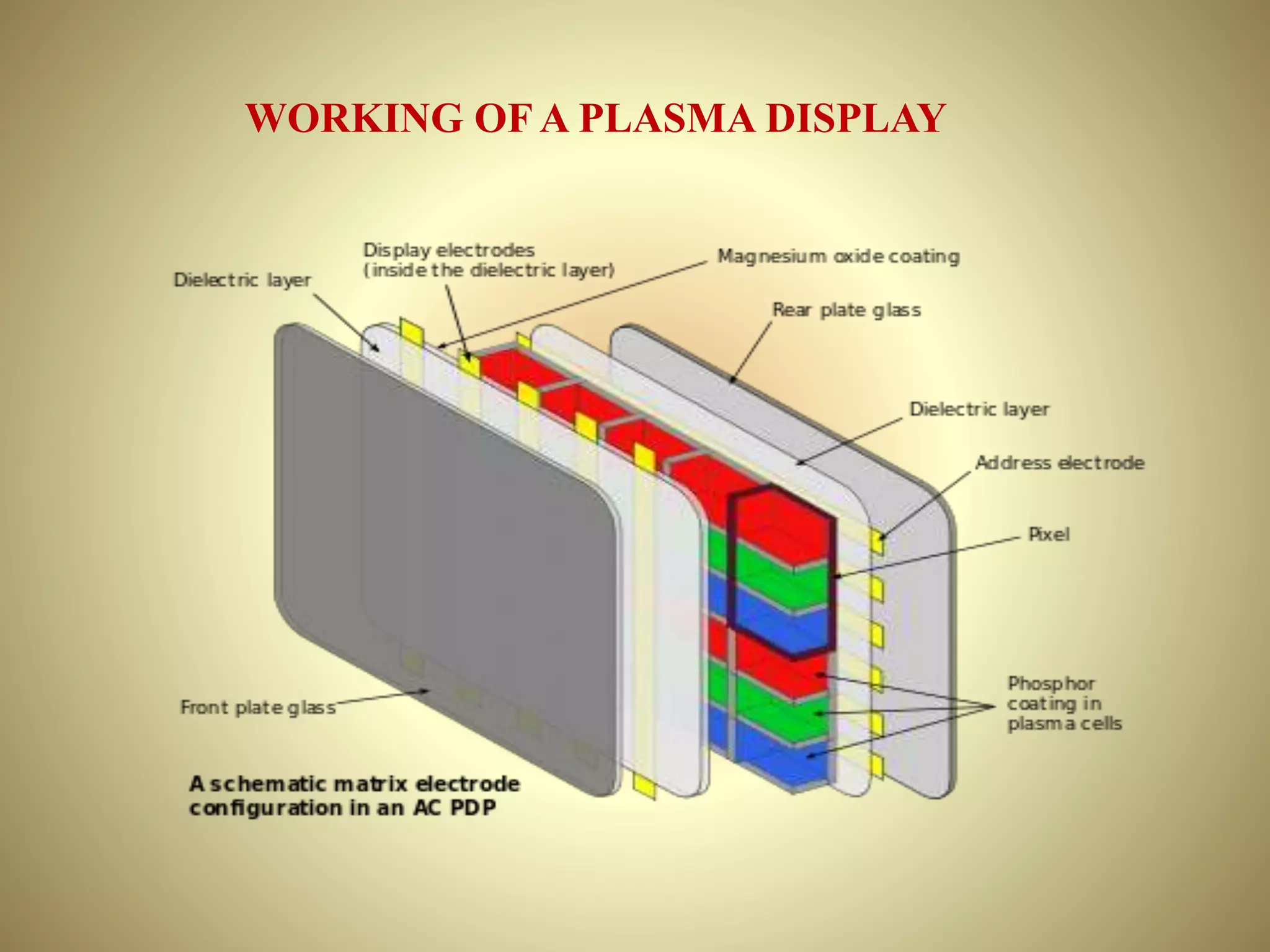
WORKING OF A PLASMA DISPLAY
HISTORY OF A PLASMA DISPLAY
In 2010, the shipments of plasma TVs reached 18.2 million
units globally.
Since that time, shipments of plasma TVs have declined
substantially.
This decline has been attributed to the competition from
liquid crystal (LCD) televisions, whose prices have fallen
more rapidly than those of the plasma TVs.
In late 2013, Panasonic announced that they would stop
producing plasma TVs from March 2014 onwards.
In 2014, LG and Samsung discontinued plasma TV
production as well, effectively killing the technology,
probably because of lowering demand.
ADVANTAGES
• Picture quality
– Capable of producing deeper blacks allowing for
superior contrast ratio.
– Wider viewing angles than those of LCD; images do
not suffer from degradation at high angles like LCDs.
– Less visible motion blur, very high refresh rates and a
faster response time, contributing to superior
performance when displaying content.
DISADVANTAGES
• Use more electrical power, on average, than an LCD TV.
• Does not work well at high altitudes above 2 km due to
pressure differential between the gases inside the screen and
the air pressure at altitude.
• It may cause a buzzing noise. For those who wish to listen to
AM radio, or are amateur radio operators (hams) or shortwave
listeners (SWL), the radio frequency interference (RFI) from
these devices can be irritating or disabling.
CONCLUSION
• This is the trend towards large-screen television technology,
the 32 inch screen size is rapidly disappearing. Though
considered bulky and thick compared with their LCD
counterparts, some sets such as Panasonic's Z1 and Samsung's
B860 series are as slim as 2.5 cm (1.0 inch) thick making them
comparable to LCDs in this respect.
• Competing display technologies include cathode ray tube
(CRT), organic light-emitting diode (OLED), AMLCD, Digital
Light Processing DLP, SED-TV, LED display, field emission
display (FED), and quantum dot display (QLED).
Plasmadisplay ppt

Plasmadisplay ppt

  • 1.
  • 2.
    INTRODUCTION • A plasmadisplay is a computer video display in which each pixel on the screen is illuminated by a tiny bit of plasma or charged gas, somewhat like a tiny neon light. • Plasma displays are thinner than cathode ray tube ( CRT ) displays and brighter than liquid crystal displays ( LCD ). • A plasma display panel (PDP) is a type of flat panel display common to large TV displays 30 inches (76 cm) or larger.
  • 3.
    They are called"plasma" displays because the technology utilizes small cells containing electrically charged ionized gases, or what are in essence chambers more commonly known as fluorescent lamps. 103" plasma display panel by Panasonic
  • 4.
    PRINCIPLE OF PLASMADISPLAY PANELS • In plasma display panels the light of each picture element is emitted from plasma created by an electric discharge. • The dimensions of the discharge are in the 100 micro-meters range at a pressure of a few hundred torrs, and the voltage applied between electrodes is in the 100-200 V range.
  • 5.
    Simulated domain includingone cell and two half cells
  • 6.
    Space And TimeVariations Of The Electric Potential And Xenon Excitation In The Cell
  • 7.
    GENERAL CHARACTERISTICS • Plasmadisplays are bright (1,000 lux or higher for the module). • They have a wide color range. • They can be produced in fairly large sizes up to 3.8 meters (150 in) diagonally. • They have a very low-luminance "dark-room" black level compared with the lighter grey of the unilluminated parts of an LCD screen (i.e. the blacks are blacker on plasmas and greyer on LCDs). • The display panel itself is about 6 cm (2.4 in) thick, generally the device's total thickness (including electronics) to be less than 10 cm (3.9 in). • Power consumption is 400 watts for a 127 cm (50 in) screen. • 200 to 310 watts for a 127 cm (50 in) display when set to cinema mode. • Most screens are set to "shop" mode by default, which draws at least twice the power (around 500–700 watts) of a "home" setting of less extreme brightness.
  • 8.
    Native Resolutions Plasma TVsscale the video image of each incoming signal to the native resolution of the display panel. ED Resolutions • 840×480 • 853×480 HD Resolutions • 1024×1024 (discontinued) • 1024×768 • 1280×768 • 1366×768 • 1280×1080 • 1920×1080
  • 9.
    WORKING OF APLASMA DISPLAY
  • 10.
    HISTORY OF APLASMA DISPLAY In 2010, the shipments of plasma TVs reached 18.2 million units globally. Since that time, shipments of plasma TVs have declined substantially. This decline has been attributed to the competition from liquid crystal (LCD) televisions, whose prices have fallen more rapidly than those of the plasma TVs. In late 2013, Panasonic announced that they would stop producing plasma TVs from March 2014 onwards. In 2014, LG and Samsung discontinued plasma TV production as well, effectively killing the technology, probably because of lowering demand.
  • 11.
    ADVANTAGES • Picture quality –Capable of producing deeper blacks allowing for superior contrast ratio. – Wider viewing angles than those of LCD; images do not suffer from degradation at high angles like LCDs. – Less visible motion blur, very high refresh rates and a faster response time, contributing to superior performance when displaying content.
  • 12.
    DISADVANTAGES • Use moreelectrical power, on average, than an LCD TV. • Does not work well at high altitudes above 2 km due to pressure differential between the gases inside the screen and the air pressure at altitude. • It may cause a buzzing noise. For those who wish to listen to AM radio, or are amateur radio operators (hams) or shortwave listeners (SWL), the radio frequency interference (RFI) from these devices can be irritating or disabling.
  • 13.
    CONCLUSION • This isthe trend towards large-screen television technology, the 32 inch screen size is rapidly disappearing. Though considered bulky and thick compared with their LCD counterparts, some sets such as Panasonic's Z1 and Samsung's B860 series are as slim as 2.5 cm (1.0 inch) thick making them comparable to LCDs in this respect. • Competing display technologies include cathode ray tube (CRT), organic light-emitting diode (OLED), AMLCD, Digital Light Processing DLP, SED-TV, LED display, field emission display (FED), and quantum dot display (QLED).