PLASMA TECHNOLOGY
What is PLASMA?

♦ IRVING LANGMUIR first used the term plasma in
  1926 to describe the inner region of an electrical
  discharge.
♦ It is defined as a state of matter in which a significant
  number of atom and/or molecules are electrically
  charged or ionised.
♦ Plasma is any substance (usually a gas) whose
  atoms have one or more electrons detached and
  therefore become ionised remains in gas.
  Thus,plasma is electrically neutral.
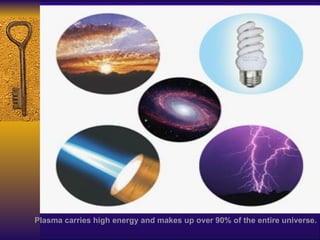
Plasma carries high energy and makes up over 90% of the entire universe.
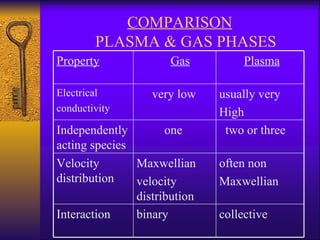
COMPARISON
        PLASMA & GAS PHASES
Property              Gas          Plasma

Electrical        very low    usually very
conductivity                  High
Independently        one       two or three
acting species
Velocity       Maxwellian     often non
distribution   velocity       Maxwellian
               distribution
Interaction    binary         collective
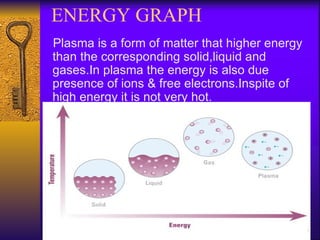
ENERGY GRAPH
Plasma is a form of matter that higher energy
than the corresponding solid,liquid and
gases.In plasma the energy is also due
presence of ions & free electrons.Inspite of
high energy it is not very hot.
GENERATION OF PLASMA
 A gas becomes plasma when the kinetic energy of
 the gas particles rises to equal the ionisation energy
 of the gas. When this level is reached, collisions of
 the gas particles cause a rapid cascading ionisation,
 resulting in plasma.
 A gas can be converted into plasma by passing high-
 energy electrons through the gas
 Generation of Plasma can be created by applying an
 electric field to a low-pressure gas, as in neon or
 fluorescent tubes
 Plasma can also be created by heating a neutral gas
 to very high temperatures by external source .
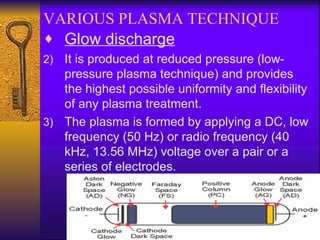
VARIOUS PLASMA TECHNIQUE
♦ Glow discharge
2) It is produced at reduced pressure (low-
   pressure plasma technique) and provides
   the highest possible uniformity and flexibility
   of any plasma treatment.
3) The plasma is formed by applying a DC, low
   frequency (50 Hz) or radio frequency (40
   kHz, 13.56 MHz) voltage over a pair or a
   series of electrodes.
Corona discharge

♦   It is formed at atmospheric pressure by applying a
    low frequency or pulsed high voltage over an
    electrode pair.
♦   The corona consists of a series of small lightning-
    type discharges; their in homogeneity and the high
    local energy levels.


    Dielectric Barrier Discharge

♦   Dielectric barrier discharge is formed by applying a
    pulsed voltage over an electrode pair of which at
    least one is covered by a dielectric material.
♦   Though also here lightning-type discharges are
    created, a major advantage over corona discharges
    is the improved textile treatment uniformity.
♦ Atmospheric pressure plasma
  technique

    This technique provides the highest
    possible plasma density at low gas
    temperatures.
    Thus treats fabric and other substrates
    without damaging them.
    The discharge uses a high-flow feed-gas
    primarily an inert carrier gas, like He, and
    small amount of additive to be activated,
    such as O2, H2O or CF4.
FORMS OF PLASMA

     Artificially produced plasma
2)   Those found in plasma display.
3)   Inside fluorescent lamp,neon signs,etc.
4)   Fusion energy research.
5)   Plasma used for surface modification of
     textiles.
6)   The electric arc in an arc lamp ,an arc
     welder, or plasma torch.
Terrestrial plasma

1) Lighting.
2) Sprites,elves,jets.
3) The ionosphere.


      Space & astrophysical plasma
6) The sun and the other stars.
7) The solar wind.
8) The interplanetary med
USES OF PLASMA

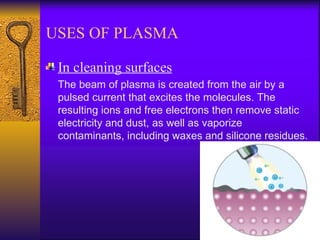
 In cleaning surfaces
 The beam of plasma is created from the air by a
 pulsed current that excites the molecules. The
 resulting ions and free electrons then remove static
 electricity and dust, as well as vaporize
 contaminants, including waxes and silicone residues.
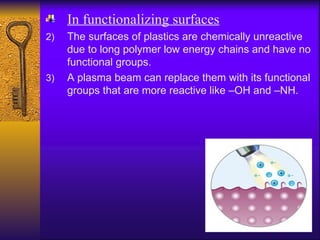
In functionalizing surfaces
2)   The surfaces of plastics are chemically unreactive
     due to long polymer low energy chains and have no
     functional groups.
3)   A plasma beam can replace them with its functional
     groups that are more reactive like –OH and –NH.
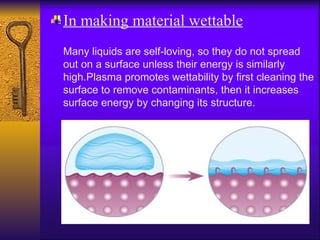
In making material wettable
Many liquids are self-loving, so they do not spread
out on a surface unless their energy is similarly
high.Plasma promotes wettability by first cleaning the
surface to remove contaminants, then it increases
surface energy by changing its structure.
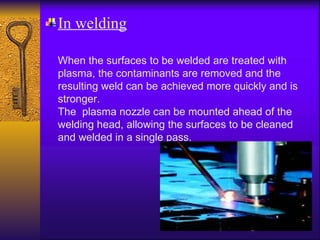
In welding

When the surfaces to be welded are treated with
plasma, the contaminants are removed and the
resulting weld can be achieved more quickly and is
stronger.
The plasma nozzle can be mounted ahead of the
welding head, allowing the surfaces to be cleaned
and welded in a single pass.
PRODUCTS

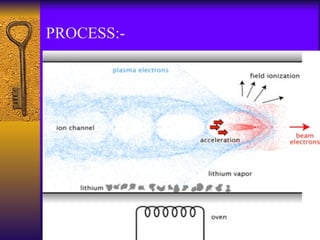
     Plasma acceleration
2) Plasma acceleration is a technique for
   accelerating charged particles using an
   electric field associated with an electron
   plasma wave.
3) If an external electric field is applied, the
   plasma will separate, with the particles
   being attracted to the external field. A
   particle injected into such a plasma would
   be accelerated by the charge separation.
PROCESS:-
PLASMA DISPLAY

♦    The plasma video display was co-invented in 1964
     at the by Donald Bitzer,H. Gene Slottow, and
     graduate student Robert Willson for the
     PLATO Computer System.
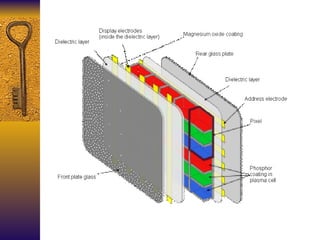
♦    A plasma display panel (PDP) is a type of flat
     panel display.Many tiny cells located between two
     panels of glass hold an inert mixture of noble gases
     (neon and xenon). The gas in the cells is
     electrically turned into a plasma which then excites
     phosphors to emit light.
APPLICATIONS
♦    Plastics
2)   With plasma dissimilar materials can be combined
     in a two-shot injection molding process.

♦    Metal-non metal combination
5)   Plasma can treat metal/non-metal combinations,
     removing organic and silicone contaminants as well
     as activating the surfaces before printing, coating
     and bonding.

     Fabrics
8)   Plasma makes textiles more hydrophilic or
     absorptive .This improved wettability enables the
     use of adhesives over clothes.
SIGNIFICANCE
  Using plasma beam we can impart more efficient
  painting and coating of metal surfaces.
  This method use lower cost materials.
  Eliminate environmentally problematic solvents.
   Plasma can carry a lot of energy and is highly
  reactive, but it is not necessarily hot.
  Plasma treatments can be integrated into the
  manufacturing process,reducing pollution and
  energy consumption.there is no waste production.
REFRENCES
1) www.wikipedia.com
2) www.plasmatreat.com
3) www.indiantextilejournal.com
Manmath Agarwal

Manmath

  • 1.
  • 2.
    What is PLASMA? ♦IRVING LANGMUIR first used the term plasma in 1926 to describe the inner region of an electrical discharge. ♦ It is defined as a state of matter in which a significant number of atom and/or molecules are electrically charged or ionised. ♦ Plasma is any substance (usually a gas) whose atoms have one or more electrons detached and therefore become ionised remains in gas. Thus,plasma is electrically neutral.
  • 3.
    Plasma carries highenergy and makes up over 90% of the entire universe.
  • 4.
    COMPARISON PLASMA & GAS PHASES Property Gas Plasma Electrical very low usually very conductivity High Independently one two or three acting species Velocity Maxwellian often non distribution velocity Maxwellian distribution Interaction binary collective
  • 5.
    ENERGY GRAPH Plasma isa form of matter that higher energy than the corresponding solid,liquid and gases.In plasma the energy is also due presence of ions & free electrons.Inspite of high energy it is not very hot.
  • 6.
    GENERATION OF PLASMA A gas becomes plasma when the kinetic energy of the gas particles rises to equal the ionisation energy of the gas. When this level is reached, collisions of the gas particles cause a rapid cascading ionisation, resulting in plasma. A gas can be converted into plasma by passing high- energy electrons through the gas Generation of Plasma can be created by applying an electric field to a low-pressure gas, as in neon or fluorescent tubes Plasma can also be created by heating a neutral gas to very high temperatures by external source .
  • 7.
    VARIOUS PLASMA TECHNIQUE ♦Glow discharge 2) It is produced at reduced pressure (low- pressure plasma technique) and provides the highest possible uniformity and flexibility of any plasma treatment. 3) The plasma is formed by applying a DC, low frequency (50 Hz) or radio frequency (40 kHz, 13.56 MHz) voltage over a pair or a series of electrodes.
  • 8.
    Corona discharge ♦ It is formed at atmospheric pressure by applying a low frequency or pulsed high voltage over an electrode pair. ♦ The corona consists of a series of small lightning- type discharges; their in homogeneity and the high local energy levels. Dielectric Barrier Discharge ♦ Dielectric barrier discharge is formed by applying a pulsed voltage over an electrode pair of which at least one is covered by a dielectric material. ♦ Though also here lightning-type discharges are created, a major advantage over corona discharges is the improved textile treatment uniformity.
  • 9.
    ♦ Atmospheric pressureplasma technique This technique provides the highest possible plasma density at low gas temperatures. Thus treats fabric and other substrates without damaging them. The discharge uses a high-flow feed-gas primarily an inert carrier gas, like He, and small amount of additive to be activated, such as O2, H2O or CF4.
  • 10.
    FORMS OF PLASMA Artificially produced plasma 2) Those found in plasma display. 3) Inside fluorescent lamp,neon signs,etc. 4) Fusion energy research. 5) Plasma used for surface modification of textiles. 6) The electric arc in an arc lamp ,an arc welder, or plasma torch.
  • 11.
    Terrestrial plasma 1) Lighting. 2)Sprites,elves,jets. 3) The ionosphere. Space & astrophysical plasma 6) The sun and the other stars. 7) The solar wind. 8) The interplanetary med
  • 12.
    USES OF PLASMA In cleaning surfaces The beam of plasma is created from the air by a pulsed current that excites the molecules. The resulting ions and free electrons then remove static electricity and dust, as well as vaporize contaminants, including waxes and silicone residues.
  • 13.
    In functionalizing surfaces 2) The surfaces of plastics are chemically unreactive due to long polymer low energy chains and have no functional groups. 3) A plasma beam can replace them with its functional groups that are more reactive like –OH and –NH.
  • 14.
    In making materialwettable Many liquids are self-loving, so they do not spread out on a surface unless their energy is similarly high.Plasma promotes wettability by first cleaning the surface to remove contaminants, then it increases surface energy by changing its structure.
  • 15.
    In welding When thesurfaces to be welded are treated with plasma, the contaminants are removed and the resulting weld can be achieved more quickly and is stronger. The plasma nozzle can be mounted ahead of the welding head, allowing the surfaces to be cleaned and welded in a single pass.
  • 16.
    PRODUCTS Plasma acceleration 2) Plasma acceleration is a technique for accelerating charged particles using an electric field associated with an electron plasma wave. 3) If an external electric field is applied, the plasma will separate, with the particles being attracted to the external field. A particle injected into such a plasma would be accelerated by the charge separation.
  • 17.
  • 18.
    PLASMA DISPLAY ♦ The plasma video display was co-invented in 1964 at the by Donald Bitzer,H. Gene Slottow, and graduate student Robert Willson for the PLATO Computer System. ♦ A plasma display panel (PDP) is a type of flat panel display.Many tiny cells located between two panels of glass hold an inert mixture of noble gases (neon and xenon). The gas in the cells is electrically turned into a plasma which then excites phosphors to emit light.
  • 20.
    APPLICATIONS ♦ Plastics 2) With plasma dissimilar materials can be combined in a two-shot injection molding process. ♦ Metal-non metal combination 5) Plasma can treat metal/non-metal combinations, removing organic and silicone contaminants as well as activating the surfaces before printing, coating and bonding. Fabrics 8) Plasma makes textiles more hydrophilic or absorptive .This improved wettability enables the use of adhesives over clothes.
  • 21.
    SIGNIFICANCE Usingplasma beam we can impart more efficient painting and coating of metal surfaces. This method use lower cost materials. Eliminate environmentally problematic solvents. Plasma can carry a lot of energy and is highly reactive, but it is not necessarily hot. Plasma treatments can be integrated into the manufacturing process,reducing pollution and energy consumption.there is no waste production.
  • 22.
  • 23.