




Presentation on:
Plant transformation vectors and their
types
Presented to:
Dr. Hamid Manzoor
Presented by:
Hina Mushtaq …………... BSBT-02
Zahra Naz ……………….. BSBT-04
07th May, 2015
Institute of Molecular Biology & Biotechnology,
Bahauddin Zakariya University, Multan,
Pakistan.
Contents
 Plant transformation
 Vectors
 Types of vectors
 Plant transformation vectors
 Plasmids
 Viruses
 Bacteriophages
– Advantages
– Disadvantages
Plant Transformation
”Transformation is the genetic alteration of
a cell resulting from the direct uptake and
incorporation of exogenous genetic material
from its surroundings.”
or
“Integration of gene into genome by means
other than
fusion of gametes”
file:///G:/agri%20biotech/NPTEL%20__%20Biotechnology%20
-%20Plant%20Biotechnology.html
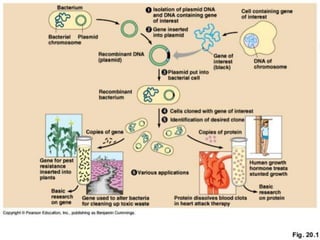
Steps of Plant Transformation
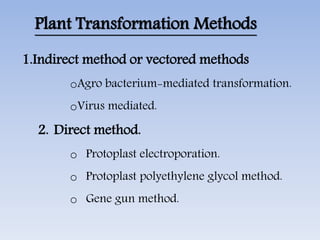
Plant Transformation Methods
1.Indirect method or vectored methods
oAgro bacterium-mediated transformation.
oVirus mediated.
2. Direct method.
o Protoplast electroporation.
o Protoplast polyethylene glycol method.
o Gene gun method.
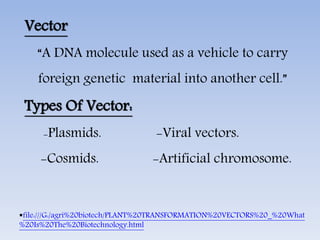
Vector
“A DNA molecule used as a vehicle to carry
foreign genetic material into another cell.”
Types Of Vector:
-Plasmids. -Viral vectors.
-Cosmids. -Artificial chromosome.
file:///G:/agri%20biotech/PLANT%20TRANSFORMATION%20VECTORS%20_%20What
%20Is%20The%20Biotechnology.html
Characteristics of vectors
 Origin of replication
 Self-replicating
 Bacterial selectable markers
 Gene constructs of interest
file:///G:/agri%20biotech/PLANT%20TRANSFORMATION%20VECTORS%20_%20What
%20Is%20The%20Biotechnology.html
Vector classification
Cloning vectors
“Small piece of DNA into which a foreign DNA
fragment is inserted for cloning purposes.”
Expression vectors
“Also known as an expression construct, is
usually a plasmid or virus designed for
protein expression in cells.”
file:///G:/agri%20biotech/PLANT%20TRANSFORMATION%20VECTORS%20_%20What
%20Is%20The%20Biotechnology.html
In plants
 Plasmids
 Viruses
 Bacteriophages
 Cosmids
Plant Physiol. 2007 Dec; 145(4): 1118–1128.
doi: 10.1104/pp.107.106104
PMCID: PMC2151730
Focus Issue on Vector Systems for Plant
Research and Biotechnology
Delivery of Multiple Transgenes to Plant
Cells
Mery Dafny-Yelin and Tzvi Tzfira
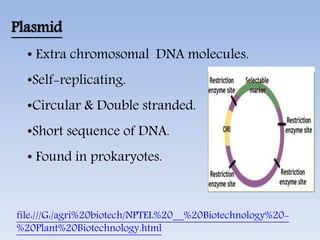
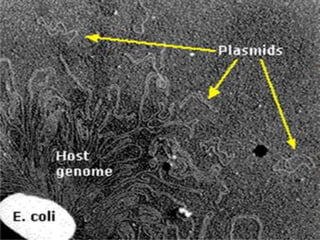
Plasmid
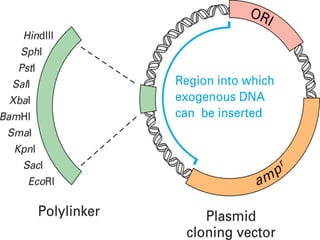
• Extra chromosomal DNA molecules.
•Self-replicating.
•Circular & Double stranded.
•Short sequence of DNA.
• Found in prokaryotes.
file:///G:/agri%20biotech/NPTEL%20__%20Biotechnology%20-
%20Plant%20Biotechnology.html
Classification
Classification of plasmids
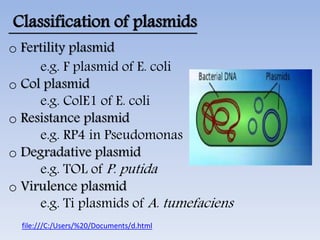
o Fertility plasmid
e.g. F plasmid of E. coli
o Col plasmid
e.g. ColE1 of E. coli
o Resistance plasmid
e.g. RP4 in Pseudomonas
o Degradative plasmid
e.g. TOL of P. putida
o Virulence plasmid
e.g. Ti plasmids of A. tumefaciens
file:///C:/Users/%20/Documents/d.html
Based on the origin or source of plasmids
Two major classes :
i) Natural plasmids:
They occur naturally in prokaryotes
Example: ColE1.
ii) Artificial plasmids:
They are constructed in-vitro by re-combining
selected segments of two or more plasmids.
Example: pBR322.
file:///C:/Users/%20/Documents/d.html
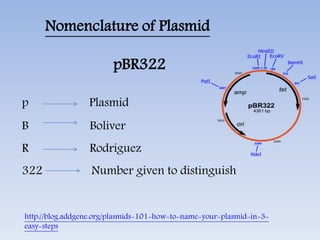
Nomenclature of Plasmid
pBR322
p Plasmid
B Boliver
R Rodriguez
322 Number given to distinguish
http://blog.addgene.org/plasmids-101-how-to-name-your-plasmid-in-3-
easy-steps
Advantages
Occur naturally in bacteria
Have different restriction sites.
Replicate completely independent of bacteria
Genes are easily inserted into plasmids
Easily transformed into bacteria
https://answers.yahoo.com/question/index?qid=20061217124130AAsvKqk
Disadvantages
 Cannot accept large fragments
 Sizes range from 10-20 kb
 Standard methods of transformation are
inefficient
https://answers.yahoo.com/question/index?qid=20061217124130AAsvKqk
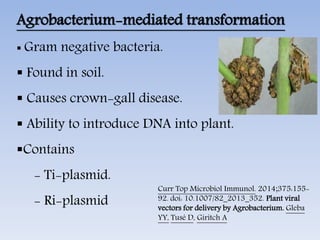
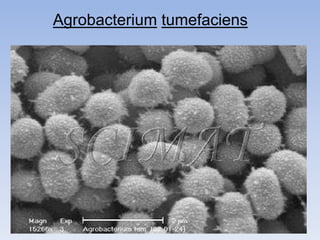
Agrobacterium-mediated transformation
 Gram negative bacteria.
 Found in soil.
 Causes crown-gall disease.
 Ability to introduce DNA into plant.
Contains
- Ti-plasmid.
- Ri-plasmid
Curr Top Microbiol Immunol. 2014;375:155-
92. doi: 10.1007/82_2013_352. Plant viral
vectors for delivery by Agrobacterium. Gleba
YY, Tusé D, Giritch A
Agrobacterium tumefaciens
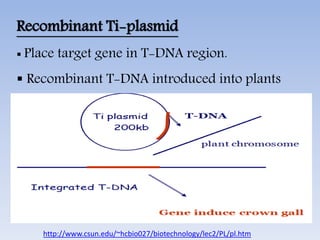
Recombinant Ti-plasmid
 Place target gene in T-DNA region.
 Recombinant T-DNA introduced into plants
http://www.csun.edu/~hcbio027/biotechnology/lec2/PL/pl.htm
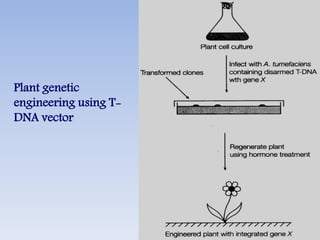
Plant genetic
engineering using T-
DNA vector
Method of screening
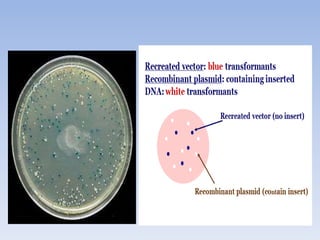
White-Blue screening
 Colonies with recombinant plasmid are white
 Colonies with non-recombinant plasmids are
blue.
For example: pUC19
Resistance to ampicilline.
Contains portion of the lacZ which codes for
beta-galactosidase.
Viral vectors
“Viruses which are used as gizmo by
molecular biologists to carry genetic
material into cells” are called viral vectors.
 Viral vectors are non-integrative as
compared to bacterial vectors
http://www.ncbi.nlm.nih.gov/pmc/articles/PMC2613721/
Examples
1.Cauliflower mosaic virus based vectors.
2.Cowpea mosaic virus
3.Bean pod mottle virus (BPMV)
4.TMV based vectors.
5.Potato virus X (PVX)
6.Bean yellow dwarf virus
7.Bacteriophage Lambda Vectors
http://www.ncbi.nlm.nih.gov/pmc/articles/PMC2613721/
Characteristics of viral vectors
 Safety
 Low toxicity
 Stability
 Cell type specificity
http://www.ncbi.nlm.nih.gov/pubmed/12828943
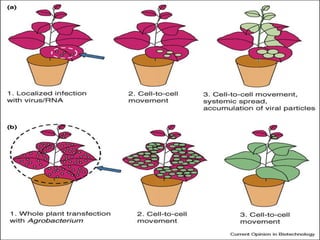
Viruses are used in two ways
–Virus directly inserted into plant
–Virus indirectly inserted (bacteria)
http://www.ncbi.nlm.nih.gov/pubmed/12828943
Cauliflower mosaic virus
 DNA virus
 Infectious when simply rubbed on leaves
 Mechanical and aphid mediated transmission
 Up to 106 copies per cell within 3-4 weeks of
infection in plant.
Use of viral vectors for vaccine production in plants, M Carmen Cañizares, Liz Nicholson
and George P Lomonossoff. John Innes Centre, Norwich, UK
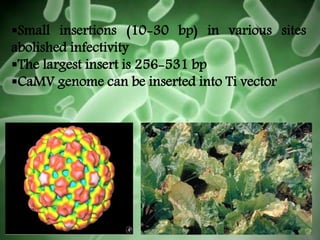
Small insertions (10-30 bp) in various sites
abolished infectivity
The largest insert is 256-531 bp
CaMV genome can be inserted into Ti vector
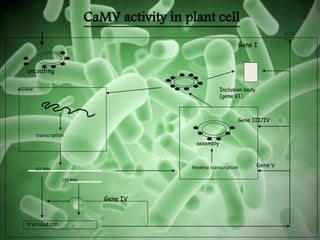
transcription
nucleus
35S RNA
19S RNA
translation
Reverse transcription
uncoating
Gene IV
Gene V
Gene III/IV
assembly
Inclusion body
(gene VI)
Gene I
CaMV activity in plant cell
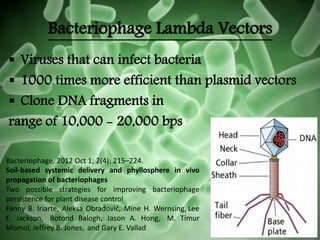
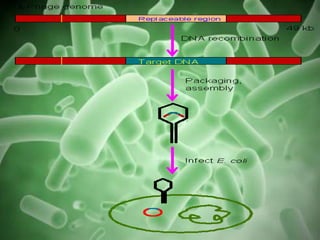
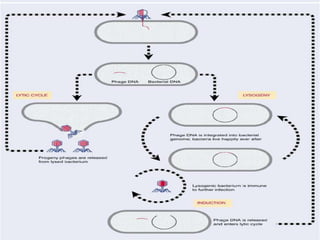
Bacteriophage Lambda Vectors
 Viruses that can infect bacteria
 1000 times more efficient than plasmid vectors
 Clone DNA fragments in
range of 10,000 - 20,000 bps
Bacteriophage. 2012 Oct 1; 2(4): 215–224.
Soil-based systemic delivery and phyllosphere in vivo
propagation of bacteriophages
Two possible strategies for improving bacteriophage
persistence for plant disease control
Fanny B. Iriarte, Aleksa Obradović, Mine H. Wernsing, Lee
E. Jackson, Botond Balogh, Jason A. Hong, M. Timur
Momol, Jeffrey B. Jones, and Gary E. Vallad
Steps
Advantages
 Fast processing ,low cost, high yield
 Good at targeting and entering cells
 Mostly target specific types of cells
 Used as virus-induced gene silencing
(VIGS) in reverse genetic studies
2003 Aug;30(4):296-303.
Virus-induced gene silencing in plants.
Lu R, Martin-Hernandez AM, Peart JR, Malcuit I, Baulcombe DC.
 Express proteins in plants for the
- Study of gene function
- Production of vaccines
- Study of metabolic engineering
- Analysis of plant-microbe interactions
Hum Vaccin. 2011 Mar;7(3):331-8. Epub 2011 Mar 1.
Geminiviral vectors based on bean yellow dwarf virus for production of vaccine
antigens and monoclonal antibodies in plants.
Chen Q, He J, Phoolcharoen W, Mason HS
Disadvantages
 Worst effects to plants by
–Producing severe disease
–Giving undesired products
–Affecting the plant adversely
(due to highest mutation rate)
http://plantsciences.utk.edu/stewart.htm
Cosmid
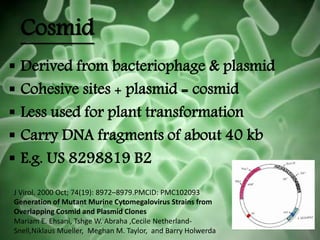
 Derived from bacteriophage & plasmid
 Cohesive sites + plasmid = cosmid
 Less used for plant transformation
 Carry DNA fragments of about 40 kb
 E.g. US 8298819 B2
J Virol. 2000 Oct; 74(19): 8972–8979.PMCID: PMC102093
Generation of Mutant Murine Cytomegalovirus Strains from
Overlapping Cosmid and Plasmid Clones
Mariam E. Ehsani, Tshge W. Abraha ,Cecile Netherland-
Snell,Niklaus Mueller, Meghan M. Taylor, and Barry Holwerda
Cohesive ends or sticky ends
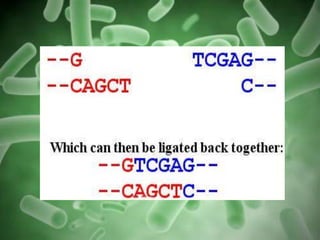
A single-stranded end of a linear
duplex DNA molecule which can
form hydrogen-bond with a
complementary single-strand base
sequence from the end of the same
or another DNA molecule
http://www.dnalc.org/view/15019-Cohesive-sticky-ends-and-their-
significance-in-genetic-engineering-Paul-Berg.html
Plant transformation vectors and their types

Plant transformation vectors and their types

  • 2.
    Presentation on: Plant transformationvectors and their types Presented to: Dr. Hamid Manzoor Presented by: Hina Mushtaq …………... BSBT-02 Zahra Naz ……………….. BSBT-04 07th May, 2015
  • 3.
    Institute of MolecularBiology & Biotechnology, Bahauddin Zakariya University, Multan, Pakistan.
  • 4.
    Contents  Plant transformation Vectors  Types of vectors  Plant transformation vectors  Plasmids  Viruses  Bacteriophages – Advantages – Disadvantages
  • 5.
    Plant Transformation ”Transformation isthe genetic alteration of a cell resulting from the direct uptake and incorporation of exogenous genetic material from its surroundings.” or “Integration of gene into genome by means other than fusion of gametes” file:///G:/agri%20biotech/NPTEL%20__%20Biotechnology%20 -%20Plant%20Biotechnology.html
  • 6.
    Steps of PlantTransformation
  • 8.
    Plant Transformation Methods 1.Indirectmethod or vectored methods oAgro bacterium-mediated transformation. oVirus mediated. 2. Direct method. o Protoplast electroporation. o Protoplast polyethylene glycol method. o Gene gun method.
  • 9.
    Vector “A DNA moleculeused as a vehicle to carry foreign genetic material into another cell.” Types Of Vector: -Plasmids. -Viral vectors. -Cosmids. -Artificial chromosome. file:///G:/agri%20biotech/PLANT%20TRANSFORMATION%20VECTORS%20_%20What %20Is%20The%20Biotechnology.html
  • 10.
    Characteristics of vectors Origin of replication  Self-replicating  Bacterial selectable markers  Gene constructs of interest file:///G:/agri%20biotech/PLANT%20TRANSFORMATION%20VECTORS%20_%20What %20Is%20The%20Biotechnology.html
  • 11.
    Vector classification Cloning vectors “Smallpiece of DNA into which a foreign DNA fragment is inserted for cloning purposes.” Expression vectors “Also known as an expression construct, is usually a plasmid or virus designed for protein expression in cells.” file:///G:/agri%20biotech/PLANT%20TRANSFORMATION%20VECTORS%20_%20What %20Is%20The%20Biotechnology.html
  • 12.
    In plants  Plasmids Viruses  Bacteriophages  Cosmids Plant Physiol. 2007 Dec; 145(4): 1118–1128. doi: 10.1104/pp.107.106104 PMCID: PMC2151730 Focus Issue on Vector Systems for Plant Research and Biotechnology Delivery of Multiple Transgenes to Plant Cells Mery Dafny-Yelin and Tzvi Tzfira
  • 13.
    Plasmid • Extra chromosomalDNA molecules. •Self-replicating. •Circular & Double stranded. •Short sequence of DNA. • Found in prokaryotes. file:///G:/agri%20biotech/NPTEL%20__%20Biotechnology%20- %20Plant%20Biotechnology.html
  • 16.
  • 17.
    Classification of plasmids oFertility plasmid e.g. F plasmid of E. coli o Col plasmid e.g. ColE1 of E. coli o Resistance plasmid e.g. RP4 in Pseudomonas o Degradative plasmid e.g. TOL of P. putida o Virulence plasmid e.g. Ti plasmids of A. tumefaciens file:///C:/Users/%20/Documents/d.html
  • 18.
    Based on theorigin or source of plasmids Two major classes : i) Natural plasmids: They occur naturally in prokaryotes Example: ColE1. ii) Artificial plasmids: They are constructed in-vitro by re-combining selected segments of two or more plasmids. Example: pBR322. file:///C:/Users/%20/Documents/d.html
  • 19.
    Nomenclature of Plasmid pBR322 pPlasmid B Boliver R Rodriguez 322 Number given to distinguish http://blog.addgene.org/plasmids-101-how-to-name-your-plasmid-in-3- easy-steps
  • 20.
    Advantages Occur naturally inbacteria Have different restriction sites. Replicate completely independent of bacteria Genes are easily inserted into plasmids Easily transformed into bacteria https://answers.yahoo.com/question/index?qid=20061217124130AAsvKqk
  • 21.
    Disadvantages  Cannot acceptlarge fragments  Sizes range from 10-20 kb  Standard methods of transformation are inefficient https://answers.yahoo.com/question/index?qid=20061217124130AAsvKqk
  • 22.
    Agrobacterium-mediated transformation  Gramnegative bacteria.  Found in soil.  Causes crown-gall disease.  Ability to introduce DNA into plant. Contains - Ti-plasmid. - Ri-plasmid Curr Top Microbiol Immunol. 2014;375:155- 92. doi: 10.1007/82_2013_352. Plant viral vectors for delivery by Agrobacterium. Gleba YY, Tusé D, Giritch A
  • 23.
  • 24.
    Recombinant Ti-plasmid  Placetarget gene in T-DNA region.  Recombinant T-DNA introduced into plants http://www.csun.edu/~hcbio027/biotechnology/lec2/PL/pl.htm
  • 25.
  • 26.
  • 27.
    White-Blue screening  Colonieswith recombinant plasmid are white  Colonies with non-recombinant plasmids are blue. For example: pUC19 Resistance to ampicilline. Contains portion of the lacZ which codes for beta-galactosidase.
  • 29.
    Viral vectors “Viruses whichare used as gizmo by molecular biologists to carry genetic material into cells” are called viral vectors.  Viral vectors are non-integrative as compared to bacterial vectors http://www.ncbi.nlm.nih.gov/pmc/articles/PMC2613721/
  • 30.
    Examples 1.Cauliflower mosaic virusbased vectors. 2.Cowpea mosaic virus 3.Bean pod mottle virus (BPMV) 4.TMV based vectors. 5.Potato virus X (PVX) 6.Bean yellow dwarf virus 7.Bacteriophage Lambda Vectors http://www.ncbi.nlm.nih.gov/pmc/articles/PMC2613721/
  • 31.
    Characteristics of viralvectors  Safety  Low toxicity  Stability  Cell type specificity http://www.ncbi.nlm.nih.gov/pubmed/12828943
  • 32.
    Viruses are usedin two ways –Virus directly inserted into plant –Virus indirectly inserted (bacteria) http://www.ncbi.nlm.nih.gov/pubmed/12828943
  • 34.
    Cauliflower mosaic virus DNA virus  Infectious when simply rubbed on leaves  Mechanical and aphid mediated transmission  Up to 106 copies per cell within 3-4 weeks of infection in plant. Use of viral vectors for vaccine production in plants, M Carmen Cañizares, Liz Nicholson and George P Lomonossoff. John Innes Centre, Norwich, UK
  • 35.
    Small insertions (10-30bp) in various sites abolished infectivity The largest insert is 256-531 bp CaMV genome can be inserted into Ti vector
  • 36.
    transcription nucleus 35S RNA 19S RNA translation Reversetranscription uncoating Gene IV Gene V Gene III/IV assembly Inclusion body (gene VI) Gene I CaMV activity in plant cell
  • 37.
    Bacteriophage Lambda Vectors Viruses that can infect bacteria  1000 times more efficient than plasmid vectors  Clone DNA fragments in range of 10,000 - 20,000 bps Bacteriophage. 2012 Oct 1; 2(4): 215–224. Soil-based systemic delivery and phyllosphere in vivo propagation of bacteriophages Two possible strategies for improving bacteriophage persistence for plant disease control Fanny B. Iriarte, Aleksa Obradović, Mine H. Wernsing, Lee E. Jackson, Botond Balogh, Jason A. Hong, M. Timur Momol, Jeffrey B. Jones, and Gary E. Vallad
  • 38.
  • 41.
    Advantages  Fast processing,low cost, high yield  Good at targeting and entering cells  Mostly target specific types of cells  Used as virus-induced gene silencing (VIGS) in reverse genetic studies 2003 Aug;30(4):296-303. Virus-induced gene silencing in plants. Lu R, Martin-Hernandez AM, Peart JR, Malcuit I, Baulcombe DC.
  • 42.
     Express proteinsin plants for the - Study of gene function - Production of vaccines - Study of metabolic engineering - Analysis of plant-microbe interactions Hum Vaccin. 2011 Mar;7(3):331-8. Epub 2011 Mar 1. Geminiviral vectors based on bean yellow dwarf virus for production of vaccine antigens and monoclonal antibodies in plants. Chen Q, He J, Phoolcharoen W, Mason HS
  • 43.
    Disadvantages  Worst effectsto plants by –Producing severe disease –Giving undesired products –Affecting the plant adversely (due to highest mutation rate) http://plantsciences.utk.edu/stewart.htm
  • 44.
    Cosmid  Derived frombacteriophage & plasmid  Cohesive sites + plasmid = cosmid  Less used for plant transformation  Carry DNA fragments of about 40 kb  E.g. US 8298819 B2 J Virol. 2000 Oct; 74(19): 8972–8979.PMCID: PMC102093 Generation of Mutant Murine Cytomegalovirus Strains from Overlapping Cosmid and Plasmid Clones Mariam E. Ehsani, Tshge W. Abraha ,Cecile Netherland- Snell,Niklaus Mueller, Meghan M. Taylor, and Barry Holwerda
  • 45.
    Cohesive ends orsticky ends A single-stranded end of a linear duplex DNA molecule which can form hydrogen-bond with a complementary single-strand base sequence from the end of the same or another DNA molecule http://www.dnalc.org/view/15019-Cohesive-sticky-ends-and-their- significance-in-genetic-engineering-Paul-Berg.html