


 A mummy is the body of a person or animal that has 
been preserved after death. 
 A withered, shrunken, or well-preserved body that 
resembles an embalmed body 
 “Mummy” comes from the Persian and Arabic words 
that describe bitumen 
Bitumen a black substance that comes from the Mumya 
Mountain in Persia 
Arabs first saw mummies named them bitumen due to 
black waxy looking substance on mummies
Mummification was a feature of ancient cultures in 
areas of South America and Asia 
The oldest known naturally mummified human corpse is 
a severed head mummy which is 6,000 years old in South 
America. 
Mummies of humans and other animals have been 
found on every continent, both as a result of natural 
preservation through unusual conditions, and as 
cultural artifacts 
Mummies were formed due to environmental conditions 
like lack of air, heat, cold and dry sand in which body was 
buried
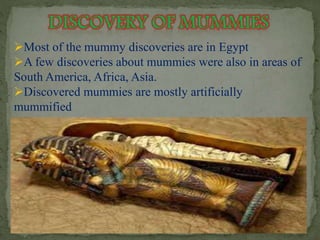
Most of the mummy discoveries are in Egypt 
A few discoveries about mummies were also in areas of 
South America, Africa, Asia. 
Discovered mummies are mostly artificially 
mummified
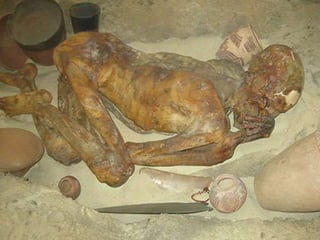
Nicknamed for its red hair, “Ginger” 
The most famous of six naturally mummified 
bodies 
Excavated in the late 19th century from shallow 
graves in the Egyptian desert 
On display at the British Museum from 1901 
The first mummy to be exhibited in public 
Ginger is the oldest known mummies in existence, 
dating back to about 3400 B.C. 
 Its body was naturally dried and preserved by the 
warm sand in which it was buried
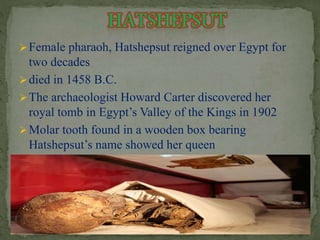
Female pharaoh, Hatshepsut reigned over Egypt for 
two decades 
 died in 1458 B.C. 
The archaeologist Howard Carter discovered her 
royal tomb in Egypt’s Valley of the Kings in 1902 
Molar tooth found in a wooden box bearing 
Hatshepsut’s name showed her queen
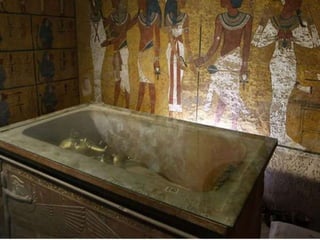
Ancient Egypt’s “boy king” 
Became pharaoh at the age of nine and ruled for 10 years 
Was known as Tutankhamen–or “King Tut” 
in 1922, archaeologist Howard Carter found his tomb in 
Egypt’s Valley of the Kings 
The tomb was crammed with a wealth of ancient treasures 
including jewelry, gilded shrines and a solid gold funerary 
mask
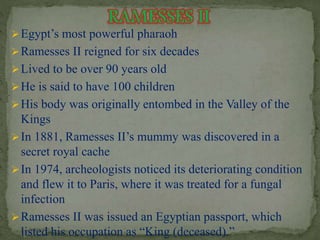
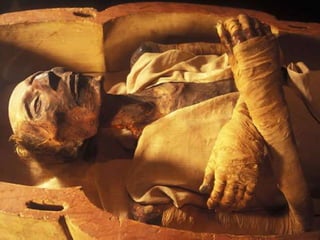
 Egypt’s most powerful pharaoh 
Ramesses II reigned for six decades 
Lived to be over 90 years old 
 He is said to have 100 children 
His body was originally entombed in the Valley of the 
Kings 
 In 1881, Ramesses II’s mummy was discovered in a 
secret royal cache 
In 1974, archeologists noticed its deteriorating condition 
and flew it to Paris, where it was treated for a fungal 
infection 
Ramesses II was issued an Egyptian passport, which 
listed his occupation as “King (deceased).”
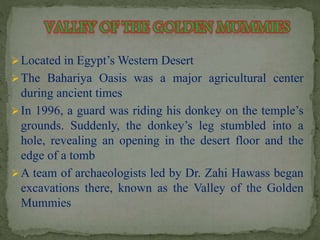
Located in Egypt’sWestern Desert 
The Bahariya Oasis was a major agricultural center 
during ancient times 
In 1996, a guard was riding his donkey on the temple’s 
grounds. Suddenly, the donkey’s leg stumbled into a 
hole, revealing an opening in the desert floor and the 
edge of a tomb 
A team of archaeologists led by Dr. Zahi Hawass began 
excavations there, known as the Valley of the Golden 
Mummies
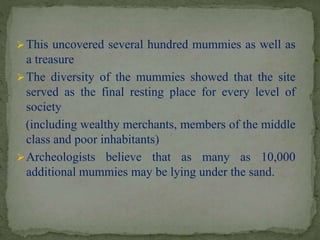
This uncovered several hundred mummies as well as 
a treasure 
The diversity of the mummies showed that the site 
served as the final resting place for every level of 
society 
(including wealthy merchants, members of the middle 
class and poor inhabitants) 
Archeologists believe that as many as 10,000 
additional mummies may be lying under the sand.
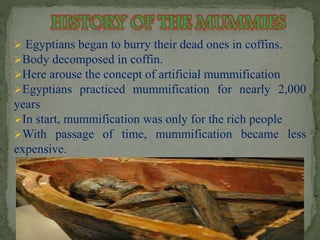
 Egyptians began to burry their dead ones in coffins. 
Body decomposed in coffin. 
Here arouse the concept of artificial mummification 
Egyptians practiced mummification for nearly 2,000 
years 
In start, mummification was only for the rich people 
With passage of time, mummification became less 
expensive.
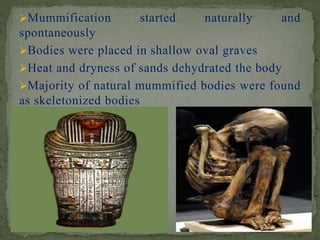
Mummification started naturally and 
spontaneously 
Bodies were placed in shallow oval graves 
Heat and dryness of sands dehydrated the body 
Majority of natural mummified bodies were found 
as skeletonized bodies
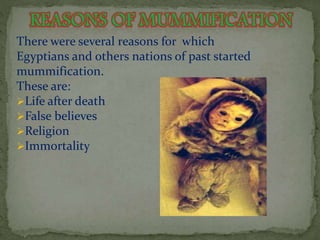
There were several reasons for which 
Egyptians and others nations of past started 
mummification. 
These are: 
Life after death 
False believes 
Religion 
Immortality
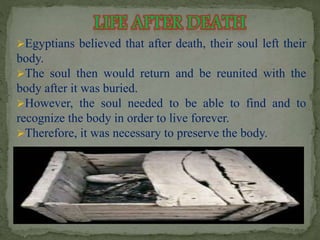
Egyptians believed that after death, their soul left their 
body. 
The soul then would return and be reunited with the 
body after it was buried. 
However, the soul needed to be able to find and to 
recognize the body in order to live forever. 
Therefore, it was necessary to preserve the body.
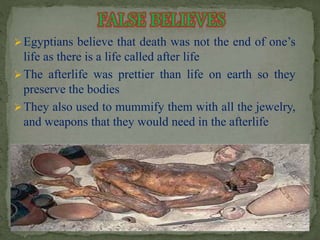
Egyptians believe that death was not the end of one’s 
life as there is a life called after life 
The afterlife was prettier than life on earth so they 
preserve the bodies 
They also used to mummify them with all the jewelry, 
and weapons that they would need in the afterlife
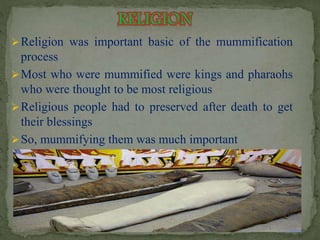
Religion was important basic of the mummification 
process 
Most who were mummified were kings and pharaohs 
who were thought to be most religious 
Religious people had to preserved after death to get 
their blessings 
So, mummifying them was much important
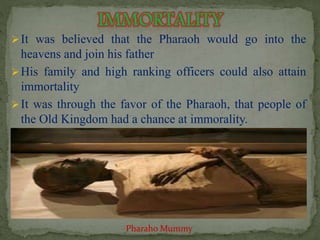
 It was believed that the Pharaoh would go into the 
heavens and join his father 
His family and high ranking officers could also attain 
immortality 
 It was through the favor of the Pharaoh, that people of 
the Old Kingdom had a chance at immorality. 
Pharaho Mummy
Involves the procedure to make a mummy of dead person. 
It involves the following steps: 
Cleaning Process 
Removal Of Internal Organs 
Drying Process 
Oiling Of Body 
Stuffing Of Body 
Wrapping Of Body 
Final Wrapping Of Body 
Funeral 
Religious Rituals
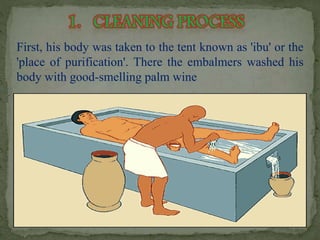
First, his body was taken to the tent known as 'ibu' or the 
'place of purification'. There the embalmers washed his 
body with good-smelling palm wine
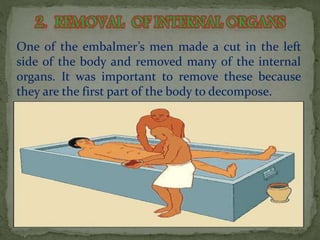
One of the embalmer’s men made a cut in the left 
side of the body and removed many of the internal 
organs. It was important to remove these because 
they are the first part of the body to decompose. 
.
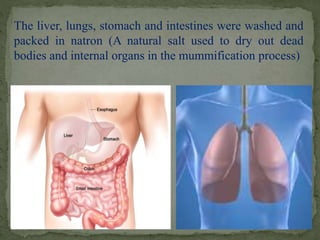
The liver, lungs, stomach and intestines were washed and 
packed in natron (A natural salt used to dry out dead 
bodies and internal organs in the mummification process)
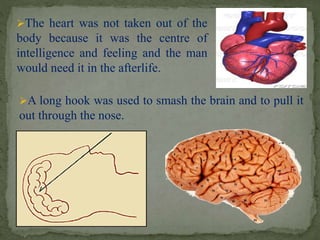
The heart was not taken out of the 
body because it was the centre of 
intelligence and feeling and the man 
would need it in the afterlife. 
A long hook was used to smash the brain and to pull it 
out through the nose.
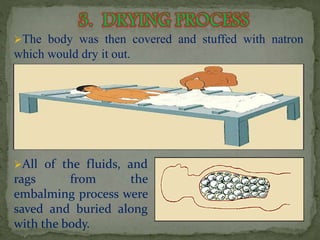
The body was then covered and stuffed with natron 
which would dry it out. 
All of the fluids, and 
rags from the 
embalming process were 
saved and buried along 
with the body.
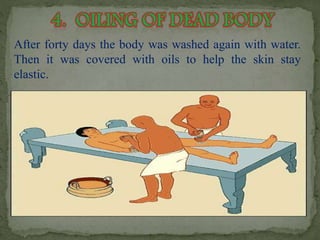
After forty days the body was washed again with water. 
Then it was covered with oils to help the skin stay 
elastic.
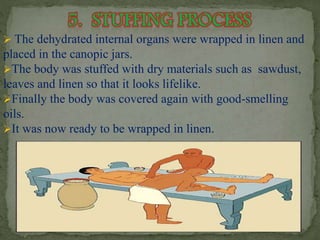
 The dehydrated internal organs were wrapped in linen and 
placed in the canopic jars. 
The body was stuffed with dry materials such as sawdust, 
leaves and linen so that it looks lifelike. 
Finally the body was covered again with good-smelling 
oils. 
It was now ready to be wrapped in linen.
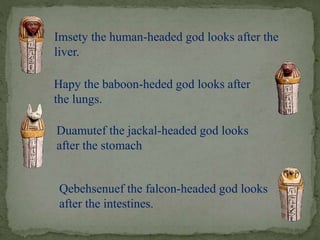
Imsety the human-headed god looks after the 
liver. 
Hapy the baboon-heded god looks after 
the lungs. 
Duamutef the jackal-headed god looks 
after the stomach 
Qebehsenuef the falcon-headed god looks 
after the intestines.
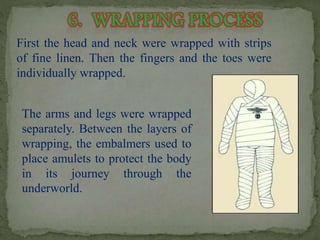
First the head and neck were wrapped with strips 
of fine linen. Then the fingers and the toes were 
individually wrapped. 
The arms and legs were wrapped 
separately. Between the layers of 
wrapping, the embalmers used to 
place amulets to protect the body 
in its journey through the 
underworld.
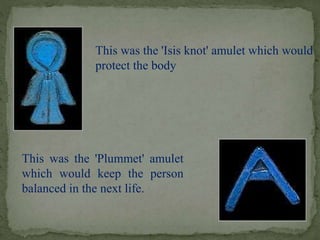
This was the 'Isis knot' amulet which would 
protect the body 
This was the 'Plummet' amulet 
which would keep the person 
balanced in the next life.
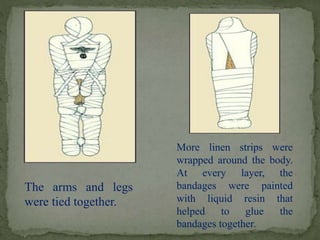
The arms and legs 
were tied together. 
More linen strips were 
wrapped around the body. 
At every layer, the 
bandages were painted 
with liquid resin that 
helped to glue the 
bandages together.
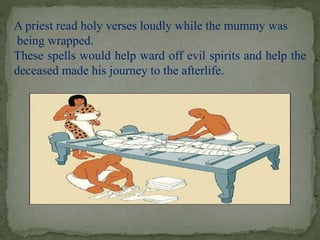
A priest read holy verses loudly while the mummy was 
being wrapped. 
These spells would help ward off evil spirits and help the 
deceased made his journey to the afterlife.
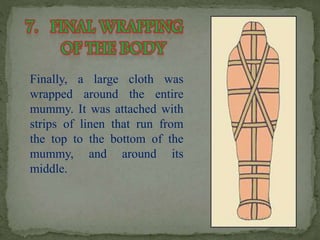
Finally, a large cloth was 
wrapped around the entire 
mummy. It was attached with 
strips of linen that run from 
the top to the bottom of the 
mummy, and around its 
middle.
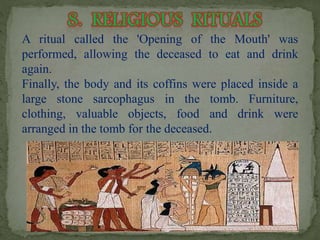
A ritual called the 'Opening of the Mouth' was 
performed, allowing the deceased to eat and drink 
again. 
Finally, the body and its coffins were placed inside a 
large stone sarcophagus in the tomb. Furniture, 
clothing, valuable objects, food and drink were 
arranged in the tomb for the deceased.
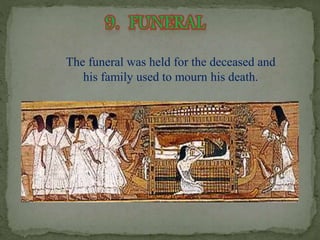
The funeral was held for the deceased and 
his family used to mourn his death.
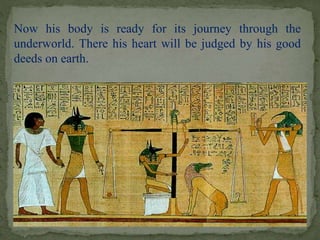
Now his body is ready for its journey through the 
underworld. There his heart will be judged by his good 
deeds on earth.
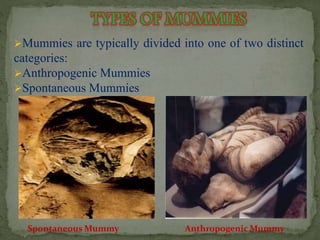
Mummies are typically divided into one of two distinct 
categories: 
Anthropogenic Mummies 
Spontaneous Mummies 
Spontaneous Mummy Anthropogenic Mummy
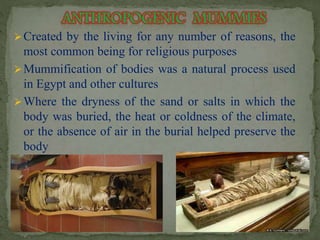
Created by the living for any number of reasons, the 
most common being for religious purposes 
Mummification of bodies was a natural process used 
in Egypt and other cultures 
Where the dryness of the sand or salts in which the 
body was buried, the heat or coldness of the climate, 
or the absence of air in the burial helped preserve the 
body
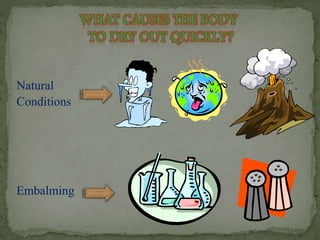
Natural 
Conditions 
Embalming
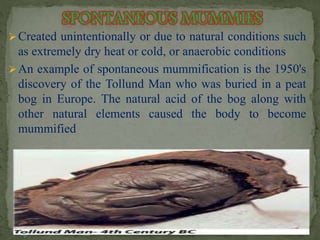
Created unintentionally or due to natural conditions such 
as extremely dry heat or cold, or anaerobic conditions 
An example of spontaneous mummification is the 1950's 
discovery of the Tollund Man who was buried in a peat 
bog in Europe. The natural acid of the bog along with 
other natural elements caused the body to become 
mummified
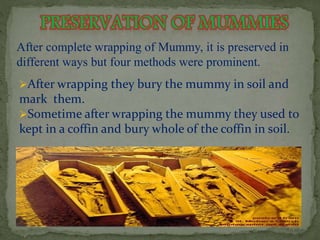
After complete wrapping of Mummy, it is preserved in 
different ways but four methods were prominent. 
After wrapping they bury the mummy in soil and 
mark them. 
Sometime after wrapping the mummy they used to 
kept in a coffin and bury whole of the coffin in soil.
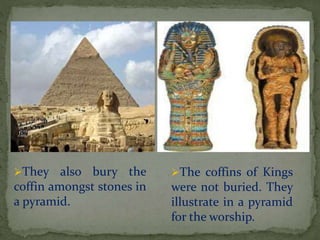
They also bury the 
coffin amongst stones in 
a pyramid. 
The coffins of Kings 
were not buried. They 
illustrate in a pyramid 
for the worship.
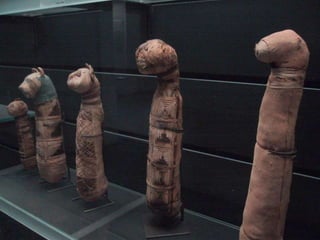
Mummies discovered from different areas of world 
are kept in museums of different countries e.g. 
1. Egyptian Museum, Egypt 
2. British Museum, London 
3. Penn Museum 
4. Brooklyn Museum, Egypt 
5. World Museum, Egypt
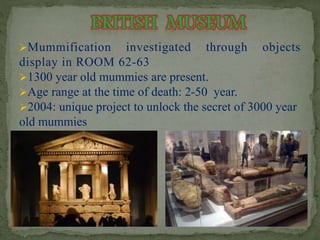
Mummification investigated through objects 
display in ROOM 62-63 
1300 year old mummies are present. 
Age range at the time of death: 2-50 year. 
2004: unique project to unlock the secret of 3000 year 
old mummies
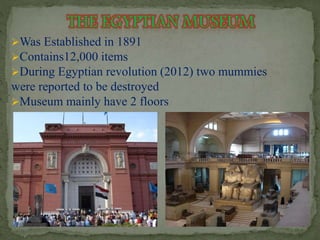
Was Established in 1891 
Contains12,000 items 
During Egyptian revolution (2012) two mummies 
were reported to be destroyed 
Museum mainly have 2 floors
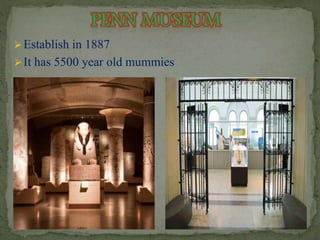
Establish in 1887 
 It has 5500 year old mummies
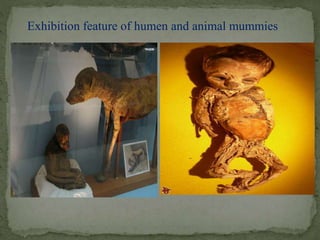
Exhibition feature of humen and animal mummies
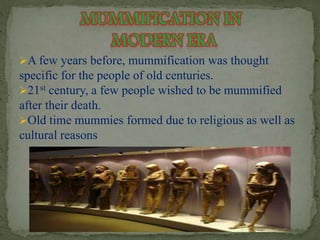
A few years before, mummification was thought 
specific for the people of old centuries. 
21st century, a few people wished to be mummified 
after their death. 
Old time mummies formed due to religious as well as 
cultural reasons
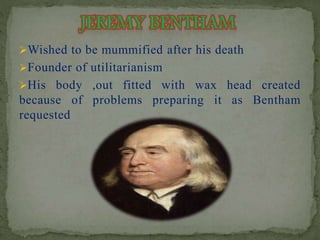
Wished to be mummified after his death 
Founder of utilitarianism 
His body ,out fitted with wax head created 
because of problems preparing it as Bentham 
requested
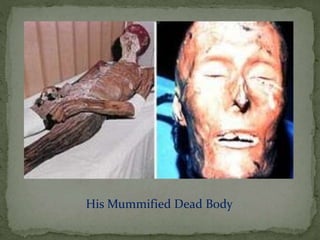
His Mummified Dead Body
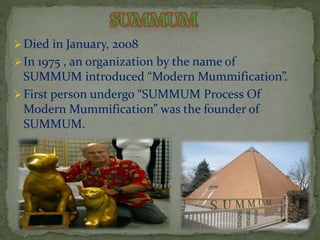
Died in January, 2008 
In 1975 , an organization by the name of 
SUMMUM introduced “Modern Mummification”. 
 First person undergo “SUMMUM Process Of 
Modern Mummification” was the founder of 
SUMMUM.
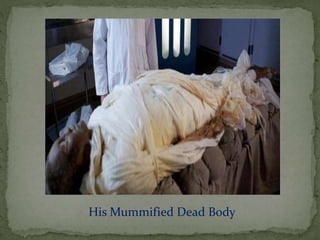
His Mummified Dead Body
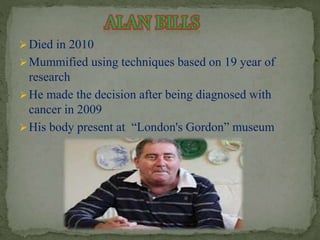
Died in 2010 
Mummified using techniques based on 19 year of 
research 
He made the decision after being diagnosed with 
cancer in 2009 
 His body present at “London's Gordon” museum
Mummies are well-preserved bodies 
Ingredients used for mummification preserved the body 
for a long time 
Mummies are studied in detail by using modern technique 
which are: 
 Radiology 
 Magnetic Resonance Imaging-MRI 
 Computed Tomography-CT Scan 
 Mass Spectroscopy 
 DNAAnalysis 
 Proteomics
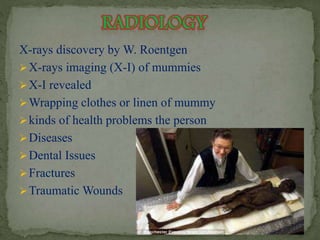
X-rays discovery by W. Roentgen 
X-rays imaging (X-I) of mummies 
X-I revealed 
Wrapping clothes or linen of mummy 
kinds of health problems the person 
Diseases 
Dental Issues 
Fractures 
Traumatic Wounds
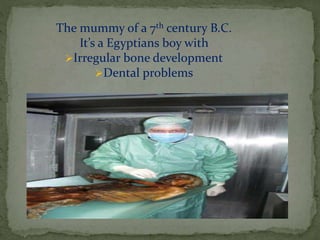
The mummy of a 7th century B.C. 
It’s a Egyptians boy with 
Irregular bone development 
Dental problems
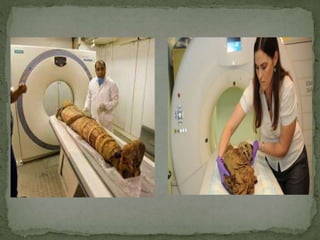
Started a few years ago 
Results suggested: 
Periodontal diseases 
Dental Cavities 
Evidence of numerous other health issues 
Bone disorders 
Infections 
Traumas 
Antherosclerosis
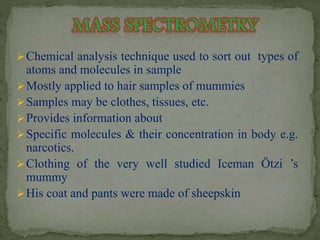
Chemical analysis technique used to sort out types of 
atoms and molecules in sample 
Mostly applied to hair samples of mummies 
Samples may be clothes, tissues, etc. 
Provides information about 
Specific molecules & their concentration in body e.g. 
narcotics. 
Clothing of the very well studied Iceman Ötzi ’s 
mummy 
His coat and pants were made of sheepskin
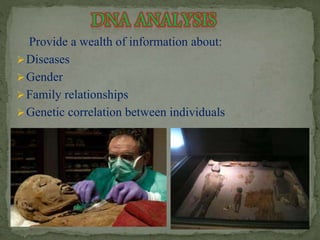
Provide a wealth of information about: 
Diseases 
Gender 
Family relationships 
Genetic correlation between individuals
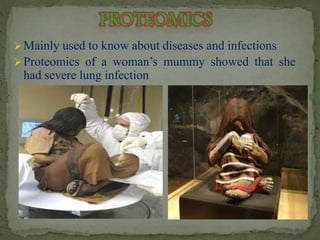
Mainly used to know about diseases and infections 
Proteomics of a woman’s mummy showed that she 
had severe lung infection
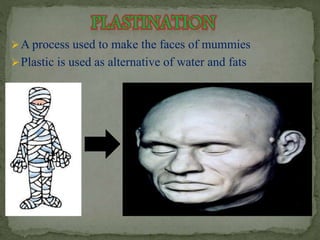
A process used to make the faces of mummies 
 Plastic is used as alternative of water and fats
Other techniques used to study mummies 
Endoscopy (the study of the internal body using a 
flexible tube) 
Histology (microscopic study of tissues) 
Imunocytochemistry (a method to look for antigens 
associated with particular parasites).
The mummies
The mummies
The mummies

The mummies

  • 5.
     A mummyis the body of a person or animal that has been preserved after death.  A withered, shrunken, or well-preserved body that resembles an embalmed body  “Mummy” comes from the Persian and Arabic words that describe bitumen Bitumen a black substance that comes from the Mumya Mountain in Persia Arabs first saw mummies named them bitumen due to black waxy looking substance on mummies
  • 6.
    Mummification was afeature of ancient cultures in areas of South America and Asia The oldest known naturally mummified human corpse is a severed head mummy which is 6,000 years old in South America. Mummies of humans and other animals have been found on every continent, both as a result of natural preservation through unusual conditions, and as cultural artifacts Mummies were formed due to environmental conditions like lack of air, heat, cold and dry sand in which body was buried
  • 7.
    Most of themummy discoveries are in Egypt A few discoveries about mummies were also in areas of South America, Africa, Asia. Discovered mummies are mostly artificially mummified
  • 8.
    Nicknamed for itsred hair, “Ginger” The most famous of six naturally mummified bodies Excavated in the late 19th century from shallow graves in the Egyptian desert On display at the British Museum from 1901 The first mummy to be exhibited in public Ginger is the oldest known mummies in existence, dating back to about 3400 B.C.  Its body was naturally dried and preserved by the warm sand in which it was buried
  • 10.
    Female pharaoh, Hatshepsutreigned over Egypt for two decades  died in 1458 B.C. The archaeologist Howard Carter discovered her royal tomb in Egypt’s Valley of the Kings in 1902 Molar tooth found in a wooden box bearing Hatshepsut’s name showed her queen
  • 11.
    Ancient Egypt’s “boyking” Became pharaoh at the age of nine and ruled for 10 years Was known as Tutankhamen–or “King Tut” in 1922, archaeologist Howard Carter found his tomb in Egypt’s Valley of the Kings The tomb was crammed with a wealth of ancient treasures including jewelry, gilded shrines and a solid gold funerary mask
  • 13.
     Egypt’s mostpowerful pharaoh Ramesses II reigned for six decades Lived to be over 90 years old  He is said to have 100 children His body was originally entombed in the Valley of the Kings  In 1881, Ramesses II’s mummy was discovered in a secret royal cache In 1974, archeologists noticed its deteriorating condition and flew it to Paris, where it was treated for a fungal infection Ramesses II was issued an Egyptian passport, which listed his occupation as “King (deceased).”
  • 15.
    Located in Egypt’sWesternDesert The Bahariya Oasis was a major agricultural center during ancient times In 1996, a guard was riding his donkey on the temple’s grounds. Suddenly, the donkey’s leg stumbled into a hole, revealing an opening in the desert floor and the edge of a tomb A team of archaeologists led by Dr. Zahi Hawass began excavations there, known as the Valley of the Golden Mummies
  • 16.
    This uncovered severalhundred mummies as well as a treasure The diversity of the mummies showed that the site served as the final resting place for every level of society (including wealthy merchants, members of the middle class and poor inhabitants) Archeologists believe that as many as 10,000 additional mummies may be lying under the sand.
  • 19.
     Egyptians beganto burry their dead ones in coffins. Body decomposed in coffin. Here arouse the concept of artificial mummification Egyptians practiced mummification for nearly 2,000 years In start, mummification was only for the rich people With passage of time, mummification became less expensive.
  • 20.
    Mummification started naturallyand spontaneously Bodies were placed in shallow oval graves Heat and dryness of sands dehydrated the body Majority of natural mummified bodies were found as skeletonized bodies
  • 21.
    There were severalreasons for which Egyptians and others nations of past started mummification. These are: Life after death False believes Religion Immortality
  • 22.
    Egyptians believed thatafter death, their soul left their body. The soul then would return and be reunited with the body after it was buried. However, the soul needed to be able to find and to recognize the body in order to live forever. Therefore, it was necessary to preserve the body.
  • 23.
    Egyptians believe thatdeath was not the end of one’s life as there is a life called after life The afterlife was prettier than life on earth so they preserve the bodies They also used to mummify them with all the jewelry, and weapons that they would need in the afterlife
  • 24.
    Religion was importantbasic of the mummification process Most who were mummified were kings and pharaohs who were thought to be most religious Religious people had to preserved after death to get their blessings So, mummifying them was much important
  • 25.
     It wasbelieved that the Pharaoh would go into the heavens and join his father His family and high ranking officers could also attain immortality  It was through the favor of the Pharaoh, that people of the Old Kingdom had a chance at immorality. Pharaho Mummy
  • 27.
    Involves the procedureto make a mummy of dead person. It involves the following steps: Cleaning Process Removal Of Internal Organs Drying Process Oiling Of Body Stuffing Of Body Wrapping Of Body Final Wrapping Of Body Funeral Religious Rituals
  • 28.
    First, his bodywas taken to the tent known as 'ibu' or the 'place of purification'. There the embalmers washed his body with good-smelling palm wine
  • 29.
    One of theembalmer’s men made a cut in the left side of the body and removed many of the internal organs. It was important to remove these because they are the first part of the body to decompose. .
  • 30.
    The liver, lungs,stomach and intestines were washed and packed in natron (A natural salt used to dry out dead bodies and internal organs in the mummification process)
  • 31.
    The heart wasnot taken out of the body because it was the centre of intelligence and feeling and the man would need it in the afterlife. A long hook was used to smash the brain and to pull it out through the nose.
  • 32.
    The body wasthen covered and stuffed with natron which would dry it out. All of the fluids, and rags from the embalming process were saved and buried along with the body.
  • 33.
    After forty daysthe body was washed again with water. Then it was covered with oils to help the skin stay elastic.
  • 34.
     The dehydratedinternal organs were wrapped in linen and placed in the canopic jars. The body was stuffed with dry materials such as sawdust, leaves and linen so that it looks lifelike. Finally the body was covered again with good-smelling oils. It was now ready to be wrapped in linen.
  • 35.
    Imsety the human-headedgod looks after the liver. Hapy the baboon-heded god looks after the lungs. Duamutef the jackal-headed god looks after the stomach Qebehsenuef the falcon-headed god looks after the intestines.
  • 36.
    First the headand neck were wrapped with strips of fine linen. Then the fingers and the toes were individually wrapped. The arms and legs were wrapped separately. Between the layers of wrapping, the embalmers used to place amulets to protect the body in its journey through the underworld.
  • 37.
    This was the'Isis knot' amulet which would protect the body This was the 'Plummet' amulet which would keep the person balanced in the next life.
  • 38.
    The arms andlegs were tied together. More linen strips were wrapped around the body. At every layer, the bandages were painted with liquid resin that helped to glue the bandages together.
  • 39.
    A priest readholy verses loudly while the mummy was being wrapped. These spells would help ward off evil spirits and help the deceased made his journey to the afterlife.
  • 40.
    Finally, a largecloth was wrapped around the entire mummy. It was attached with strips of linen that run from the top to the bottom of the mummy, and around its middle.
  • 41.
    A ritual calledthe 'Opening of the Mouth' was performed, allowing the deceased to eat and drink again. Finally, the body and its coffins were placed inside a large stone sarcophagus in the tomb. Furniture, clothing, valuable objects, food and drink were arranged in the tomb for the deceased.
  • 42.
    The funeral washeld for the deceased and his family used to mourn his death.
  • 43.
    Now his bodyis ready for its journey through the underworld. There his heart will be judged by his good deeds on earth.
  • 45.
    Mummies are typicallydivided into one of two distinct categories: Anthropogenic Mummies Spontaneous Mummies Spontaneous Mummy Anthropogenic Mummy
  • 46.
    Created by theliving for any number of reasons, the most common being for religious purposes Mummification of bodies was a natural process used in Egypt and other cultures Where the dryness of the sand or salts in which the body was buried, the heat or coldness of the climate, or the absence of air in the burial helped preserve the body
  • 47.
  • 48.
    Created unintentionally ordue to natural conditions such as extremely dry heat or cold, or anaerobic conditions An example of spontaneous mummification is the 1950's discovery of the Tollund Man who was buried in a peat bog in Europe. The natural acid of the bog along with other natural elements caused the body to become mummified
  • 49.
    After complete wrappingof Mummy, it is preserved in different ways but four methods were prominent. After wrapping they bury the mummy in soil and mark them. Sometime after wrapping the mummy they used to kept in a coffin and bury whole of the coffin in soil.
  • 50.
    They also burythe coffin amongst stones in a pyramid. The coffins of Kings were not buried. They illustrate in a pyramid for the worship.
  • 52.
    Mummies discovered fromdifferent areas of world are kept in museums of different countries e.g. 1. Egyptian Museum, Egypt 2. British Museum, London 3. Penn Museum 4. Brooklyn Museum, Egypt 5. World Museum, Egypt
  • 53.
    Mummification investigated throughobjects display in ROOM 62-63 1300 year old mummies are present. Age range at the time of death: 2-50 year. 2004: unique project to unlock the secret of 3000 year old mummies
  • 55.
    Was Established in1891 Contains12,000 items During Egyptian revolution (2012) two mummies were reported to be destroyed Museum mainly have 2 floors
  • 58.
    Establish in 1887  It has 5500 year old mummies
  • 59.
    Exhibition feature ofhumen and animal mummies
  • 61.
    A few yearsbefore, mummification was thought specific for the people of old centuries. 21st century, a few people wished to be mummified after their death. Old time mummies formed due to religious as well as cultural reasons
  • 62.
    Wished to bemummified after his death Founder of utilitarianism His body ,out fitted with wax head created because of problems preparing it as Bentham requested
  • 63.
  • 64.
    Died in January,2008 In 1975 , an organization by the name of SUMMUM introduced “Modern Mummification”.  First person undergo “SUMMUM Process Of Modern Mummification” was the founder of SUMMUM.
  • 65.
  • 66.
    Died in 2010 Mummified using techniques based on 19 year of research He made the decision after being diagnosed with cancer in 2009  His body present at “London's Gordon” museum
  • 68.
    Mummies are well-preservedbodies Ingredients used for mummification preserved the body for a long time Mummies are studied in detail by using modern technique which are:  Radiology  Magnetic Resonance Imaging-MRI  Computed Tomography-CT Scan  Mass Spectroscopy  DNAAnalysis  Proteomics
  • 69.
    X-rays discovery byW. Roentgen X-rays imaging (X-I) of mummies X-I revealed Wrapping clothes or linen of mummy kinds of health problems the person Diseases Dental Issues Fractures Traumatic Wounds
  • 70.
    The mummy ofa 7th century B.C. It’s a Egyptians boy with Irregular bone development Dental problems
  • 71.
    Started a fewyears ago Results suggested: Periodontal diseases Dental Cavities Evidence of numerous other health issues Bone disorders Infections Traumas Antherosclerosis
  • 73.
    Chemical analysis techniqueused to sort out types of atoms and molecules in sample Mostly applied to hair samples of mummies Samples may be clothes, tissues, etc. Provides information about Specific molecules & their concentration in body e.g. narcotics. Clothing of the very well studied Iceman Ötzi ’s mummy His coat and pants were made of sheepskin
  • 74.
    Provide a wealthof information about: Diseases Gender Family relationships Genetic correlation between individuals
  • 75.
    Mainly used toknow about diseases and infections Proteomics of a woman’s mummy showed that she had severe lung infection
  • 76.
    A process usedto make the faces of mummies  Plastic is used as alternative of water and fats
  • 77.
    Other techniques usedto study mummies Endoscopy (the study of the internal body using a flexible tube) Histology (microscopic study of tissues) Imunocytochemistry (a method to look for antigens associated with particular parasites).