
Dr. Divya Sharma
Assistant Professor
 Agrobacterium species
 Ti-Plasmid
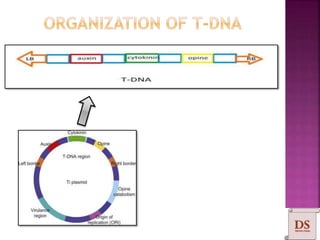
 Organization of T-DNA
 Genes responsible for transfer of T-DNA
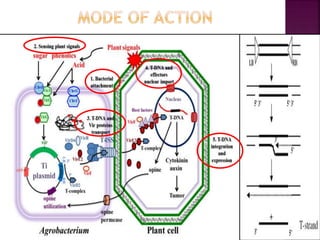
 Mode of action
 Gene of interest
 Gene cloning
 Genes Agrobacterium is a rod shaped, Gram negative soil
bacterium that naturally infect the dicot plants (commonly), but
also used for monocots.
 Common species of Agrobacterium like A. tumefaciens,
A.rhizogenes, A. rubi and A. vitis are naturally infect plants at
wound sites and causing ‘Crown gall' and ‘Hairy root’ diseases.
 These bacteria are natural genetic engineer due to they insert
their genes into the genome of higher plants.
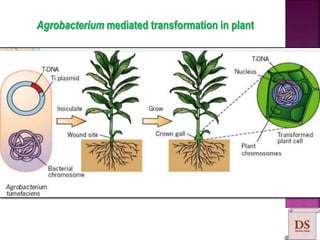
Agrobacterium mediated transformation in plant
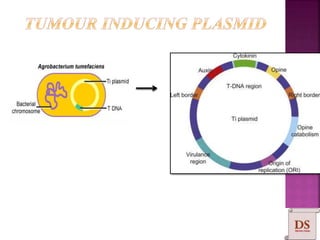
 The bacterium contains a plasmid (called Ti-plasmid or Tumour-
inducing plasmid), their part of T-DNA (Transfer DNA)
integrates into the host plant chromosomes.
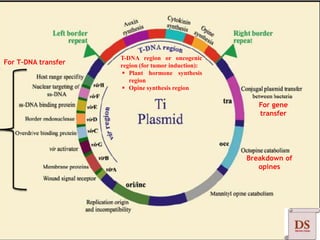
 The Ti-plasmid contains several genes including the vir genes
which control the process of infection of the plant and transfer of
the T-DNA to the chromosome.
 The T-DNA contains the auxin and cytokines genes and these
gene expressed specific compounds, like opines, resulting in
tumor and changes in plant metabolism.
 A. tumefaciens, now used as a tool for engineering desired genes
into plants (called as Gene cloning).
1. A. tumefaciens:
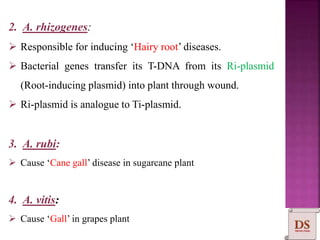
 Infects wounded plant tissue which is induced plant tumor i.e.,
‘Crown gall’ disease.
 Crown gall occurs when bacterium releases Ti-plasmid (Tumour-
inducing plasmid) into cytoplasm.
 Serious pathogen of walnut, grapevines, stone fruits, nut trees,
sugar beets, horse radish and rhubarb.
 It grows optimally at 28 °C. The doubling time can range from
2.5-4h depending on the media, culture format, grow aerobically,
without forming endospores.
Ti - Plasmid Ri - Plasmid
2. A. rhizogenes:
 Responsible for inducing ‘Hairy root’ diseases.
 Bacterial genes transfer its T-DNA from its Ri-plasmid
(Root-inducing plasmid) into plant through wound.
 Ri-plasmid is analogue to Ti-plasmid.
3. A. rubi:
 Cause ‘Cane gall’ disease in sugarcane plant
4. A. vitis:
 Cause ‘Gall’ in grapes plant
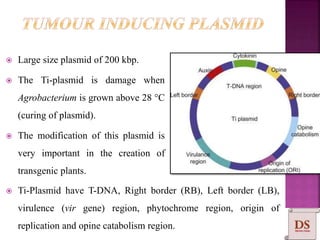
 Large size plasmid of 200 kbp.
 The Ti-plasmid is damage when
Agrobacterium is grown above 28 °C
(curing of plasmid).
 The modification of this plasmid is
very important in the creation of
transgenic plants.
 Ti-Plasmid have T-DNA, Right border (RB), Left border (LB),
virulence (vir gene) region, phytochrome region, origin of
replication and opine catabolism region.
For T-DNA transfer
Breakdown of
opines
For gene
transfer
T-DNA region or oncogenic
region (for tumor induction):
 Plant hormone synthesis
region
 Opine synthesis region
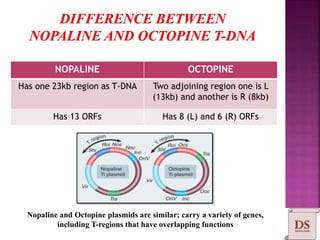
NOPALINE OCTOPINE
Has one 23kb region as T-DNA Two adjoining region one is L
(13kb) and another is R (8kb)
Has 13 ORFs Has 8 (L) and 6 (R) ORFs
Nopaline and Octopine plasmids are similar; carry a variety of genes,
including T-regions that have overlapping functions
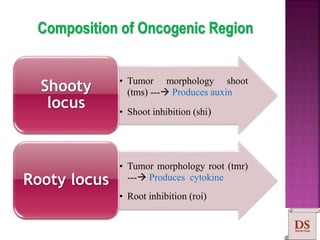
Composition of Oncogenic Region
• Tumor morphology shoot
(tms) --- Produces auxin
• Shoot inhibition (shi)
Shooty
locus
• Tumor morphology root (tmr)
--- Produces cytokine
• Root inhibition (roi)
Rooty locus
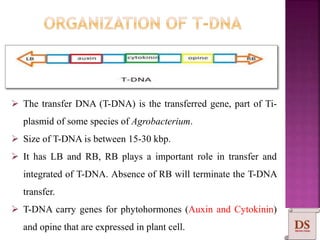
 The transfer DNA (T-DNA) is the transferred gene, part of Ti-
plasmid of some species of Agrobacterium.
 Size of T-DNA is between 15-30 kbp.
 It has LB and RB, RB plays a important role in transfer and
integrated of T-DNA. Absence of RB will terminate the T-DNA
transfer.
 T-DNA carry genes for phytohormones (Auxin and Cytokinin)
and opine that are expressed in plant cell.
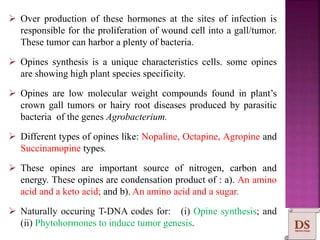
 Over production of these hormones at the sites of infection is
responsible for the proliferation of wound cell into a gall/tumor.
These tumor can harbor a plenty of bacteria.
 Opines synthesis is a unique characteristics cells. some opines
are showing high plant species specificity.
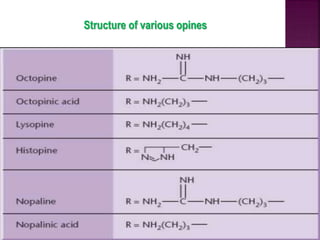
 Opines are low molecular weight compounds found in plant’s
crown gall tumors or hairy root diseases produced by parasitic
bacteria of the genes Agrobacterium.
 Different types of opines like: Nopaline, Octapine, Agropine and
Succinamopine types.
 These opines are important source of nitrogen, carbon and
energy. These opines are condensation product of : a). An amino
acid and a keto acid; and b). An amino acid and a sugar.
 Naturally occuring T-DNA codes for: (i) Opine synthesis; and
(ii) Phytohormones to induce tumor genesis.
Structure of various opines
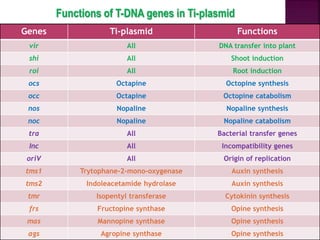
Functions of T-DNA genes in Ti-plasmid
Genes Ti-plasmid Functions
vir All DNA transfer into plant
shi All Shoot induction
roi All Root induction
ocs Octapine Octopine synthesis
occ Octapine Octopine catabolism
nos Nopaline Nopaline synthesis
noc Nopaline Nopaline catabolism
tra All Bacterial transfer genes
Inc All Incompatibility genes
oriV All Origin of replication
tms1 Trytophane-2-mono-oxygenase Auxin synthesis
tms2 Indoleacetamide hydrolase Auxin synthesis
tmr Isopentyl transferase Cytokinin synthesis
frs Fructopine synthase Opine synthesis
mas Mannopine synthase Opine synthesis
ags Agropine synthase Opine synthesis
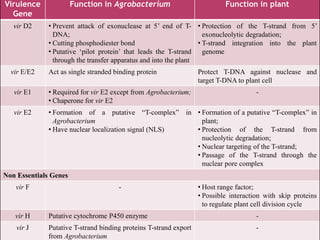
Virulence
Gene
Function in Agrobacterium Function in plant
Essential genes
vir A • Kinase protein in bacterial membrane;
• Receptor of phenolic compounds, sensor of a 2
component regulatory system
-
vir A and G Phenolic response regulator of a 2 component
regulatory system (acetosyringone)
-
vir G Activates other vir genes
vir D1 • Endonuclease
• Required for T-DNA processing in-vivo and for
ds T-DNA border nicking in-vitro
-
vir B/D4 • Type IV secretion system (T4SS - binding
system apparatus)
• Synthesis and assembly of the T-pilus (vir B2
encodes a prepropilin)
• Formation of pore channel to transfer T-DNA
from bacterium to plant cell
-
vir C1 • Stimulate transfer
• Putative “overdrive” binding protein;
• Enhancement of T-DNA transfer
-
vir D2 • T-DNA border specific endonuclease; • Nuclear targeting of the T-stranded;
Virulence
Gene
Function in Agrobacterium Function in plant
vir D2 • Prevent attack of exonuclease at 5’ end of T-
DNA;
• Cutting phosphodiester bond
• Putative ‘pilot protein’ that leads the T-strand
through the transfer apparatus and into the plant
• Protection of the T-strand from 5’
exonucleolytic degradation;
• T-strand integration into the plant
genome
vir E/E2 Act as single stranded binding protein Protect T-DNA against nuclease and
target T-DNA to plant cell
vir E1 • Required for vir E2 except from Agrobacterium;
• Chaperone for vir E2
-
vir E2 • Formation of a putative “T-complex” in
Agrobacterium
• Have nuclear localization signal (NLS)
• Formation of a putative “T-complex” in
plant;
• Protection of the T-strand from
nucleolytic degradation;
• Nuclear targeting of the T-strand;
• Passage of the T-strand through the
nuclear pore complex
Non Essentials Genes
vir F - • Host range factor;
• Possible interaction with skip proteins
to regulate plant cell division cycle
vir H Putative cytochrome P450 enzyme -
vir J Putative T-strand binding proteins T-strand export
from Agrobacterium
-
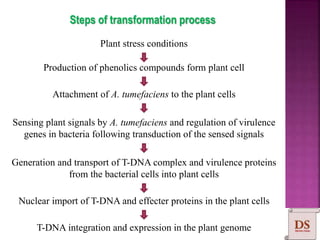
Attachment of A. tumefaciens to the plant cells
Sensing plant signals by A. tumefaciens and regulation of virulence
genes in bacteria following transduction of the sensed signals
Generation and transport of T-DNA complex and virulence proteins
from the bacterial cells into plant cells
Nuclear import of T-DNA and effecter proteins in the plant cells
T-DNA integration and expression in the plant genome
Steps of transformation process
Plant stress conditions
Production of phenolics compounds form plant cell
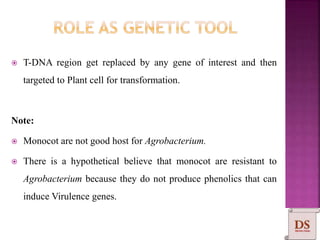
 T-DNA region get replaced by any gene of interest and then
targeted to Plant cell for transformation.
Note:
 Monocot are not good host for Agrobacterium.
 There is a hypothetical believe that monocot are resistant to
Agrobacterium because they do not produce phenolics that can
induce Virulence genes.
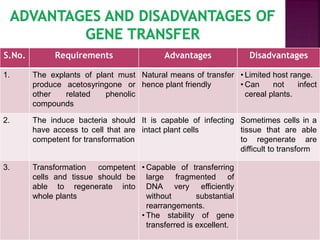
S.No. Requirements Advantages Disadvantages
1. The explants of plant must
produce acetosyringone or
other related phenolic
compounds
Natural means of transfer
hence plant friendly
• Limited host range.
• Can not infect
cereal plants.
2. The induce bacteria should
have access to cell that are
competent for transformation
It is capable of infecting
intact plant cells
Sometimes cells in a
tissue that are able
to regenerate are
difficult to transform
3. Transformation competent
cells and tissue should be
able to regenerate into
whole plants
• Capable of transferring
large fragmented of
DNA very efficiently
without substantial
rearrangements.
• The stability of gene
transferred is excellent.
Agrobacterium-mediated Gene Transfer

Agrobacterium-mediated Gene Transfer

  • 1.
  • 2.
     Agrobacterium species Ti-Plasmid  Organization of T-DNA  Genes responsible for transfer of T-DNA  Mode of action  Gene of interest  Gene cloning
  • 3.
     Genes Agrobacteriumis a rod shaped, Gram negative soil bacterium that naturally infect the dicot plants (commonly), but also used for monocots.  Common species of Agrobacterium like A. tumefaciens, A.rhizogenes, A. rubi and A. vitis are naturally infect plants at wound sites and causing ‘Crown gall' and ‘Hairy root’ diseases.  These bacteria are natural genetic engineer due to they insert their genes into the genome of higher plants.
  • 4.
  • 5.
     The bacteriumcontains a plasmid (called Ti-plasmid or Tumour- inducing plasmid), their part of T-DNA (Transfer DNA) integrates into the host plant chromosomes.  The Ti-plasmid contains several genes including the vir genes which control the process of infection of the plant and transfer of the T-DNA to the chromosome.  The T-DNA contains the auxin and cytokines genes and these gene expressed specific compounds, like opines, resulting in tumor and changes in plant metabolism.  A. tumefaciens, now used as a tool for engineering desired genes into plants (called as Gene cloning).
  • 6.
    1. A. tumefaciens: Infects wounded plant tissue which is induced plant tumor i.e., ‘Crown gall’ disease.  Crown gall occurs when bacterium releases Ti-plasmid (Tumour- inducing plasmid) into cytoplasm.  Serious pathogen of walnut, grapevines, stone fruits, nut trees, sugar beets, horse radish and rhubarb.  It grows optimally at 28 °C. The doubling time can range from 2.5-4h depending on the media, culture format, grow aerobically, without forming endospores.
  • 7.
    Ti - PlasmidRi - Plasmid
  • 8.
    2. A. rhizogenes: Responsible for inducing ‘Hairy root’ diseases.  Bacterial genes transfer its T-DNA from its Ri-plasmid (Root-inducing plasmid) into plant through wound.  Ri-plasmid is analogue to Ti-plasmid. 3. A. rubi:  Cause ‘Cane gall’ disease in sugarcane plant 4. A. vitis:  Cause ‘Gall’ in grapes plant
  • 10.
     Large sizeplasmid of 200 kbp.  The Ti-plasmid is damage when Agrobacterium is grown above 28 °C (curing of plasmid).  The modification of this plasmid is very important in the creation of transgenic plants.  Ti-Plasmid have T-DNA, Right border (RB), Left border (LB), virulence (vir gene) region, phytochrome region, origin of replication and opine catabolism region.
  • 11.
    For T-DNA transfer Breakdownof opines For gene transfer T-DNA region or oncogenic region (for tumor induction):  Plant hormone synthesis region  Opine synthesis region
  • 12.
    NOPALINE OCTOPINE Has one23kb region as T-DNA Two adjoining region one is L (13kb) and another is R (8kb) Has 13 ORFs Has 8 (L) and 6 (R) ORFs Nopaline and Octopine plasmids are similar; carry a variety of genes, including T-regions that have overlapping functions
  • 13.
    Composition of OncogenicRegion • Tumor morphology shoot (tms) --- Produces auxin • Shoot inhibition (shi) Shooty locus • Tumor morphology root (tmr) --- Produces cytokine • Root inhibition (roi) Rooty locus
  • 15.
     The transferDNA (T-DNA) is the transferred gene, part of Ti- plasmid of some species of Agrobacterium.  Size of T-DNA is between 15-30 kbp.  It has LB and RB, RB plays a important role in transfer and integrated of T-DNA. Absence of RB will terminate the T-DNA transfer.  T-DNA carry genes for phytohormones (Auxin and Cytokinin) and opine that are expressed in plant cell.
  • 16.
     Over productionof these hormones at the sites of infection is responsible for the proliferation of wound cell into a gall/tumor. These tumor can harbor a plenty of bacteria.  Opines synthesis is a unique characteristics cells. some opines are showing high plant species specificity.  Opines are low molecular weight compounds found in plant’s crown gall tumors or hairy root diseases produced by parasitic bacteria of the genes Agrobacterium.  Different types of opines like: Nopaline, Octapine, Agropine and Succinamopine types.  These opines are important source of nitrogen, carbon and energy. These opines are condensation product of : a). An amino acid and a keto acid; and b). An amino acid and a sugar.  Naturally occuring T-DNA codes for: (i) Opine synthesis; and (ii) Phytohormones to induce tumor genesis.
  • 17.
  • 18.
    Functions of T-DNAgenes in Ti-plasmid Genes Ti-plasmid Functions vir All DNA transfer into plant shi All Shoot induction roi All Root induction ocs Octapine Octopine synthesis occ Octapine Octopine catabolism nos Nopaline Nopaline synthesis noc Nopaline Nopaline catabolism tra All Bacterial transfer genes Inc All Incompatibility genes oriV All Origin of replication tms1 Trytophane-2-mono-oxygenase Auxin synthesis tms2 Indoleacetamide hydrolase Auxin synthesis tmr Isopentyl transferase Cytokinin synthesis frs Fructopine synthase Opine synthesis mas Mannopine synthase Opine synthesis ags Agropine synthase Opine synthesis
  • 20.
    Virulence Gene Function in AgrobacteriumFunction in plant Essential genes vir A • Kinase protein in bacterial membrane; • Receptor of phenolic compounds, sensor of a 2 component regulatory system - vir A and G Phenolic response regulator of a 2 component regulatory system (acetosyringone) - vir G Activates other vir genes vir D1 • Endonuclease • Required for T-DNA processing in-vivo and for ds T-DNA border nicking in-vitro - vir B/D4 • Type IV secretion system (T4SS - binding system apparatus) • Synthesis and assembly of the T-pilus (vir B2 encodes a prepropilin) • Formation of pore channel to transfer T-DNA from bacterium to plant cell - vir C1 • Stimulate transfer • Putative “overdrive” binding protein; • Enhancement of T-DNA transfer - vir D2 • T-DNA border specific endonuclease; • Nuclear targeting of the T-stranded;
  • 21.
    Virulence Gene Function in AgrobacteriumFunction in plant vir D2 • Prevent attack of exonuclease at 5’ end of T- DNA; • Cutting phosphodiester bond • Putative ‘pilot protein’ that leads the T-strand through the transfer apparatus and into the plant • Protection of the T-strand from 5’ exonucleolytic degradation; • T-strand integration into the plant genome vir E/E2 Act as single stranded binding protein Protect T-DNA against nuclease and target T-DNA to plant cell vir E1 • Required for vir E2 except from Agrobacterium; • Chaperone for vir E2 - vir E2 • Formation of a putative “T-complex” in Agrobacterium • Have nuclear localization signal (NLS) • Formation of a putative “T-complex” in plant; • Protection of the T-strand from nucleolytic degradation; • Nuclear targeting of the T-strand; • Passage of the T-strand through the nuclear pore complex Non Essentials Genes vir F - • Host range factor; • Possible interaction with skip proteins to regulate plant cell division cycle vir H Putative cytochrome P450 enzyme - vir J Putative T-strand binding proteins T-strand export from Agrobacterium -
  • 22.
    Attachment of A.tumefaciens to the plant cells Sensing plant signals by A. tumefaciens and regulation of virulence genes in bacteria following transduction of the sensed signals Generation and transport of T-DNA complex and virulence proteins from the bacterial cells into plant cells Nuclear import of T-DNA and effecter proteins in the plant cells T-DNA integration and expression in the plant genome Steps of transformation process Plant stress conditions Production of phenolics compounds form plant cell
  • 23.
     T-DNA regionget replaced by any gene of interest and then targeted to Plant cell for transformation. Note:  Monocot are not good host for Agrobacterium.  There is a hypothetical believe that monocot are resistant to Agrobacterium because they do not produce phenolics that can induce Virulence genes.
  • 24.
    S.No. Requirements AdvantagesDisadvantages 1. The explants of plant must produce acetosyringone or other related phenolic compounds Natural means of transfer hence plant friendly • Limited host range. • Can not infect cereal plants. 2. The induce bacteria should have access to cell that are competent for transformation It is capable of infecting intact plant cells Sometimes cells in a tissue that are able to regenerate are difficult to transform 3. Transformation competent cells and tissue should be able to regenerate into whole plants • Capable of transferring large fragmented of DNA very efficiently without substantial rearrangements. • The stability of gene transferred is excellent.