Host cells and vectors
Gene cloning is concerned with the selection and use of a suitable carrier molecule or
vector, and a living system or host in which the vector can be propagated
Host
 Gene for structural analysis- simple system
 Express the genetic information - more specific system
 simple primary host is used to isolate a sequence that is then introduced into
a more complex system for expression.
 A host is an organism that harbors a parasite, or a mutual or commensal
symbiont, typically providing nourishment and shelter
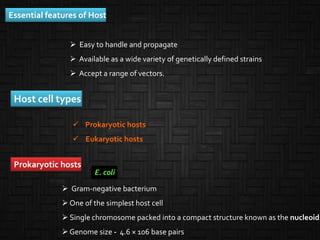
Host cell types
 Prokaryotic hosts
 Eukaryotic hosts
Prokaryotic hosts
 Easy to handle and propagate
 Available as a wide variety of genetically defined strains
 Accept a range of vectors.
Essential features of Host
 Gram-negative bacterium
 One of the simplest host cell
 Single chromosome packed into a compact structure known as the nucleoid
 Genome size - 4.6 × 10⁶ base pairs
E. coli
 Processes of gene expression (transcription and translation) are coupled
 No post-transcriptional modification of the primary transcript
 Many genetically different strains available for specific applications
 Bacillus
 Pseudomonas
 Streptomyces
Other bacteria used as hosts
Gram-positive bacteria
Gram-positive bacteria are well known for their contributions to
agricultural, medical and food biotechnology and for the production of
recombinant proteins.
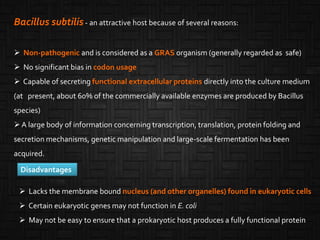
Bacillus
Bacillus subtilis- an attractive host because of several reasons:
 Non-pathogenic and is considered as a GRAS organism (generally regarded as safe)
 No significant bias in codon usage
 Capable of secreting functional extracellular proteins directly into the culture medium
(at present, about 60% of the commercially available enzymes are produced by Bacillus
species)
 A large body of information concerning transcription, translation, protein folding and
secretion mechanisms, genetic manipulation and large-scale fermentation has been
acquired.
Disadvantages
 Lacks the membrane bound nucleus (and other organelles) found in eukaryotic cells
 Certain eukaryotic genes may not function in E. coli
 May not be easy to ensure that a prokaryotic host produces a fully functional protein
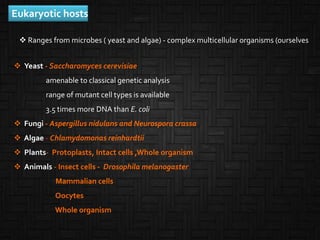
Eukaryotic hosts
 Ranges from microbes ( yeast and algae) - complex multicellular organisms (ourselves
 Yeast - Saccharomyces cerevisiae
amenable to classical genetic analysis
range of mutant cell types is available
3.5 times more DNA than E. coli
 Fungi - Aspergillus nidulans and Neurospora crassa
 Algae - Chlamydomonas reinhardtii
 Plants- Protoplasts, Intact cells ,Whole organism
 Animals - Insect cells - Drosophila melanogaster
Mammalian cells
Oocytes
Whole organism
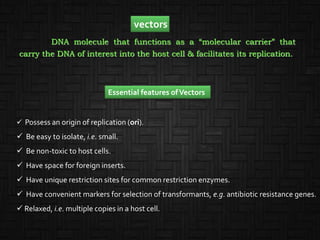
vectors
Essential features ofVectors
DNA molecule that functions as a “molecular carrier” that
carry the DNA of interest into the host cell & facilitates its replication.
 Possess an origin of replication (ori).
 Be easy to isolate, i.e. small.
 Be non-toxic to host cells.
 Have space for foreign inserts.
 Have unique restriction sites for common restriction enzymes.
 Have convenient markers for selection of transformants, e.g. antibiotic resistance genes.
 Relaxed, i.e. multiple copies in a host cell.
Most prokaryotic vectors are based on
1. Plasmids
2. Bacteriophages
3. Cosmids
Plasmids
 Extra chromosomal genetic elements
 Not essential for bacteria to survive
 Confer advantageous traits (such as antibiotic resistance) on the host cell
 Cleaved by restriction enzymes, leaving sticky or blunt ends.
 Artificial plasmids can be constructed by linking new DNA fragments to the
sticky ends of plasmid.
What are plasmids?
Plasmid classification
The most useful classification of naturally occurring plasmids is based on the
main characteristic coded by the plasmid genes
(1) Fertility plasmid
carry only tra genes and have no characteristic beyond the ability to
promote conjugal transfer of plasmids
example : F plasmid of E. coli.
(2) Resistance or R plasmids
carry genes conferring on the host bacterium resistance to one or
more antibacterial agents, such as chloramphenicol,ampicillin and mercury
Important in clinical microbiology-treatment of bacterial infections
example : RP4,found in Pseudomonas, also occurs in many other bacteria
(3) Col plasmids code for colicins
proteins that kill other bacteria
example : ColEl of E. coli.
(4) Degradative plasmids
allow the host bacterium to metabolize unusual molecules such
as toluene and salicylic acid
example :TOL of Pseudomonas putida.
(5)Virulence plasmids
confer pathogenicity on the host bacterium
example:Ti plasmids of Agrobacterium tumefaciens, which induce
crown gall disease on dicotyledonous plants.
conjugative and non-conjugative plasmids
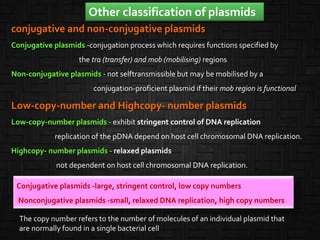
Conjugative plasmids -conjugation process which requires functions specified by
the tra (transfer) and mob (mobilising) regions
Non-conjugative plasmids - not selftransmissible but may be mobilised by a
conjugation-proficient plasmid if their mob region is functional
Low-copy-number and Highcopy- number plasmids
Low-copy-number plasmids - exhibit stringent control of DNA replication
replication of the pDNA depend on host cell chromosomal DNA replication.
Highcopy- number plasmids - relaxed plasmids
not dependent on host cell chromosomal DNA replication.
Other classification of plasmids
The copy number refers to the number of molecules of an individual plasmid that
are normally found in a single bacterial cell
Conjugative plasmids -large, stringent control, low copy numbers
Nonconjugative plasmids -small, relaxed DNA replication, high copy numbers
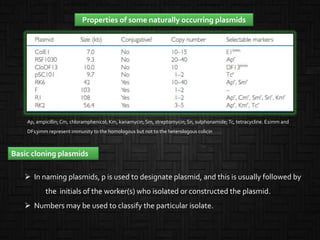
Properties of some naturally occurring plasmids
Ap, ampicillin; Cm, chloramphenicol; Km, kanamycin; Sm, streptomycin; Sn, sulphonamide;Tc, tetracycline. E1imm and
DF13imm represent immunity to the homologous but not to the heterologous colicin
Basic cloning plasmids
 In naming plasmids, p is used to designate plasmid, and this is usually followed by
the initials of the worker(s) who isolated or constructed the plasmid.
 Numbers may be used to classify the particular isolate.
pBR322
developed by Francisco Bolivar and his colleagues (The p stands for "plasmid," and
BR for "Bolivar" and "Rodriguez.“)
Construction of pBR322 involved a series of manipulations -DNA from three sources
(the replicon of plasmid pMB1, ampR gene -RSF2124, tetR gene-pSC101)
features of this plasmid
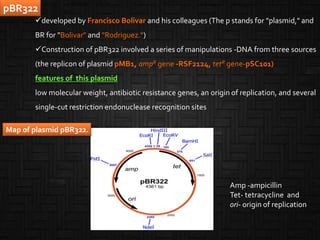
low molecular weight, antibiotic resistance genes, an origin of replication, and several
single-cut restriction endonuclease recognition sites
Amp -ampicillin
Tet- tetracycline and
ori- origin of replication
Map of plasmid pBR322.
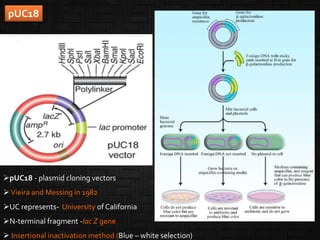
pUC18 - plasmid cloning vectors
Vieira and Messing in 1982
UC represents- University of California
N-terminal fragment -lac Z gene
 Insertional inactivation method (Blue – white selection)
pUC18
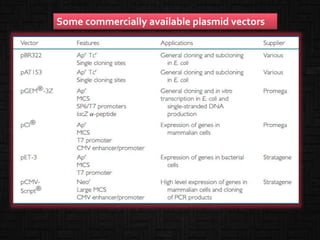
Some commercially available plasmid vectors
What are bacteriophages?
Bacteriophages
 1940s Max Delbruck
 ‘eaters of bacteria’ - viruses that are dependent on bacteria for their propagation.
 phages fall into three main groups: (1) tailless, (2) head with tail and (3) filamentous
 genetic material-single or double-stranded DNA or RNA
 In tailless and tailed phages the genome encapsulated in an icosahedral protein
shell called a capsid (sometimes known as a phage coat or head).
 Typical dsDNA phages- genome makes up about 50% of the mass of the phage particle
 phages -relatively simple systems when compared to bacteria-used as models
for the study of gene expression
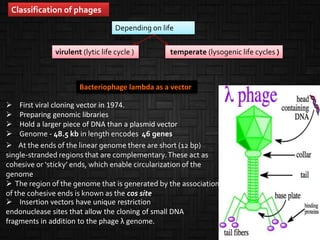
temperate (lysogenic life cycles )
Classification of phages
Depending on life
cycle
virulent (lytic life cycle )
Bacteriophage lambda as a vector
 First viral cloning vector in 1974.
 Preparing genomic libraries
 Hold a larger piece of DNA than a plasmid vector
 Genome - 48.5 kb in length encodes 46 genes
 At the ends of the linear genome there are short (12 bp)
single-stranded regions that are complementary.These act as
cohesive or ‘sticky’ ends, which enable circularization of the
genome
 The region of the genome that is generated by the association
of the cohesive ends is known as the cos site
 Insertion vectors have unique restriction
endonuclease sites that allow the cloning of small DNA
fragments in addition to the phage λ genome.
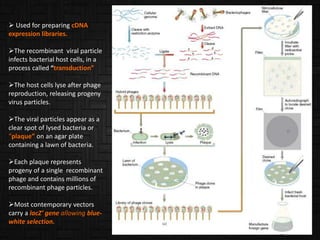
 Used for preparing cDNA
expression libraries.
The recombinant viral particle
infects bacterial host cells, in a
process called “transduction”
The host cells lyse after phage
reproduction, releasing progeny
virus particles.
The viral particles appear as a
clear spot of lysed bacteria or
“plaque” on an agar plate
containing a lawn of bacteria.
Each plaque represents
progeny of a single recombinant
phage and contains millions of
recombinant phage particles.
Most contemporary vectors
carry a lacZ′ gene allowing blue-
white selection.
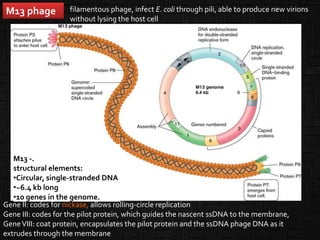
M13 phage
M13 -.
structural elements:
•Circular, single-stranded DNA
•~6.4 kb long
•10 genes in the genome.
filamentous phage, infect E. coli through pili, able to produce new virions
without lysing the host cell
Gene II: codes for nickase, allows rolling-circle replication
Gene III: codes for the pilot protein, which guides the nascent ssDNA to the membrane,
GeneVIII: coat protein, encapsulates the pilot protein and the ssDNA phage DNA as it
extrudes through the membrane
Cosmids
A hybrid vector made up of plasmid sequences and the cohesive ends (cos
sites) of bacteriophage lambda.
Cosmids can be packaged in lambda
phage particles for infection into E. coli.
 This permits cloning of larger DNA
fragments (up to 45 kb)
Cosmids and cosmid recombinants
replicate as plasmids.
 Likely to be less stable than plasmids
because of large insert and high copy
number.
Phagemids
 contain the f1 (M13) phage origin of
replication
 developed to overcome the size
limitation of the M13 cloning system
applications
DNA sequencing and the
production of probes for hybridization
.
Example
pEMBL9 or pBluescript
A phagemid or phasmid is a type of cloning vector developed as a hybrid of
the filamentous phage M13 and plasmids to produce a vector that can grow as
a plasmid, and also be packaged as single stranded DNA in viral particles.
Why do we need artificial chromosomes?
 Transformation of novel genes into plants and animals has employed various methods for delivering
DNA into cells (eg. transfection, microinjection, Agrobacterium infection)
 These methods all ultimately depend upon the DNA repair mechanisms of the target cell to insert
the DNA into chromosomes at a random location, anywhere in the genome.
Advantages of artificial chromosomes
Random insertion can potentially disrupt important genes. Artificial chromosomes don't require
insertion of sequences into naturally-occurring chromosomes.
No limit to the number of genes or size of fragments that could be inserted using artificial
chromosomes.
Because all inserted genes on an artificial chromosome are all linked, they will not segregate
independently, making it easy to cross the transformed genes into a new genetic background.
easily control copy number with artificial chromosomes.
With random insertion, the level of expression is highly dependent on the site of insertion. Insertion
near a strong enhancer could cause very strong expression
Artificial chromosomes
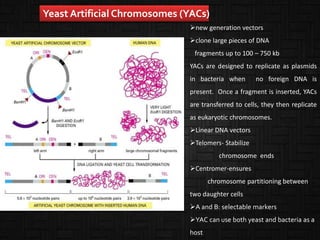
new generation vectors
clone large pieces of DNA
fragments up to 100 – 750 kb
YACs are designed to replicate as plasmids
in bacteria when no foreign DNA is
present. Once a fragment is inserted, YACs
are transferred to cells, they then replicate
as eukaryotic chromosomes.
Linear DNA vectors
Telomers- Stabilize
chromosome ends
Centromer-ensures
chromosome partitioning between
two daughter cells
A and B: selectable markers
YAC can use both yeast and bacteria as a
host
Yeast Artificial Chromosomes (YACs)
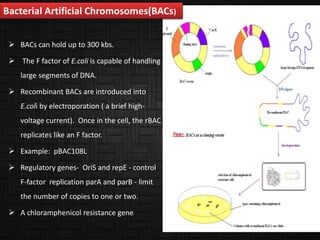
 BACs can hold up to 300 kbs.
 The F factor of E.coli is capable of handling
large segments of DNA.
 Recombinant BACs are introduced into
E.coli by electroporation ( a brief high-
voltage current). Once in the cell, the rBAC
replicates like an F factor.
 Example: pBAC108L
 Regulatory genes- OriS and repE - control
F-factor replication parA and parB - limit
the number of copies to one or two.
 A chloramphenicol resistance gene
Bacterial Artificial Chromosomes(BACs)
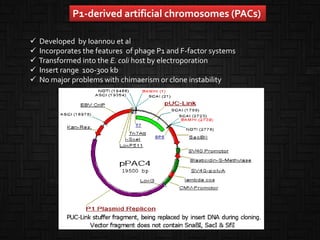
P1-derived artificial chromosomes (PACs)
 Developed by Ioannou et al
 Incorporates the features of phage P1 and F-factor systems
 Transformed into the E. coli host by electroporation
 Insert range 100-300 kb
 No major problems with chimaerism or clone instability
Mammalian artificial chromosomes (MACs)
Main features for an efficient mammalian AC (MAC)
(1) a vectorial capacity up to a few megabase
(2) a manageable size for their in vitro manipulation
(3) a correct intracellular location and copy number
(4) no untoward effect on the host cell
(5)The ability to express the transgene (or transchromosome) in a physiological way
 A pre-engineered platform MAC with multiple acceptor sites [Artificial
Chromosome Expression System (ACE system) ]
 Capable of harboring a number of different genes
 Large carrying capacity
 Represents a non-integrating safe vector.
 ACE Integrase, a lambda integrase enzyme, which has been modified to render
the integrase functionally independent of bacterial host cell factors and
capable of operating in a mammalian context.
ACE system)
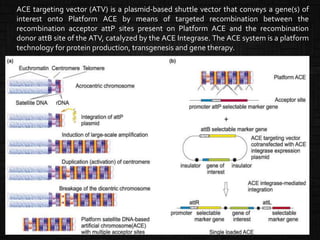
ACE targeting vector (ATV) is a plasmid-based shuttle vector that conveys a gene(s) of
interest onto Platform ACE by means of targeted recombination between the
recombination acceptor attP sites present on Platform ACE and the recombination
donor attB site of the ATV, catalyzed by the ACE Integrase. The ACE system is a platform
technology for protein production, transgenesis and gene therapy.
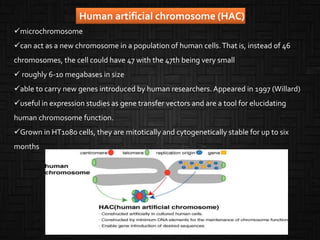
microchromosome
can act as a new chromosome in a population of human cells.That is, instead of 46
chromosomes, the cell could have 47 with the 47th being very small
 roughly 6-10 megabases in size
able to carry new genes introduced by human researchers. Appeared in 1997 (Willard)
useful in expression studies as gene transfer vectors and are a tool for elucidating
human chromosome function.
Grown in HT1080 cells, they are mitotically and cytogenetically stable for up to six
months
Human artificial chromosome (HAC)
Host cell and vectors

Host cell and vectors

  • 1.
  • 2.
    Host cells andvectors Gene cloning is concerned with the selection and use of a suitable carrier molecule or vector, and a living system or host in which the vector can be propagated Host  Gene for structural analysis- simple system  Express the genetic information - more specific system  simple primary host is used to isolate a sequence that is then introduced into a more complex system for expression.  A host is an organism that harbors a parasite, or a mutual or commensal symbiont, typically providing nourishment and shelter
  • 3.
    Host cell types Prokaryotic hosts  Eukaryotic hosts Prokaryotic hosts  Easy to handle and propagate  Available as a wide variety of genetically defined strains  Accept a range of vectors. Essential features of Host  Gram-negative bacterium  One of the simplest host cell  Single chromosome packed into a compact structure known as the nucleoid  Genome size - 4.6 × 10⁶ base pairs E. coli
  • 4.
     Processes ofgene expression (transcription and translation) are coupled  No post-transcriptional modification of the primary transcript  Many genetically different strains available for specific applications  Bacillus  Pseudomonas  Streptomyces Other bacteria used as hosts Gram-positive bacteria Gram-positive bacteria are well known for their contributions to agricultural, medical and food biotechnology and for the production of recombinant proteins. Bacillus
  • 5.
    Bacillus subtilis- anattractive host because of several reasons:  Non-pathogenic and is considered as a GRAS organism (generally regarded as safe)  No significant bias in codon usage  Capable of secreting functional extracellular proteins directly into the culture medium (at present, about 60% of the commercially available enzymes are produced by Bacillus species)  A large body of information concerning transcription, translation, protein folding and secretion mechanisms, genetic manipulation and large-scale fermentation has been acquired. Disadvantages  Lacks the membrane bound nucleus (and other organelles) found in eukaryotic cells  Certain eukaryotic genes may not function in E. coli  May not be easy to ensure that a prokaryotic host produces a fully functional protein
  • 6.
    Eukaryotic hosts  Rangesfrom microbes ( yeast and algae) - complex multicellular organisms (ourselves  Yeast - Saccharomyces cerevisiae amenable to classical genetic analysis range of mutant cell types is available 3.5 times more DNA than E. coli  Fungi - Aspergillus nidulans and Neurospora crassa  Algae - Chlamydomonas reinhardtii  Plants- Protoplasts, Intact cells ,Whole organism  Animals - Insect cells - Drosophila melanogaster Mammalian cells Oocytes Whole organism
  • 7.
    vectors Essential features ofVectors DNAmolecule that functions as a “molecular carrier” that carry the DNA of interest into the host cell & facilitates its replication.  Possess an origin of replication (ori).  Be easy to isolate, i.e. small.  Be non-toxic to host cells.  Have space for foreign inserts.  Have unique restriction sites for common restriction enzymes.  Have convenient markers for selection of transformants, e.g. antibiotic resistance genes.  Relaxed, i.e. multiple copies in a host cell.
  • 8.
    Most prokaryotic vectorsare based on 1. Plasmids 2. Bacteriophages 3. Cosmids Plasmids  Extra chromosomal genetic elements  Not essential for bacteria to survive  Confer advantageous traits (such as antibiotic resistance) on the host cell  Cleaved by restriction enzymes, leaving sticky or blunt ends.  Artificial plasmids can be constructed by linking new DNA fragments to the sticky ends of plasmid. What are plasmids?
  • 9.
    Plasmid classification The mostuseful classification of naturally occurring plasmids is based on the main characteristic coded by the plasmid genes (1) Fertility plasmid carry only tra genes and have no characteristic beyond the ability to promote conjugal transfer of plasmids example : F plasmid of E. coli. (2) Resistance or R plasmids carry genes conferring on the host bacterium resistance to one or more antibacterial agents, such as chloramphenicol,ampicillin and mercury Important in clinical microbiology-treatment of bacterial infections example : RP4,found in Pseudomonas, also occurs in many other bacteria (3) Col plasmids code for colicins proteins that kill other bacteria example : ColEl of E. coli. (4) Degradative plasmids allow the host bacterium to metabolize unusual molecules such as toluene and salicylic acid example :TOL of Pseudomonas putida. (5)Virulence plasmids confer pathogenicity on the host bacterium example:Ti plasmids of Agrobacterium tumefaciens, which induce crown gall disease on dicotyledonous plants.
  • 10.
    conjugative and non-conjugativeplasmids Conjugative plasmids -conjugation process which requires functions specified by the tra (transfer) and mob (mobilising) regions Non-conjugative plasmids - not selftransmissible but may be mobilised by a conjugation-proficient plasmid if their mob region is functional Low-copy-number and Highcopy- number plasmids Low-copy-number plasmids - exhibit stringent control of DNA replication replication of the pDNA depend on host cell chromosomal DNA replication. Highcopy- number plasmids - relaxed plasmids not dependent on host cell chromosomal DNA replication. Other classification of plasmids The copy number refers to the number of molecules of an individual plasmid that are normally found in a single bacterial cell Conjugative plasmids -large, stringent control, low copy numbers Nonconjugative plasmids -small, relaxed DNA replication, high copy numbers
  • 11.
    Properties of somenaturally occurring plasmids Ap, ampicillin; Cm, chloramphenicol; Km, kanamycin; Sm, streptomycin; Sn, sulphonamide;Tc, tetracycline. E1imm and DF13imm represent immunity to the homologous but not to the heterologous colicin Basic cloning plasmids  In naming plasmids, p is used to designate plasmid, and this is usually followed by the initials of the worker(s) who isolated or constructed the plasmid.  Numbers may be used to classify the particular isolate.
  • 12.
    pBR322 developed by FranciscoBolivar and his colleagues (The p stands for "plasmid," and BR for "Bolivar" and "Rodriguez.“) Construction of pBR322 involved a series of manipulations -DNA from three sources (the replicon of plasmid pMB1, ampR gene -RSF2124, tetR gene-pSC101) features of this plasmid low molecular weight, antibiotic resistance genes, an origin of replication, and several single-cut restriction endonuclease recognition sites Amp -ampicillin Tet- tetracycline and ori- origin of replication Map of plasmid pBR322.
  • 13.
    pUC18 - plasmidcloning vectors Vieira and Messing in 1982 UC represents- University of California N-terminal fragment -lac Z gene  Insertional inactivation method (Blue – white selection) pUC18
  • 14.
  • 15.
    What are bacteriophages? Bacteriophages 1940s Max Delbruck  ‘eaters of bacteria’ - viruses that are dependent on bacteria for their propagation.  phages fall into three main groups: (1) tailless, (2) head with tail and (3) filamentous  genetic material-single or double-stranded DNA or RNA  In tailless and tailed phages the genome encapsulated in an icosahedral protein shell called a capsid (sometimes known as a phage coat or head).  Typical dsDNA phages- genome makes up about 50% of the mass of the phage particle  phages -relatively simple systems when compared to bacteria-used as models for the study of gene expression
  • 16.
    temperate (lysogenic lifecycles ) Classification of phages Depending on life cycle virulent (lytic life cycle ) Bacteriophage lambda as a vector  First viral cloning vector in 1974.  Preparing genomic libraries  Hold a larger piece of DNA than a plasmid vector  Genome - 48.5 kb in length encodes 46 genes  At the ends of the linear genome there are short (12 bp) single-stranded regions that are complementary.These act as cohesive or ‘sticky’ ends, which enable circularization of the genome  The region of the genome that is generated by the association of the cohesive ends is known as the cos site  Insertion vectors have unique restriction endonuclease sites that allow the cloning of small DNA fragments in addition to the phage λ genome.
  • 17.
     Used forpreparing cDNA expression libraries. The recombinant viral particle infects bacterial host cells, in a process called “transduction” The host cells lyse after phage reproduction, releasing progeny virus particles. The viral particles appear as a clear spot of lysed bacteria or “plaque” on an agar plate containing a lawn of bacteria. Each plaque represents progeny of a single recombinant phage and contains millions of recombinant phage particles. Most contemporary vectors carry a lacZ′ gene allowing blue- white selection.
  • 18.
    M13 phage M13 -. structuralelements: •Circular, single-stranded DNA •~6.4 kb long •10 genes in the genome. filamentous phage, infect E. coli through pili, able to produce new virions without lysing the host cell Gene II: codes for nickase, allows rolling-circle replication Gene III: codes for the pilot protein, which guides the nascent ssDNA to the membrane, GeneVIII: coat protein, encapsulates the pilot protein and the ssDNA phage DNA as it extrudes through the membrane
  • 19.
    Cosmids A hybrid vectormade up of plasmid sequences and the cohesive ends (cos sites) of bacteriophage lambda. Cosmids can be packaged in lambda phage particles for infection into E. coli.  This permits cloning of larger DNA fragments (up to 45 kb) Cosmids and cosmid recombinants replicate as plasmids.  Likely to be less stable than plasmids because of large insert and high copy number.
  • 20.
    Phagemids  contain thef1 (M13) phage origin of replication  developed to overcome the size limitation of the M13 cloning system applications DNA sequencing and the production of probes for hybridization . Example pEMBL9 or pBluescript A phagemid or phasmid is a type of cloning vector developed as a hybrid of the filamentous phage M13 and plasmids to produce a vector that can grow as a plasmid, and also be packaged as single stranded DNA in viral particles.
  • 21.
    Why do weneed artificial chromosomes?  Transformation of novel genes into plants and animals has employed various methods for delivering DNA into cells (eg. transfection, microinjection, Agrobacterium infection)  These methods all ultimately depend upon the DNA repair mechanisms of the target cell to insert the DNA into chromosomes at a random location, anywhere in the genome. Advantages of artificial chromosomes Random insertion can potentially disrupt important genes. Artificial chromosomes don't require insertion of sequences into naturally-occurring chromosomes. No limit to the number of genes or size of fragments that could be inserted using artificial chromosomes. Because all inserted genes on an artificial chromosome are all linked, they will not segregate independently, making it easy to cross the transformed genes into a new genetic background. easily control copy number with artificial chromosomes. With random insertion, the level of expression is highly dependent on the site of insertion. Insertion near a strong enhancer could cause very strong expression Artificial chromosomes
  • 22.
    new generation vectors clonelarge pieces of DNA fragments up to 100 – 750 kb YACs are designed to replicate as plasmids in bacteria when no foreign DNA is present. Once a fragment is inserted, YACs are transferred to cells, they then replicate as eukaryotic chromosomes. Linear DNA vectors Telomers- Stabilize chromosome ends Centromer-ensures chromosome partitioning between two daughter cells A and B: selectable markers YAC can use both yeast and bacteria as a host Yeast Artificial Chromosomes (YACs)
  • 23.
     BACs canhold up to 300 kbs.  The F factor of E.coli is capable of handling large segments of DNA.  Recombinant BACs are introduced into E.coli by electroporation ( a brief high- voltage current). Once in the cell, the rBAC replicates like an F factor.  Example: pBAC108L  Regulatory genes- OriS and repE - control F-factor replication parA and parB - limit the number of copies to one or two.  A chloramphenicol resistance gene Bacterial Artificial Chromosomes(BACs)
  • 24.
    P1-derived artificial chromosomes(PACs)  Developed by Ioannou et al  Incorporates the features of phage P1 and F-factor systems  Transformed into the E. coli host by electroporation  Insert range 100-300 kb  No major problems with chimaerism or clone instability
  • 25.
    Mammalian artificial chromosomes(MACs) Main features for an efficient mammalian AC (MAC) (1) a vectorial capacity up to a few megabase (2) a manageable size for their in vitro manipulation (3) a correct intracellular location and copy number (4) no untoward effect on the host cell (5)The ability to express the transgene (or transchromosome) in a physiological way  A pre-engineered platform MAC with multiple acceptor sites [Artificial Chromosome Expression System (ACE system) ]  Capable of harboring a number of different genes  Large carrying capacity  Represents a non-integrating safe vector.  ACE Integrase, a lambda integrase enzyme, which has been modified to render the integrase functionally independent of bacterial host cell factors and capable of operating in a mammalian context. ACE system)
  • 26.
    ACE targeting vector(ATV) is a plasmid-based shuttle vector that conveys a gene(s) of interest onto Platform ACE by means of targeted recombination between the recombination acceptor attP sites present on Platform ACE and the recombination donor attB site of the ATV, catalyzed by the ACE Integrase. The ACE system is a platform technology for protein production, transgenesis and gene therapy.
  • 27.
    microchromosome can act asa new chromosome in a population of human cells.That is, instead of 46 chromosomes, the cell could have 47 with the 47th being very small  roughly 6-10 megabases in size able to carry new genes introduced by human researchers. Appeared in 1997 (Willard) useful in expression studies as gene transfer vectors and are a tool for elucidating human chromosome function. Grown in HT1080 cells, they are mitotically and cytogenetically stable for up to six months Human artificial chromosome (HAC)