A
SEMINAR
ON
INSECTS RESISTANCE PLANT
DR. R.K. RAO (PRINCIPAL)
GUIDED BY - HUMA NAZ
SIDDIQUI
PRESENTED BY..
NIKITA DEWANGAN
M.Sc.2ND SEM
BIOTECHNOLOGY
G.D. RUNGTA COLLEGE OF SCIENCE & TECHNOLOGY
KOHKA-KURUD,BHILAI DURG (C.G.)
 INTRODUCTION TO TRANSGENIC PLANT
 DEFINITION
 RESISTANCE TO BIOTIC STRESSES
 INSECT RESISTANCE
1. RESISTANCE GENE FROM MICRO – ORGANISM
2. RESISTANCE GENE FROM HIGHER PLANTS
3. RESISTANCE GENE FROM ANIMALS
 LIST OF TRANSGENIC PLANT
 CONCLUSION
 REFRENCES
S
Y
N
O
P
S
I
S
1
INSECTS RESISTANCE PLANT
 Transfer of genes between plant species has played an important role in
crop improvement for many decades.
 Useful traits such as resistance to diseases , insects and pests have been
transferred to crop varieties from non – cultivated plants.
 The overall process of genetic transformation involves introduction,
integration and expression of foreign gene (s) in the recipient host plant.
I
N
T
R
O
D
U
C
T
I
O
N
2
INSECTS RESISTANCE PLANT
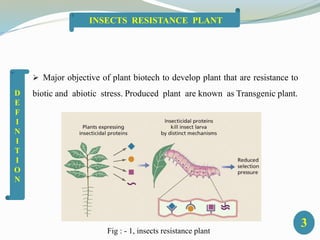
 Major objective of plant biotech to develop plant that are resistance to
biotic and abiotic stress. Produced plant are known as Transgenic plant.D
E
F
I
N
I
T
I
O
N
3
INSECTS RESISTANCE PLANT
Fig : - 1, insects resistance plant
 Resistance to biotic stresses has been discussed under the following
headings.
1. Insects resistance
2. Viral resistance
3. Fungal and bacterial disease resistance
R
E
S
I
S
T
A
N
C
E
T
O
B
I
O
T
I
C
S
T
R
E
S
S
E
4
INSECTS RESISTANCE PLANT
 Progress in engineering insect resistance in transgenic plants has been
achieved through the use of insect control protein genes of BACILLUS
THURINGIENSIS.
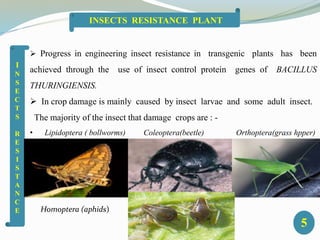
 In crop damage is mainly caused by insect larvae and some adult insect.
The majority of the insect that damage crops are : -
• Lipidoptera ( bollworms) Coleoptera(beetle) Orthoptera(grass hpper)
I
N
S
E
C
T
S
R
E
S
I
S
T
A
N
C
E
5
INSECTS RESISTANCE PLANT
Homoptera (aphids)
 Chemical pest used to control only pest but due to their toxicity to
other organism ( such as plant and animal ) some alternative pesticide
have been developed.
 These alternative pesticle provide insect resistance to plant without any
harmful effect Insect resistance was 1st reported in tobacco ( vack et al
1987 ) and tomato ( fischhoff et al 1987 )
 Gene conferring insect resistance to plant have been isolated from
micro organism that is:-
I
N
S
E
C
T
S
R
E
S
I
S
T
A
N
C
E
6
INSECTS RESISTANCE PLANT
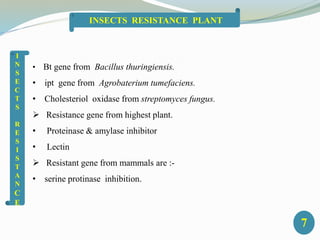
• Bt gene from Bacillus thuringiensis.
• ipt gene from Agrobaterium tumefaciens.
• Cholesteriol oxidase from streptomyces fungus.
 Resistance gene from highest plant.
• Proteinase & amylase inhibitor
• Lectin
 Resistant gene from mammals are :-
• serine protinase inhibition.
I
N
S
E
C
T
S
R
E
S
I
S
T
A
N
C
E
7
INSECTS RESISTANCE PLANT
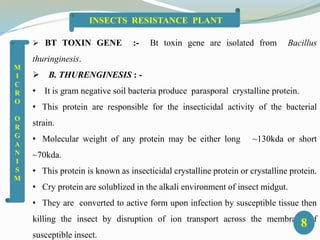
 BT TOXIN GENE :- Bt toxin gene are isolated from Bacillus
thuringinesis.
 B. THURENGINESIS : -
• It is gram negative soil bacteria produce parasporal crystalline protein.
• This protein are responsible for the insecticidal activity of the bacterial
strain.
• Molecular weight of any protein may be either long ~130kda or short
~70kda.
• This protein is known as insecticidal crystalline protein or crystalline protein.
• Cry protein are solublized in the alkali environment of insect midgut.
• They are converted to active form upon infection by susceptible tissue then
killing the insect by disruption of ion transport across the membrane of
susceptible insect.
M
I
C
R
O
O
R
G
A
N
I
S
M
8
INSECTS RESISTANCE PLANT
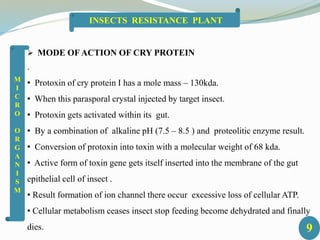
 MODE OF ACTION OF CRY PROTEIN
.
• Protoxin of cry protein I has a mole mass – 130kda.
• When this parasporal crystal injected by target insect.
• Protoxin gets activated within its gut.
• By a combination of alkaline pH (7.5 – 8.5 ) and proteolitic enzyme result.
• Conversion of protoxin into toxin with a molecular weight of 68 kda.
• Active form of toxin gene gets itself inserted into the membrane of the gut
epithelial cell of insect .
• Result formation of ion channel there occur excessive loss of cellular ATP.
• Cellular metabolism ceases insect stop feeding become dehydrated and finally
dies.
M
I
C
R
O
O
R
G
A
N
I
S
M
9
INSECTS RESISTANCE PLANT
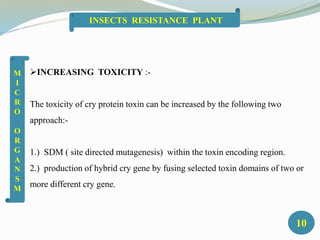
INCREASING TOXICITY :-
The toxicity of cry protein toxin can be increased by the following two
approach:-
1.) SDM ( site directed mutagenesis) within the toxin encoding region.
2.) production of hybrid cry gene by fusing selected toxin domains of two or
more different cry gene.
10
INSECTS RESISTANCE PLANT
M
I
C
R
O
O
R
G
A
N
S
M
 Currently there are two major groups of plant derived gene that are used to
confer insect resistance on crop plant by retarding insect growth and
development.
11
INSECTS RESISTANCE PLANT
H
I
G
H
E
R
P
L
A
N
T
S
 PROTEINASE INHIBITORS :-
• Plants contain peptides acting as protease inhibitors .
• The different proteinases are serine, cysteine, aspartic and metallo proteinases.
• They catalyse the release of amino acids from dietary protein, there by
providing the nutrients crucial for development of insects.
• The proteinase inhibitors deprive the insect of nutrients by interfering with
digestive enzymes of the insect. Two such proteinase inhibitor genes have been
described.
12
INSECTS RESISTANCE PLANT
H
I
G
H
E
R
P
L
A
N
T
S
 α – Amylase inhibitor :-
• Genes for three α – amylase inhibitors have been expressed in tobacco but the
main emphasis has been on transferring the inhibitor isolated from adzuki bean.
• This α – amylase inhibitor protein blocks the larval feeding in the midgut.
• The larvae secrete agut enzyme called α – amylase that digest the starch.
• By adding a protein that inhibits insect gut α – amylase the weevil can be
starved and it dies.
13
INSECTS RESISTANCE PLANT
H
I
G
H
E
R
P
L
A
N
T
S
 LECTINS :-
• It has shown activity against aphids.
• Features of this protein is that it also acts against piercing and sucking
insects.
• However one disadvantage is that the protein works well only when it is
ingested in large quantities.
14
INSECTS RESISTANCE PLANT
H
I
G
H
E
R
P
L
A
N
T
S
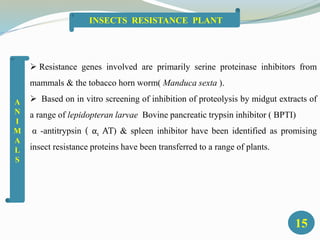
 Resistance genes involved are primarily serine proteinase inhibitors from
mammals & the tobacco horn worm( Manduca sexta ).
 Based on in vitro screening of inhibition of proteolysis by midgut extracts of
a range of lepidopteran larvae Bovine pancreatic trypsin inhibitor ( BPTI)
α -antitrypsin ( α1 AT) & spleen inhibitor have been identified as promising
insect resistance proteins have been transferred to a range of plants.
15
INSECTS RESISTANCE PLANT
A
N
I
M
A
L
S

•
INSECTS RESISTANCE PLANT
L
I
S
T
O
F
T
R
A
N
S
G
E
N
I
C
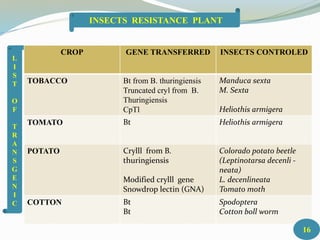
CROP GENE TRANSFERRED INSECTS CONTROLED
TOBACCO Bt from B. thuringiensis
Truncated cryl from B.
Thuringiensis
CpTl
Manduca sexta
M. Sexta
Heliothis armigera
TOMATO Bt Heliothis armigera
POTATO Crylll from B.
thuringiensis
Modified crylll gene
Snowdrop lectin (GNA)
Colorado potato beetle
(Leptinotarsa decenli -
neata)
L. decenlineata
Tomato moth
COTTON Bt
Bt
Spodoptera
Cotton boll worm
16
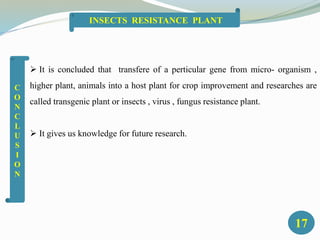
 It is concluded that transfere of a perticular gene from micro- organism ,
higher plant, animals into a host plant for crop improvement and researches are
called transgenic plant or insects , virus , fungus resistance plant.
 It gives us knowledge for future research.
17
INSECTS RESISTANCE PLANT
C
O
N
C
L
U
S
I
O
N
 H. S.CHAWLA. THIRD PLANT
EDITION 2012 BIOTCHNOLOGY
18
INSECTS RESISTANCE PLANT
R
E
F
R
E
N
C
E
S
Insect resisance  ppt

Insect resisance ppt

  • 1.
    A SEMINAR ON INSECTS RESISTANCE PLANT DR.R.K. RAO (PRINCIPAL) GUIDED BY - HUMA NAZ SIDDIQUI PRESENTED BY.. NIKITA DEWANGAN M.Sc.2ND SEM BIOTECHNOLOGY G.D. RUNGTA COLLEGE OF SCIENCE & TECHNOLOGY KOHKA-KURUD,BHILAI DURG (C.G.)
  • 2.
     INTRODUCTION TOTRANSGENIC PLANT  DEFINITION  RESISTANCE TO BIOTIC STRESSES  INSECT RESISTANCE 1. RESISTANCE GENE FROM MICRO – ORGANISM 2. RESISTANCE GENE FROM HIGHER PLANTS 3. RESISTANCE GENE FROM ANIMALS  LIST OF TRANSGENIC PLANT  CONCLUSION  REFRENCES S Y N O P S I S 1 INSECTS RESISTANCE PLANT
  • 3.
     Transfer ofgenes between plant species has played an important role in crop improvement for many decades.  Useful traits such as resistance to diseases , insects and pests have been transferred to crop varieties from non – cultivated plants.  The overall process of genetic transformation involves introduction, integration and expression of foreign gene (s) in the recipient host plant. I N T R O D U C T I O N 2 INSECTS RESISTANCE PLANT
  • 4.
     Major objectiveof plant biotech to develop plant that are resistance to biotic and abiotic stress. Produced plant are known as Transgenic plant.D E F I N I T I O N 3 INSECTS RESISTANCE PLANT Fig : - 1, insects resistance plant
  • 5.
     Resistance tobiotic stresses has been discussed under the following headings. 1. Insects resistance 2. Viral resistance 3. Fungal and bacterial disease resistance R E S I S T A N C E T O B I O T I C S T R E S S E 4 INSECTS RESISTANCE PLANT
  • 6.
     Progress inengineering insect resistance in transgenic plants has been achieved through the use of insect control protein genes of BACILLUS THURINGIENSIS.  In crop damage is mainly caused by insect larvae and some adult insect. The majority of the insect that damage crops are : - • Lipidoptera ( bollworms) Coleoptera(beetle) Orthoptera(grass hpper) I N S E C T S R E S I S T A N C E 5 INSECTS RESISTANCE PLANT Homoptera (aphids)
  • 7.
     Chemical pestused to control only pest but due to their toxicity to other organism ( such as plant and animal ) some alternative pesticide have been developed.  These alternative pesticle provide insect resistance to plant without any harmful effect Insect resistance was 1st reported in tobacco ( vack et al 1987 ) and tomato ( fischhoff et al 1987 )  Gene conferring insect resistance to plant have been isolated from micro organism that is:- I N S E C T S R E S I S T A N C E 6 INSECTS RESISTANCE PLANT
  • 8.
    • Bt genefrom Bacillus thuringiensis. • ipt gene from Agrobaterium tumefaciens. • Cholesteriol oxidase from streptomyces fungus.  Resistance gene from highest plant. • Proteinase & amylase inhibitor • Lectin  Resistant gene from mammals are :- • serine protinase inhibition. I N S E C T S R E S I S T A N C E 7 INSECTS RESISTANCE PLANT
  • 9.
     BT TOXINGENE :- Bt toxin gene are isolated from Bacillus thuringinesis.  B. THURENGINESIS : - • It is gram negative soil bacteria produce parasporal crystalline protein. • This protein are responsible for the insecticidal activity of the bacterial strain. • Molecular weight of any protein may be either long ~130kda or short ~70kda. • This protein is known as insecticidal crystalline protein or crystalline protein. • Cry protein are solublized in the alkali environment of insect midgut. • They are converted to active form upon infection by susceptible tissue then killing the insect by disruption of ion transport across the membrane of susceptible insect. M I C R O O R G A N I S M 8 INSECTS RESISTANCE PLANT
  • 10.
     MODE OFACTION OF CRY PROTEIN . • Protoxin of cry protein I has a mole mass – 130kda. • When this parasporal crystal injected by target insect. • Protoxin gets activated within its gut. • By a combination of alkaline pH (7.5 – 8.5 ) and proteolitic enzyme result. • Conversion of protoxin into toxin with a molecular weight of 68 kda. • Active form of toxin gene gets itself inserted into the membrane of the gut epithelial cell of insect . • Result formation of ion channel there occur excessive loss of cellular ATP. • Cellular metabolism ceases insect stop feeding become dehydrated and finally dies. M I C R O O R G A N I S M 9 INSECTS RESISTANCE PLANT
  • 11.
    INCREASING TOXICITY :- Thetoxicity of cry protein toxin can be increased by the following two approach:- 1.) SDM ( site directed mutagenesis) within the toxin encoding region. 2.) production of hybrid cry gene by fusing selected toxin domains of two or more different cry gene. 10 INSECTS RESISTANCE PLANT M I C R O O R G A N S M
  • 12.
     Currently thereare two major groups of plant derived gene that are used to confer insect resistance on crop plant by retarding insect growth and development. 11 INSECTS RESISTANCE PLANT H I G H E R P L A N T S
  • 13.
     PROTEINASE INHIBITORS:- • Plants contain peptides acting as protease inhibitors . • The different proteinases are serine, cysteine, aspartic and metallo proteinases. • They catalyse the release of amino acids from dietary protein, there by providing the nutrients crucial for development of insects. • The proteinase inhibitors deprive the insect of nutrients by interfering with digestive enzymes of the insect. Two such proteinase inhibitor genes have been described. 12 INSECTS RESISTANCE PLANT H I G H E R P L A N T S
  • 14.
     α –Amylase inhibitor :- • Genes for three α – amylase inhibitors have been expressed in tobacco but the main emphasis has been on transferring the inhibitor isolated from adzuki bean. • This α – amylase inhibitor protein blocks the larval feeding in the midgut. • The larvae secrete agut enzyme called α – amylase that digest the starch. • By adding a protein that inhibits insect gut α – amylase the weevil can be starved and it dies. 13 INSECTS RESISTANCE PLANT H I G H E R P L A N T S
  • 15.
     LECTINS :- •It has shown activity against aphids. • Features of this protein is that it also acts against piercing and sucking insects. • However one disadvantage is that the protein works well only when it is ingested in large quantities. 14 INSECTS RESISTANCE PLANT H I G H E R P L A N T S
  • 16.
     Resistance genesinvolved are primarily serine proteinase inhibitors from mammals & the tobacco horn worm( Manduca sexta ).  Based on in vitro screening of inhibition of proteolysis by midgut extracts of a range of lepidopteran larvae Bovine pancreatic trypsin inhibitor ( BPTI) α -antitrypsin ( α1 AT) & spleen inhibitor have been identified as promising insect resistance proteins have been transferred to a range of plants. 15 INSECTS RESISTANCE PLANT A N I M A L S
  • 17.
     • INSECTS RESISTANCE PLANT L I S T O F T R A N S G E N I C CROPGENE TRANSFERRED INSECTS CONTROLED TOBACCO Bt from B. thuringiensis Truncated cryl from B. Thuringiensis CpTl Manduca sexta M. Sexta Heliothis armigera TOMATO Bt Heliothis armigera POTATO Crylll from B. thuringiensis Modified crylll gene Snowdrop lectin (GNA) Colorado potato beetle (Leptinotarsa decenli - neata) L. decenlineata Tomato moth COTTON Bt Bt Spodoptera Cotton boll worm 16
  • 18.
     It isconcluded that transfere of a perticular gene from micro- organism , higher plant, animals into a host plant for crop improvement and researches are called transgenic plant or insects , virus , fungus resistance plant.  It gives us knowledge for future research. 17 INSECTS RESISTANCE PLANT C O N C L U S I O N
  • 19.
     H. S.CHAWLA.THIRD PLANT EDITION 2012 BIOTCHNOLOGY 18 INSECTS RESISTANCE PLANT R E F R E N C E S