CLONING VECTORS AND GENE CONSTRUCTS
SUBMITTED TO:
Dr. Shyamalamma.S
Professor
Department of Plant Biotechnology
GKVK,
UAS Bangalore
SUBMITTED BY:
K.Kavya
ID NO.:- PALB 5269
Jr.M.Sc.(Agri.) Plant Biotechnology
GKVK,
UAS Bangalore
CONTENTS
 Introduction
 Vector
 Simple & expression vector
 Purpose of the expression vector
 Steps in molecular cloning
 Types of vectors
 Desirable features of a plasmid vector
 Features of artificially constructed vector
 Screening procedures
 DNA construct
 Gene cassette and integrons
INTRODUCTION
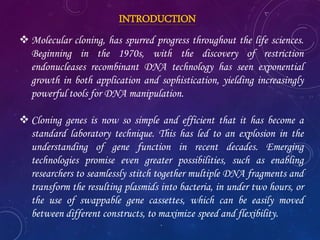
 Molecular cloning, has spurred progress throughout the life sciences.
Beginning in the 1970s, with the discovery of restriction
endonucleases recombinant DNA technology has seen exponential
growth in both application and sophistication, yielding increasingly
powerful tools for DNA manipulation.
 Cloning genes is now so simple and efficient that it has become a
standard laboratory technique. This has led to an explosion in the
understanding of gene function in recent decades. Emerging
technologies promise even greater possibilities, such as enabling
researchers to seamlessly stitch together multiple DNA fragments and
transform the resulting plasmids into bacteria, in under two hours, or
the use of swappable gene cassettes, which can be easily moved
between different constructs, to maximize speed and flexibility.
.
VECTOR
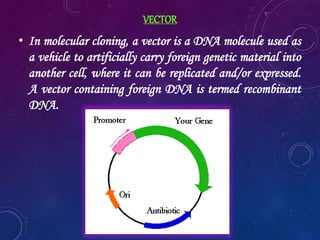
• In molecular cloning, a vector is a DNA molecule used as
a vehicle to artificially carry foreign genetic material into
another cell, where it can be replicated and/or expressed.
A vector containing foreign DNA is termed recombinant
DNA.
HISTORY OF CLONING
RODRIGUEZ RAYMON
Rodriguez Raymon along with Paco Bolivar
constructed the vector “pBR 322” in the year
1977.
Every engineered vector consists of the following:
• Origin of replication
• Multi-cloning site
• Selectable marker
SIMPLE AND EXPRESSIONVECTORS
• SIMPLE VECTOR:- Simple vectors called transcription vectors
are only capable of being transcribed but not translated : they
can be replicated in a target cell but not expressed.
• EXPRESSION VECTORS :- Transcription vectors are used to
not only amplify their insert but also express the gene in an
organism.
The expression vector generally has a promoter sequence that
drives the expression of the transgene.
PURPOSE OF THE EXPRESSION VECTOR
Gene
Isolation
Step 1
Multiplication
Step 2
Gene
expression
Step 3
• The vector itself is generally a DNA sequence that consists of
an insert (transgene) and a larger sequence that serves as the "backbone" of
the vector.
• The process of insertion of the vector :
(a) Transformation in bacterial cells. (b) Transfection in eukaryotic cells.
But if a viral vector is inserted, it is
called transduction.
CLONING VECTOR
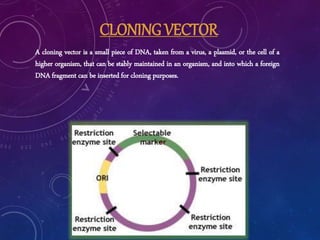
A cloning vector is a small piece of DNA, taken from a virus, a plasmid, or the cell of a
higher organism, that can be stably maintained in an organism, and into which a foreign
DNA fragment can be inserted for cloning purposes.
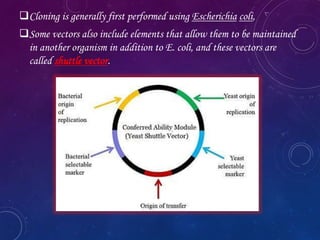
Cloning is generally first performed using Escherichia coli,
Some vectors also include elements that allow them to be maintained
in another organism in addition to E. coli, and these vectors are
called shuttle vector.
STEPS IN MOLECULAR CLONING
A
• 1. Choice of host organism and cloning vector
• 2. Preparation of vector DNA and DNA to be cloned.
B
• 3. Creation of recombinant DNA
• 4. Introduction of recombinant DNA into host organism
C
• 5. Selection of organisms containing recombinant DNA
• 6. Screening for clones with desired DNA inserts and biological properties
TYPES OF VECTORS
The four major types of vectors are
1. Plasmids,
2. Bacteriophages (as phage λ)
3. Cosmids, and
4. Artificial chromosomes.
PLASMID
 Autonomously replicating circular extra-chromosomal DNA.
They are the standard cloning vectors and the most commonly used.
 Most general plasmids may be used to clone DNA insert of up to 15 kb
in size.
The bacteriophages used for cloning are the phage λ and M13 phage.
Some plasmids contain an M13 bacteriophage origin of replication and may be used
to generate single-stranded DNA. These are called phagemid, and examples are
the pBluescript series of cloning vectors.
BACTERIOPHAGE
 There is an upper limit on the amount of DNA that can be packed into a phage
(a maximum of 53 kb),
therefore to allow foreign DNA to be inserted into phage DNA, phage cloning vectors
need to have some non-essential genes deleted, for e.g., the genes for lysogeny in phage λ.
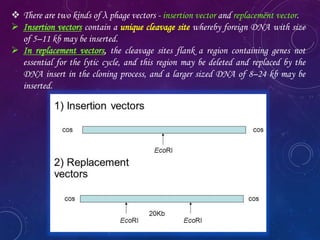
 There are two kinds of λ phage vectors - insertion vector and replacement vector.
 Insertion vectors contain a unique cleavage site whereby foreign DNA with size
of 5–11 kb may be inserted.
 In replacement vectors, the cleavage sites flank a region containing genes not
essential for the lytic cycle, and this region may be deleted and replaced by the
DNA insert in the cloning process, and a larger sized DNA of 8–24 kb may be
inserted.
COSMID
Cosmids are plasmids that incorporate a segment of bacteriophage λ DNA that
has the cohesive end site (cos) which contains elements required for packaging
DNA into λ particles. It is normally used to clone large DNA fragments
between 28 to 45 Kb.
Bacterial artificial chromosome
Insert size of up to 350 kb can be cloned in bacterial artificial chromosome (BAC). BACs are maintained in E. coli with a
copy number of only 1 per cell.
Yeast artificial chromosome
 They are very useful in mapping human genome as they could accommodate hundreds of thousands ofbp.
 Insert of up to 3,000 kb may be carried by YAC.
Human artificial chromosome
 Human artificial chromosome may be potentially useful as a gene transfer vectors for gene delivery into human cells, and a tool for
expression studies and determining human chromosome function.
 It can carry very large DNA fragment (there is no upper limit on size for practical purposes), therefore it does not have the problem of
limited cloning capacity of other vectors, and it also avoids possible insertional mutagenesis caused by integration into host
chromosomes by viral vector.
DESIRABLE FEATURES OF ANY
PLASMID VECTOR
1. It should be of a small size.
2. It should Confer a selectable phenotype on the host cells so that the transformed cells can be selected for.
3. Should contain single sites for a large number of restriction enzymes to enable efficient production of recombinant
vectors.
4. Should enable the identification of bacterial colonies containing recombinant plasmids.
FEATURESOF AN ARTIFICIALLY CONSTRUCTEDVECTOR
1. Origin of replication
2. Promoter
3. Cloning site/Multiple cloning site
4. Selectable marker/Genetic markers
5. Antibiotic resistance
6. Epitope
7. Reporter genes
8. Protein purification tags
1. ORIGIN OF REPLICATION: Necessary for the replication and maintenance of the
vector in the host cell.
2. PROMOTER: Promoters are used to drive the transcription of the vector's
transgene as well as the other genes in the vector such as the antibiotic resistance
gene.
3. CLONING SITE: This may be a multiple cloning site or other features that allow for
the insertion of foreign DNA into the vector through ligation.
4. GENETIC MARKERS: Genetic markers for viral vectors allow for
confirmation that the vector has integrated with the host genomic
DNA.
6. EPITOPE: Vector contains a sequence for a specific epitope that is
incorporated into the expressed protein. Allows for antibody
identification of cells expressing the target protein.
7. REPORTER GENES: Some vectors may contain a reporter gene that
allow for identification of plasmid that contains inserted DNA sequence.
An example is lacZ-α which codes for the N-terminus fragment of β-
galactosidase, an enzyme that digests galactose.
Green Fluorescent Protein (GFP):- It is rapidly becoming a widely used
used reporter gene. It is easier to assay than GUS and is a non-
destructive method. GFP can be used in situations where GUS cannot,
for e.g., In screening primary transformants, in time-course experiments,
or for analyzing segregation in small seedlings.
The GFP is actually located in discrete spots around the bell margin of the
jellyfish and will fluoresce under certain conditions.
To work efficiently in plants “gfp gene” has to be modified significantly in order
to :
1. Remove a cryptic intron
2. Make the codon usage more ‘plant-like’
3. Prevent accumulation in the nucleoplasm.
The mutant form of GFP used in pGREEN makes the bacteria a yellow-green
color even in white light.
Jelly fish Aequorea victoria
8. PROTEIN PURIFICATION TAGS: Some expression vectors include
proteins or peptide sequences that allows for easier purification of the
expressed protein. Examples include polyhistidine-tag, glutathione-S-
transferase, and maltose binding protein. Some of these tags may also
allow for increased solubility of the target protein.
SCREENINGPROCEDURE OF CLONINGVECTORS
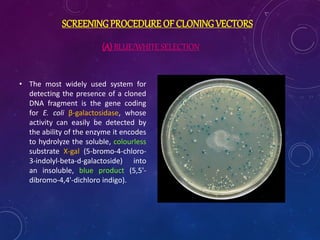
• The most widely used system for
detecting the presence of a cloned
DNA fragment is the gene coding
for E. coli β-galactosidase, whose
activity can easily be detected by
the ability of the enzyme it encodes
to hydrolyze the soluble, colourless
substrate X-gal (5-bromo-4-chloro-
3-indolyl-beta-d-galactoside) into
an insoluble, blue product (5,5'-
dibromo-4,4'-dichloro indigo).
(A) BLUE/WHITE SELECTION
(B) REPLICA PLATING TECHNIQUE
 Replica plating is a microbiological technique in which one or more
secondary Petri plates containing different solid (agar-based) selective growth
media (lacking nutrients or containing chemical growth inhibitors such
as antibiotics) are inoculated with the same colonies of microorganisms from a
primary plate (or master dish), reproducing the original spatial pattern of
colonies.
 The purpose of replica plating is to be able to compare the master plate and any
secondary plates, typically to screen for a desired phenotype.
 It is more correct to refer to "negative screening”.
(B) REPLICA PLATING TECHNIQUE
 The development of replica plating required two steps.
1. The first step was to define the problem: a method of identifiably
duplicating colonies.
2. The second step was to devise a means to reliably implement the first
step.
Esther Lederberg and Joshua Lederberg
DNA CONSTRUCT
A DNA construct is an artificially constructed segment of nucleic acid that is going to be "transplanted" into a target tissue or cell.
It often contains a DNA insert, bacterial resistance genes and promoters.
A DNA construct may express wildtype protein, prevent the expression of certain genes by expressing competitors or inhibitors, or express mutant proteins,
such as deletion mutations or missense mutations.
A DNA construct is often used in molecular biology to analyze macromolecules such as proteins or RNA in more detail.
GENE CASSETTE & INTEGRONS
 A GENE CASSETTE is a type of mobile genetic element that contains a gene
and a recombination site.
 They may exist as incorporated into an integron or freely as circular DNA.
Gene cassettes often carry antibiotic resistance genes.
 An example would be the kanMX cassette which
confers kanamycin (an antibiotic) resistance upon bacteria.
 INTEGRONS are genetic structures in bacteria which express and are capable
of acquiring and exchanging gene cassettes.
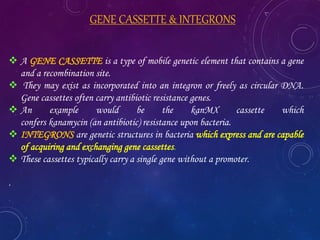
 These cassettes typically carry a single gene without a promoter.
.
In genetic engineering, a gene cassette refers to a manipulable fragment of DNA
carrying, and capable of expressing, one or more genes of interest between one or
more sets of restriction sites. It can be transferred from one DNA sequence (usually
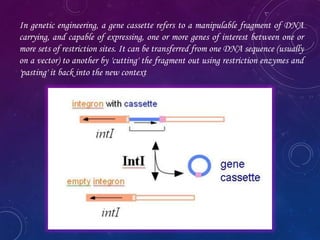
on a vector) to another by 'cutting' the fragment out using restriction enzymes and
'pasting' it back into the new context
APPLICATIONS
 A particular gene can be isolated and its nucleotide sequence can be determined.
 Controlled sequences of DNA can be identified and analyzed.
 Protein/Enzyme/RNA function can be investigated.
 Mutations can be identified, e.g. gene defects related to specific diseases.
 Organisms can be engineered foe specific purposes, e.g., Insulin production.
FUTURE PROSPECTS OF MOLECULAR CLONING
• In the near future, molecular cloning will likely see the
emergence of a new paradigm, with synthetic biology
techniques that will enable in vitro chemical synthesis of
any in silico-specified DNA construct.
• These advances should enable faster construction and
iteration of DNA clones, accelerating the development of
gene therapy vectors, recombinant protein production
processes and new vaccines.
REFERENCES
1. Hall, RM; Collis, CM (1995). "Mobile gene cassettes and integrons:
Capture and spread of genes by site-specific recombination". Molecular
microbiology
2. Plant biotechnology – the genetic manipulations of plants 2nd edition
by Adrian Slater, Nigel W.Scott & Mark R. Fowler
3. Principles of gene Manipulations & Genomics – Primrose & Twyman
7th edition
4. Joseph Sambrook, David Russell. "Chapter 1". Molecular Cloning - A
Laboratory Manual 1 (3rd ed.)
5. Lederberg, J and Lederberg, EM (1952) Replica plating and indirect
selection of bacterial mutants. J Bacteriol.
6. Wikipedia search
Cloning vectors & gene constructs

Cloning vectors & gene constructs

  • 1.
    CLONING VECTORS ANDGENE CONSTRUCTS SUBMITTED TO: Dr. Shyamalamma.S Professor Department of Plant Biotechnology GKVK, UAS Bangalore SUBMITTED BY: K.Kavya ID NO.:- PALB 5269 Jr.M.Sc.(Agri.) Plant Biotechnology GKVK, UAS Bangalore
  • 2.
    CONTENTS  Introduction  Vector Simple & expression vector  Purpose of the expression vector  Steps in molecular cloning  Types of vectors  Desirable features of a plasmid vector  Features of artificially constructed vector  Screening procedures  DNA construct  Gene cassette and integrons
  • 3.
    INTRODUCTION  Molecular cloning,has spurred progress throughout the life sciences. Beginning in the 1970s, with the discovery of restriction endonucleases recombinant DNA technology has seen exponential growth in both application and sophistication, yielding increasingly powerful tools for DNA manipulation.  Cloning genes is now so simple and efficient that it has become a standard laboratory technique. This has led to an explosion in the understanding of gene function in recent decades. Emerging technologies promise even greater possibilities, such as enabling researchers to seamlessly stitch together multiple DNA fragments and transform the resulting plasmids into bacteria, in under two hours, or the use of swappable gene cassettes, which can be easily moved between different constructs, to maximize speed and flexibility. .
  • 4.
    VECTOR • In molecularcloning, a vector is a DNA molecule used as a vehicle to artificially carry foreign genetic material into another cell, where it can be replicated and/or expressed. A vector containing foreign DNA is termed recombinant DNA.
  • 5.
    HISTORY OF CLONING RODRIGUEZRAYMON Rodriguez Raymon along with Paco Bolivar constructed the vector “pBR 322” in the year 1977.
  • 6.
    Every engineered vectorconsists of the following: • Origin of replication • Multi-cloning site • Selectable marker
  • 7.
    SIMPLE AND EXPRESSIONVECTORS •SIMPLE VECTOR:- Simple vectors called transcription vectors are only capable of being transcribed but not translated : they can be replicated in a target cell but not expressed. • EXPRESSION VECTORS :- Transcription vectors are used to not only amplify their insert but also express the gene in an organism. The expression vector generally has a promoter sequence that drives the expression of the transgene.
  • 8.
    PURPOSE OF THEEXPRESSION VECTOR Gene Isolation Step 1 Multiplication Step 2 Gene expression Step 3
  • 9.
    • The vectoritself is generally a DNA sequence that consists of an insert (transgene) and a larger sequence that serves as the "backbone" of the vector. • The process of insertion of the vector : (a) Transformation in bacterial cells. (b) Transfection in eukaryotic cells.
  • 10.
    But if aviral vector is inserted, it is called transduction.
  • 11.
    CLONING VECTOR A cloningvector is a small piece of DNA, taken from a virus, a plasmid, or the cell of a higher organism, that can be stably maintained in an organism, and into which a foreign DNA fragment can be inserted for cloning purposes.
  • 12.
    Cloning is generallyfirst performed using Escherichia coli, Some vectors also include elements that allow them to be maintained in another organism in addition to E. coli, and these vectors are called shuttle vector.
  • 13.
    STEPS IN MOLECULARCLONING A • 1. Choice of host organism and cloning vector • 2. Preparation of vector DNA and DNA to be cloned. B • 3. Creation of recombinant DNA • 4. Introduction of recombinant DNA into host organism C • 5. Selection of organisms containing recombinant DNA • 6. Screening for clones with desired DNA inserts and biological properties
  • 14.
    TYPES OF VECTORS Thefour major types of vectors are 1. Plasmids, 2. Bacteriophages (as phage λ) 3. Cosmids, and 4. Artificial chromosomes.
  • 15.
    PLASMID  Autonomously replicatingcircular extra-chromosomal DNA. They are the standard cloning vectors and the most commonly used.  Most general plasmids may be used to clone DNA insert of up to 15 kb in size.
  • 16.
    The bacteriophages usedfor cloning are the phage λ and M13 phage. Some plasmids contain an M13 bacteriophage origin of replication and may be used to generate single-stranded DNA. These are called phagemid, and examples are the pBluescript series of cloning vectors. BACTERIOPHAGE  There is an upper limit on the amount of DNA that can be packed into a phage (a maximum of 53 kb), therefore to allow foreign DNA to be inserted into phage DNA, phage cloning vectors need to have some non-essential genes deleted, for e.g., the genes for lysogeny in phage λ.
  • 17.
     There aretwo kinds of λ phage vectors - insertion vector and replacement vector.  Insertion vectors contain a unique cleavage site whereby foreign DNA with size of 5–11 kb may be inserted.  In replacement vectors, the cleavage sites flank a region containing genes not essential for the lytic cycle, and this region may be deleted and replaced by the DNA insert in the cloning process, and a larger sized DNA of 8–24 kb may be inserted.
  • 18.
    COSMID Cosmids are plasmidsthat incorporate a segment of bacteriophage λ DNA that has the cohesive end site (cos) which contains elements required for packaging DNA into λ particles. It is normally used to clone large DNA fragments between 28 to 45 Kb.
  • 19.
    Bacterial artificial chromosome Insertsize of up to 350 kb can be cloned in bacterial artificial chromosome (BAC). BACs are maintained in E. coli with a copy number of only 1 per cell.
  • 20.
    Yeast artificial chromosome They are very useful in mapping human genome as they could accommodate hundreds of thousands ofbp.  Insert of up to 3,000 kb may be carried by YAC.
  • 22.
    Human artificial chromosome Human artificial chromosome may be potentially useful as a gene transfer vectors for gene delivery into human cells, and a tool for expression studies and determining human chromosome function.  It can carry very large DNA fragment (there is no upper limit on size for practical purposes), therefore it does not have the problem of limited cloning capacity of other vectors, and it also avoids possible insertional mutagenesis caused by integration into host chromosomes by viral vector.
  • 23.
    DESIRABLE FEATURES OFANY PLASMID VECTOR 1. It should be of a small size. 2. It should Confer a selectable phenotype on the host cells so that the transformed cells can be selected for. 3. Should contain single sites for a large number of restriction enzymes to enable efficient production of recombinant vectors. 4. Should enable the identification of bacterial colonies containing recombinant plasmids.
  • 24.
    FEATURESOF AN ARTIFICIALLYCONSTRUCTEDVECTOR 1. Origin of replication 2. Promoter 3. Cloning site/Multiple cloning site 4. Selectable marker/Genetic markers 5. Antibiotic resistance 6. Epitope 7. Reporter genes 8. Protein purification tags
  • 25.
    1. ORIGIN OFREPLICATION: Necessary for the replication and maintenance of the vector in the host cell. 2. PROMOTER: Promoters are used to drive the transcription of the vector's transgene as well as the other genes in the vector such as the antibiotic resistance gene. 3. CLONING SITE: This may be a multiple cloning site or other features that allow for the insertion of foreign DNA into the vector through ligation.
  • 26.
    4. GENETIC MARKERS:Genetic markers for viral vectors allow for confirmation that the vector has integrated with the host genomic DNA. 6. EPITOPE: Vector contains a sequence for a specific epitope that is incorporated into the expressed protein. Allows for antibody identification of cells expressing the target protein.
  • 27.
    7. REPORTER GENES:Some vectors may contain a reporter gene that allow for identification of plasmid that contains inserted DNA sequence. An example is lacZ-α which codes for the N-terminus fragment of β- galactosidase, an enzyme that digests galactose. Green Fluorescent Protein (GFP):- It is rapidly becoming a widely used used reporter gene. It is easier to assay than GUS and is a non- destructive method. GFP can be used in situations where GUS cannot, for e.g., In screening primary transformants, in time-course experiments, or for analyzing segregation in small seedlings.
  • 28.
    The GFP isactually located in discrete spots around the bell margin of the jellyfish and will fluoresce under certain conditions. To work efficiently in plants “gfp gene” has to be modified significantly in order to : 1. Remove a cryptic intron 2. Make the codon usage more ‘plant-like’ 3. Prevent accumulation in the nucleoplasm. The mutant form of GFP used in pGREEN makes the bacteria a yellow-green color even in white light. Jelly fish Aequorea victoria
  • 29.
    8. PROTEIN PURIFICATIONTAGS: Some expression vectors include proteins or peptide sequences that allows for easier purification of the expressed protein. Examples include polyhistidine-tag, glutathione-S- transferase, and maltose binding protein. Some of these tags may also allow for increased solubility of the target protein.
  • 30.
    SCREENINGPROCEDURE OF CLONINGVECTORS •The most widely used system for detecting the presence of a cloned DNA fragment is the gene coding for E. coli β-galactosidase, whose activity can easily be detected by the ability of the enzyme it encodes to hydrolyze the soluble, colourless substrate X-gal (5-bromo-4-chloro- 3-indolyl-beta-d-galactoside) into an insoluble, blue product (5,5'- dibromo-4,4'-dichloro indigo). (A) BLUE/WHITE SELECTION
  • 33.
    (B) REPLICA PLATINGTECHNIQUE  Replica plating is a microbiological technique in which one or more secondary Petri plates containing different solid (agar-based) selective growth media (lacking nutrients or containing chemical growth inhibitors such as antibiotics) are inoculated with the same colonies of microorganisms from a primary plate (or master dish), reproducing the original spatial pattern of colonies.  The purpose of replica plating is to be able to compare the master plate and any secondary plates, typically to screen for a desired phenotype.  It is more correct to refer to "negative screening”.
  • 34.
  • 35.
     The developmentof replica plating required two steps. 1. The first step was to define the problem: a method of identifiably duplicating colonies. 2. The second step was to devise a means to reliably implement the first step. Esther Lederberg and Joshua Lederberg
  • 36.
    DNA CONSTRUCT A DNAconstruct is an artificially constructed segment of nucleic acid that is going to be "transplanted" into a target tissue or cell. It often contains a DNA insert, bacterial resistance genes and promoters. A DNA construct may express wildtype protein, prevent the expression of certain genes by expressing competitors or inhibitors, or express mutant proteins, such as deletion mutations or missense mutations. A DNA construct is often used in molecular biology to analyze macromolecules such as proteins or RNA in more detail.
  • 37.
    GENE CASSETTE &INTEGRONS  A GENE CASSETTE is a type of mobile genetic element that contains a gene and a recombination site.  They may exist as incorporated into an integron or freely as circular DNA. Gene cassettes often carry antibiotic resistance genes.  An example would be the kanMX cassette which confers kanamycin (an antibiotic) resistance upon bacteria.  INTEGRONS are genetic structures in bacteria which express and are capable of acquiring and exchanging gene cassettes.  These cassettes typically carry a single gene without a promoter. .
  • 38.
    In genetic engineering,a gene cassette refers to a manipulable fragment of DNA carrying, and capable of expressing, one or more genes of interest between one or more sets of restriction sites. It can be transferred from one DNA sequence (usually on a vector) to another by 'cutting' the fragment out using restriction enzymes and 'pasting' it back into the new context
  • 39.
    APPLICATIONS  A particulargene can be isolated and its nucleotide sequence can be determined.  Controlled sequences of DNA can be identified and analyzed.  Protein/Enzyme/RNA function can be investigated.  Mutations can be identified, e.g. gene defects related to specific diseases.  Organisms can be engineered foe specific purposes, e.g., Insulin production.
  • 40.
    FUTURE PROSPECTS OFMOLECULAR CLONING • In the near future, molecular cloning will likely see the emergence of a new paradigm, with synthetic biology techniques that will enable in vitro chemical synthesis of any in silico-specified DNA construct. • These advances should enable faster construction and iteration of DNA clones, accelerating the development of gene therapy vectors, recombinant protein production processes and new vaccines.
  • 41.
    REFERENCES 1. Hall, RM;Collis, CM (1995). "Mobile gene cassettes and integrons: Capture and spread of genes by site-specific recombination". Molecular microbiology 2. Plant biotechnology – the genetic manipulations of plants 2nd edition by Adrian Slater, Nigel W.Scott & Mark R. Fowler 3. Principles of gene Manipulations & Genomics – Primrose & Twyman 7th edition 4. Joseph Sambrook, David Russell. "Chapter 1". Molecular Cloning - A Laboratory Manual 1 (3rd ed.) 5. Lederberg, J and Lederberg, EM (1952) Replica plating and indirect selection of bacterial mutants. J Bacteriol. 6. Wikipedia search

Editor's Notes

  • #28 Reporter genes: Some vectors may contain a reporter gene that allow for identification of plasmid that contains inserted DNA sequence. An example is lacZ-α which codes for the N-terminus fragment of β-galactosidase, an enzyme that digests galactose. A multiple cloning site is located within lacZ-α, and an insert successfully ligated into the vector will disrupt the gene sequence, resulting in an inactive β-galactosidase. Cells containing vector with an insert may be identified using blue/white selection by growing cells in media containing an analogue of galactose (X-gal). Cells expressing β-galactosidase (therefore doesn't contain an insert) appear as blue colonies. White colonies would be selected as those that may contain an insert. Other commonly used reporters include green fluorescent protein and luciferase. Targeting sequence: Expression vectors may include encoding for a targeting sequence in the finished protein that directs the expressed protein to a specific organelle in the cell or specific location such as the periplasmic space of bacteria. Protein purification tags: Some expression vectors include proteins or peptide sequences that allows for easier purification of the expressed protein. Examples include polyhistidine-tag, glutathione-S-transferase, and maltose binding protein. Some of these tags may also allow for increased solubility of the target protein. The target protein is fused to the protein tag, but a protease cleavage site positioned in the polypeptide linker region between the protein and the tag allows the tag to be removed later.