A BRIEF INTRODUCTION TO
“BACTERIAL BIOMASS”
School of Biological Sciences (SBS)
Zahra Naz
(PhD-BS06F18)
PhD Biological Sciences (2018)
By:
Dr. Nasir Ahmad
Presented to:
Advanced Food Biotechnology
CONTENTS
3/4/2019 2
• Definition
• History
• Need for biomass
• Why use bacteria?
• Comparison of different biomasses
• Factors affecting biomass production
• Raw substrates
• Procedure
• Properties of the products
• Applications
• Economical aspects
• Disadvantages
• Commercially available products
• Research
• Future insight
• Summary
• References
• End…!
WHAT IS THE BIOMASS…?
“Total organic cell substance of a living organism”
Single-cell protein (SCP): biomass as unconventional protein sources i.e. bacteria, algae,
& yeasts
Lee, B. H. (2014). DOI: 10.1002/9781118384947
3/4/2019 3
HISTORY
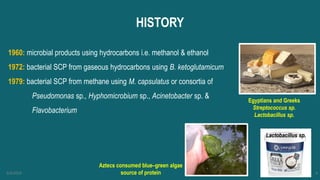
Egyptians and Greeks
Streptococcus sp.
Lactobacillus sp.
Aztecs consumed blue–green algae
source of protein
Lactobacillus sp.
3/4/2019 4
1960: microbial products using hydrocarbons i.e. methanol & ethanol
1972: bacterial SCP from gaseous hydrocarbons using B. ketoglutamicum
1979: bacterial SCP from methane using M. capsulatus or consortia of
Pseudomonas sp., Hyphomicrobium sp., Acinetobacter sp. &
Flavobacterium
NEED FOR BACTERIAL BIOMASS
─To meet world food demand, especially for developing countries
─Minimized area of cultivation land
─Reduced yield per unit cultivated area
Lee, B. H. (2014). DOI: 10.1002/9781118384947
3/4/2019 5
WHY USE BACTERIA…???
1. High protein contents (35–60%)
2. Less generation time than other microbes
3. Good nutritional value than conventional foods rich in protein
4. Production in fermenters without requiring land
5. Ease of genetic manipulation to improve production and product quality
Lee, B. H. (2014). DOI: 10.1002/9781118384947
3/4/2019 6
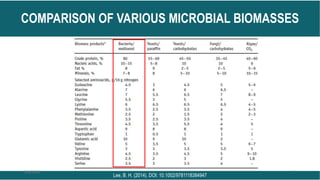
COMPARISON OF VARIOUS MICROBIAL BIOMASSES
Lee, B. H. (2014). DOI: 10.1002/9781118384947
3/4/2019 7
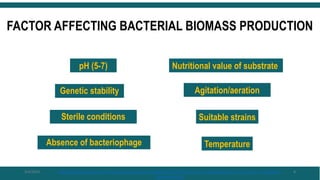
FACTOR AFFECTING BACTERIAL BIOMASS PRODUCTION
Sterile conditions
Nutritional value of substrate
Temperature
pH (5-7)
Suitable strains
Agitation/aeration
3/4/2019 8
Genetic stability
Absence of bacteriophage
https://biocyclopedia.com/index/biotechnology/microbial_biotechnology/single_cell_protein_scp_and_mycoprotein/biotech_scp_production_of_bacterial_a
ctinomycetous.php
RAW SUBSTRATES
Renewable Resources
─ Lignocellulosic material
(Agriculture/forests waste)
─ High carbon contents (sugars)
─ Seasonal availability
─ High cost of processing
Non-Renewable Resources
─ Petrochemical substrates
(gas–oil/paraffins)
─ Easy availability
─ High productivity
─ Toxicity issues
Lee, B. H. (2014). DOI: 10.1002/97811183849473/4/2019 9
.
Lee, B. H. (2014). DOI: 10.1002/9781118384947
3/4/2019 10
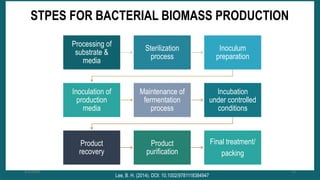
STPES FOR BACTERIAL BIOMASS PRODUCTION
Processing of
substrate &
media
Sterilization
process
Inoculum
preparation
Inoculation of
production
media
Maintenance of
fermentation
process
Incubation
under controlled
conditions
Product
recovery
Product
purification
Final treatment/
packing
Lee, B. H. (2014). DOI: 10.1002/9781118384947
3/4/2019 11
PROPERTIES OF BACTERIAL BIOMASS/ PRODUCTS
Products must not contain:
• Toxins
• Pathogens (pure)
• Heavy metals
• Undesirable metabolites
Lee, B. H. (2014). DOI: 10.1002/9781118384947
3/4/2019 12
APPLICATIONS
e.g. single cell proteins (SCP): Arthrospira platensis
• Improves muscle strength
• Lowers cholesterol level
• Helps to reduce allergic Rhinitis (nasal allergy)
• Anti-cancer properties (research)
https://www.healthline.com/nutrition/10-proven-benefits-of-spirulina#section9
3/4/2019 13
1. Protein Supplements in Human Foods
APPLICATIONS
https://www.peakendurancesport.com/nutrition-for-endurance-athletes/supplements/probiotics-help-hindrance-athletes/
3/4/2019 14
2. Food industry
Lactobacillus: milk sugar (lactose) to lactic acid
Mesophilic bacteria: mellow cheeses i.e. Cheddar, & Gouda
Thermophilic bacteria: sharper cheeses i.e. Parmesan & Romano
APPLICATIONS
e.g. Pruteen from Methylophilus Methylotrophus
http://biomaster2011.blogspot.com/2011/03/scp-derived-from-bacteria.html
3/4/2019 15
3. Protein Supplements for Livestock Feeding
APPLICATIONS
https://www.peakendurancesport.com/nutrition-for-endurance-athletes/supplements/probiotics-help-hindrance-athletes/
3/4/2019 16
4. Probiotics
ECONOMICAL ASPECTS
Lee, B. H. (2014). DOI: 10.1002/9781118384947
• Lower cost: by using thermotolerant strains
• Development of cheaper recovery methods
• Advanced processes: to achieve higher cell densities and productivities
• Genetically engineered strains: having better conversion efficiency and the
ability to use available substrates
3/4/2019 17
DISADVANTAGES
Lee, B. H. (2014). DOI: 10.1002/9781118384947
• High content of nucleic acids: elevated levels of uric acid
• Excess usage: development of kidney stone and gout
• Toxicity: chances for presence of secondary metabolites
• Poor digestibility: bulky stools, flatulence, nausea, vomiting, and diarrhea
• Hypersensitivity: peeling skin from the palms and the soles
3/4/2019 18
COMMERCIALLY AVAILABLE MICROBIAL BIOMASSES
AND THEIR PRODUCTS
Pruteen (livestock feed
supplement) from bacteria
Methylophilus
methylotrophus3/4/2019 19
RESEARCH AROUND US…!
Italy
3/4/2019 20
School of Biological Sciences
At present bacterial biomass production is in its infancy. One of the ways
to enhance productivity and quality is genetic improvements of micro-
organisms. Moreover, Using microbial biomass as a food source
deserves serious consideration because of insufficient world food supply
and high protein content of most microorganisms.
SUMMARY
3/4/2019 21
BIBLIOGRAPHY
• Hélène Boze, et al. (2008). Production of Microbial Biomass. Montpellier, France, VCH Verlagsgesellshaft mbH
• Lee, B. H. (2014). Fundamentals of Food Biotechnology, John Wiley & Sons, Ltd.
• Nasseri, A., et al. (2011). "Single cell protein: production and process." American Journal of food technology
6(2): 103-116.
• Aguirre-Ezkauriatza, E. J., et al. (2010). Production of probiotic biomass (Lactobacillus casei) in goat milk
whey: Comparison of batch, continuous and fed-batch cultures.
• http://soilquality.org.au/factsheets/microbial-biomass
• http://www.shapeme.com.au/blog/which-cheese-is-good-for-you/
• https://www.sciencelearn.org.nz/resources/827-the-science-of-cheese
• https://www.peakendurancesport.com/nutrition-for-endurance-athletes/supplements/probiotics-help-hindrance-
athletes/
3/4/2019 22
Q. & A.

Bacterial biomass

  • 1.
    A BRIEF INTRODUCTIONTO “BACTERIAL BIOMASS” School of Biological Sciences (SBS) Zahra Naz (PhD-BS06F18) PhD Biological Sciences (2018) By: Dr. Nasir Ahmad Presented to: Advanced Food Biotechnology
  • 2.
    CONTENTS 3/4/2019 2 • Definition •History • Need for biomass • Why use bacteria? • Comparison of different biomasses • Factors affecting biomass production • Raw substrates • Procedure • Properties of the products • Applications • Economical aspects • Disadvantages • Commercially available products • Research • Future insight • Summary • References • End…!
  • 3.
    WHAT IS THEBIOMASS…? “Total organic cell substance of a living organism” Single-cell protein (SCP): biomass as unconventional protein sources i.e. bacteria, algae, & yeasts Lee, B. H. (2014). DOI: 10.1002/9781118384947 3/4/2019 3
  • 4.
    HISTORY Egyptians and Greeks Streptococcussp. Lactobacillus sp. Aztecs consumed blue–green algae source of protein Lactobacillus sp. 3/4/2019 4 1960: microbial products using hydrocarbons i.e. methanol & ethanol 1972: bacterial SCP from gaseous hydrocarbons using B. ketoglutamicum 1979: bacterial SCP from methane using M. capsulatus or consortia of Pseudomonas sp., Hyphomicrobium sp., Acinetobacter sp. & Flavobacterium
  • 5.
    NEED FOR BACTERIALBIOMASS ─To meet world food demand, especially for developing countries ─Minimized area of cultivation land ─Reduced yield per unit cultivated area Lee, B. H. (2014). DOI: 10.1002/9781118384947 3/4/2019 5
  • 6.
    WHY USE BACTERIA…??? 1.High protein contents (35–60%) 2. Less generation time than other microbes 3. Good nutritional value than conventional foods rich in protein 4. Production in fermenters without requiring land 5. Ease of genetic manipulation to improve production and product quality Lee, B. H. (2014). DOI: 10.1002/9781118384947 3/4/2019 6
  • 7.
    COMPARISON OF VARIOUSMICROBIAL BIOMASSES Lee, B. H. (2014). DOI: 10.1002/9781118384947 3/4/2019 7
  • 8.
    FACTOR AFFECTING BACTERIALBIOMASS PRODUCTION Sterile conditions Nutritional value of substrate Temperature pH (5-7) Suitable strains Agitation/aeration 3/4/2019 8 Genetic stability Absence of bacteriophage https://biocyclopedia.com/index/biotechnology/microbial_biotechnology/single_cell_protein_scp_and_mycoprotein/biotech_scp_production_of_bacterial_a ctinomycetous.php
  • 9.
    RAW SUBSTRATES Renewable Resources ─Lignocellulosic material (Agriculture/forests waste) ─ High carbon contents (sugars) ─ Seasonal availability ─ High cost of processing Non-Renewable Resources ─ Petrochemical substrates (gas–oil/paraffins) ─ Easy availability ─ High productivity ─ Toxicity issues Lee, B. H. (2014). DOI: 10.1002/97811183849473/4/2019 9
  • 10.
    . Lee, B. H.(2014). DOI: 10.1002/9781118384947 3/4/2019 10
  • 11.
    STPES FOR BACTERIALBIOMASS PRODUCTION Processing of substrate & media Sterilization process Inoculum preparation Inoculation of production media Maintenance of fermentation process Incubation under controlled conditions Product recovery Product purification Final treatment/ packing Lee, B. H. (2014). DOI: 10.1002/9781118384947 3/4/2019 11
  • 12.
    PROPERTIES OF BACTERIALBIOMASS/ PRODUCTS Products must not contain: • Toxins • Pathogens (pure) • Heavy metals • Undesirable metabolites Lee, B. H. (2014). DOI: 10.1002/9781118384947 3/4/2019 12
  • 13.
    APPLICATIONS e.g. single cellproteins (SCP): Arthrospira platensis • Improves muscle strength • Lowers cholesterol level • Helps to reduce allergic Rhinitis (nasal allergy) • Anti-cancer properties (research) https://www.healthline.com/nutrition/10-proven-benefits-of-spirulina#section9 3/4/2019 13 1. Protein Supplements in Human Foods
  • 14.
    APPLICATIONS https://www.peakendurancesport.com/nutrition-for-endurance-athletes/supplements/probiotics-help-hindrance-athletes/ 3/4/2019 14 2. Foodindustry Lactobacillus: milk sugar (lactose) to lactic acid Mesophilic bacteria: mellow cheeses i.e. Cheddar, & Gouda Thermophilic bacteria: sharper cheeses i.e. Parmesan & Romano
  • 15.
    APPLICATIONS e.g. Pruteen fromMethylophilus Methylotrophus http://biomaster2011.blogspot.com/2011/03/scp-derived-from-bacteria.html 3/4/2019 15 3. Protein Supplements for Livestock Feeding
  • 16.
  • 17.
    ECONOMICAL ASPECTS Lee, B.H. (2014). DOI: 10.1002/9781118384947 • Lower cost: by using thermotolerant strains • Development of cheaper recovery methods • Advanced processes: to achieve higher cell densities and productivities • Genetically engineered strains: having better conversion efficiency and the ability to use available substrates 3/4/2019 17
  • 18.
    DISADVANTAGES Lee, B. H.(2014). DOI: 10.1002/9781118384947 • High content of nucleic acids: elevated levels of uric acid • Excess usage: development of kidney stone and gout • Toxicity: chances for presence of secondary metabolites • Poor digestibility: bulky stools, flatulence, nausea, vomiting, and diarrhea • Hypersensitivity: peeling skin from the palms and the soles 3/4/2019 18
  • 19.
    COMMERCIALLY AVAILABLE MICROBIALBIOMASSES AND THEIR PRODUCTS Pruteen (livestock feed supplement) from bacteria Methylophilus methylotrophus3/4/2019 19
  • 20.
    RESEARCH AROUND US…! Italy 3/4/201920 School of Biological Sciences
  • 21.
    At present bacterialbiomass production is in its infancy. One of the ways to enhance productivity and quality is genetic improvements of micro- organisms. Moreover, Using microbial biomass as a food source deserves serious consideration because of insufficient world food supply and high protein content of most microorganisms. SUMMARY 3/4/2019 21
  • 22.
    BIBLIOGRAPHY • Hélène Boze,et al. (2008). Production of Microbial Biomass. Montpellier, France, VCH Verlagsgesellshaft mbH • Lee, B. H. (2014). Fundamentals of Food Biotechnology, John Wiley & Sons, Ltd. • Nasseri, A., et al. (2011). "Single cell protein: production and process." American Journal of food technology 6(2): 103-116. • Aguirre-Ezkauriatza, E. J., et al. (2010). Production of probiotic biomass (Lactobacillus casei) in goat milk whey: Comparison of batch, continuous and fed-batch cultures. • http://soilquality.org.au/factsheets/microbial-biomass • http://www.shapeme.com.au/blog/which-cheese-is-good-for-you/ • https://www.sciencelearn.org.nz/resources/827-the-science-of-cheese • https://www.peakendurancesport.com/nutrition-for-endurance-athletes/supplements/probiotics-help-hindrance- athletes/ 3/4/2019 22
  • 23.

Editor's Notes

  • #4 unconventional protein sources i.e. bacteria, algae, yeasts and higher fungi
  • #5 Aztecs: ancient misoamericans Brevibacterium ketoglutamicum Methylococcus capsulatus
  • #6 Most of the agricultural land today is being rapidly diverted for other uses, limiting further the area that can be used for increasing food production. Genetic improvement of crop varieties is an alternative with its own limitations.
  • #7 appears to be the most attractive alternative to date for at least six reasons:
  • #9 Illumination time FOR ALGAE
  • #10 The raw materials required for the growth and metabolism of microorganisms include a carbon or energy source, a nitrogen source, and supplementary nutrients. The carbon or energy sources that have been considered to be suitable for the production of MBP fall into two broad categories: substrates from renewable resources and substrates from nonrenewable Resources Renewable: The Pekilo process, the largest fungal biomass-based process, was developed in Finland at the Finnish Pulp and Paper Institute. It produces 15–16.5 tons dry weight of Paecilomyces varioti mycelium on SWL in 24 hours with a protein content of 55%. gas–oil/paraffins (ethane, propane, n- and isobutane).
  • #11 Actinomyces is a genus of the Actinobacteria class of bacteria. They are all gram-positive. Actinomyces species are facultatively anaerobic (except A. meyeri and A. israelii both obligate anaerobe), and they grow best under anaerobic conditions.
  • #12 cooling
  • #14 Blue green algae
  • #15 LAB is frequently used by the food industry to convert carbohydrates to lactic acid. It is this process that results in the sour taste of foods such as yogurt and in the lowering of pH (increase in acidity) to reduce spoilage. Enzymes speed up coagulation Some cheeses are curdled only by acidity. For example, paneer cheese is made using lemon juice to curdle the milk and cottage cheese is made using mesophilic bacteria. However, for most cheeses, rennet is also added to the milk after a starter bacteria. Rennet is a mixture containing the active enzyme chymosin. Rennet speeds up the coagulation of casein and produces a stronger curd. It also allows curdling at a lower acidity, which is important for some types of cheese. mellow. When something becomes mellow, it gets softer or more relaxed Sharp: pungent and firm cheese as it ages
  • #17 Probiotics are live microorganisms intended to provide health benefits when consumed, generally by improving or restoring the gut flora.
  • #18 The higher operating temperature, the lower is the cooling cost Using thermotolerant strains
  • #20 Spirullina: cyanobacteria (whole feed supplements for human and aqua culture)
  • #21 Probiotic and Food Safety Laboratory, NIBGE, Faisalabad KNU, SOUTH KOREA