CLONING AND EXPRESSION VECTORS
FOR PLANT GENE
PLANT BIOTECHNOLOGY
AISHWARYA JAITLY
M.Sc.BIOTECHNOLOGY
ROLL NO. 2
Dr. ALKA NARULA
• A vector is a small DNA molecule used
as a carrier of DNA fragment i.e. foreign
genetic material into another cell.
• The vector is also termed as cloning
vehicle or cloning DNA.
VECTORS OR CLONING VEHICLES
• It should be able to replicate autonomously.
• Supposed to have one origin of replication.
• Should be small in size and of low molecular
weight.
• Should contain a suitable marker.
• Should have unique target sites for restriction
enzymes.
CHARACTERSTICS OF A GOODVECTOR
• CLONING VECTORS; to clone a gene in a vector.
• EXPRESSION VECTORS; allowing the exogenous
DNA to be inserted, stored, and manipulated
mainly at DNA level.
• INTEGRATION VECTORS; allowing the exogenous
DNA to be inserted, stored, and expressed.
Classification Of VECTORS
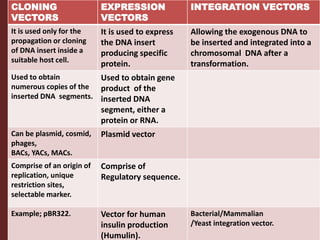
CLONING
VECTORS
EXPRESSION
VECTORS
INTEGRATION VECTORS
It is used only for the
propagation or cloning
of DNA insert inside a
suitable host cell.
It is used to express
the DNA insert
producing specific
protein.
Allowing the exogenous DNA to
be inserted and integrated into a
chromosomal DNA after a
transformation.
Used to obtain
numerous copies of the
inserted DNA segments.
Used to obtain gene
product of the
inserted DNA
segment, either a
protein or RNA.
Can be plasmid, cosmid,
phages,
BACs, YACs, MACs.
Plasmid vector
Comprise of an origin of
replication, unique
restriction sites,
selectable marker.
Comprise of
Regulatory sequence.
Example; pBR322. Vector for human
insulin production
(Humulin).
Bacterial/Mammalian
/Yeast integration vector.
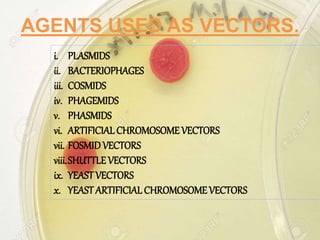
AGENTS USED AS VECTORS.
i. PLASMIDS
ii. BACTERIOPHAGES
iii. COSMIDS
iv. PHAGEMIDS
v. PHASMIDS
vi. ARTIFICIALCHROMOSOMEVECTORS
vii. FOSMIDVECTORS
viii.SHUTTLE VECTORS
ix. YEAST VECTORS
x. YEAST ARTIFICIALCHROMOSOME VECTORS
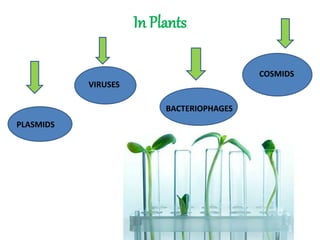
In Plants
VIRUSES
PLASMIDS
BACTERIOPHAGES
COSMIDS
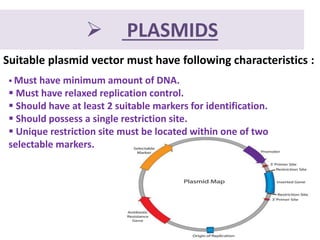
 PLASMIDS
Suitable plasmid vector must have following characteristics :
 Must have minimum amount of DNA.
 Must have relaxed replication control.
 Should have at least 2 suitable markers for identification.
 Should possess a single restriction site.
 Unique restriction site must be located within one of two
selectable markers.
Types of Plasmid Vectors
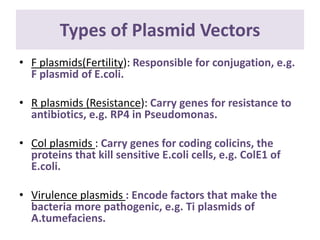
• F plasmids(Fertility): Responsible for conjugation, e.g.
F plasmid of E.coli.
• R plasmids (Resistance): Carry genes for resistance to
antibiotics, e.g. RP4 in Pseudomonas.
• Col plasmids : Carry genes for coding colicins, the
proteins that kill sensitive E.coli cells, e.g. ColE1 of
E.coli.
• Virulence plasmids : Encode factors that make the
bacteria more pathogenic, e.g. Ti plasmids of
A.tumefaciens.
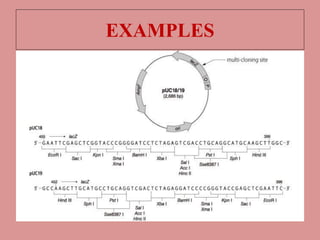
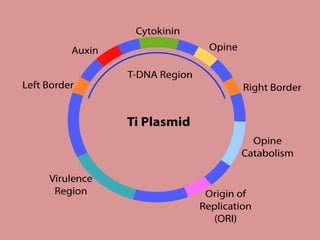
EXAMPLES
Agrobacterium tumefaciens
for Transgenic Plants
2 ways:
a) Binary vector system
b)Co-integration vector system
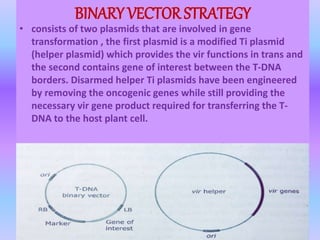
BINARY VECTOR STRATEGY
• consists of two plasmids that are involved in gene
transformation , the first plasmid is a modified Ti plasmid
(helper plasmid) which provides the vir functions in trans and
the second contains gene of interest between the T-DNA
borders. Disarmed helper Ti plasmids have been engineered
by removing the oncogenic genes while still providing the
necessary vir gene product required for transferring the T-
DNA to the host plant cell.
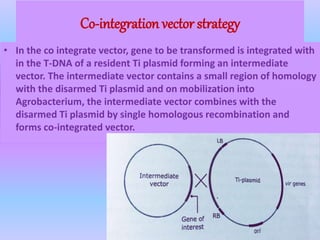
Co-integration vector strategy
• In the co integrate vector, gene to be transformed is integrated with
in the T-DNA of a resident Ti plasmid forming an intermediate
vector. The intermediate vector contains a small region of homology
with the disarmed Ti plasmid and on mobilization into
Agrobacterium, the intermediate vector combines with the
disarmed Ti plasmid by single homologous recombination and
forms co-integrated vector.
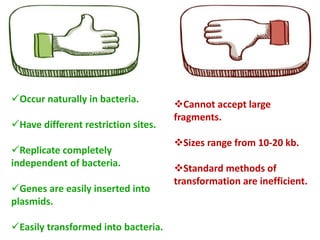
Occur naturally in bacteria.
Have different restriction sites.
Replicate completely
independent of bacteria.
Genes are easily inserted into
plasmids.
Easily transformed into bacteria.
Cannot accept large
fragments.
Sizes range from 10-20 kb.
Standard methods of
transformation are inefficient.
• Viral vectors are vectors that can be used to
deliver nucleic acids into the genetic makeup
of cells including retrovirus, lentivirus,
adenovirus etc.
• Viral vectors are non-integrative.
EXAMPLES
I. Cauliflower mosaic virus based
vectors.
II. Cowpea mosaic virus
III. Bean pod mottle virus
IV. TMV based vectors
V. Potato virus X
VI. Bean yellow dwarf virus
VII.Bacteriophage Lambda vectors
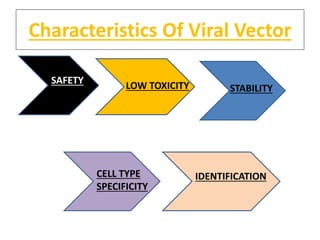
Characteristics Of Viral Vector
SAFETY
LOW TOXICITY STABILITY
CELL TYPE
SPECIFICITY
IDENTIFICATION
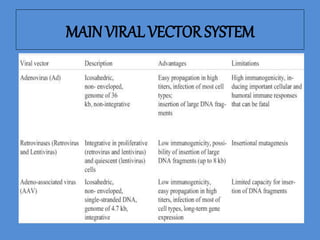
MAIN VIRAL VECTOR SYSTEM
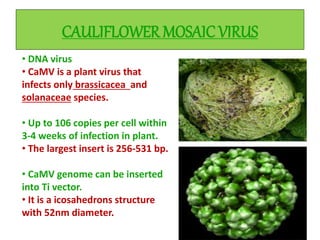
CAULIFLOWER MOSAIC VIRUS
• DNA virus
• CaMV is a plant virus that
infects only brassicacea and
solanaceae species.
• Up to 106 copies per cell within
3-4 weeks of infection in plant.
• The largest insert is 256-531 bp.
• CaMV genome can be inserted
into Ti vector.
• It is a icosahedrons structure
with 52nm diameter.
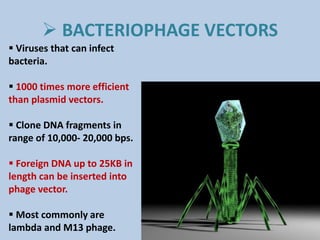
 BACTERIOPHAGE VECTORS
 Viruses that can infect
bacteria.
 1000 times more efficient
than plasmid vectors.
 Clone DNA fragments in
range of 10,000- 20,000 bps.
 Foreign DNA up to 25KB in
length can be inserted into
phage vector.
 Most commonly are
lambda and M13 phage.
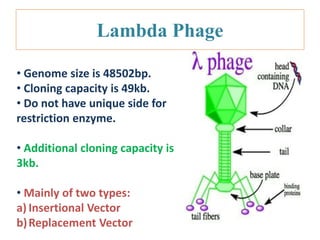
Lambda Phage
• Genome size is 48502bp.
• Cloning capacity is 49kb.
• Do not have unique side for
restriction enzyme.
• Additional cloning capacity is
3kb.
• Mainly of two types:
a) Insertional Vector
b)Replacement Vector
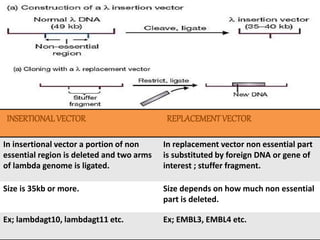
INSERTIONAL VECTOR REPLACEMENTVECTOR
In insertional vector a portion of non
essential region is deleted and two arms
of lambda genome is ligated.
In replacement vector non essential part
is substituted by foreign DNA or gene of
interest ; stuffer fragment.
Size is 35kb or more. Size depends on how much non essential
part is deleted.
Ex; lambdagt10, lambdagt11 etc. Ex; EMBL3, EMBL4 etc.
n
ADVANTAGES DISADVANTAGES
Foreign DNA up to 25kb in length can be
inserted.
Limits to size of cloned DNA (2kb)
Fast processing , low cost, high yield, good at
targeting and entering cells.
Phage proteins toxic in high concentration.
Mostly target specific types of cells. Less easy to handle.
Use in production of vaccines, study of gene
function, in study of metabolic engineering ,
etc.
Serious effects on plants ; due to highest
mutation rate.
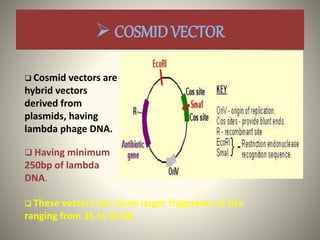
 COSMID VECTOR
 Cosmid vectors are
hybrid vectors
derived from
plasmids, having
lambda phage DNA.
 Having minimum
250bp of lambda
DNA.
 These vectors can clone larger fragments of size
ranging from 35 to 50 kb.
• ADVANATGES:
a. They can be used to clone dna inserts of up to 40-
45kb.
b. Packaged cosmids infect host cell like lambda
phage particles but multiply and propagate like
plasmids.
c. They are amplified and maintained in the same
way as the plasmids.
d. They are used for the construction of genome
libraries of eukaryotes.
• DISADVANTAGES:
a. Not easy to handle ; large plasmids.
REFERENCES
• https://en.m.wikipedia.org/wiki/Expression_vect
or
• http://www.rastogipublications.com/b-cell-
molecular-biology.html
• http://vle.du.ac.in/mod/book/view.php?id=1190
1&chapterid=23641
THANKYOU..

VECTORS INTRODUCTION

  • 1.
    CLONING AND EXPRESSIONVECTORS FOR PLANT GENE PLANT BIOTECHNOLOGY AISHWARYA JAITLY M.Sc.BIOTECHNOLOGY ROLL NO. 2 Dr. ALKA NARULA
  • 2.
    • A vectoris a small DNA molecule used as a carrier of DNA fragment i.e. foreign genetic material into another cell. • The vector is also termed as cloning vehicle or cloning DNA. VECTORS OR CLONING VEHICLES
  • 3.
    • It shouldbe able to replicate autonomously. • Supposed to have one origin of replication. • Should be small in size and of low molecular weight. • Should contain a suitable marker. • Should have unique target sites for restriction enzymes. CHARACTERSTICS OF A GOODVECTOR
  • 4.
    • CLONING VECTORS;to clone a gene in a vector. • EXPRESSION VECTORS; allowing the exogenous DNA to be inserted, stored, and manipulated mainly at DNA level. • INTEGRATION VECTORS; allowing the exogenous DNA to be inserted, stored, and expressed. Classification Of VECTORS
  • 5.
    CLONING VECTORS EXPRESSION VECTORS INTEGRATION VECTORS It isused only for the propagation or cloning of DNA insert inside a suitable host cell. It is used to express the DNA insert producing specific protein. Allowing the exogenous DNA to be inserted and integrated into a chromosomal DNA after a transformation. Used to obtain numerous copies of the inserted DNA segments. Used to obtain gene product of the inserted DNA segment, either a protein or RNA. Can be plasmid, cosmid, phages, BACs, YACs, MACs. Plasmid vector Comprise of an origin of replication, unique restriction sites, selectable marker. Comprise of Regulatory sequence. Example; pBR322. Vector for human insulin production (Humulin). Bacterial/Mammalian /Yeast integration vector.
  • 6.
    AGENTS USED ASVECTORS. i. PLASMIDS ii. BACTERIOPHAGES iii. COSMIDS iv. PHAGEMIDS v. PHASMIDS vi. ARTIFICIALCHROMOSOMEVECTORS vii. FOSMIDVECTORS viii.SHUTTLE VECTORS ix. YEAST VECTORS x. YEAST ARTIFICIALCHROMOSOME VECTORS
  • 7.
  • 8.
     PLASMIDS Suitable plasmidvector must have following characteristics :  Must have minimum amount of DNA.  Must have relaxed replication control.  Should have at least 2 suitable markers for identification.  Should possess a single restriction site.  Unique restriction site must be located within one of two selectable markers.
  • 9.
    Types of PlasmidVectors • F plasmids(Fertility): Responsible for conjugation, e.g. F plasmid of E.coli. • R plasmids (Resistance): Carry genes for resistance to antibiotics, e.g. RP4 in Pseudomonas. • Col plasmids : Carry genes for coding colicins, the proteins that kill sensitive E.coli cells, e.g. ColE1 of E.coli. • Virulence plasmids : Encode factors that make the bacteria more pathogenic, e.g. Ti plasmids of A.tumefaciens.
  • 10.
  • 12.
    Agrobacterium tumefaciens for TransgenicPlants 2 ways: a) Binary vector system b)Co-integration vector system
  • 13.
    BINARY VECTOR STRATEGY •consists of two plasmids that are involved in gene transformation , the first plasmid is a modified Ti plasmid (helper plasmid) which provides the vir functions in trans and the second contains gene of interest between the T-DNA borders. Disarmed helper Ti plasmids have been engineered by removing the oncogenic genes while still providing the necessary vir gene product required for transferring the T- DNA to the host plant cell.
  • 14.
    Co-integration vector strategy •In the co integrate vector, gene to be transformed is integrated with in the T-DNA of a resident Ti plasmid forming an intermediate vector. The intermediate vector contains a small region of homology with the disarmed Ti plasmid and on mobilization into Agrobacterium, the intermediate vector combines with the disarmed Ti plasmid by single homologous recombination and forms co-integrated vector.
  • 15.
    Occur naturally inbacteria. Have different restriction sites. Replicate completely independent of bacteria. Genes are easily inserted into plasmids. Easily transformed into bacteria. Cannot accept large fragments. Sizes range from 10-20 kb. Standard methods of transformation are inefficient.
  • 16.
    • Viral vectorsare vectors that can be used to deliver nucleic acids into the genetic makeup of cells including retrovirus, lentivirus, adenovirus etc. • Viral vectors are non-integrative.
  • 17.
    EXAMPLES I. Cauliflower mosaicvirus based vectors. II. Cowpea mosaic virus III. Bean pod mottle virus IV. TMV based vectors V. Potato virus X VI. Bean yellow dwarf virus VII.Bacteriophage Lambda vectors
  • 18.
    Characteristics Of ViralVector SAFETY LOW TOXICITY STABILITY CELL TYPE SPECIFICITY IDENTIFICATION
  • 19.
  • 20.
    CAULIFLOWER MOSAIC VIRUS •DNA virus • CaMV is a plant virus that infects only brassicacea and solanaceae species. • Up to 106 copies per cell within 3-4 weeks of infection in plant. • The largest insert is 256-531 bp. • CaMV genome can be inserted into Ti vector. • It is a icosahedrons structure with 52nm diameter.
  • 21.
     BACTERIOPHAGE VECTORS Viruses that can infect bacteria.  1000 times more efficient than plasmid vectors.  Clone DNA fragments in range of 10,000- 20,000 bps.  Foreign DNA up to 25KB in length can be inserted into phage vector.  Most commonly are lambda and M13 phage.
  • 22.
    Lambda Phage • Genomesize is 48502bp. • Cloning capacity is 49kb. • Do not have unique side for restriction enzyme. • Additional cloning capacity is 3kb. • Mainly of two types: a) Insertional Vector b)Replacement Vector
  • 23.
    INSERTIONAL VECTOR REPLACEMENTVECTOR Ininsertional vector a portion of non essential region is deleted and two arms of lambda genome is ligated. In replacement vector non essential part is substituted by foreign DNA or gene of interest ; stuffer fragment. Size is 35kb or more. Size depends on how much non essential part is deleted. Ex; lambdagt10, lambdagt11 etc. Ex; EMBL3, EMBL4 etc.
  • 24.
    n ADVANTAGES DISADVANTAGES Foreign DNAup to 25kb in length can be inserted. Limits to size of cloned DNA (2kb) Fast processing , low cost, high yield, good at targeting and entering cells. Phage proteins toxic in high concentration. Mostly target specific types of cells. Less easy to handle. Use in production of vaccines, study of gene function, in study of metabolic engineering , etc. Serious effects on plants ; due to highest mutation rate.
  • 25.
     COSMID VECTOR Cosmid vectors are hybrid vectors derived from plasmids, having lambda phage DNA.  Having minimum 250bp of lambda DNA.  These vectors can clone larger fragments of size ranging from 35 to 50 kb.
  • 26.
    • ADVANATGES: a. Theycan be used to clone dna inserts of up to 40- 45kb. b. Packaged cosmids infect host cell like lambda phage particles but multiply and propagate like plasmids. c. They are amplified and maintained in the same way as the plasmids. d. They are used for the construction of genome libraries of eukaryotes. • DISADVANTAGES: a. Not easy to handle ; large plasmids.
  • 27.
  • 28.