TRANSGENE SILENCING
Presented By,
POORANACHITHRA M
Ist M.Tech Biotechnology
Introduction:
 Gene silencing (GS) is defined as a molecular process involved in
the down regulation of specific genes, and probably evolved as a
genetic defense system against viruses and invading nucleic acids.
 In genetically modified plants, the introduced transgenes are
sometimes not expressed. They can be silenced.
 Transgenes can also cause the silencing of endogenous plant genes
if they are sufficiently homologous, a phenomenon known as
transgene silencing or co-suppression.
Early Findings Of GS In Plants:
 First discovered in plants by
R. Jorgensen in1990
 When Jorgensen introduced a
re-engineered gene into petunia that
had a lot of homology with an
endogenous petunia gene, both
genes became suppressed!
Cont.…
 Jorgensen tried to obtain transgenic petunias with greater amounts
of anthocyanin pigments, by amplifying the gene activity of
chalcone synthase.
 Instead of obtaining deeper purples in the petals, white or chimeric
flowers were produced.
 The transgene was not expressed, and ended up silencing a
homologue endogenous gene.
 The phenomenon, named “co-suppression”
Wild-type petunia
producing purple
anthocyanin
pigments
Chalcone synthase (CHS)
is the enzyme at the
start of the biosynthetic
pathway for anthocyanins
Anthocyanins
Chalcone
synthase (CHS)
Sense RNA
Antisense
RNA
Sense construct:
PRO ORF
Endogenous gene
mRNA
Transgene
PRO ORF
mRNA
Protein translated
mRNA
mRNA
Extra protein translated
Antisense construct:
PRO
ORF
Transgene
Sense-antisense duplex forms
and prohibits translation
Hypothesis: sense RNA production enhances
pigmentation and antisense RNA production
blocks pigmentation
Surprisingly, both antisense and sense
gene constructs can inhibit pigment
production
Plants carrying CHS transgene
CaMV 35S pro : CHS CaMV 35S pro : CHS
Sense Antisense
OR
Silencing of transgenes:
 Transgenes introduced into plants are frequently silenced by the
siRNA pathway
 Silencing can be triggered by:
# Very high levels of gene expression
# dsRNA derived from transgenes
# Aberrant RNAs encoded by transgenes
 Transgenes are silenced post-transcriptionally and transcriptionally
Routes Of GS In Plants:
 Transcriptional gene silencing
 siRNA mediated silencing
 MicroRNA silencing
 Virus induced gene silencing
Transcriptional gene silencing:
 DNA methylation and chromatin remodeling play a major role in
transcriptional gene silencing (TGS), blocking gene expression.
 In TGS, silenced transgenes coding regions and promoters are
densely methylated.
 DNA methylation promotes protein binding that recognizes
methylated cytosine, leading to chromatin remodeling thus avoiding
the binding of transcription factors.
Co-suppression is a consequence of siRNA
production
PRO ORF
Wild-type
mRNA
mRNA
Protein translated
Endogenous gene
Sense RNA
Sense construct
Co-suppressed transgenic
PRO ORF
Co-suppression
PRO ORF
Endogenous gene
mRNA
siRNA
produced
Most siRNAs are produced from transposons
and repetitive DNA:
Most of the cellular siRNAs are derived from transposons and other
repetitive sequences. In Arabidopsis, as shown above, there is a high
density of these repeats in the pericentromeric regions of the
chromosome.
Abundance of
small RNAs
Abundance of
transposon/
retrotransposons
Chromosome
Centromere
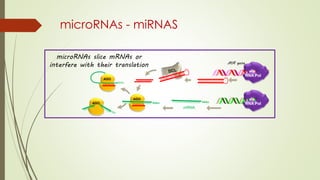
microRNAs – miRNAs:
 miRNAs are thought to have evolved from siRNAs, and are
produced and processed somewhat similarly
 Plants have a small number of highly conserved miRNAs, and a
large number of non-conserved miRNAs
 miRNAs are encoded by specific MIR genes but act on other
genes – they are trans-acting regulatory factors
 miRNAs in plants regulate developmental and physiological
events
MIR genes are transcribed into long RNAs
that are processed to miRNAs
 miRNAs are encoded by MIR genes.
 The primary miRNA (pri-miRNA)
transcript folds back into a double-
stranded structure, which is
processed by DCL1.
 The miRNA* strand is degraded
3'
5' miRNA
miRNA*
3'
5' pri-miRNA
miRNA
MIR gene
mRNA target
microRNAs - miRNAS
MIR gene
RNA Pol
AGO
RNA Pol
mRNA
AGO
AGO
AAAn
microRNAs slice mRNAs or
interfere with their translation
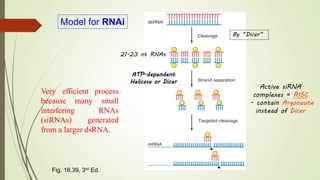
Model for RNAi
By “Dicer”
21-23 nt RNAs
Fig. 16.39, 3rd Ed.
ATP-dependent
Helicase or Dicer
Active siRNA
complexes = RISC
- contain Argonaute
instead of Dicer
Very efficient process
because many small
interfering RNAs
(siRNAs) generated
from a larger dsRNA.
Virus Induced Gene Silencing (VIGS):
 Virus induced gene silencing is a technique designed to suppress
gene expression and study gene function in plants.
 If viral transgenes are introduced and silenced, the
posttranscriptional process also prevents homologous RNA viruses
from accumulating; this is a means of generating virus-resistant
plants.
Applications:
 Plant protection to multiple pathogens (viruses, bacteria) &
Production of virus resistant plants through genetic transformation.
 Food quality modification such as the reduction of caffeine levels in
coffee beans and Increase the nutritional value of corn protein and
tomatoes.
 silencing of specific metabolic pathways (lignin synthesis, ethylene,
allergens, caffeine and others)
 Developmental and reproductive trait alteration in plants (induced
male sterility and self-compatibility).
GS & Plant Disease Resistance:
 Virus disease resistance in plants may be achieved by several
approaches, including
# Coat protein mediated protection,
# Antisense RNA,
# Replicase mediated protection,
# PTGS / RNAi,
# Pathogen derived resistance (PDR)
 Currently, RNAi is the major strategy in plant transformation for
virus resistance.
 Citrus tristeza virus (CTV) - resistant citrus plants, expressing the
coat protein of the virus has been obtained.
 Resistant transgenic plums containing the silenced Plum pox virus
(PPV) coat protein gene.
 Crown gall resistant apple tree roots were obtained by
transformation with transgenes designed to express double-stranded
RNA from the iaaM and ipt genes.
Thank you…!!

Transgene silencing

  • 1.
  • 2.
    Introduction:  Gene silencing(GS) is defined as a molecular process involved in the down regulation of specific genes, and probably evolved as a genetic defense system against viruses and invading nucleic acids.  In genetically modified plants, the introduced transgenes are sometimes not expressed. They can be silenced.  Transgenes can also cause the silencing of endogenous plant genes if they are sufficiently homologous, a phenomenon known as transgene silencing or co-suppression.
  • 3.
    Early Findings OfGS In Plants:  First discovered in plants by R. Jorgensen in1990  When Jorgensen introduced a re-engineered gene into petunia that had a lot of homology with an endogenous petunia gene, both genes became suppressed!
  • 4.
    Cont.…  Jorgensen triedto obtain transgenic petunias with greater amounts of anthocyanin pigments, by amplifying the gene activity of chalcone synthase.  Instead of obtaining deeper purples in the petals, white or chimeric flowers were produced.  The transgene was not expressed, and ended up silencing a homologue endogenous gene.  The phenomenon, named “co-suppression”
  • 6.
    Wild-type petunia producing purple anthocyanin pigments Chalconesynthase (CHS) is the enzyme at the start of the biosynthetic pathway for anthocyanins Anthocyanins Chalcone synthase (CHS)
  • 7.
    Sense RNA Antisense RNA Sense construct: PROORF Endogenous gene mRNA Transgene PRO ORF mRNA Protein translated mRNA mRNA Extra protein translated Antisense construct: PRO ORF Transgene Sense-antisense duplex forms and prohibits translation Hypothesis: sense RNA production enhances pigmentation and antisense RNA production blocks pigmentation
  • 8.
    Surprisingly, both antisenseand sense gene constructs can inhibit pigment production Plants carrying CHS transgene CaMV 35S pro : CHS CaMV 35S pro : CHS Sense Antisense OR
  • 9.
    Silencing of transgenes: Transgenes introduced into plants are frequently silenced by the siRNA pathway  Silencing can be triggered by: # Very high levels of gene expression # dsRNA derived from transgenes # Aberrant RNAs encoded by transgenes  Transgenes are silenced post-transcriptionally and transcriptionally
  • 10.
    Routes Of GSIn Plants:  Transcriptional gene silencing  siRNA mediated silencing  MicroRNA silencing  Virus induced gene silencing
  • 11.
    Transcriptional gene silencing: DNA methylation and chromatin remodeling play a major role in transcriptional gene silencing (TGS), blocking gene expression.  In TGS, silenced transgenes coding regions and promoters are densely methylated.  DNA methylation promotes protein binding that recognizes methylated cytosine, leading to chromatin remodeling thus avoiding the binding of transcription factors.
  • 12.
    Co-suppression is aconsequence of siRNA production PRO ORF Wild-type mRNA mRNA Protein translated Endogenous gene Sense RNA Sense construct Co-suppressed transgenic PRO ORF Co-suppression PRO ORF Endogenous gene mRNA siRNA produced
  • 13.
    Most siRNAs areproduced from transposons and repetitive DNA: Most of the cellular siRNAs are derived from transposons and other repetitive sequences. In Arabidopsis, as shown above, there is a high density of these repeats in the pericentromeric regions of the chromosome. Abundance of small RNAs Abundance of transposon/ retrotransposons Chromosome Centromere
  • 14.
    microRNAs – miRNAs: miRNAs are thought to have evolved from siRNAs, and are produced and processed somewhat similarly  Plants have a small number of highly conserved miRNAs, and a large number of non-conserved miRNAs  miRNAs are encoded by specific MIR genes but act on other genes – they are trans-acting regulatory factors  miRNAs in plants regulate developmental and physiological events
  • 15.
    MIR genes aretranscribed into long RNAs that are processed to miRNAs  miRNAs are encoded by MIR genes.  The primary miRNA (pri-miRNA) transcript folds back into a double- stranded structure, which is processed by DCL1.  The miRNA* strand is degraded 3' 5' miRNA miRNA* 3' 5' pri-miRNA miRNA MIR gene mRNA target
  • 16.
    microRNAs - miRNAS MIRgene RNA Pol AGO RNA Pol mRNA AGO AGO AAAn microRNAs slice mRNAs or interfere with their translation
  • 17.
    Model for RNAi By“Dicer” 21-23 nt RNAs Fig. 16.39, 3rd Ed. ATP-dependent Helicase or Dicer Active siRNA complexes = RISC - contain Argonaute instead of Dicer Very efficient process because many small interfering RNAs (siRNAs) generated from a larger dsRNA.
  • 18.
    Virus Induced GeneSilencing (VIGS):  Virus induced gene silencing is a technique designed to suppress gene expression and study gene function in plants.  If viral transgenes are introduced and silenced, the posttranscriptional process also prevents homologous RNA viruses from accumulating; this is a means of generating virus-resistant plants.
  • 19.
    Applications:  Plant protectionto multiple pathogens (viruses, bacteria) & Production of virus resistant plants through genetic transformation.  Food quality modification such as the reduction of caffeine levels in coffee beans and Increase the nutritional value of corn protein and tomatoes.  silencing of specific metabolic pathways (lignin synthesis, ethylene, allergens, caffeine and others)  Developmental and reproductive trait alteration in plants (induced male sterility and self-compatibility).
  • 20.
    GS & PlantDisease Resistance:  Virus disease resistance in plants may be achieved by several approaches, including # Coat protein mediated protection, # Antisense RNA, # Replicase mediated protection, # PTGS / RNAi, # Pathogen derived resistance (PDR)  Currently, RNAi is the major strategy in plant transformation for virus resistance.
  • 21.
     Citrus tristezavirus (CTV) - resistant citrus plants, expressing the coat protein of the virus has been obtained.  Resistant transgenic plums containing the silenced Plum pox virus (PPV) coat protein gene.  Crown gall resistant apple tree roots were obtained by transformation with transgenes designed to express double-stranded RNA from the iaaM and ipt genes.
  • 22.