
HAPLOID
PRODUCTION
ANUGYA JAISWAL
BSc.(HONS.)BIOTECHNOLOGY
OVERVIEW
 Introduction
 Categories of haploid
 Technique involved in haploid production
 Androgenesis
 Gynogenesis
 Applications
 Problems
INTRODUCTION
 The term haploid refers to those plants which possess a
gametophytic number of chromosomes single set in their
sporophytes.
 Artificial production of haploids was attempted through
distant hybridization, delayed pollination, application of
irradiated pollen, hormone treatment and temperature shock.
 Haploid plants are of great significance for the production of
homozygous lines (homozygous plants) and for the
improvement of plants in plant breeding programme.
 Haploid is applied to any plant originating from a sporophyte
(2n) and containing (n) number of chromosomes.
Haploids are broadlydivided into two categories
 Monoploids (monohapioids):- These are the
haploids that possess half the number of
chromosomes from a diploid species e.g. maize,
barley.
 Polyhaploids:- The haploids possessing half the
number of chromosomes from a polyploid species
are regarded as polyhaploids e.g. wheat, potato.
TECHNIQUE
 Androgenesis:-
Haploid production occurs through anther or pollen
culture, and they are referred to as androgenic
haploids.
 Gynogenesis:-
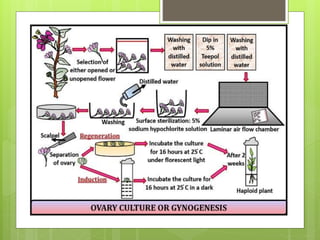
Ovary or ovule culture that results in the production
of haploids, known as gynogenic haploids.
ANDROGENESIS
 The androgenic method of haploid production is
from the male gametophyte of an angiosperm
plant, i.e. microspore (immature pollen).
 The principle is to stop the development of
pollen cell whose fate is normally to become a
gamete, i.e. a sexual cell, and to force its
development directly into a plant.
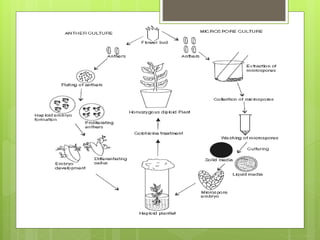
 Haploids can be obtained by the culture of
excised anthers and culture of isolated pollen
(microspore).
FACTOR AFFECTING ANDROGENESIS
 Physiological status of the donor plants
 Stage of pollen development
 Anther wall factor
 Genotype
 Pre-treatment of cultured anther/pollen grains
 Culture medium
 Culture density
 Effect of gaseous environment
 Effect of light
GYNOGENESIS
 Development of plants from unfertilized cells of
the female gametophyte (embryo sac), in floret,
ovary or ovule culture.
 It was first reported in barley by San Noeum
1976
 The gynogenic plants may arise through direct
embryogenesis, or the gametic cells may form a
callus followed by plant regeneration on another
medium.
FACTOR AFFECTINGgynoGENESIS
 Explant
 Pretreatment
 Culture medium
 Genotype
 Embryo sac stage
 Seasonal effect
 Physical factor
 Stage of harvest of ovule
 Growth condition of donor plant
APPLICATIONOF HAPLOIDPRODUCTION
 Development of pure homozygous lines
 Developing asexual lines of trees/perennial species
 Hybrid development
 Induction of mutation & genetic variability
 Cytogenetic research
 hybrid sorting in haploid breeding
 Disease, insect, salt resistance
 Doubled haploid in genome mapping
 Significance in early release of varieties
 Generation of Exclusively Male Plants and a few
others
PROBLEMS
 Production of gynogenic haploids through female
gametophyte still needs more refinement and also there
are problems in dissection of unfertilized ovules and
ovaries.
 High level of management and expertise is required to
operate the tissue culture production of haploids.
 Diploids and tetraploids often regenerate at the same
rate as the haploids.
 Selective cell division must take place in the haploid
microspores and not in other unwanted diploid tissues.
 The lack of selection of traits during the derivation of
haploid material.
 The doubling of a haploid does not always result in the
production of a homozygote.
Haploid Production - Techniques, Application & Problem

Haploid Production - Techniques, Application & Problem

  • 1.
  • 2.
    OVERVIEW  Introduction  Categoriesof haploid  Technique involved in haploid production  Androgenesis  Gynogenesis  Applications  Problems
  • 3.
    INTRODUCTION  The termhaploid refers to those plants which possess a gametophytic number of chromosomes single set in their sporophytes.  Artificial production of haploids was attempted through distant hybridization, delayed pollination, application of irradiated pollen, hormone treatment and temperature shock.  Haploid plants are of great significance for the production of homozygous lines (homozygous plants) and for the improvement of plants in plant breeding programme.  Haploid is applied to any plant originating from a sporophyte (2n) and containing (n) number of chromosomes.
  • 4.
    Haploids are broadlydividedinto two categories  Monoploids (monohapioids):- These are the haploids that possess half the number of chromosomes from a diploid species e.g. maize, barley.  Polyhaploids:- The haploids possessing half the number of chromosomes from a polyploid species are regarded as polyhaploids e.g. wheat, potato.
  • 5.
    TECHNIQUE  Androgenesis:- Haploid productionoccurs through anther or pollen culture, and they are referred to as androgenic haploids.  Gynogenesis:- Ovary or ovule culture that results in the production of haploids, known as gynogenic haploids.
  • 6.
    ANDROGENESIS  The androgenicmethod of haploid production is from the male gametophyte of an angiosperm plant, i.e. microspore (immature pollen).  The principle is to stop the development of pollen cell whose fate is normally to become a gamete, i.e. a sexual cell, and to force its development directly into a plant.  Haploids can be obtained by the culture of excised anthers and culture of isolated pollen (microspore).
  • 8.
    FACTOR AFFECTING ANDROGENESIS Physiological status of the donor plants  Stage of pollen development  Anther wall factor  Genotype  Pre-treatment of cultured anther/pollen grains  Culture medium  Culture density  Effect of gaseous environment  Effect of light
  • 9.
    GYNOGENESIS  Development ofplants from unfertilized cells of the female gametophyte (embryo sac), in floret, ovary or ovule culture.  It was first reported in barley by San Noeum 1976  The gynogenic plants may arise through direct embryogenesis, or the gametic cells may form a callus followed by plant regeneration on another medium.
  • 11.
    FACTOR AFFECTINGgynoGENESIS  Explant Pretreatment  Culture medium  Genotype  Embryo sac stage  Seasonal effect  Physical factor  Stage of harvest of ovule  Growth condition of donor plant
  • 12.
    APPLICATIONOF HAPLOIDPRODUCTION  Developmentof pure homozygous lines  Developing asexual lines of trees/perennial species  Hybrid development  Induction of mutation & genetic variability  Cytogenetic research  hybrid sorting in haploid breeding  Disease, insect, salt resistance  Doubled haploid in genome mapping  Significance in early release of varieties  Generation of Exclusively Male Plants and a few others
  • 13.
    PROBLEMS  Production ofgynogenic haploids through female gametophyte still needs more refinement and also there are problems in dissection of unfertilized ovules and ovaries.  High level of management and expertise is required to operate the tissue culture production of haploids.  Diploids and tetraploids often regenerate at the same rate as the haploids.  Selective cell division must take place in the haploid microspores and not in other unwanted diploid tissues.  The lack of selection of traits during the derivation of haploid material.  The doubling of a haploid does not always result in the production of a homozygote.