
QUORUM SENSING IN ARCHAEA
Presented to
Dr. Naeem Rashid
Dr. Mehwish Aslam
Under the Course Title of
Archaea, The Third Domain Of Life
Presenter
Zahra Naz
(PhD-BS06F18)
PhD Biological Sciences (2018)
School of Biological Sciences (SBS) 09/01/2019
POINTS TO BE DISCUSSED
1. Definition
2. History
3. Principle
4. Mechanism
5. Types of microbial interaction
6. Types of QS
7. Archaea & QS
8. Consequences
9. Applications of QS
10. Future perspective
11. Databases
12. Research on QS in Archaea
13. Summary
14. References
2
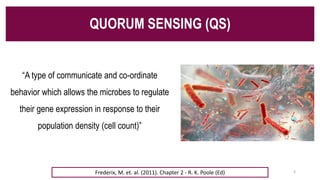
QUORUM SENSING (QS)
“A type of communicate and co-ordinate
behavior which allows the microbes to regulate
their gene expression in response to their
population density (cell count)”
Frederix, M. et. al. (2011). Chapter 2 - R. K. Poole (Ed) 3
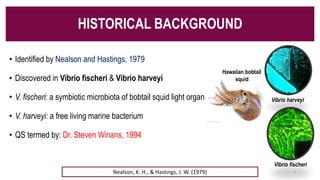
• Identified by Nealson and Hastings, 1979
• Discovered in Vibrio fischeri & Vibrio harveyi
• V. fischeri: a symbiotic microbiota of bobtail squid light organ
• V. harveyi: a free living marine bacterium
• QS termed by: Dr. Steven Winans, 1994
Nealson, K. H., & Hastings, J. W. (1979)
Hawaiian bobtail
squid
Vibrio harveyi
Vibrio fischeri
HISTORICAL BACKGROUND
4
“Regulation of gene expression through the production, release,
subsequent detection of and response to the threshold level of
synchronization molecules (autoinducers) in a microbial population”
BASIC PRINCIPLE
Abisado, R. G. et. al. (2018). doi: 10.1128/mBio.02331-17 5
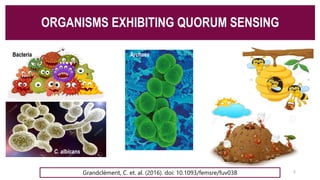
ORGANISMS EXHIBITING QUORUM SENSING
6
C. albicans
Bacteria Archaea
Grandclément, C. et. al. (2016). doi: 10.1093/femsre/fuv038
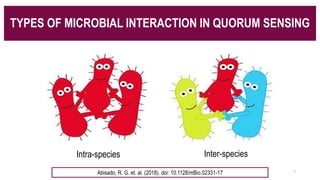
TYPES OF MICROBIAL INTERACTION IN QUORUM SENSING
7
Intra-species Inter-species
Abisado, R. G. et. al. (2018). doi: 10.1128/mBio.02331-17
https://sites.tufts.edu/quorumsensing/quorumsensing101/
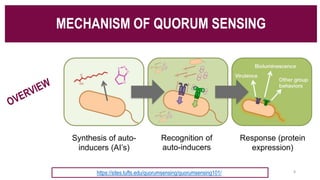
MECHANISM OF QUORUM SENSING
Response (protein
expression)
Synthesis of auto-
inducers (AI’s)
Recognition of
auto-inducers
8
TYPES OF QUORUM SENSING BASED ON AUTO-INDUCERS
Pan, J. et. al. (2009). doi: 10.1517/13543770903222293 9
#. Type of QS
system
Auto-inducer
(AI)
Description of AI’s
1 Type 1 AI-1 Acylated homoserine
lactones (AHLs)
2 Type 2 AIP Auto-inducer peptides
3 Type 3 (hybrid) AI-1 + AI-2 AHL’s + Furanosyl
borate diester (AI-2)
Furanosyl borate diester
AIP
AHL
• Signal transduction: One component
• Enzyme: Lux1 (Acyl-homoserine-lactone synthase)
• Auto-inducer: N- acyl-homoserine lactones (AHLs)
• Receptors: LuxR (Acyl-homoserine-lactone receptor)
• Gene regulation for: Antibiotic production,
Biofilm formation,
Luminescence,
Virulence
TYPE 1: AI-1 BASED QUORUM SENSING
Federle, M. J. et. al. (2003). doi: 10.1172/JC0I20195 10
ABC
Protein precursor
locus
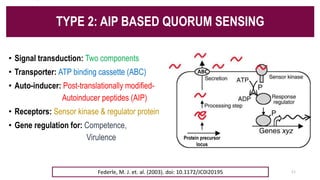
TYPE 2: AIP BASED QUORUM SENSING
• Signal transduction: Two components
• Transporter: ATP binding cassette (ABC)
• Auto-inducer: Post-translationally modified-
Autoinducer peptides (AIP)
• Receptors: Sensor kinase & regulator protein
• Gene regulation for: Competence,
Virulence
Federle, M. J. et. al. (2003). doi: 10.1172/JC0I20195 11
TYPE 3: AI-2 BASED / HYBRID QUORUM SENSING
• Signal transduction: Two components, two parallel systems
• Enzyme: LuxLM, LuxN, LuxO, LuxP,
LuxQ, LuxR, LuxS, LuxU
• Auto-inducer: Furanosyl borate diester (AI-2),
N- acyl-homoserine lactones (AI-1)
• Receptors: Kinases & regulator protein
• Gene regulation for: Luminescence
Federle, M. J. et. al. (2003). doi: 10.1172/JC0I20195 12
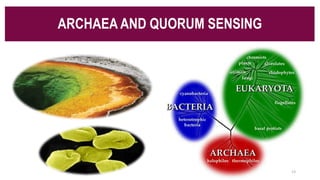
ARCHAEA AND QUORUM SENSING
13
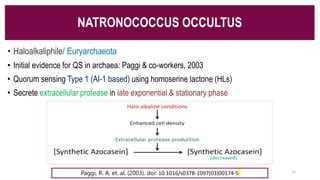
NATRONOCOCCUS OCCULTUS
• Haloalkaliphile/ Euryarchaeota
• Initial evidence for QS in archaea: Paggi & co-workers, 2003
• Quorum sensing Type 1 (AI-1 based) using homoserine lactone (HLs)
• Secrete extracellular protease in late exponential & stationary phase
Paggi, R. A. et. al. (2003). doi: 10.1016/s0378-1097(03)00174-5 14
METHANOSAETA HARUNDINACEA 6AC
• Haloalkaliphile /methanogen/ Euryarchaeota
• Carboxylated- acyl homoserine lactone (AHL)/ AI-1 based QS
• Showed a cell density-dependent physiology transition
• Different gene expression in single cell and filamentous form
Zhang, G. et. al. (2012). doi: 10.1038/ismej.2011.203 15
CONSEQUENCES OF QUORUM SENSING IN ARCHAEA
1. Biofilm formation
o M. jannaschii + bacterium T. maritima = exopolysaccharide (EPS) biofilm
o P. furiosus + Methanopyrus kandleri = proposed to form biofilm but yet uncertain
2. Extracellular enzymes
o Nep: halosin-like protease from Natrialba magadii
3. Membrane vesicle formations
Pan, J. et. al. (2009). doi: 10.1517/13543770903222293 16
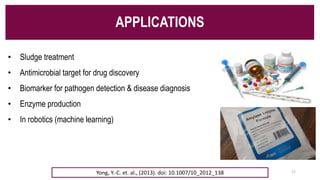
APPLICATIONS
Yong, Y.-C. et. al., (2013). doi: 10.1007/10_2012_138
• Sludge treatment
• Antimicrobial target for drug discovery
• Biomarker for pathogen detection & disease diagnosis
• Enzyme production
• In robotics (machine learning)
17
FUTURE PERSPECTIVES
• Identification of the Carboxylated auto-inducers (AI’s) in other archaea (Bioinformatics
and wet lab-work)
• Isolation and biochemical characterization of archaeal AI’s
• Strategies for purification of commercially valuable products from QS exhibiting archaea
18
Paggi, R. A. et. al. (2003). doi: 10.1016/s0378-1097(03)00174-5
DATABASES
SigMol: Repertoire of quorum sensing signaling molecules in prokaryotes
http://bioinfo.imtech.res.in/manojk/sigmol/
Quorumpeps® : A resource of quorum sensing signaling peptides
http://quorumpeps.ugent.be/
19
Research in World on “QUORUM SENSING IN ARCHAEA”
University of New South Wales, Australia
20
SUMMARY
“Quorum sensing is a proven gift of nature for organisms to
survive in groups in extreme conditions but the mechanism
varies from domain to domain, and species to species. The
mentioned process is supposed to exist in most of archaeal
species and needs more digging.”
21
REFERENCES TO GO THROUGH…!
• Zhang, G., Zhang, F., Ding, G., Li, J., Guo, X., Zhu, J., . . . Dong, X. (2012). Acyl homoserine lactone-based quorum sensing
in a methanogenic archaeon. The ISME journal, 6(7), 1336-1344. doi: 10.1038/ismej.2011.203.
• Federle, M. J., & Bassler, B. L. (2003). Interspecies communication in bacteria. The Journal of clinical investigation, 112(9),
1291-1299. doi: 10.1172/JCI20195.
• Mackin, C. (2011). Quorum Sensing in Archaea. (PhD), University of Connecticut, Storrs, Connecticut, United States.
Retrieved from https://opencommons.uconn.edu/srhonors_theses/206/ Honors Scholar Theses. database. (206).
• Hadla, M., & Halabi, M. A. (2018). Chapter Three - Effect of Quorum Sensing. In D. S. Chormey, S. Bakırdere, N. B. Turan
& G. Ö. Engin (Eds.), Comprehensive Analytical Chemistry (Vol. 81, pp. 95-116): Elsevier.
• Kaur, A., Capalash, N., & Sharma, P. (2018). Quorum sensing in thermophiles: prevalence of autoinducer-2 system. BMC
Microbiology, 18(1), 62. doi: 10.1186/s12866-018-1204-x.
• Charlesworth, J. C., Beloe, C., Watters, C., & Burns, B. P. (2017). Quorum Sensing in Archaea: Recent Advances and
Emerging Directions. In G. Witzany (Ed.), Biocommunication of Archaea (pp. 119-132).
• Paggi, R. A., Martone, C. B., Fuqua, C., & De Castro, R. E. (2003). Detection of quorum sensing signals in the
haloalkaliphilic archaeon Natronococcus occultus. FEMS Microbiol Lett, 221(1), 49-52. 22
Thank You!
23
24
Questions & Answers

Quorum sensing in Archaea

  • 1.
    QUORUM SENSING INARCHAEA Presented to Dr. Naeem Rashid Dr. Mehwish Aslam Under the Course Title of Archaea, The Third Domain Of Life Presenter Zahra Naz (PhD-BS06F18) PhD Biological Sciences (2018) School of Biological Sciences (SBS) 09/01/2019
  • 2.
    POINTS TO BEDISCUSSED 1. Definition 2. History 3. Principle 4. Mechanism 5. Types of microbial interaction 6. Types of QS 7. Archaea & QS 8. Consequences 9. Applications of QS 10. Future perspective 11. Databases 12. Research on QS in Archaea 13. Summary 14. References 2
  • 3.
    QUORUM SENSING (QS) “Atype of communicate and co-ordinate behavior which allows the microbes to regulate their gene expression in response to their population density (cell count)” Frederix, M. et. al. (2011). Chapter 2 - R. K. Poole (Ed) 3
  • 4.
    • Identified byNealson and Hastings, 1979 • Discovered in Vibrio fischeri & Vibrio harveyi • V. fischeri: a symbiotic microbiota of bobtail squid light organ • V. harveyi: a free living marine bacterium • QS termed by: Dr. Steven Winans, 1994 Nealson, K. H., & Hastings, J. W. (1979) Hawaiian bobtail squid Vibrio harveyi Vibrio fischeri HISTORICAL BACKGROUND 4
  • 5.
    “Regulation of geneexpression through the production, release, subsequent detection of and response to the threshold level of synchronization molecules (autoinducers) in a microbial population” BASIC PRINCIPLE Abisado, R. G. et. al. (2018). doi: 10.1128/mBio.02331-17 5
  • 6.
    ORGANISMS EXHIBITING QUORUMSENSING 6 C. albicans Bacteria Archaea Grandclément, C. et. al. (2016). doi: 10.1093/femsre/fuv038
  • 7.
    TYPES OF MICROBIALINTERACTION IN QUORUM SENSING 7 Intra-species Inter-species Abisado, R. G. et. al. (2018). doi: 10.1128/mBio.02331-17
  • 8.
    https://sites.tufts.edu/quorumsensing/quorumsensing101/ MECHANISM OF QUORUMSENSING Response (protein expression) Synthesis of auto- inducers (AI’s) Recognition of auto-inducers 8
  • 9.
    TYPES OF QUORUMSENSING BASED ON AUTO-INDUCERS Pan, J. et. al. (2009). doi: 10.1517/13543770903222293 9 #. Type of QS system Auto-inducer (AI) Description of AI’s 1 Type 1 AI-1 Acylated homoserine lactones (AHLs) 2 Type 2 AIP Auto-inducer peptides 3 Type 3 (hybrid) AI-1 + AI-2 AHL’s + Furanosyl borate diester (AI-2) Furanosyl borate diester AIP AHL
  • 10.
    • Signal transduction:One component • Enzyme: Lux1 (Acyl-homoserine-lactone synthase) • Auto-inducer: N- acyl-homoserine lactones (AHLs) • Receptors: LuxR (Acyl-homoserine-lactone receptor) • Gene regulation for: Antibiotic production, Biofilm formation, Luminescence, Virulence TYPE 1: AI-1 BASED QUORUM SENSING Federle, M. J. et. al. (2003). doi: 10.1172/JC0I20195 10
  • 11.
    ABC Protein precursor locus TYPE 2:AIP BASED QUORUM SENSING • Signal transduction: Two components • Transporter: ATP binding cassette (ABC) • Auto-inducer: Post-translationally modified- Autoinducer peptides (AIP) • Receptors: Sensor kinase & regulator protein • Gene regulation for: Competence, Virulence Federle, M. J. et. al. (2003). doi: 10.1172/JC0I20195 11
  • 12.
    TYPE 3: AI-2BASED / HYBRID QUORUM SENSING • Signal transduction: Two components, two parallel systems • Enzyme: LuxLM, LuxN, LuxO, LuxP, LuxQ, LuxR, LuxS, LuxU • Auto-inducer: Furanosyl borate diester (AI-2), N- acyl-homoserine lactones (AI-1) • Receptors: Kinases & regulator protein • Gene regulation for: Luminescence Federle, M. J. et. al. (2003). doi: 10.1172/JC0I20195 12
  • 13.
  • 14.
    NATRONOCOCCUS OCCULTUS • Haloalkaliphile/Euryarchaeota • Initial evidence for QS in archaea: Paggi & co-workers, 2003 • Quorum sensing Type 1 (AI-1 based) using homoserine lactone (HLs) • Secrete extracellular protease in late exponential & stationary phase Paggi, R. A. et. al. (2003). doi: 10.1016/s0378-1097(03)00174-5 14
  • 15.
    METHANOSAETA HARUNDINACEA 6AC •Haloalkaliphile /methanogen/ Euryarchaeota • Carboxylated- acyl homoserine lactone (AHL)/ AI-1 based QS • Showed a cell density-dependent physiology transition • Different gene expression in single cell and filamentous form Zhang, G. et. al. (2012). doi: 10.1038/ismej.2011.203 15
  • 16.
    CONSEQUENCES OF QUORUMSENSING IN ARCHAEA 1. Biofilm formation o M. jannaschii + bacterium T. maritima = exopolysaccharide (EPS) biofilm o P. furiosus + Methanopyrus kandleri = proposed to form biofilm but yet uncertain 2. Extracellular enzymes o Nep: halosin-like protease from Natrialba magadii 3. Membrane vesicle formations Pan, J. et. al. (2009). doi: 10.1517/13543770903222293 16
  • 17.
    APPLICATIONS Yong, Y.-C. et.al., (2013). doi: 10.1007/10_2012_138 • Sludge treatment • Antimicrobial target for drug discovery • Biomarker for pathogen detection & disease diagnosis • Enzyme production • In robotics (machine learning) 17
  • 18.
    FUTURE PERSPECTIVES • Identificationof the Carboxylated auto-inducers (AI’s) in other archaea (Bioinformatics and wet lab-work) • Isolation and biochemical characterization of archaeal AI’s • Strategies for purification of commercially valuable products from QS exhibiting archaea 18 Paggi, R. A. et. al. (2003). doi: 10.1016/s0378-1097(03)00174-5
  • 19.
    DATABASES SigMol: Repertoire ofquorum sensing signaling molecules in prokaryotes http://bioinfo.imtech.res.in/manojk/sigmol/ Quorumpeps® : A resource of quorum sensing signaling peptides http://quorumpeps.ugent.be/ 19
  • 20.
    Research in Worldon “QUORUM SENSING IN ARCHAEA” University of New South Wales, Australia 20
  • 21.
    SUMMARY “Quorum sensing isa proven gift of nature for organisms to survive in groups in extreme conditions but the mechanism varies from domain to domain, and species to species. The mentioned process is supposed to exist in most of archaeal species and needs more digging.” 21
  • 22.
    REFERENCES TO GOTHROUGH…! • Zhang, G., Zhang, F., Ding, G., Li, J., Guo, X., Zhu, J., . . . Dong, X. (2012). Acyl homoserine lactone-based quorum sensing in a methanogenic archaeon. The ISME journal, 6(7), 1336-1344. doi: 10.1038/ismej.2011.203. • Federle, M. J., & Bassler, B. L. (2003). Interspecies communication in bacteria. The Journal of clinical investigation, 112(9), 1291-1299. doi: 10.1172/JCI20195. • Mackin, C. (2011). Quorum Sensing in Archaea. (PhD), University of Connecticut, Storrs, Connecticut, United States. Retrieved from https://opencommons.uconn.edu/srhonors_theses/206/ Honors Scholar Theses. database. (206). • Hadla, M., & Halabi, M. A. (2018). Chapter Three - Effect of Quorum Sensing. In D. S. Chormey, S. Bakırdere, N. B. Turan & G. Ö. Engin (Eds.), Comprehensive Analytical Chemistry (Vol. 81, pp. 95-116): Elsevier. • Kaur, A., Capalash, N., & Sharma, P. (2018). Quorum sensing in thermophiles: prevalence of autoinducer-2 system. BMC Microbiology, 18(1), 62. doi: 10.1186/s12866-018-1204-x. • Charlesworth, J. C., Beloe, C., Watters, C., & Burns, B. P. (2017). Quorum Sensing in Archaea: Recent Advances and Emerging Directions. In G. Witzany (Ed.), Biocommunication of Archaea (pp. 119-132). • Paggi, R. A., Martone, C. B., Fuqua, C., & De Castro, R. E. (2003). Detection of quorum sensing signals in the haloalkaliphilic archaeon Natronococcus occultus. FEMS Microbiol Lett, 221(1), 49-52. 22
  • 23.
  • 24.

Editor's Notes

  • #4 Quorum sensing is a particularly well-studied form of microbial communication in which messenger molecules are released into the environment until a critical threshold of signal is reached triggering phenotypic change(s). These messenger molecules are often subject to diffusion leading quorum sensing to be sometimes referred to as diffusion sensing, and typically this means quorum sensing phenotypes are often observed in the latter phases of growth when cell density is high. Microbes live together, eat together and stay together
  • #5 Lux operon was discovered as QS regulatory coding region. Quorum sensing in Vibrio fischeri Research into AHL based quorum sensing started in the late 1960s. The marine bioluminescent bacteria Vibrio fischeri was being grown in liquid cultures and it was observed that the cultures produced light only when large numbers of bacteria were present (Greenberg, 1997). The initial explanation for this was that the culture media contained an inhibitor of luminescence, which was removed by the bacteria when large numbers were present (Kempner & Hanson, 1968). This was suggested because when grown in media "conditioned" by preliminary exposure to the bacteria, luminescence could be induced even at low cell densities. It was later shown that the luminescence was initiated not by the removal of an inhibitor but by the accumulation of an activator molecule or "autoinducer" (Nealson et al, 1970, Eberhard, 1972). This molecule is made by the bacteria and activates luminescence when it has accumulated to a high enough concentration. The bacteria are able to sense their cell density by monitoring the autoinducer concentration. This mechanism of cell density sensing was termed quorum sensing (QS). The molecule produced by V. fischeri was first isolated and characterised in 1981 by Eberhard et al. and identified as N-(3-oxohexanoyl)-homoserine lactone (3-oxo-C6-HSL). Analysis of the genes involved in QS in V. fischeri was first carried out by Engebrecht et al (1983). This led to the basic model for quorum sensing in V. fischeri which is now a paradigm for other similar quorum sensing systems.
  • #6 These molecules, called autoinducers, have the ability of triggering the release of more of the same kind, when sensed. Hence, as the population of bacteria grows, the extracellular concentration of autoinducers increases as well. If, at a certain point, the concentration of synchronization molecules reaches a critical threshold, it means that a certain population has been attained. That situation is sensed by the group, which responds to it with a population-wide regulation of the gene expression.
  • #7 Naturally in insects Physics (artificial intelligence), decision making, machine learning
  • #9 General mechanism of QS in microbes, these mechanisms are identified in bacteria and then implied in archaea 3 steps (Quorum Sensing: Bacteria Talk Sense) Quorum sensing can be divided into at least 4 steps: (1) production of small biochemical signal molecules by the bacterial cell; (2) release of the signal molecules, either actively or passively, into the surrounding environment; and (3) recognition of the signal molecules by specific receptors once they exceed a threshold concentration, leading to (4) changes in gene regulation. One common consequence of quorum sensing induction of gene expression is increased synthesis of the proteins involved in signal molecule production. Increased synthesis of the signal molecule creates a positive feedback loop, which is why quorum signals are commonly called autoinducers.
  • #10 AI’s= Small molecular weight compounds (overview in the table) gram-positive bacteria use, which act through two-component phosphorelay cascades Lactones are cyclic esters (OCO) of hydroxycarboxylic acids
  • #11 Acyl-homoserine-lactone synthase: This enzyme catalyses the following chemical reaction. Homoserine, or its lactone form, is the product of a cyanogen bromide cleavage of a peptide by degradation of methionine. acyl-[acyl-carrier protein] + S-adenosyl-L-methionine ⇌ {\displaystyle \rightleftharpoons } [acyl-carrier protein] + S-methyl-5'-thioadenosine + N-acyl-L-homoserine lactone. 3. AHLs are produced by the LuxI synthase and will bind to the cognate LuxR receptor. The AHL-LuxR protein complex will bind to promoter DNA elements and regulate transcription of QS-regulated genes. Biofilm formation Pseudomonas aeruginosa Virulence Vibrio cholerae Antibiotic production Photorhabdus luminescences
  • #12 Gram-positive bacteria synthesize AIP that are post-translationally modified and secreted. AIP detection occurs via a two-component signal transduction circuit, leading to the ATP-driven phosphorylation of a response regulator protein, which then binds to promoter DNA and regulates transcription of QS-regulated genes. Competence in B. subtilis (ability to uptake foreign DNA) he accessory gene regulatory (agr) operon of the opportunistic human pathogen Staphylococcus aureus is a prime pathogenesis factor
  • #13 Quorum sensing in Vibrio harveyi. Two parallel two-component systems detect AI-1 (blue triangles), an AHL synthesized by LuxLM, and AI-2 (red circles), a furanosyl borate diester, which is synthesized by LuxS. In the absence of autoinducer, the sensors act as kinases and autophosphorylate at a conserved histidine residue, H1, and the phosphate is transferred to a conserved aspartate residue, D1, in the response regulator domain. Phosphate is sequentially transferred to the conserved histidine (H2) of the phosphotransferase LuxU and then to the conserved aspartate (D2) of the response regulator LuxO. Phospho-LuxO indirectly represses transcription of luxCDABE, the enzymes encoding luciferase. Binding of the autoinducers by LuxN and LuxPQ leads to the dephosphorylation of LuxU and LuxO. Dephosphorylation of LuxO relieves repression of luxCDABE. A transcriptional activator called LuxR (not similar to LuxR in a) is required for expression of luxCDABE.
  • #14 beyond bacteria, this cell-to-cell communication mechanism is poorly understood. Then why we want to study QS in archaea? Because we wish to explore the reason for the survival of this micro-creature in extreme environment.
  • #15 1. No >2 reports about QS or QS- like mechanisms in archaea 2. Protease secretion is commonly monitored by quorum sensing in bacteria, leading to the idea that some extracellular proteases are possibly regulated by the same quorum sensing mechanism in archaea. Isolated from Soda lake Lake Magadi. environments with 8–30% NaCl, pH range of 8.5–11 (optimum at 9.5) and a temperature range of 20–50 °C (optimum at 40 °C). Further confirmation is required
  • #16 1. isolated from an upflow anaerobic sludge blanket reactor treating beer-manufacture wastewater in Beijing, China. 2. a bacterial luxI–luxR-like circuit was observed in M. harundinacea 6Ac and a luxI homolog called the filI gene was shown to encode AHL synthase. This archaeal enzyme synthesized a group of carboxylated AHL with 10–14 carbon atoms in the acyl chain. 3. In the filaments, genes encoding enzymes in the methanogenesis pathway were upregulated, whereas those for cellular carbon assimilation were downregulated. 4. A luxI–luxR ortholog filI–filR was present in the genome of strain 6Ac. 5. This discovery of AHL-based quorum sensing systems in methanogenic archaea implies that quorum sensing mechanisms are universal among prokaryotes. In the filaments,
  • #17 MV formation also occurs in archaea, such as by sulfolobus These MVs are also utilised by these archaea to export bioactive molecules such as the sulfolobicins. It is proposed that MV formation is quorum sensing regulated in archaea as observed in bacteria, and thus is a viable candidate for future research concerning quorum sensing in archaea.
  • #18 Archaea can be made to form biofilm and then use those archaeal biofilms at high temperature for thein enzymes e.g. amylases, pullulanases
  • #19 In research, nothing is supposed to be end…So, we can have a chance to work on ::::
  • #22 Here Conclude my talk with few words extremophilic archaea So good luck you people if you could achieve a milestone.
  • #23 For deep in-sight