The branch of biology that deals with identifying and naming organisms is  taxonomy . In the 1700s,  Carl von Linne  (Linnaeus) of Sweden determined a classification system for minerals, plants, and animals. Kingdom, Phylum, Class, Oder, Family, Genus, Species Binomial Nomenclature – 2 word naming system Genus and species Latin Descriptive, no slang, universal
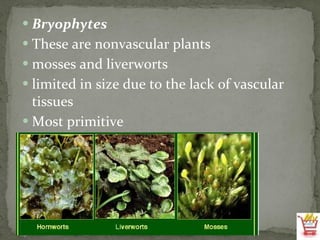
Bryophytes  These are nonvascular plants mosses and liverworts limited in size due to the lack of vascular tissues Most primitive
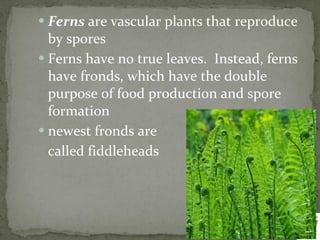
Ferns  are vascular plants that reproduce by spores Ferns have no true leaves.  Instead, ferns have fronds, which have the double purpose of food production and spore formation newest fronds are  called fiddleheads
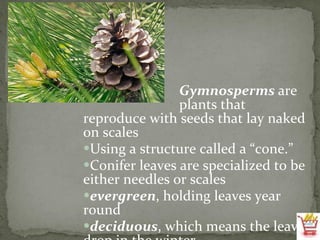
Gymnosperms  are  plants that reproduce with seeds that lay naked on scales Using a structure called a “cone.”  Conifer leaves are specialized to be either needles or scales evergreen , holding leaves year round deciduous , which means the leaves drop in the winter
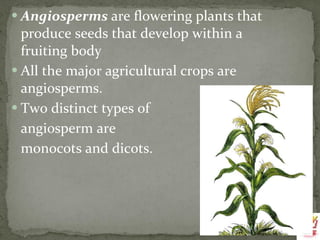
Angiosperms  are flowering plants that produce seeds that develop within a fruiting body All the major agricultural crops are angiosperms.  Two distinct types of  angiosperm are  monocots and dicots.  
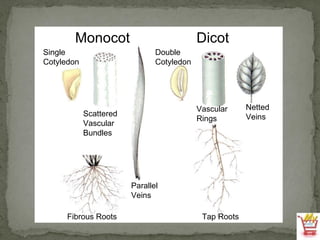
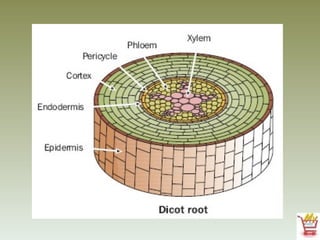
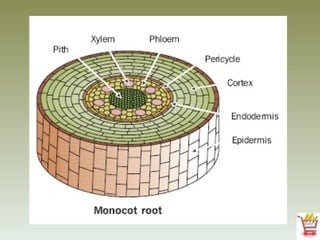
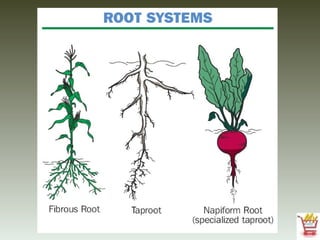
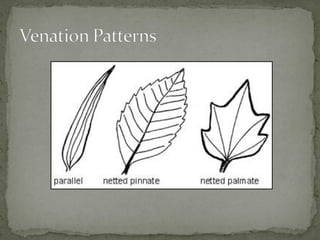
Single Cotyledon Scattered Vascular Bundles Parallel Veins Fibrous Roots Double Cotyledon Vascular Rings Netted Veins Tap Roots Monocot Dicot


The  cell wall  is a protective layer made of cellulose which surrounds the cell.  The  cell membrane  is a thin film comprised of 2 fatty layers that surround the cell and regulate the movement of material into and out of the cell.
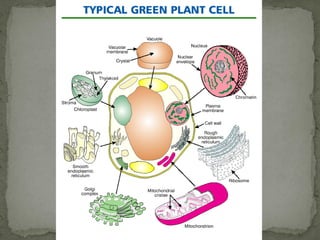
Cytoplasm  is the semi-fluid inside the cell membrane which surrounds the organelles. Organelles  are small structures inside the cell which carry out the physiological processes of the organism.
Chloroplasts  are membranes filled with chlorophyll and are the site of photosynthesis. Nucleus  contains the chromosomes. It is surrounded by a membrane that allows the movement of materials needed for protein synthesis to pass through.
Endoplasmic reticulum  is a system of tubes which move compounds through the cell to the ribosomes for protein synthesis. Mitochondria  are the site of cellular respiration.
Golgi apparatus  processes, packages, and transports compounds through the cell. Ribosomes  assemble amino acids into proteins. Vacuole  is a large storage compartment filled mostly with water.
 
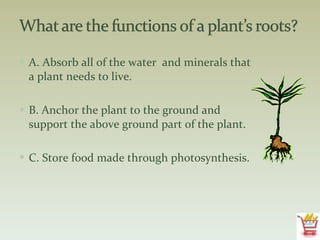
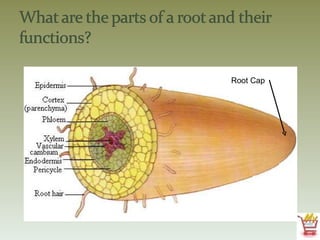
A. Absorb all of the water  and minerals that a plant needs to live. B. Anchor the plant to the ground and support the above ground part of the plant.  C. Store food made through photosynthesis.
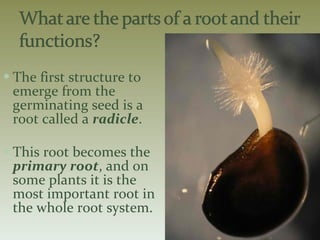
The first structure to emerge from the germinating seed is a root called a  radicle . This root becomes the  primary root , and on some plants it is the most important root in the whole root system.
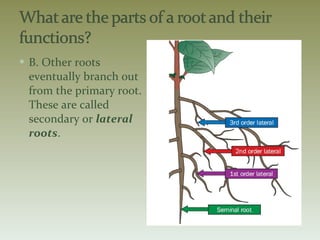
B. Other roots eventually branch out from the primary root. These are called secondary or  lateral roots .
Root Cap


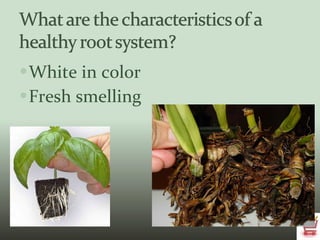
White in color Fresh smelling
 
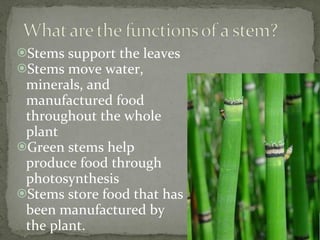
Stems support the leaves Stems move water, minerals, and manufactured food throughout the whole plant Green stems help produce food through photosynthesis Stems store food that has been manufactured by the plant.
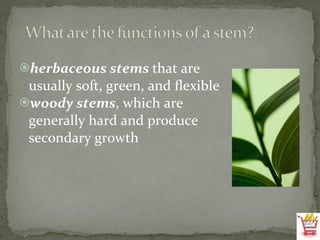
herbaceous stems  that are usually soft, green, and flexible woody stems , which are generally hard and produce secondary growth
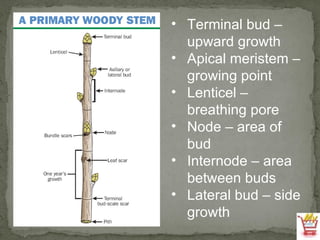
Terminal bud – upward growth Apical meristem – growing point Lenticel – breathing pore Node – area of bud Internode – area between buds Lateral bud – side growth
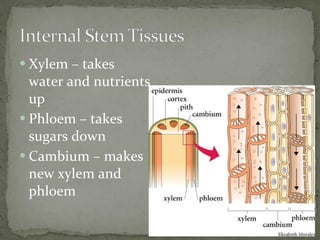
Xylem – takes water and nutrients up Phloem – takes sugars down Cambium – makes new xylem and phloem
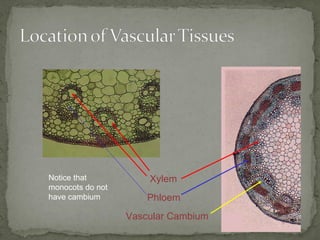
Xylem Phloem Vascular Cambium Notice that monocots do not have cambium
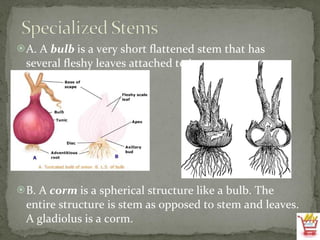
A. A  bulb  is a very short flattened stem that has several fleshy leaves attached to it.  B. A  corm  is a spherical structure like a bulb. The entire structure is stem as opposed to stem and leaves. A gladiolus is a corm.
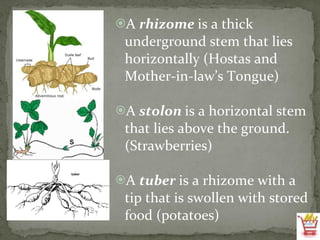
A  rhizome  is a thick underground stem that lies horizontally (Hostas and Mother-in-law’s Tongue) A  stolon  is a horizontal stem that lies above the ground. (Strawberries) A  tuber  is a rhizome with a tip that is swollen with stored food (potatoes)
 
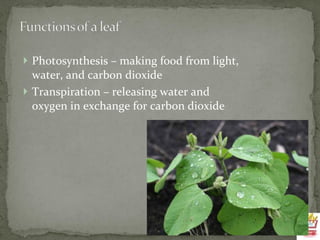
Photosynthesis – making food from light, water, and carbon dioxide Transpiration – releasing water and oxygen in exchange for carbon dioxide
 
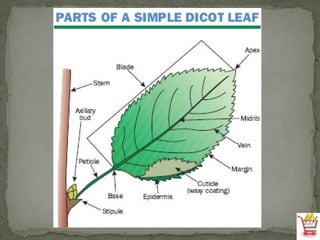
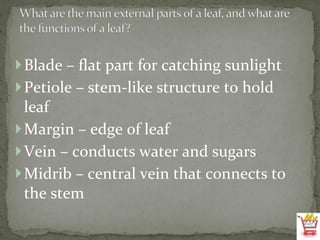
Blade – flat part for catching sunlight Petiole – stem-like structure to hold leaf Margin – edge of leaf Vein – conducts water and sugars Midrib – central vein that connects to the stem
 
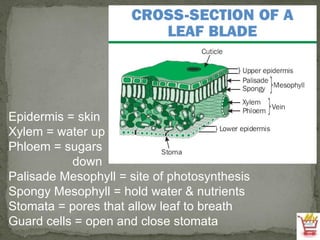
Epidermis = skin Xylem = water up Phloem = sugars  down Palisade Mesophyll = site of photosynthesis Spongy Mesophyll = hold water & nutrients Stomata = pores that allow leaf to breath Guard cells = open and close stomata


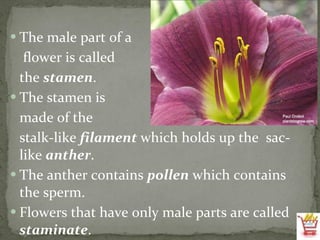
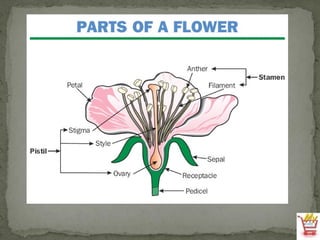
The male part of a   flower is called  the  stamen . The stamen is  made of the  stalk-like  filament  which holds up the  sac-like  anther . The anther contains  pollen  which contains the sperm. Flowers that have only male parts are called  staminate .
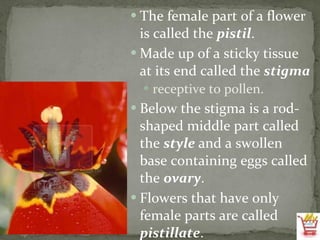
The female part of a flower is called the  pistil . Made up of a sticky tissue at its end called the  stigma receptive to pollen. Below the stigma is a rod-shaped middle part called the  style  and a swollen base containing eggs called the  ovary .  Flowers that have only female parts are called  pistillate .
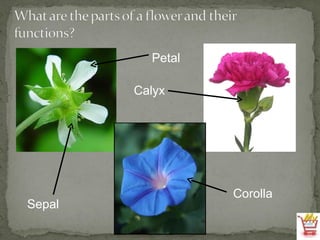
Petal Calyx Corolla Sepal
 
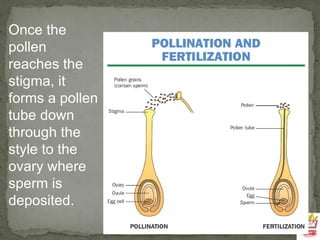
Once the pollen reaches the stigma, it forms a pollen tube down through the style to the ovary where sperm is deposited.
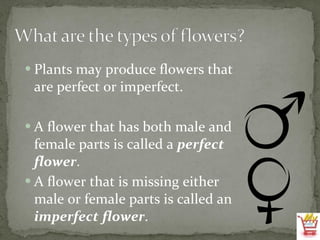
Plants may produce flowers that are perfect or imperfect. A flower that has both male and female parts is called a  perfect flower . A flower that is missing either male or female parts is called an  imperfect   flower .
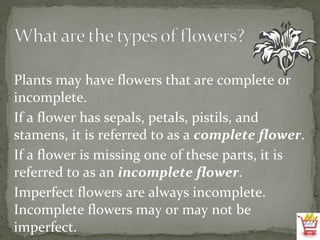
Plants may have flowers that are complete or incomplete. If a flower has sepals, petals, pistils, and stamens, it is referred to as a  complete   flower . If a flower is missing one of these parts, it is referred to as an  incomplete   flower . Imperfect flowers are always incomplete. Incomplete flowers may or may not be imperfect.

Plant science ppt

  • 1.
  • 2.
    The branch ofbiology that deals with identifying and naming organisms is taxonomy . In the 1700s, Carl von Linne (Linnaeus) of Sweden determined a classification system for minerals, plants, and animals. Kingdom, Phylum, Class, Oder, Family, Genus, Species Binomial Nomenclature – 2 word naming system Genus and species Latin Descriptive, no slang, universal
  • 3.
    Bryophytes Theseare nonvascular plants mosses and liverworts limited in size due to the lack of vascular tissues Most primitive
  • 4.
    Ferns arevascular plants that reproduce by spores Ferns have no true leaves. Instead, ferns have fronds, which have the double purpose of food production and spore formation newest fronds are called fiddleheads
  • 5.
    Gymnosperms are plants that reproduce with seeds that lay naked on scales Using a structure called a “cone.” Conifer leaves are specialized to be either needles or scales evergreen , holding leaves year round deciduous , which means the leaves drop in the winter
  • 6.
    Angiosperms areflowering plants that produce seeds that develop within a fruiting body All the major agricultural crops are angiosperms. Two distinct types of angiosperm are monocots and dicots.  
  • 7.
    Single Cotyledon ScatteredVascular Bundles Parallel Veins Fibrous Roots Double Cotyledon Vascular Rings Netted Veins Tap Roots Monocot Dicot
  • 8.
  • 9.
  • 10.
  • 11.
    The cellwall is a protective layer made of cellulose which surrounds the cell. The cell membrane is a thin film comprised of 2 fatty layers that surround the cell and regulate the movement of material into and out of the cell.
  • 12.
    Cytoplasm isthe semi-fluid inside the cell membrane which surrounds the organelles. Organelles are small structures inside the cell which carry out the physiological processes of the organism.
  • 13.
    Chloroplasts aremembranes filled with chlorophyll and are the site of photosynthesis. Nucleus contains the chromosomes. It is surrounded by a membrane that allows the movement of materials needed for protein synthesis to pass through.
  • 14.
    Endoplasmic reticulum is a system of tubes which move compounds through the cell to the ribosomes for protein synthesis. Mitochondria are the site of cellular respiration.
  • 15.
    Golgi apparatus processes, packages, and transports compounds through the cell. Ribosomes assemble amino acids into proteins. Vacuole is a large storage compartment filled mostly with water.
  • 16.
  • 17.
    A. Absorb allof the water and minerals that a plant needs to live. B. Anchor the plant to the ground and support the above ground part of the plant. C. Store food made through photosynthesis.
  • 18.
    The first structureto emerge from the germinating seed is a root called a radicle . This root becomes the primary root , and on some plants it is the most important root in the whole root system.
  • 19.
    B. Other rootseventually branch out from the primary root. These are called secondary or lateral roots .
  • 20.
  • 21.
  • 22.
  • 23.
  • 24.
    White in colorFresh smelling
  • 25.
  • 26.
    Stems support theleaves Stems move water, minerals, and manufactured food throughout the whole plant Green stems help produce food through photosynthesis Stems store food that has been manufactured by the plant.
  • 27.
    herbaceous stems that are usually soft, green, and flexible woody stems , which are generally hard and produce secondary growth
  • 28.
    Terminal bud –upward growth Apical meristem – growing point Lenticel – breathing pore Node – area of bud Internode – area between buds Lateral bud – side growth
  • 29.
    Xylem – takeswater and nutrients up Phloem – takes sugars down Cambium – makes new xylem and phloem
  • 30.
    Xylem Phloem VascularCambium Notice that monocots do not have cambium
  • 31.
    A. A bulb is a very short flattened stem that has several fleshy leaves attached to it. B. A corm is a spherical structure like a bulb. The entire structure is stem as opposed to stem and leaves. A gladiolus is a corm.
  • 32.
    A rhizome is a thick underground stem that lies horizontally (Hostas and Mother-in-law’s Tongue) A stolon is a horizontal stem that lies above the ground. (Strawberries) A tuber is a rhizome with a tip that is swollen with stored food (potatoes)
  • 33.
  • 34.
    Photosynthesis – makingfood from light, water, and carbon dioxide Transpiration – releasing water and oxygen in exchange for carbon dioxide
  • 35.
  • 36.
    Blade – flatpart for catching sunlight Petiole – stem-like structure to hold leaf Margin – edge of leaf Vein – conducts water and sugars Midrib – central vein that connects to the stem
  • 37.
  • 38.
    Epidermis = skinXylem = water up Phloem = sugars down Palisade Mesophyll = site of photosynthesis Spongy Mesophyll = hold water & nutrients Stomata = pores that allow leaf to breath Guard cells = open and close stomata
  • 39.
  • 40.
  • 41.
  • 42.
  • 43.
  • 44.
  • 45.
  • 46.
  • 47.
    The male partof a flower is called the stamen . The stamen is made of the stalk-like filament which holds up the sac-like anther . The anther contains pollen which contains the sperm. Flowers that have only male parts are called staminate .
  • 48.
    The female partof a flower is called the pistil . Made up of a sticky tissue at its end called the stigma receptive to pollen. Below the stigma is a rod-shaped middle part called the style and a swollen base containing eggs called the ovary . Flowers that have only female parts are called pistillate .
  • 49.
  • 50.
  • 51.
    Once the pollenreaches the stigma, it forms a pollen tube down through the style to the ovary where sperm is deposited.
  • 52.
    Plants may produceflowers that are perfect or imperfect. A flower that has both male and female parts is called a perfect flower . A flower that is missing either male or female parts is called an imperfect flower .
  • 53.
    Plants may haveflowers that are complete or incomplete. If a flower has sepals, petals, pistils, and stamens, it is referred to as a complete flower . If a flower is missing one of these parts, it is referred to as an incomplete flower . Imperfect flowers are always incomplete. Incomplete flowers may or may not be imperfect.