Plant Anatomy and
Physiology
What are the parts of the plant, and
how do they work?
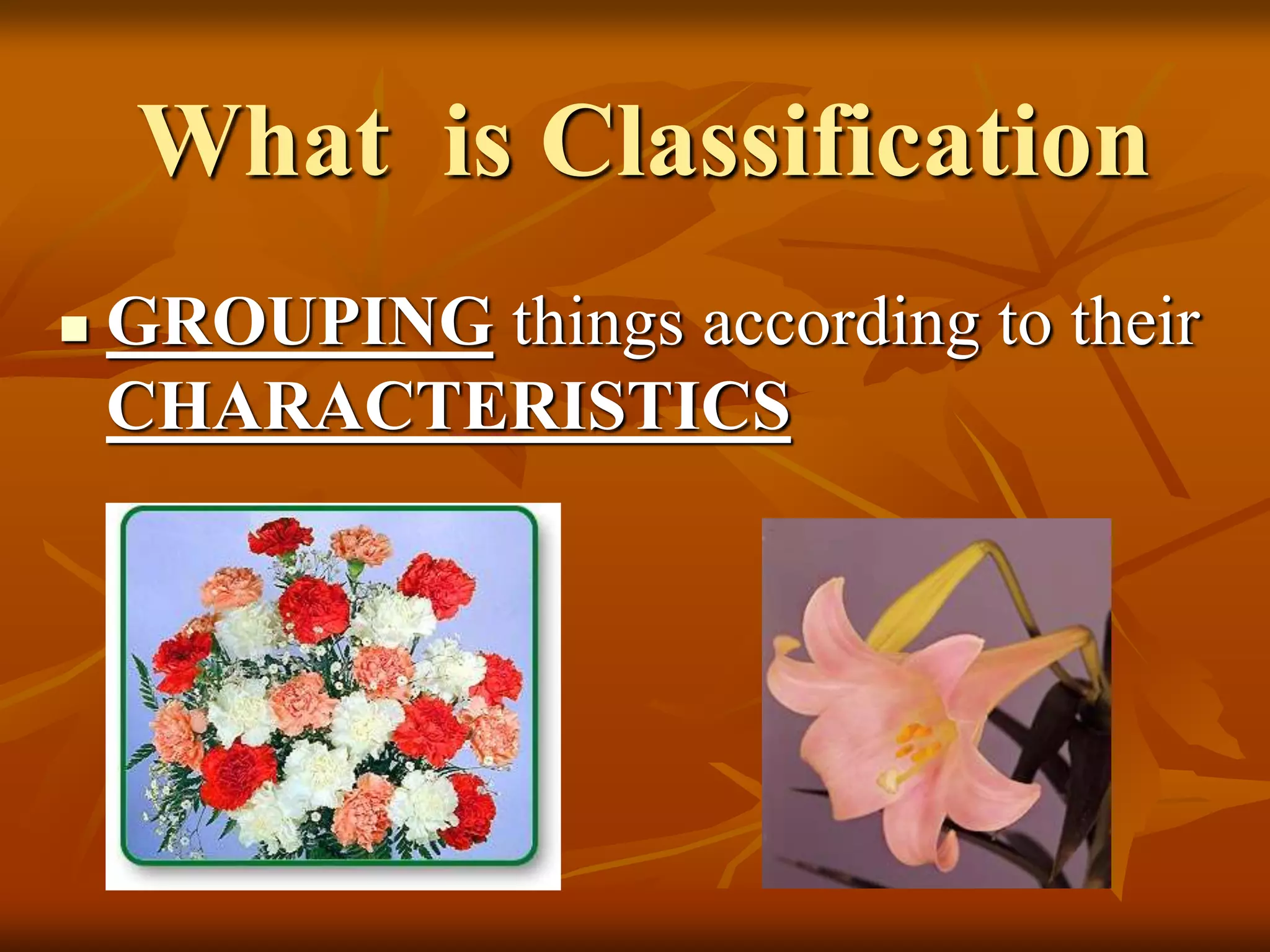
What is Classification
 GROUPING things according to their
CHARACTERISTICS
Plant Classification (5 Kingdoms)
 ANIMAL
 PLANT
 FUNGI
 BACTERIA (MONERA)
 PROTISTS
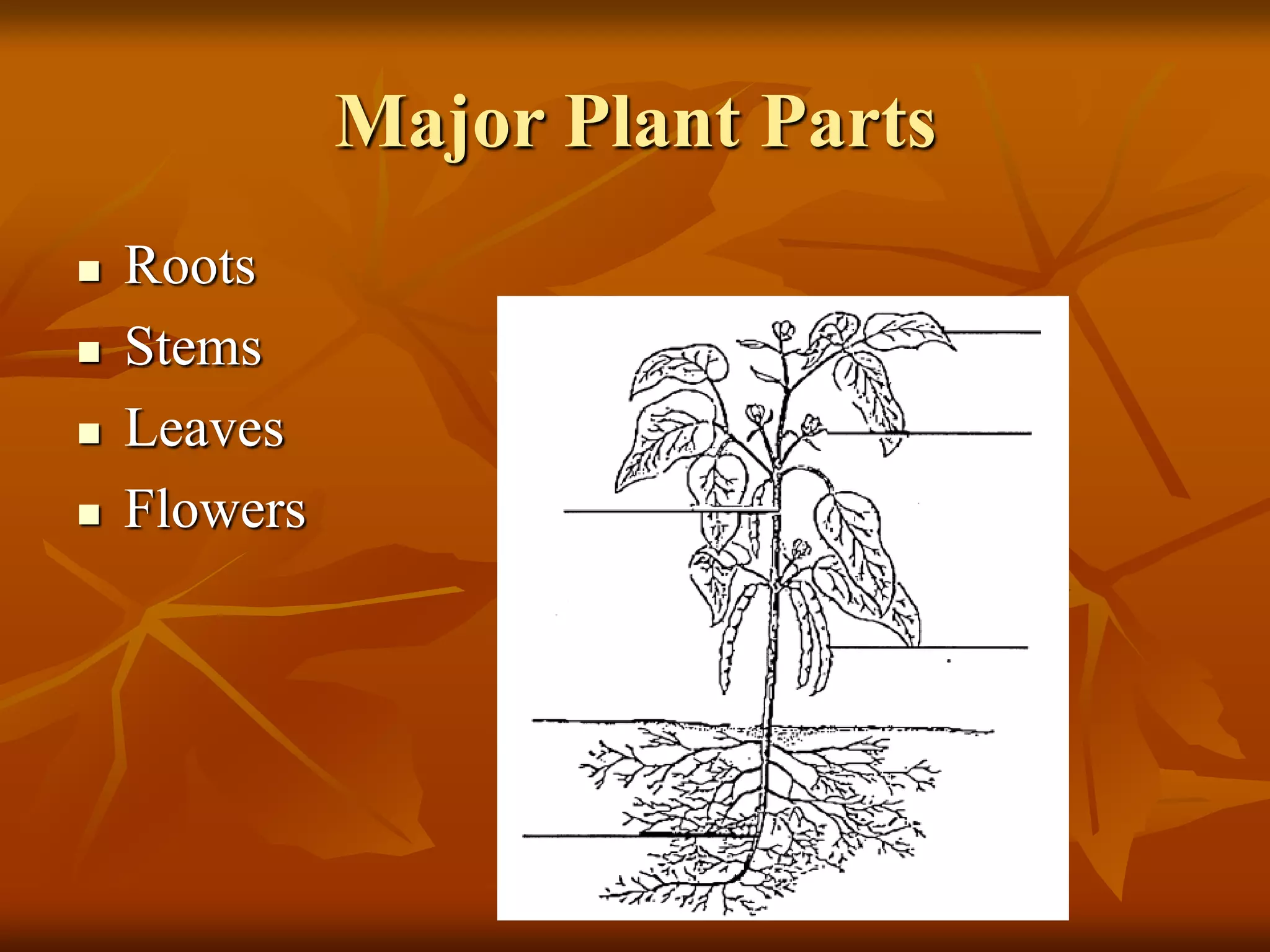
Major Plant Parts
 Roots
 Stems
 Leaves
 Flowers
Roots
 Functions:
 Absorb water and nutrients
 Anchor the plant, and support the above ground
part of the plant.
 Store food.
Roots
 Root Systems:
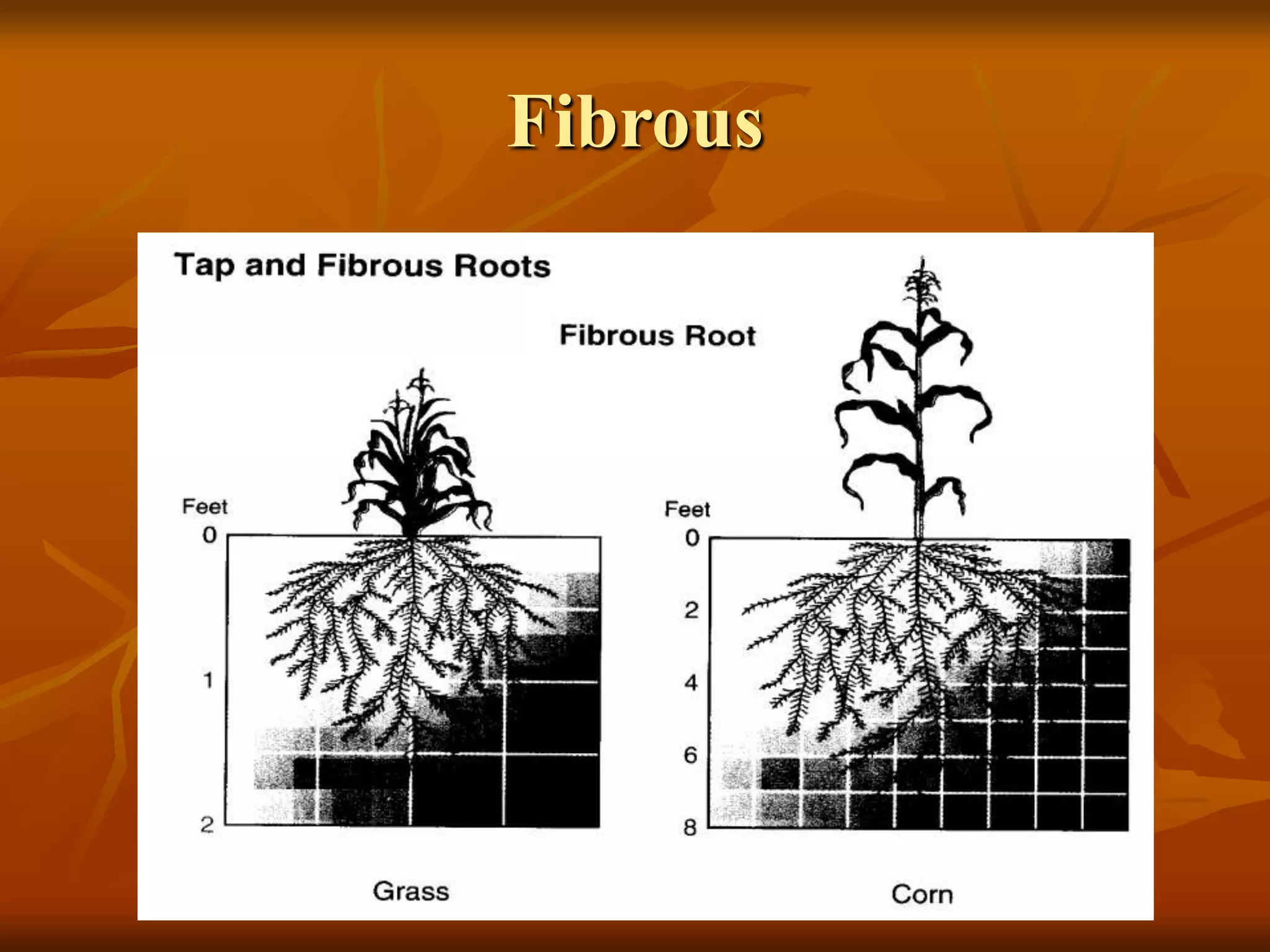
 Fibrous: A system that has no dominant primary
root.
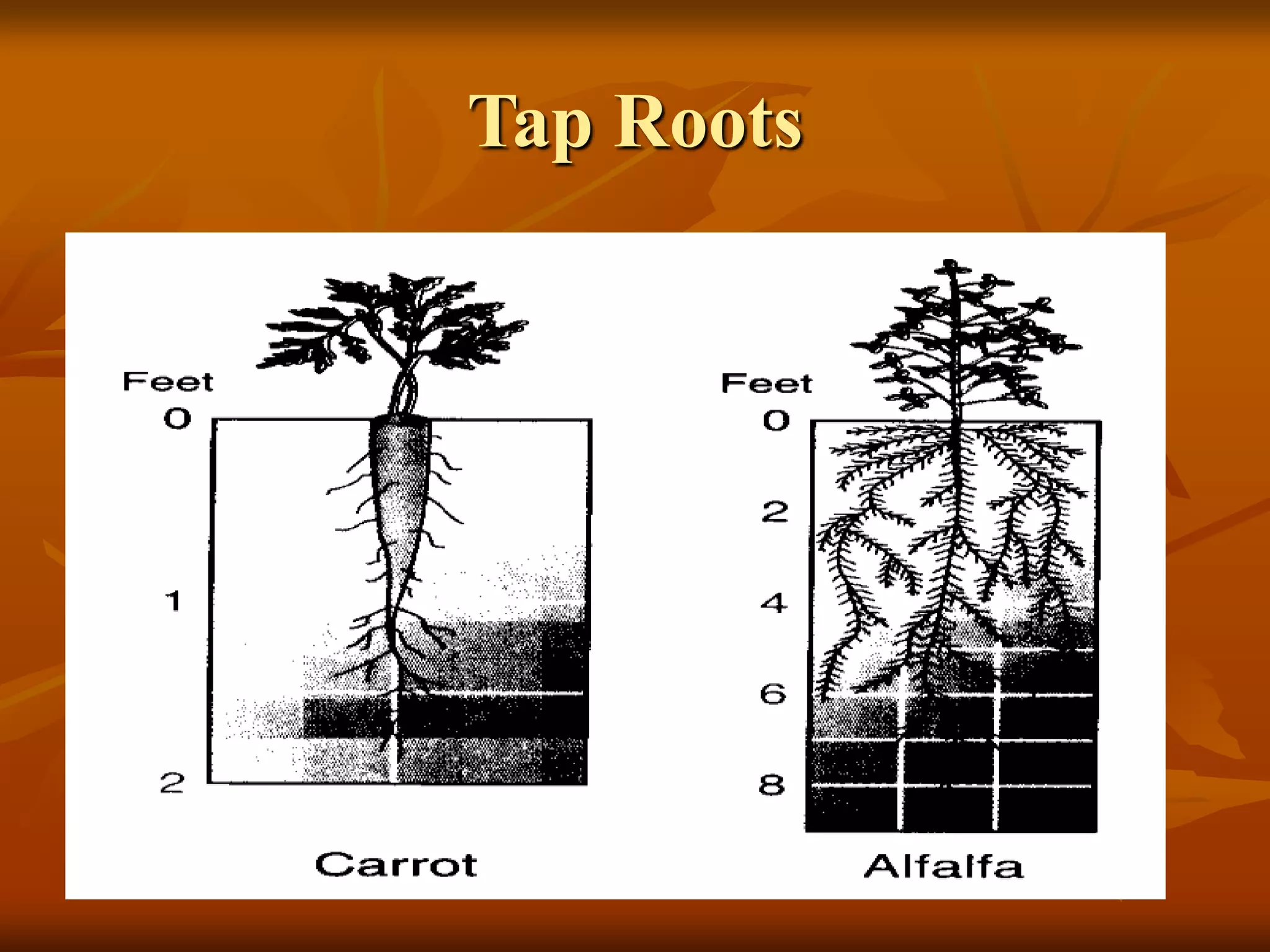
 Tap: A system composed of one primary root and
many secondary roots that branch off.
Fibrous
Tap Roots
Roots
 Primary Root: The first root to emerge at
germination. May become the main tap root.
 Secondary Roots: Roots that branch out from
the primary root.
 Apical Meristem: Area at the tip of the root
where new cells develop
Roots
 Healthy Roots: Roots are white or nearly
white, and smell fresh.
 Unhealthy Roots: Roots are black, brown, or
dark orange and smell rotten and sour.
Stems
 Functions:
 Support the leaves, and positions them so they can
receive as much sunlight as possible
 Responsible for the size and shape of the plant.
Stems
 Functions:
 Move water, minerals, and manufactured food
throughout the whole plant.
 Green stems produce food through photosynthesis.
Stems
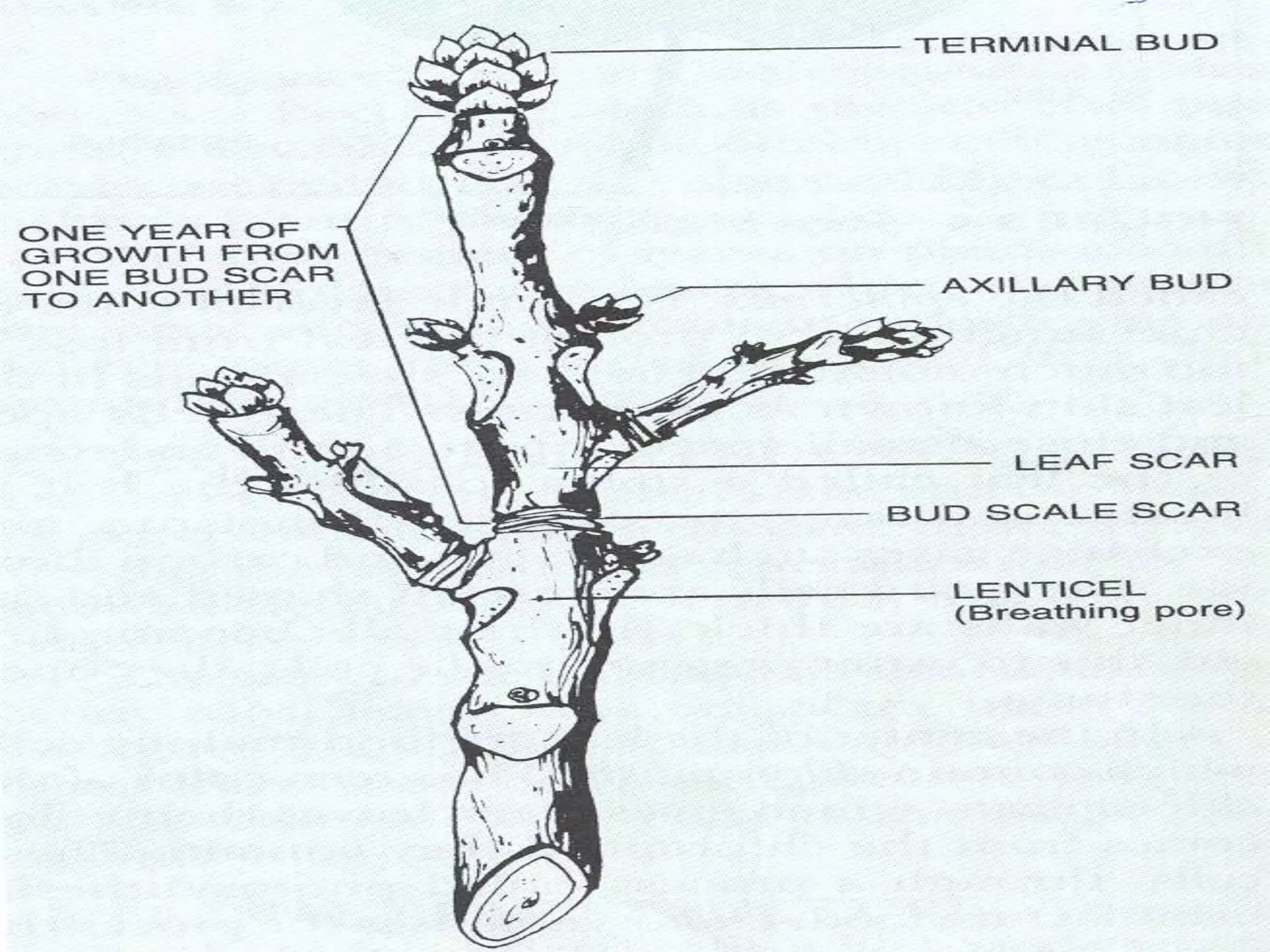
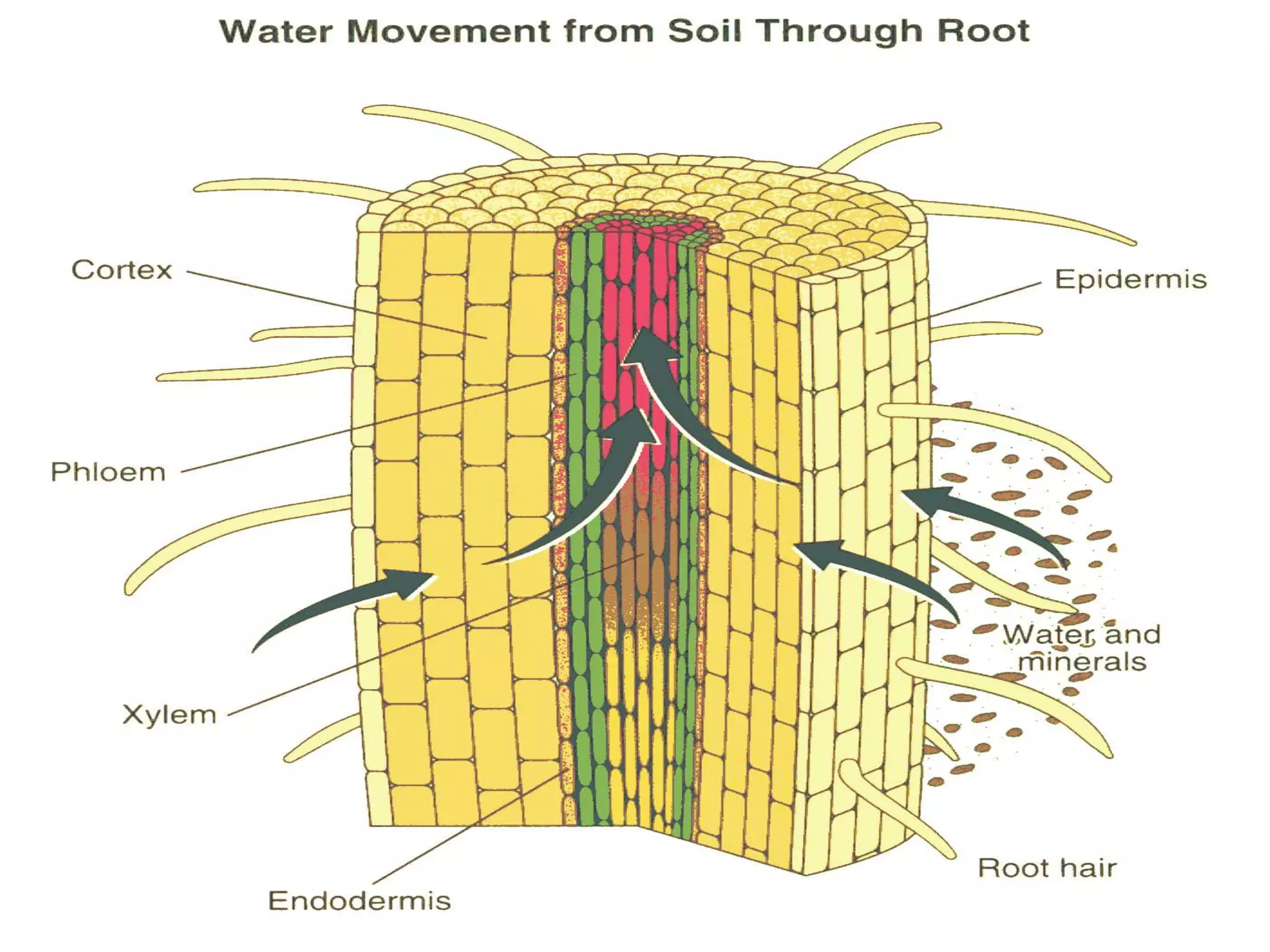
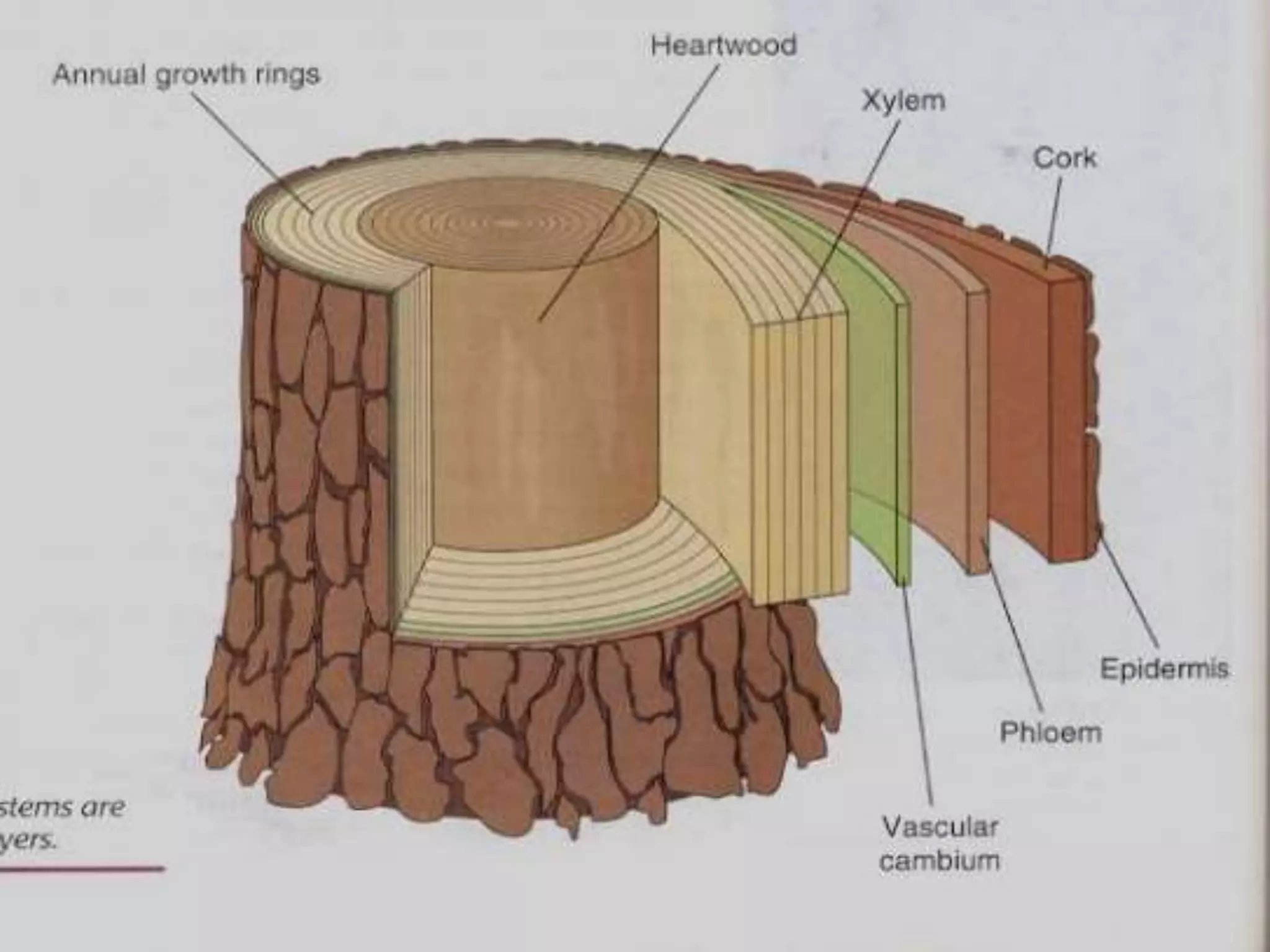
 Internal Structures
 Xylem: Tissue responsible for carrying water and
nutrients from the roots to the leaves. It is located
near the center of the stem.
 Xylem Up!!
Stems
 Internal Structure:
 Phloem: Tissue responsible for carrying food
produced in the leaf to the rest of the plant. The
phloem is usually located near the outside of the
stem.
 Phloem Down!!
Stems
 Internal Structure
 Cambium: Tissue responsible for the production
of new xylum and phloem. It is found between the
xylum and phloem.
Stems
 Specialized Stems
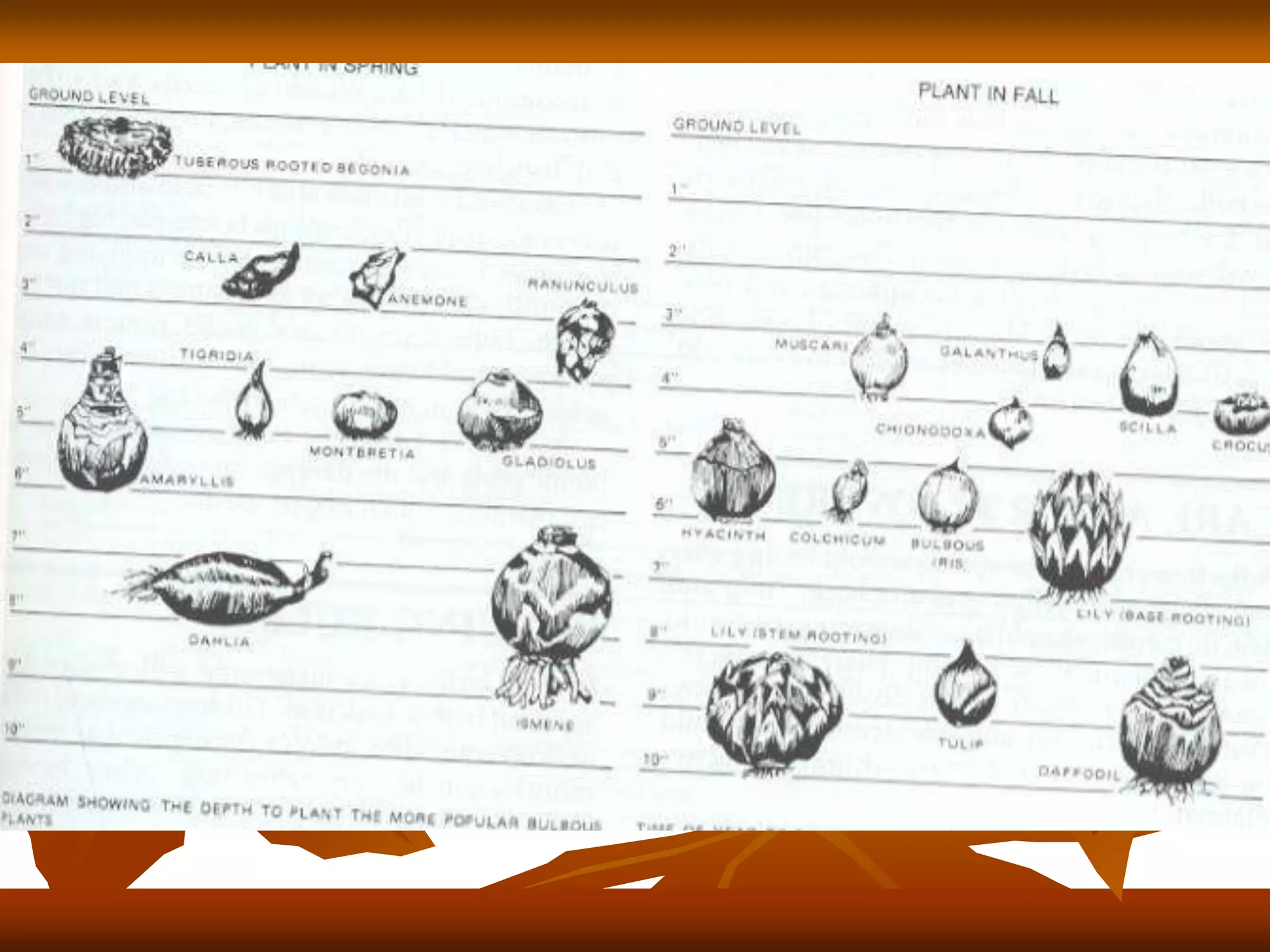
 Bulbs: Short flattened stem which has several
fleshy leaves. Bulbs are found beneath the soil.
 Example: Onions
 Corm: Sphyrical structure similar to a bulb.
 Example: Gladiolus
Stems
 Specialized Stems
 Rhizome: Thick underground stem which lies
horizontally.
 Example: Mother in Law’s Tongue
 Stolon: Horizontal stem which lies above the
ground (often called runners).
 Example: Strawberry runners
Stems
 Specialized Stems
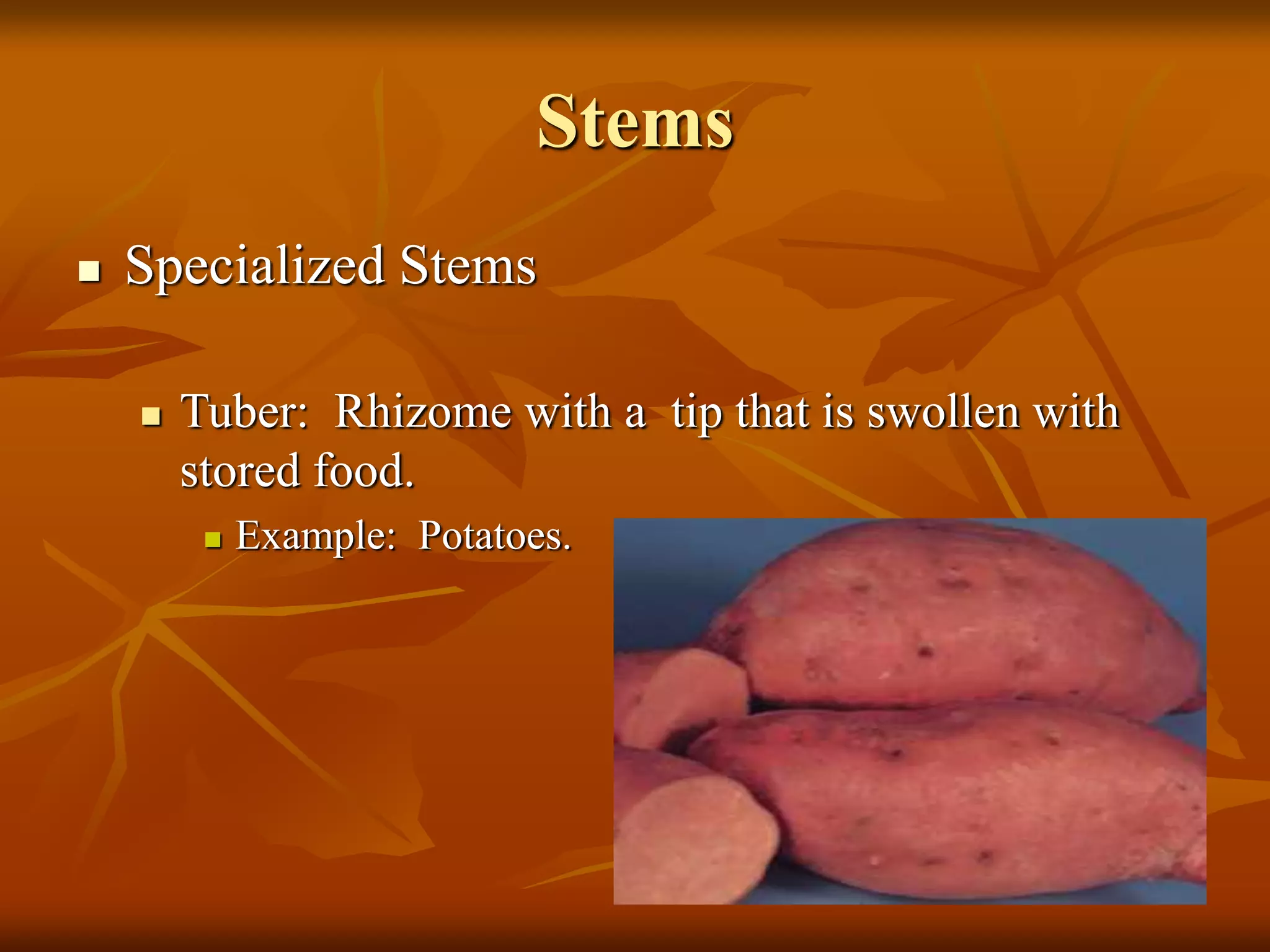
 Tuber: Rhizome with a tip that is swollen with
stored food.
 Example: Potatoes.
Leaves
 Functions:
 Produce food for the plants. They are designed to
efficiently collect light and use that light to make
energy.
Leaves
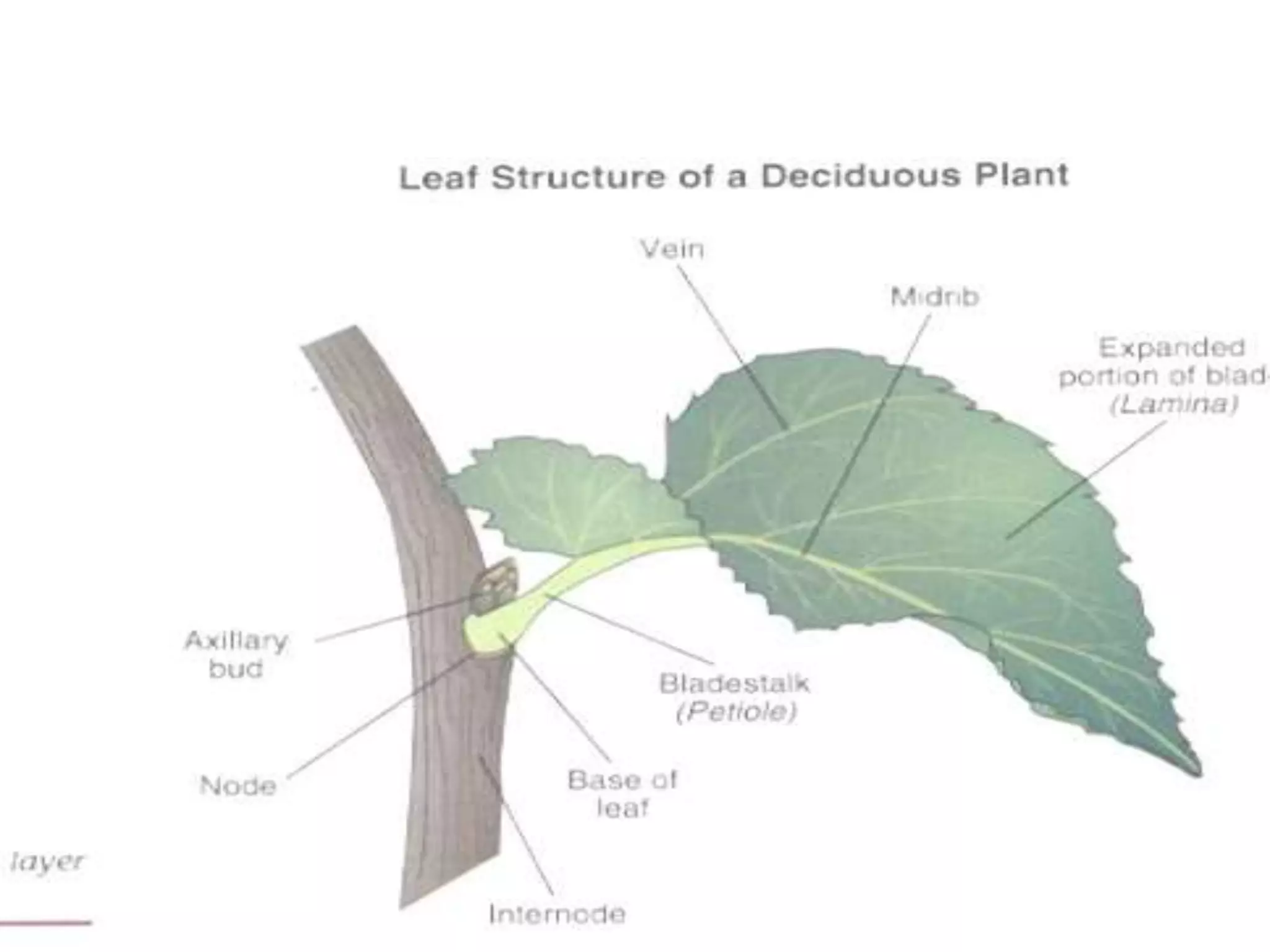
 Leaf Parts
 Leaf Blade: Large, broad, flat surface whose job is
to collect sunlight
 Petiole: supports the leaf and holds it away from
the stem.
 Midrib: Main vein running down the center of the
leaf. It helps hold the leaf so it is facing the sun.
Leaves
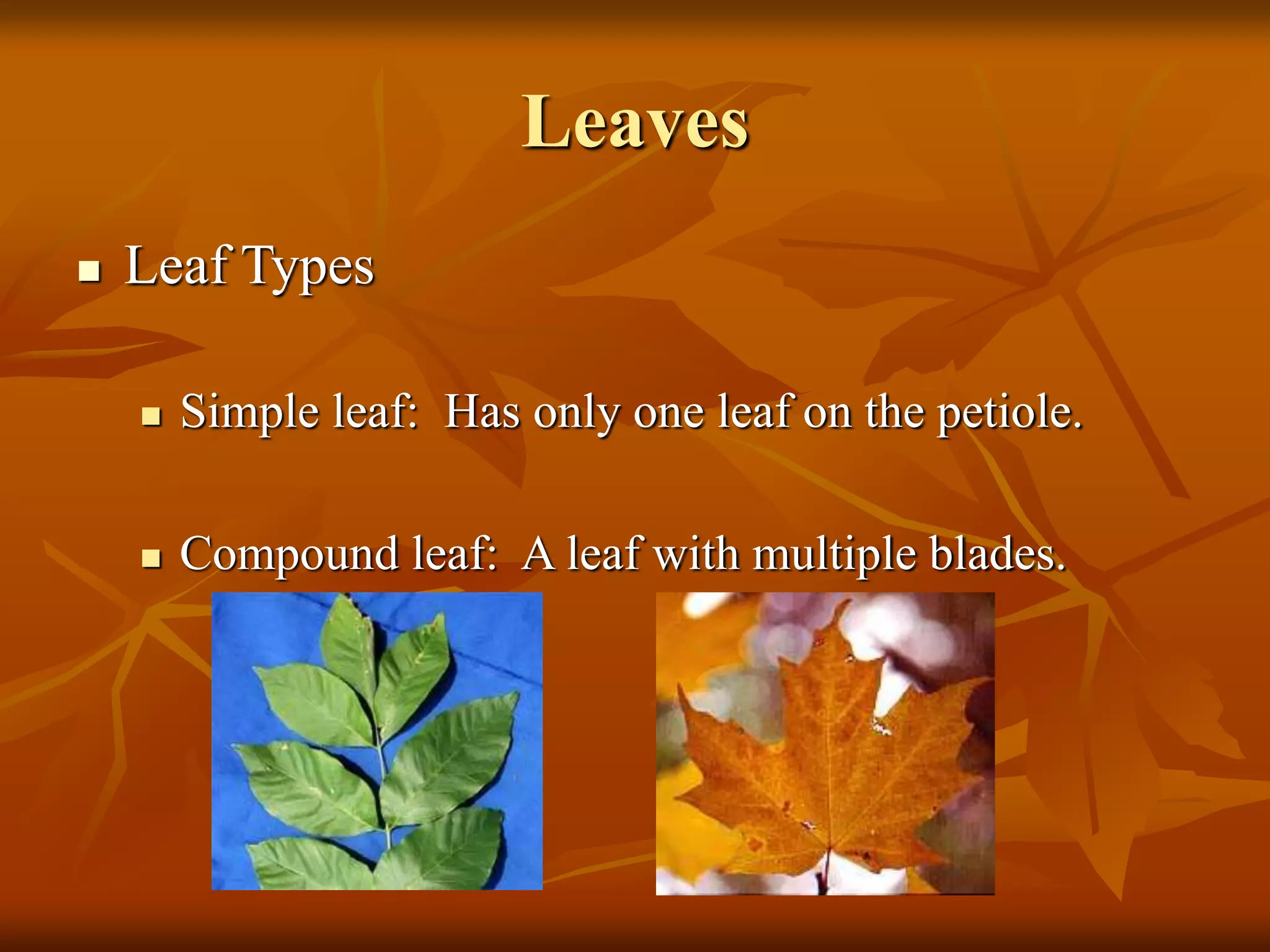
 Leaf Types
 Simple leaf: Has only one leaf on the petiole.
 Compound leaf: A leaf with multiple blades.
Leaves
 Vein Patterns
 Parallel: Veins never cross. Found in monocots.
 Netted: Veins form a network. Found in Dicots.
Leaves
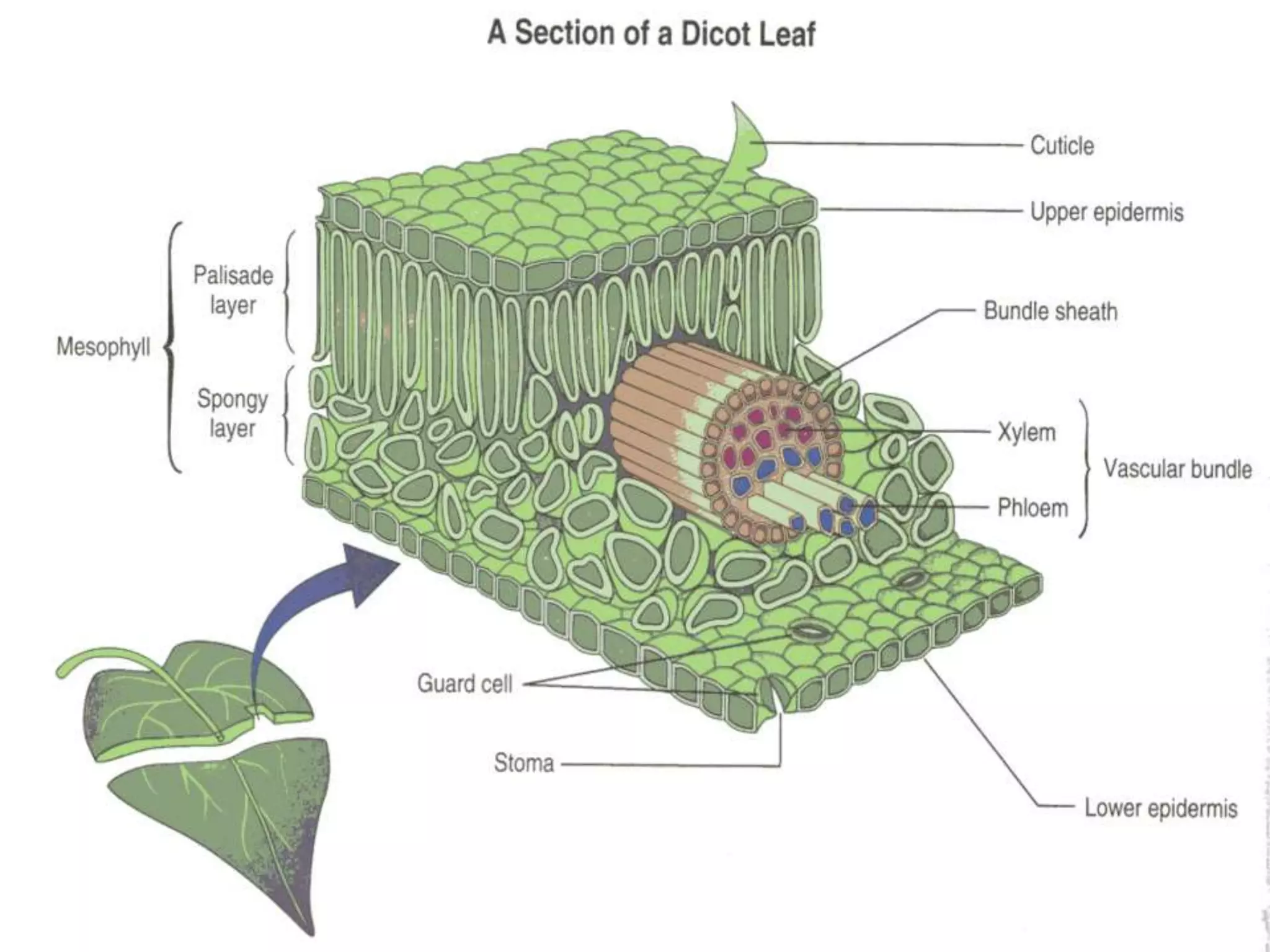
 Leaf Layers:
 Cuticle: The top waxy, non-cellular part of the
leaf. Its job is to prevent water escaping.
 Epidermis: Skin like layer of cells found on both
the top and bottom of the leaf. Its job is to protect
the leaf.
Leaves
 Leaf Layers
 Palisade Mesophyll: A layer of cells standing on
end directly below the upper epidermis. This area
is responsible for photosynthesis.
 Spongy Mesophyll: Loosely packed cells located
beneath the palasade mesophyll. This area is
responsible for holding the products of
photosynthesis.
Leaves
 Leaf Layers
 Stomata: Holes in the lower epidermis responisble
for gas exchange.
 Guard Cells: Surround the stomata’s which open
and close them.
Leaf Layers
Photosynthesis
 Photosynthesis: A chemical process by which
a plant turns light energy from the sun into
chemical energy in the form of sugar.
Photosynthesis
 Photosynthesis
 The plant uses water and carbon dioxide to
produce glucose (a sugar). The by product of
photosynthesis is oxygen.
 These chemical reactions take place inside the cells
near the chloroplasts. Chloroplasts are filled with
Chlorphyll which makes the plants green.
Photosynthesis
 Photosynthesis
 Plants don’t photosynthesize. Chloroplasts do!
Plants just happen to be lucky enough to have
chloroplasts in their cells.
Respiration
 Cellular Respiration: The opposite of
photosynthesis. This process breaks sugars
down so plants can use them.
 Similar to digestion in animals.
 Takes place in a place in the cell called the
mitochondria.
Respiration
 How are photosynthesis and respiration
important to us as human beings?
Flowers
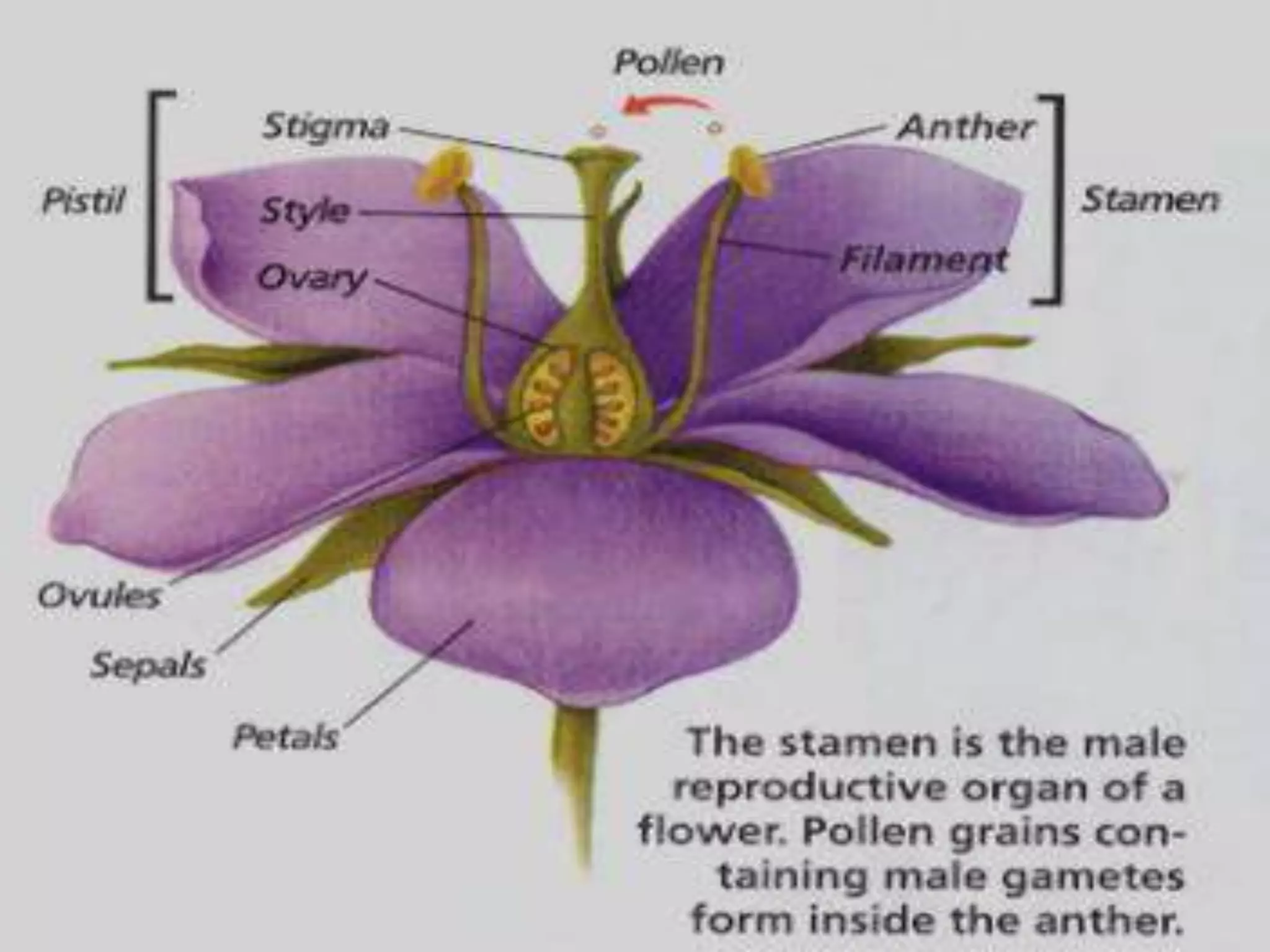
 Flower Parts -- Male
 Stamen: Male part of the flower.
 Filament: Stalk like in the stamen that holds up
the anther
 Anther: Sack-like structure that contains pollen.
Flowers
 Flower Parts -- Male
 Pollen grains are released from the anther that
contains sperm.
 Staminate: Flowers that have only male parts.
Flowers
 Flower Parts – Female
 Pistil: Female part of the flower
 Stigma: Sticky part of the pistil that is receptive to
pollen.
 Style: Rod shaped middle part that has a swollen
base (ovary) containing eggs
Flowers
 Flower Parts – Neither male or female
 Petals: colorful leaf-like structures which attract
animals and insects.
 Corolla: When all of the petals are fused together.
 Sepals: Green leaves that protect the flower before
it opens.
Flowers
 Flower Parts – Niether male or female
 Calyx: When all of the sepals are fused together.
Flowers
 Sexual Reproduction in Plants: Two parents
(meiosis)
 #1 The stamen releases pollen.
 #2 Pollen is carried by wind, gravity, animals, or insects to
the stigma of another flower. (This is when pollination
occurs)
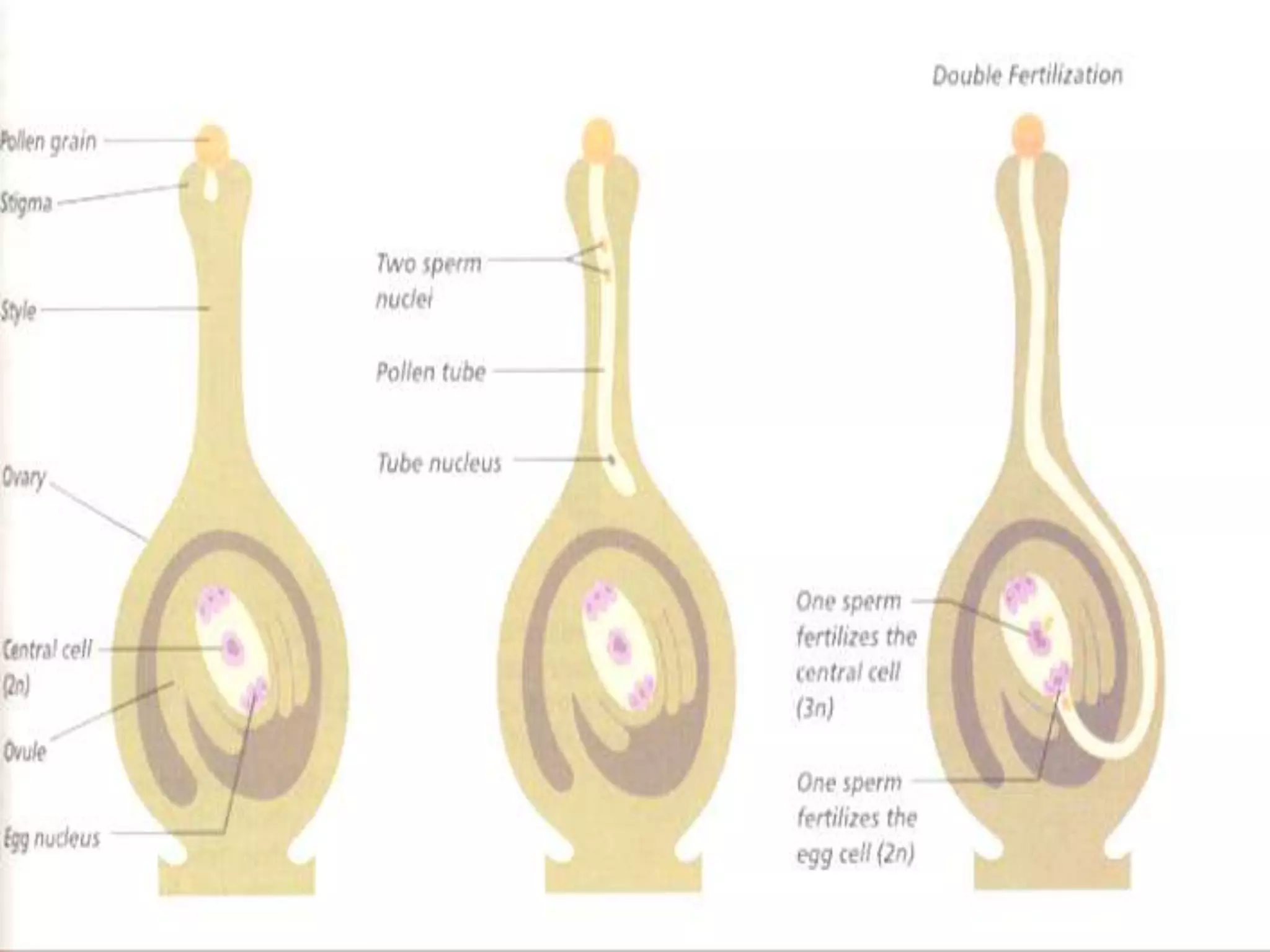
 #3 The pollen moves from the stigma down through in a
pollen tube the style depositing sperm in the ovary.
Flowers
 Sexual Reproduction in Plants:
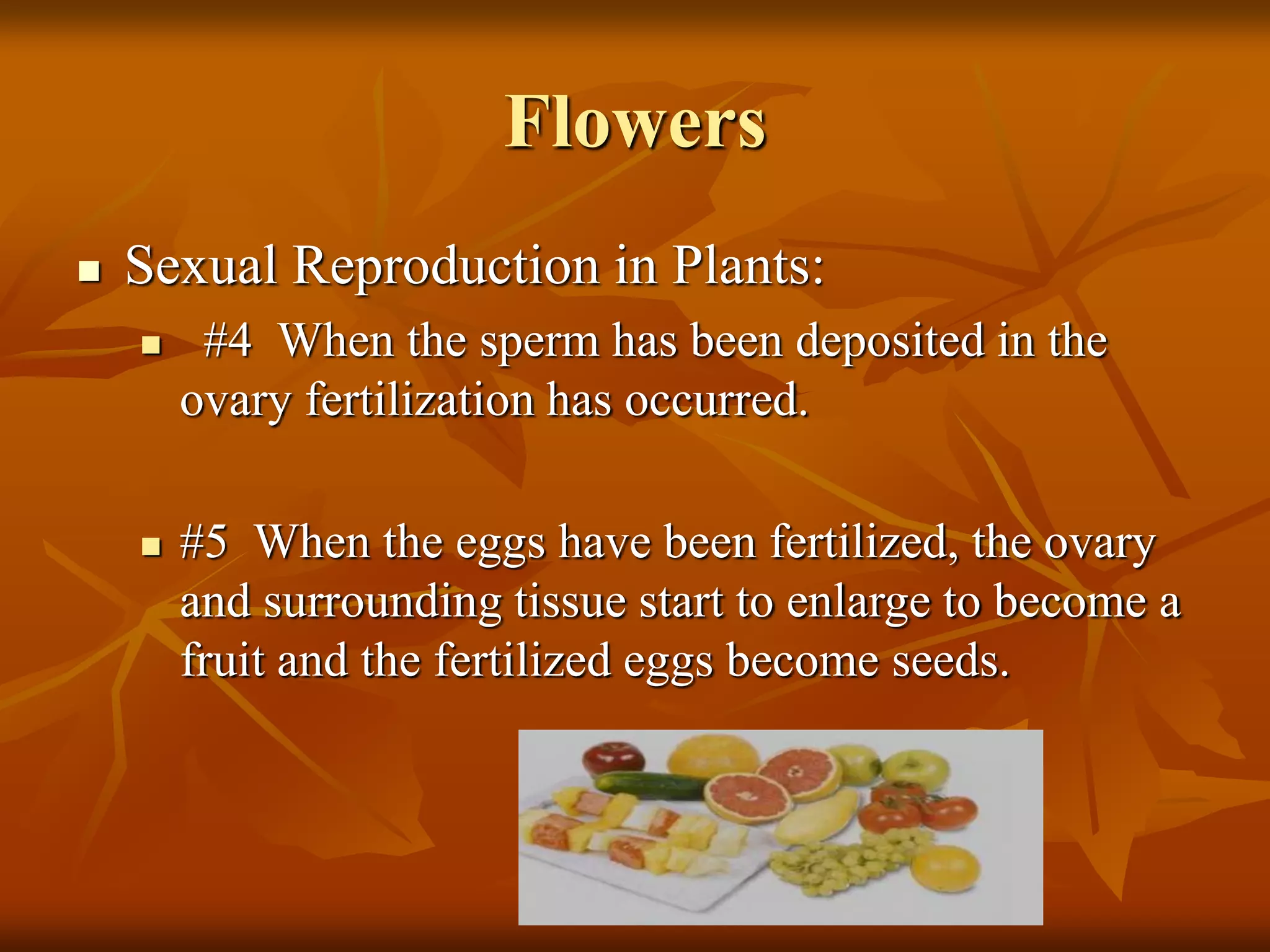
 #4 When the sperm has been deposited in the
ovary fertilization has occurred.
 #5 When the eggs have been fertilized, the ovary
and surrounding tissue start to enlarge to become a
fruit and the fertilized eggs become seeds.
Flowers
 Flower Types:
 Perfect Flower: Has both male and female parts.
 Imperfect Flower: A flower that is missing either
male or female parts.
 Complete Flower: Flowers that have sepals,
petals, pistils, and stamens.
Flowers
 Flower Types:
 Incomplete Flowers: When a flower is missing
sepals, petals, pistils, or stamen.
 Imperfect Flowers are always incomplete.
Incomplete flowers may or may not be imperfect
Light
 Plants need the colors blue and red to activate
chlorophyll.
 Light bulbs are deficient in the color blue.
 Fluorescent tubes are deficient in the color red.
Light
 Special grow lights are made that carry the
correct blue and red wavelengths.
 Light intensity is measured in foot candles.
 Foot Candle: The amount of light given off by
a candle a foot away.
Light
 Plants have adapted to survive in either high,
partial, or low light intensities.
Light
 Photoperiod: The length of daylight.
 Short Day Plants: Plants that begin to flower when
the nights are over 12 hours long.
 Long Day Plants: Begin to flower when the nights
are under 12 hours long.
 Neutral Plants: Flowering response is unaffected by
day length.
Temperature
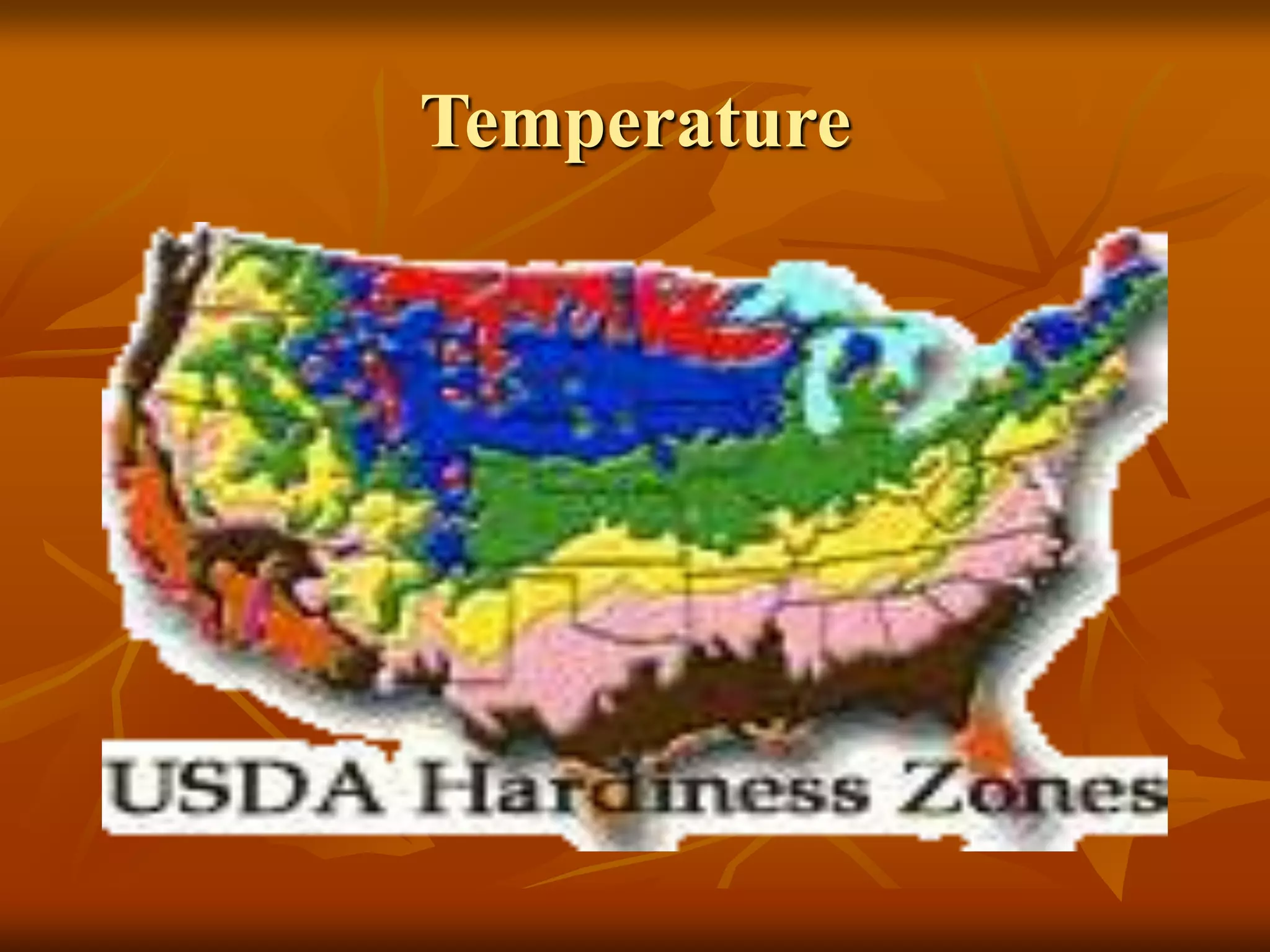
 Hardiness: A plants ability to withstand cold
temperatures.
 Hardiness is measured using the USDA
hardiness Zone Map.
 We are in zone 5, Logan is in Zone 4
Temperature
Temperature
 Wilting: A condition caused by excess heat
and dryness. When a plant wilts it closes its’
stomatas, and the cells loose their turgor
pressure.
Air
 Oxygen: Is needed by the plant for respiration.
It is obtained by the roots.
 Carbon Dioxide: Is needed by the plant for
photosynthesis. It is obtained through the
stomata’s
Water
 Plants get most of the water through their
roots. Some small quantities are also obtained
through the stems.
 Difficult task about watering: Plants need both
adequete levels of water and oxygen.
Water
 Plants should be watered all the way through
the root zone to encourage even root growth.
 Plants should be grown in pots with drainage
holes so the water can drain and allow oxygen
into the root zone.
Growth Regulators
 Plant hormones: growth regulators naturally
produced by the plant.
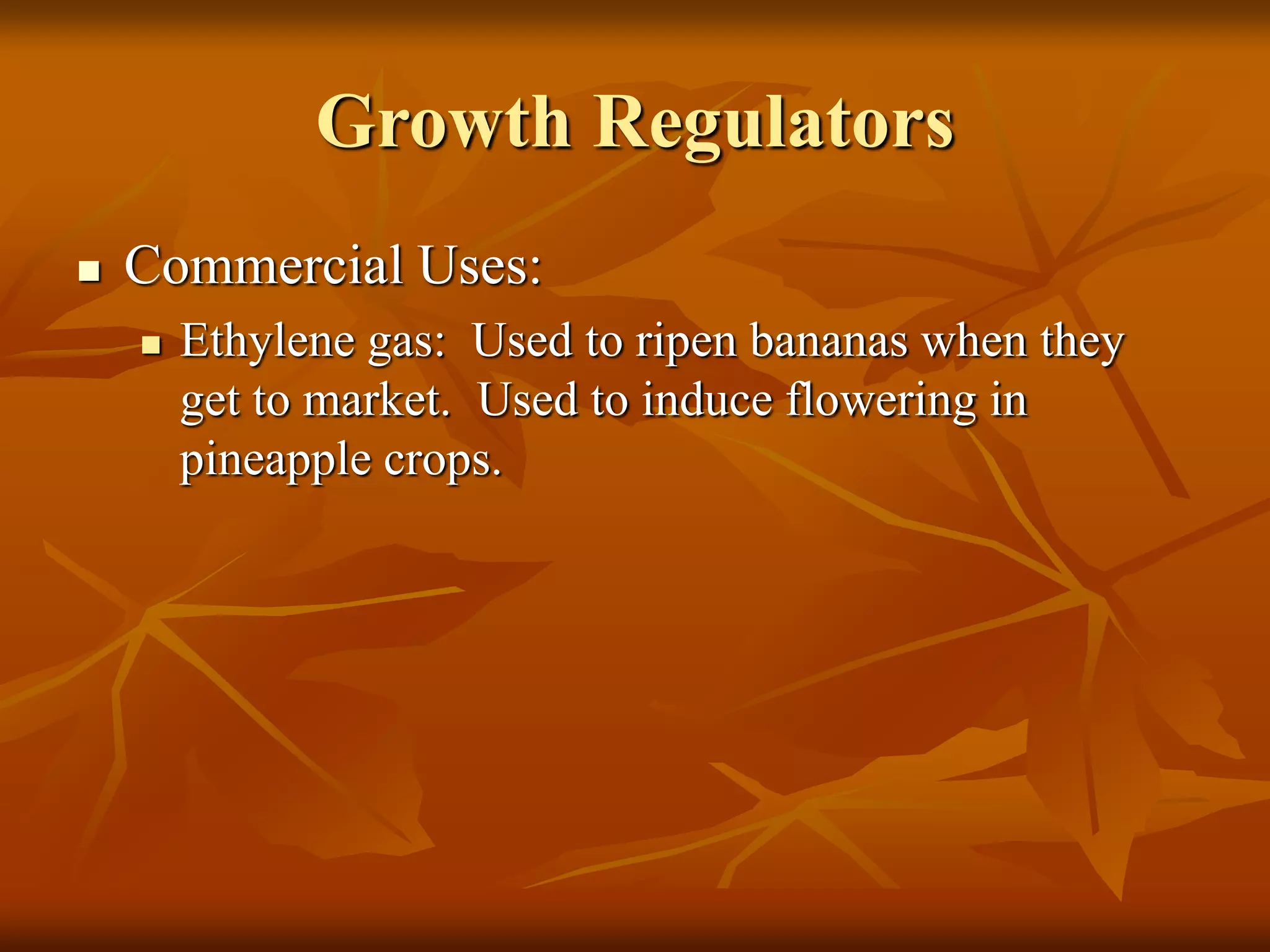
 Auxins: Growth hormones produced by the apical
meristem. They encourage height growth, and
discourage lateral growth.
Growth Regulators
 Plant Hormones:
 Cytokinins: Produced in roots and seeds, and are
responsible for cell division and differentiation.
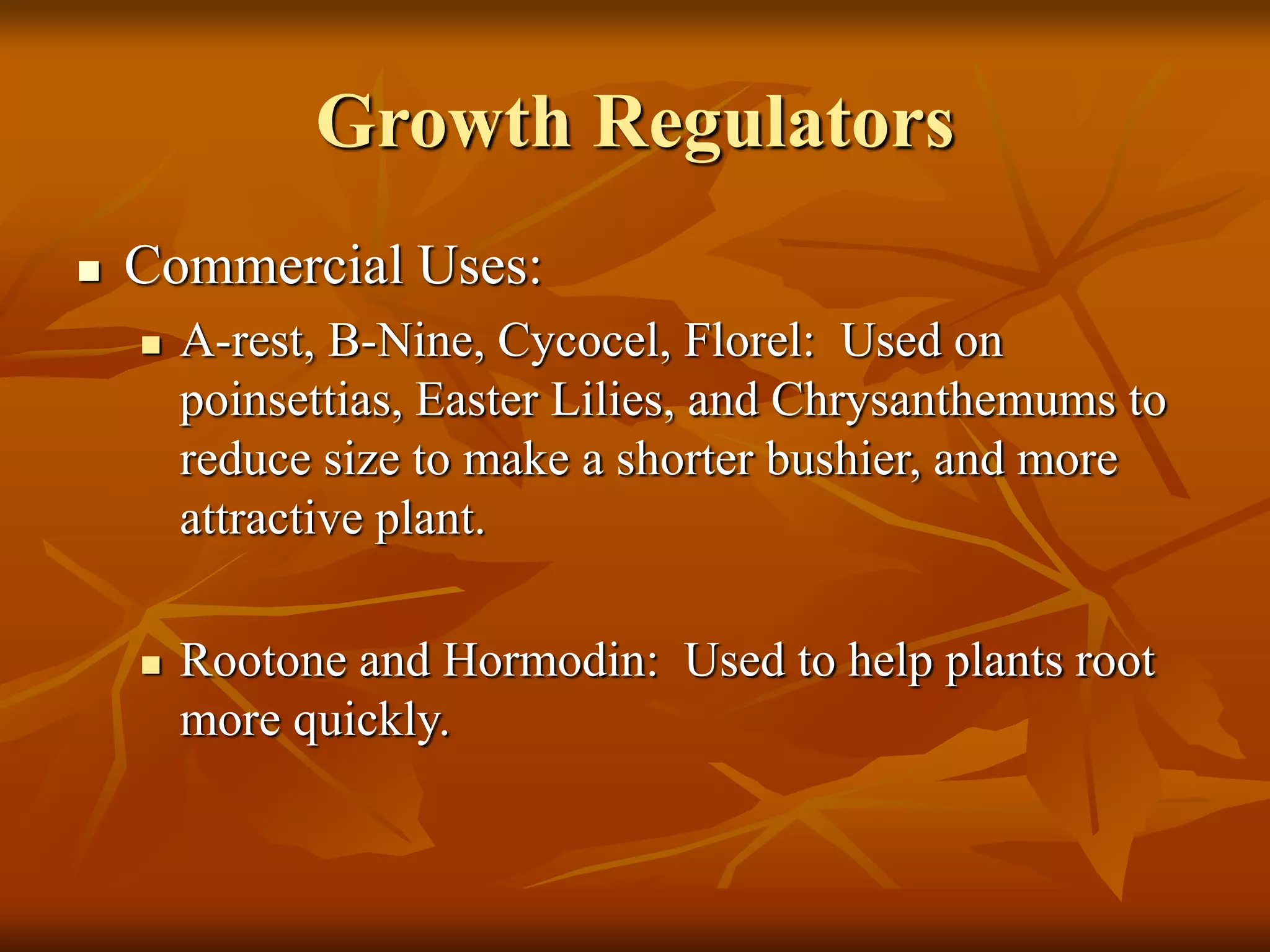
 Ethylene: Produced by ripening fruit, it stimulates
flowering, and ripening.
Growth Regulators
 Plant Hormones:
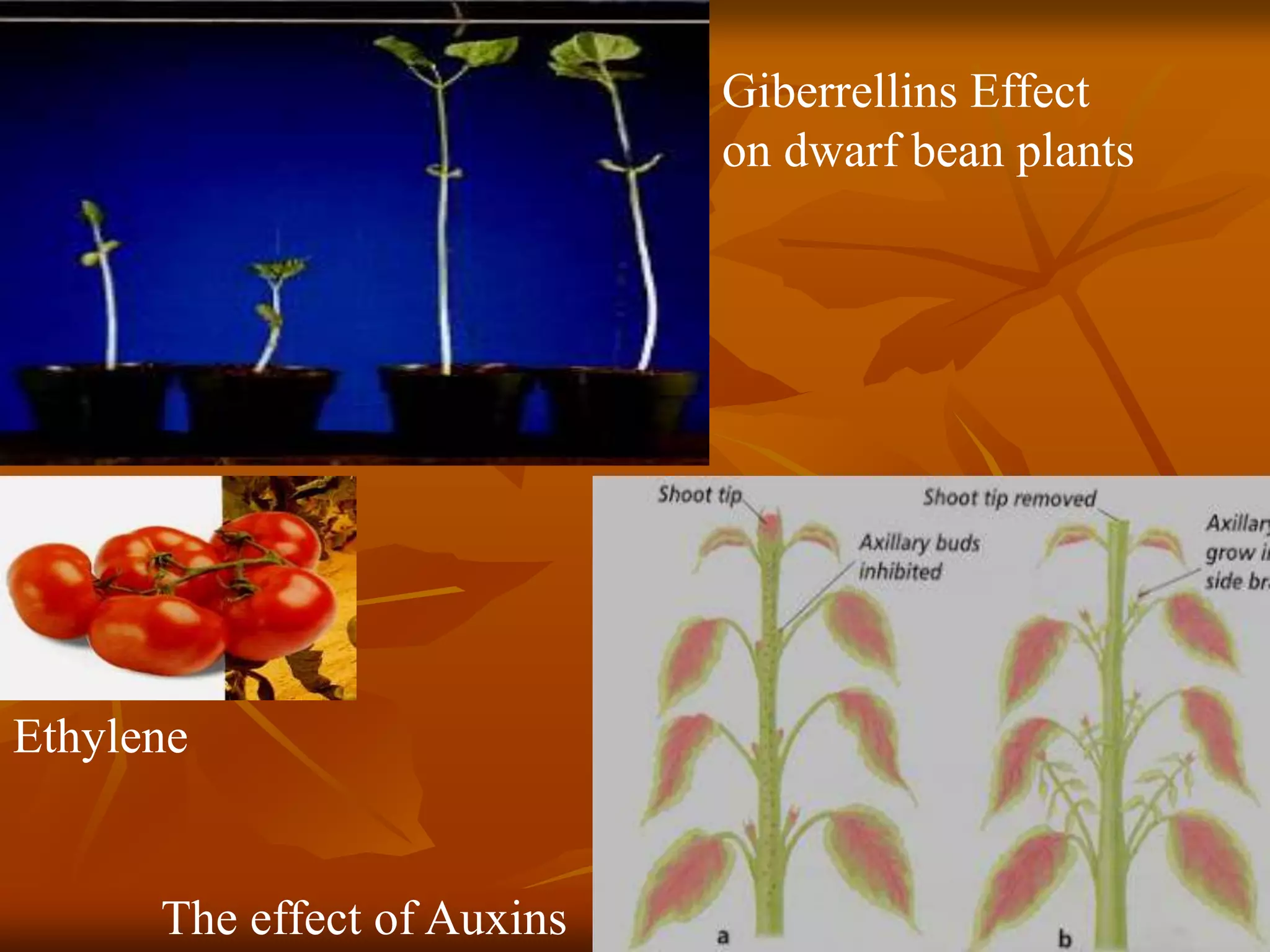
 Gibberellins: Produced in stems, roots, and young
leaves. They are responsible for internodal
elongation.
 Abscisic Acid: Found in seeds. A hormone which
inhibits growth.
Giberrellins Effect
on dwarf bean plants
The effect of Auxins
Ethylene
Growth Regulators
 Commercial Uses:
 A-rest, B-Nine, Cycocel, Florel: Used on
poinsettias, Easter Lilies, and Chrysanthemums to
reduce size to make a shorter bushier, and more
attractive plant.
 Rootone and Hormodin: Used to help plants root
more quickly.
Growth Regulators
 Commercial Uses:
 Ethylene gas: Used to ripen bananas when they
get to market. Used to induce flowering in
pineapple crops.
Plant Classification
 Non Flowering
 Ferns
 Cone-Producers (Conifers)
 Flowering
 Monocots
 Dicots
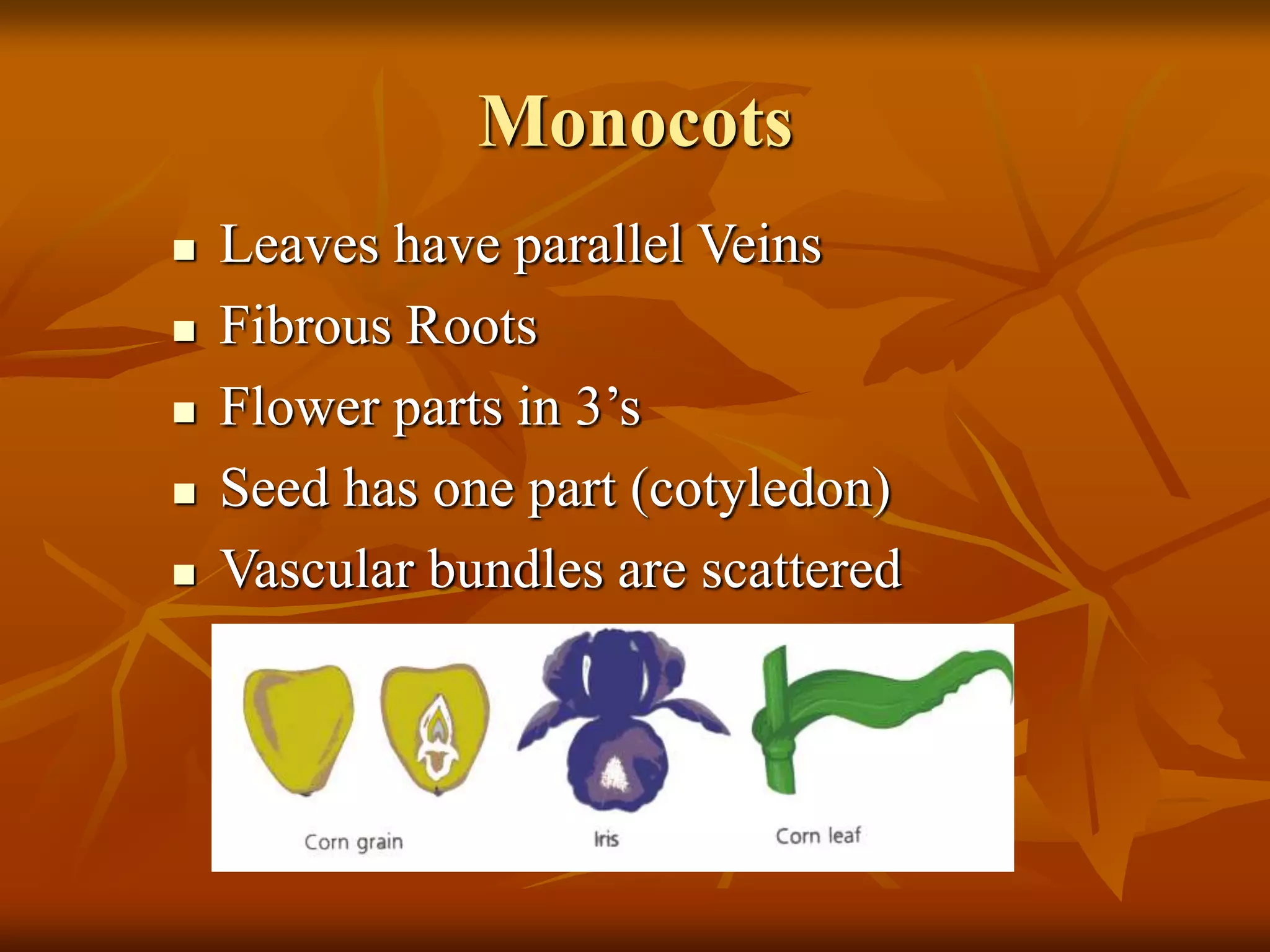
Monocots
 Leaves have parallel Veins
 Fibrous Roots
 Flower parts in 3’s
 Seed has one part (cotyledon)
 Vascular bundles are scattered
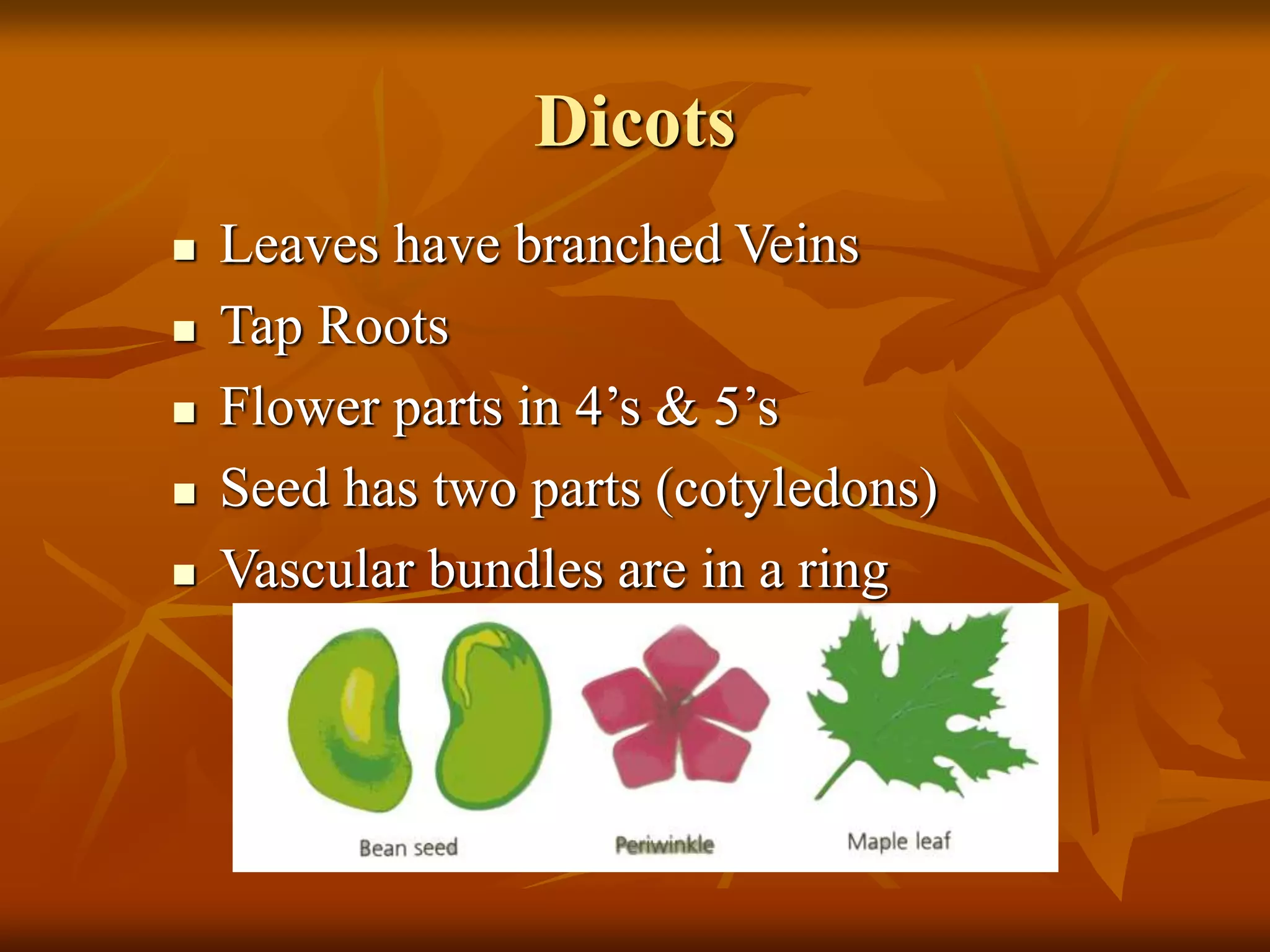
Dicots
 Leaves have branched Veins
 Tap Roots
 Flower parts in 4’s & 5’s
 Seed has two parts (cotyledons)
 Vascular bundles are in a ring

Plant Structure and Function.ppt

  • 1.
    Plant Anatomy and Physiology Whatare the parts of the plant, and how do they work?
  • 2.
    What is Classification GROUPING things according to their CHARACTERISTICS
  • 3.
    Plant Classification (5Kingdoms)  ANIMAL  PLANT  FUNGI  BACTERIA (MONERA)  PROTISTS
  • 4.
    Major Plant Parts Roots  Stems  Leaves  Flowers
  • 5.
    Roots  Functions:  Absorbwater and nutrients  Anchor the plant, and support the above ground part of the plant.  Store food.
  • 6.
    Roots  Root Systems: Fibrous: A system that has no dominant primary root.  Tap: A system composed of one primary root and many secondary roots that branch off.
  • 7.
  • 8.
  • 9.
    Roots  Primary Root:The first root to emerge at germination. May become the main tap root.  Secondary Roots: Roots that branch out from the primary root.  Apical Meristem: Area at the tip of the root where new cells develop
  • 10.
    Roots  Healthy Roots:Roots are white or nearly white, and smell fresh.  Unhealthy Roots: Roots are black, brown, or dark orange and smell rotten and sour.
  • 11.
    Stems  Functions:  Supportthe leaves, and positions them so they can receive as much sunlight as possible  Responsible for the size and shape of the plant.
  • 12.
    Stems  Functions:  Movewater, minerals, and manufactured food throughout the whole plant.  Green stems produce food through photosynthesis.
  • 14.
    Stems  Internal Structures Xylem: Tissue responsible for carrying water and nutrients from the roots to the leaves. It is located near the center of the stem.  Xylem Up!!
  • 16.
    Stems  Internal Structure: Phloem: Tissue responsible for carrying food produced in the leaf to the rest of the plant. The phloem is usually located near the outside of the stem.  Phloem Down!!
  • 17.
    Stems  Internal Structure Cambium: Tissue responsible for the production of new xylum and phloem. It is found between the xylum and phloem.
  • 19.
    Stems  Specialized Stems Bulbs: Short flattened stem which has several fleshy leaves. Bulbs are found beneath the soil.  Example: Onions  Corm: Sphyrical structure similar to a bulb.  Example: Gladiolus
  • 21.
    Stems  Specialized Stems Rhizome: Thick underground stem which lies horizontally.  Example: Mother in Law’s Tongue  Stolon: Horizontal stem which lies above the ground (often called runners).  Example: Strawberry runners
  • 22.
    Stems  Specialized Stems Tuber: Rhizome with a tip that is swollen with stored food.  Example: Potatoes.
  • 23.
    Leaves  Functions:  Producefood for the plants. They are designed to efficiently collect light and use that light to make energy.
  • 25.
    Leaves  Leaf Parts Leaf Blade: Large, broad, flat surface whose job is to collect sunlight  Petiole: supports the leaf and holds it away from the stem.  Midrib: Main vein running down the center of the leaf. It helps hold the leaf so it is facing the sun.
  • 26.
    Leaves  Leaf Types Simple leaf: Has only one leaf on the petiole.  Compound leaf: A leaf with multiple blades.
  • 27.
    Leaves  Vein Patterns Parallel: Veins never cross. Found in monocots.  Netted: Veins form a network. Found in Dicots.
  • 28.
    Leaves  Leaf Layers: Cuticle: The top waxy, non-cellular part of the leaf. Its job is to prevent water escaping.  Epidermis: Skin like layer of cells found on both the top and bottom of the leaf. Its job is to protect the leaf.
  • 29.
    Leaves  Leaf Layers Palisade Mesophyll: A layer of cells standing on end directly below the upper epidermis. This area is responsible for photosynthesis.  Spongy Mesophyll: Loosely packed cells located beneath the palasade mesophyll. This area is responsible for holding the products of photosynthesis.
  • 30.
    Leaves  Leaf Layers Stomata: Holes in the lower epidermis responisble for gas exchange.  Guard Cells: Surround the stomata’s which open and close them.
  • 31.
  • 32.
    Photosynthesis  Photosynthesis: Achemical process by which a plant turns light energy from the sun into chemical energy in the form of sugar.
  • 33.
    Photosynthesis  Photosynthesis  Theplant uses water and carbon dioxide to produce glucose (a sugar). The by product of photosynthesis is oxygen.  These chemical reactions take place inside the cells near the chloroplasts. Chloroplasts are filled with Chlorphyll which makes the plants green.
  • 34.
    Photosynthesis  Photosynthesis  Plantsdon’t photosynthesize. Chloroplasts do! Plants just happen to be lucky enough to have chloroplasts in their cells.
  • 35.
    Respiration  Cellular Respiration:The opposite of photosynthesis. This process breaks sugars down so plants can use them.  Similar to digestion in animals.  Takes place in a place in the cell called the mitochondria.
  • 36.
    Respiration  How arephotosynthesis and respiration important to us as human beings?
  • 38.
    Flowers  Flower Parts-- Male  Stamen: Male part of the flower.  Filament: Stalk like in the stamen that holds up the anther  Anther: Sack-like structure that contains pollen.
  • 39.
    Flowers  Flower Parts-- Male  Pollen grains are released from the anther that contains sperm.  Staminate: Flowers that have only male parts.
  • 40.
    Flowers  Flower Parts– Female  Pistil: Female part of the flower  Stigma: Sticky part of the pistil that is receptive to pollen.  Style: Rod shaped middle part that has a swollen base (ovary) containing eggs
  • 41.
    Flowers  Flower Parts– Neither male or female  Petals: colorful leaf-like structures which attract animals and insects.  Corolla: When all of the petals are fused together.  Sepals: Green leaves that protect the flower before it opens.
  • 42.
    Flowers  Flower Parts– Niether male or female  Calyx: When all of the sepals are fused together.
  • 43.
    Flowers  Sexual Reproductionin Plants: Two parents (meiosis)  #1 The stamen releases pollen.  #2 Pollen is carried by wind, gravity, animals, or insects to the stigma of another flower. (This is when pollination occurs)  #3 The pollen moves from the stigma down through in a pollen tube the style depositing sperm in the ovary.
  • 44.
    Flowers  Sexual Reproductionin Plants:  #4 When the sperm has been deposited in the ovary fertilization has occurred.  #5 When the eggs have been fertilized, the ovary and surrounding tissue start to enlarge to become a fruit and the fertilized eggs become seeds.
  • 46.
    Flowers  Flower Types: Perfect Flower: Has both male and female parts.  Imperfect Flower: A flower that is missing either male or female parts.  Complete Flower: Flowers that have sepals, petals, pistils, and stamens.
  • 47.
    Flowers  Flower Types: Incomplete Flowers: When a flower is missing sepals, petals, pistils, or stamen.  Imperfect Flowers are always incomplete. Incomplete flowers may or may not be imperfect
  • 48.
    Light  Plants needthe colors blue and red to activate chlorophyll.  Light bulbs are deficient in the color blue.  Fluorescent tubes are deficient in the color red.
  • 49.
    Light  Special growlights are made that carry the correct blue and red wavelengths.  Light intensity is measured in foot candles.  Foot Candle: The amount of light given off by a candle a foot away.
  • 50.
    Light  Plants haveadapted to survive in either high, partial, or low light intensities.
  • 51.
    Light  Photoperiod: Thelength of daylight.  Short Day Plants: Plants that begin to flower when the nights are over 12 hours long.  Long Day Plants: Begin to flower when the nights are under 12 hours long.  Neutral Plants: Flowering response is unaffected by day length.
  • 52.
    Temperature  Hardiness: Aplants ability to withstand cold temperatures.  Hardiness is measured using the USDA hardiness Zone Map.  We are in zone 5, Logan is in Zone 4
  • 53.
  • 54.
    Temperature  Wilting: Acondition caused by excess heat and dryness. When a plant wilts it closes its’ stomatas, and the cells loose their turgor pressure.
  • 55.
    Air  Oxygen: Isneeded by the plant for respiration. It is obtained by the roots.  Carbon Dioxide: Is needed by the plant for photosynthesis. It is obtained through the stomata’s
  • 56.
    Water  Plants getmost of the water through their roots. Some small quantities are also obtained through the stems.  Difficult task about watering: Plants need both adequete levels of water and oxygen.
  • 57.
    Water  Plants shouldbe watered all the way through the root zone to encourage even root growth.  Plants should be grown in pots with drainage holes so the water can drain and allow oxygen into the root zone.
  • 58.
    Growth Regulators  Planthormones: growth regulators naturally produced by the plant.  Auxins: Growth hormones produced by the apical meristem. They encourage height growth, and discourage lateral growth.
  • 59.
    Growth Regulators  PlantHormones:  Cytokinins: Produced in roots and seeds, and are responsible for cell division and differentiation.  Ethylene: Produced by ripening fruit, it stimulates flowering, and ripening.
  • 60.
    Growth Regulators  PlantHormones:  Gibberellins: Produced in stems, roots, and young leaves. They are responsible for internodal elongation.  Abscisic Acid: Found in seeds. A hormone which inhibits growth.
  • 61.
    Giberrellins Effect on dwarfbean plants The effect of Auxins Ethylene
  • 62.
    Growth Regulators  CommercialUses:  A-rest, B-Nine, Cycocel, Florel: Used on poinsettias, Easter Lilies, and Chrysanthemums to reduce size to make a shorter bushier, and more attractive plant.  Rootone and Hormodin: Used to help plants root more quickly.
  • 63.
    Growth Regulators  CommercialUses:  Ethylene gas: Used to ripen bananas when they get to market. Used to induce flowering in pineapple crops.
  • 64.
    Plant Classification  NonFlowering  Ferns  Cone-Producers (Conifers)  Flowering  Monocots  Dicots
  • 65.
    Monocots  Leaves haveparallel Veins  Fibrous Roots  Flower parts in 3’s  Seed has one part (cotyledon)  Vascular bundles are scattered
  • 66.
    Dicots  Leaves havebranched Veins  Tap Roots  Flower parts in 4’s & 5’s  Seed has two parts (cotyledons)  Vascular bundles are in a ring