Plant Growth And Development
Growth: in living organisms may be defined as an
irreversible increase in the number and size of a cell,
organ or whole organism, related to change in size &
mass.
Development: referring to the sum of all changes that an
organism undergo through its life cycle from seed
germination and through growth , maturation, flowering,
and Senescence.
Growth
Growth is regarded as one of the most fundamental and
conspicuous characteristics of a living being. Generally,
growth is accompanied by metabolic processes (both
anabolic and catabolic), that occur at the expense of
energy. Therefore, for example, expansion of a leaf is
growth
Types of Growth
Classified by
Developmental Stages
Primary growth:
Apical meristems extend
roots and shoots by giving
rise to the primary plant
body
Secondary growth:
Lateral meristems add girth
by producing secondary
vascular tissue and
periderm.
MEASUREMENT OF GROWTH
It can be measured in terms of:
•Increase in length or growth – in case of stem and root.
•Increase in area or volume - in case of leaves and fruits.
•Increase in the number of cells - in algae, yeast and bacteria
Types of Growth & Development
• Vegetative Phase
- Carbohydrate Utilization
•Reproductive Phase
- Accumulation or storage of carbohydrates
Vegetative Phase
From seed germination through growth of the primary supportive
structure
Three important processes:
- Cell division
- Cell enlargement
- Cell differentiation (initial stages)
Phases of Growth Meristematic:
both at the root apex and the shoot apex, represent the
meristematic phase of growth Meristematic Cells (Stem
Cells)
Primary
•Shoot Apical Meristem (SAM)
•Root Apical Meristem (RAM)
Secondary
•Axillary Buds
•Vascular Cambium
•Cork Cambium
•Pericycle (root)
Elongation: The size of individual cell increases after cell division due to
increase in the volume of its protoplasm.
Adjacent to Meristems
•Inter node growth – Shoot
•Zone of Elongation – Root
Turgor Pressure
•H2O Uptake
•Cell Wall Loosening
•New cell walls
Maturation(differenciation) :In this stage, structure of the cells changes to
perform specific functions. And similar type of cells having same functions form
a group, which is known as tissue.
Secondary cell walls
•Xylem - Vascular tissue
•Fibers
•Epidermal cells
•root hairs
•leaf hairs
•guard cells
•Leaves, Flowers Fruit,
•Tubers, Bulbs, etc
Growth Rates
The increased growth per unit time is termed as growth rate.
Thus, rate of growth can be expressed mathematically. An
organism, or a part of the organism can produce more cells in a
variety of ways.
Types of growth rates:
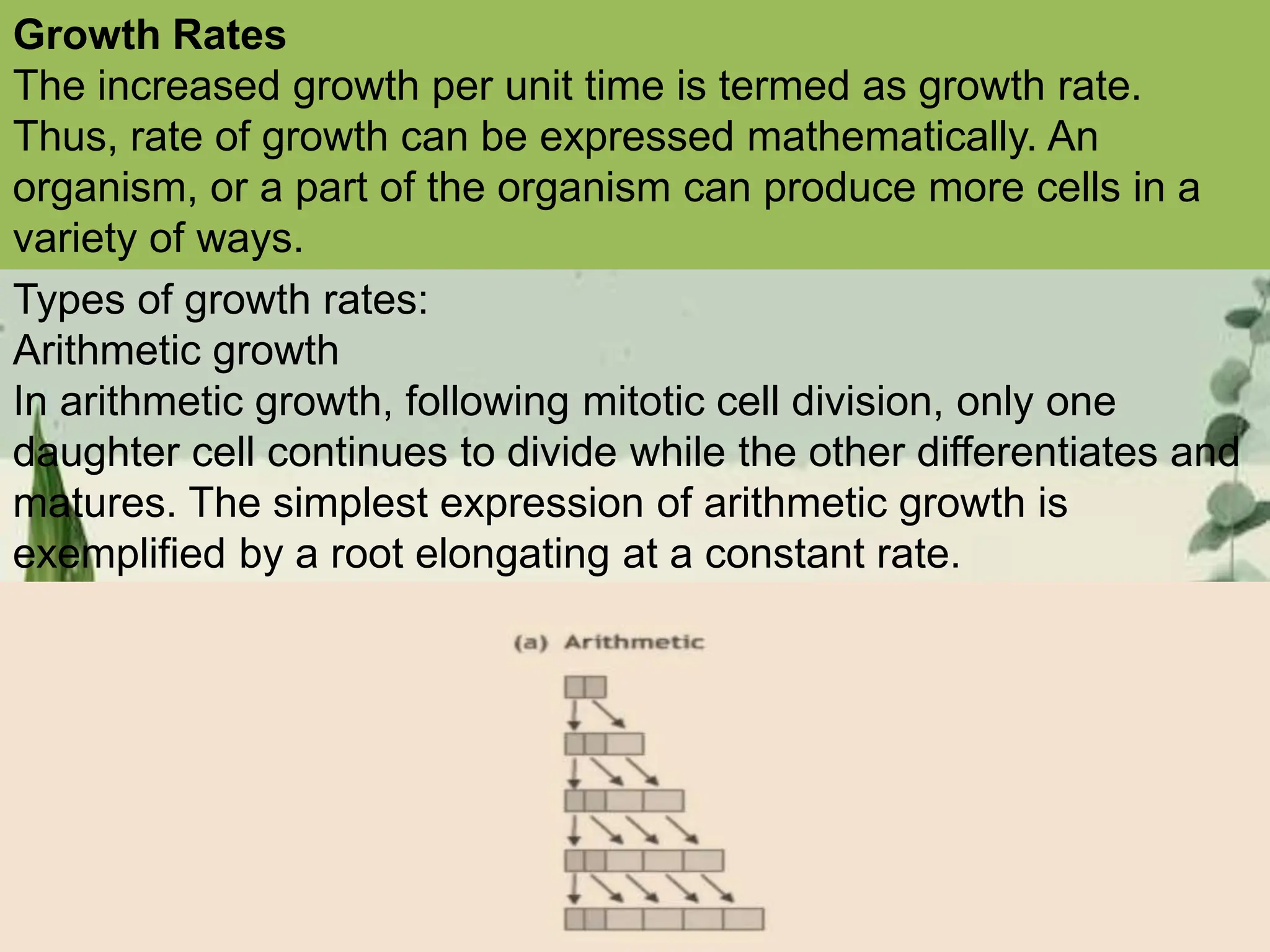
Arithmetic growth
In arithmetic growth, following mitotic cell division, only one
daughter cell continues to divide while the other differentiates and
matures. The simplest expression of arithmetic growth is
exemplified by a root elongating at a constant rate.
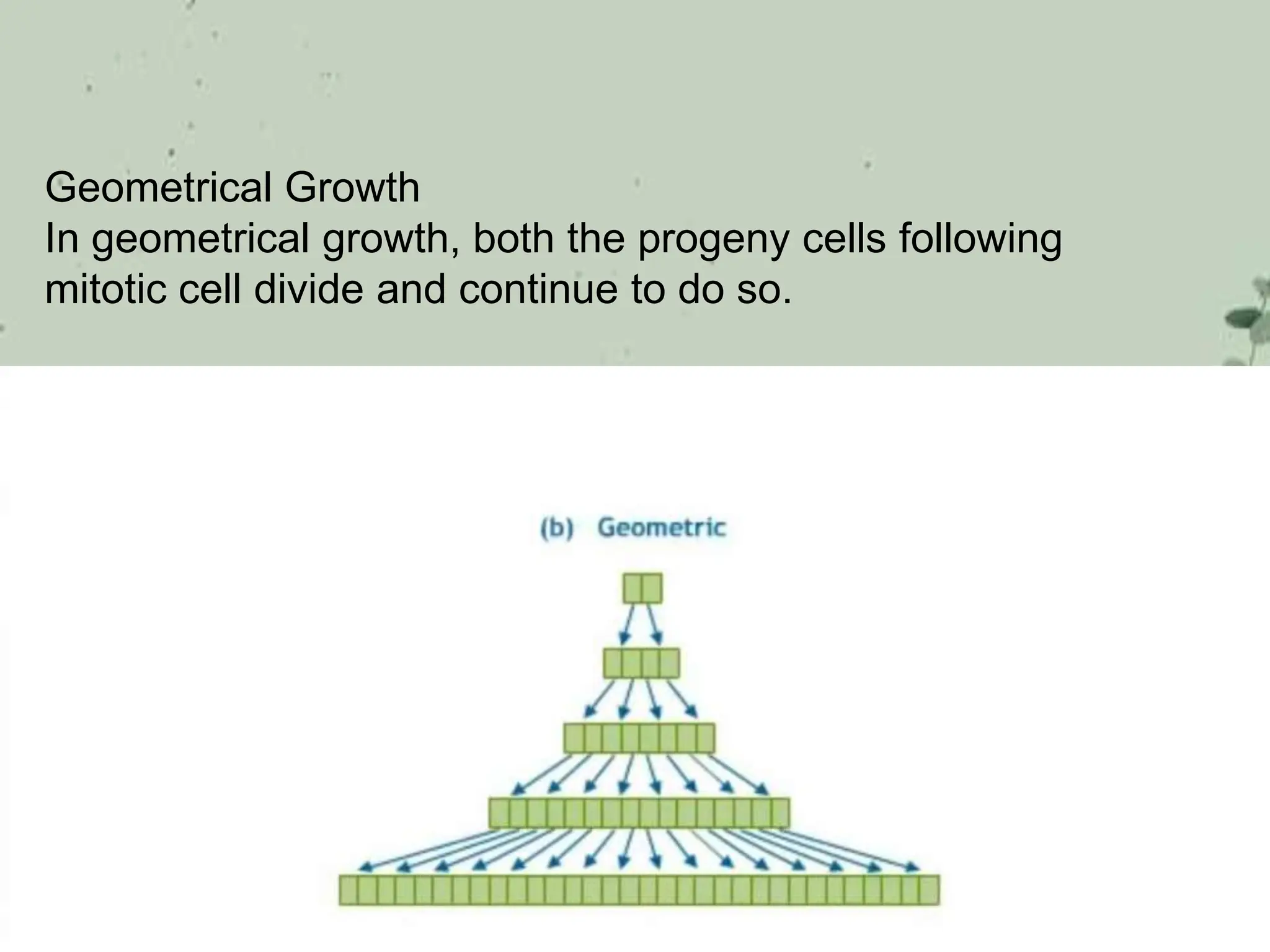
Geometrical Growth
In geometrical growth, both the progeny cells following
mitotic cell divide and continue to do so.
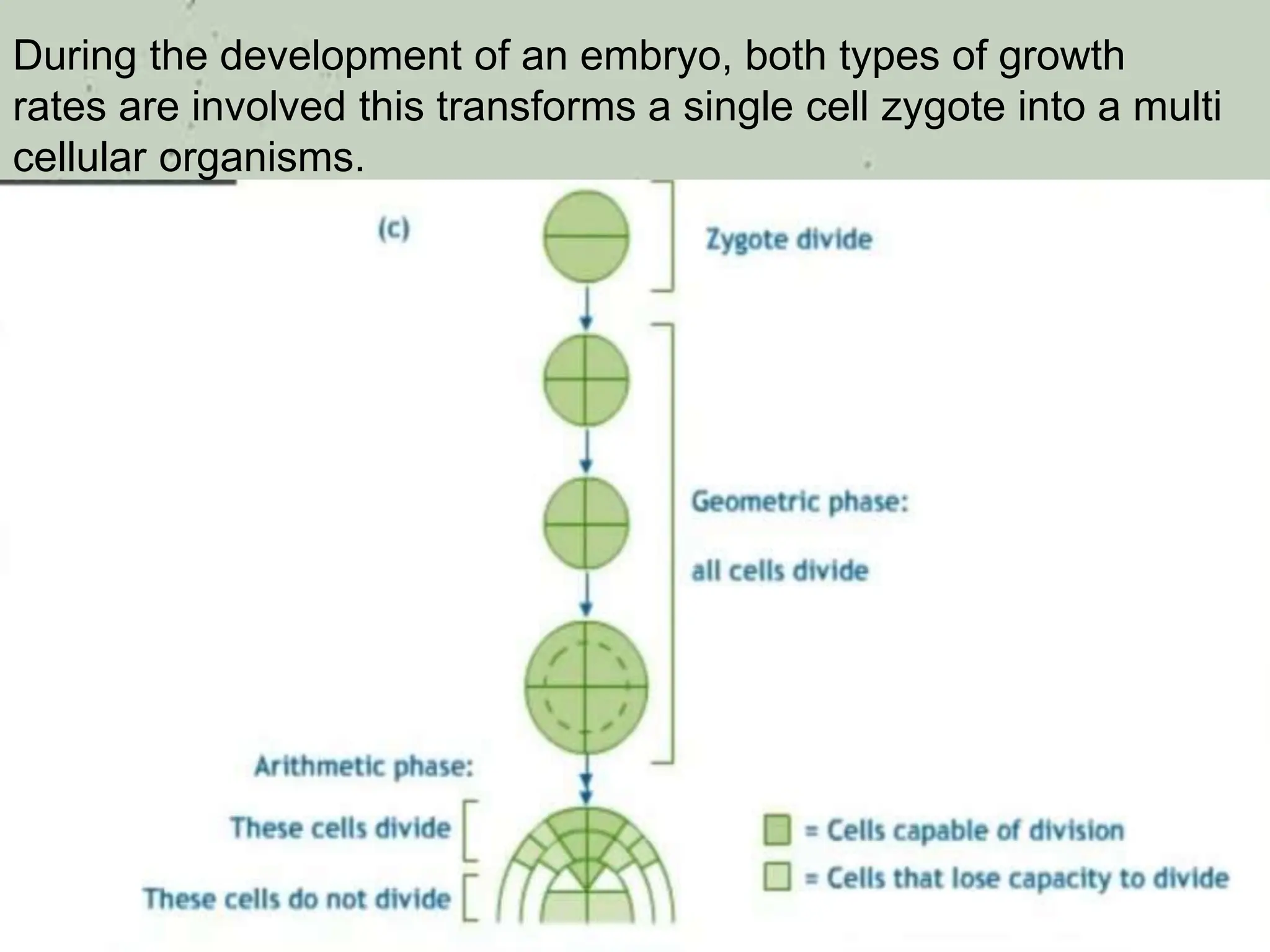
During the development of an embryo, both types of growth
rates are involved this transforms a single cell zygote into a multi
cellular organisms.
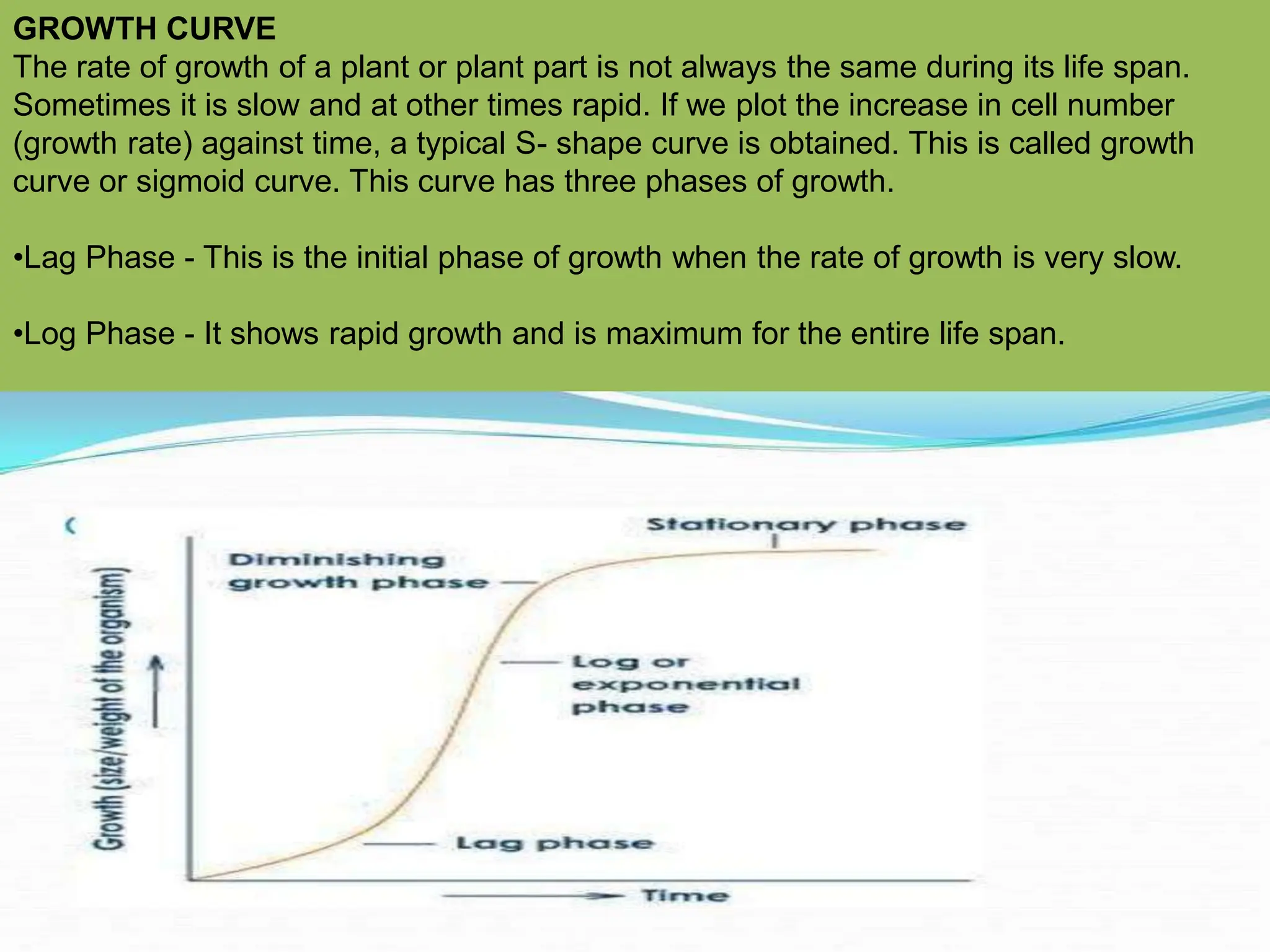
GROWTH CURVE
The rate of growth of a plant or plant part is not always the same during its life span.
Sometimes it is slow and at other times rapid. If we plot the increase in cell number
(growth rate) against time, a typical S- shape curve is obtained. This is called growth
curve or sigmoid curve. This curve has three phases of growth.
•Lag Phase - This is the initial phase of growth when the rate of growth is very slow.
•Log Phase - It shows rapid growth and is maximum for the entire life span.
•Stationary Phase - Here the rate of growth starts decreasing and finally it stops.
Growth Requirements
•Nutrients
•Water
•Temperature (Heat)
•Light Growth Substances (Hormones)
Types of Growth:
Growth is of two types
•Indefinite or unlimited growth exhibited by root, stem and their
branches,
•Definite or limited growth exhibited by leaves, flowers, fruits, etc.
Development is associated with morphogenesis and
differentiation.
Morphogenesis is the process of development of shape and
structure of an organism. When a cell loses the capacity to divide,
it leads to differentiation.
Differentiation results in development of structures that is
commensurate with the function the cells finally has to perform.
General principles for differentiation for cell, tissues and organs
are similar. A differentiated cell may dedifferentiate and then re
differentiate. Since differentiation in plants is open, the
development could also be flexible, i.e., the development is the
sum of growth and differentiation.
Development is the sum of two processes: growth and
differentiation. To begin with, it is essential and sufficient to know
that the development of a mature plant from a zygote (fertilized
egg) follow a precise and highly ordered succession of events.
During this process a complex body organization is formed that
produces roots, leaves, branches, flowers, fruits, and seeds, and
eventually they die.
Senescence: A program in which the function of organ or whole
plant naturally declines to death. This is an essential phase of the
growth and development in plant .Senescence is an active
developmental process that is controlled by the plant's genetic
program and initiated by specific environmental or developmental
cues.
All cells of a plant develops from a zygote
Zygote produces a number of cells which organize into tissues
and organs. Development referring to the sum of all changes and
stages that an organism undergo through a life cycle from seed
germination, growth, maturation, flowering, and senescene.
EMBRYO AND SEED DEVELOPMENT
Proteins, lipids, and starch are produced and stored by embryonic
cells, especially cotyledons, to provide energy and basic building
blocks for seedling growth.
The embryo then starts to decompose, losing up to 80% of its
previous water content, and enters a dormant state. Seeds
containing dormant embryos can live for several years
(sometimes centuries) and endure extreme temperatures and
drought because their growth and metabolism are halted. In
embryogenesis and seed dormancy, plant hormones play an
important role.
Control of growth and development
Thus, growth, differentiation and development are very closely
related events in the life of a plant. Broadly, development is
considered as theism of growth and differentiation. Development
in plants (i.e., both growth and differentiation) is under the control
of:
1- Inter cellular controls Involves in changes in gene expression
that influences cellular activities through altering the kind of
proteins in the cell.
2-Intra cellular controls: focus on hormones(phytohormones)
and their role the activities of groups of cells.
3-Extra cellular controls :they originate outside the organism
and information about the Any change in the environmental
conditions that may adversely affect the growth or development in
plants is called biological stress. This stress occurs mainly due to
temperature, water, salt, shade, light, and various pollutants
Germination
As a plant germinates and matures, it undergoes the processes of
growth and development. Growth arises from the addition of new
cells and the increase in their size. Development is the result of
cells differentiating into a diversity of tissues that make up organs
such as roots, shoots, leaves, and flowers. Each of these organs
has specialized functions coordinated to enable the individual
plant to complete its cycle in the spiral of life.
the growth and development of plants is not just limited to an
embryonic or juvenile period, but occurs throughout the life of the
plant. - At any given instance, a typical plant consists of embryonic
organs, developing organs, and mature organ
There are 6 plant processes that effect growth which are:
Photosynthesis
Respiration
Absorption
Transpiration
Translocation
Reproduction
Photosynthesis - Creating carbohydrates (stored energy) from CO2 +
water + sunlight in the presence of chlorophyll.
Respiration - An energy releasing reaction; chemical energy originating
through photosynthesis is used for growth and development.
.
Absorption
Plants absorb water from the soil by a process called osmosis –
the natural movement of water molecules from an area of high
concentration, across a semi-permeable, sieve-like membrane, to
an area of low concentration.
Transpiration
Transpiration is the process of water movement through
a plant and its evaporation from aerial parts, such as
leaves, stems and flowers
Translocation
Translocation is the movement of materials in
plants from the leaves to other parts of the plant.
Reproduction
The genetic material from the male and female gametes combines
to produce offspring

Plant-growth-and-development in general biology

  • 1.
    Plant Growth AndDevelopment
  • 2.
    Plant Growth AndDevelopment Growth: in living organisms may be defined as an irreversible increase in the number and size of a cell, organ or whole organism, related to change in size & mass. Development: referring to the sum of all changes that an organism undergo through its life cycle from seed germination and through growth , maturation, flowering, and Senescence.
  • 3.
    Growth Growth is regardedas one of the most fundamental and conspicuous characteristics of a living being. Generally, growth is accompanied by metabolic processes (both anabolic and catabolic), that occur at the expense of energy. Therefore, for example, expansion of a leaf is growth
  • 4.
    Types of Growth Classifiedby Developmental Stages Primary growth: Apical meristems extend roots and shoots by giving rise to the primary plant body Secondary growth: Lateral meristems add girth by producing secondary vascular tissue and periderm.
  • 6.
    MEASUREMENT OF GROWTH Itcan be measured in terms of: •Increase in length or growth – in case of stem and root. •Increase in area or volume - in case of leaves and fruits. •Increase in the number of cells - in algae, yeast and bacteria Types of Growth & Development • Vegetative Phase - Carbohydrate Utilization •Reproductive Phase - Accumulation or storage of carbohydrates Vegetative Phase From seed germination through growth of the primary supportive structure Three important processes: - Cell division - Cell enlargement - Cell differentiation (initial stages)
  • 8.
    Phases of GrowthMeristematic: both at the root apex and the shoot apex, represent the meristematic phase of growth Meristematic Cells (Stem Cells) Primary •Shoot Apical Meristem (SAM) •Root Apical Meristem (RAM) Secondary •Axillary Buds •Vascular Cambium •Cork Cambium •Pericycle (root)
  • 9.
    Elongation: The sizeof individual cell increases after cell division due to increase in the volume of its protoplasm. Adjacent to Meristems •Inter node growth – Shoot •Zone of Elongation – Root Turgor Pressure •H2O Uptake •Cell Wall Loosening •New cell walls Maturation(differenciation) :In this stage, structure of the cells changes to perform specific functions. And similar type of cells having same functions form a group, which is known as tissue. Secondary cell walls •Xylem - Vascular tissue •Fibers •Epidermal cells •root hairs •leaf hairs •guard cells •Leaves, Flowers Fruit, •Tubers, Bulbs, etc
  • 10.
    Growth Rates The increasedgrowth per unit time is termed as growth rate. Thus, rate of growth can be expressed mathematically. An organism, or a part of the organism can produce more cells in a variety of ways. Types of growth rates: Arithmetic growth In arithmetic growth, following mitotic cell division, only one daughter cell continues to divide while the other differentiates and matures. The simplest expression of arithmetic growth is exemplified by a root elongating at a constant rate.
  • 11.
    Geometrical Growth In geometricalgrowth, both the progeny cells following mitotic cell divide and continue to do so.
  • 12.
    During the developmentof an embryo, both types of growth rates are involved this transforms a single cell zygote into a multi cellular organisms.
  • 13.
    GROWTH CURVE The rateof growth of a plant or plant part is not always the same during its life span. Sometimes it is slow and at other times rapid. If we plot the increase in cell number (growth rate) against time, a typical S- shape curve is obtained. This is called growth curve or sigmoid curve. This curve has three phases of growth. •Lag Phase - This is the initial phase of growth when the rate of growth is very slow. •Log Phase - It shows rapid growth and is maximum for the entire life span. •Stationary Phase - Here the rate of growth starts decreasing and finally it stops.
  • 14.
    Growth Requirements •Nutrients •Water •Temperature (Heat) •LightGrowth Substances (Hormones) Types of Growth: Growth is of two types •Indefinite or unlimited growth exhibited by root, stem and their branches, •Definite or limited growth exhibited by leaves, flowers, fruits, etc.
  • 15.
    Development is associatedwith morphogenesis and differentiation. Morphogenesis is the process of development of shape and structure of an organism. When a cell loses the capacity to divide, it leads to differentiation. Differentiation results in development of structures that is commensurate with the function the cells finally has to perform. General principles for differentiation for cell, tissues and organs are similar. A differentiated cell may dedifferentiate and then re differentiate. Since differentiation in plants is open, the development could also be flexible, i.e., the development is the sum of growth and differentiation.
  • 17.
    Development is thesum of two processes: growth and differentiation. To begin with, it is essential and sufficient to know that the development of a mature plant from a zygote (fertilized egg) follow a precise and highly ordered succession of events. During this process a complex body organization is formed that produces roots, leaves, branches, flowers, fruits, and seeds, and eventually they die. Senescence: A program in which the function of organ or whole plant naturally declines to death. This is an essential phase of the growth and development in plant .Senescence is an active developmental process that is controlled by the plant's genetic program and initiated by specific environmental or developmental cues.
  • 19.
    All cells ofa plant develops from a zygote Zygote produces a number of cells which organize into tissues and organs. Development referring to the sum of all changes and stages that an organism undergo through a life cycle from seed germination, growth, maturation, flowering, and senescene. EMBRYO AND SEED DEVELOPMENT Proteins, lipids, and starch are produced and stored by embryonic cells, especially cotyledons, to provide energy and basic building blocks for seedling growth. The embryo then starts to decompose, losing up to 80% of its previous water content, and enters a dormant state. Seeds containing dormant embryos can live for several years (sometimes centuries) and endure extreme temperatures and drought because their growth and metabolism are halted. In embryogenesis and seed dormancy, plant hormones play an important role.
  • 21.
    Control of growthand development Thus, growth, differentiation and development are very closely related events in the life of a plant. Broadly, development is considered as theism of growth and differentiation. Development in plants (i.e., both growth and differentiation) is under the control of: 1- Inter cellular controls Involves in changes in gene expression that influences cellular activities through altering the kind of proteins in the cell. 2-Intra cellular controls: focus on hormones(phytohormones) and their role the activities of groups of cells. 3-Extra cellular controls :they originate outside the organism and information about the Any change in the environmental conditions that may adversely affect the growth or development in plants is called biological stress. This stress occurs mainly due to temperature, water, salt, shade, light, and various pollutants
  • 22.
    Germination As a plantgerminates and matures, it undergoes the processes of growth and development. Growth arises from the addition of new cells and the increase in their size. Development is the result of cells differentiating into a diversity of tissues that make up organs such as roots, shoots, leaves, and flowers. Each of these organs has specialized functions coordinated to enable the individual plant to complete its cycle in the spiral of life. the growth and development of plants is not just limited to an embryonic or juvenile period, but occurs throughout the life of the plant. - At any given instance, a typical plant consists of embryonic organs, developing organs, and mature organ
  • 25.
    There are 6plant processes that effect growth which are: Photosynthesis Respiration Absorption Transpiration Translocation Reproduction Photosynthesis - Creating carbohydrates (stored energy) from CO2 + water + sunlight in the presence of chlorophyll. Respiration - An energy releasing reaction; chemical energy originating through photosynthesis is used for growth and development. .
  • 26.
    Absorption Plants absorb waterfrom the soil by a process called osmosis – the natural movement of water molecules from an area of high concentration, across a semi-permeable, sieve-like membrane, to an area of low concentration. Transpiration Transpiration is the process of water movement through a plant and its evaporation from aerial parts, such as leaves, stems and flowers Translocation Translocation is the movement of materials in plants from the leaves to other parts of the plant. Reproduction The genetic material from the male and female gametes combines to produce offspring