Nutrition in Plants
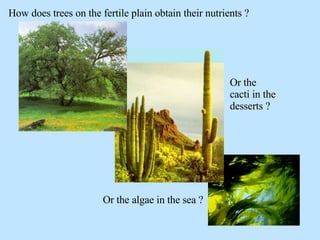
How does trees on the fertile plain obtain their nutrients ? Or the algae in the sea ? Or the cacti in the desserts ?
Review Question Which mode of nutrition do the  green  plants carry out? A. Autotrophic nutrition B. Heterotrophic nutrition
Sorry!  You’re wrong! Heterotrophic nutrition  is the mode of nutrition in which organisms have to depend on  other organisms  or  dead organic matters  as their food sources.  Green plants, however, can make organic food by themselves using simple inorganic substances.
Very Good! Autotrophic nutrition is the mode of nutrition in which organisms can make organic food by themselves using  simple inorganic substances . The process by which the green plants obtain nutrients is called : Photosynthesis
Nature of photosynthesis Takes place in  Chloroplast Necessary factors : Carbon dioxide Water Sunlight Chlorophyll
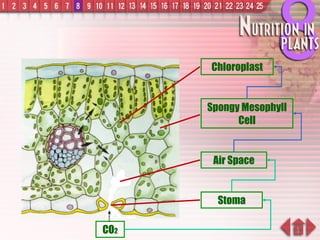
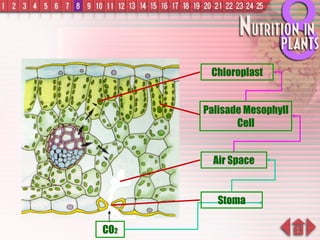
Route of Carbon Dioxide for Photosynthesis
CO 2 Stoma Air Space Spongy Mesophyll Cell Chloroplast
CO 2 Chloroplast Palisade Mesophyll Cell Stoma Air Space
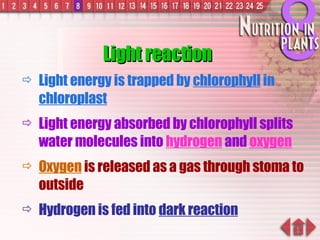
Light energy is trapped by  chlorophyll  in  chloroplast Light energy absorbed by chlorophyll splits water molecules into  hydrogen  and  oxygen Oxygen  is released as a gas through stoma to outside Hydrogen is fed into  dark reaction Light reaction
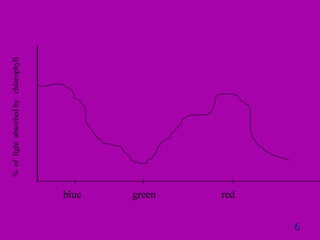
6 blue red %  of  light  absorbed by  chlorophyll   green
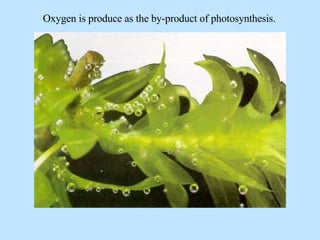
Oxygen is produce as the by-product of photosynthesis.
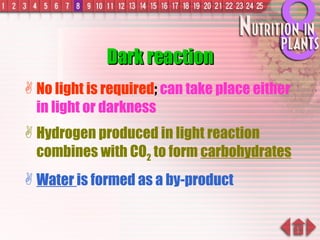
Dark reaction No light is required ;  can take place either in light or darkness Hydrogen produced in light reaction combines with CO 2  to form  carbohydrates Water  is formed as a by-product
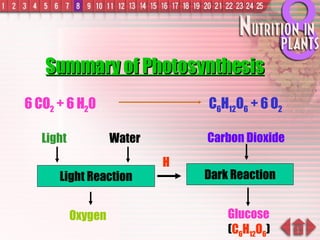
Dark Reaction H Summary of Photosynthesis Water Oxygen Glucose ( C 6 H 12 O 6 ) Light Reaction 6 CO 2  + 6 H 2 0 C 6 H 12 O 6  + 6 O 2 Light Carbon Dioxide
Fate of carbohydrate products in the plant
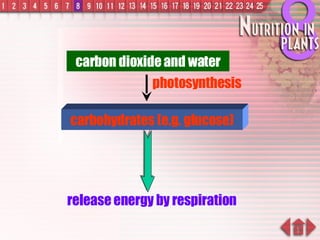
carbohydrates (e.g. glucose) carbon dioxide and water release energy by respiration photosynthesis
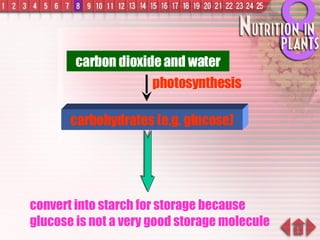
convert into starch for storage because glucose is not a very good storage molecule carbohydrates (e.g. glucose) carbon dioxide and water photosynthesis
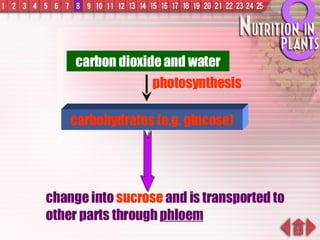
change into  sucrose  and is transported to other parts through  phloem carbohydrates (e.g. glucose) carbon dioxide and water photosynthesis
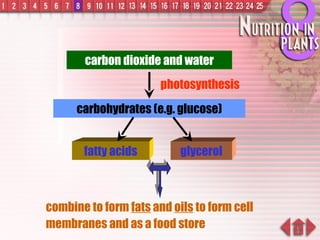
carbon dioxide and water photosynthesis carbohydrates (e.g. glucose) combine to form  fats  and  oils  to form cell membranes and as a food store fatty acids glycerol
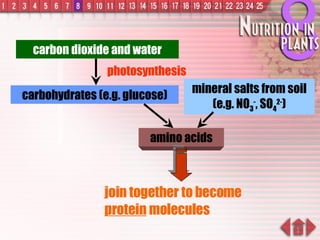
carbon dioxide and water photosynthesis carbohydrates (e.g. glucose) mineral salts from soil (e.g. NO 3 - , SO 4 2- ) amino acids join together to become  protein  molecules
Experiments on photosynthesis
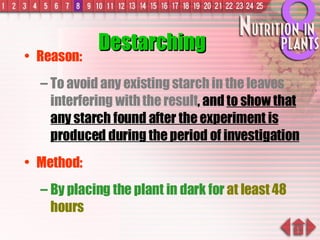
Destarching Reason: To avoid any existing starch in the leaves interfering with the result , and  to show that any starch found after the experiment is produced during the period of investigation Method: By placing the plant in dark for  at least 48 hours
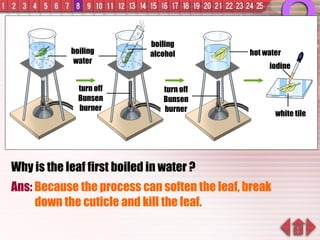
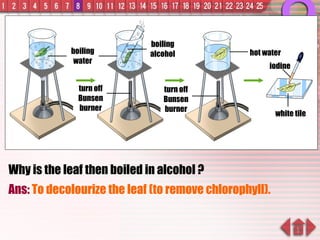
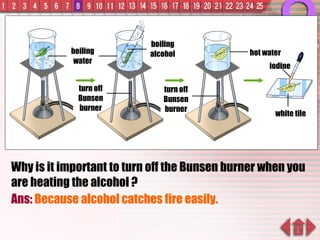
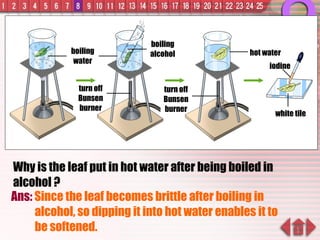
To test a leaf for the presence of Starch Investigation 8.1
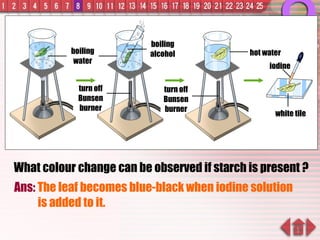
Why is the leaf first boiled in water ? Ans:  Because the process can soften the leaf, break down the cuticle and kill the leaf. boiling water turn off Bunsen burner boiling alcohol hot water iodine white tile turn off Bunsen burner
Why is the leaf then boiled in alcohol ? Ans:  To decolourize the leaf (to remove chlorophyll). boiling water turn off Bunsen burner boiling alcohol hot water iodine white tile turn off Bunsen burner
Why is it important to turn off the Bunsen burner when you are heating the alcohol ? Ans:  Because alcohol catches fire easily. boiling water turn off Bunsen burner boiling alcohol hot water iodine white tile turn off Bunsen burner
Why is the leaf put in hot water after being boiled in alcohol ? Ans:  Since the leaf becomes brittle after boiling in alcohol, so dipping it into hot water enables it to be softened. boiling water turn off Bunsen burner boiling alcohol hot water iodine white tile turn off Bunsen burner
What colour change can be observed if starch is present ? Ans:  The leaf becomes blue-black when iodine solution is added to it. boiling water turn off Bunsen burner boiling alcohol hot water iodine white tile turn off Bunsen burner
To show that Chlorophyll is necessary for Photosynthesis Investigation 8.3
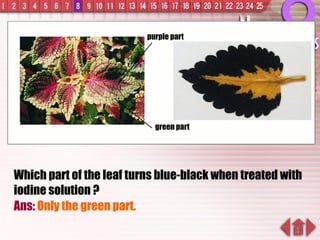
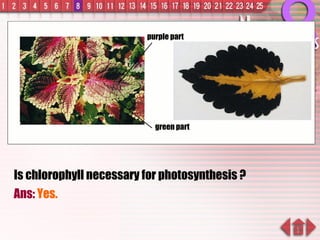
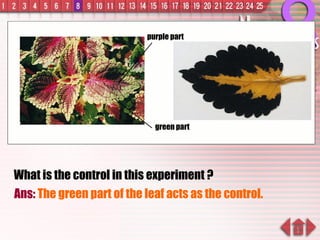
Which part of the leaf turns blue-black when treated with iodine solution ? Ans:  Only the green part. green part purple part
Is chlorophyll necessary for photosynthesis ? Ans:  Yes. green part purple part
What is the control in this experiment ? Ans:  The green part of the leaf acts as the control. green part purple part
To show that Carbon Dioxide is necessary for Photosynthesis Investigation 8.4
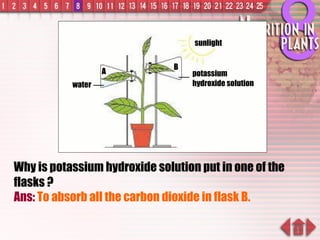
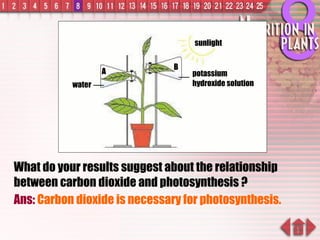
Why is potassium hydroxide solution put in one of the flasks ? Ans:  To absorb all the carbon dioxide in flask B. sunlight B A water potassium hydroxide solution
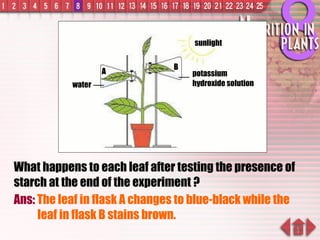
What happens to each leaf after testing the presence of starch at the end of the experiment ? Ans:  The leaf in flask A changes to blue-black while the leaf in flask B stains brown. sunlight B A water potassium hydroxide solution
What do your results suggest about the relationship between carbon dioxide and photosynthesis ? Ans:  Carbon dioxide is necessary for photosynthesis. sunlight B A water potassium hydroxide solution
Factors affecting the rate of photosynthesis
   Light intensity     Rate of Photosynthesis Light Intensity
   Carbon dioxide concentration    Rate of Photosynthesis Carbon Dioxide Concentration
   Temperature     Rate of Photosynthesis  Temperature Temperature > 40 ℃ Rate    & Stop soon
If no water, stomata close  no gaseous exchange photosynthesis ceases Water Supply
Why is Photosynthesis important ? Green plants: the only organisms capable of trapping light to manufacture food from simple inorganic substances
Why is Photosynthesis important ? Green plants(producers) starts the food chain & provide food for other organisms
Why is Photosynthesis important ? Atmospheric carbon dioxide is absorbed & oxygen is released into the atmosphere which maintains the composition of the atmosphere constant
Parts of plant where photosynthesis takes place Mainly in the leaf because   it contains a lot of chloroplasts it is well adapted for performing photosynthesis
Internal Structure of Leaf
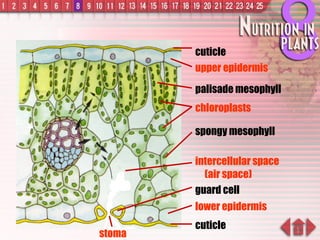
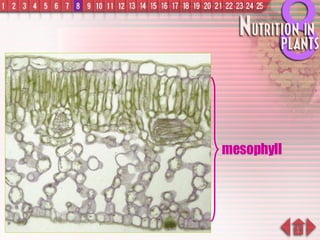
cuticle upper epidermis palisade mesophyll spongy mesophyll intercellular space   (air space) guard cell lower epidermis cuticle stoma chloroplasts
Cross-section of a leaf of dicotyledon
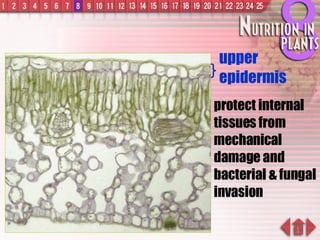
upper epidermis protect internal tissues from mechanical damage and bacterial & fungal invasion
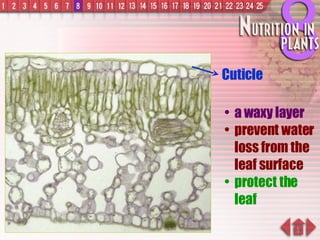
Cuticle a waxy layer prevent water loss from the leaf surface protect the leaf
mesophyll
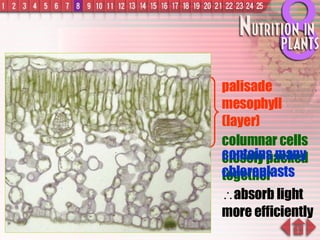
palisade mesophyll (layer) columnar cells closely packed together  absorb light more efficiently contains many chloroplasts
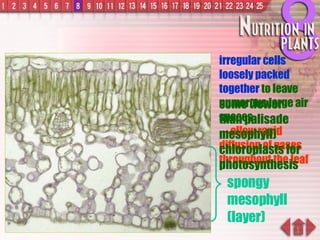
spongy mesophyll (layer)  irregular cells loosely packed together  to leave numerous large air spaces  allow rapid diffusion of gases throughout the leaf some (fewer than palisade mesophyll) chloroplasts for photosynthesis
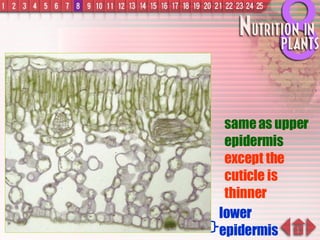
lower epidermis same as upper epidermis  except the cuticle is thinner
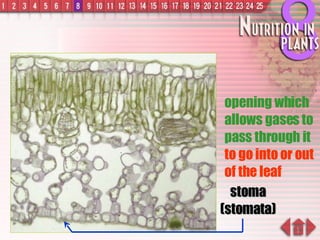
stoma (stomata) opening which allows gases to pass through it  to go into or out of the leaf
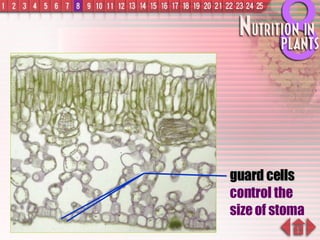
guard cells control the size of stoma
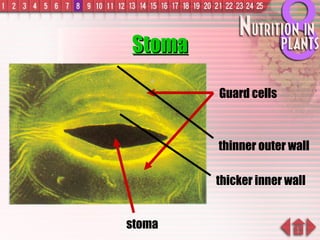
Stoma stoma Guard cells thinner outer wall thicker inner wall
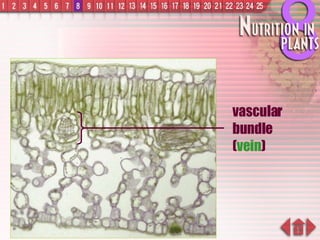
vascular bundle ( vein )
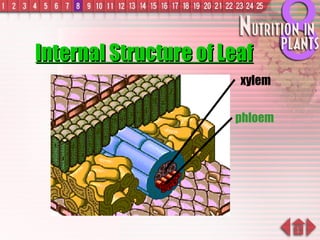
Internal Structure of Leaf xylem phloem
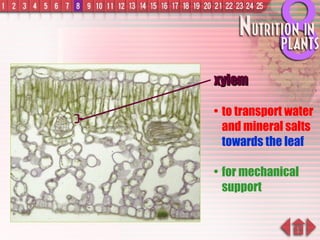
xylem to transport water and mineral salts towards the leaf for   mechanical support
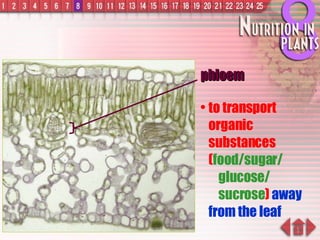
phloem to transport organic substances ( food/sugar/   glucose/    sucrose )  away from the leaf
Adaptation of leaf to photosynthesis
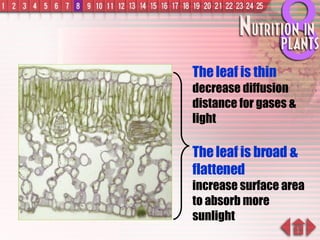
The leaf is thin  decrease diffusion distance for gases & light The leaf is broad & flattened   increase surface area to absorb more sunlight
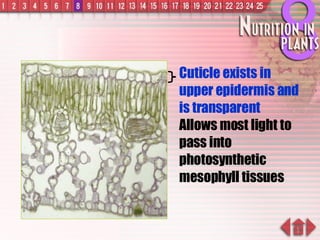
Cuticle exists in upper epidermis and is transparent Allows most light to pass into photosynthetic mesophyll tissues
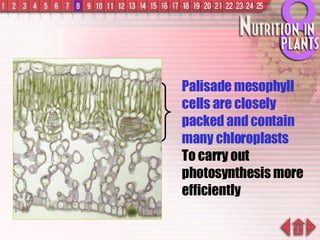
Palisade mesophyll cells are closely packed and contain many chloroplasts To carry out photosynthesis more efficiently
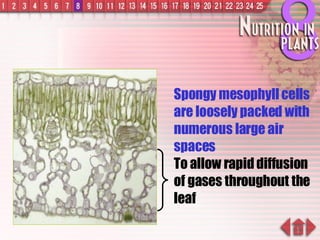
Spongy mesophyll cells are loosely packed with numerous large air spaces To allow rapid diffusion of gases throughout the leaf
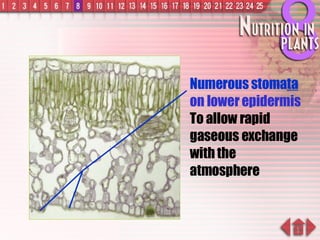
Numerous stoma ta   on lower epidermis To allow rapid gaseous exchange with the atmosphere
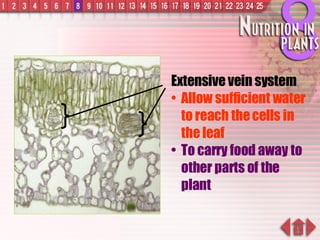
Extensive vein system Allow sufficient water to reach the cells in the leaf To carry food away to other parts of the plant
Mineral requirements in plants In order to synthesize  amino acids, nitrate   ions  which must be taken into the plant from the soil through the root Other minerals are also necessary to maintain the life of the plant (N, Mg, P, K, S, etc)
The importance of  nitrogen For synthesis of proteins, chlorophyll, etc Taken in form of nitrate ions Deficiency symptoms: Little growth ( - no   protein made) Yellowing of leaves ( - no chlorophyll made)
The importance of  magnesium Essential component of chlorophyll Deficiency symptoms: Yellowing of leaves (no chlorophyll made) Poor growth   (no food manufactured because of lack of chlorophyll)
Use of fertilizers in agriculture Continuous harvesting crops removes valuable mineral salts from soil  Fertilizers are added to replace such loss Two kinds of fertilizers: Natural fertilizers Chemical fertilizers
Natural fertilizers From manure Organic compounds in it are decomposed by the bacteria in soil to form mineral salts
Chemical fertilizers Mainly  nitrogenous  and  phosphorous  compounds manufactured artificially
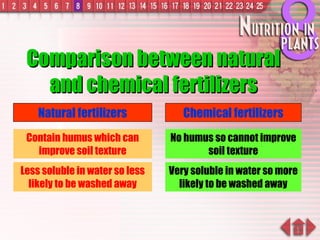
Comparison between natural and chemical fertilizers Natural fertilizers Chemical fertilizers Contain humus which can improve soil texture No humus so cannot improve soil texture Less soluble in water so less likely to be washed away Very soluble in water so more likely to be washed away
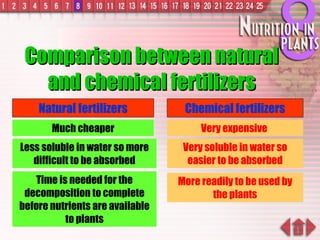
Comparison between natural and chemical fertilizers Natural fertilizers Chemical fertilizers Less soluble in water so more difficult to be absorbed Very soluble in water so easier to be absorbed More readily to be used by the plants Time is needed for the decomposition to complete before nutrients are available to plants Very expensive  Much cheaper
~  END   ~

nutrition in plants

  • 1.
  • 2.
    How does treeson the fertile plain obtain their nutrients ? Or the algae in the sea ? Or the cacti in the desserts ?
  • 3.
    Review Question Whichmode of nutrition do the green plants carry out? A. Autotrophic nutrition B. Heterotrophic nutrition
  • 4.
    Sorry! You’rewrong! Heterotrophic nutrition is the mode of nutrition in which organisms have to depend on other organisms or dead organic matters as their food sources. Green plants, however, can make organic food by themselves using simple inorganic substances.
  • 5.
    Very Good! Autotrophicnutrition is the mode of nutrition in which organisms can make organic food by themselves using simple inorganic substances . The process by which the green plants obtain nutrients is called : Photosynthesis
  • 6.
    Nature of photosynthesisTakes place in Chloroplast Necessary factors : Carbon dioxide Water Sunlight Chlorophyll
  • 7.
    Route of CarbonDioxide for Photosynthesis
  • 8.
    CO 2 StomaAir Space Spongy Mesophyll Cell Chloroplast
  • 9.
    CO 2 ChloroplastPalisade Mesophyll Cell Stoma Air Space
  • 10.
    Light energy istrapped by chlorophyll in chloroplast Light energy absorbed by chlorophyll splits water molecules into hydrogen and oxygen Oxygen is released as a gas through stoma to outside Hydrogen is fed into dark reaction Light reaction
  • 11.
    6 blue red% of light absorbed by chlorophyll green
  • 12.
    Oxygen is produceas the by-product of photosynthesis.
  • 13.
    Dark reaction Nolight is required ; can take place either in light or darkness Hydrogen produced in light reaction combines with CO 2 to form carbohydrates Water is formed as a by-product
  • 14.
    Dark Reaction HSummary of Photosynthesis Water Oxygen Glucose ( C 6 H 12 O 6 ) Light Reaction 6 CO 2 + 6 H 2 0 C 6 H 12 O 6 + 6 O 2 Light Carbon Dioxide
  • 15.
    Fate of carbohydrateproducts in the plant
  • 16.
    carbohydrates (e.g. glucose)carbon dioxide and water release energy by respiration photosynthesis
  • 17.
    convert into starchfor storage because glucose is not a very good storage molecule carbohydrates (e.g. glucose) carbon dioxide and water photosynthesis
  • 18.
    change into sucrose and is transported to other parts through phloem carbohydrates (e.g. glucose) carbon dioxide and water photosynthesis
  • 19.
    carbon dioxide andwater photosynthesis carbohydrates (e.g. glucose) combine to form fats and oils to form cell membranes and as a food store fatty acids glycerol
  • 20.
    carbon dioxide andwater photosynthesis carbohydrates (e.g. glucose) mineral salts from soil (e.g. NO 3 - , SO 4 2- ) amino acids join together to become protein molecules
  • 21.
  • 22.
    Destarching Reason: Toavoid any existing starch in the leaves interfering with the result , and to show that any starch found after the experiment is produced during the period of investigation Method: By placing the plant in dark for at least 48 hours
  • 23.
    To test aleaf for the presence of Starch Investigation 8.1
  • 24.
    Why is theleaf first boiled in water ? Ans: Because the process can soften the leaf, break down the cuticle and kill the leaf. boiling water turn off Bunsen burner boiling alcohol hot water iodine white tile turn off Bunsen burner
  • 25.
    Why is theleaf then boiled in alcohol ? Ans: To decolourize the leaf (to remove chlorophyll). boiling water turn off Bunsen burner boiling alcohol hot water iodine white tile turn off Bunsen burner
  • 26.
    Why is itimportant to turn off the Bunsen burner when you are heating the alcohol ? Ans: Because alcohol catches fire easily. boiling water turn off Bunsen burner boiling alcohol hot water iodine white tile turn off Bunsen burner
  • 27.
    Why is theleaf put in hot water after being boiled in alcohol ? Ans: Since the leaf becomes brittle after boiling in alcohol, so dipping it into hot water enables it to be softened. boiling water turn off Bunsen burner boiling alcohol hot water iodine white tile turn off Bunsen burner
  • 28.
    What colour changecan be observed if starch is present ? Ans: The leaf becomes blue-black when iodine solution is added to it. boiling water turn off Bunsen burner boiling alcohol hot water iodine white tile turn off Bunsen burner
  • 29.
    To show thatChlorophyll is necessary for Photosynthesis Investigation 8.3
  • 30.
    Which part ofthe leaf turns blue-black when treated with iodine solution ? Ans: Only the green part. green part purple part
  • 31.
    Is chlorophyll necessaryfor photosynthesis ? Ans: Yes. green part purple part
  • 32.
    What is thecontrol in this experiment ? Ans: The green part of the leaf acts as the control. green part purple part
  • 33.
    To show thatCarbon Dioxide is necessary for Photosynthesis Investigation 8.4
  • 34.
    Why is potassiumhydroxide solution put in one of the flasks ? Ans: To absorb all the carbon dioxide in flask B. sunlight B A water potassium hydroxide solution
  • 35.
    What happens toeach leaf after testing the presence of starch at the end of the experiment ? Ans: The leaf in flask A changes to blue-black while the leaf in flask B stains brown. sunlight B A water potassium hydroxide solution
  • 36.
    What do yourresults suggest about the relationship between carbon dioxide and photosynthesis ? Ans: Carbon dioxide is necessary for photosynthesis. sunlight B A water potassium hydroxide solution
  • 37.
    Factors affecting therate of photosynthesis
  • 38.
    Light intensity  Rate of Photosynthesis Light Intensity
  • 39.
    Carbon dioxide concentration  Rate of Photosynthesis Carbon Dioxide Concentration
  • 40.
    Temperature  Rate of Photosynthesis Temperature Temperature > 40 ℃ Rate  & Stop soon
  • 41.
    If no water,stomata close no gaseous exchange photosynthesis ceases Water Supply
  • 42.
    Why is Photosynthesisimportant ? Green plants: the only organisms capable of trapping light to manufacture food from simple inorganic substances
  • 43.
    Why is Photosynthesisimportant ? Green plants(producers) starts the food chain & provide food for other organisms
  • 44.
    Why is Photosynthesisimportant ? Atmospheric carbon dioxide is absorbed & oxygen is released into the atmosphere which maintains the composition of the atmosphere constant
  • 45.
    Parts of plantwhere photosynthesis takes place Mainly in the leaf because it contains a lot of chloroplasts it is well adapted for performing photosynthesis
  • 46.
  • 47.
    cuticle upper epidermispalisade mesophyll spongy mesophyll intercellular space (air space) guard cell lower epidermis cuticle stoma chloroplasts
  • 48.
    Cross-section of aleaf of dicotyledon
  • 49.
    upper epidermis protectinternal tissues from mechanical damage and bacterial & fungal invasion
  • 50.
    Cuticle a waxylayer prevent water loss from the leaf surface protect the leaf
  • 51.
  • 52.
    palisade mesophyll (layer)columnar cells closely packed together  absorb light more efficiently contains many chloroplasts
  • 53.
    spongy mesophyll (layer) irregular cells loosely packed together to leave numerous large air spaces  allow rapid diffusion of gases throughout the leaf some (fewer than palisade mesophyll) chloroplasts for photosynthesis
  • 54.
    lower epidermis sameas upper epidermis except the cuticle is thinner
  • 55.
    stoma (stomata) openingwhich allows gases to pass through it to go into or out of the leaf
  • 56.
    guard cells controlthe size of stoma
  • 57.
    Stoma stoma Guardcells thinner outer wall thicker inner wall
  • 58.
  • 59.
    Internal Structure ofLeaf xylem phloem
  • 60.
    xylem to transportwater and mineral salts towards the leaf for mechanical support
  • 61.
    phloem to transportorganic substances ( food/sugar/ glucose/ sucrose ) away from the leaf
  • 62.
    Adaptation of leafto photosynthesis
  • 63.
    The leaf isthin decrease diffusion distance for gases & light The leaf is broad & flattened increase surface area to absorb more sunlight
  • 64.
    Cuticle exists inupper epidermis and is transparent Allows most light to pass into photosynthetic mesophyll tissues
  • 65.
    Palisade mesophyll cellsare closely packed and contain many chloroplasts To carry out photosynthesis more efficiently
  • 66.
    Spongy mesophyll cellsare loosely packed with numerous large air spaces To allow rapid diffusion of gases throughout the leaf
  • 67.
    Numerous stoma ta on lower epidermis To allow rapid gaseous exchange with the atmosphere
  • 68.
    Extensive vein systemAllow sufficient water to reach the cells in the leaf To carry food away to other parts of the plant
  • 69.
    Mineral requirements inplants In order to synthesize amino acids, nitrate ions which must be taken into the plant from the soil through the root Other minerals are also necessary to maintain the life of the plant (N, Mg, P, K, S, etc)
  • 70.
    The importance of nitrogen For synthesis of proteins, chlorophyll, etc Taken in form of nitrate ions Deficiency symptoms: Little growth ( - no protein made) Yellowing of leaves ( - no chlorophyll made)
  • 71.
    The importance of magnesium Essential component of chlorophyll Deficiency symptoms: Yellowing of leaves (no chlorophyll made) Poor growth (no food manufactured because of lack of chlorophyll)
  • 72.
    Use of fertilizersin agriculture Continuous harvesting crops removes valuable mineral salts from soil  Fertilizers are added to replace such loss Two kinds of fertilizers: Natural fertilizers Chemical fertilizers
  • 73.
    Natural fertilizers Frommanure Organic compounds in it are decomposed by the bacteria in soil to form mineral salts
  • 74.
    Chemical fertilizers Mainly nitrogenous and phosphorous compounds manufactured artificially
  • 75.
    Comparison between naturaland chemical fertilizers Natural fertilizers Chemical fertilizers Contain humus which can improve soil texture No humus so cannot improve soil texture Less soluble in water so less likely to be washed away Very soluble in water so more likely to be washed away
  • 76.
    Comparison between naturaland chemical fertilizers Natural fertilizers Chemical fertilizers Less soluble in water so more difficult to be absorbed Very soluble in water so easier to be absorbed More readily to be used by the plants Time is needed for the decomposition to complete before nutrients are available to plants Very expensive Much cheaper
  • 77.