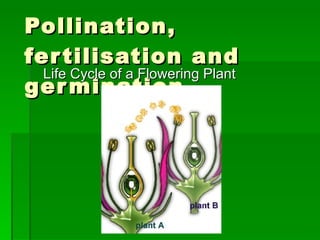
Pollination, fertilisation and germination  Life Cycle of a Flowering Plant
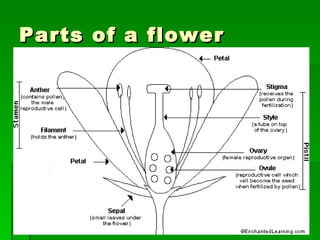
Parts of a flower
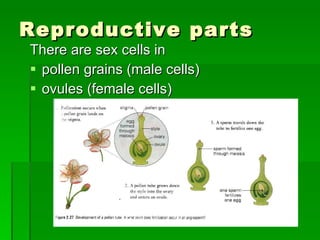
Reproductive parts There are sex cells in pollen grains (male cells) ovules (female cells)
By fertilization For fruits and seeds to form, male and female sex cells must  meet  and  fuse . Since male and female sex cells are involved, this is called “ sexual reproduction ”.  When the male cells meet with the female cell, they join together…this is called  fertilization .
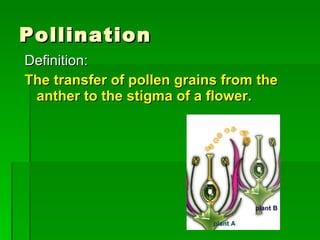
Pollination Definition: The transfer of pollen grains from the anther to the stigma of a flower.
Pollination Two types of pollination Self-pollination Cross-pollination
Pollination Self-pollination Transfer of pollen grains within one flower: One flower. Pollen grains from the anther are transferred onto the stigma.
Pollination Cross-pollination Transfer of pollen grains from one flower to  another: Two similar flowers. Pollen grains from the anther of one flower are transferred onto the stigma of the other flower.
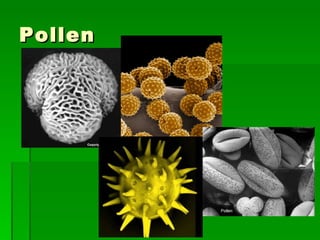
Pollen Pollen of different plants have different shapes and sizes. Pollen are small and light so that they can be carried by the  agents of pollination.
Pollen
Agents of pollination Plants generally do not transfer the pollen from one flower to another by themselves. Although a few plants do have self-pollination – pollen from flower’s anther pollinating its own stigma. These plants need  agents of pollination  to help them.
Agents of pollination Insects (bees) Other animals (birds and bats)  Wind
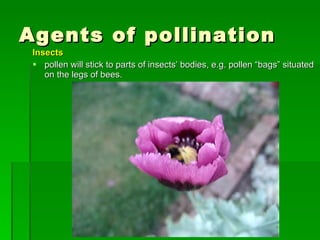
Agents of pollination Insects  pollen will stick to parts of insects’ bodies, e.g. pollen “bags” situated on the legs of bees.
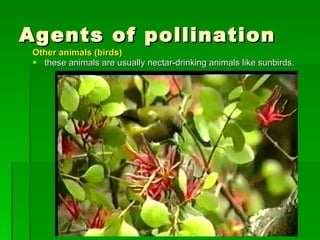
Agents of pollination Other animals (birds)  these animals are usually nectar-drinking animals like sunbirds.
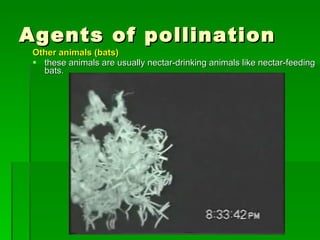
Agents of pollination Other animals (bats)  these animals are usually nectar-drinking animals like nectar-feeding bats.
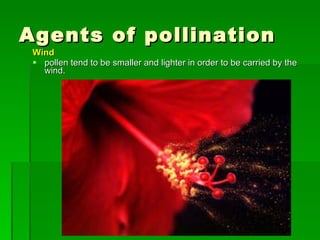
Agents of pollination Wind  pollen tend to be smaller and lighter in order to be carried by the wind.
Fertilisation When the male sex cells join with the female sex cells within the ovule. The resulting embryo then develops into a seed. Unfertilised ovules cannot become seeds. Fertilised ovules become seeds.
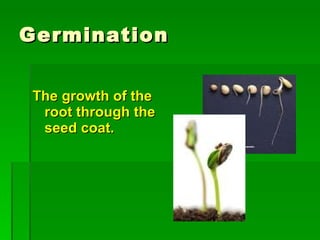
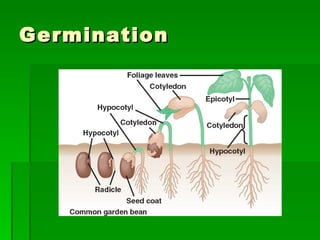
Germination The growth of the root through the seed coat.
Germination
Steps in germination: When a seed lands on a place with  sufficient  warmth, water   and   air , it starts to germinate. Sunlight  is not necessary for germination. 1.  The root of the baby plant grows out of the seed to form a seedling.  The seed coat falls on the ground. 2.  The shoot appears and breaks through the soil and the first leaves show .  The cotyledons fall on the ground. 3. The young plant now can make its own food with  the sunlight by photosynthesis.
Germination When a seed lands on a place with  sufficient  warmth, water   and   air , it starts to germinate. Sunlight is not necessary for germination. First, the root of the baby plant grows out of the seed to form a seedling. During this stage, the seedling cannot make its own food. It gets its energy from the food stored in its seed leaves.
Germination Seed leaves are the parts of a seed that protect the baby plant. Next, the shoot appears and breaks through the soil and the first leaves unfold. The young plant is now able to make its own food as the green leaves makes food in the sunlight (photosynthesis). Note: seed leaves are the parts of a seed that protect the baby plant, leaves are the part of the plant that manufactures food.
Remember: Pollination - the transfer of pollen grains from the  anther to the stigma of a flower. Agents of pollination - animals that help plants transfer the  pollen from one flower to another  (insects, animals, water, wind) Fertilisation - when the male sex cells join with the female  sex cells within the ovule. Germination - the growth of the root through the seed  coat.
The end

Pollination, fertilisation and germination

  • 1.
    Pollination, fertilisation andgermination Life Cycle of a Flowering Plant
  • 2.
    Parts of aflower
  • 3.
    Reproductive parts Thereare sex cells in pollen grains (male cells) ovules (female cells)
  • 4.
    By fertilization Forfruits and seeds to form, male and female sex cells must meet and fuse . Since male and female sex cells are involved, this is called “ sexual reproduction ”. When the male cells meet with the female cell, they join together…this is called fertilization .
  • 5.
    Pollination Definition: Thetransfer of pollen grains from the anther to the stigma of a flower.
  • 6.
    Pollination Two typesof pollination Self-pollination Cross-pollination
  • 7.
    Pollination Self-pollination Transferof pollen grains within one flower: One flower. Pollen grains from the anther are transferred onto the stigma.
  • 8.
    Pollination Cross-pollination Transferof pollen grains from one flower to another: Two similar flowers. Pollen grains from the anther of one flower are transferred onto the stigma of the other flower.
  • 9.
    Pollen Pollen ofdifferent plants have different shapes and sizes. Pollen are small and light so that they can be carried by the agents of pollination.
  • 10.
  • 11.
    Agents of pollinationPlants generally do not transfer the pollen from one flower to another by themselves. Although a few plants do have self-pollination – pollen from flower’s anther pollinating its own stigma. These plants need agents of pollination to help them.
  • 12.
    Agents of pollinationInsects (bees) Other animals (birds and bats) Wind
  • 13.
    Agents of pollinationInsects pollen will stick to parts of insects’ bodies, e.g. pollen “bags” situated on the legs of bees.
  • 14.
    Agents of pollinationOther animals (birds) these animals are usually nectar-drinking animals like sunbirds.
  • 15.
    Agents of pollinationOther animals (bats) these animals are usually nectar-drinking animals like nectar-feeding bats.
  • 16.
    Agents of pollinationWind pollen tend to be smaller and lighter in order to be carried by the wind.
  • 17.
    Fertilisation When themale sex cells join with the female sex cells within the ovule. The resulting embryo then develops into a seed. Unfertilised ovules cannot become seeds. Fertilised ovules become seeds.
  • 18.
    Germination The growthof the root through the seed coat.
  • 19.
  • 20.
    Steps in germination:When a seed lands on a place with sufficient warmth, water and air , it starts to germinate. Sunlight is not necessary for germination. 1. The root of the baby plant grows out of the seed to form a seedling. The seed coat falls on the ground. 2. The shoot appears and breaks through the soil and the first leaves show . The cotyledons fall on the ground. 3. The young plant now can make its own food with the sunlight by photosynthesis.
  • 21.
    Germination When aseed lands on a place with sufficient warmth, water and air , it starts to germinate. Sunlight is not necessary for germination. First, the root of the baby plant grows out of the seed to form a seedling. During this stage, the seedling cannot make its own food. It gets its energy from the food stored in its seed leaves.
  • 22.
    Germination Seed leavesare the parts of a seed that protect the baby plant. Next, the shoot appears and breaks through the soil and the first leaves unfold. The young plant is now able to make its own food as the green leaves makes food in the sunlight (photosynthesis). Note: seed leaves are the parts of a seed that protect the baby plant, leaves are the part of the plant that manufactures food.
  • 23.
    Remember: Pollination -the transfer of pollen grains from the anther to the stigma of a flower. Agents of pollination - animals that help plants transfer the pollen from one flower to another (insects, animals, water, wind) Fertilisation - when the male sex cells join with the female sex cells within the ovule. Germination - the growth of the root through the seed coat.
  • 24.