Warren County Master Gardener Class Botany 101 Carol La Faver  CEA for Horticulture—Warren County


When Is a Tree a Tree?
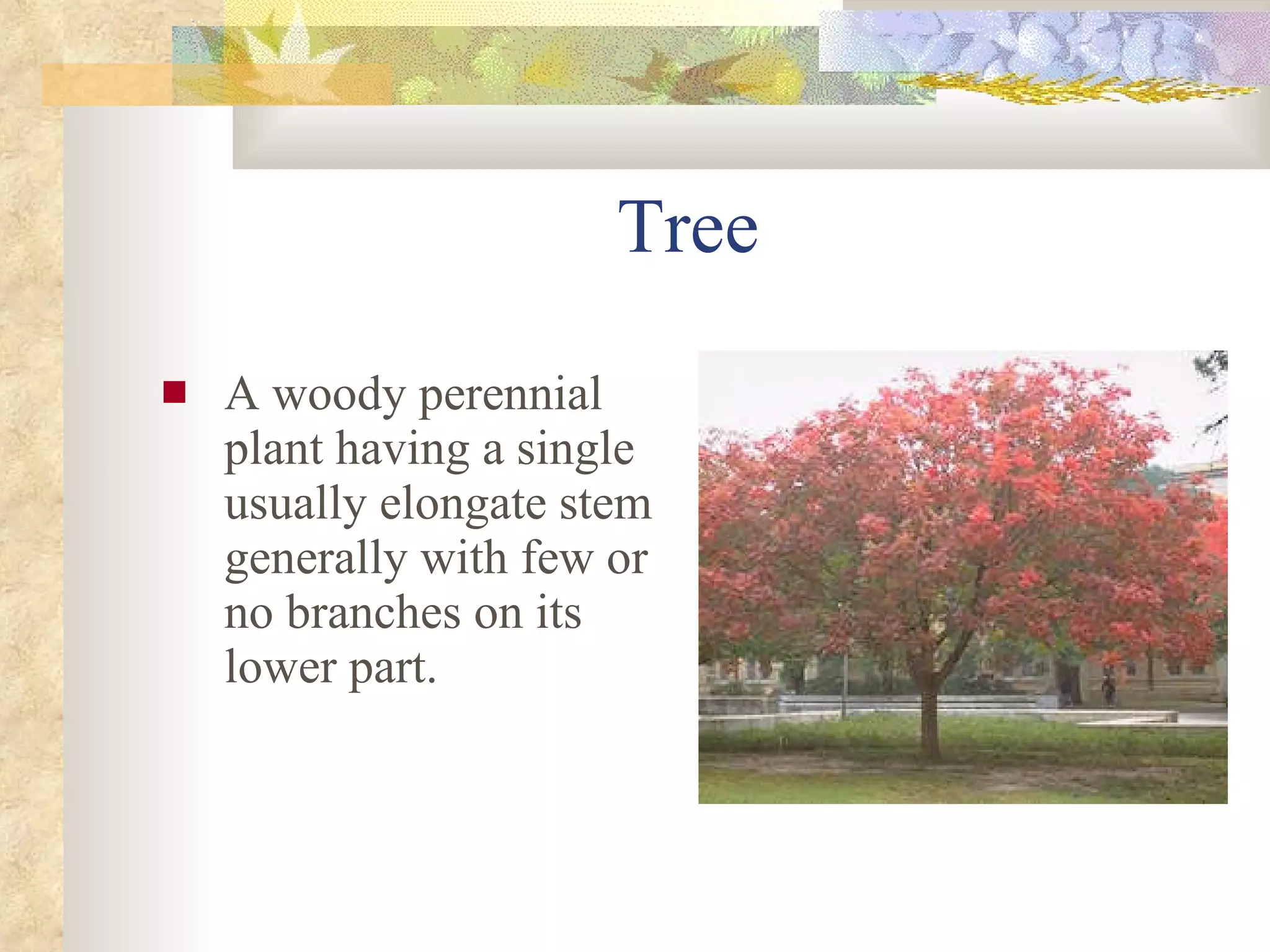
Tree A woody perennial plant having a single usually elongate stem generally with few or no branches on its lower part.
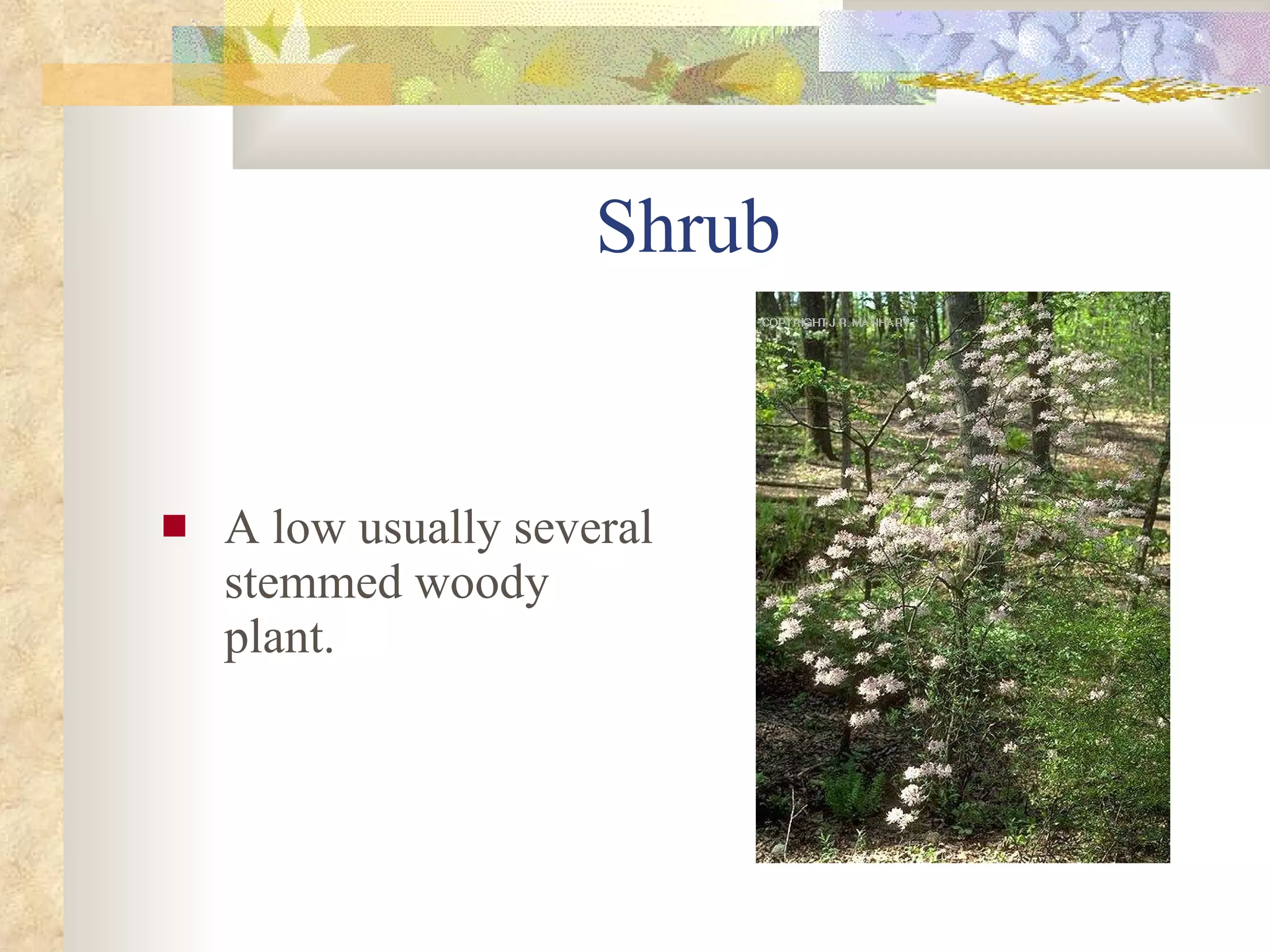
Shrub A low usually several stemmed woody plant.
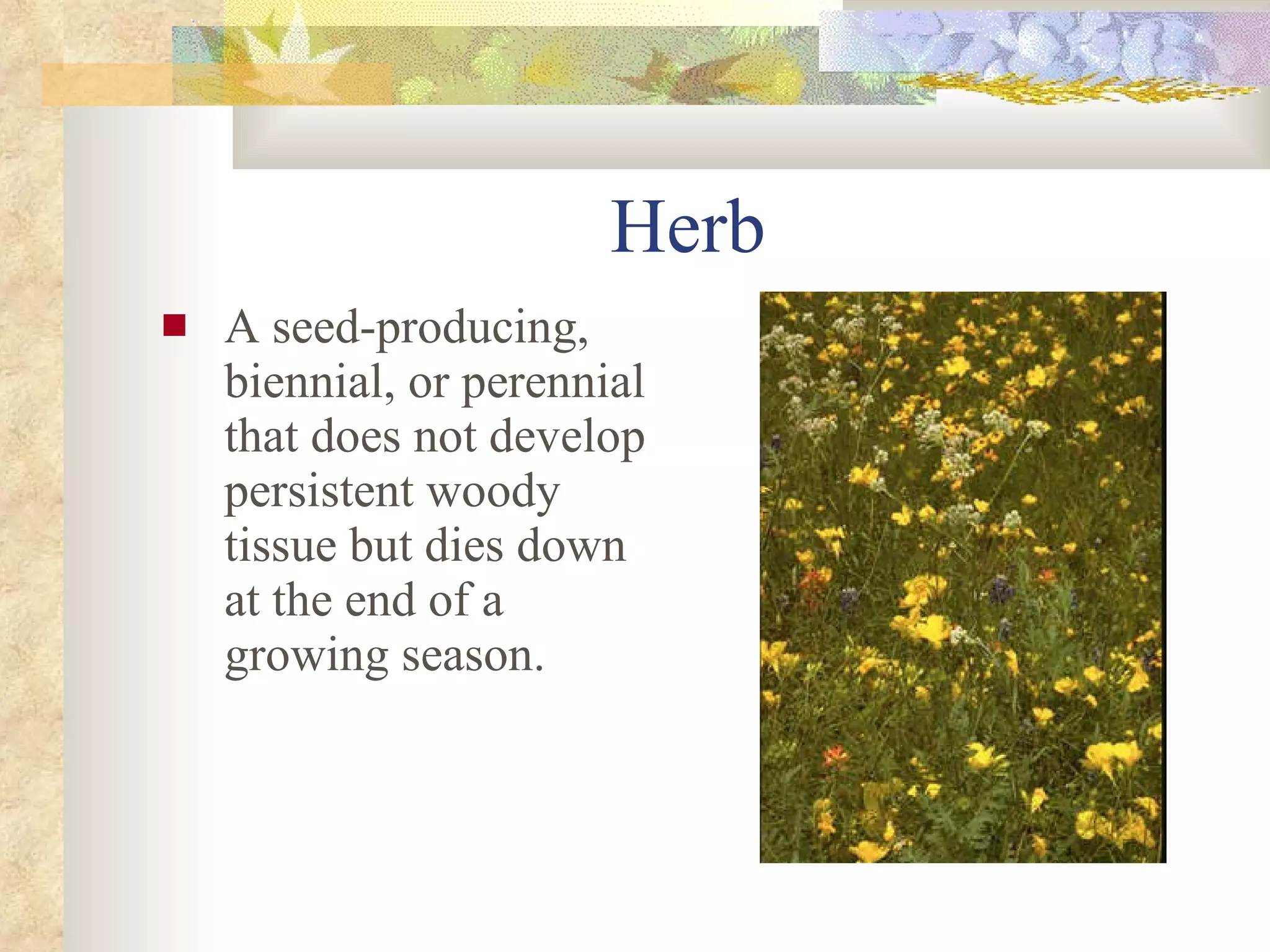
Herb A seed-producing, biennial, or perennial that does not develop persistent woody tissue but dies down at the end of a growing season.
Plants Have Two Parts Sexual Flower Buds Flowers Fruit  Seeds Vegetative Leaves Leaf Buds Roots  Stems
Stems Structures which support buds and leaves and serves as conduits for carrying water, minerals and sugars
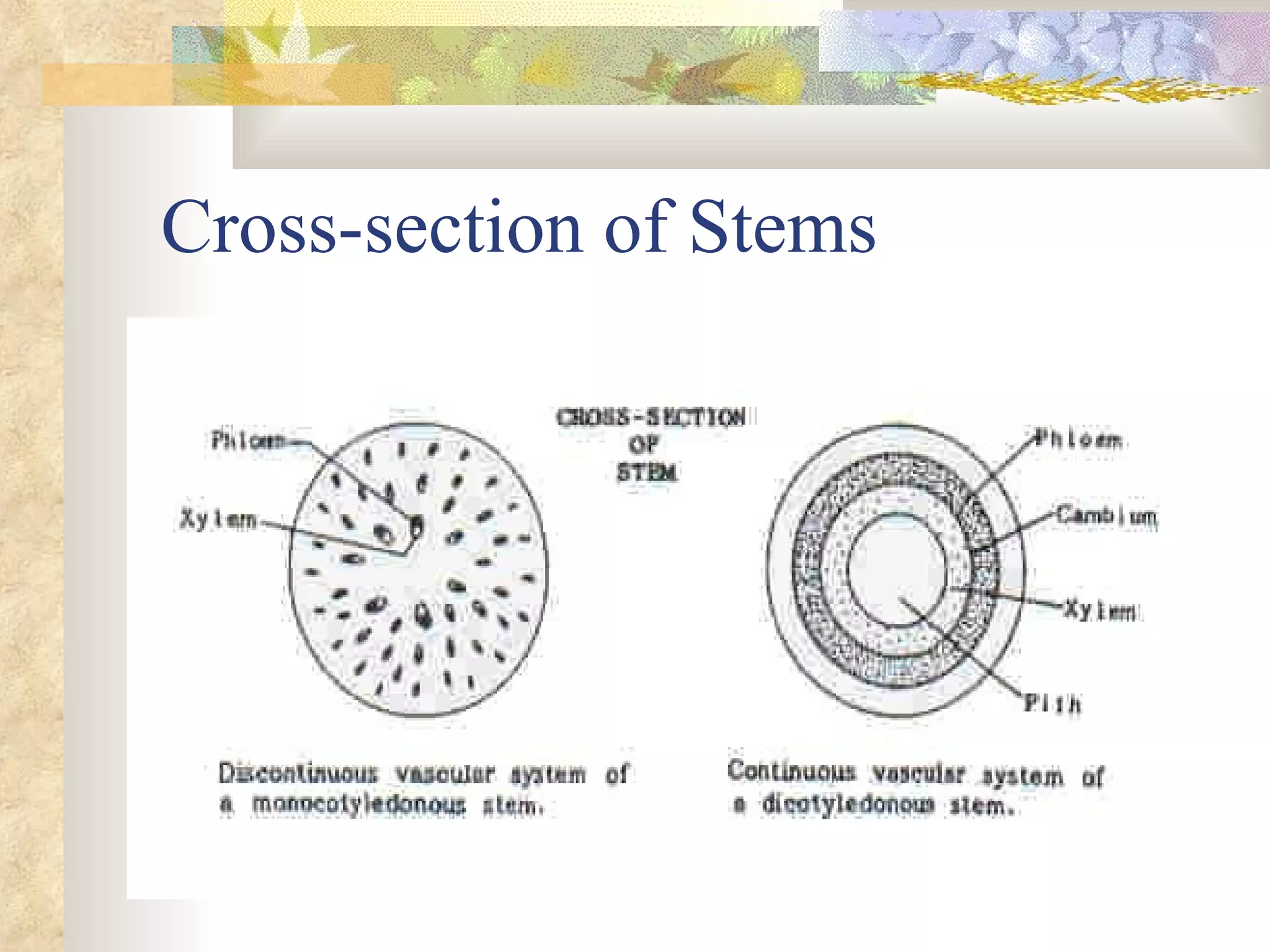
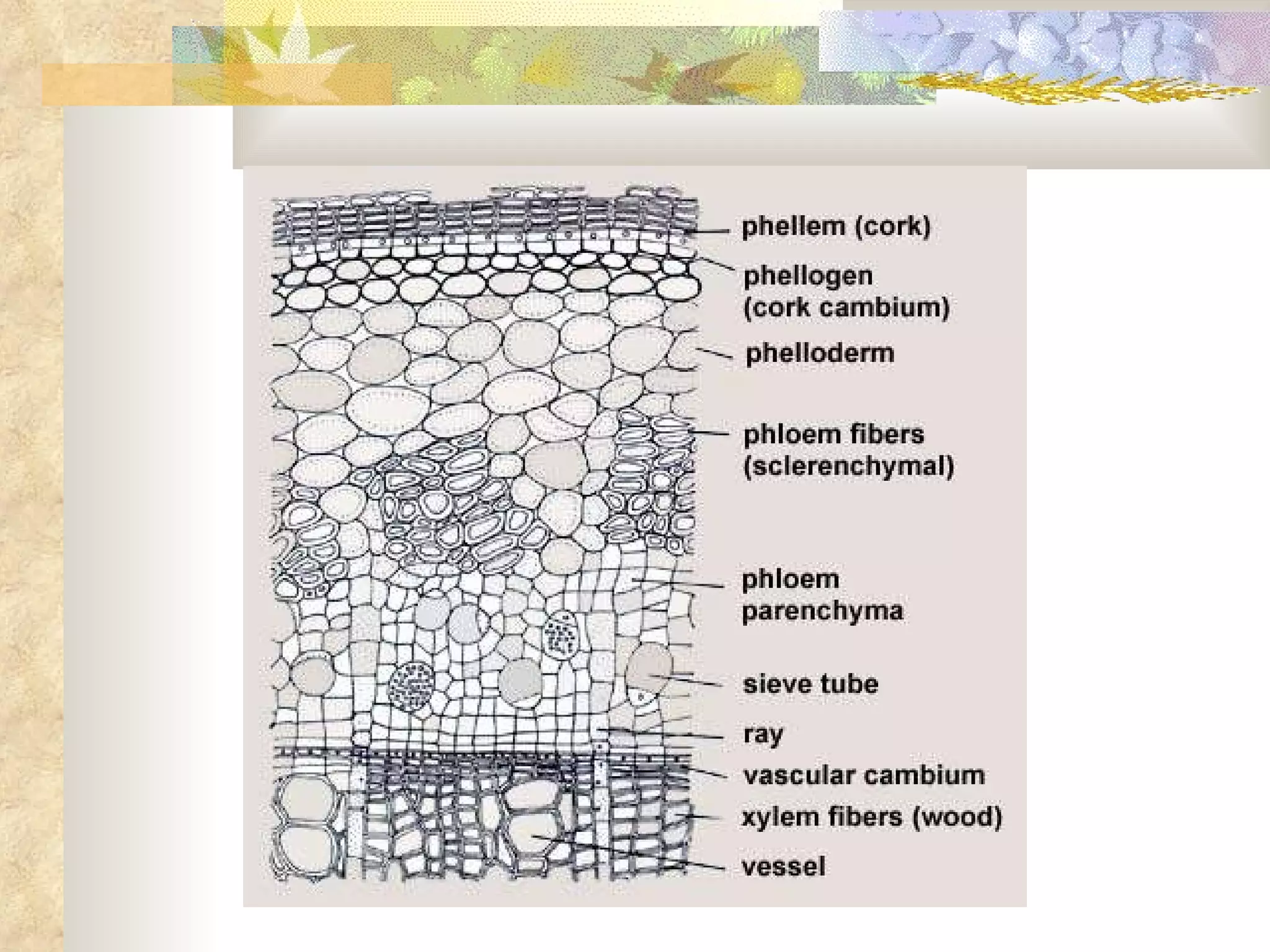
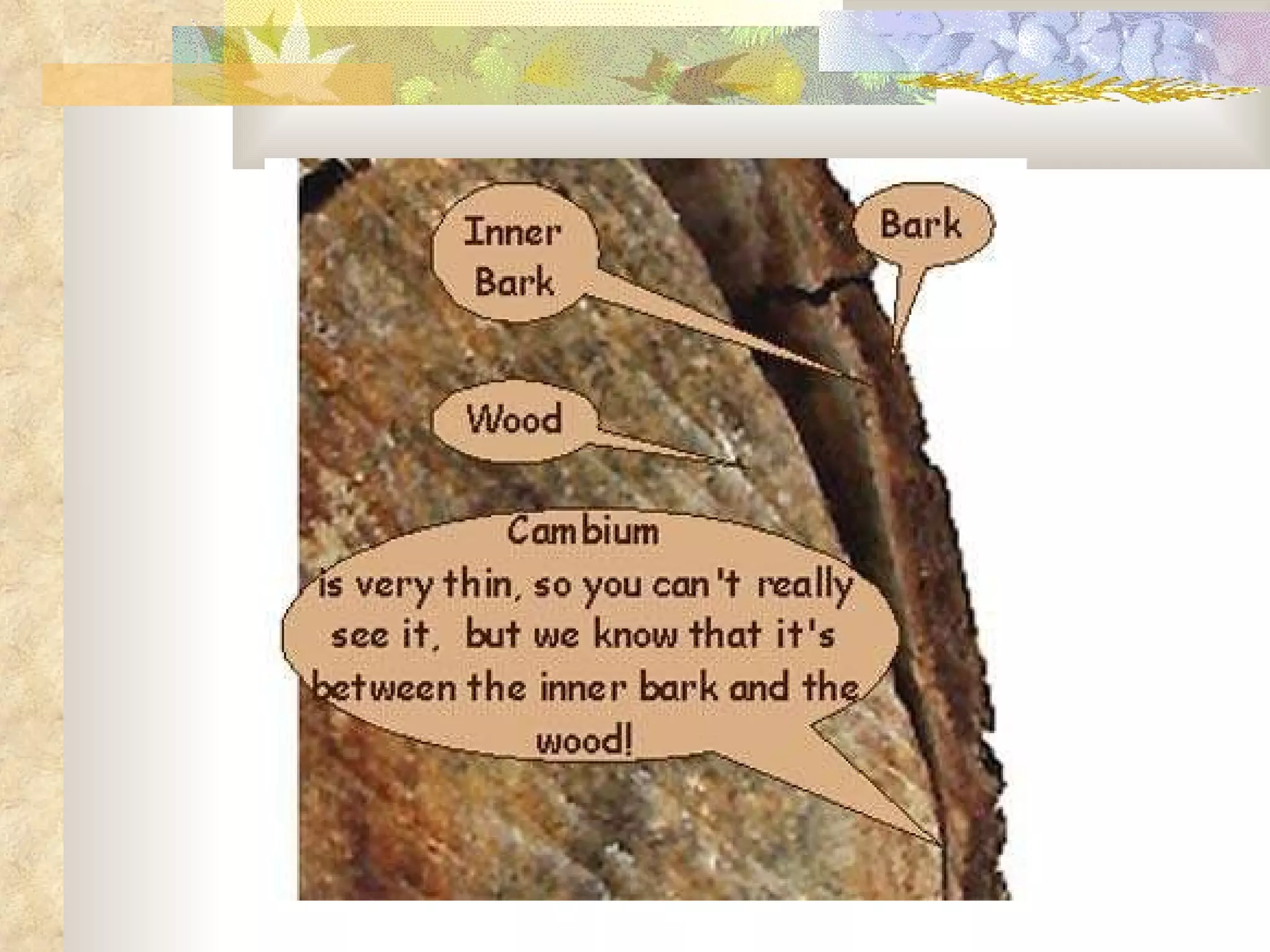
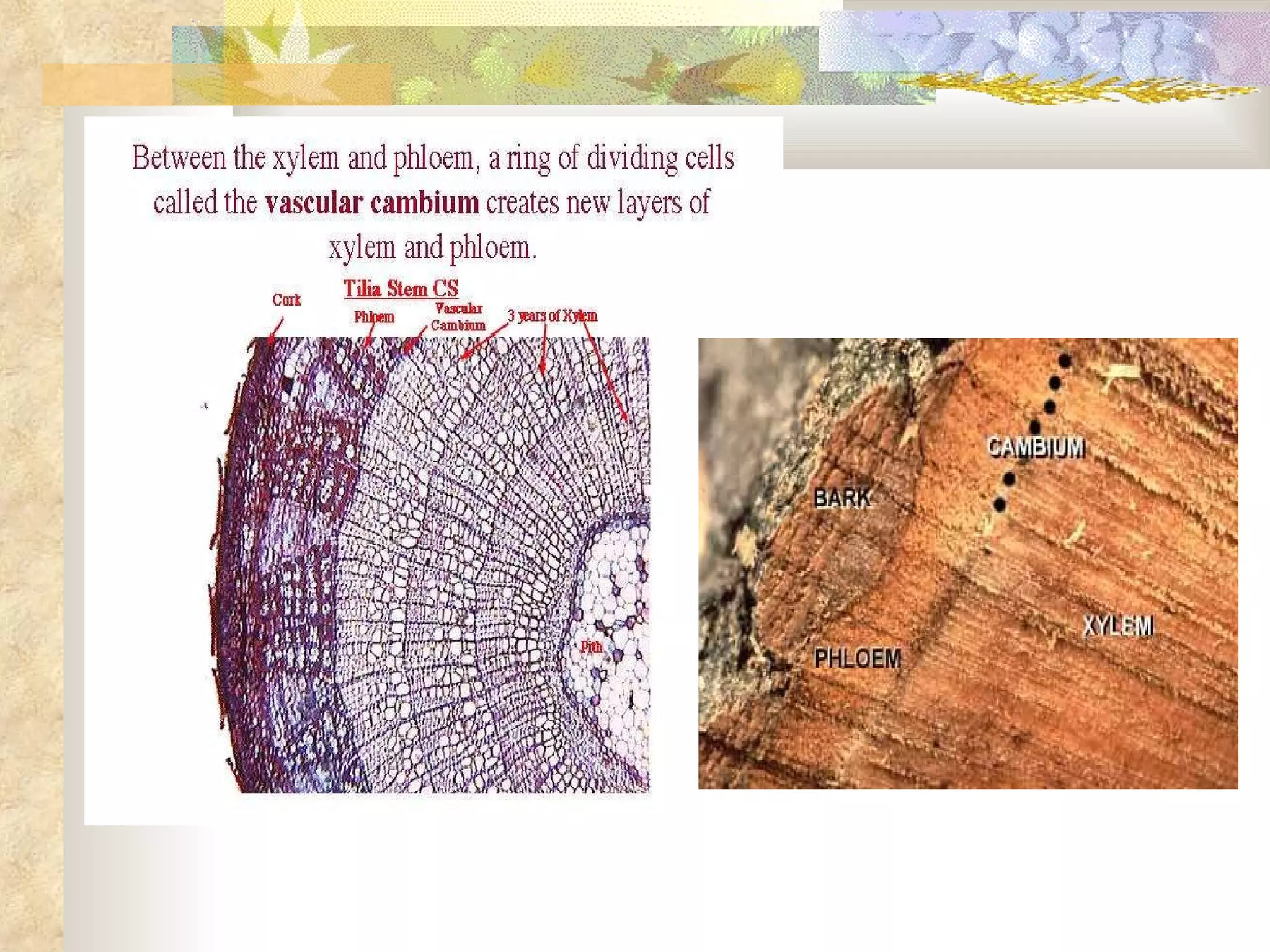
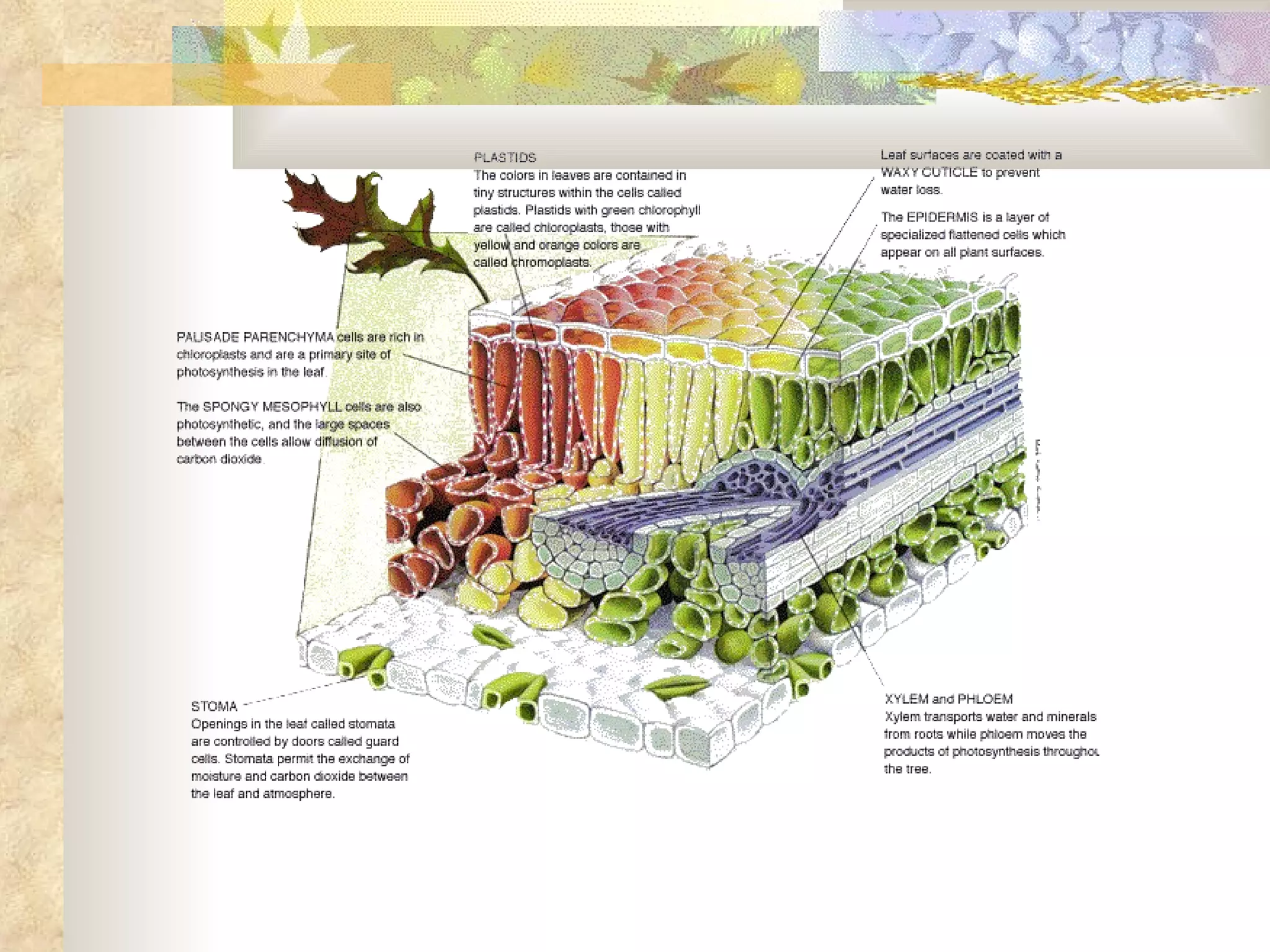
Three Major Internal Parts of Stems Xylem – conduct water and minerals Phloem – conduct sugars  Cambium – a meristem, the site of cell division and active growth, located between the xylem and phloem
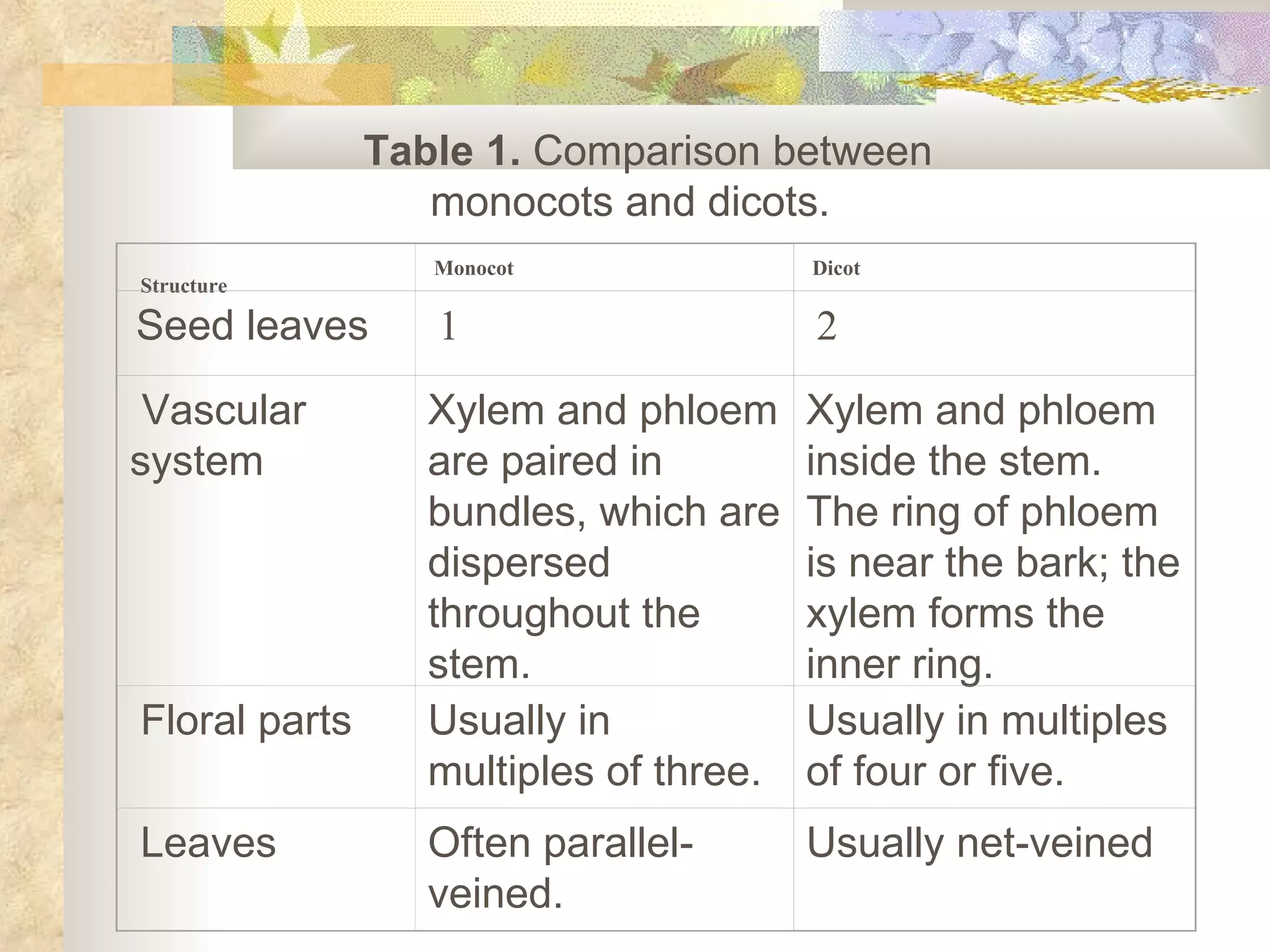
    Table 1.  Comparison between monocots and dicots.   Structure   Monocot   Dicot   Seed leaves   1   2   Vascular system Xylem and phloem are paired in bundles, which are dispersed throughout the stem. Xylem and phloem inside the stem. The ring of phloem is near the bark; the xylem forms the inner ring.   Floral parts Usually in multiples of three. Usually in multiples of four or five.   Leaves Often parallel-veined. Usually net-veined
Cross-section of Stems


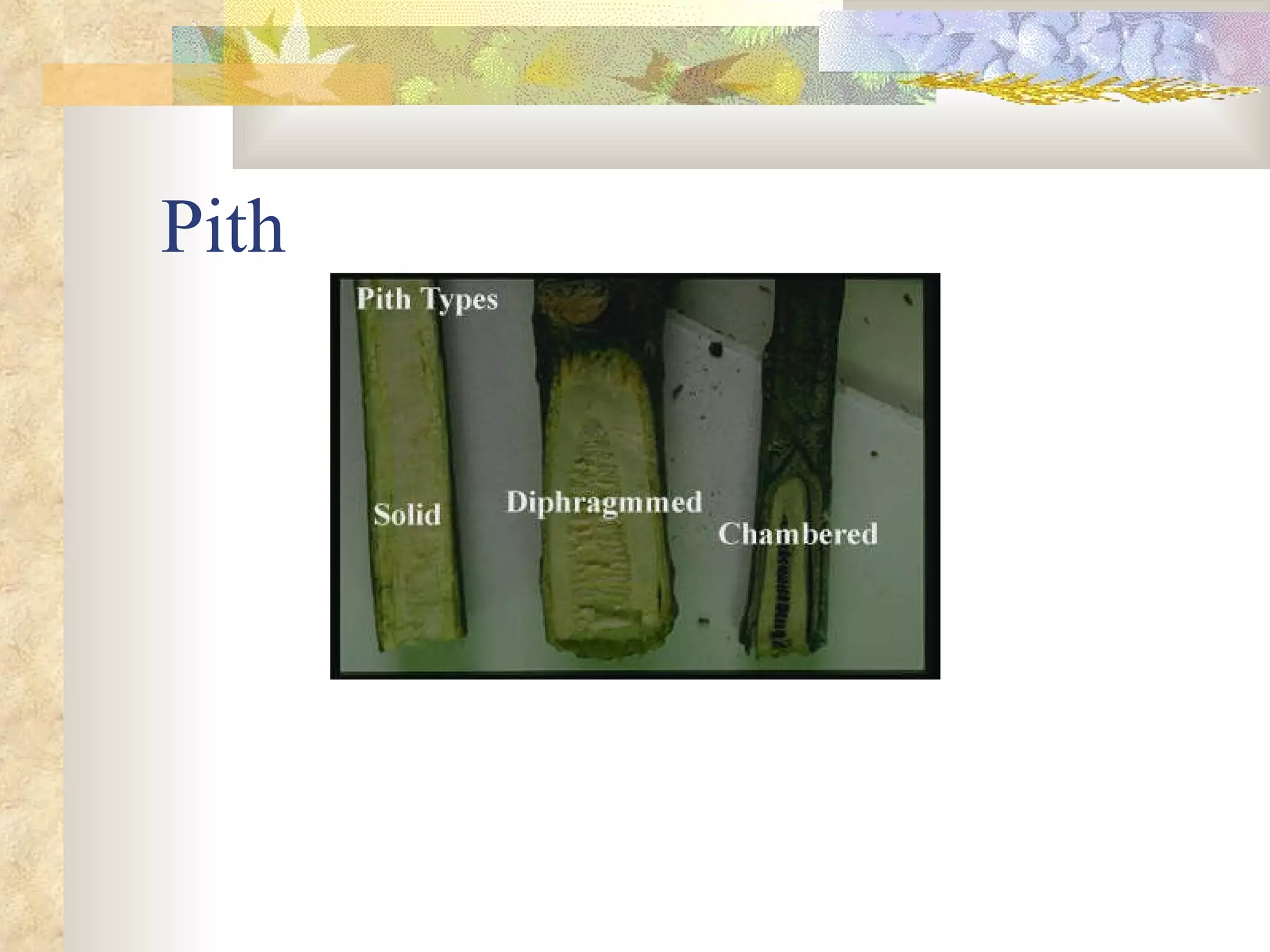
Pith
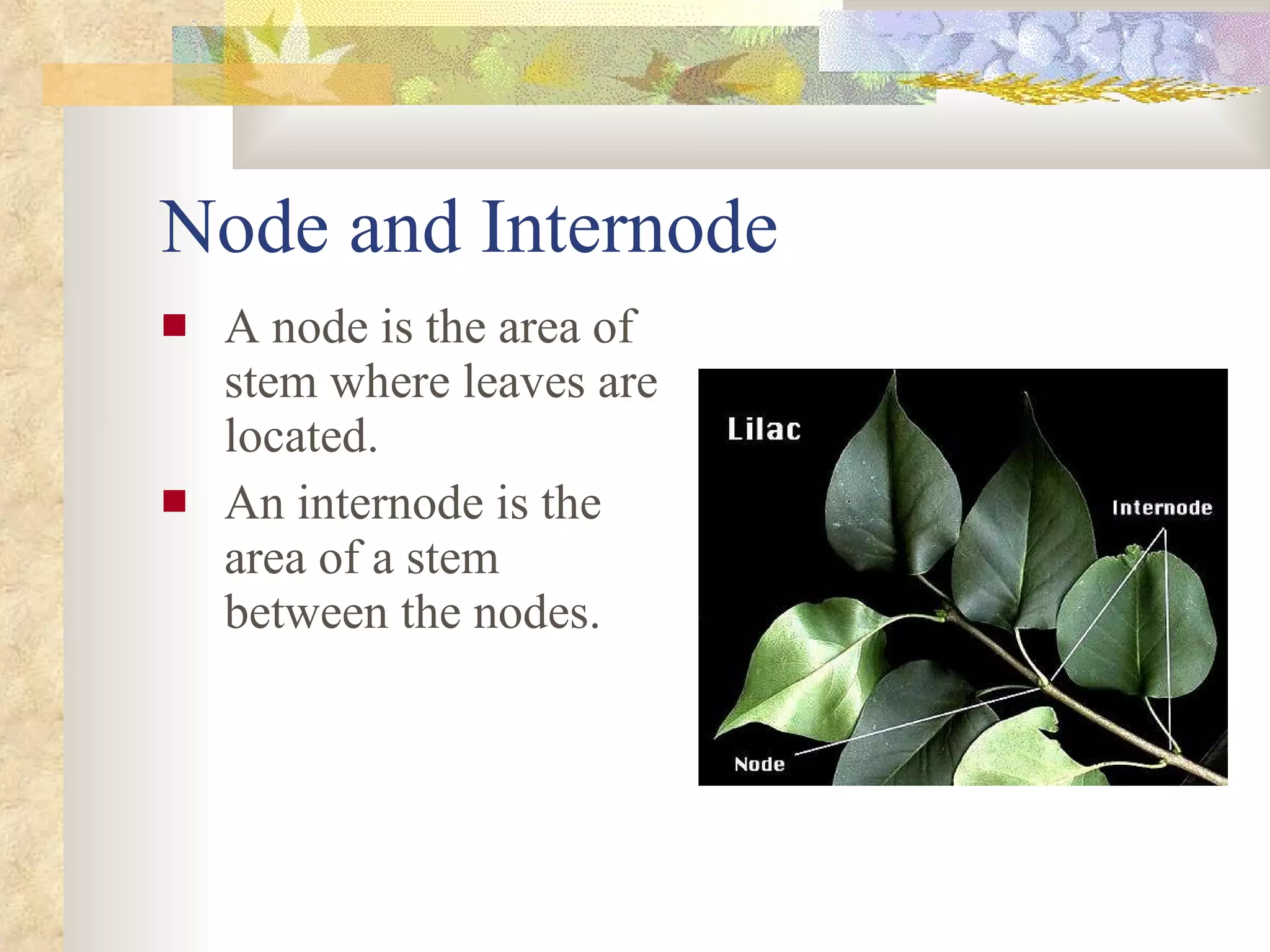
Node and Internode A node is the area of stem where leaves are located. An internode is the area of a stem between the nodes.
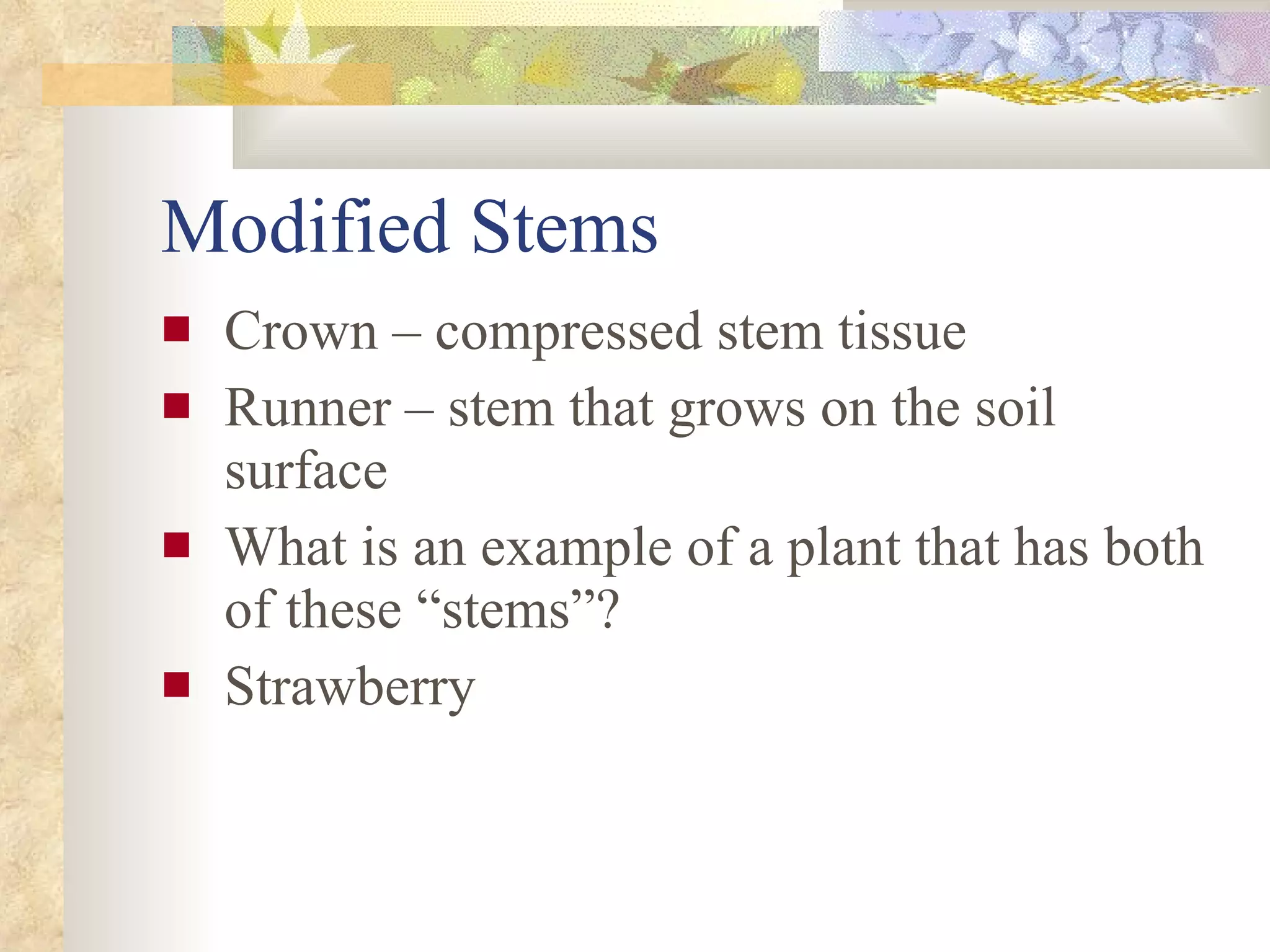
Modified Stems Crown – compressed stem tissue Runner – stem that grows on the soil surface  What is an example of a plant that has both of these “stems”?  Strawberry
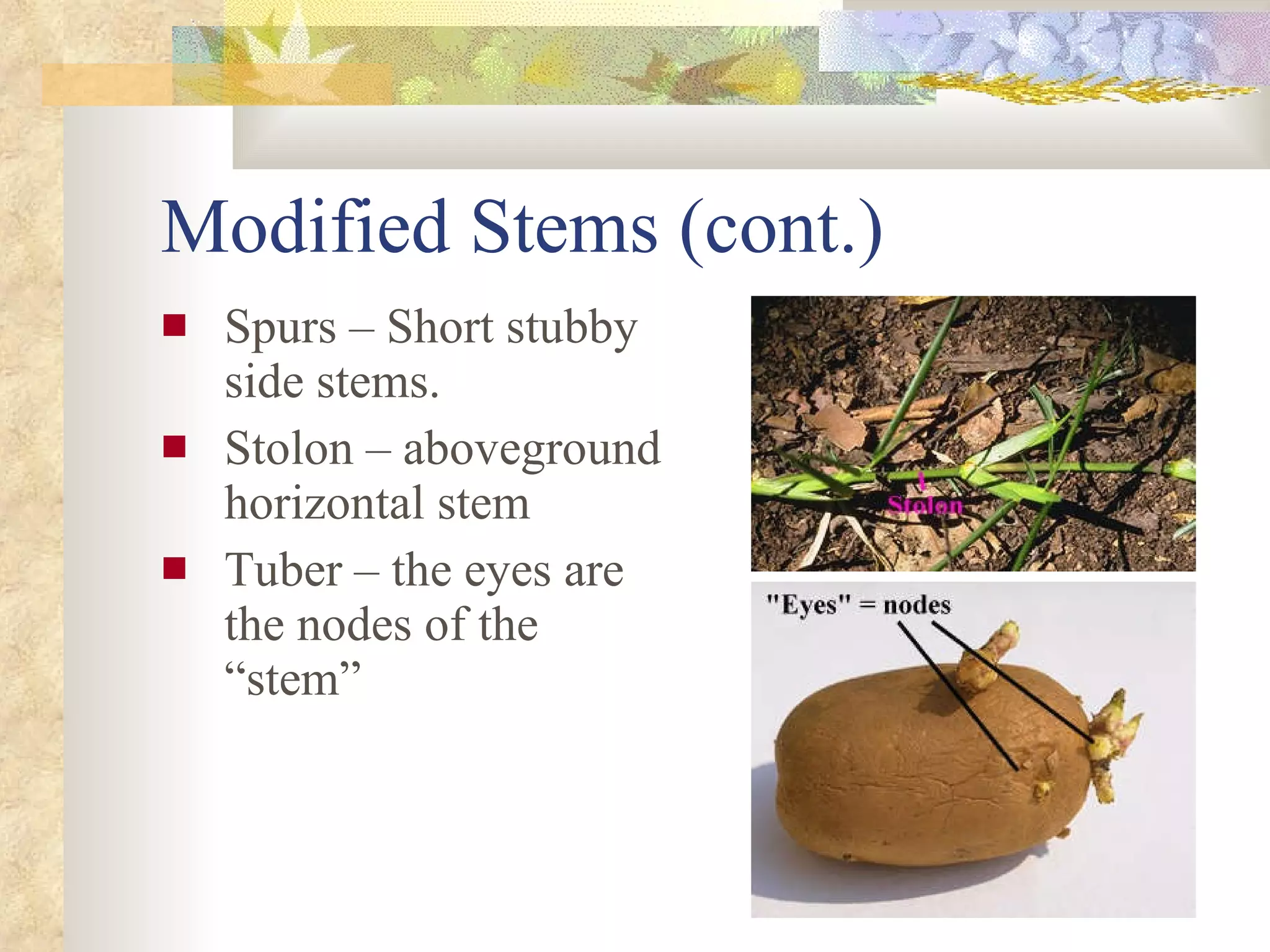
Modified Stems (cont.) Spurs – Short stubby side stems. Stolon – aboveground horizontal stem Tuber – the eyes are the nodes of the “stem”
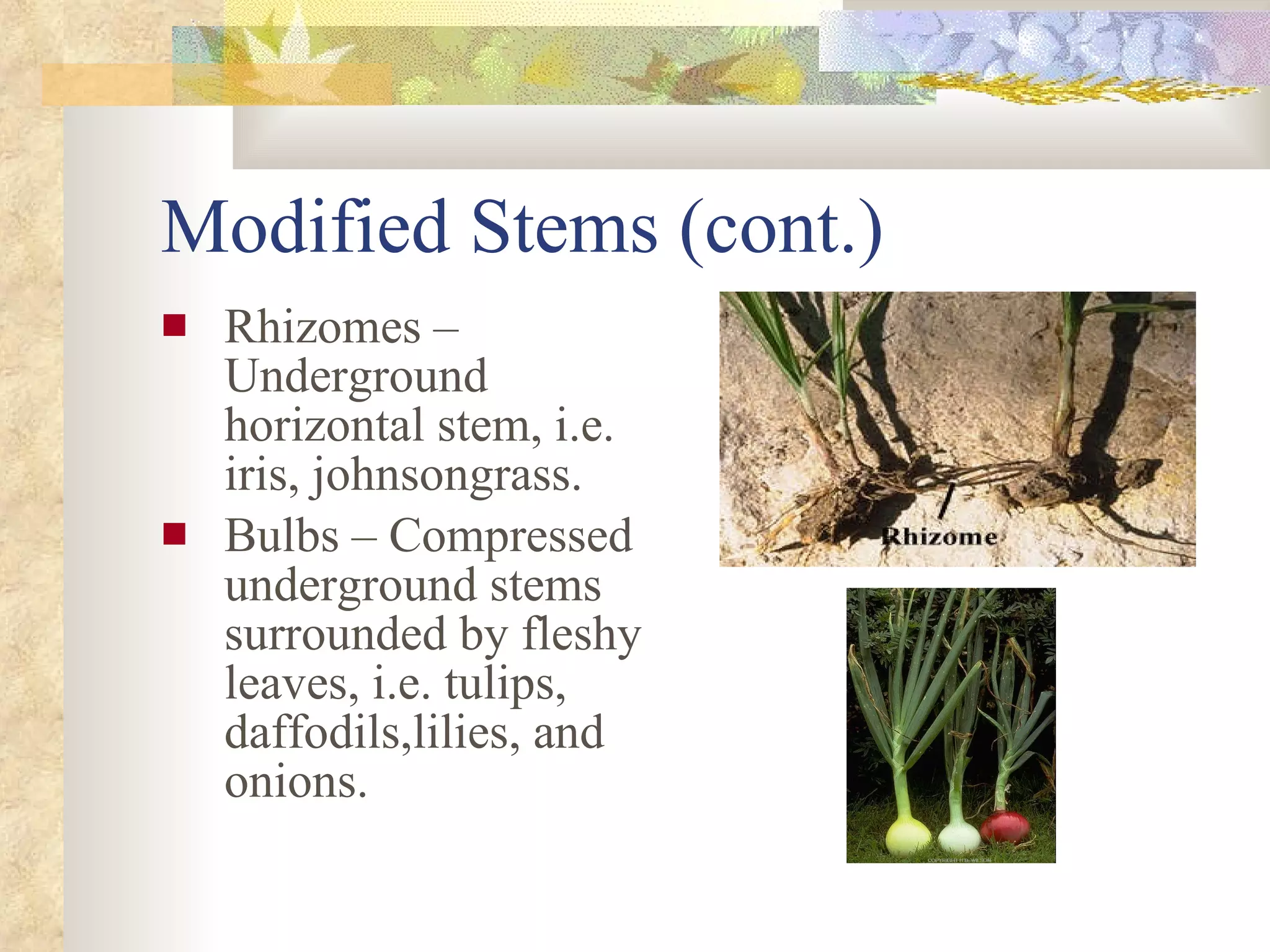
Modified Stems (cont.) Rhizomes – Underground horizontal stem, i.e. iris, johnsongrass. Bulbs – Compressed underground stems surrounded by fleshy leaves, i.e. tulips, daffodils,lilies, and onions.
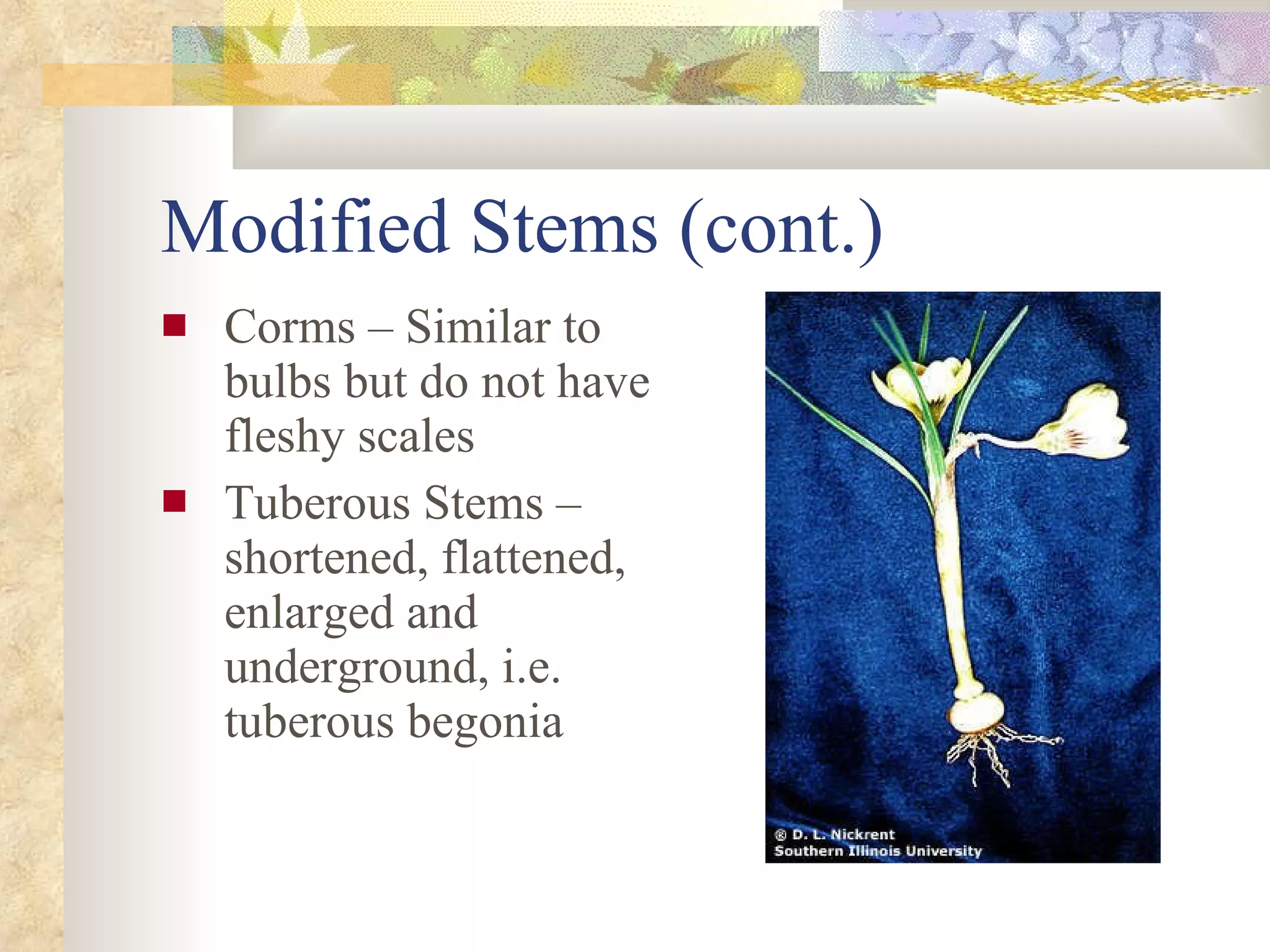
Modified Stems (cont.) Corms – Similar to bulbs but do not have fleshy scales Tuberous Stems – shortened, flattened, enlarged and underground, i.e. tuberous begonia
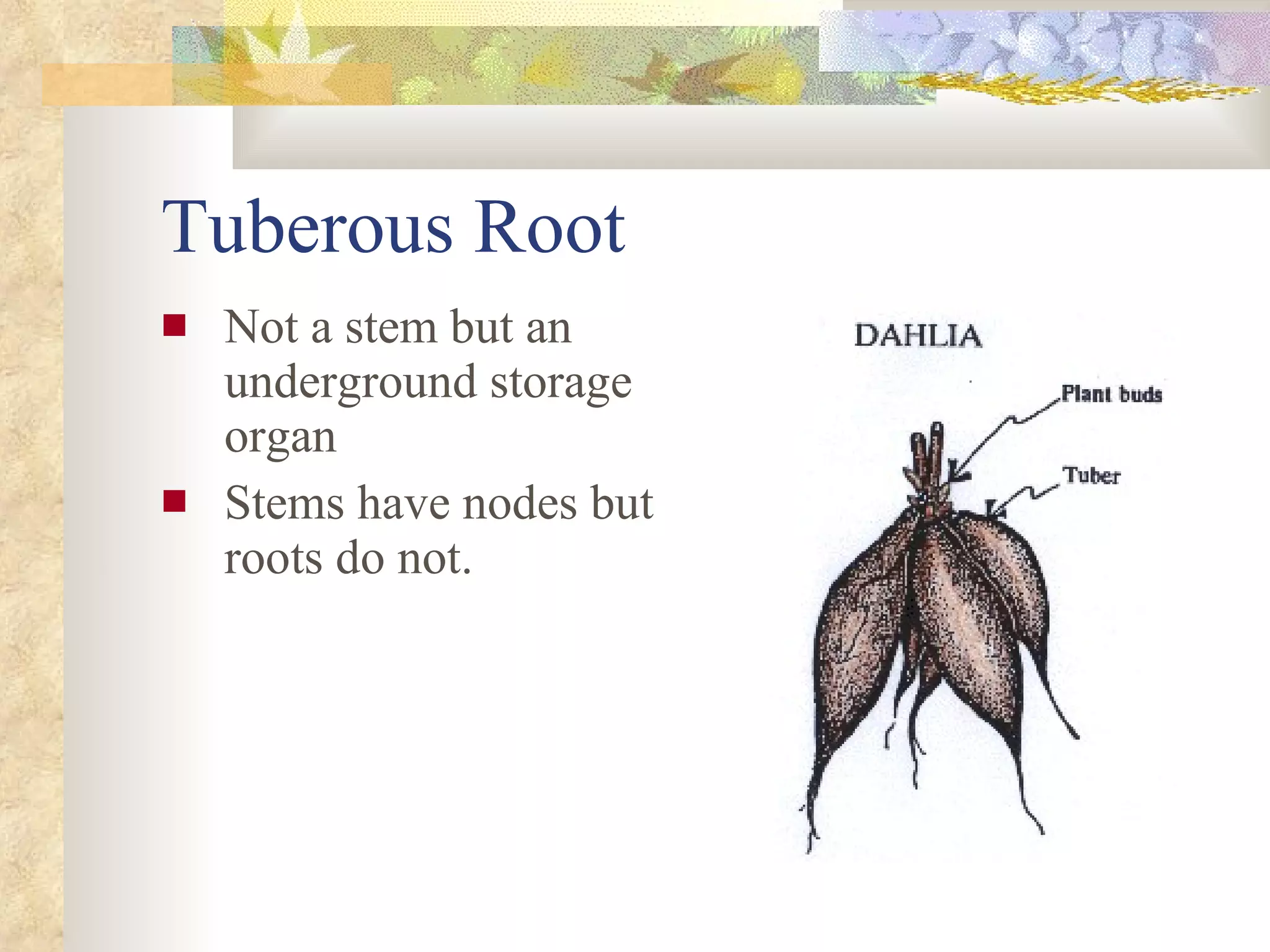
Tuberous Root Not a stem but an underground storage organ Stems have nodes but roots do not.
Stem Terminology  - Shoot - A young stem (1 year old or less) with leaves. Twig - A young stem (1 year old or less) that is in the dormant winter stage (has no leaves). Branch - A stem that is more than 1 year old, typically with lateral stems radiating from it. Trunk - A woody plant's main stem.
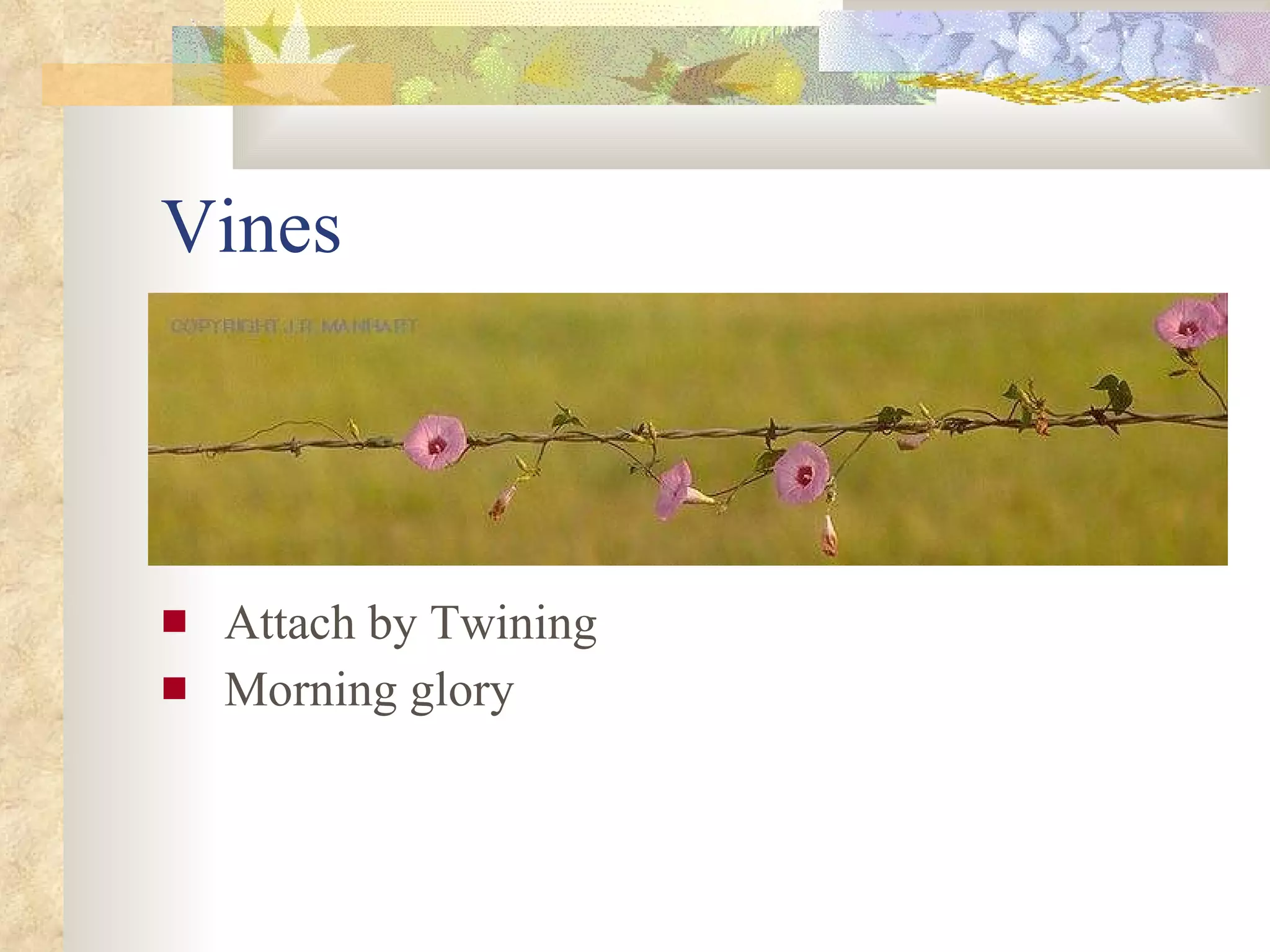
Vines Attach by Twining Morning glory
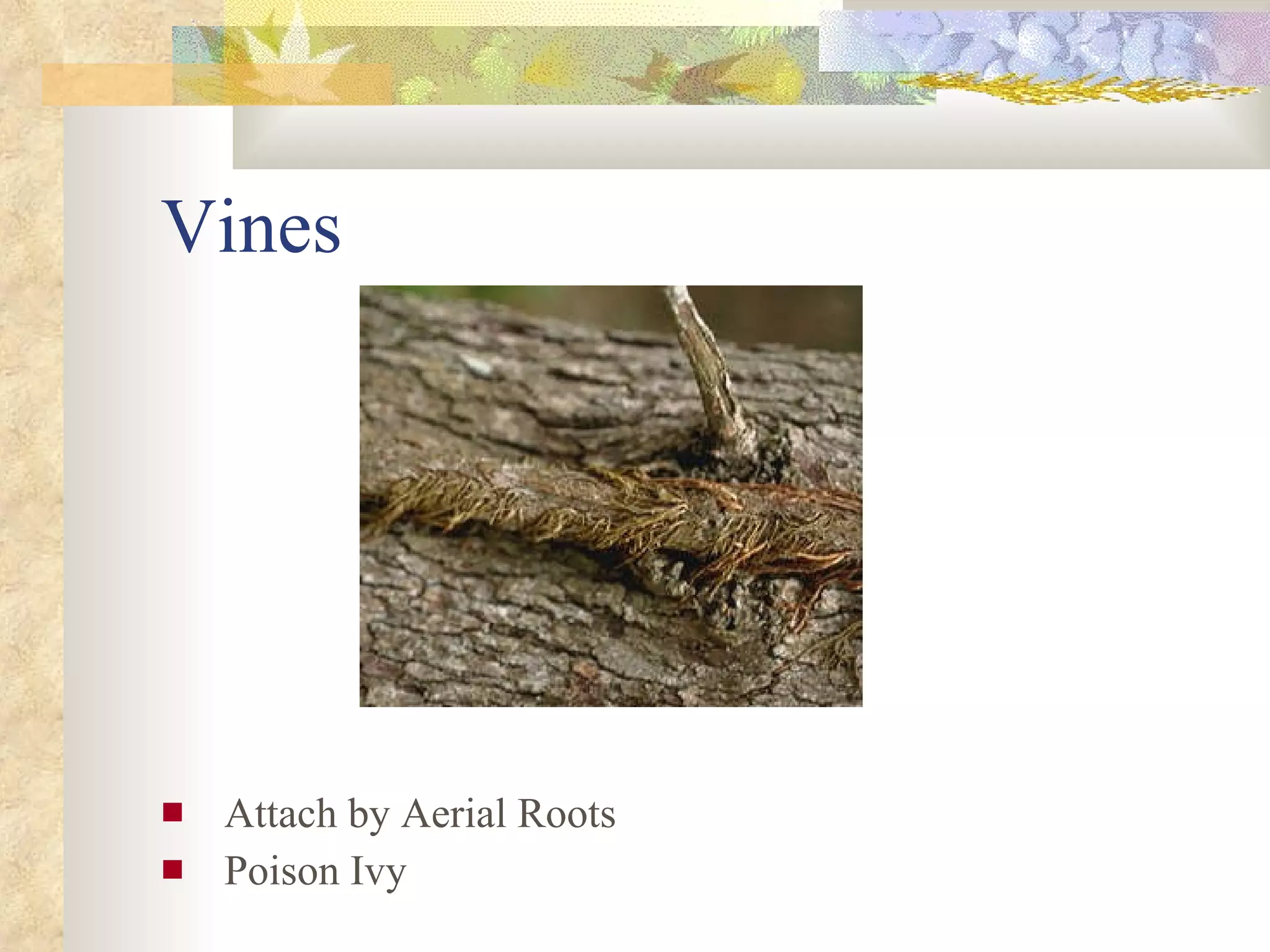
Vines Attach by Aerial Roots Poison Ivy
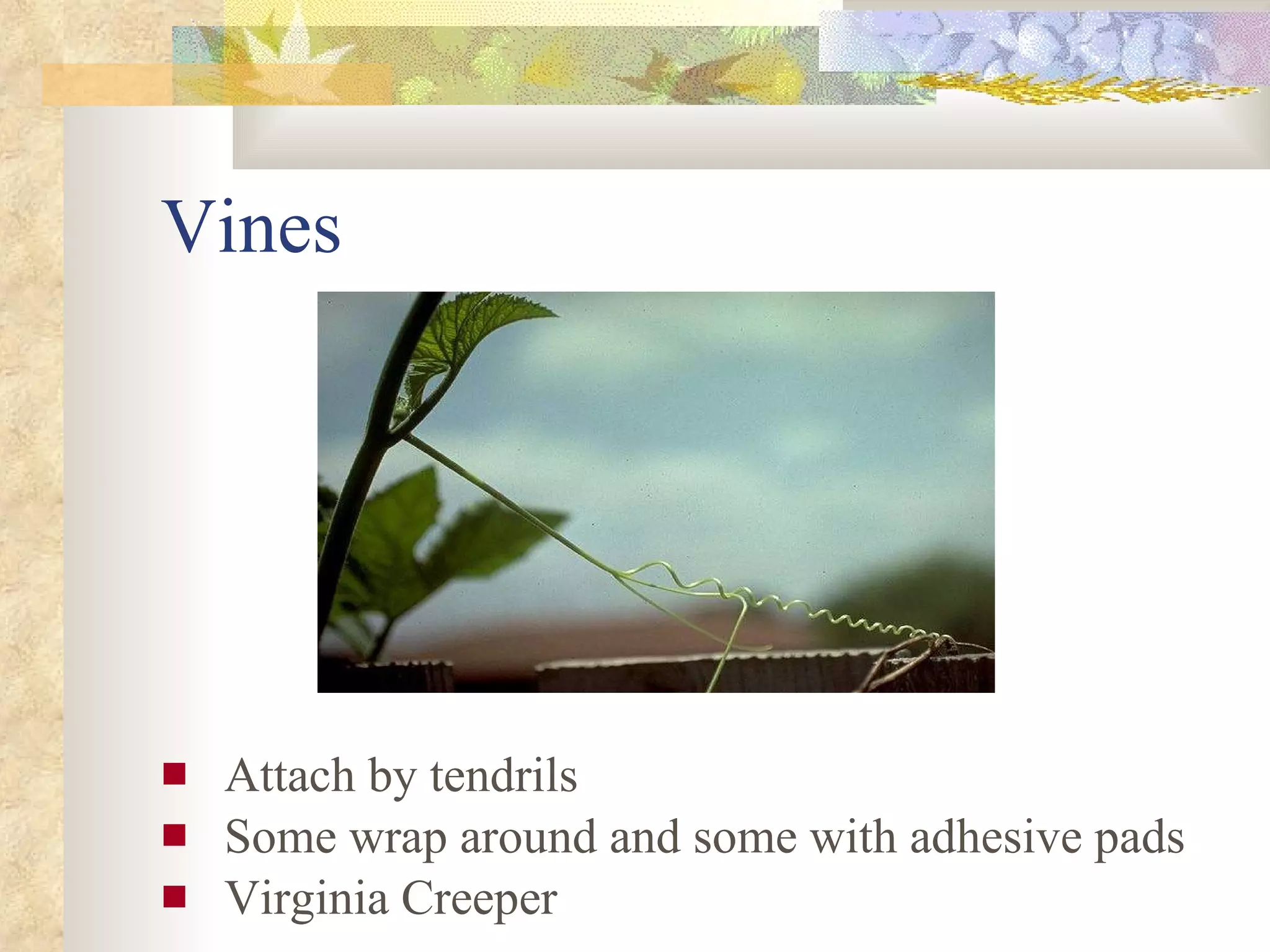
Vines Attach by tendrils Some wrap around and some with adhesive pads Virginia Creeper
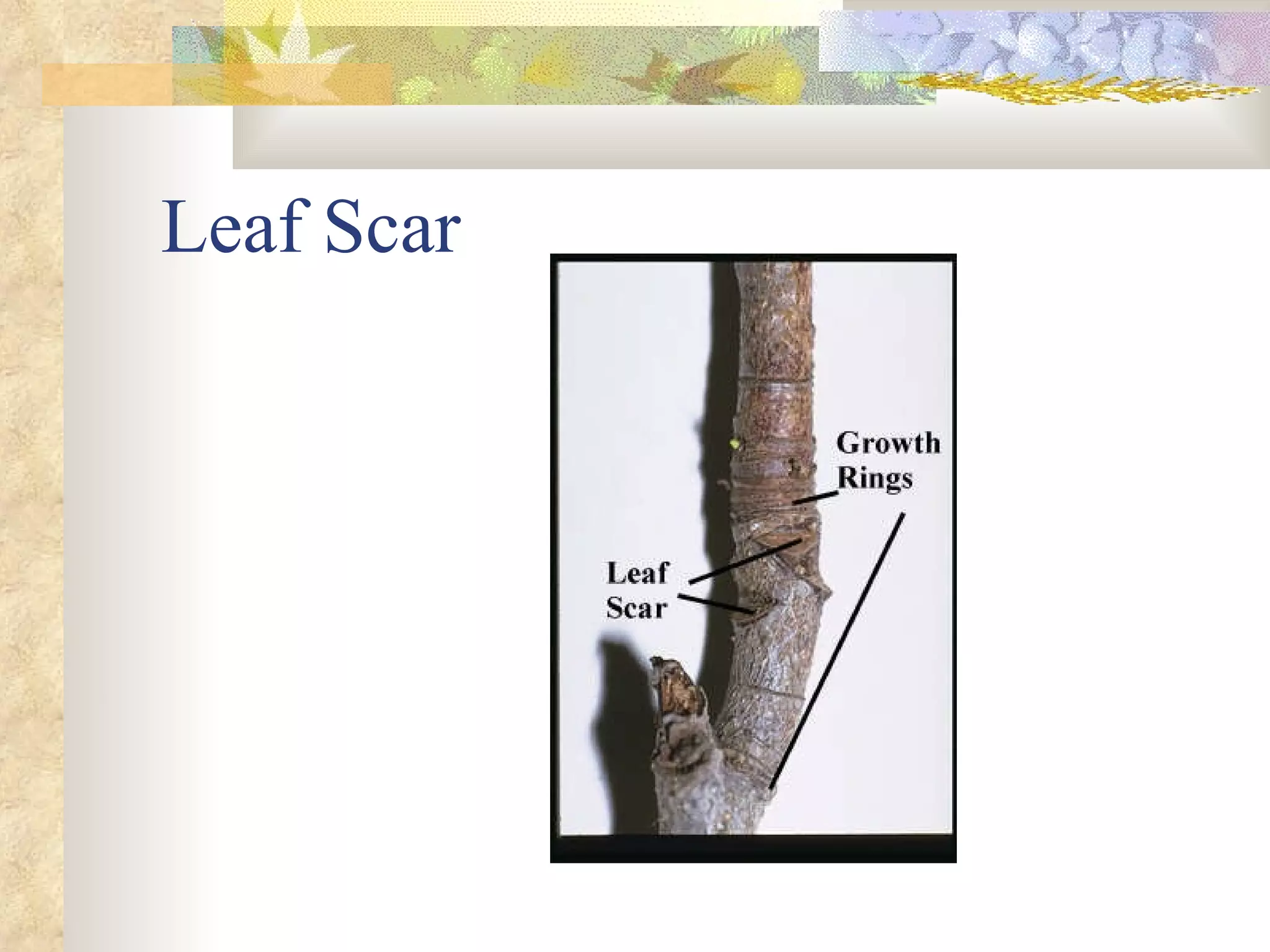
Leaf Scar
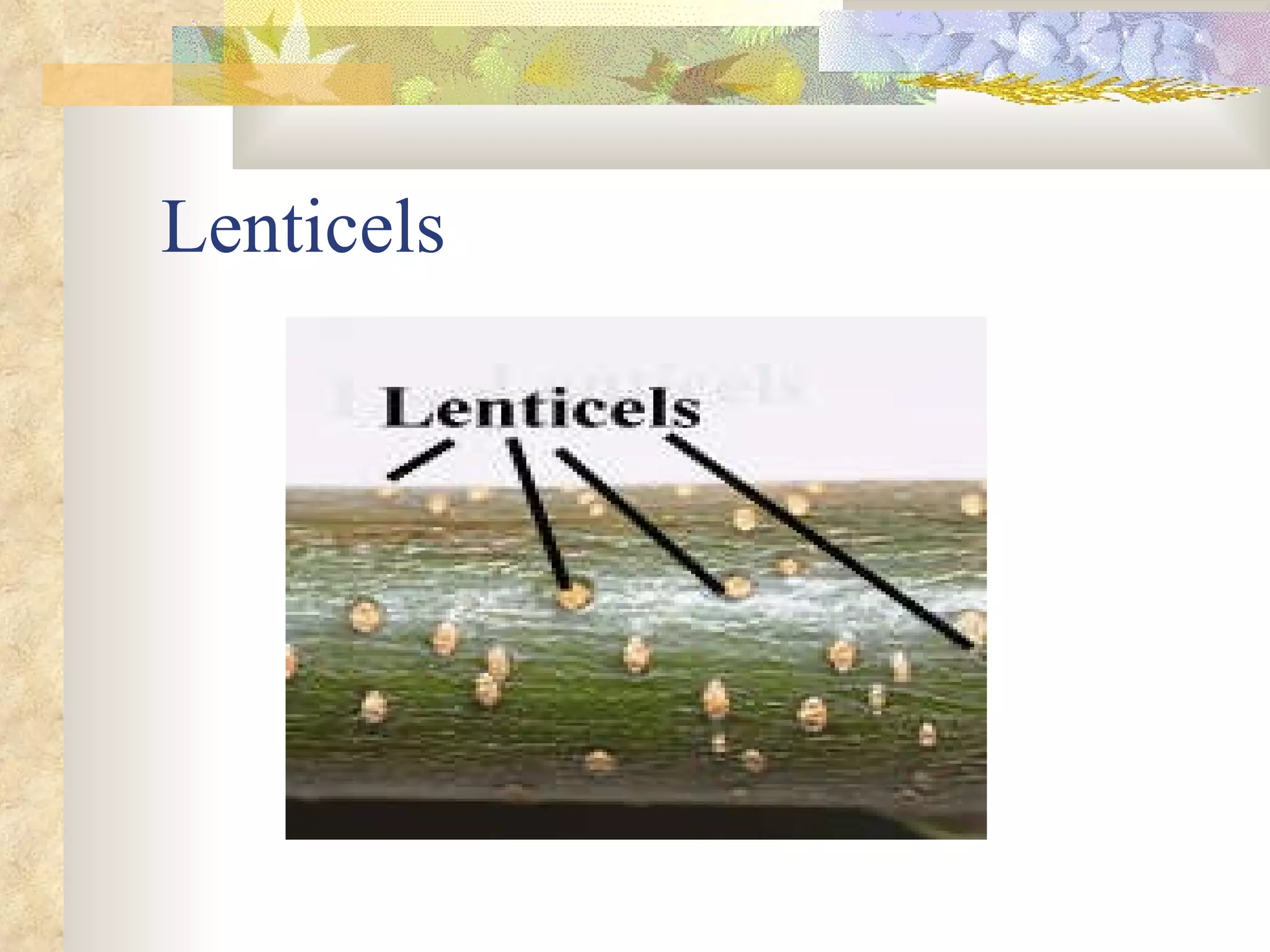
Lenticels
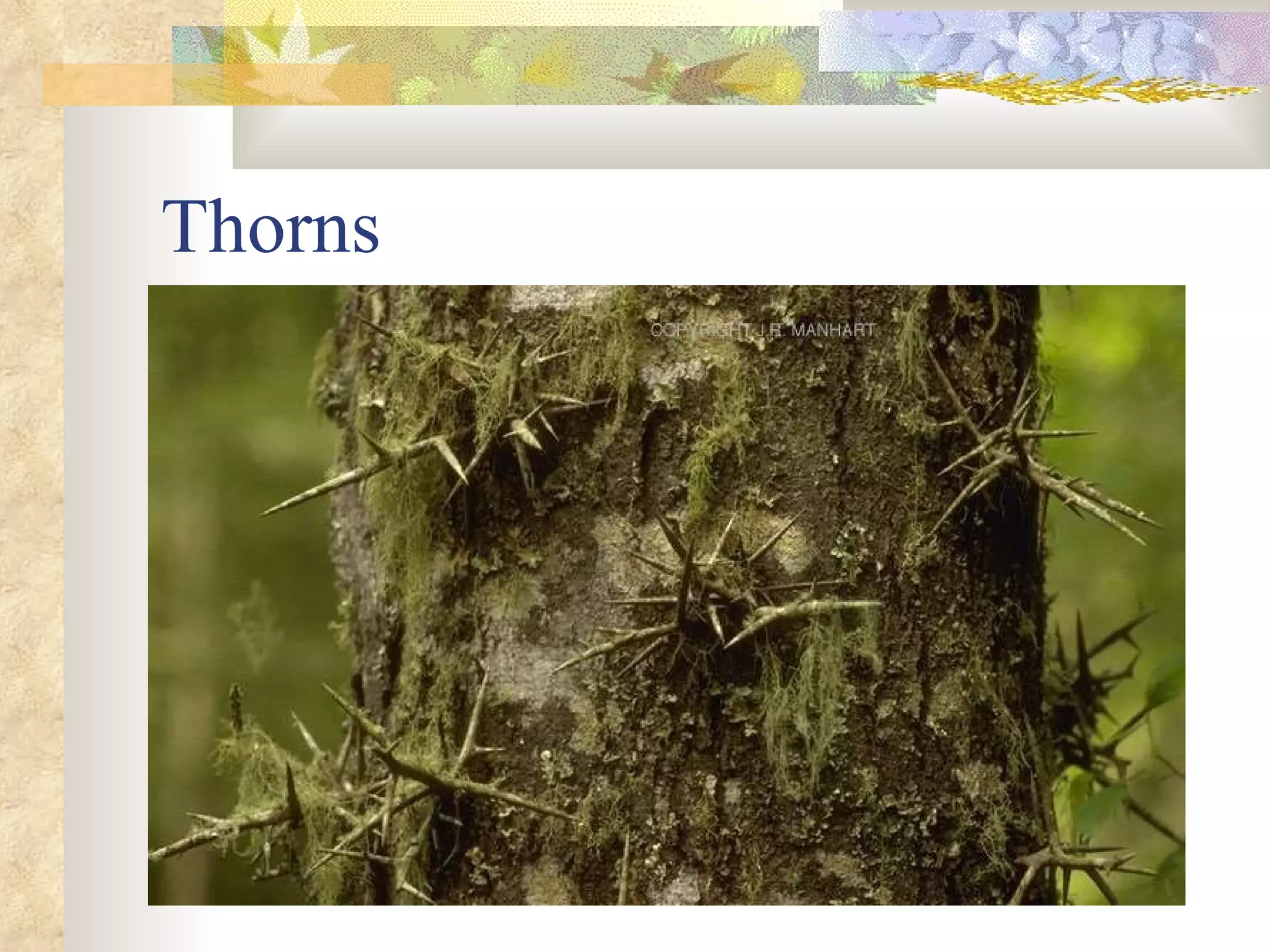
Thorns
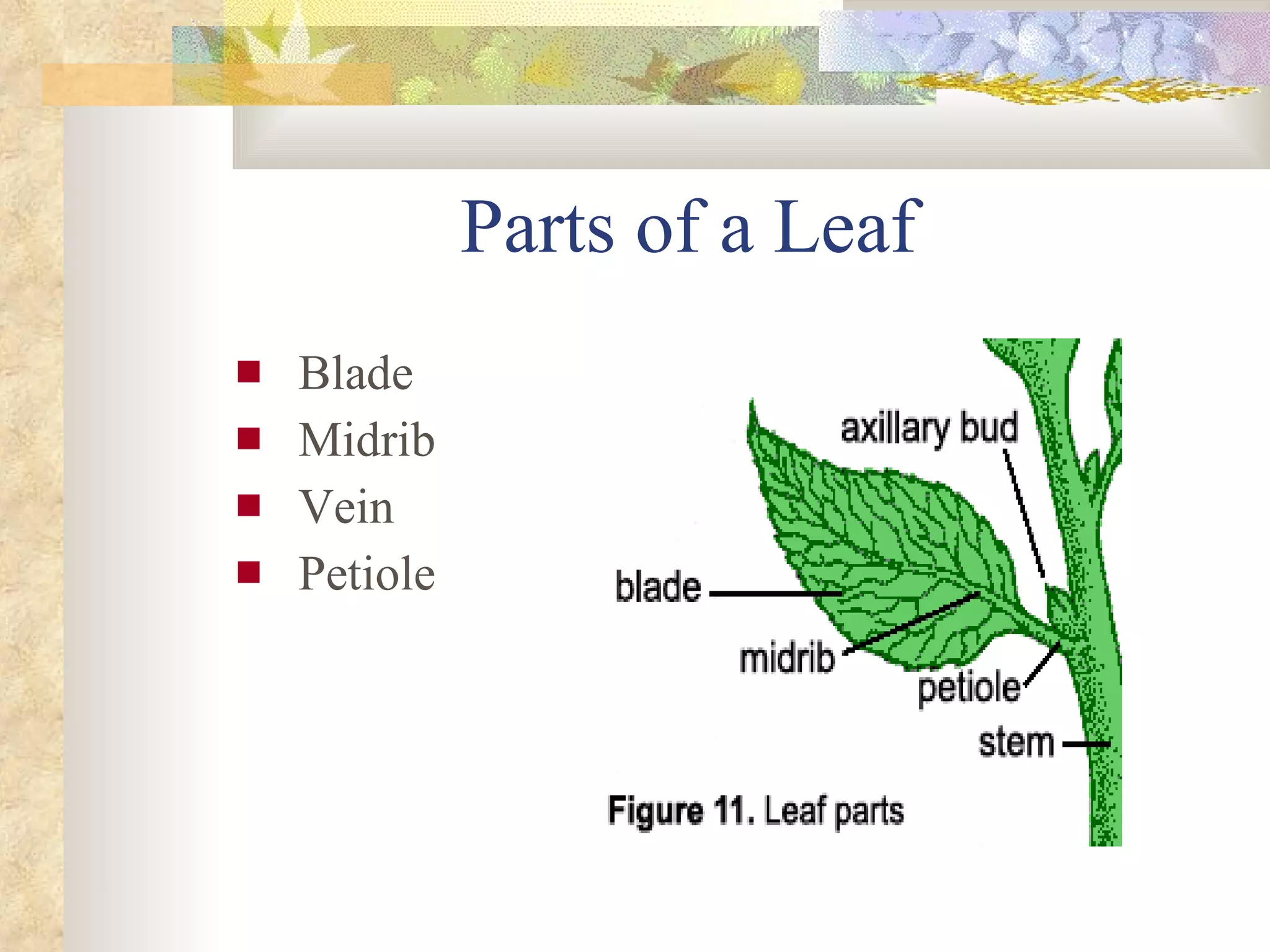
Parts of a Leaf Blade Midrib Vein Petiole
Leaf Facts Principle function of leaves is to absorb sunlight for photosynthesis What are leaves flat? (except conifers) Petiole is attached to the stem at a node Angle between the petiole and the stem is the leaf axil Buds are located in the leaf axil
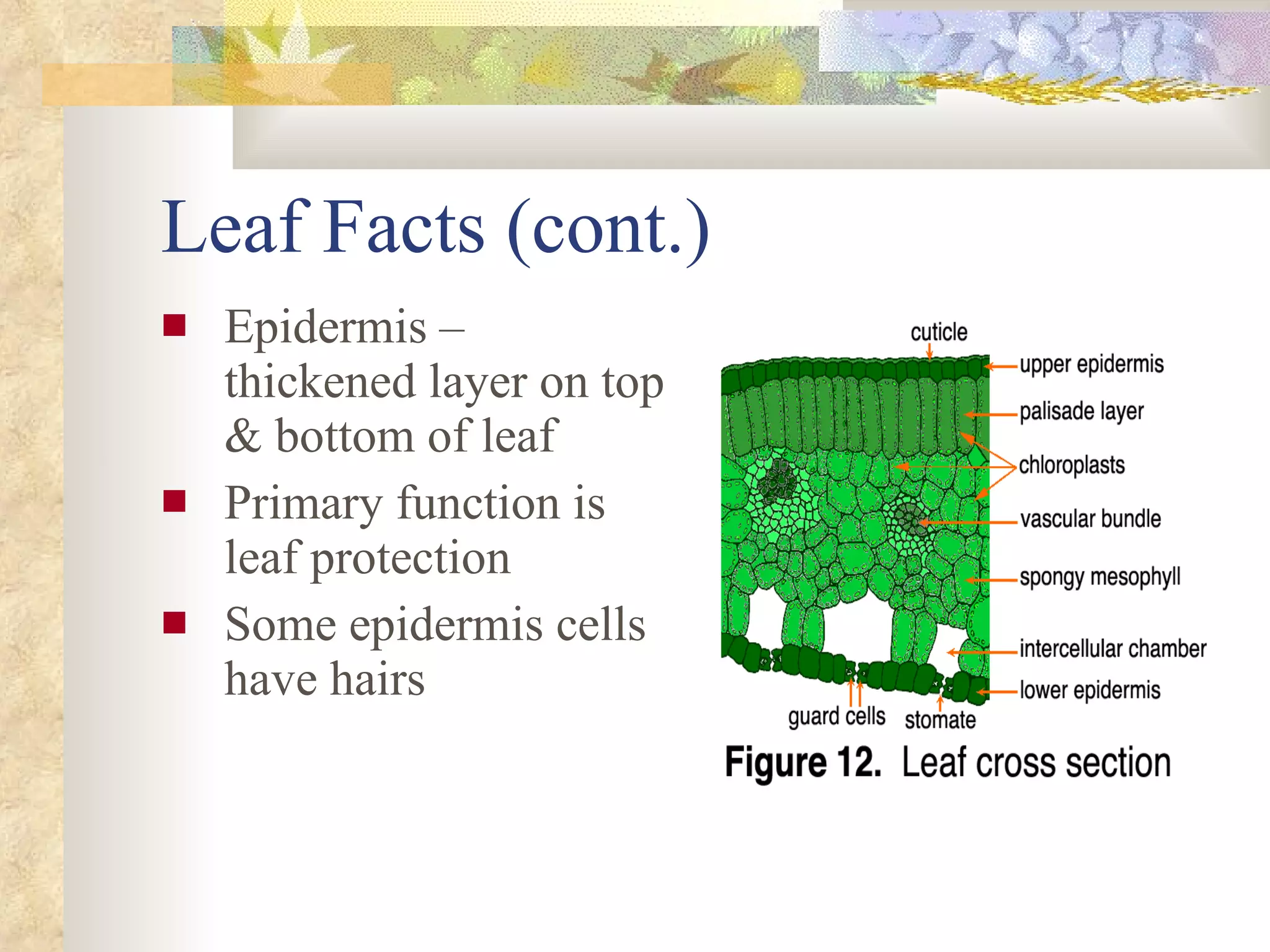
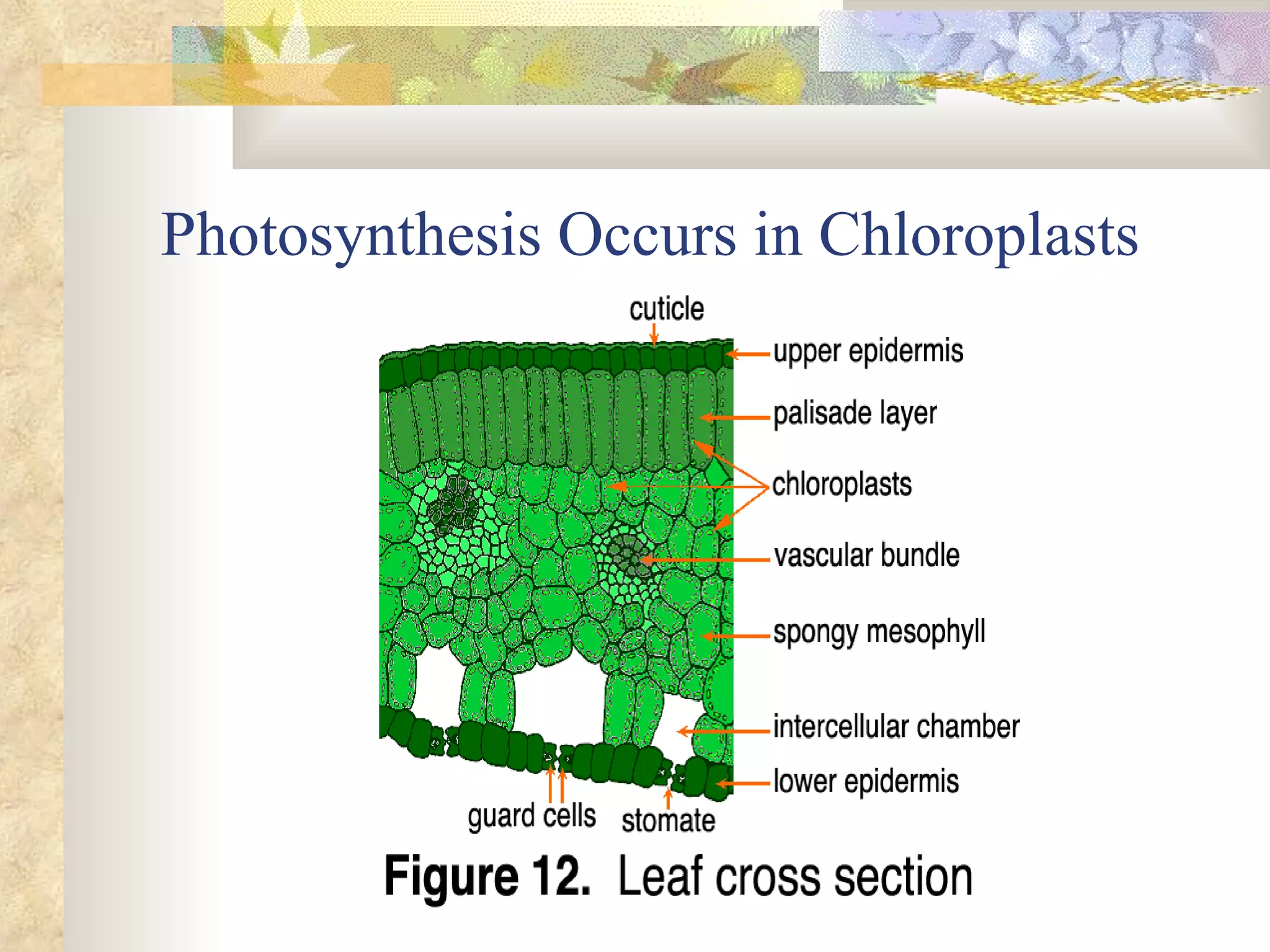
Leaf Facts (cont.) Epidermis – thickened layer on top & bottom of leaf Primary function is leaf protection Some epidermis cells have hairs
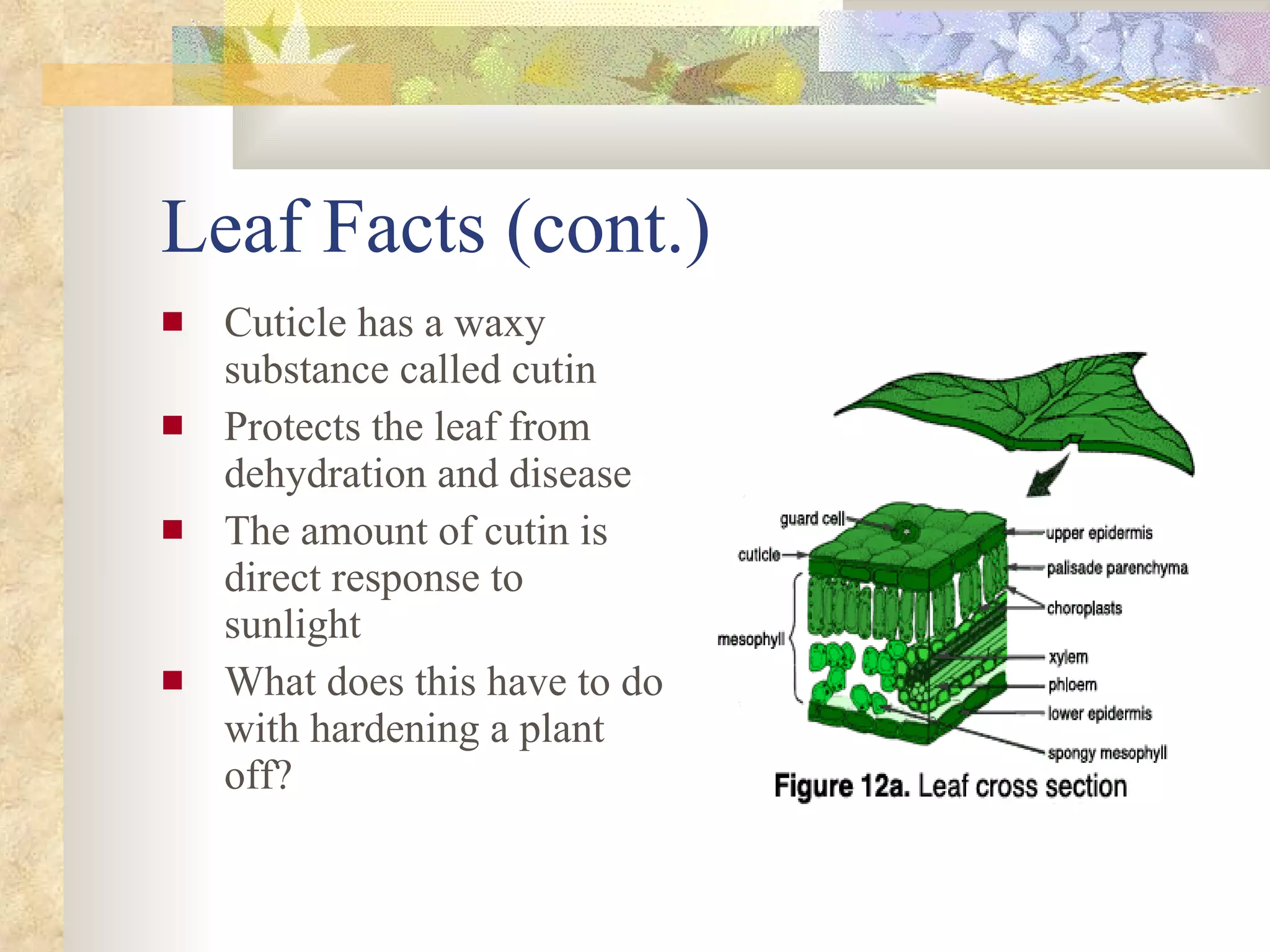
Leaf Facts (cont.) Cuticle has a waxy substance called cutin Protects the leaf from dehydration and disease The amount of cutin is direct response to sunlight What does this have to do with hardening a plant off?
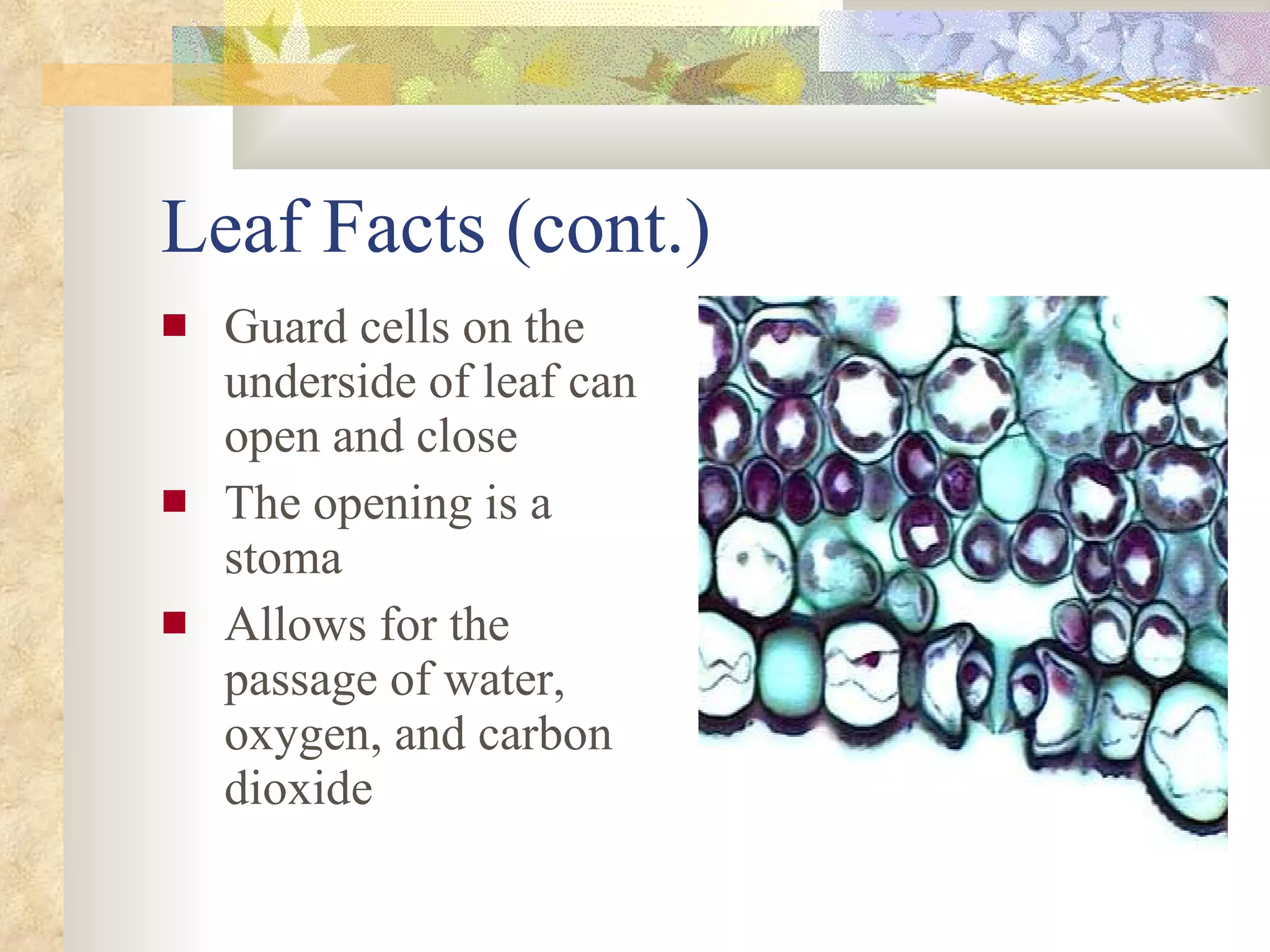
Leaf Facts (cont.) Guard cells on the underside of leaf can open and close The opening is a stoma Allows for the passage of water, oxygen, and carbon dioxide
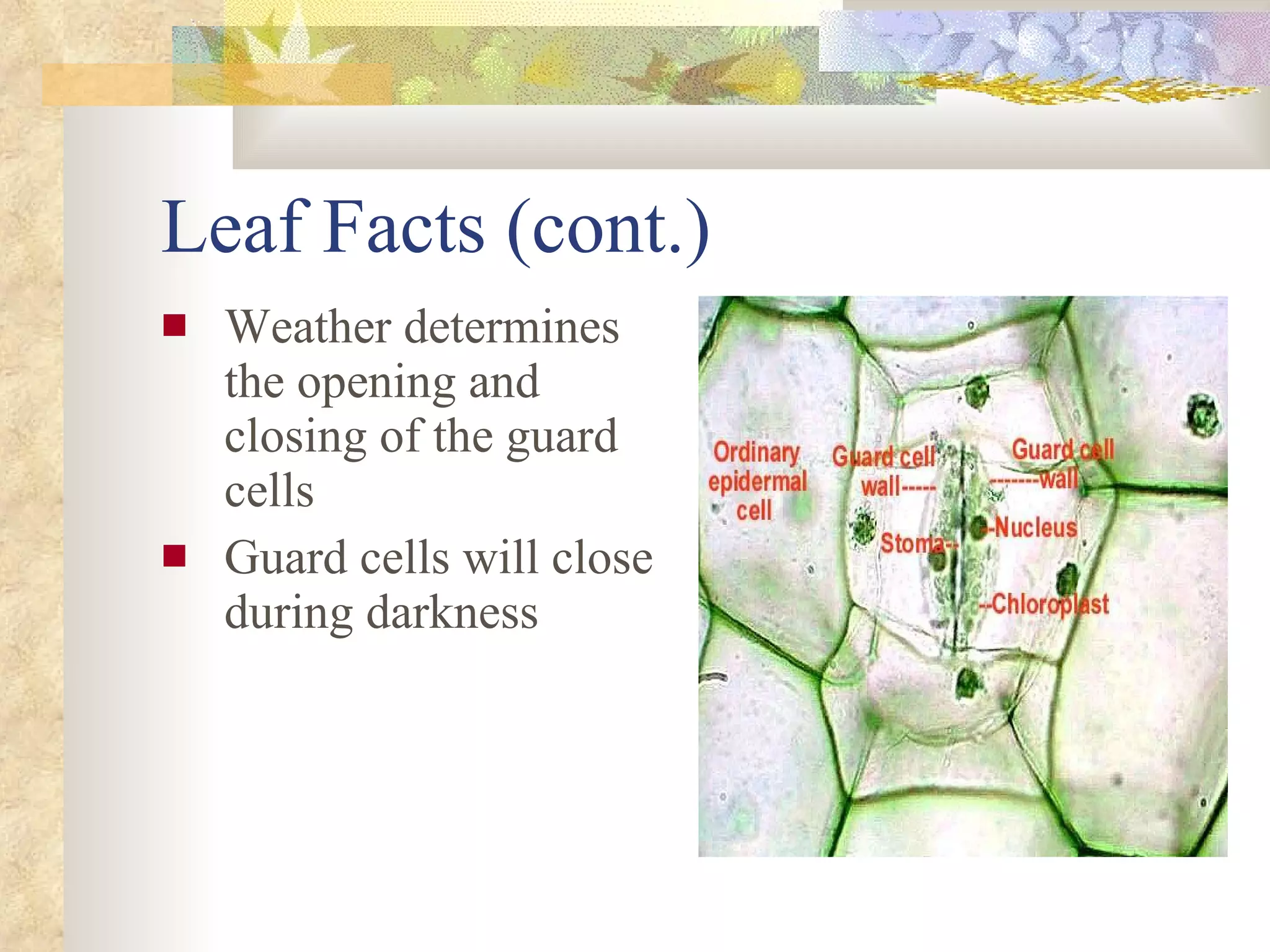
Leaf Facts (cont.) Weather determines the opening and closing of the guard cells Guard cells will close during darkness
 
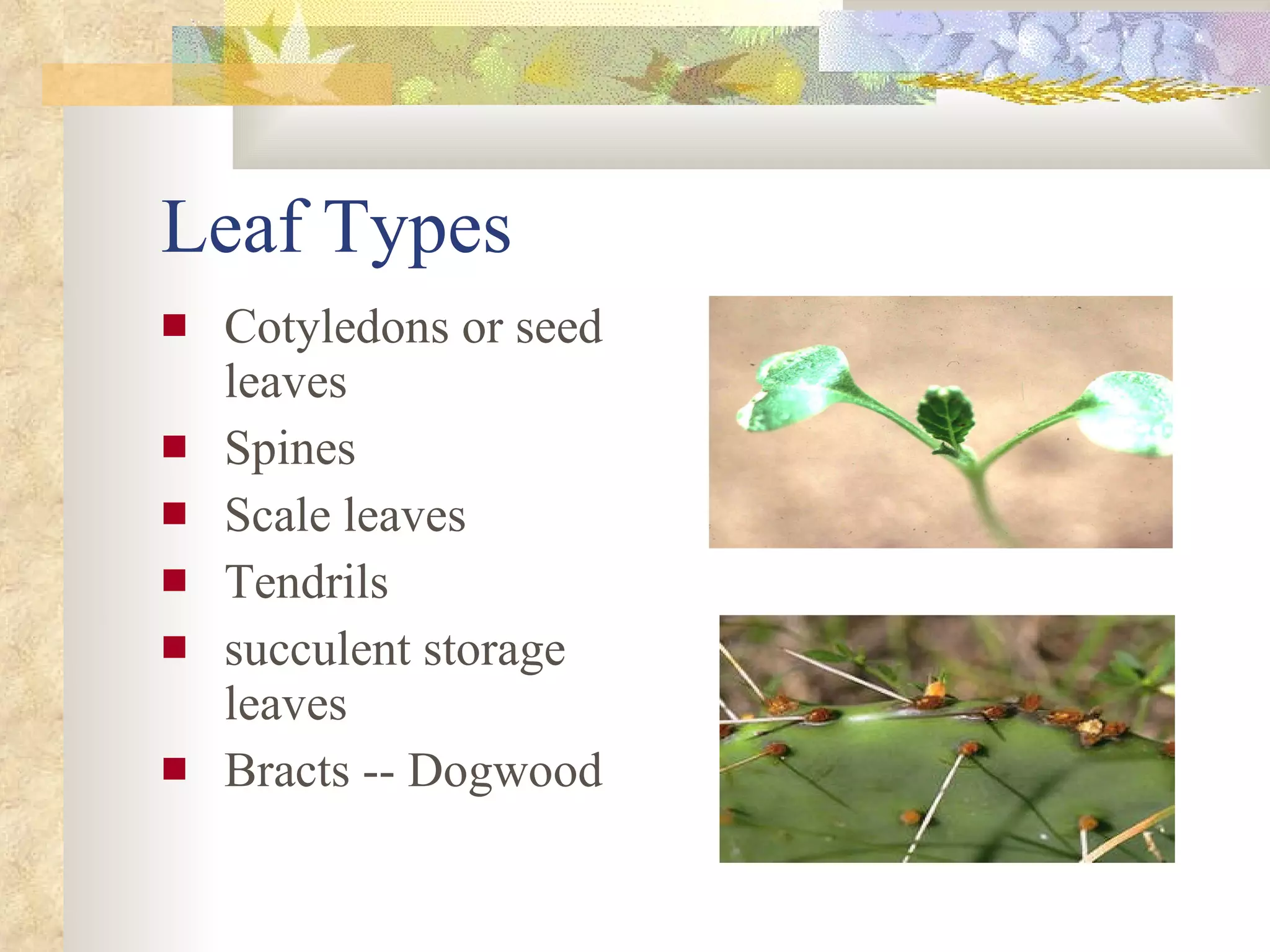
Leaf Types Cotyledons or seed leaves Spines Scale leaves Tendrils succulent storage leaves Bracts -- Dogwood
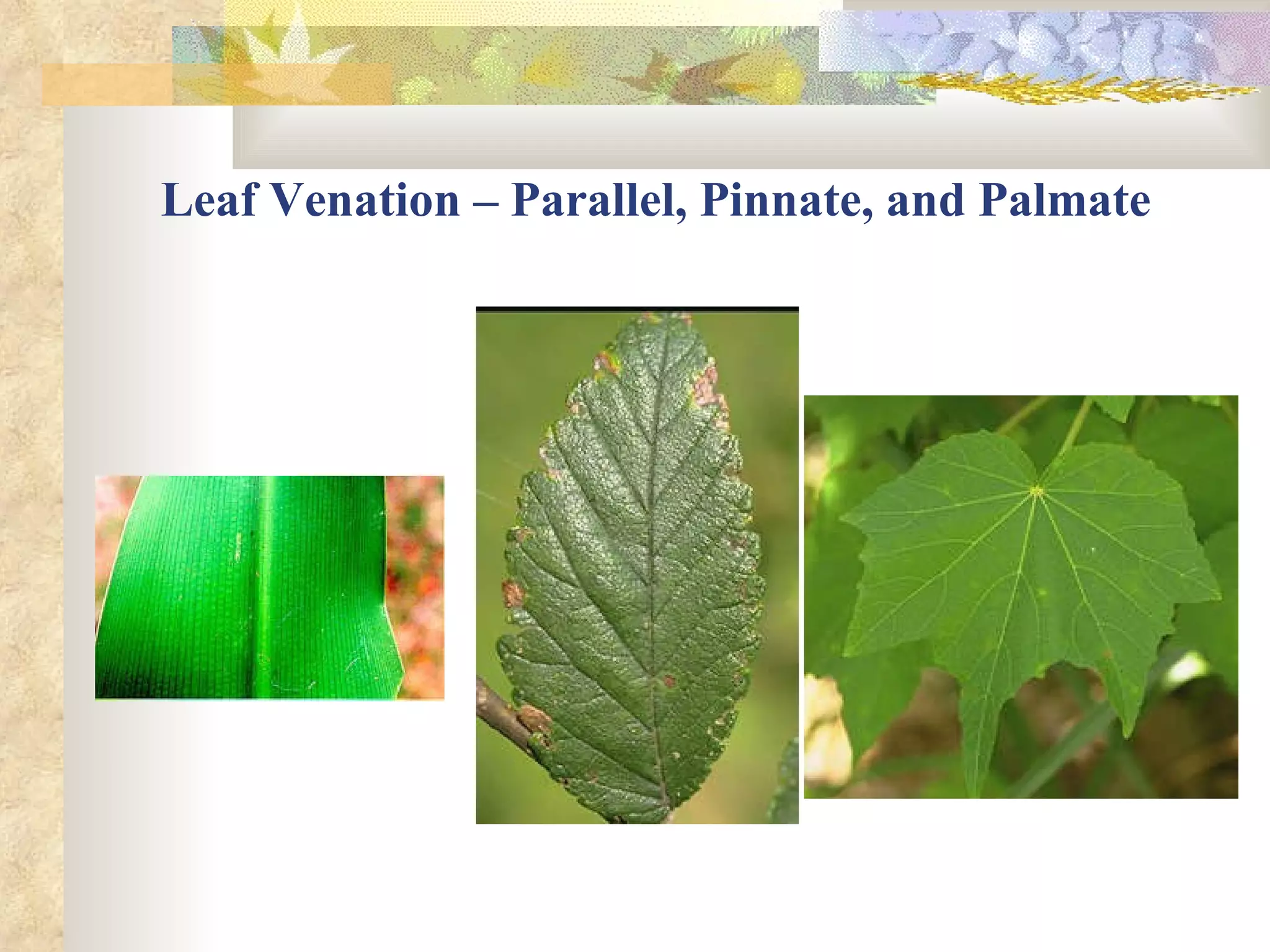
Leaf Venation – Parallel, Pinnate, and Palmate
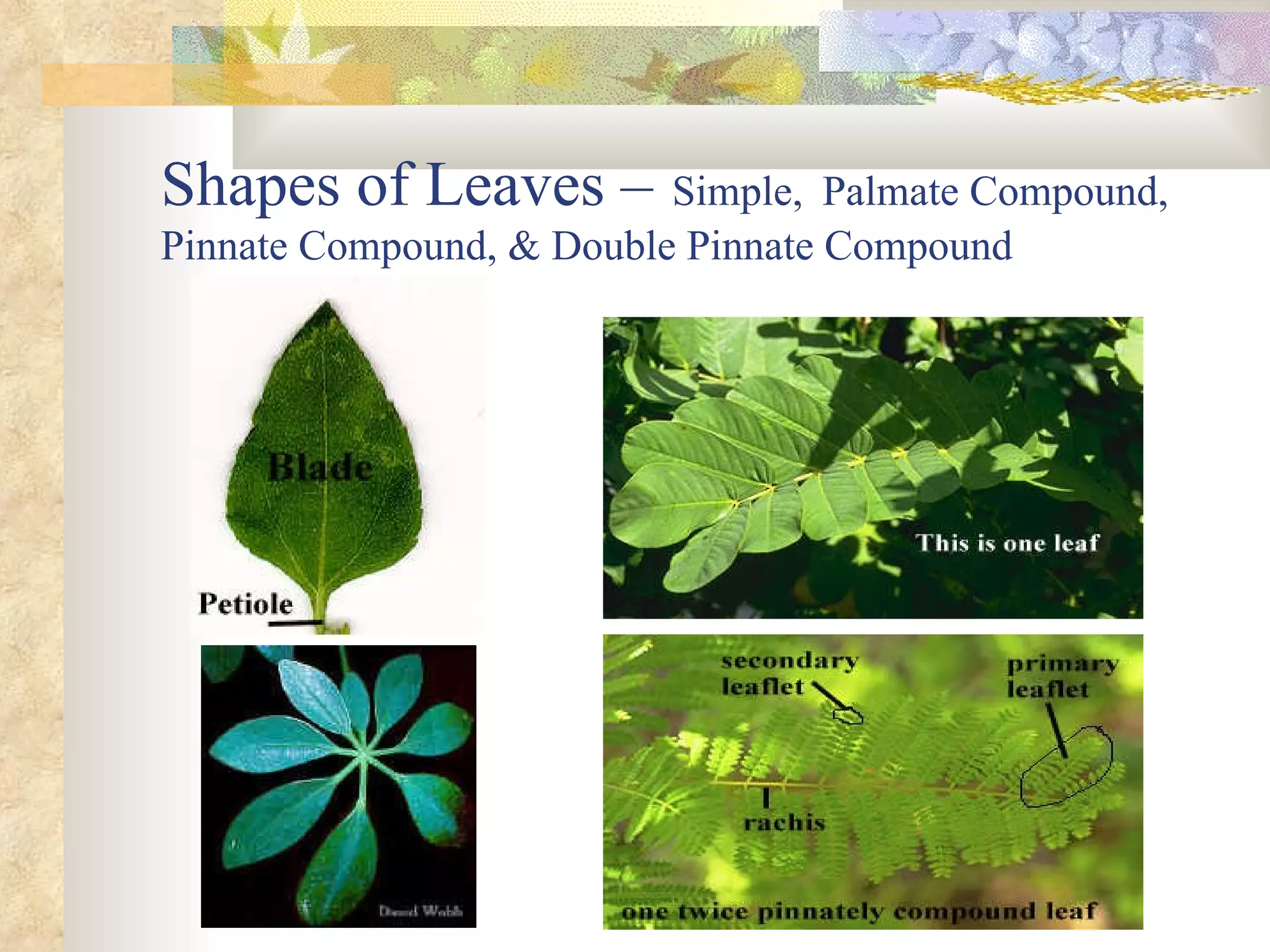
Shapes of Leaves –   Simple,   Palmate Compound, Pinnate Compound, & Double Pinnate Compound
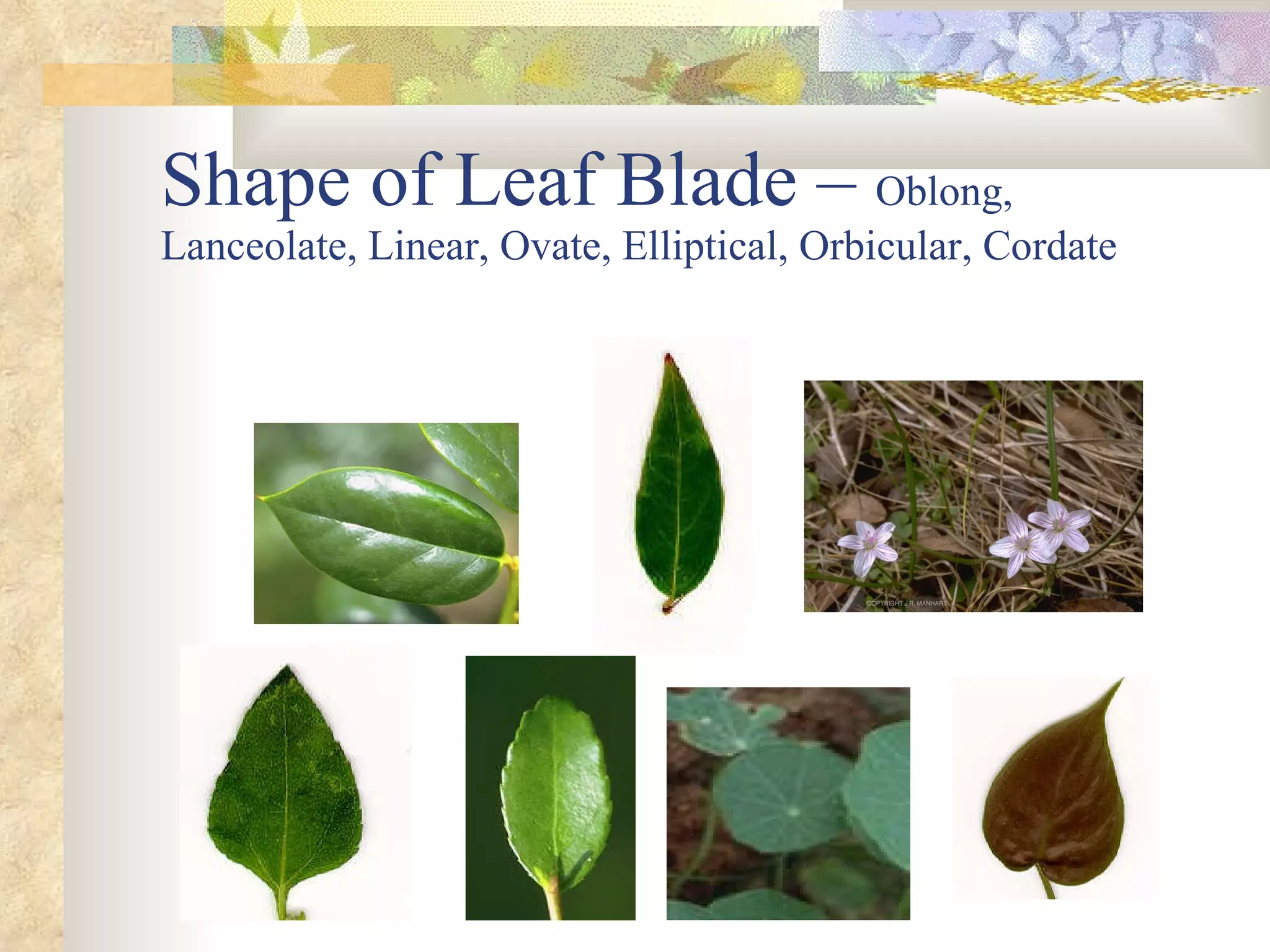
Shape of Leaf Blade –  Oblong, Lanceolate, Linear, Ovate, Elliptical, Orbicular, Cordate
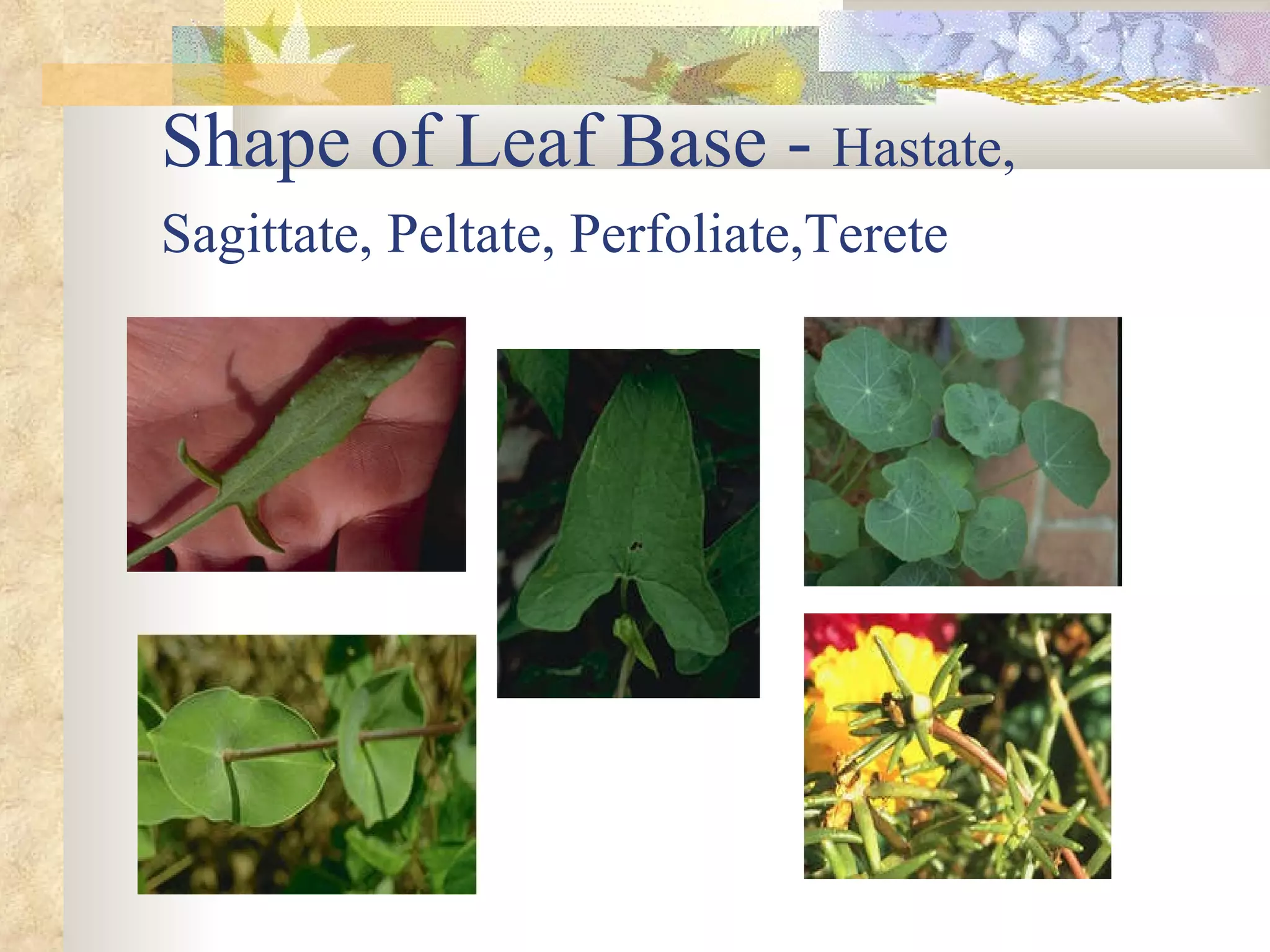
Shape of Leaf Base -  Hastate, Sagittate, Peltate, Perfoliate,Terete
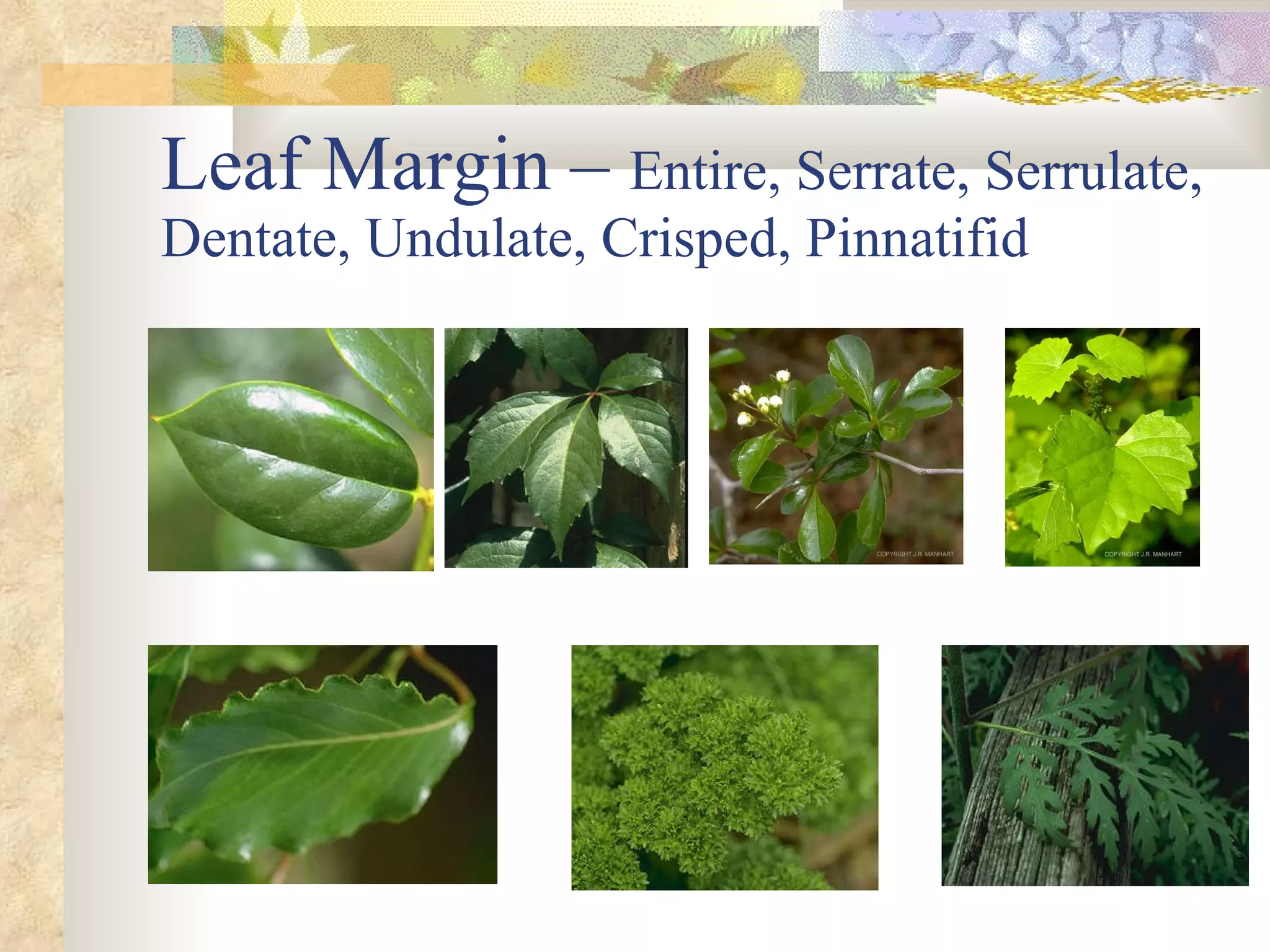
Leaf Margin –  Entire, Serrate, Serrulate, Dentate, Undulate, Crisped, Pinnatifid
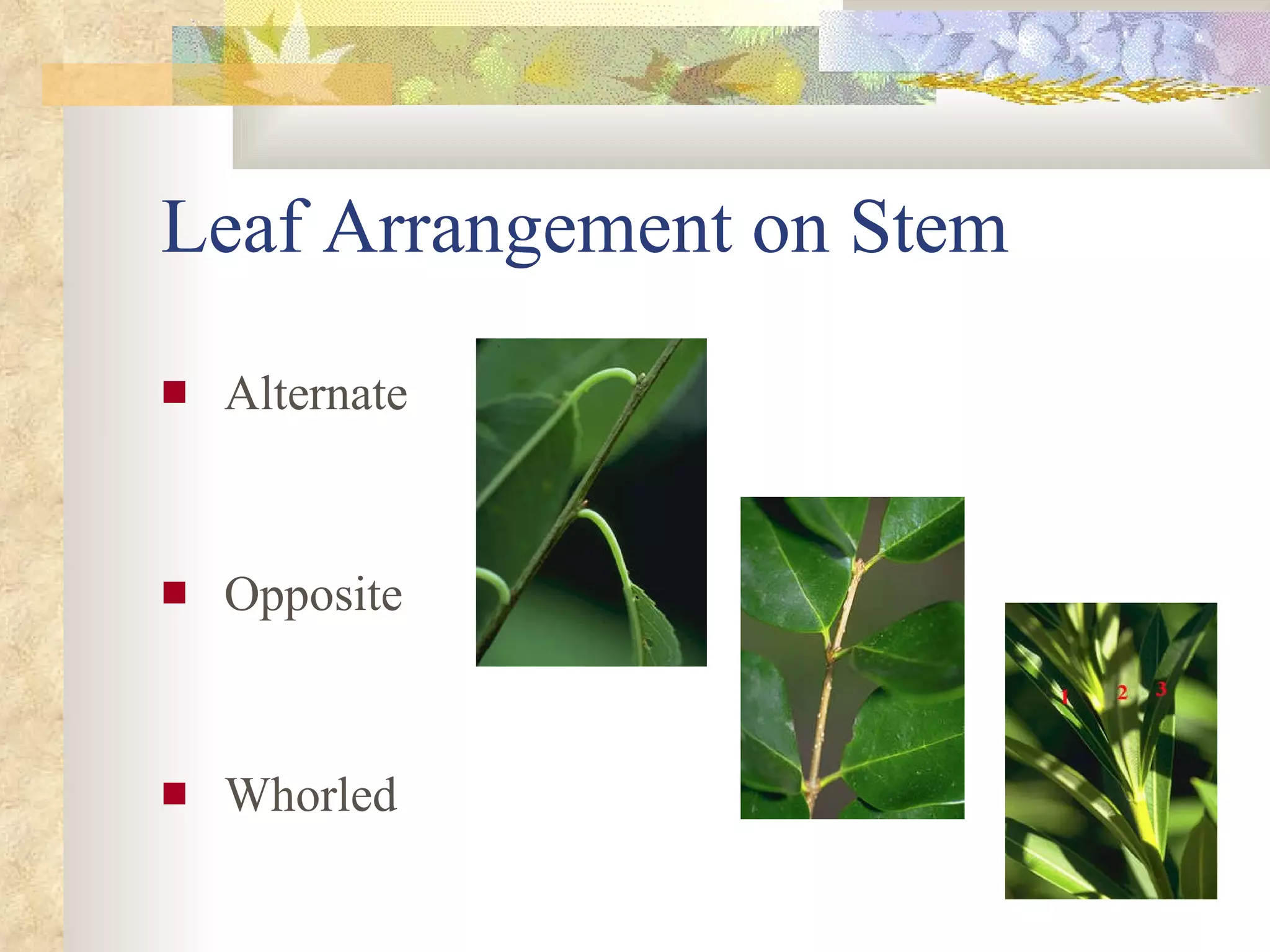
Leaf Arrangement on Stem Alternate Opposite Whorled
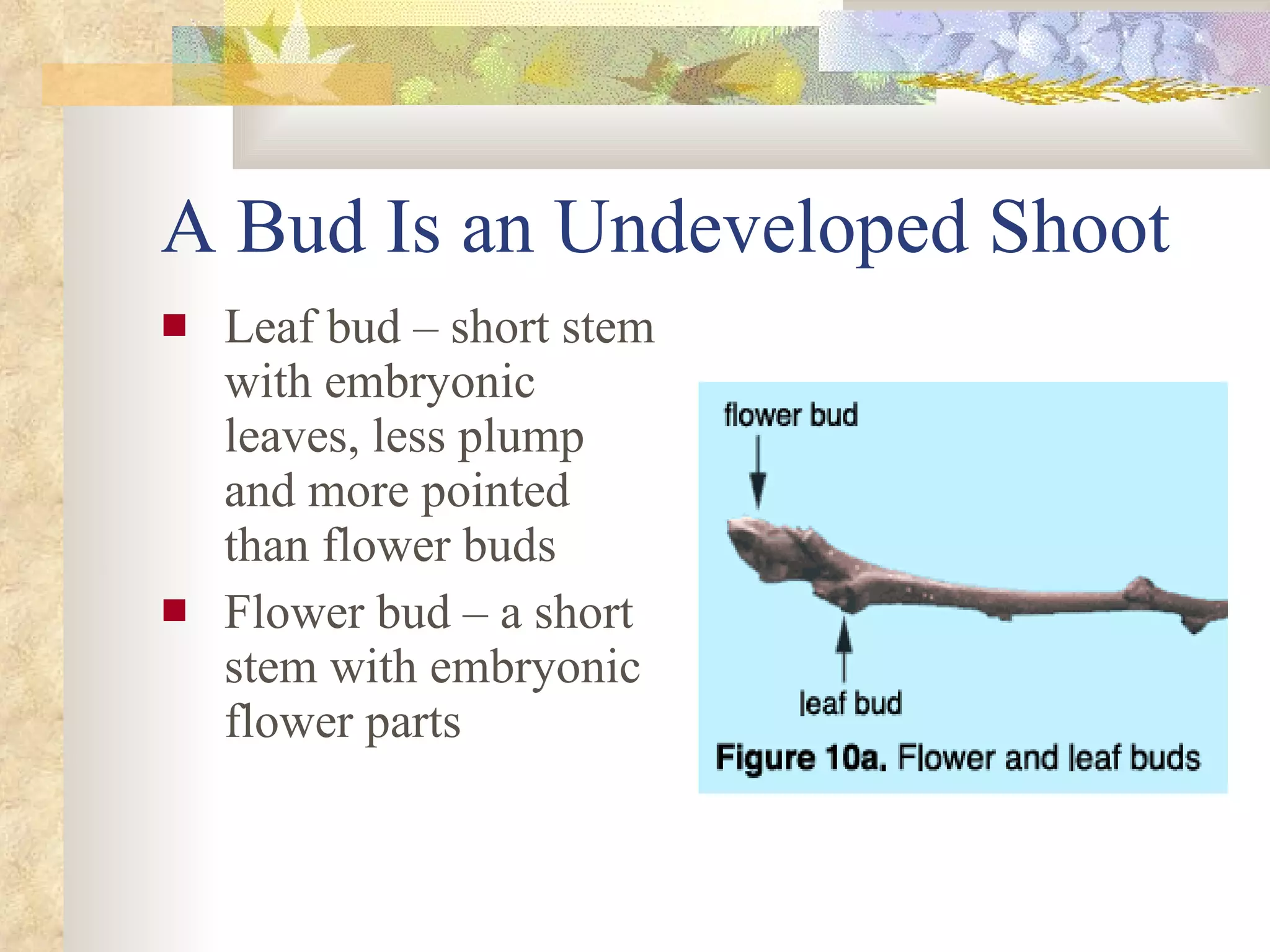
A Bud Is an Undeveloped Shoot Leaf bud – short stem with embryonic leaves, less plump and more pointed than flower buds Flower bud – a short stem with embryonic flower parts
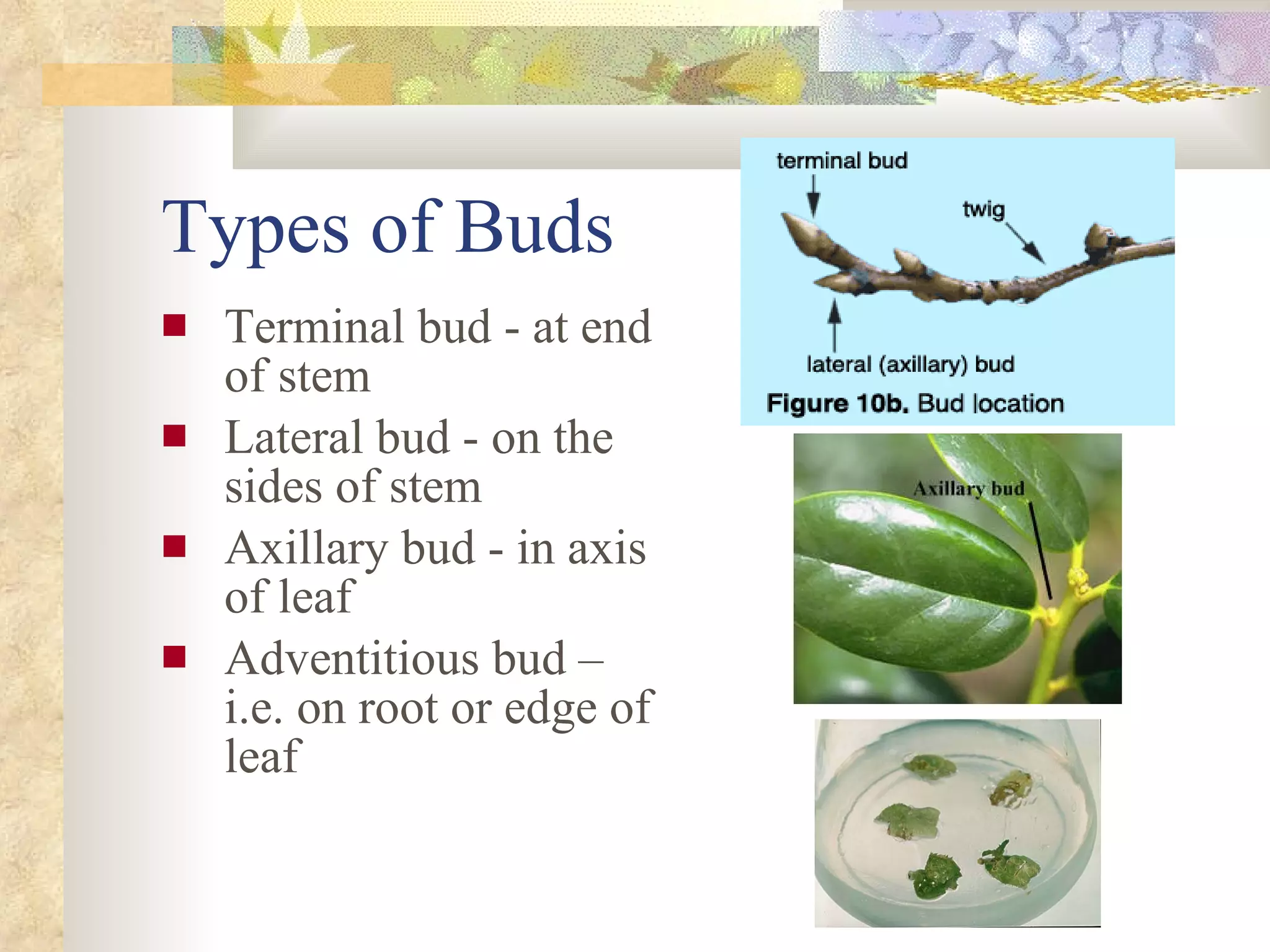
Types of Buds Terminal bud - at end of stem Lateral bud - on the sides of stem Axillary bud - in axis of leaf Adventitious bud – i.e. on root or edge of leaf
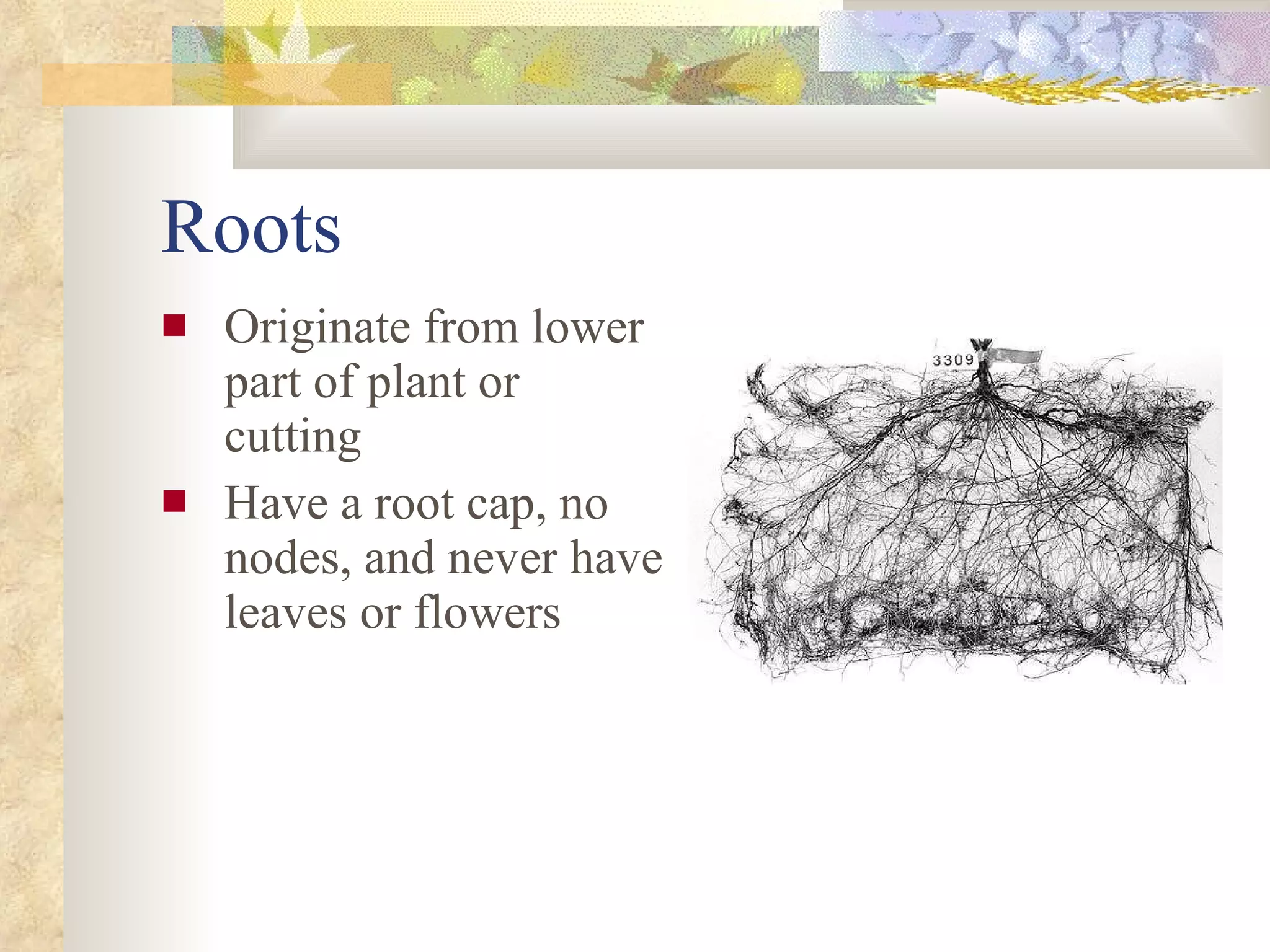
Roots  Originate from lower part of plant or cutting Have a root cap, no nodes, and never have leaves or flowers
Principle Functions of Roots Absorb nutrients and moisture Anchor the plant in the soil Furnish physical support of the stem Serve as food storage organs May be used as a means of propagation
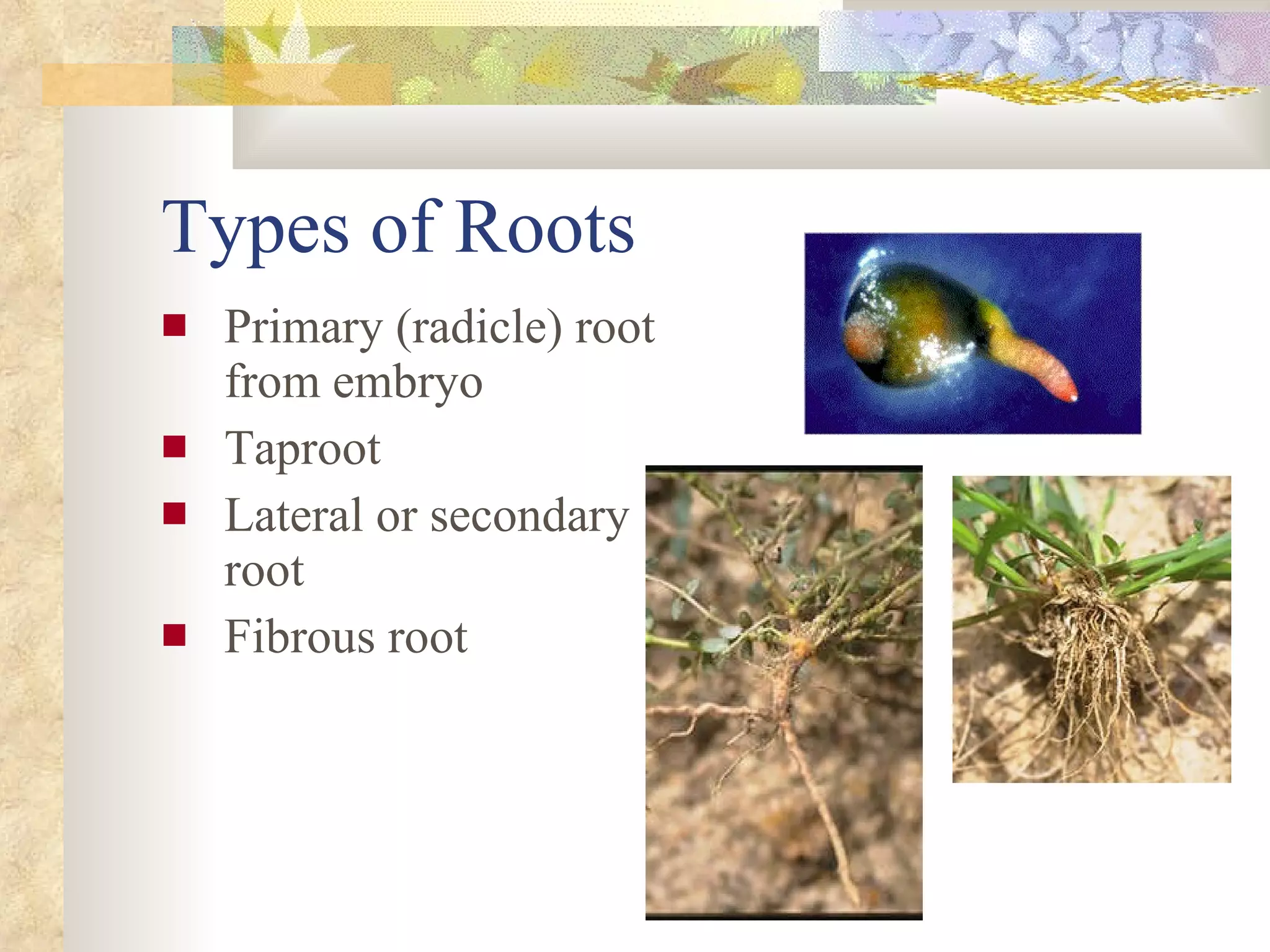
Types of Roots Primary (radicle) root from embryo  Taproot Lateral or secondary root Fibrous root
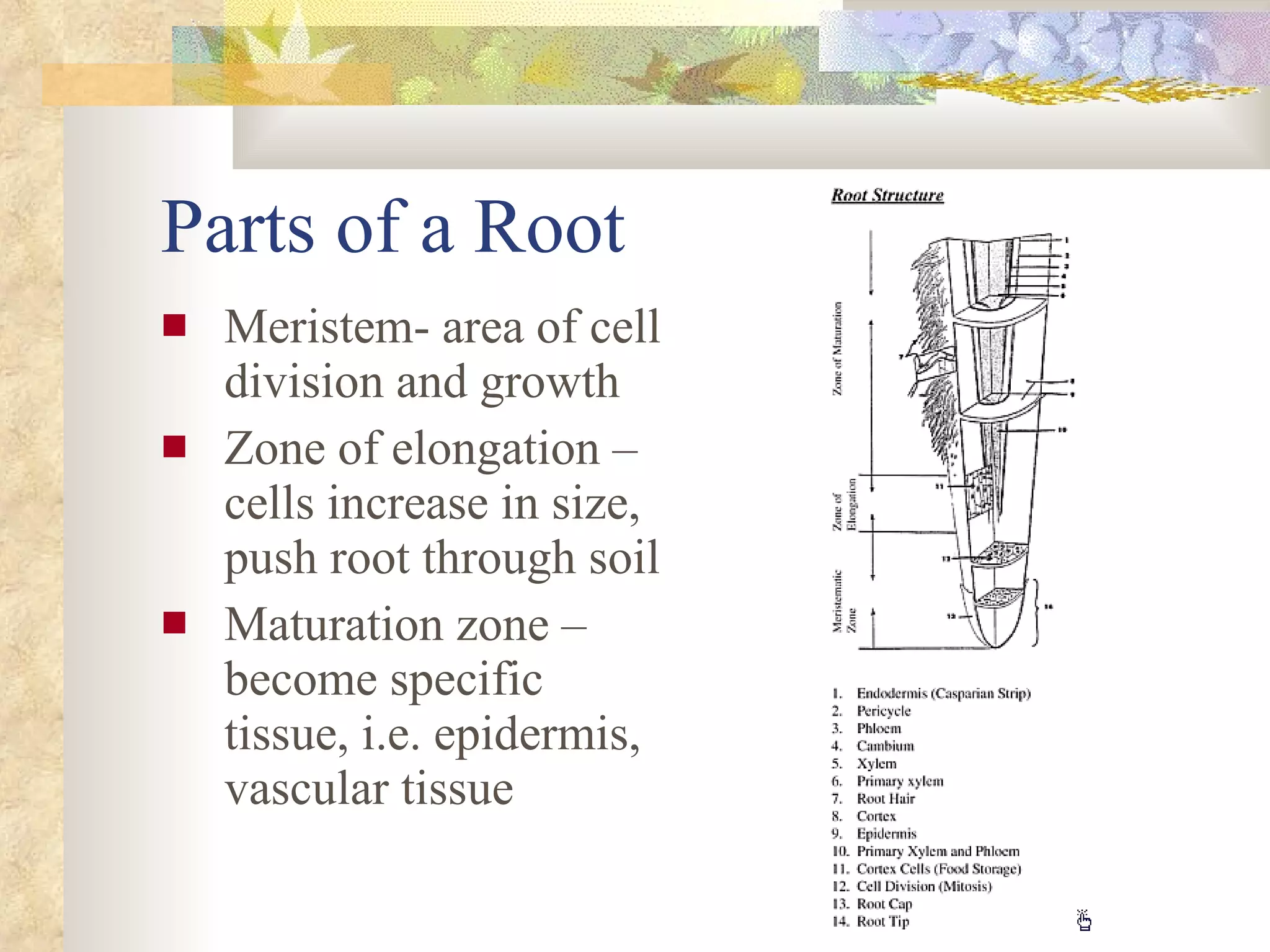
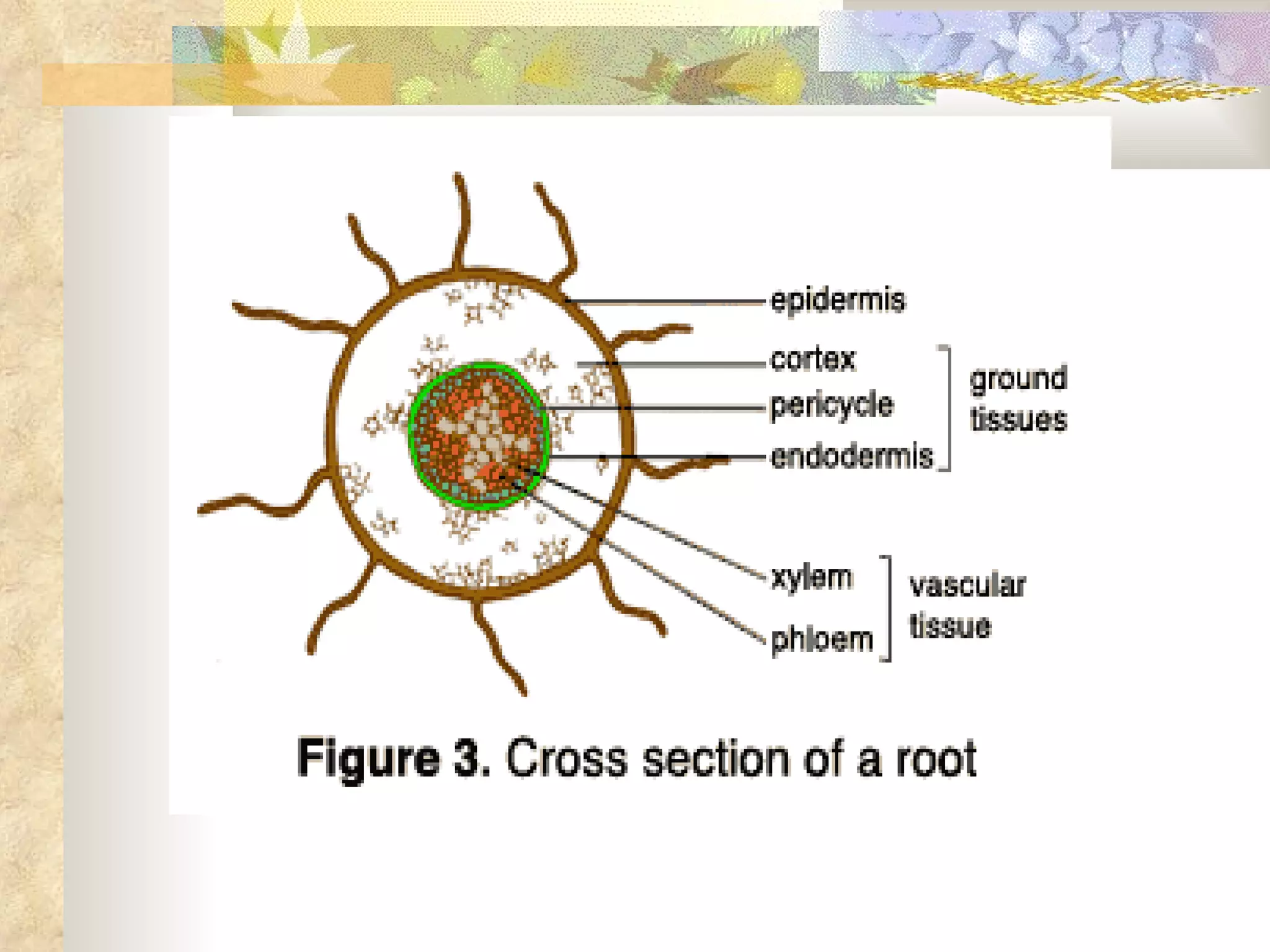
Parts of a Root Meristem- area of cell division and growth Zone of elongation – cells increase in size, push root through soil Maturation zone – become specific tissue, i.e. epidermis, vascular tissue
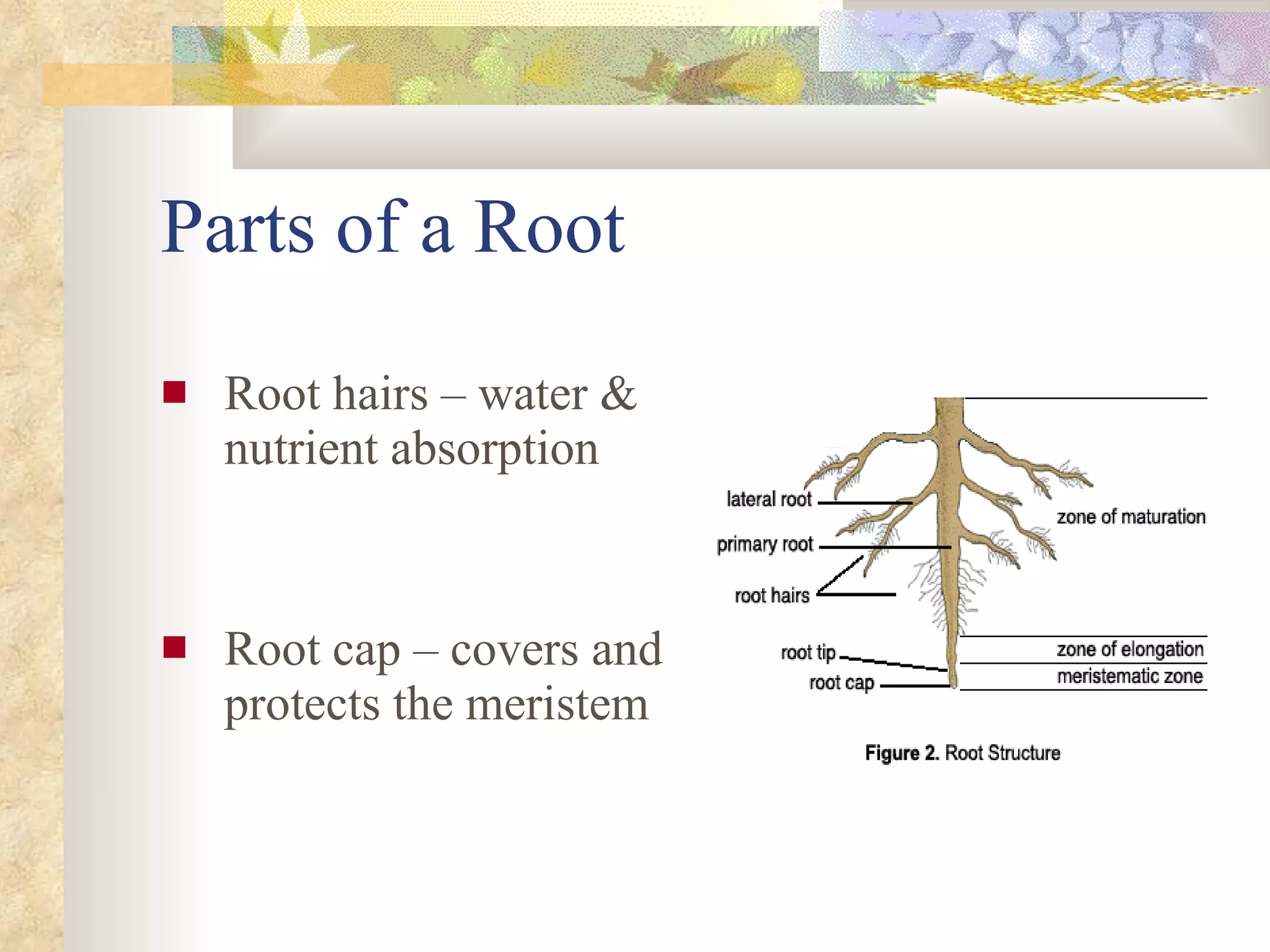
Parts of a Root Root hairs – water & nutrient absorption Root cap – covers and protects the meristem
 
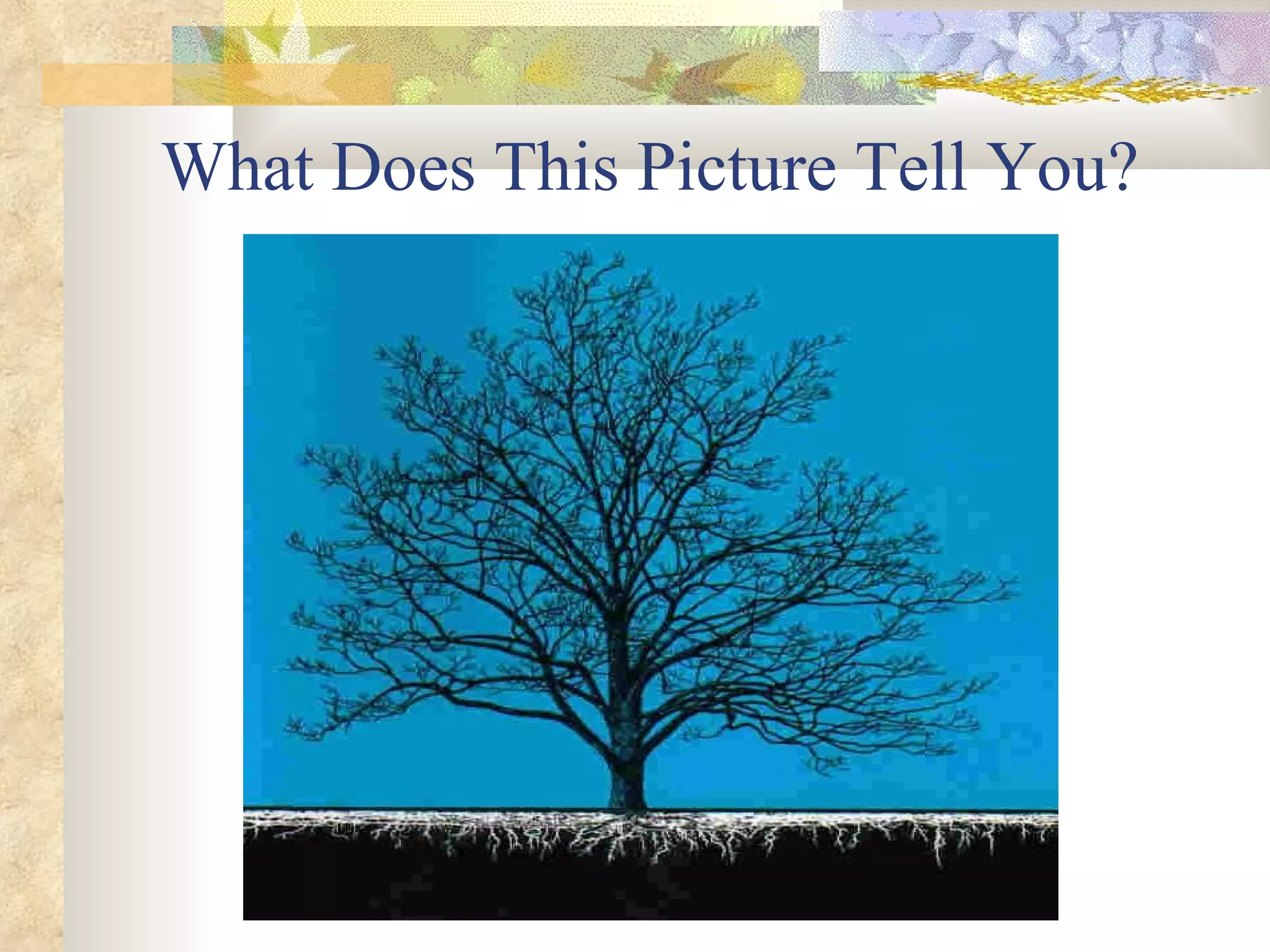
What Does This Picture Tell You?
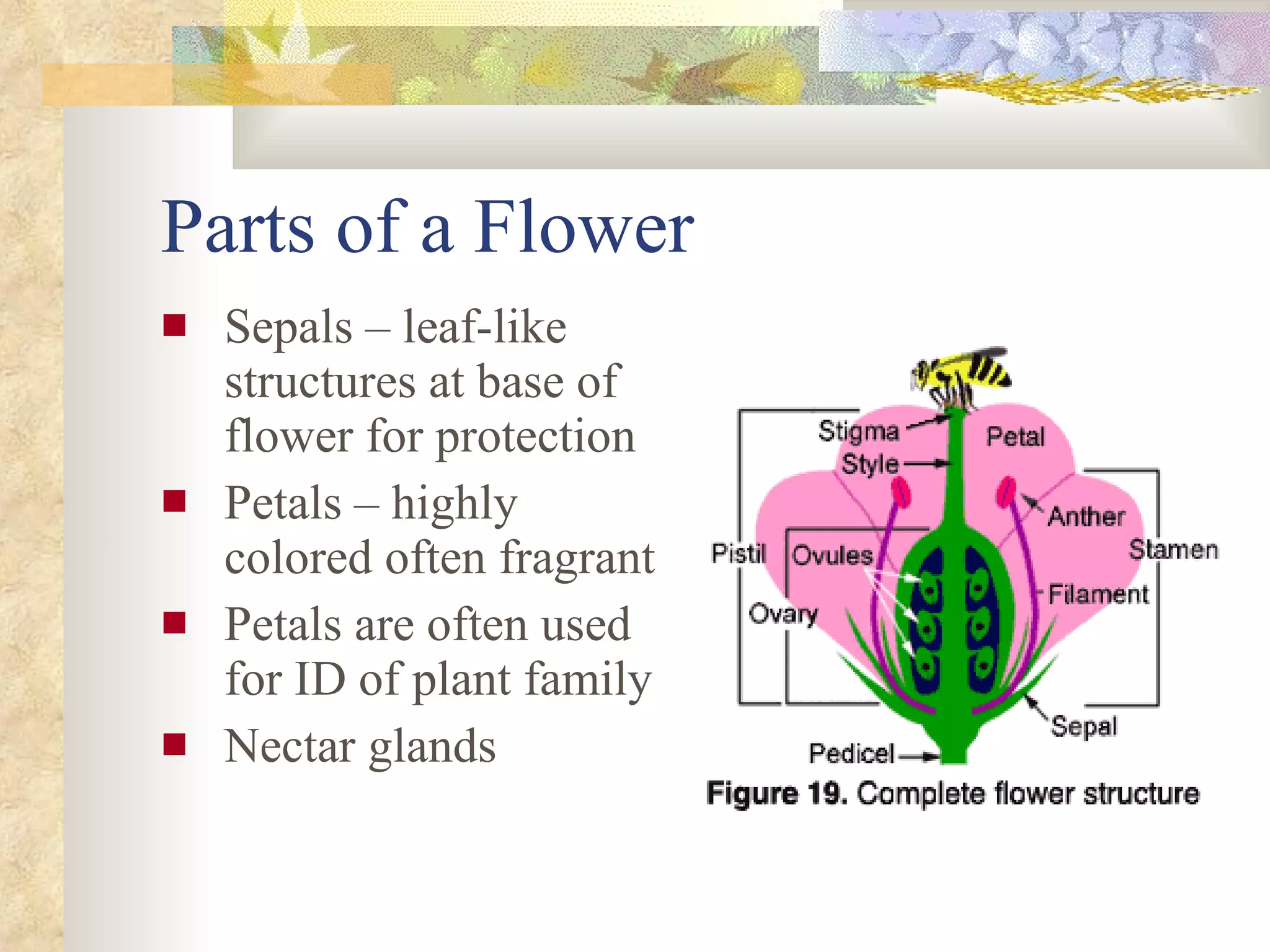
Parts of a Flower Sepals – leaf-like structures at base of flower for protection Petals – highly colored often fragrant Petals are often used for ID of plant family Nectar glands
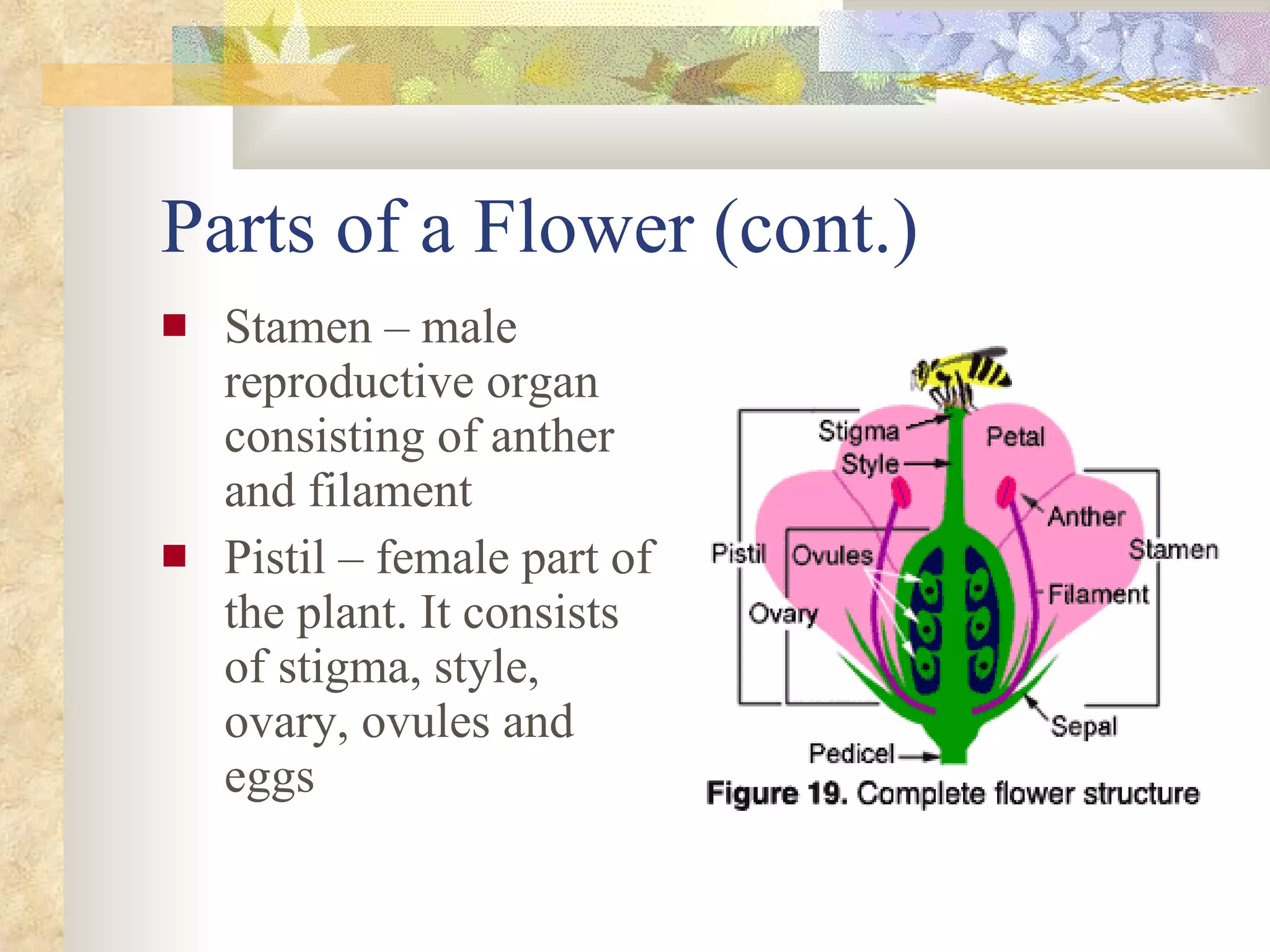
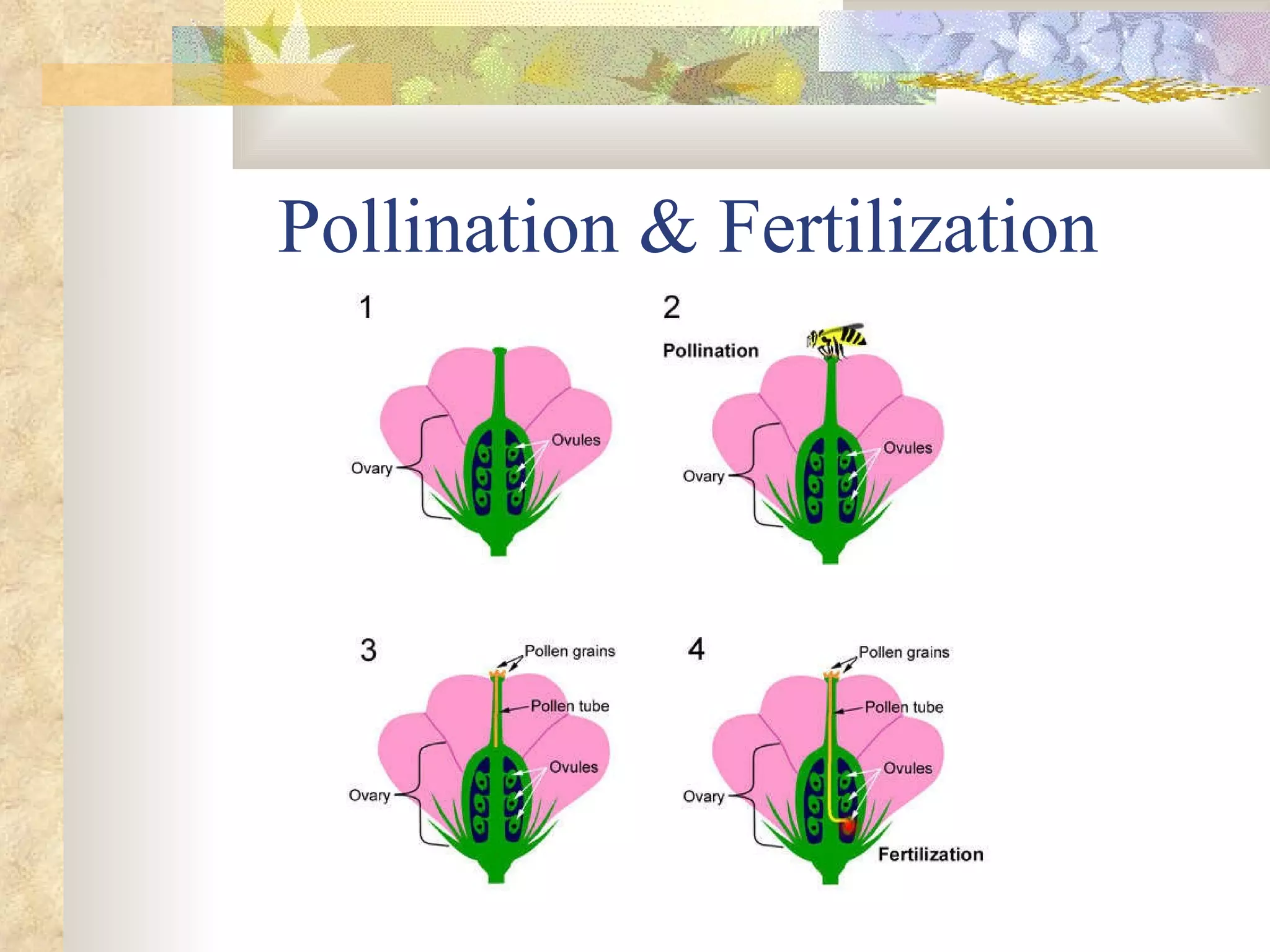
Parts of a Flower (cont.) Stamen – male reproductive organ consisting of anther and filament Pistil – female part of the plant. It consists of stigma, style, ovary, ovules and eggs
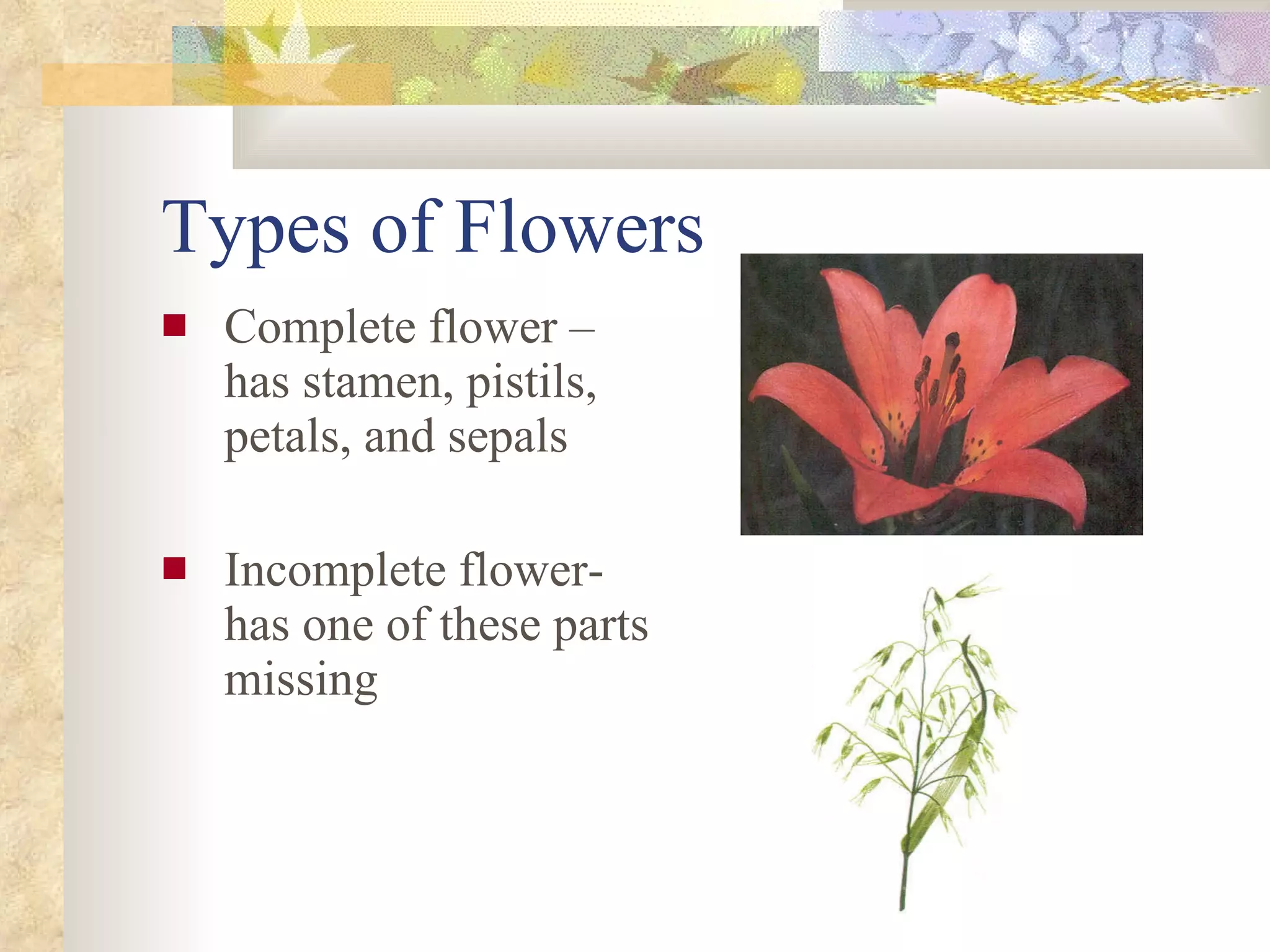
Types of Flowers Complete flower – has stamen, pistils, petals, and sepals Incomplete flower- has one of these parts missing
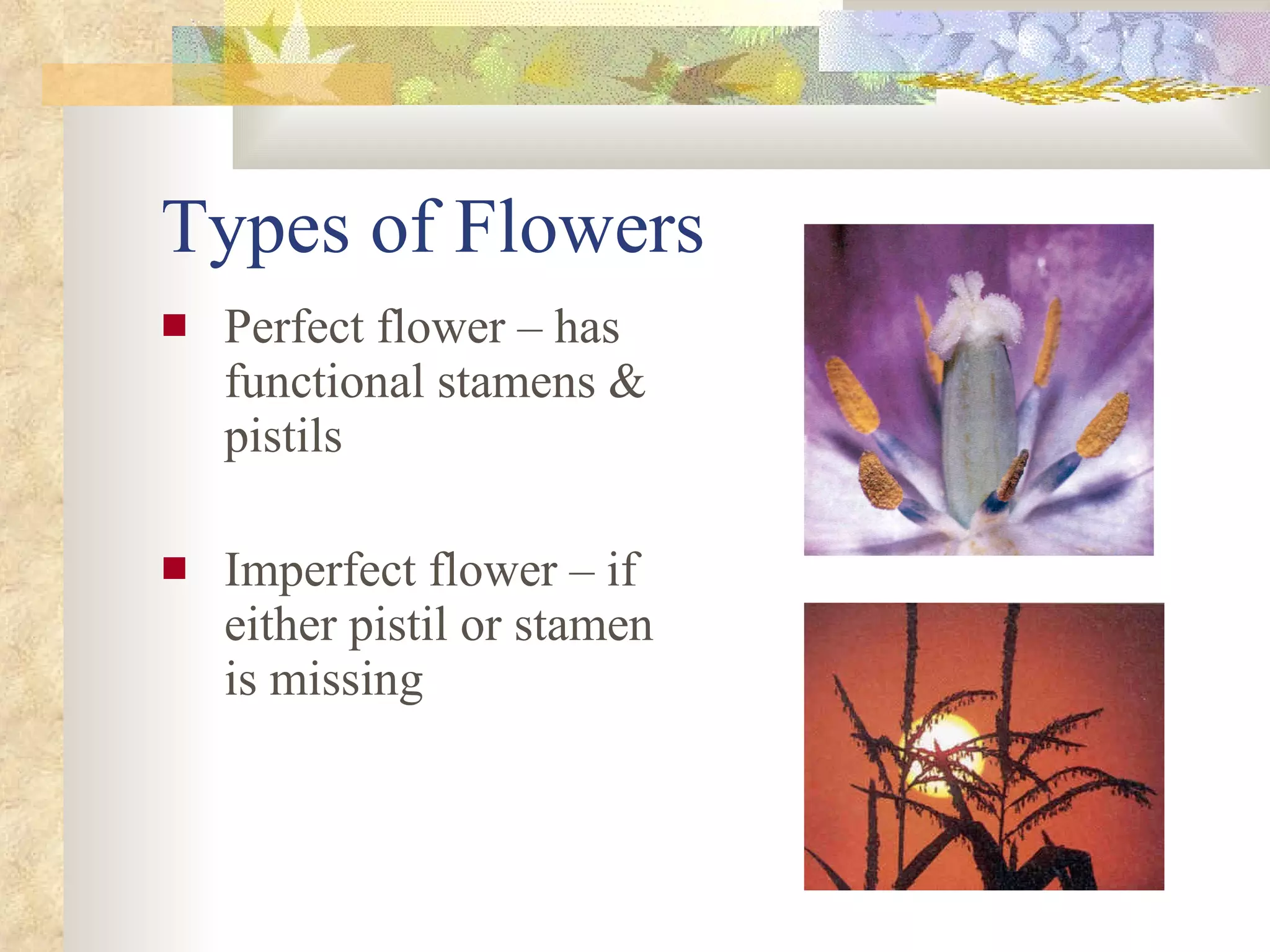
Types of Flowers Perfect flower – has functional stamens & pistils Imperfect flower – if either pistil or stamen is missing
Types of Flowers Pistillate or female flowers have no stamen Staminate or male flowers have no pistils
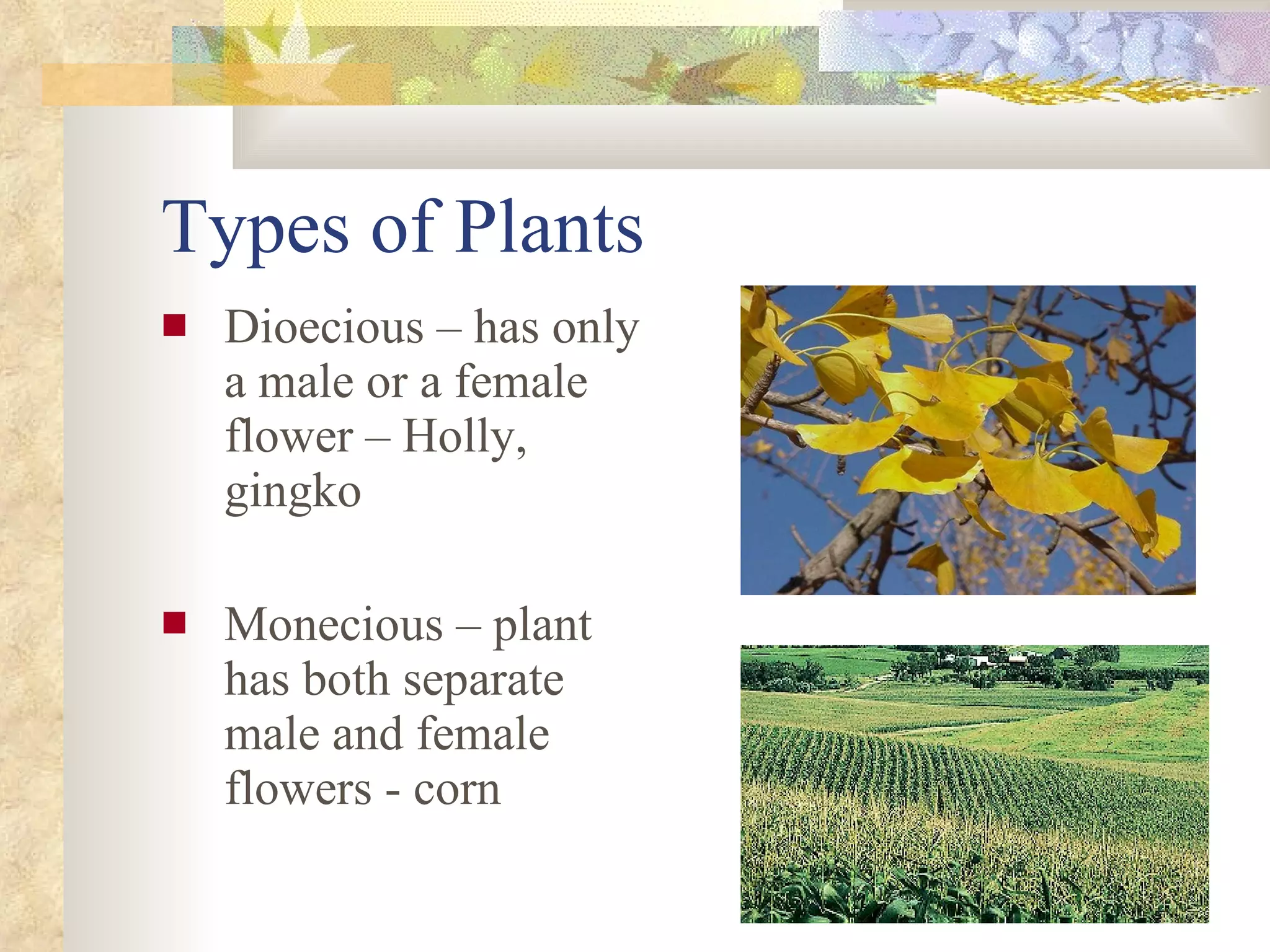
Types of Plants Dioecious – has only a male or a female flower – Holly, gingko Monecious – plant has both separate male and female flowers - corn
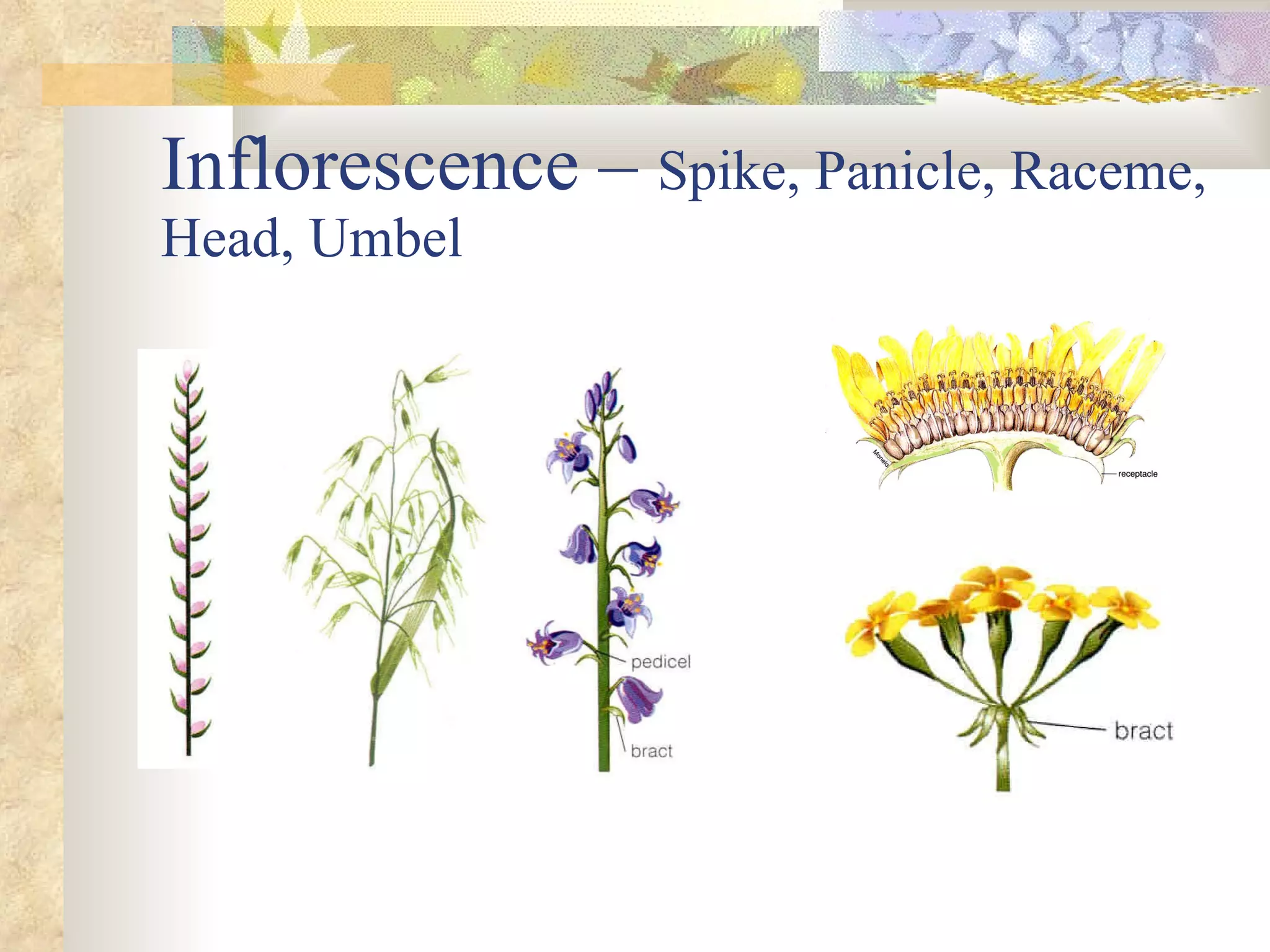
Inflorescence –  Spike, Panicle, Raceme, Head, Umbel
Pollination & Fertilization
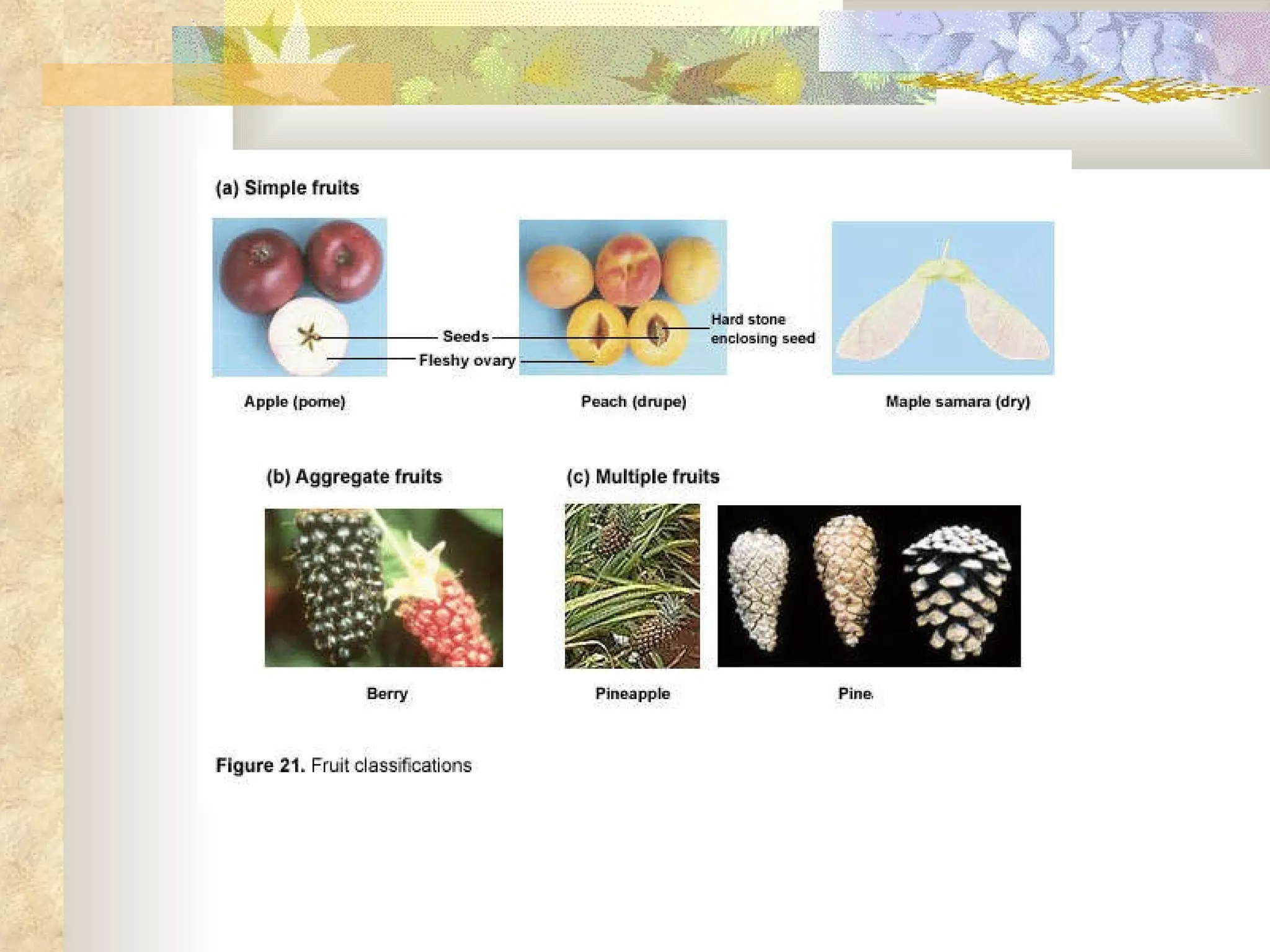
Types of Fruit Simple – develop from a single ovary Aggregate – develop from a single flower which has many ovaries Multiple – tight cluster of individual flowers borne on a single cluster
 
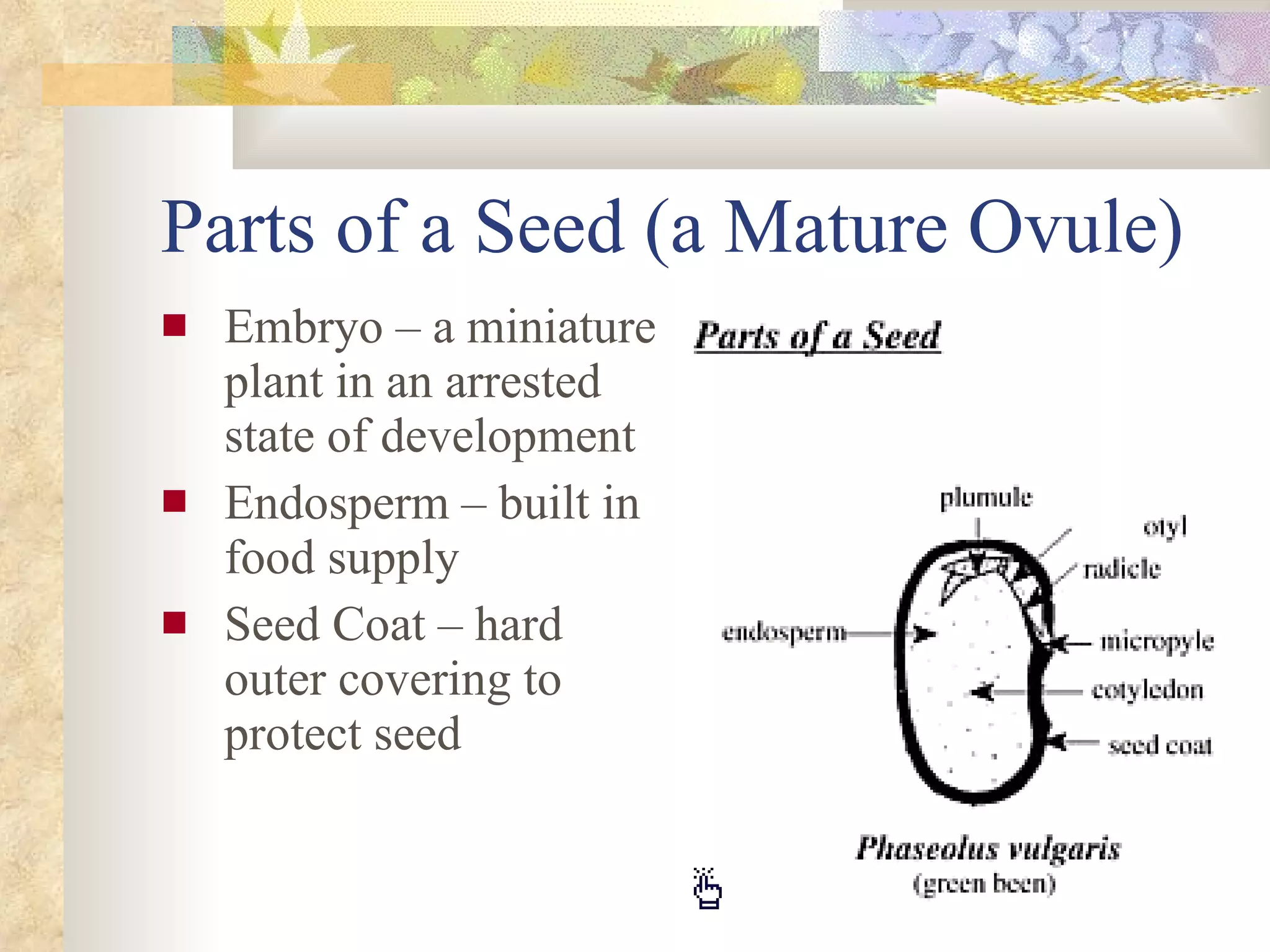
Parts of a Seed (a Mature Ovule) Embryo – a miniature plant in an arrested state of development Endosperm – built in food supply Seed Coat – hard outer covering to protect seed
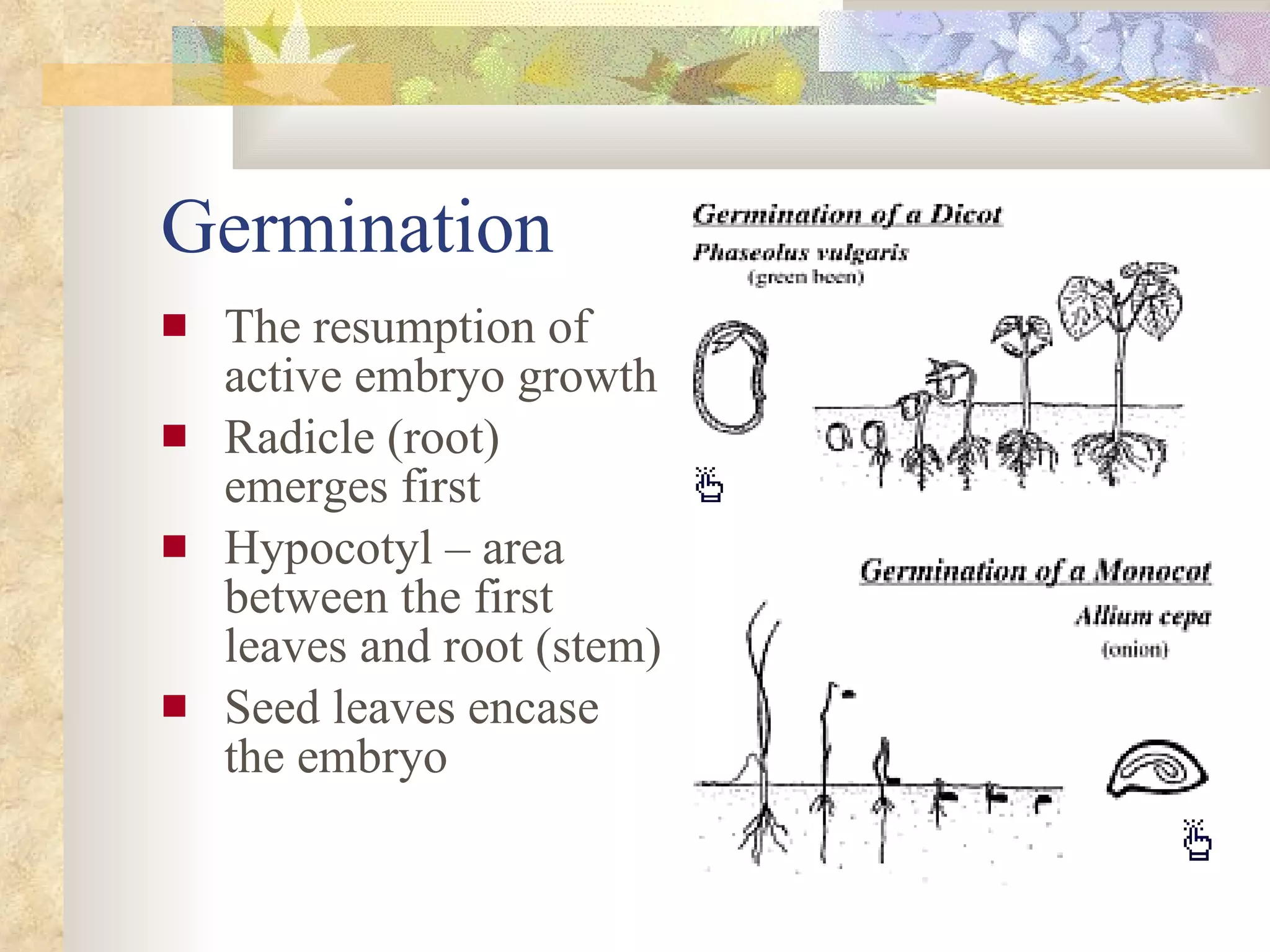
Germination The resumption of active embryo growth Radicle (root) emerges first Hypocotyl – area between the first leaves and root (stem) Seed leaves encase the embryo
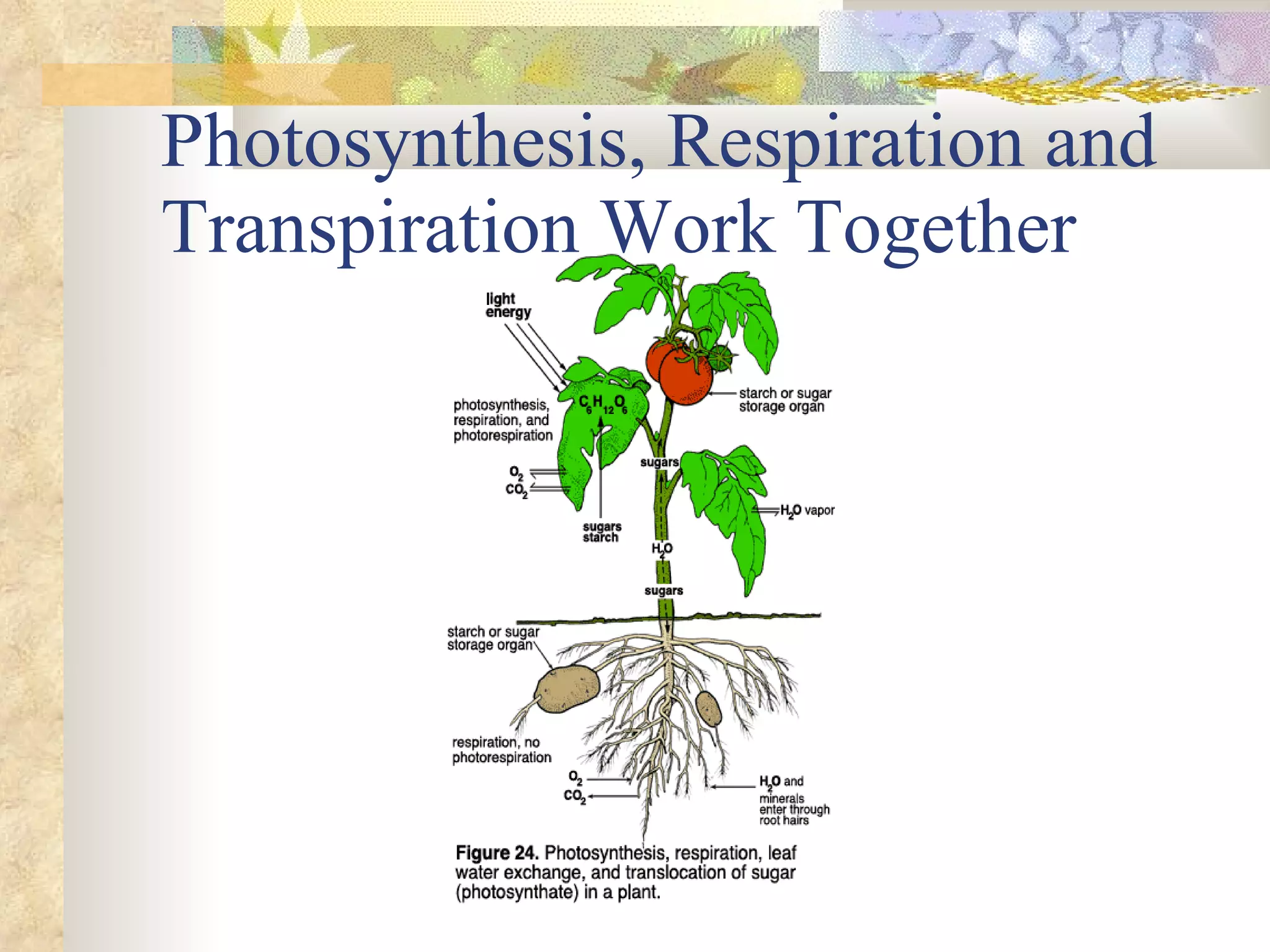
The Three Major Plant Functions Photosynthesis – food production Respiration – uses food for plant energy Transpiration – process for moving/losing water
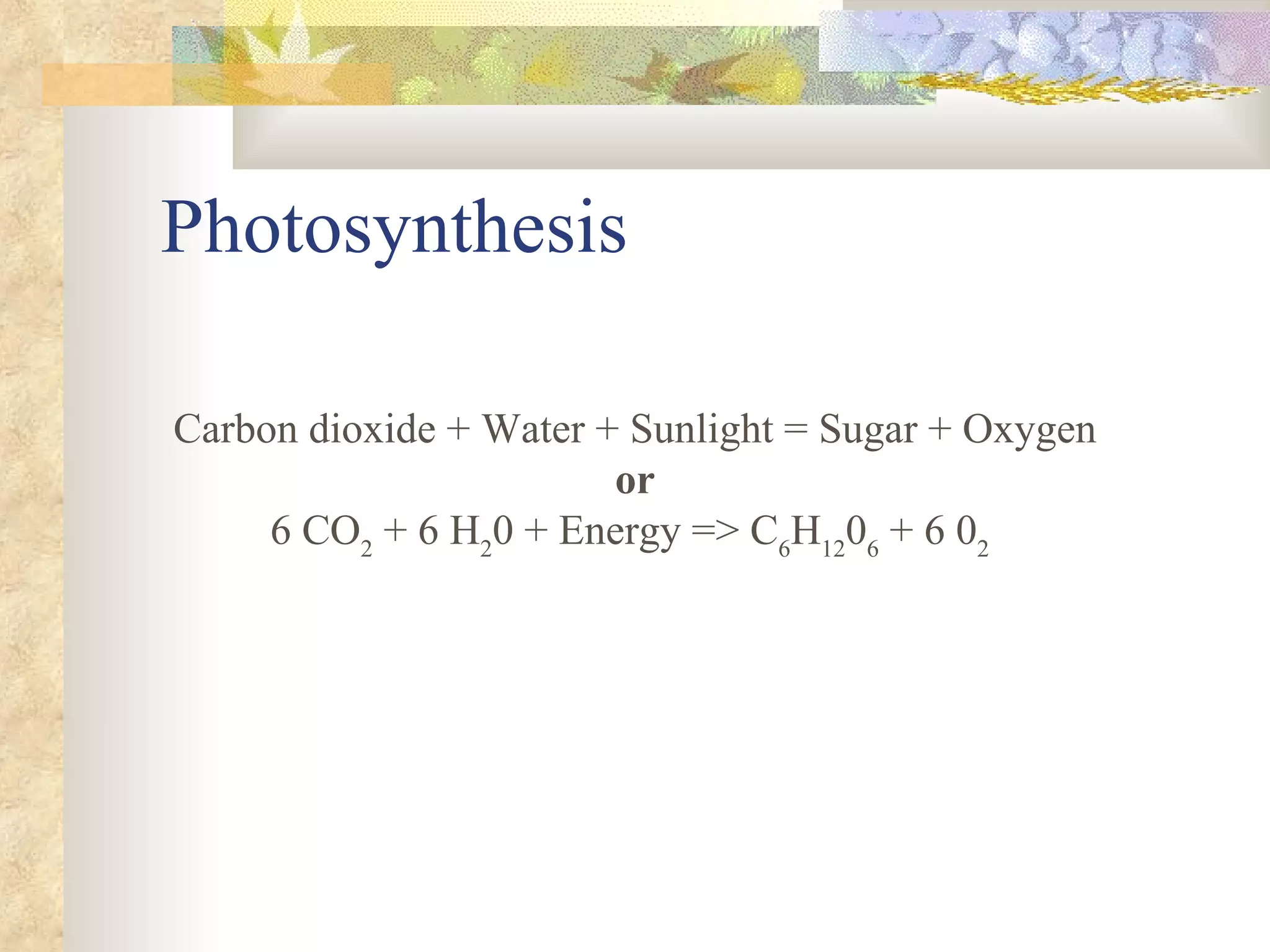
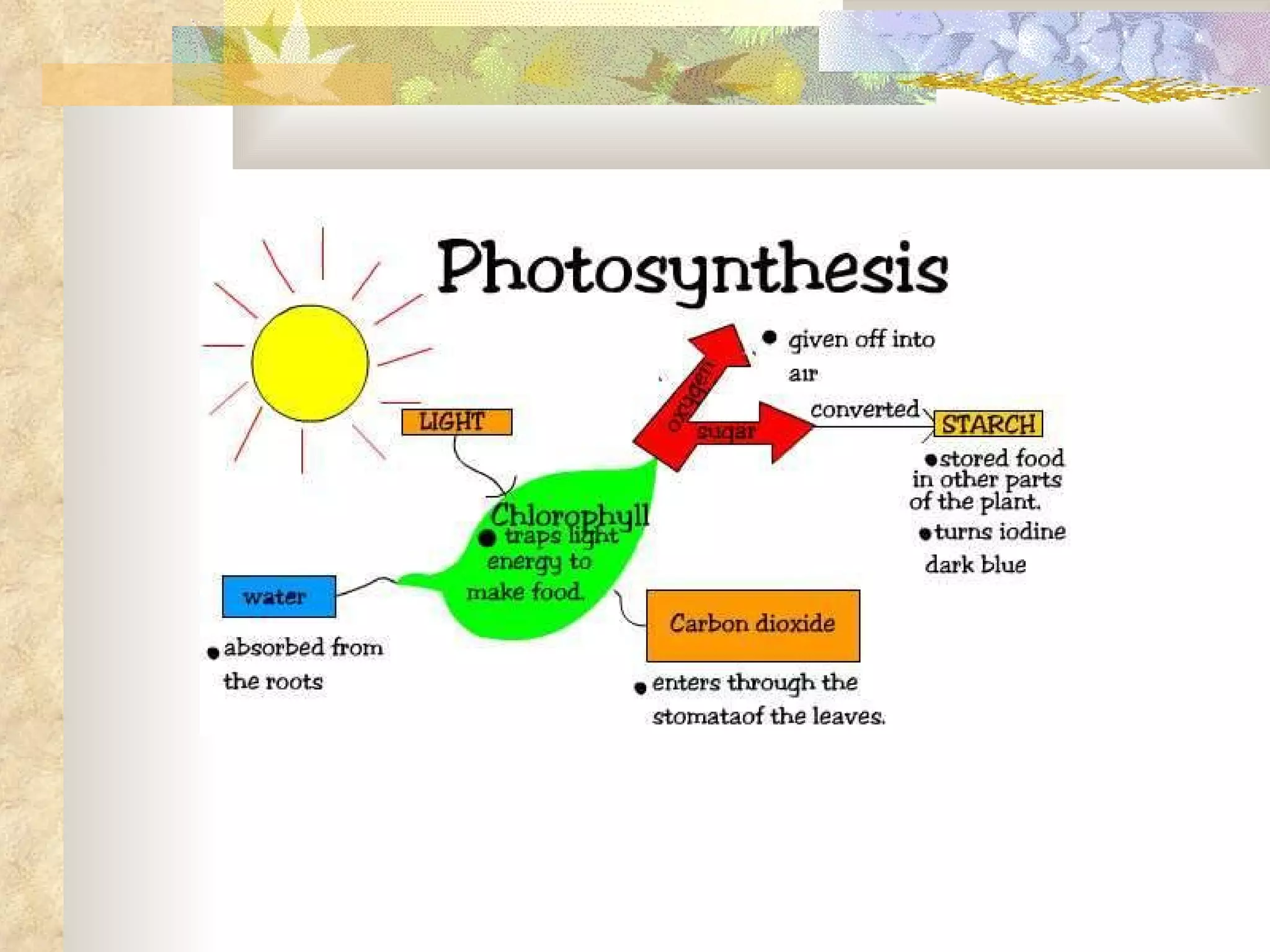
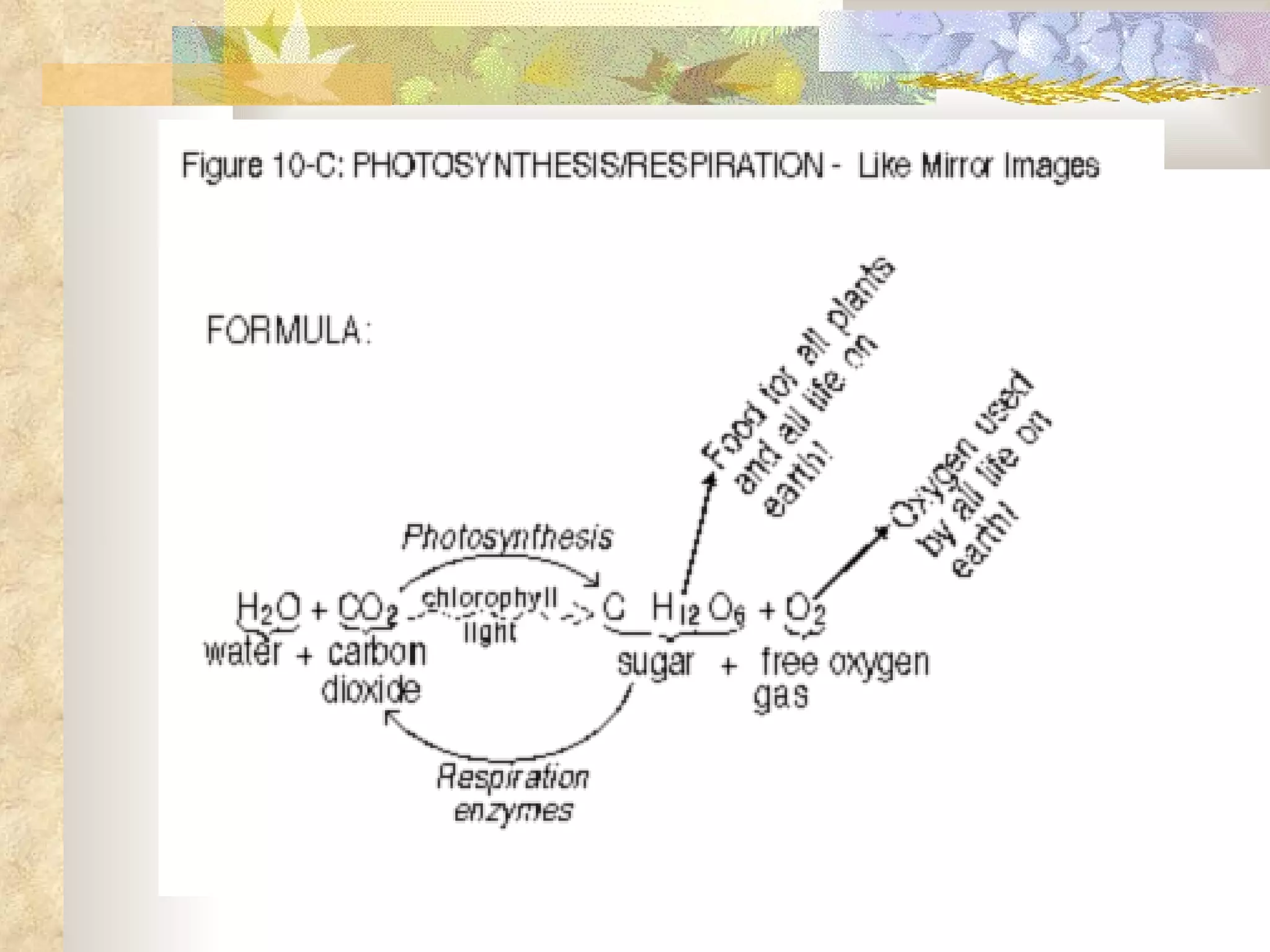
Photosynthesis Carbon dioxide + Water + Sunlight = Sugar + Oxygen or 6 CO 2  + 6 H 2 0 + Energy => C 6 H 12 0 6  + 6 0 2
 
Photosynthesis Occurs in Chloroplasts
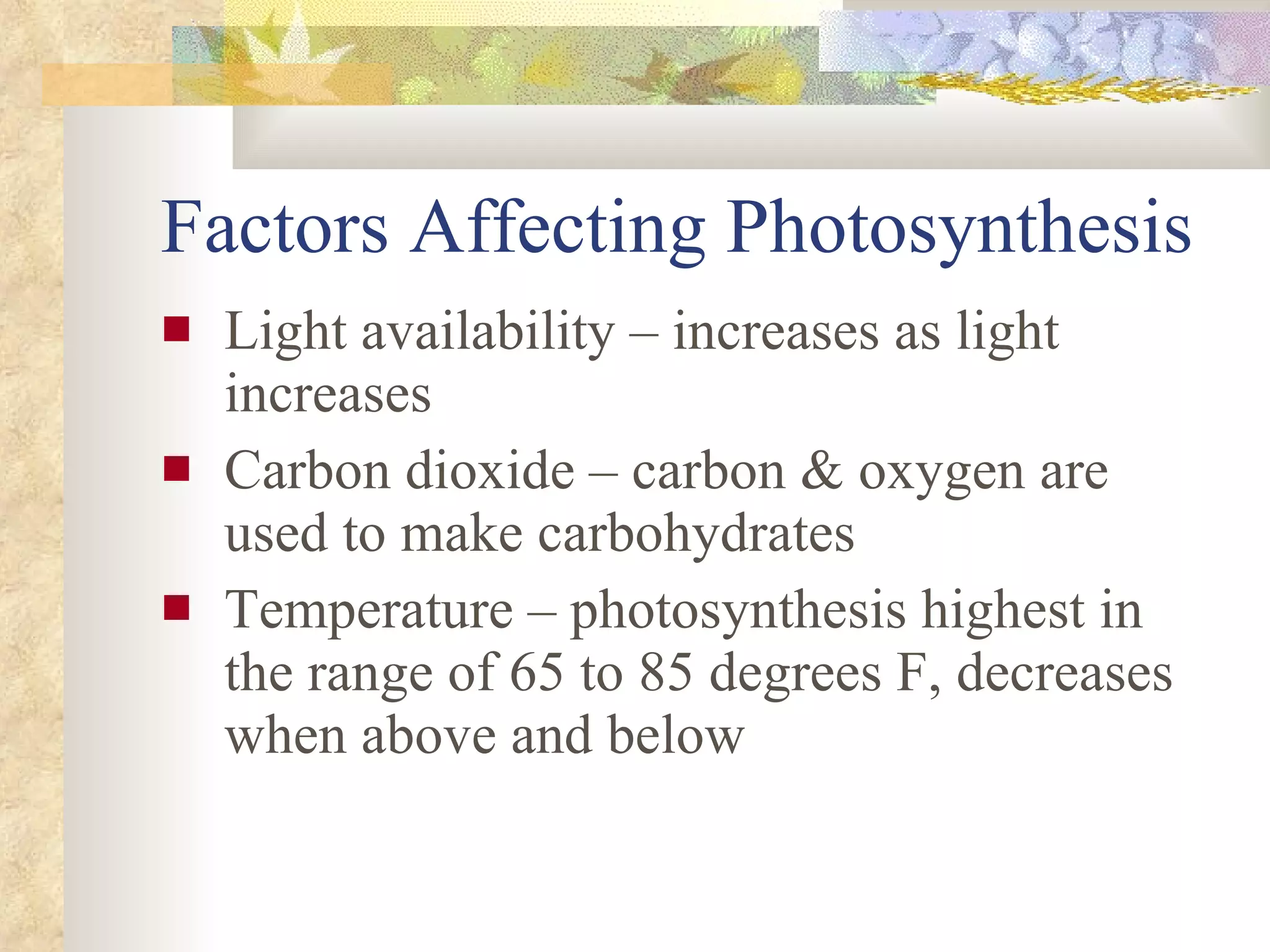
Factors Affecting Photosynthesis Light availability – increases as light increases Carbon dioxide – carbon & oxygen are used to make carbohydrates Temperature – photosynthesis highest in the range of 65 to 85 degrees F, decreases when above and below
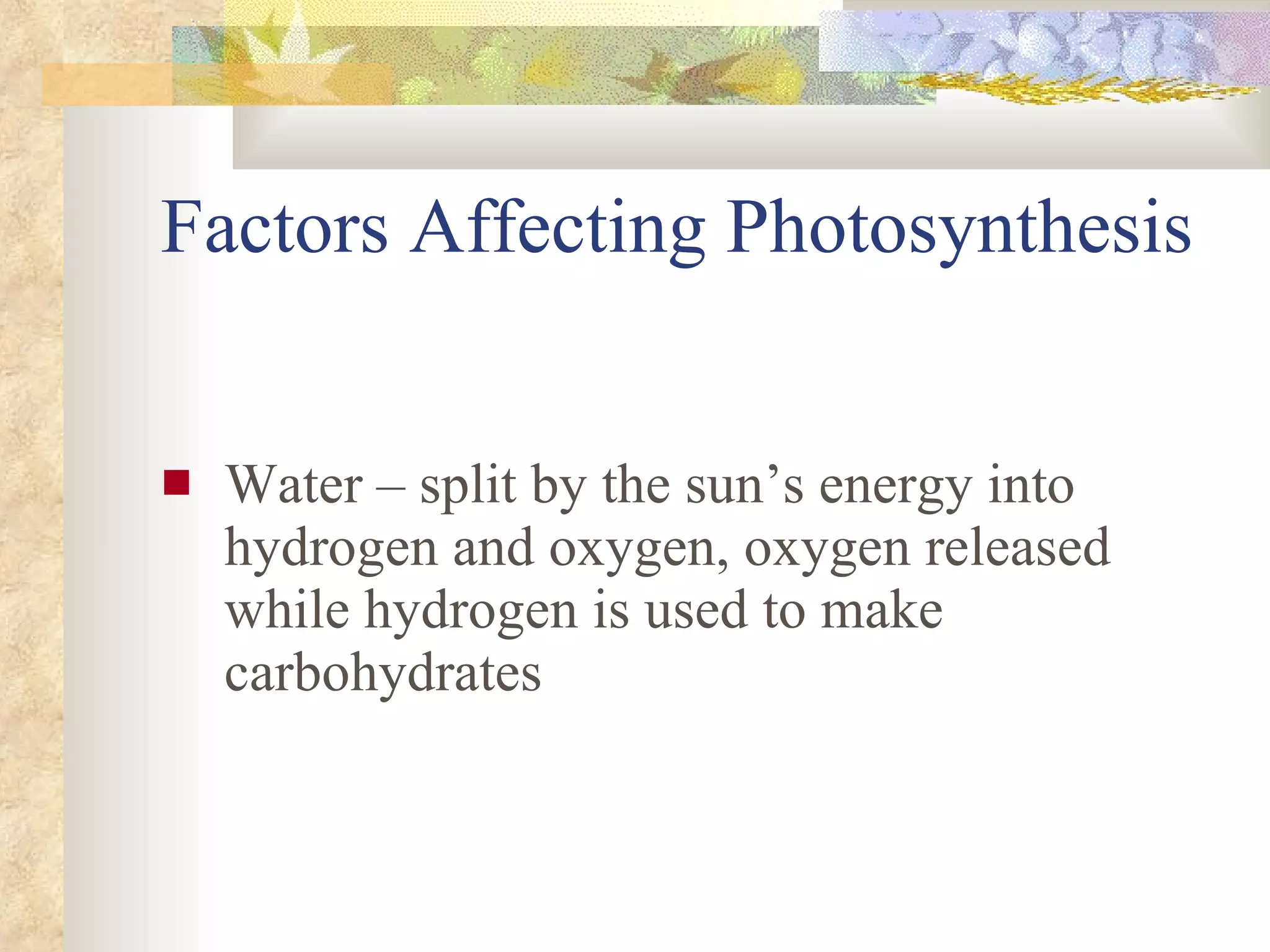
Factors Affecting Photosynthesis Water – split by the sun’s energy into hydrogen and oxygen, oxygen released while hydrogen is used to make carbohydrates
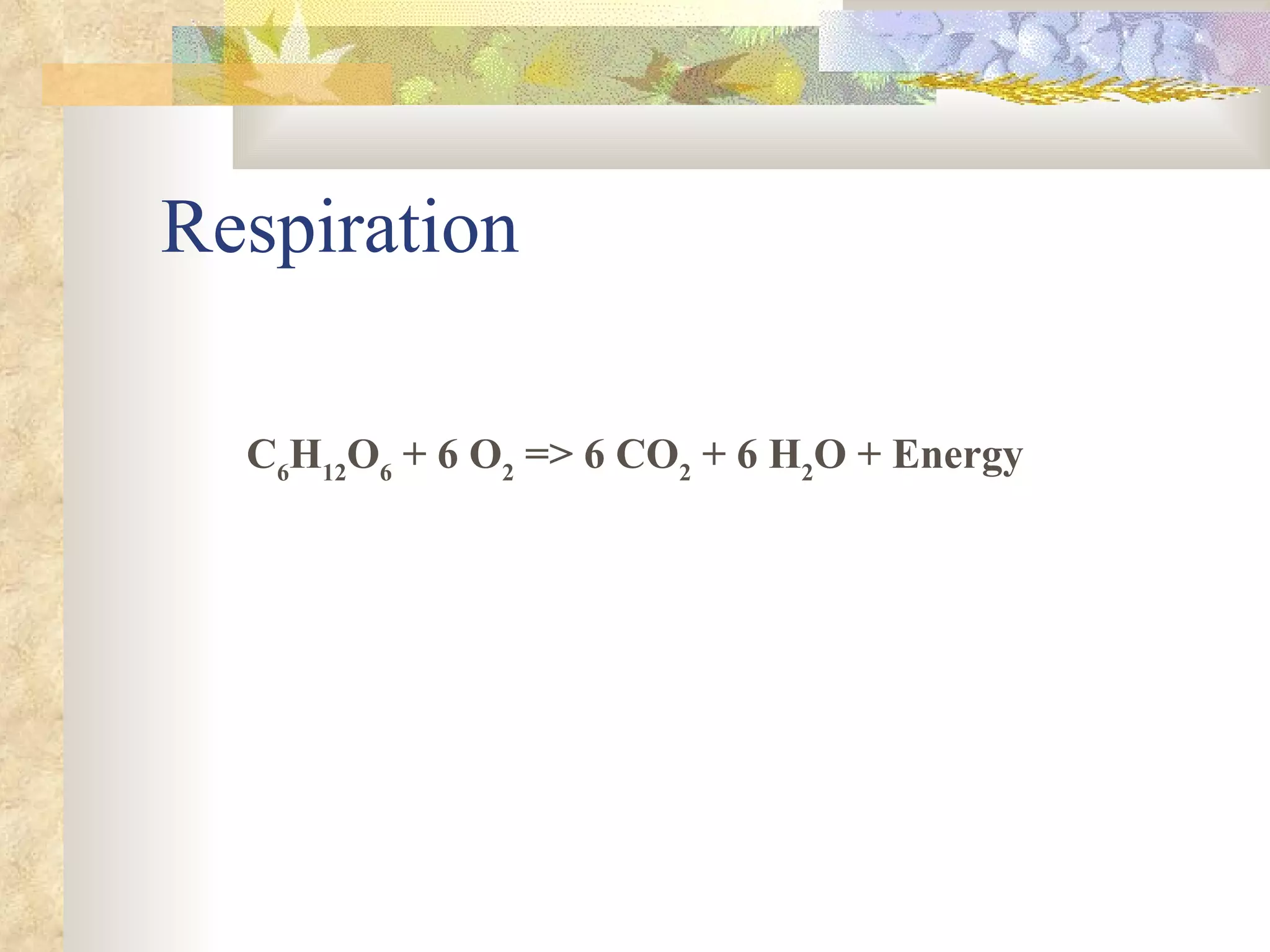
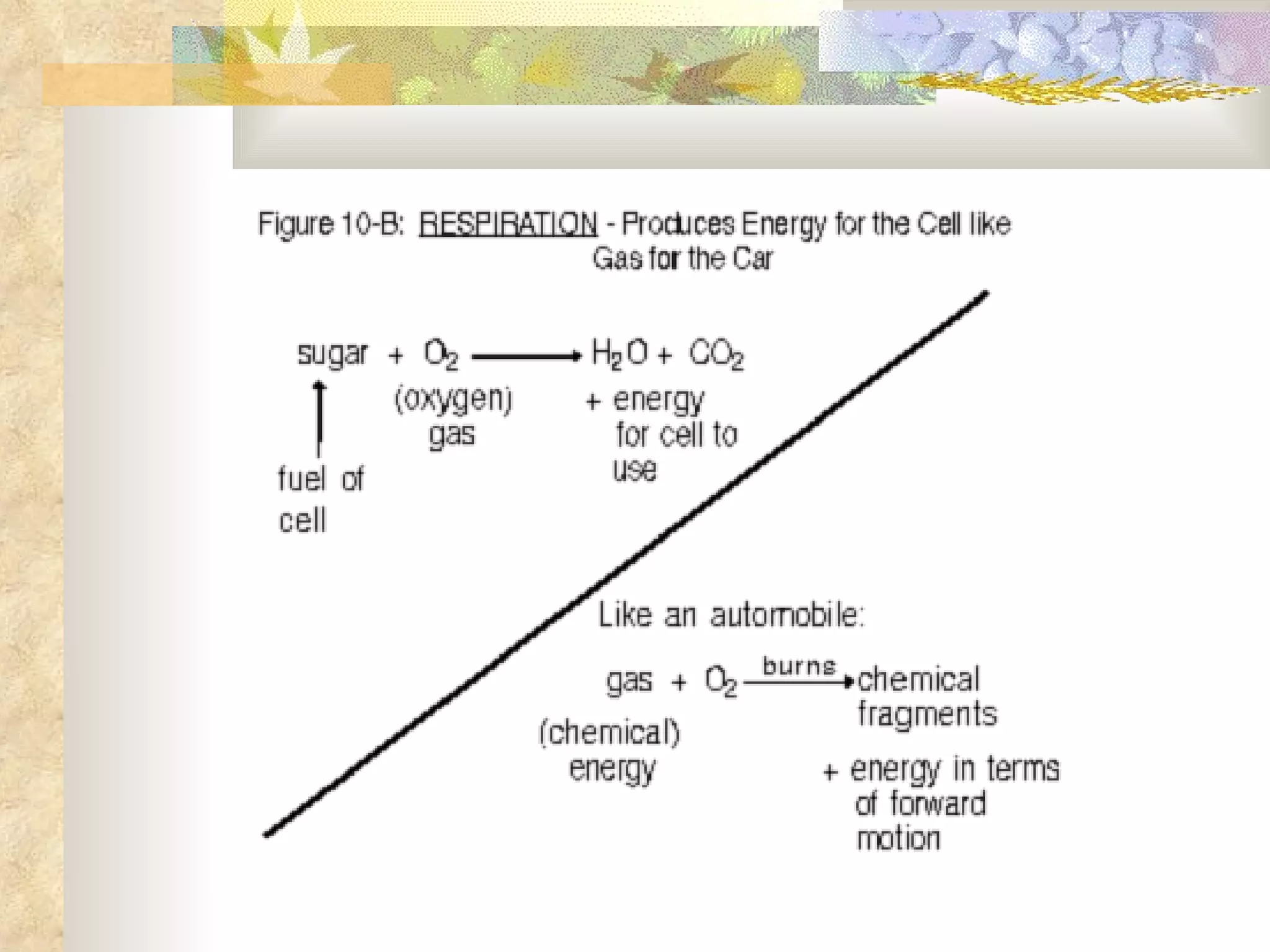
Respiration C 6 H 12 O 6  + 6 O 2  => 6 CO 2  + 6 H 2 O + Energy
 
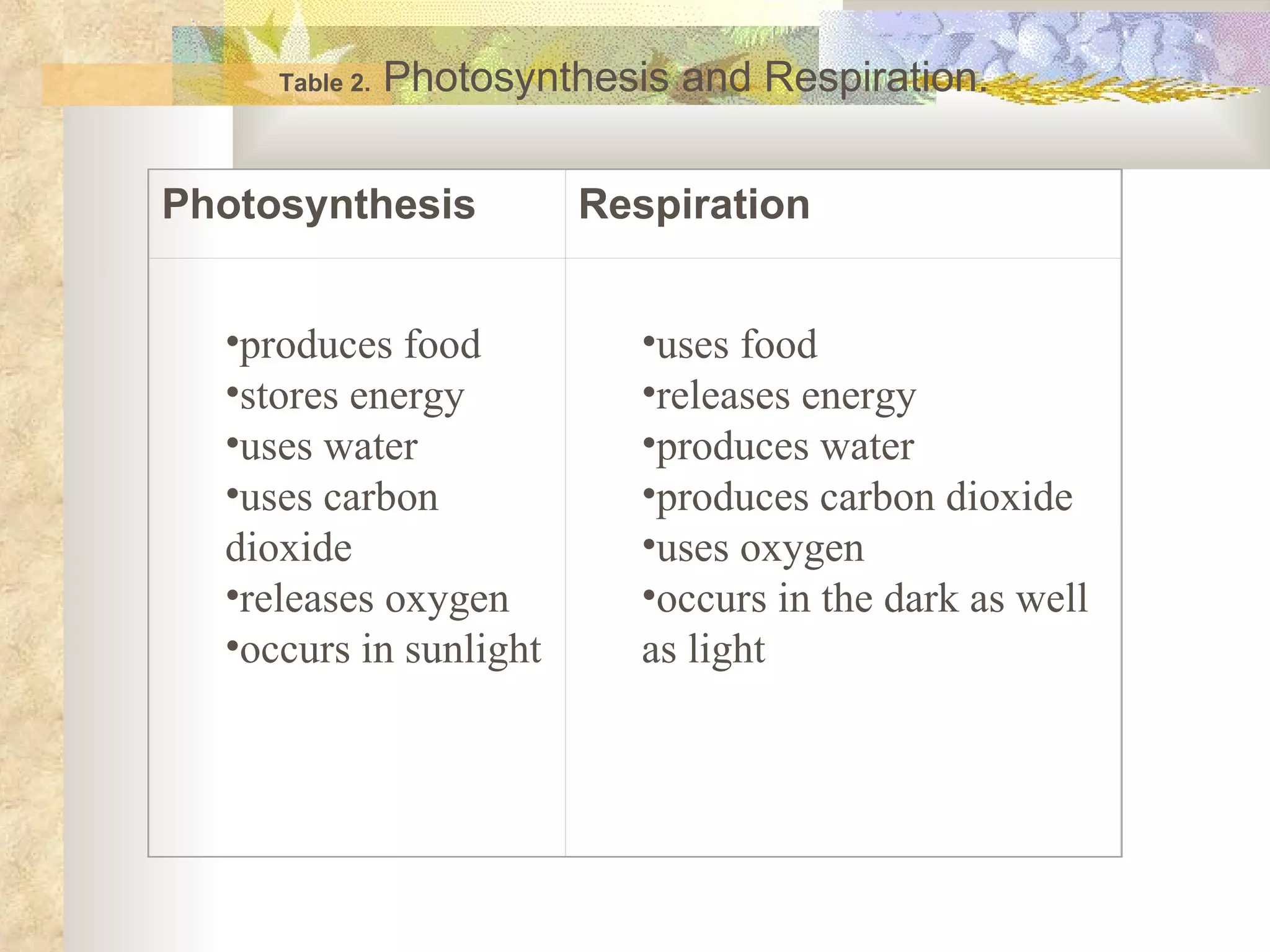
    Table 2.  Photosynthesis and Respiration. Photosynthesis Respiration produces food  stores energy  uses water  uses carbon dioxide  releases oxygen  occurs in sunlight  uses food  releases energy  produces water  produces carbon dioxide  uses oxygen  occurs in the dark as well as light
 
 
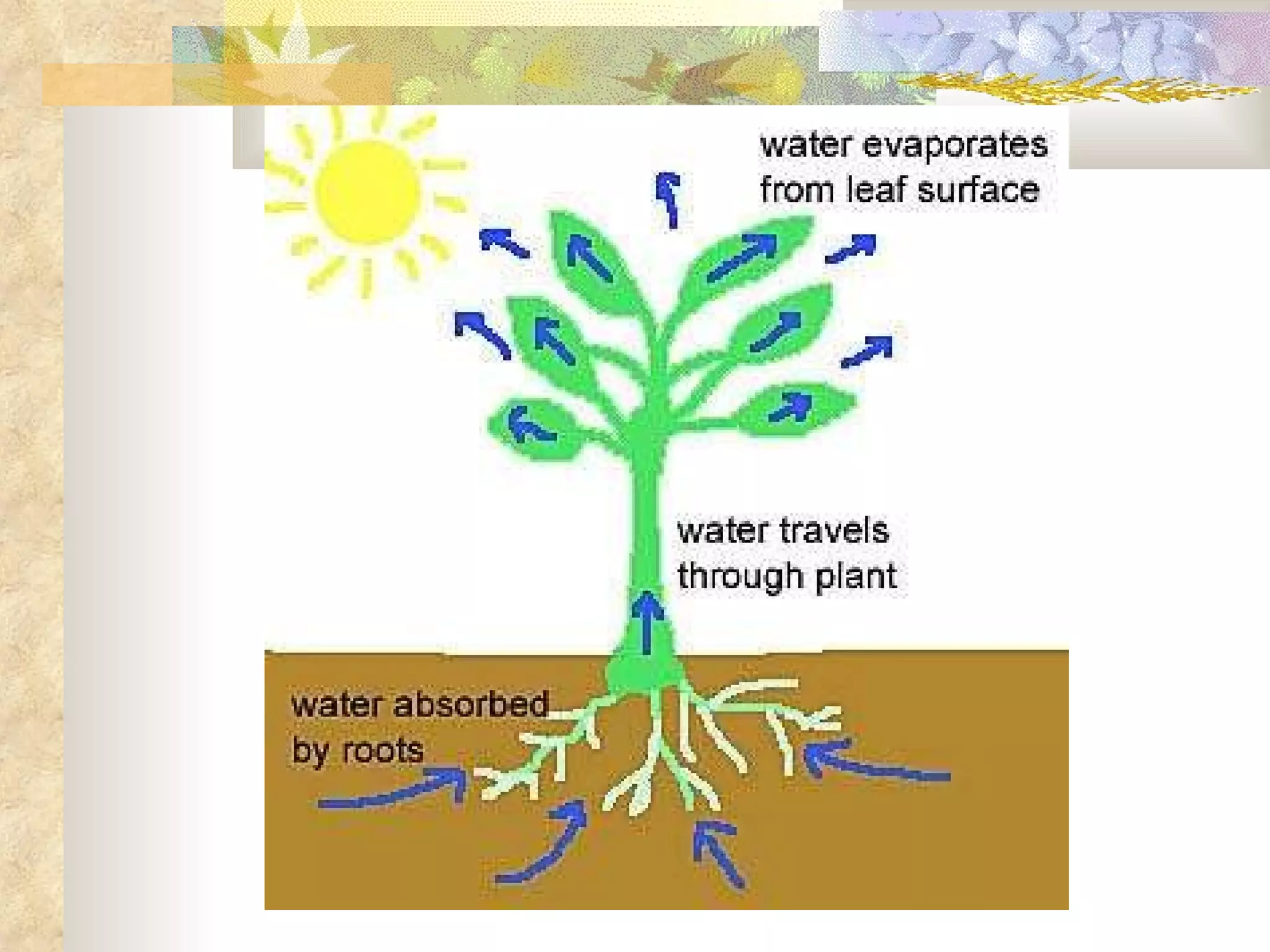
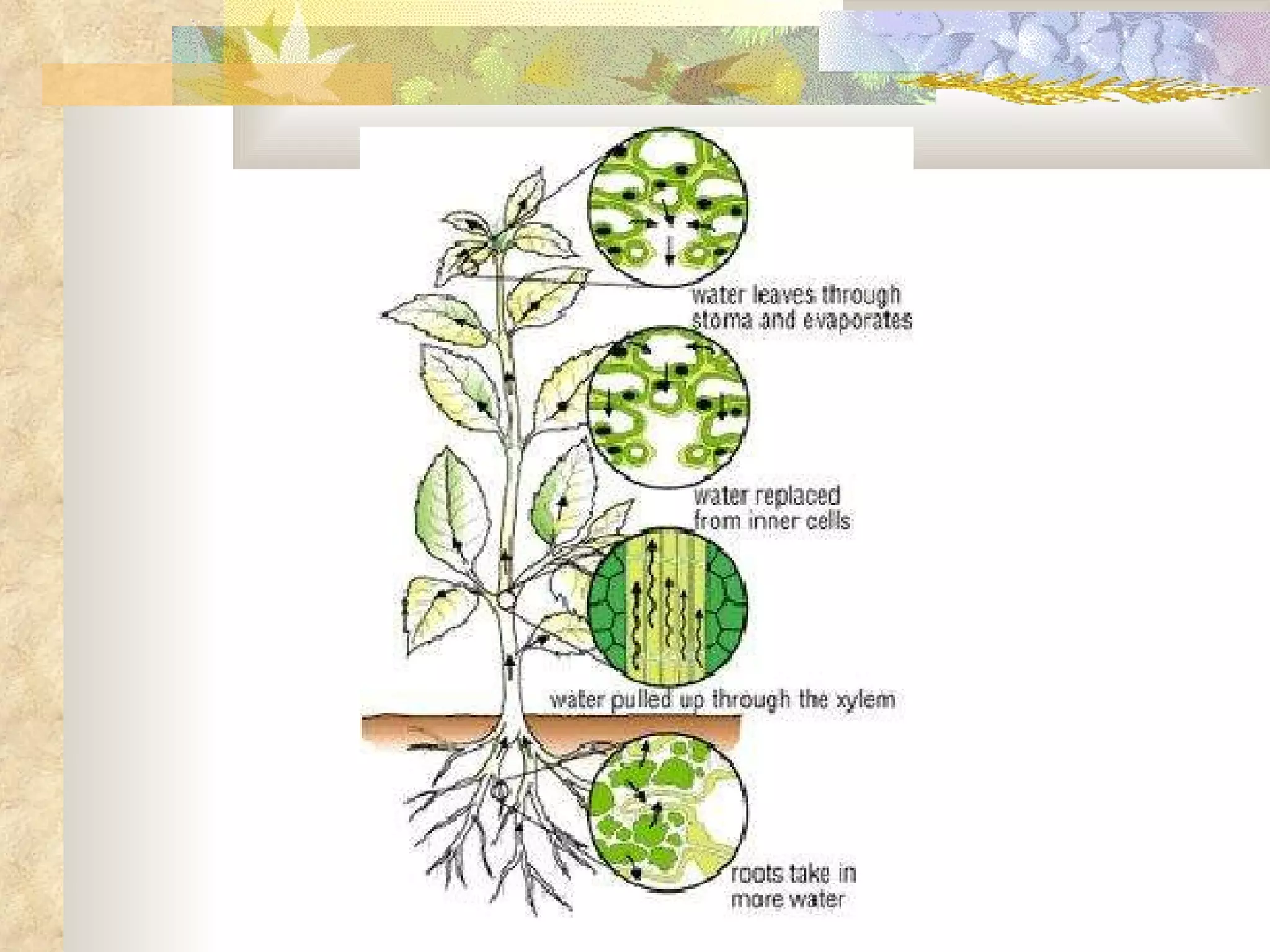
Transpiration is responsible for: Transporting minerals from the soil throughout the plant.  Cooling the plant through evaporation.  Moving sugars and plant chemicals.  Maintaining turgor pressure.
 
 
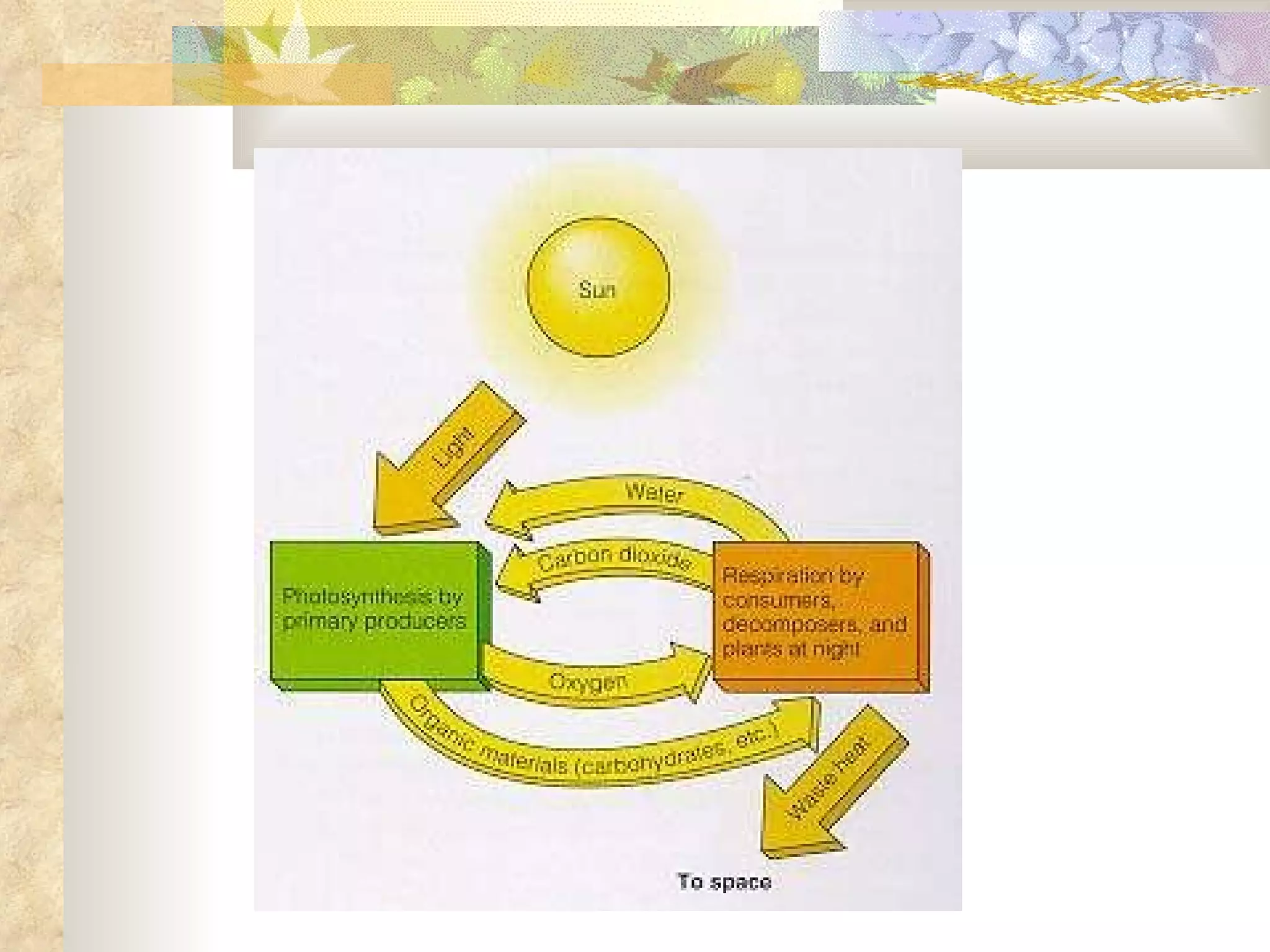
Photosynthesis, Respiration and Transpiration Work Together
Environmental Factors That Affect Plant Growth Light  Temperature Water
Light Quantity  – concentration of sunlight, varies with season. How can you decrease it? Quality  – color reaching the plant. Red & blue have greatest effect on growth, green is reflected. Blue light = leaf growth; Blue light + red light = flowering. What light do you want for seedlings?
Light (cont.) Duration  – Amount of time a plant is exposed to light. Plants flower in response to uninterrupted dark periods. Plants are classified as either Short-day or long-day or Day-neutral.
Light (cont.) Short-day plants – form flowers when day length is less than 12 hours in duration. Mums & Pointsettia Long-day plants – form flowers when day length exceed 12 hours. Lettuce & Rudbekia  Day-neutral plants – form flowers regardless of day length.  Petunia
Temperature If temperature is high and day length long cool season crops will bolt. If temperatures are too low then warm season crops may not set fruit. Adverse temperatures will cause stunted growth and poor quality, i.e. bitter lettuce in high temperature.
Temperature Effects on Plant Growth Photosynthesis – increase with temp to a point Respiration – rapidly increase with temp Transpiration – increase with temp  Flowering – partially triggered by temp Sugar storage – low temp reduce energy use increase sugar storage Dormancy – warmth will break dormancy
Water  Maintains turgor pressure which regulates the opening and closing of the stoma. Stoma are involved in the gradual evaporation of water from the leaf surface which help stabilize the plant temperature.
Relative Humidity The water in the air divided by the amount of water the air can hold (at constant temperature and pressure).
Relative Humidity Warm air can hold more water so if water amount remains the same and temps go up then relative humidity goes down. Water vapor will move from an area of high humidity to one of low humidity. Humidity inside a leaf is close to 100% When stoma opens the water vapor rushes out causing the humidity on leaf surface to go up.
Relative Humidity (Cont.) The “cloud” of humidity slows down transpiration and cools the leaf. What happens to transpiration if the wind starts to blow?
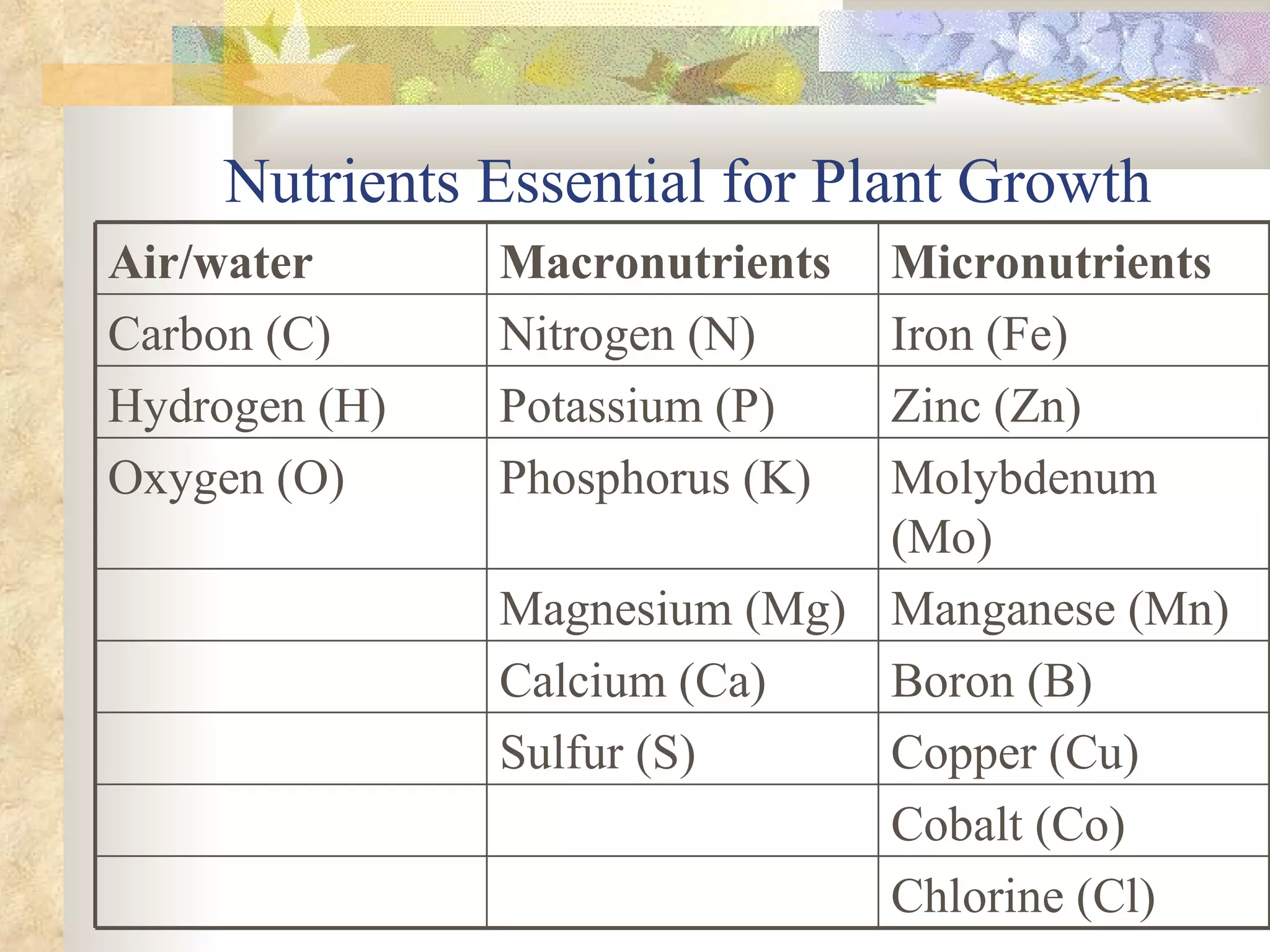
Nutrients Essential for Plant Growth Chlorine (Cl) Cobalt (Co) Copper (Cu) Sulfur (S) Boron (B) Calcium (Ca) Manganese (Mn) Magnesium (Mg) Molybdenum (Mo) Phosphorus (K) Oxygen (O) Zinc (Zn) Potassium (P) Hydrogen (H) Iron (Fe) Nitrogen (N) Carbon (C) Micronutrients Macronutrients Air/water

Botany 101b

  • 1.
    Warren County MasterGardener Class Botany 101 Carol La Faver CEA for Horticulture—Warren County
  • 2.
  • 3.
  • 4.
  • 5.
    When Is aTree a Tree?
  • 6.
    Tree A woodyperennial plant having a single usually elongate stem generally with few or no branches on its lower part.
  • 7.
    Shrub A lowusually several stemmed woody plant.
  • 8.
    Herb A seed-producing,biennial, or perennial that does not develop persistent woody tissue but dies down at the end of a growing season.
  • 9.
    Plants Have TwoParts Sexual Flower Buds Flowers Fruit Seeds Vegetative Leaves Leaf Buds Roots Stems
  • 10.
    Stems Structures whichsupport buds and leaves and serves as conduits for carrying water, minerals and sugars
  • 11.
    Three Major InternalParts of Stems Xylem – conduct water and minerals Phloem – conduct sugars Cambium – a meristem, the site of cell division and active growth, located between the xylem and phloem
  • 12.
        Table 1. Comparison between monocots and dicots.   Structure   Monocot   Dicot   Seed leaves   1   2   Vascular system Xylem and phloem are paired in bundles, which are dispersed throughout the stem. Xylem and phloem inside the stem. The ring of phloem is near the bark; the xylem forms the inner ring.   Floral parts Usually in multiples of three. Usually in multiples of four or five.   Leaves Often parallel-veined. Usually net-veined
  • 13.
  • 14.
  • 15.
  • 16.
  • 17.
  • 18.
    Node and InternodeA node is the area of stem where leaves are located. An internode is the area of a stem between the nodes.
  • 19.
    Modified Stems Crown– compressed stem tissue Runner – stem that grows on the soil surface What is an example of a plant that has both of these “stems”? Strawberry
  • 20.
    Modified Stems (cont.)Spurs – Short stubby side stems. Stolon – aboveground horizontal stem Tuber – the eyes are the nodes of the “stem”
  • 21.
    Modified Stems (cont.)Rhizomes – Underground horizontal stem, i.e. iris, johnsongrass. Bulbs – Compressed underground stems surrounded by fleshy leaves, i.e. tulips, daffodils,lilies, and onions.
  • 22.
    Modified Stems (cont.)Corms – Similar to bulbs but do not have fleshy scales Tuberous Stems – shortened, flattened, enlarged and underground, i.e. tuberous begonia
  • 23.
    Tuberous Root Nota stem but an underground storage organ Stems have nodes but roots do not.
  • 24.
    Stem Terminology  -Shoot - A young stem (1 year old or less) with leaves. Twig - A young stem (1 year old or less) that is in the dormant winter stage (has no leaves). Branch - A stem that is more than 1 year old, typically with lateral stems radiating from it. Trunk - A woody plant's main stem.
  • 25.
    Vines Attach byTwining Morning glory
  • 26.
    Vines Attach byAerial Roots Poison Ivy
  • 27.
    Vines Attach bytendrils Some wrap around and some with adhesive pads Virginia Creeper
  • 28.
  • 29.
  • 30.
  • 31.
    Parts of aLeaf Blade Midrib Vein Petiole
  • 32.
    Leaf Facts Principlefunction of leaves is to absorb sunlight for photosynthesis What are leaves flat? (except conifers) Petiole is attached to the stem at a node Angle between the petiole and the stem is the leaf axil Buds are located in the leaf axil
  • 33.
    Leaf Facts (cont.)Epidermis – thickened layer on top & bottom of leaf Primary function is leaf protection Some epidermis cells have hairs
  • 34.
    Leaf Facts (cont.)Cuticle has a waxy substance called cutin Protects the leaf from dehydration and disease The amount of cutin is direct response to sunlight What does this have to do with hardening a plant off?
  • 35.
    Leaf Facts (cont.)Guard cells on the underside of leaf can open and close The opening is a stoma Allows for the passage of water, oxygen, and carbon dioxide
  • 36.
    Leaf Facts (cont.)Weather determines the opening and closing of the guard cells Guard cells will close during darkness
  • 37.
  • 38.
    Leaf Types Cotyledonsor seed leaves Spines Scale leaves Tendrils succulent storage leaves Bracts -- Dogwood
  • 39.
    Leaf Venation –Parallel, Pinnate, and Palmate
  • 40.
    Shapes of Leaves– Simple, Palmate Compound, Pinnate Compound, & Double Pinnate Compound
  • 41.
    Shape of LeafBlade – Oblong, Lanceolate, Linear, Ovate, Elliptical, Orbicular, Cordate
  • 42.
    Shape of LeafBase - Hastate, Sagittate, Peltate, Perfoliate,Terete
  • 43.
    Leaf Margin – Entire, Serrate, Serrulate, Dentate, Undulate, Crisped, Pinnatifid
  • 44.
    Leaf Arrangement onStem Alternate Opposite Whorled
  • 45.
    A Bud Isan Undeveloped Shoot Leaf bud – short stem with embryonic leaves, less plump and more pointed than flower buds Flower bud – a short stem with embryonic flower parts
  • 46.
    Types of BudsTerminal bud - at end of stem Lateral bud - on the sides of stem Axillary bud - in axis of leaf Adventitious bud – i.e. on root or edge of leaf
  • 47.
    Roots Originatefrom lower part of plant or cutting Have a root cap, no nodes, and never have leaves or flowers
  • 48.
    Principle Functions ofRoots Absorb nutrients and moisture Anchor the plant in the soil Furnish physical support of the stem Serve as food storage organs May be used as a means of propagation
  • 49.
    Types of RootsPrimary (radicle) root from embryo Taproot Lateral or secondary root Fibrous root
  • 50.
    Parts of aRoot Meristem- area of cell division and growth Zone of elongation – cells increase in size, push root through soil Maturation zone – become specific tissue, i.e. epidermis, vascular tissue
  • 51.
    Parts of aRoot Root hairs – water & nutrient absorption Root cap – covers and protects the meristem
  • 52.
  • 53.
    What Does ThisPicture Tell You?
  • 54.
    Parts of aFlower Sepals – leaf-like structures at base of flower for protection Petals – highly colored often fragrant Petals are often used for ID of plant family Nectar glands
  • 55.
    Parts of aFlower (cont.) Stamen – male reproductive organ consisting of anther and filament Pistil – female part of the plant. It consists of stigma, style, ovary, ovules and eggs
  • 56.
    Types of FlowersComplete flower – has stamen, pistils, petals, and sepals Incomplete flower- has one of these parts missing
  • 57.
    Types of FlowersPerfect flower – has functional stamens & pistils Imperfect flower – if either pistil or stamen is missing
  • 58.
    Types of FlowersPistillate or female flowers have no stamen Staminate or male flowers have no pistils
  • 59.
    Types of PlantsDioecious – has only a male or a female flower – Holly, gingko Monecious – plant has both separate male and female flowers - corn
  • 60.
    Inflorescence – Spike, Panicle, Raceme, Head, Umbel
  • 61.
  • 62.
    Types of FruitSimple – develop from a single ovary Aggregate – develop from a single flower which has many ovaries Multiple – tight cluster of individual flowers borne on a single cluster
  • 63.
  • 64.
    Parts of aSeed (a Mature Ovule) Embryo – a miniature plant in an arrested state of development Endosperm – built in food supply Seed Coat – hard outer covering to protect seed
  • 65.
    Germination The resumptionof active embryo growth Radicle (root) emerges first Hypocotyl – area between the first leaves and root (stem) Seed leaves encase the embryo
  • 66.
    The Three MajorPlant Functions Photosynthesis – food production Respiration – uses food for plant energy Transpiration – process for moving/losing water
  • 67.
    Photosynthesis Carbon dioxide+ Water + Sunlight = Sugar + Oxygen or 6 CO 2 + 6 H 2 0 + Energy => C 6 H 12 0 6 + 6 0 2
  • 68.
  • 69.
  • 70.
    Factors Affecting PhotosynthesisLight availability – increases as light increases Carbon dioxide – carbon & oxygen are used to make carbohydrates Temperature – photosynthesis highest in the range of 65 to 85 degrees F, decreases when above and below
  • 71.
    Factors Affecting PhotosynthesisWater – split by the sun’s energy into hydrogen and oxygen, oxygen released while hydrogen is used to make carbohydrates
  • 72.
    Respiration C 6H 12 O 6 + 6 O 2 => 6 CO 2 + 6 H 2 O + Energy
  • 73.
  • 74.
        Table 2. Photosynthesis and Respiration. Photosynthesis Respiration produces food stores energy uses water uses carbon dioxide releases oxygen occurs in sunlight uses food releases energy produces water produces carbon dioxide uses oxygen occurs in the dark as well as light
  • 75.
  • 76.
  • 77.
    Transpiration is responsiblefor: Transporting minerals from the soil throughout the plant. Cooling the plant through evaporation. Moving sugars and plant chemicals. Maintaining turgor pressure.
  • 78.
  • 79.
  • 80.
    Photosynthesis, Respiration andTranspiration Work Together
  • 81.
    Environmental Factors ThatAffect Plant Growth Light Temperature Water
  • 82.
    Light Quantity – concentration of sunlight, varies with season. How can you decrease it? Quality – color reaching the plant. Red & blue have greatest effect on growth, green is reflected. Blue light = leaf growth; Blue light + red light = flowering. What light do you want for seedlings?
  • 83.
    Light (cont.) Duration – Amount of time a plant is exposed to light. Plants flower in response to uninterrupted dark periods. Plants are classified as either Short-day or long-day or Day-neutral.
  • 84.
    Light (cont.) Short-dayplants – form flowers when day length is less than 12 hours in duration. Mums & Pointsettia Long-day plants – form flowers when day length exceed 12 hours. Lettuce & Rudbekia Day-neutral plants – form flowers regardless of day length. Petunia
  • 85.
    Temperature If temperatureis high and day length long cool season crops will bolt. If temperatures are too low then warm season crops may not set fruit. Adverse temperatures will cause stunted growth and poor quality, i.e. bitter lettuce in high temperature.
  • 86.
    Temperature Effects onPlant Growth Photosynthesis – increase with temp to a point Respiration – rapidly increase with temp Transpiration – increase with temp Flowering – partially triggered by temp Sugar storage – low temp reduce energy use increase sugar storage Dormancy – warmth will break dormancy
  • 87.
    Water Maintainsturgor pressure which regulates the opening and closing of the stoma. Stoma are involved in the gradual evaporation of water from the leaf surface which help stabilize the plant temperature.
  • 88.
    Relative Humidity Thewater in the air divided by the amount of water the air can hold (at constant temperature and pressure).
  • 89.
    Relative Humidity Warmair can hold more water so if water amount remains the same and temps go up then relative humidity goes down. Water vapor will move from an area of high humidity to one of low humidity. Humidity inside a leaf is close to 100% When stoma opens the water vapor rushes out causing the humidity on leaf surface to go up.
  • 90.
    Relative Humidity (Cont.)The “cloud” of humidity slows down transpiration and cools the leaf. What happens to transpiration if the wind starts to blow?
  • 91.
    Nutrients Essential forPlant Growth Chlorine (Cl) Cobalt (Co) Copper (Cu) Sulfur (S) Boron (B) Calcium (Ca) Manganese (Mn) Magnesium (Mg) Molybdenum (Mo) Phosphorus (K) Oxygen (O) Zinc (Zn) Potassium (P) Hydrogen (H) Iron (Fe) Nitrogen (N) Carbon (C) Micronutrients Macronutrients Air/water

Editor's Notes

  • #10 Vegetative parts can be used in asexual reproduction.