
KINGDOM PLANTAE
CHAPTER-3
 GENERAL CHARACTERISTICS
 Multicellular organisms with walled and frequently
vacuolate eukaryotic cells.
 They contain photosynthetic pigments in plastids.
 Principle mode of nutrition is Photosynthesis, but number of
plants have become absorptive.
 Primarily non-motile, living anchored to a substrate.
 Reproduction is sexual.
 Haploid generation is progressively reduced in higher
members of kingdom.
PLANTAE
CRYPTOGAMEA
THALLOPHYTA
BRYOPHYTA
PTERIDOPHYTA
PHANEROGAMAE
GYMNOSPERMS
ANGIOSPERMS
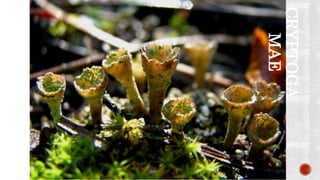
CRYPTOGA
MAE
 They contain chloroplasts.
 They are autotrophic.
 They are aquatic or semi-aquatic.
 The sex organs are usually unicellular and non-jacketed.
 Sporophytic and gametophytic stages are independent.
 Vascular tissue absent.
 Dominating plant phase is gametophytic.
 They are supplied by nutrients by surrounding water.
 They do not need vascular tissue.
 Water keeps the algae buoyant, they do not need
mechanical support tissue like sclerenchyma.
 Due to their flexible nature, tides and current fail to
tear and injure them.
 Water is suitable medium for fusion of gametes
during sexual reproduction. Aquatic conditions also
help in dispersal of asexual spores.
Division Storage
product
Flagellation Photosynthetic
apparatus
Cell wall
Chlorophyta
(Green algae)
Starch 1 or 2 equal,
anterior
Chloroplast with
2-6 thylakoids in a
band. Pyrenoids
with starch sheath
Cellulose
Phaeophyta
(Brown algae)
Lamanarin,
Mannitol &
Leucosin
2, unequal
lateral
Like Xanthophyta,
pyrenoids naked
and projecting
Cellulosic
with alginic
and fucinic
acids
Rhodophyta
(Red algae)
Floridean
Starch
Absent Chromatophores
with single and
widely separated
thylakoids, naked
pyreonid
Non-
cellulosic
polysacchari
des or with
xylem,
galactose
and xylose
 Wide variety of habitat from salt water to freshwater.
 Some are found in snow or in association with fungi to
form lichen.
 Some are epizoic such as Zoochlorella are associated with
animals as shells of molluscs, sponges etc.
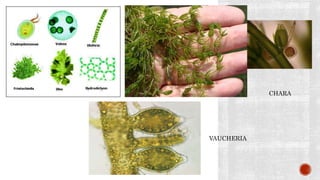
 They exhibit variety in form and shape
 Unicellular motile forms eg: Chlamydomonas
 Unicelluar non-motile forms eg : Chlorella
 Colonial motile forms eg : Volvox, Pandorina
 Colonial coccoid forms eg : Hydrodictyon
 Colonial palmellate forms eg : Tetraspora
 Filamentous forms
Unbranched : Ulothrix, Spirogyra
Branched : Cladophora
 Heterotrichous : Coleochaete
 Foliaeous or parenchymatous : Ulva
 Umbrella like : Acetabularia
 Siphanaceous : Vaucheria
CHARA
VAUCHERIA
 The photosynthetic pigments present are chlorophyll a
& b and the yellow pigment carotene & Xanthophyll.
 Cell wall is two layered, Inner layer is Cellulose while
the outer layer is Pectone.
 Many green algae bear Pyrenoids.
 They have a well defined nucleus like eukaryotes.
 They reproduce by asexual and sexual methods.
 Asexual method is by Zoospores, Aplanospores,
Hypnospores and Akinetes.
 Sexual reproduction takes place by gametes formation.
The gametes are similar to zoospores.
 Sexual reproduction may be Isogamous, Anisogamous or
Oogamous type.
 After syngamy, a diploid zygote develops a thick wall to
form Zygospore, which undergo meiosis to finally
produce plant body
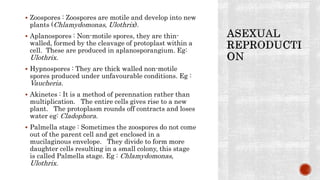
 Zoospores : Zoospores are motile and develop into new
plants (Chlamydomonas, Ulothrix).
 Aplanospores : Non-motile spores, they are thin-
walled, formed by the cleavage of protoplast within a
cell. These are produced in aplanosporangium. Eg:
Ulothrix.
 Hypnospores : They are thick walled non-motile
spores produced under unfavourable conditions. Eg :
Vaucheria.
 Akinetes : It is a method of perennation rather than
multiplication. The entire cells gives rise to a new
plant. The protoplasm rounds off contracts and loses
water eg: Cladophora.
 Palmella stage : Sometimes the zoospores do not come
out of the parent cell and get enclosed in a
mucilaginous envelope. They divide to form more
daughter cells resulting in a small colony, this stage
is called Palmella stage. Eg : Chlamydomonas,
Ulothrix.
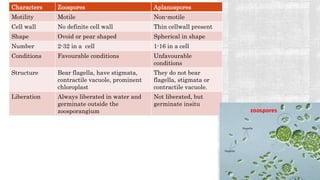
Characters Zoospores Aplanospores
Motility Motile Non-motile
Cell wall No definite cell wall Thin cellwall present
Shape Ovoid or pear shaped Spherical in shape
Number 2-32 in a cell 1-16 in a cell
Conditions Favourable conditions Unfavourable
conditions
Structure Bear flagella, have stigmata,
contractile vacuole, prominent
chloroplast
They do not bear
flagella, stigmata or
contractile vacuole.
Liberation Always liberated in water and
germinate outside the
zoosporangium
Not liberated, but
germinate insitu
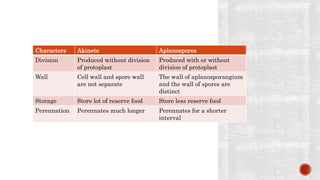
Characters Akinete Aplanospores
Division Produced without division
of protoplast
Produced with or without
division of protoplast
Wall Cell wall and spore wall
are not separate
The wall of aplanosporangium
and the wall of spores are
distinct
Storage Store lot of reserve food Store less reserve food
Perennation Perennates much longer Perennates for a shorter
interval
Characters Aplanospore Hypnospore
Cell wall Cell wall is thin Cell wall is thicker
Perennation Perennate for a short
period
Perennate for longer
period
Number Produced very
commonly
Produced less
commonly
KINGDOM GROUP PIGMENTS STORAGE
FOOD
COMPLEXITY &
STRUCTURE
PLANTAE RED ALGAE CHLOROPHYL
L a, d
Phycobilins
(Phycoerythrin
&
Phycocyanin)
Floridean
starch
Unicellular to
Multicellular
PLANTAE BROWN
ALGAE
CHLOROPHYL
L a + c
Carotenoids,
Fucoxanthin
Lipid,
laminarin,
Mannitol
Multicellular
PLANTAE GREEN
ALGAE
CHLOROPHYL
L a + b
ß-Carotene &
Carotenoids
Starch Unicellular to
Multicellular
PIGMENTS, STORAGE FOOD AND COMPLEXITY OF
THALLUS IN KINGDOM PLANTAE
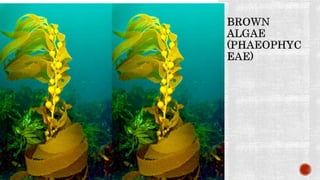
 No unicellular algae is reported in Phaeophyceae, the
size range up to giant kelps o f 60-70 meters in
length.
 They are brownish green sea weeds that cover the
rocks in the tidal zone and extend out in water 15
meters deep.
 The pigments present are Chlorophyll a & c, and the
brown pigment fucoxanthin. Fucoxanthin masks all
the other pigments.
 On the cellulose cell wall, there is a covering of
Phycocolloids (alginic acid). Phycocolloids are
responsible for :
 Protecting the brown algae from drying or freezing on
their exposure to air
 Protecting the brown algae from mechanical waves
which beat them with rocks.
 Alginic acid is constitutent of Phycocolloid in the cell
walls of brown algae.
 Some members are Fucus, Ectocarpus, Nereocystis,
Macrocystis, Laminaria, Alaria, Sargassum natans.
 Laminaria is attached with rocks in sea firmly by its holdfast. The
lamina is photosynthetic & stipe is equal to stem of higher land
plants.
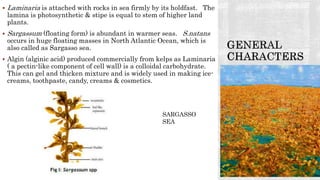
 Sargassum (floating form) is abundant in warmer seas. S.natans
occurs in huge floating masses in North Atlantic Ocean, which is
also called as Sargasso sea.
 Algin (alginic acid) produced commercially from kelps as Laminaria
( a pectin-like component of cell wall) is a colloidal carbohydrate.
This can gel and thicken mixture and is widely used in making ice-
creams, toothpaste, candy, creams & cosmetics.
SARGASSO
SEA
 Asexual reproduction is common in brown algae and is affected by
fragmentation of the thallus. The fragments either remain
attached to the substratum or float away and give rise to new
individuals.
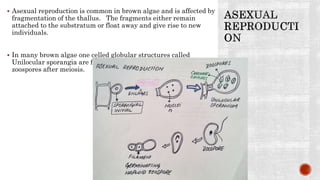
 In many brown algae one celled globular structures called
Unilocular sporangia are formed which produce biflagellate
zoospores after meiosis.
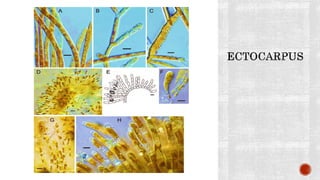
 In Ectocarpus, multilocular ellipsoidal structures called
pleurilouclar sporangia are produced which produce zoospores
but without meiosis.
 In Dictyota non-motile tetraspores are produced in unilocular
tetrasporangia. The haploid tetraspores produced by meiosis
give rise to male and female plants
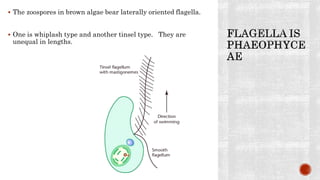
 The zoospores in brown algae bear laterally oriented flagella.
 One is whiplash type and another tinsel type. They are
unequal in lengths.
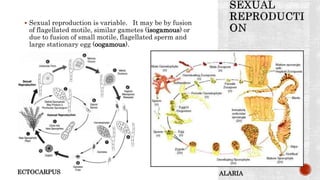
 Sexual reproduction is variable. It may be by fusion
of flagellated motile, similar gametes (isogamous) or
due to fusion of small motile, flagellated sperm and
large stationary egg (oogamous).
ECTOCARPUS ALARIA
 Size ranges form unicellular to half a meter in length.
 The photosynthetic pigments are biliproteins
(Phycoerythrin & Phycocyanin) along with
chlorophyll & carotenoid tetraxanthin.
 The coralline red algae accumulate calcium from the
sea water and deposit if in their bodies as calcium
carbonate.
 The reserve food material is usually floridean starch
and galactoside floridoside outside the chromatophore
in cytoplasm.
 Flagellated cells are lacking altogether in red algae.
 Cell wall in red algae is made up of Polysulphate
esters along with pectic materials, cellulose is also
present in the cell wall.
 Members of Rhodophyceae include Polysiphonia,
Porphyra, Chondrus, Grinellia.
 It occurs by both sexual and asexual methods. The spores
are non-motile.
 Sexual reproduction is highly specialised. Male gametes
are non-motile and called spermatia.
 Spermatia are carried by water current to elongated tip
trichogyne of female sex organ called carpogonium.
 After fertilization, carpospores are produced Eg:
Porphyra, Batrachospermum & Polysiphonia.
 Some red aglae like Harveyella is found as parasite on
other autotrophic photosynthesizing red algae.
POLYSIPHONIA
CYSTOCAR
P
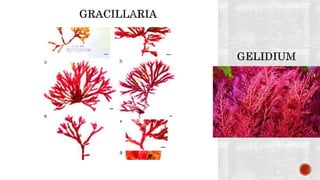
 Red algae like Gelidium and Gracillaria is the source
of agar jelly used in culturing micro-organisms.
 Some Rhodophytes such as Porphyra, Chondrus are
used as vegetables.
 Carragenin from red algae is used in preparation of
chocolate milk.
 Porphyra is used as important ingredient in soups
and also cooked as flavouring agent.
 Chondrus is used in preparation of various
pharmaceuticals including laxatives and comsetics.
 Rhodymenia palmata was used as food at the of
famine in Ireland.
 Algae as food : They form an important source of food for
the fishes and other aquatic animals, people in coastal
areas like China & Japan have used algae for food such as
Chlorella, Porphyra, Ulva, Chondrus, Laminaria, Alaria,
Nostoc, Codium, Rhodymenia etc.
 Algae as Fodder : Many sea weeds such as Ascophyllum,
Fucus, Laminaria, Sargassum and Rhodymenia are used
as fodder for sheep, goats, cattle etc.
 Algae in Industry :
 Agar Agar : It is a jelly like non-nitrogenous product,
extracted from Gelidium, Gracillaria, Chondrus. It is a
complex polysaccharide consisting of agarose & agaropectin
produced & stored in cell wall.
 Agar is used as stabilizer or emulsifier in food stuffs,
cosmetics, medicines, baking, preservation, it is also used as
laxative and in tissue culture medium.
 Carrageenin : It is similar to agar agar, a polysaccharide
esterified with sulphate and found in the cell wall of
Chondrus crispus and Gigartina. It is used as emulsifier in
paints & cosmetics also used in textiles, leather, breweries,
food & pharmaceutical industry.
 Alginate : Salts of alginic acid extracted from the cell wall of
brown algae like Laminaria, Macrocystis, Ascophyllum, Fucus,
Sargassum etc.
 It is a polysaccharide made up of galuronic acid & mannuronic
acid & used as a stabilizer, emulsifier, gelling agent and used in
preparation of soup, jelly, creams, soaps, printing ink etc.
 Diatomite : The fossilized diatoms deposited a sedimentary rock
called diatomaceous earth and is used a s filter, absorbent and
insulator in oil and chemical industry, furnaces, refrigertors,
sound proof rooms, tooth powder etc.
 Mucliage : Extracted from Careragean and Chondrus is used as
stiffening agent in cosmetics, shaving creams, shoepolish,
shampoos etc.
 Algae in Agriculture ;
 Nitrogen fixation : Many blue green algae are known for
nitrogen fixation eg: Nostoc, Anabaena, Calothrix,
Oscillatoria etc.
 Soil reclamation : The barren and alkaline soils can be
reclaimed by inducing growth of blue green algae.
 Soil formation & Conservation : Some algae like Anabaena
help in preventing soil erosion.
 Fertilizers & Manures : Sea weeds are utilized as manures,
they are rich in potassium, phosphorus etc. Blue algae are
rich in Nitrogen & Phosphorus etc.
 Algae in Medicine
 Chlorellin is the first antibiotic obtained from Chlorella
 Agar Agar is used in pills and ointments and also as
laxative.
 Carrageenin is used as blood coagulant.
 Algae in Space research
 Algae are used as source of single cell protein (SCP) by
austronauts. Eg: Chlorella.
Plant kingdom-I

Plant kingdom-I

  • 1.
  • 3.
     GENERAL CHARACTERISTICS Multicellular organisms with walled and frequently vacuolate eukaryotic cells.  They contain photosynthetic pigments in plastids.  Principle mode of nutrition is Photosynthesis, but number of plants have become absorptive.  Primarily non-motile, living anchored to a substrate.  Reproduction is sexual.  Haploid generation is progressively reduced in higher members of kingdom.
  • 4.
  • 5.
  • 6.
     They containchloroplasts.  They are autotrophic.  They are aquatic or semi-aquatic.  The sex organs are usually unicellular and non-jacketed.  Sporophytic and gametophytic stages are independent.  Vascular tissue absent.  Dominating plant phase is gametophytic.
  • 7.
     They aresupplied by nutrients by surrounding water.  They do not need vascular tissue.  Water keeps the algae buoyant, they do not need mechanical support tissue like sclerenchyma.  Due to their flexible nature, tides and current fail to tear and injure them.  Water is suitable medium for fusion of gametes during sexual reproduction. Aquatic conditions also help in dispersal of asexual spores.
  • 8.
    Division Storage product Flagellation Photosynthetic apparatus Cellwall Chlorophyta (Green algae) Starch 1 or 2 equal, anterior Chloroplast with 2-6 thylakoids in a band. Pyrenoids with starch sheath Cellulose Phaeophyta (Brown algae) Lamanarin, Mannitol & Leucosin 2, unequal lateral Like Xanthophyta, pyrenoids naked and projecting Cellulosic with alginic and fucinic acids Rhodophyta (Red algae) Floridean Starch Absent Chromatophores with single and widely separated thylakoids, naked pyreonid Non- cellulosic polysacchari des or with xylem, galactose and xylose
  • 9.
     Wide varietyof habitat from salt water to freshwater.  Some are found in snow or in association with fungi to form lichen.  Some are epizoic such as Zoochlorella are associated with animals as shells of molluscs, sponges etc.  They exhibit variety in form and shape  Unicellular motile forms eg: Chlamydomonas  Unicelluar non-motile forms eg : Chlorella  Colonial motile forms eg : Volvox, Pandorina  Colonial coccoid forms eg : Hydrodictyon  Colonial palmellate forms eg : Tetraspora  Filamentous forms Unbranched : Ulothrix, Spirogyra Branched : Cladophora  Heterotrichous : Coleochaete  Foliaeous or parenchymatous : Ulva  Umbrella like : Acetabularia  Siphanaceous : Vaucheria
  • 11.
  • 12.
     The photosyntheticpigments present are chlorophyll a & b and the yellow pigment carotene & Xanthophyll.  Cell wall is two layered, Inner layer is Cellulose while the outer layer is Pectone.  Many green algae bear Pyrenoids.  They have a well defined nucleus like eukaryotes.  They reproduce by asexual and sexual methods.  Asexual method is by Zoospores, Aplanospores, Hypnospores and Akinetes.  Sexual reproduction takes place by gametes formation. The gametes are similar to zoospores.  Sexual reproduction may be Isogamous, Anisogamous or Oogamous type.  After syngamy, a diploid zygote develops a thick wall to form Zygospore, which undergo meiosis to finally produce plant body
  • 13.
     Zoospores :Zoospores are motile and develop into new plants (Chlamydomonas, Ulothrix).  Aplanospores : Non-motile spores, they are thin- walled, formed by the cleavage of protoplast within a cell. These are produced in aplanosporangium. Eg: Ulothrix.  Hypnospores : They are thick walled non-motile spores produced under unfavourable conditions. Eg : Vaucheria.  Akinetes : It is a method of perennation rather than multiplication. The entire cells gives rise to a new plant. The protoplasm rounds off contracts and loses water eg: Cladophora.  Palmella stage : Sometimes the zoospores do not come out of the parent cell and get enclosed in a mucilaginous envelope. They divide to form more daughter cells resulting in a small colony, this stage is called Palmella stage. Eg : Chlamydomonas, Ulothrix.
  • 16.
    Characters Zoospores Aplanospores MotilityMotile Non-motile Cell wall No definite cell wall Thin cellwall present Shape Ovoid or pear shaped Spherical in shape Number 2-32 in a cell 1-16 in a cell Conditions Favourable conditions Unfavourable conditions Structure Bear flagella, have stigmata, contractile vacuole, prominent chloroplast They do not bear flagella, stigmata or contractile vacuole. Liberation Always liberated in water and germinate outside the zoosporangium Not liberated, but germinate insitu
  • 17.
    Characters Akinete Aplanospores DivisionProduced without division of protoplast Produced with or without division of protoplast Wall Cell wall and spore wall are not separate The wall of aplanosporangium and the wall of spores are distinct Storage Store lot of reserve food Store less reserve food Perennation Perennates much longer Perennates for a shorter interval
  • 18.
    Characters Aplanospore Hypnospore Cellwall Cell wall is thin Cell wall is thicker Perennation Perennate for a short period Perennate for longer period Number Produced very commonly Produced less commonly
  • 21.
    KINGDOM GROUP PIGMENTSSTORAGE FOOD COMPLEXITY & STRUCTURE PLANTAE RED ALGAE CHLOROPHYL L a, d Phycobilins (Phycoerythrin & Phycocyanin) Floridean starch Unicellular to Multicellular PLANTAE BROWN ALGAE CHLOROPHYL L a + c Carotenoids, Fucoxanthin Lipid, laminarin, Mannitol Multicellular PLANTAE GREEN ALGAE CHLOROPHYL L a + b ß-Carotene & Carotenoids Starch Unicellular to Multicellular PIGMENTS, STORAGE FOOD AND COMPLEXITY OF THALLUS IN KINGDOM PLANTAE
  • 23.
     No unicellularalgae is reported in Phaeophyceae, the size range up to giant kelps o f 60-70 meters in length.  They are brownish green sea weeds that cover the rocks in the tidal zone and extend out in water 15 meters deep.  The pigments present are Chlorophyll a & c, and the brown pigment fucoxanthin. Fucoxanthin masks all the other pigments.  On the cellulose cell wall, there is a covering of Phycocolloids (alginic acid). Phycocolloids are responsible for :  Protecting the brown algae from drying or freezing on their exposure to air  Protecting the brown algae from mechanical waves which beat them with rocks.  Alginic acid is constitutent of Phycocolloid in the cell walls of brown algae.
  • 24.
     Some membersare Fucus, Ectocarpus, Nereocystis, Macrocystis, Laminaria, Alaria, Sargassum natans.
  • 27.
     Laminaria isattached with rocks in sea firmly by its holdfast. The lamina is photosynthetic & stipe is equal to stem of higher land plants.  Sargassum (floating form) is abundant in warmer seas. S.natans occurs in huge floating masses in North Atlantic Ocean, which is also called as Sargasso sea.  Algin (alginic acid) produced commercially from kelps as Laminaria ( a pectin-like component of cell wall) is a colloidal carbohydrate. This can gel and thicken mixture and is widely used in making ice- creams, toothpaste, candy, creams & cosmetics. SARGASSO SEA
  • 28.
     Asexual reproductionis common in brown algae and is affected by fragmentation of the thallus. The fragments either remain attached to the substratum or float away and give rise to new individuals.  In many brown algae one celled globular structures called Unilocular sporangia are formed which produce biflagellate zoospores after meiosis.
  • 29.
     In Ectocarpus,multilocular ellipsoidal structures called pleurilouclar sporangia are produced which produce zoospores but without meiosis.  In Dictyota non-motile tetraspores are produced in unilocular tetrasporangia. The haploid tetraspores produced by meiosis give rise to male and female plants
  • 30.
     The zoosporesin brown algae bear laterally oriented flagella.  One is whiplash type and another tinsel type. They are unequal in lengths.
  • 31.
     Sexual reproductionis variable. It may be by fusion of flagellated motile, similar gametes (isogamous) or due to fusion of small motile, flagellated sperm and large stationary egg (oogamous). ECTOCARPUS ALARIA
  • 33.
     Size rangesform unicellular to half a meter in length.  The photosynthetic pigments are biliproteins (Phycoerythrin & Phycocyanin) along with chlorophyll & carotenoid tetraxanthin.  The coralline red algae accumulate calcium from the sea water and deposit if in their bodies as calcium carbonate.  The reserve food material is usually floridean starch and galactoside floridoside outside the chromatophore in cytoplasm.  Flagellated cells are lacking altogether in red algae.  Cell wall in red algae is made up of Polysulphate esters along with pectic materials, cellulose is also present in the cell wall.  Members of Rhodophyceae include Polysiphonia, Porphyra, Chondrus, Grinellia.
  • 35.
     It occursby both sexual and asexual methods. The spores are non-motile.  Sexual reproduction is highly specialised. Male gametes are non-motile and called spermatia.  Spermatia are carried by water current to elongated tip trichogyne of female sex organ called carpogonium.  After fertilization, carpospores are produced Eg: Porphyra, Batrachospermum & Polysiphonia.  Some red aglae like Harveyella is found as parasite on other autotrophic photosynthesizing red algae. POLYSIPHONIA CYSTOCAR P
  • 39.
     Red algaelike Gelidium and Gracillaria is the source of agar jelly used in culturing micro-organisms.  Some Rhodophytes such as Porphyra, Chondrus are used as vegetables.  Carragenin from red algae is used in preparation of chocolate milk.  Porphyra is used as important ingredient in soups and also cooked as flavouring agent.  Chondrus is used in preparation of various pharmaceuticals including laxatives and comsetics.  Rhodymenia palmata was used as food at the of famine in Ireland.
  • 40.
     Algae asfood : They form an important source of food for the fishes and other aquatic animals, people in coastal areas like China & Japan have used algae for food such as Chlorella, Porphyra, Ulva, Chondrus, Laminaria, Alaria, Nostoc, Codium, Rhodymenia etc.  Algae as Fodder : Many sea weeds such as Ascophyllum, Fucus, Laminaria, Sargassum and Rhodymenia are used as fodder for sheep, goats, cattle etc.  Algae in Industry :  Agar Agar : It is a jelly like non-nitrogenous product, extracted from Gelidium, Gracillaria, Chondrus. It is a complex polysaccharide consisting of agarose & agaropectin produced & stored in cell wall.  Agar is used as stabilizer or emulsifier in food stuffs, cosmetics, medicines, baking, preservation, it is also used as laxative and in tissue culture medium.  Carrageenin : It is similar to agar agar, a polysaccharide esterified with sulphate and found in the cell wall of Chondrus crispus and Gigartina. It is used as emulsifier in paints & cosmetics also used in textiles, leather, breweries, food & pharmaceutical industry.
  • 41.
     Alginate :Salts of alginic acid extracted from the cell wall of brown algae like Laminaria, Macrocystis, Ascophyllum, Fucus, Sargassum etc.  It is a polysaccharide made up of galuronic acid & mannuronic acid & used as a stabilizer, emulsifier, gelling agent and used in preparation of soup, jelly, creams, soaps, printing ink etc.  Diatomite : The fossilized diatoms deposited a sedimentary rock called diatomaceous earth and is used a s filter, absorbent and insulator in oil and chemical industry, furnaces, refrigertors, sound proof rooms, tooth powder etc.  Mucliage : Extracted from Careragean and Chondrus is used as stiffening agent in cosmetics, shaving creams, shoepolish, shampoos etc.
  • 42.
     Algae inAgriculture ;  Nitrogen fixation : Many blue green algae are known for nitrogen fixation eg: Nostoc, Anabaena, Calothrix, Oscillatoria etc.  Soil reclamation : The barren and alkaline soils can be reclaimed by inducing growth of blue green algae.  Soil formation & Conservation : Some algae like Anabaena help in preventing soil erosion.  Fertilizers & Manures : Sea weeds are utilized as manures, they are rich in potassium, phosphorus etc. Blue algae are rich in Nitrogen & Phosphorus etc.  Algae in Medicine  Chlorellin is the first antibiotic obtained from Chlorella  Agar Agar is used in pills and ointments and also as laxative.  Carrageenin is used as blood coagulant.  Algae in Space research  Algae are used as source of single cell protein (SCP) by austronauts. Eg: Chlorella.