
PTERIDOPHYTES
 Plant body is differentiated into roots, stem and leaves.
 Vascular tissues are present.
 Sexual reproduction is of Oogamous type.
 The antheridium is sessile and reduced in size.
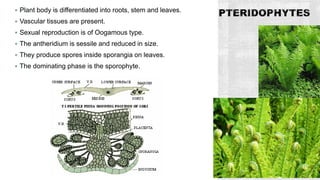
 They produce spores inside sporangia on leaves.
 The dominating phase is the sporophyte.
 The plants are small sized, most of them are terrestrial plants while
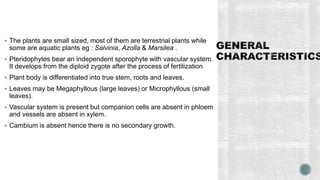
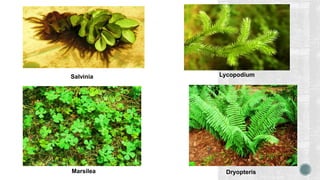
some are aquatic plants eg : Salvinia, Azolla & Marsilea .
 Pteridophytes bear an independent sporophyte with vascular system.
It develops from the diploid zygote after the process of fertilization
 Plant body is differentiated into true stem, roots and leaves.
 Leaves may be Megaphyllous (large leaves) or Microphyllous (small
leaves).
 Vascular system is present but companion cells are absent in phloem
and vessels are absent in xylem.
 Cambium is absent hence there is no secondary growth.
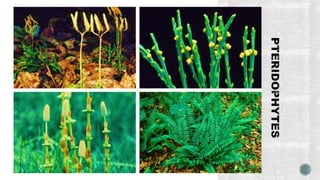
Salvinia
Dryopteris
Lycopodium
Marsilea
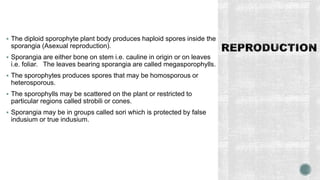
 The diploid sporophyte plant body produces haploid spores inside the
sporangia (Asexual reproduction).
 Sporangia are either bone on stem i.e. cauline in origin or on leaves
i.e. foliar. The leaves bearing sporangia are called megasporophylls.
 The sporophytes produces spores that may be homosporous or
heterosporous.
 The sporophylls may be scattered on the plant or restricted to
particular regions called strobili or cones.
 Sporangia may be in groups called sori which is protected by false
indusium or true indusium.
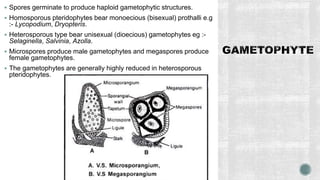
 Spores germinate to produce haploid gametophytic structures.
 Homosporous pteridophytes bear monoecious (bisexual) prothalli e.g
:- Lycopodium, Dryopteris.
 Heterosporous type bear unisexual (dioecious) gametophytes eg :-
Selaginella, Salvinia, Azolla.
 Microspores produce male gametophytes and megaspores produce
female gametophytes.
 The gametophytes are generally highly reduced in heterosporous
pteridophytes.
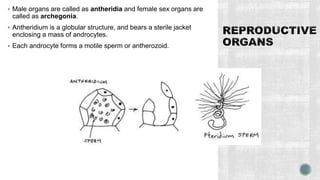
 Male organs are called as antheridia and female sex organs are
called as archegonia.
 Antheridium is a globular structure, and bears a sterile jacket
enclosing a mass of androcytes.
 Each androcyte forms a motile sperm or antherozoid.
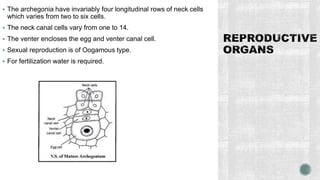
 The archegonia have invariably four longitudinal rows of neck cells
which varies from two to six cells.
 The neck canal cells vary from one to 14.
 The venter encloses the egg and venter canal cell.
 Sexual reproduction is of Oogamous type.
 For fertilization water is required.
 Pteridophytes are classified into four classes.
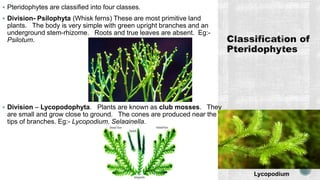
 Division- Psilophyta (Whisk ferns) These are most primitive land
plants. The body is very simple with green upright branches and an
underground stem-rhizome. Roots and true leaves are absent. Eg:-
Psilotum.
 Division – Lycopodophyta. Plants are known as club mosses. They
are small and grow close to ground. The cones are produced near the
tips of branches. Eg:- Lycopodium, Selaginella.
Lycopodium
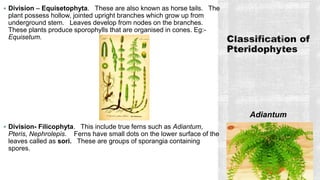
 Division – Equisetophyta. These are also known as horse tails. The
plant possess hollow, jointed upright branches which grow up from
underground stem. Leaves develop from nodes on the branches.
These plants produce sporophylls that are organised in cones. Eg:-
Equisetum.
 Division- Filicophyta. This include true ferns such as Adiantum,
Pteris, Nephrolepis. Ferns have small dots on the lower surface of the
leaves called as sori. These are groups of sporangia containing
spores.
Adiantum
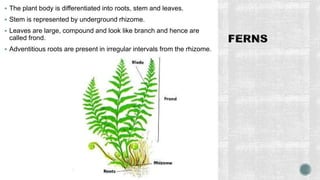
 The plant body is differentiated into roots, stem and leaves.
 Stem is represented by underground rhizome.
 Leaves are large, compound and look like branch and hence are
called frond.
 Adventitious roots are present in irregular intervals from the rhizome.
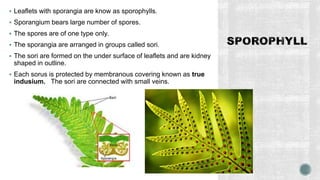
 Leaflets with sporangia are know as sporophylls.
 Sporangium bears large number of spores.
 The spores are of one type only.
 The sporangia are arranged in groups called sori.
 The sori are formed on the under surface of leaflets and are kidney
shaped in outline.
 Each sorus is protected by membranous covering known as true
indusium. The sori are connected with small veins.
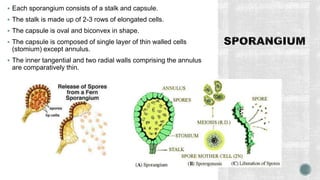
 Each sporangium consists of a stalk and capsule.
 The stalk is made up of 2-3 rows of elongated cells.
 The capsule is oval and biconvex in shape.
 The capsule is composed of single layer of thin walled cells
(stomium) except annulus.
 The inner tangential and two radial walls comprising the annulus
are comparatively thin.
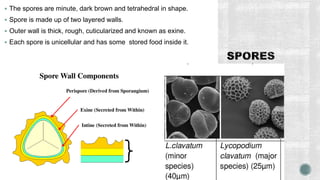
 The spores are minute, dark brown and tetrahedral in shape.
 Spore is made up of two layered walls.
 Outer wall is thick, rough, cuticularized and known as exine.
 Each spore is unicellular and has some stored food inside it.
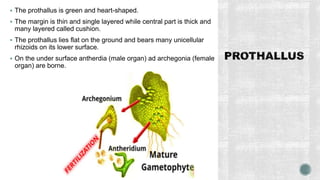
 The prothallus is green and heart-shaped.
 The margin is thin and single layered while central part is thick and
many layered called cushion.
 The prothallus lies flat on the ground and bears many unicellular
rhizoids on its lower surface.
 On the under surface antherdia (male organ) ad archegonia (female
organ) are borne.
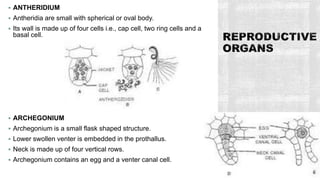
 ANTHERIDIUM
 Antheridia are small with spherical or oval body.
 Its wall is made up of four cells i.e., cap cell, two ring cells and a
basal cell.
 ARCHEGONIUM
 Archegonium is a small flask shaped structure.
 Lower swollen venter is embedded in the prothallus.
 Neck is made up of four vertical rows.
 Archegonium contains an egg and a venter canal cell.
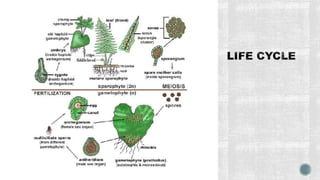
 Antherozoids swim towards the ovum with the help of cilia.
 Venter canal cell & neck canal cell disintegrate to produce
mucilage and malic acid.
 These chemicals attract sperms and they pass into the venter.
 One of the antherozoid fuses with egg to form zygote.
 It covers itself with a cellwall and is called Oospore.
Plant Kingdom III
Plant Kingdom III

Plant Kingdom III

  • 1.
  • 3.
     Plant bodyis differentiated into roots, stem and leaves.  Vascular tissues are present.  Sexual reproduction is of Oogamous type.  The antheridium is sessile and reduced in size.  They produce spores inside sporangia on leaves.  The dominating phase is the sporophyte.
  • 4.
     The plantsare small sized, most of them are terrestrial plants while some are aquatic plants eg : Salvinia, Azolla & Marsilea .  Pteridophytes bear an independent sporophyte with vascular system. It develops from the diploid zygote after the process of fertilization  Plant body is differentiated into true stem, roots and leaves.  Leaves may be Megaphyllous (large leaves) or Microphyllous (small leaves).  Vascular system is present but companion cells are absent in phloem and vessels are absent in xylem.  Cambium is absent hence there is no secondary growth.
  • 5.
  • 6.
     The diploidsporophyte plant body produces haploid spores inside the sporangia (Asexual reproduction).  Sporangia are either bone on stem i.e. cauline in origin or on leaves i.e. foliar. The leaves bearing sporangia are called megasporophylls.  The sporophytes produces spores that may be homosporous or heterosporous.  The sporophylls may be scattered on the plant or restricted to particular regions called strobili or cones.  Sporangia may be in groups called sori which is protected by false indusium or true indusium.
  • 8.
     Spores germinateto produce haploid gametophytic structures.  Homosporous pteridophytes bear monoecious (bisexual) prothalli e.g :- Lycopodium, Dryopteris.  Heterosporous type bear unisexual (dioecious) gametophytes eg :- Selaginella, Salvinia, Azolla.  Microspores produce male gametophytes and megaspores produce female gametophytes.  The gametophytes are generally highly reduced in heterosporous pteridophytes.
  • 9.
     Male organsare called as antheridia and female sex organs are called as archegonia.  Antheridium is a globular structure, and bears a sterile jacket enclosing a mass of androcytes.  Each androcyte forms a motile sperm or antherozoid.
  • 10.
     The archegoniahave invariably four longitudinal rows of neck cells which varies from two to six cells.  The neck canal cells vary from one to 14.  The venter encloses the egg and venter canal cell.  Sexual reproduction is of Oogamous type.  For fertilization water is required.
  • 11.
     Pteridophytes areclassified into four classes.  Division- Psilophyta (Whisk ferns) These are most primitive land plants. The body is very simple with green upright branches and an underground stem-rhizome. Roots and true leaves are absent. Eg:- Psilotum.  Division – Lycopodophyta. Plants are known as club mosses. They are small and grow close to ground. The cones are produced near the tips of branches. Eg:- Lycopodium, Selaginella. Lycopodium
  • 12.
     Division –Equisetophyta. These are also known as horse tails. The plant possess hollow, jointed upright branches which grow up from underground stem. Leaves develop from nodes on the branches. These plants produce sporophylls that are organised in cones. Eg:- Equisetum.  Division- Filicophyta. This include true ferns such as Adiantum, Pteris, Nephrolepis. Ferns have small dots on the lower surface of the leaves called as sori. These are groups of sporangia containing spores. Adiantum
  • 13.
     The plantbody is differentiated into roots, stem and leaves.  Stem is represented by underground rhizome.  Leaves are large, compound and look like branch and hence are called frond.  Adventitious roots are present in irregular intervals from the rhizome.
  • 14.
     Leaflets withsporangia are know as sporophylls.  Sporangium bears large number of spores.  The spores are of one type only.  The sporangia are arranged in groups called sori.  The sori are formed on the under surface of leaflets and are kidney shaped in outline.  Each sorus is protected by membranous covering known as true indusium. The sori are connected with small veins.
  • 15.
     Each sporangiumconsists of a stalk and capsule.  The stalk is made up of 2-3 rows of elongated cells.  The capsule is oval and biconvex in shape.  The capsule is composed of single layer of thin walled cells (stomium) except annulus.  The inner tangential and two radial walls comprising the annulus are comparatively thin.
  • 16.
     The sporesare minute, dark brown and tetrahedral in shape.  Spore is made up of two layered walls.  Outer wall is thick, rough, cuticularized and known as exine.  Each spore is unicellular and has some stored food inside it.
  • 17.
     The prothallusis green and heart-shaped.  The margin is thin and single layered while central part is thick and many layered called cushion.  The prothallus lies flat on the ground and bears many unicellular rhizoids on its lower surface.  On the under surface antherdia (male organ) ad archegonia (female organ) are borne.
  • 18.
     ANTHERIDIUM  Antheridiaare small with spherical or oval body.  Its wall is made up of four cells i.e., cap cell, two ring cells and a basal cell.  ARCHEGONIUM  Archegonium is a small flask shaped structure.  Lower swollen venter is embedded in the prothallus.  Neck is made up of four vertical rows.  Archegonium contains an egg and a venter canal cell.
  • 19.
     Antherozoids swimtowards the ovum with the help of cilia.  Venter canal cell & neck canal cell disintegrate to produce mucilage and malic acid.  These chemicals attract sperms and they pass into the venter.  One of the antherozoid fuses with egg to form zygote.  It covers itself with a cellwall and is called Oospore.