DR. V. VIJAYA, M. Sc., M. Phil., Ph. D
ASSISTANT PROFESSOR
DEPARTMENT OF BOTANY
E.M.G. YADAVA WOMEN’S COLLEGE
MADURAI-14
• Algae are abundant all over the world.
• Belong to the group protists.
• Its size extend from unicellular(microscopic) to
multicellular (macroscopic).
• Habitat ranges from freshwater, marine, soil, lichens,
limestone, polar ice etc.
• Occur in different shape, size and colours.
• Survives on their own, some grow on the surface of other
organisms, also grown on the soil land rocks surfaces.
➢ Photoautotrophs - do photosynthesis and release oxygen
(except purple and green bacteria).
➢ Using light, water and carbondioxide it produce oxygen as
by-product.
➢ Replenishes the atmosphere with oxygen abundantly for
living organisms.
➢ Not all algae are beneficial some are harmful too.
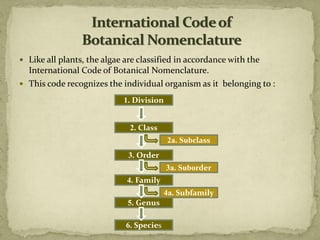
 Like all plants, the algae are classified in accordance with the
International Code of Botanical Nomenclature.
 This code recognizes the individual organism as it belonging to :
1. Division
2. Class
3. Order
4. Family
5. Genus
6. Species
2a. Subclass
3a. Suborder
4a. Subfamily
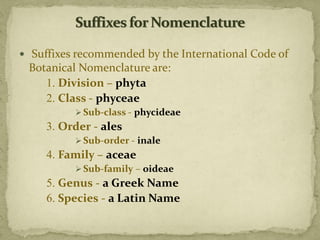
 Suffixes recommended by the International Code of
Botanical Nomenclature are:
1. Division – phyta
2. Class - phyceae
➢ Sub-class - phycideae
3. Order - ales
➢ Sub-order - inale
4. Family – aceae
➢ Sub-family – oideae
5. Genus - a Greek Name
6. Species - a Latin Name
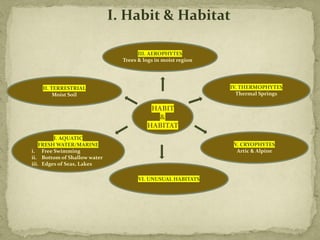
HABIT
&
HABITAT
II. TERRESTRIAL
Moist Soil
III. AEROPHYTES
Trees & logs in moist region
IV. THERMOPHYTES
Thermal Springs
V. CRYOPHYTES
Artic & Alpine
I. AQUATIC
FRESH WATER/MARINE
i. Free Swimming
ii. Bottom of Shallow water
iii. Edges of Seas, Lakes
VI. UNUSUAL HABITATS
I. Habit & Habitat
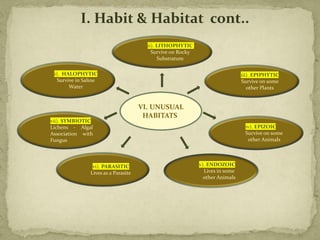
ii). LITHOPHYTIC
Survive on Rocky
Substratum
iv). EPIZOIC
Survive on some
other Animals
v). ENDOZOIC
Lives in some
other Animals
iii). EPIPHYTIC
Survive on some
other Plants
vi). PARASITIC
Lives as a Parasite
i). HALOPHYTIC
Survive in Saline
Water
VI. UNUSUAL
HABITATS:
vii). SYMBIOTIC
Lichens - Algal
Association with
Fungus
I. Habit & Habitat cont..
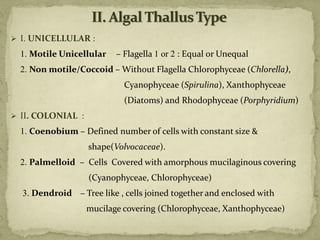
➢ I. UNICELLULAR :
1. Motile Unicellular – Flagella 1 or 2 : Equal or Unequal
2. Non motile/Coccoid – Without Flagella Chlorophyceae (Chlorella),
Cyanophyceae (Spirulina), Xanthophyceae
(Diatoms) and Rhodophyceae (Porphyridium)
➢ II. COLONIAL :
1. Coenobium – Defined number of cells with constant size &
shape(Volvocaceae).
2. Palmelloid – Cells Covered with amorphous mucilaginous covering
(Cyanophyceae, Chlorophyceae)
3. Dendroid – Tree like , cells joined together and enclosed with
mucilage covering (Chlorophyceae, Xanthophyceae)
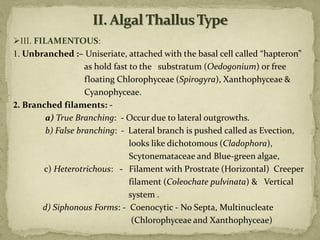
➢III. FILAMENTOUS:
1. Unbranched :– Uniseriate, attached with the basal cell called “hapteron”
as hold fast to the substratum (Oedogonium) or free
floating Chlorophyceae (Spirogyra), Xanthophyceae &
Cyanophyceae.
2. Branched filaments: -
a) True Branching: - Occur due to lateral outgrowths.
b) False branching: - Lateral branch is pushed called as Evection,
looks like dichotomous (Cladophora),
Scytonemataceae and Blue-green algae,
c) Heterotrichous: - Filament with Prostrate (Horizontal) Creeper
filament (Coleochate pulvinata) & Vertical
system .
d) Siphonous Forms: - Coenocytic - No Septa, Multinucleate
(Chlorophyceae and Xanthophyceae)
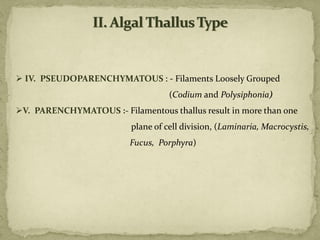
➢ IV. PSEUDOPARENCHYMATOUS : - Filaments Loosely Grouped
(Codium and Polysiphonia)
➢V. PARENCHYMATOUS :- Filamentous thallus result in more than one
plane of cell division, (Laminaria, Macrocystis,
Fucus, Porphyra)
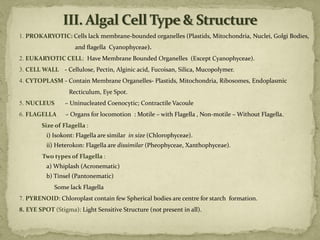
1. PROKARYOTIC: Cells lack membrane-bounded organelles (Plastids, Mitochondria, Nuclei, Golgi Bodies,
and flagella Cyanophyceae).
2. EUKARYOTIC CELL: Have Membrane Bounded Organelles (Except Cyanophyceae).
3. CELL WALL - Cellulose, Pectin, Alginic acid, Fucoisan, Silica, Mucopolymer.
4. CYTOPLASM - Contain Membrane Organelles- Plastids, Mitochondria, Ribosomes, Endoplasmic
Recticulum, Eye Spot.
5. NUCLEUS – Uninucleated Coenocytic; Contractile Vacoule
6. FLAGELLA – Organs for locomotion : Motile – with Flagella , Non-motile – Without Flagella.
Size of Flagella :
i) Isokont: Flagella are similar in size (Chlorophyceae).
ii) Heterokon: Flagella are dissimilar (Pheophyceae, Xanthophyceae).
Two types of Flagella :
a) Whiplash (Acronematic)
b) Tinsel (Pantonematic)
Some lack Flagella
7. PYRENOID: Chloroplast contain few Spherical bodies are centre for starch formation.
8. EYE SPOT (Stigma): Light Sensitive Structure (not present in all).
•
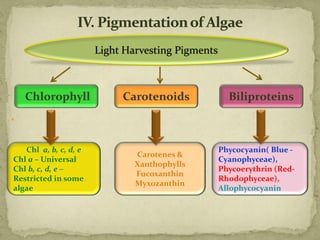
Chlorophyll Carotenoids Biliproteins
Chl a, b, c, d, e
Chl a – Universal
Chl b, c, d, e –
Restricted in some
algae
Carotenes &
Xanthophylls
Fucoxanthin
Myxozanthin
Phycocyanin( Blue -
Cyanophyceae),
Phycoerythrin (Red-
Rhodophyceae),
Allophycocyanin
Light Harvesting Pigments
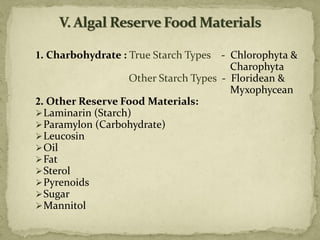
1. Charbohydrate : True Starch Types - Chlorophyta &
Charophyta
Other Starch Types - Floridean &
Myxophycean
2. Other Reserve Food Materials:
➢Laminarin (Starch)
➢Paramylon (Carbohydrate)
➢Leucosin
➢Oil
➢Fat
➢Sterol
➢Pyrenoids
➢Sugar
➢Mannitol
Eye Spot:
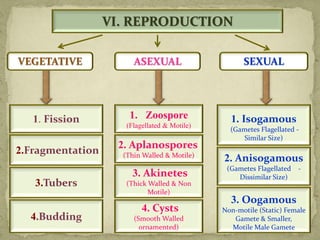
2. Anisogamous
(Gametes Flagellated -
Dissimilar Size)
1. Isogamous
(Gametes Flagellated -
Similar Size)
3. Oogamous
Non-motile (Static) Female
Gamete & Smaller,
Motile Male Gamete
2. Aplanospores
(Thin Walled & Motile)
1. Zoospore
(Flagellated & Motile)
3. Akinetes
(Thick Walled & Non
Motile)
1. Fission
2.Fragmentation
3.Tubers
4.Budding
VI. REPRODUCTION
VEGETATIVE ASEXUAL SEXUAL
4. Cysts
(Smooth Walled
ornamented)
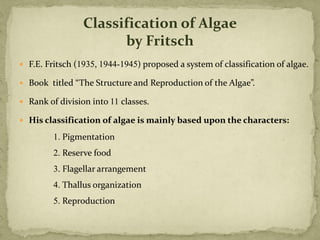
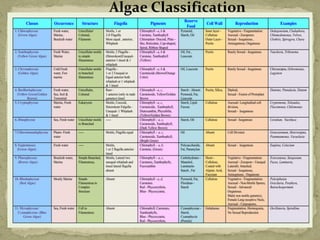
 F.E. Fritsch (1935, 1944-1945) proposed a system of classification of algae.
 Book titled “The Structure and Reproduction of the Algae”.
 Rank of division into 11 classes.
 His classification of algae is mainly based upon the characters:
1. Pigmentation
2. Reserve food
3. Flagellar arrangement
4. Thallus organization
5. Reproduction
Classification of Algae
by Fritsch
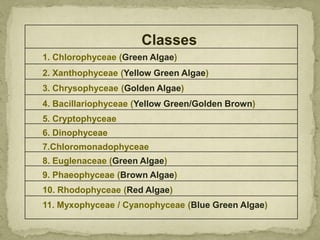
Classes
1. Chlorophyceae (Green Algae)
2. Xanthophyceae (Yellow Green Algae)
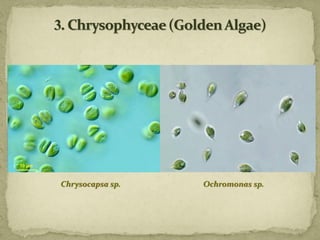
3. Chrysophyceae (Golden Algae)
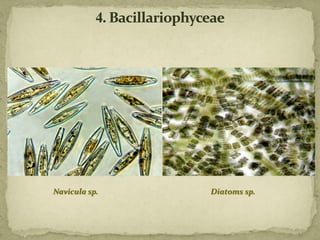
4. Bacillariophyceae (Yellow Green/Golden Brown)
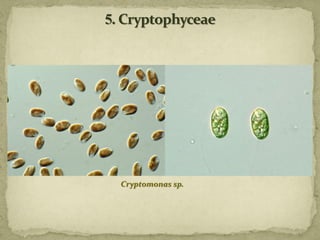
5. Cryptophyceae
6. Dinophyceae
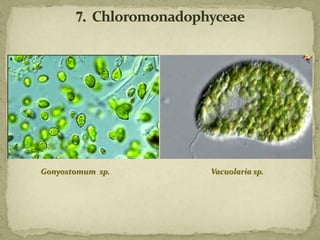
7.Chloromonadophyceae
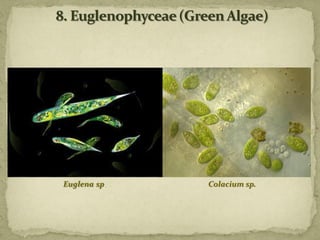
8. Euglenaceae (Green Algae)
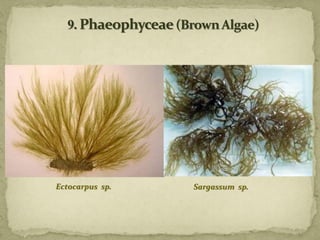
9. Phaeophyceae (Brown Algae)
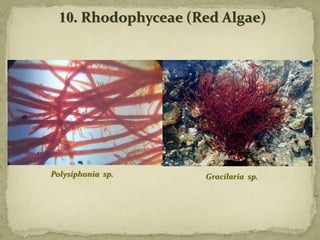
10. Rhodophyceae (Red Algae)
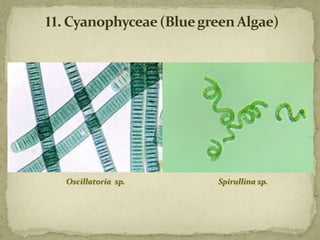
11. Myxophyceae / Cyanophyceae (Blue Green Algae)
Algae Classification
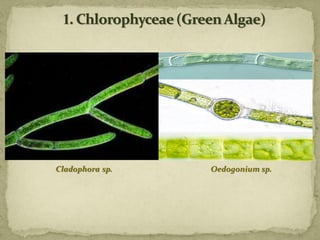
Cladophora sp. Oedogonium sp.
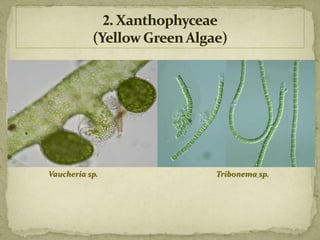
Vaucheria sp. Tribonema sp.
Chrysocapsa sp. Ochromonas sp.
Navicula sp. Diatoms sp.
Cryptomonas sp.
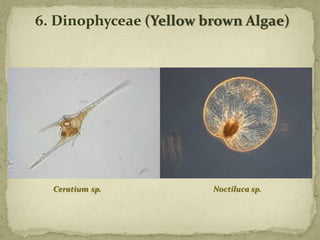
6. Dinophyceae (Yellow brown Algae)
Ceratium sp. Noctiluca sp.
Vacuolaria sp.Gonyostomum sp.
Colacium sp.Euglena sp.
Ectocarpus sp. Sargassum sp.
Gracilaria sp.
10. Rhodophyceae (Red Algae)
Polysiphonia sp.
Oscillatoria sp. Spirullina sp.
1. https://www.livescience.com/
2. WWW.researchgate.net
3. https://www.plantscience4u.com/
4. http://saivenkateshbotany.blogspot.com/
5. https://biology4isc.weebly.com/
6. https://www.brainkart.com/article/Classification-of-Algae_32866/
7. http://premabotany.blogspot.com/
8. https://www.britannica.com/science
9. https://www.sparknotes.com/biology/microorganisms/.../
10.www.googleimages/algae.com
11.https://search.library.wisc.edu/
12. F.E. Fritsch : The Structure and Reproduction of the Algae [Volume 1],
Book Published by Cambridge at the University Press, London, 1965.
THANK YOU

Introduction to Algal Classification: Part-1

  • 1.
    DR. V. VIJAYA,M. Sc., M. Phil., Ph. D ASSISTANT PROFESSOR DEPARTMENT OF BOTANY E.M.G. YADAVA WOMEN’S COLLEGE MADURAI-14
  • 2.
    • Algae areabundant all over the world. • Belong to the group protists. • Its size extend from unicellular(microscopic) to multicellular (macroscopic). • Habitat ranges from freshwater, marine, soil, lichens, limestone, polar ice etc. • Occur in different shape, size and colours. • Survives on their own, some grow on the surface of other organisms, also grown on the soil land rocks surfaces.
  • 3.
    ➢ Photoautotrophs -do photosynthesis and release oxygen (except purple and green bacteria). ➢ Using light, water and carbondioxide it produce oxygen as by-product. ➢ Replenishes the atmosphere with oxygen abundantly for living organisms. ➢ Not all algae are beneficial some are harmful too.
  • 4.
     Like allplants, the algae are classified in accordance with the International Code of Botanical Nomenclature.  This code recognizes the individual organism as it belonging to : 1. Division 2. Class 3. Order 4. Family 5. Genus 6. Species 2a. Subclass 3a. Suborder 4a. Subfamily
  • 5.
     Suffixes recommendedby the International Code of Botanical Nomenclature are: 1. Division – phyta 2. Class - phyceae ➢ Sub-class - phycideae 3. Order - ales ➢ Sub-order - inale 4. Family – aceae ➢ Sub-family – oideae 5. Genus - a Greek Name 6. Species - a Latin Name
  • 6.
    HABIT & HABITAT II. TERRESTRIAL Moist Soil III.AEROPHYTES Trees & logs in moist region IV. THERMOPHYTES Thermal Springs V. CRYOPHYTES Artic & Alpine I. AQUATIC FRESH WATER/MARINE i. Free Swimming ii. Bottom of Shallow water iii. Edges of Seas, Lakes VI. UNUSUAL HABITATS I. Habit & Habitat
  • 7.
    ii). LITHOPHYTIC Survive onRocky Substratum iv). EPIZOIC Survive on some other Animals v). ENDOZOIC Lives in some other Animals iii). EPIPHYTIC Survive on some other Plants vi). PARASITIC Lives as a Parasite i). HALOPHYTIC Survive in Saline Water VI. UNUSUAL HABITATS: vii). SYMBIOTIC Lichens - Algal Association with Fungus I. Habit & Habitat cont..
  • 8.
    ➢ I. UNICELLULAR: 1. Motile Unicellular – Flagella 1 or 2 : Equal or Unequal 2. Non motile/Coccoid – Without Flagella Chlorophyceae (Chlorella), Cyanophyceae (Spirulina), Xanthophyceae (Diatoms) and Rhodophyceae (Porphyridium) ➢ II. COLONIAL : 1. Coenobium – Defined number of cells with constant size & shape(Volvocaceae). 2. Palmelloid – Cells Covered with amorphous mucilaginous covering (Cyanophyceae, Chlorophyceae) 3. Dendroid – Tree like , cells joined together and enclosed with mucilage covering (Chlorophyceae, Xanthophyceae)
  • 9.
    ➢III. FILAMENTOUS: 1. Unbranched:– Uniseriate, attached with the basal cell called “hapteron” as hold fast to the substratum (Oedogonium) or free floating Chlorophyceae (Spirogyra), Xanthophyceae & Cyanophyceae. 2. Branched filaments: - a) True Branching: - Occur due to lateral outgrowths. b) False branching: - Lateral branch is pushed called as Evection, looks like dichotomous (Cladophora), Scytonemataceae and Blue-green algae, c) Heterotrichous: - Filament with Prostrate (Horizontal) Creeper filament (Coleochate pulvinata) & Vertical system . d) Siphonous Forms: - Coenocytic - No Septa, Multinucleate (Chlorophyceae and Xanthophyceae)
  • 10.
    ➢ IV. PSEUDOPARENCHYMATOUS: - Filaments Loosely Grouped (Codium and Polysiphonia) ➢V. PARENCHYMATOUS :- Filamentous thallus result in more than one plane of cell division, (Laminaria, Macrocystis, Fucus, Porphyra)
  • 11.
    1. PROKARYOTIC: Cellslack membrane-bounded organelles (Plastids, Mitochondria, Nuclei, Golgi Bodies, and flagella Cyanophyceae). 2. EUKARYOTIC CELL: Have Membrane Bounded Organelles (Except Cyanophyceae). 3. CELL WALL - Cellulose, Pectin, Alginic acid, Fucoisan, Silica, Mucopolymer. 4. CYTOPLASM - Contain Membrane Organelles- Plastids, Mitochondria, Ribosomes, Endoplasmic Recticulum, Eye Spot. 5. NUCLEUS – Uninucleated Coenocytic; Contractile Vacoule 6. FLAGELLA – Organs for locomotion : Motile – with Flagella , Non-motile – Without Flagella. Size of Flagella : i) Isokont: Flagella are similar in size (Chlorophyceae). ii) Heterokon: Flagella are dissimilar (Pheophyceae, Xanthophyceae). Two types of Flagella : a) Whiplash (Acronematic) b) Tinsel (Pantonematic) Some lack Flagella 7. PYRENOID: Chloroplast contain few Spherical bodies are centre for starch formation. 8. EYE SPOT (Stigma): Light Sensitive Structure (not present in all).
  • 12.
    • Chlorophyll Carotenoids Biliproteins Chla, b, c, d, e Chl a – Universal Chl b, c, d, e – Restricted in some algae Carotenes & Xanthophylls Fucoxanthin Myxozanthin Phycocyanin( Blue - Cyanophyceae), Phycoerythrin (Red- Rhodophyceae), Allophycocyanin Light Harvesting Pigments
  • 13.
    1. Charbohydrate :True Starch Types - Chlorophyta & Charophyta Other Starch Types - Floridean & Myxophycean 2. Other Reserve Food Materials: ➢Laminarin (Starch) ➢Paramylon (Carbohydrate) ➢Leucosin ➢Oil ➢Fat ➢Sterol ➢Pyrenoids ➢Sugar ➢Mannitol
  • 14.
    Eye Spot: 2. Anisogamous (GametesFlagellated - Dissimilar Size) 1. Isogamous (Gametes Flagellated - Similar Size) 3. Oogamous Non-motile (Static) Female Gamete & Smaller, Motile Male Gamete 2. Aplanospores (Thin Walled & Motile) 1. Zoospore (Flagellated & Motile) 3. Akinetes (Thick Walled & Non Motile) 1. Fission 2.Fragmentation 3.Tubers 4.Budding VI. REPRODUCTION VEGETATIVE ASEXUAL SEXUAL 4. Cysts (Smooth Walled ornamented)
  • 15.
     F.E. Fritsch(1935, 1944-1945) proposed a system of classification of algae.  Book titled “The Structure and Reproduction of the Algae”.  Rank of division into 11 classes.  His classification of algae is mainly based upon the characters: 1. Pigmentation 2. Reserve food 3. Flagellar arrangement 4. Thallus organization 5. Reproduction Classification of Algae by Fritsch
  • 16.
    Classes 1. Chlorophyceae (GreenAlgae) 2. Xanthophyceae (Yellow Green Algae) 3. Chrysophyceae (Golden Algae) 4. Bacillariophyceae (Yellow Green/Golden Brown) 5. Cryptophyceae 6. Dinophyceae 7.Chloromonadophyceae 8. Euglenaceae (Green Algae) 9. Phaeophyceae (Brown Algae) 10. Rhodophyceae (Red Algae) 11. Myxophyceae / Cyanophyceae (Blue Green Algae)
  • 17.
  • 18.
  • 19.
  • 20.
  • 21.
  • 22.
  • 23.
    6. Dinophyceae (Yellowbrown Algae) Ceratium sp. Noctiluca sp.
  • 24.
  • 25.
  • 26.
  • 27.
    Gracilaria sp. 10. Rhodophyceae(Red Algae) Polysiphonia sp.
  • 28.
  • 29.
    1. https://www.livescience.com/ 2. WWW.researchgate.net 3.https://www.plantscience4u.com/ 4. http://saivenkateshbotany.blogspot.com/ 5. https://biology4isc.weebly.com/ 6. https://www.brainkart.com/article/Classification-of-Algae_32866/ 7. http://premabotany.blogspot.com/ 8. https://www.britannica.com/science 9. https://www.sparknotes.com/biology/microorganisms/.../ 10.www.googleimages/algae.com 11.https://search.library.wisc.edu/ 12. F.E. Fritsch : The Structure and Reproduction of the Algae [Volume 1], Book Published by Cambridge at the University Press, London, 1965.
  • 30.