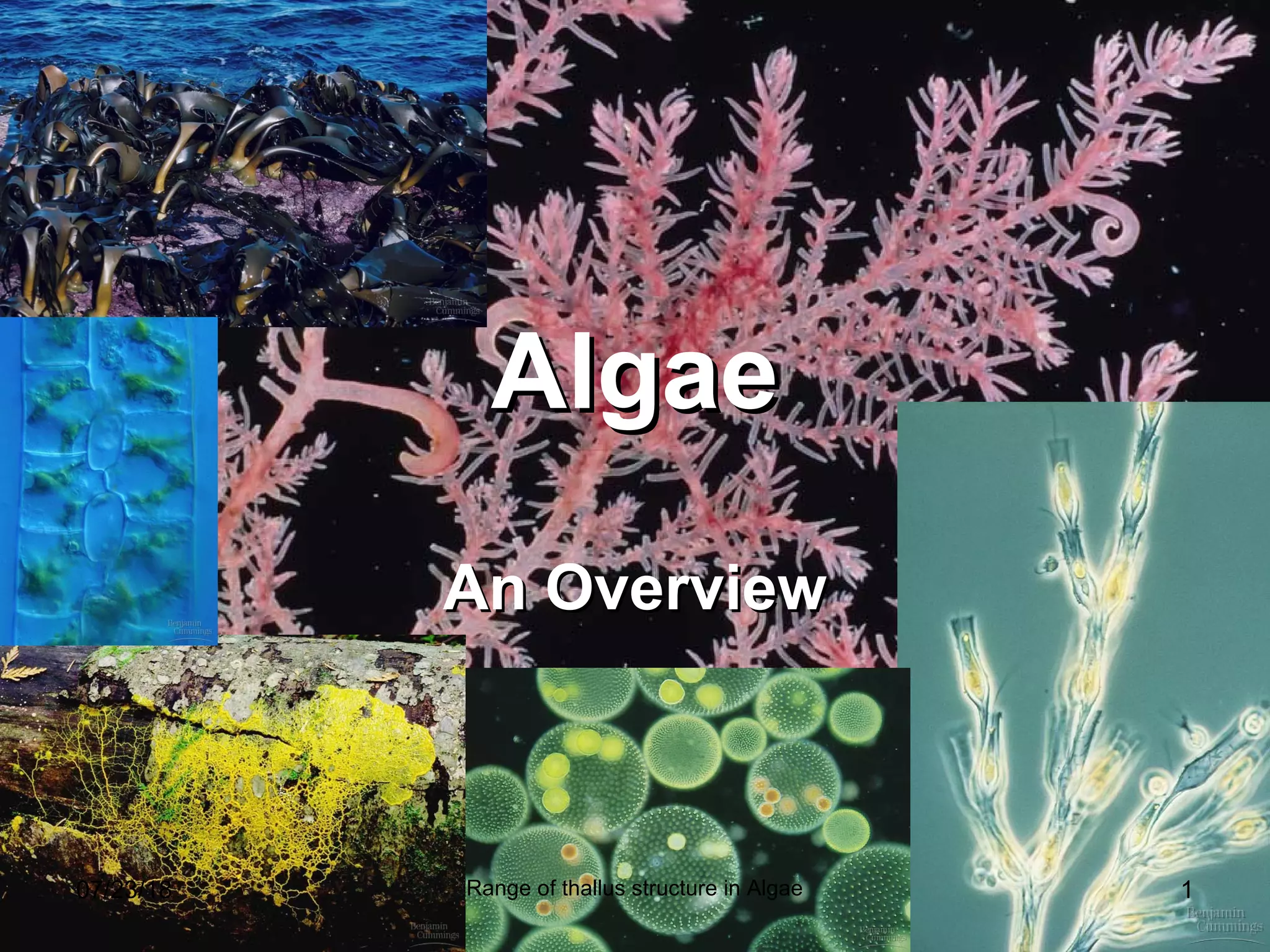
AlgaeAlgae
An OverviewAn Overview
1Range of thallus structure in Algae07/23/18
07/23/18
Range of thallus structure in Algae 2
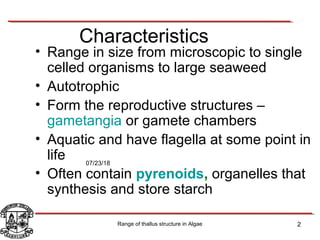
Characteristics
• Range in size from microscopic to single
celled organisms to large seaweed
• Autotrophic
• Form the reproductive structures –
gametangia or gamete chambers
• Aquatic and have flagella at some point in
life
• Often contain pyrenoids, organelles that
synthesis and store starch
STRUCTURE
• Thallus (haploid)
• Types of algae
–Unicellular[motile and non-motile]
–Colonial[flagellated & non-
flagellated]
–Filamentous[branched &
unbranched]
3Range of thallus structure in Algae
07/23/18
07/23/18
Range of thallus structure in Algae 4
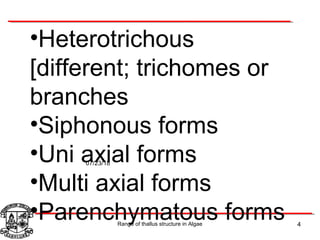
•Heterotrichous
[different; trichomes or
branches
•Siphonous forms
•Uni axial forms
•Multi axial forms
•Parenchymatous forms
Forms of Green Algae
Unicellular Filamentous Colonial
Chlamydomonas
Spirogyra
Cladophora
Volvox
5Range of thallus structure in Algae
07/23/18
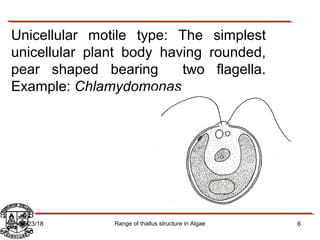
Unicellular motile type: The simplest
unicellular plant body having rounded,
pear shaped bearing two flagella.
Example: Chlamydomonas
6Range of thallus structure in Algae07/23/18
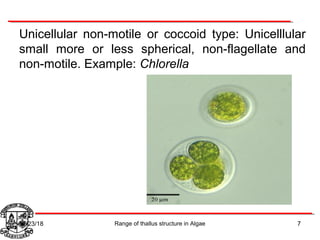
Unicellular non-motile or coccoid type: Unicelllular
small more or less spherical, non-flagellate and
non-motile. Example: Chlorella
7Range of thallus structure in Algae07/23/18
Motile coenobial type: In this type unicellular cells with their
flagella protruded out is embedded together in a gelatinous
sheath to form a more or less rounded motile colony or
coenobium. Example: Volvox [Evolution in the Volvocine
Line]
8Range of thallus structure in Algae07/23/18
Non motile coenobial type: In this type the colony or
coenobium is composed of non-motile cells arranged in a
single layer along the long axis, e.g. Scenedesmus [Fig. a]
or cells are arranged end to end forming a pentagonal or
hexagonal meshes of net, e.g. Hydrodictyon [Fig. b] and
Pediastrum [Fig. c]
9Range of thallus structure in Algae07/23/18
Palmelloid type: It is a temporary stage formed in
Chlamydomonas under un favourable conditions.
(palmella)
10Range of thallus structure in Algae07/23/18
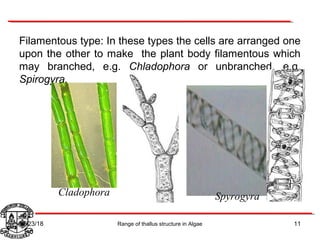
Filamentous type: In these types the cells are arranged one
upon the other to make the plant body filamentous which
may branched, e.g. Chladophora or unbranched, e.g.
Spirogyra.
SpyrogyraCladophora
11Range of thallus structure in Algae07/23/18
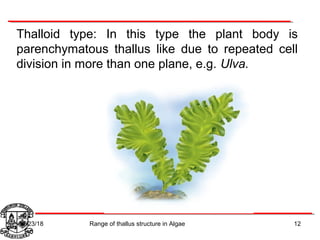
Thalloid type: In this type the plant body is
parenchymatous thallus like due to repeated cell
division in more than one plane, e.g. Ulva.
12Range of thallus structure in Algae07/23/18
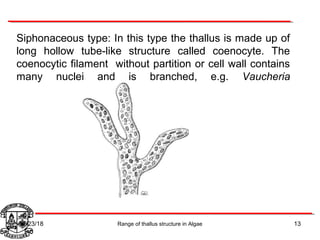
Siphonaceous type: In this type the thallus is made up of
long hollow tube-like structure called coenocyte. The
coenocytic filament without partition or cell wall contains
many nuclei and is branched, e.g. Vaucheria
Range of thallus structure in Algae 1307/23/18
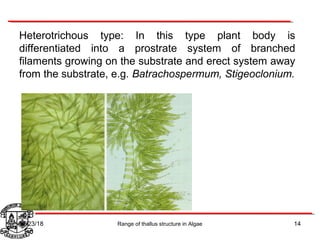
Heterotrichous type: In this type plant body is
differentiated into a prostrate system of branched
filaments growing on the substrate and erect system away
from the substrate, e.g. Batrachospermum, Stigeoclonium.
Range of thallus structure in Algae 1407/23/18
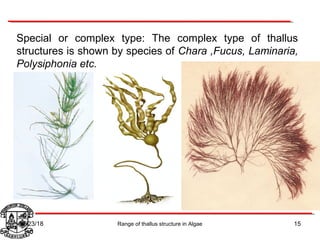
Special or complex type: The complex type of thallus
structures is shown by species of Chara ,Fucus, Laminaria,
Polysiphonia etc.
Range of thallus structure in Algae 1507/23/18
IDENTIFY THE TYPE OF ALGAE
16Range of thallus structure in Algae07/23/18
CLASSIFICATION OF ALGAE
• 11 classes based on:
– COLOR
– TYPE OF CHLOROPHYLL
– FOOD-STORAGE SUBSTANCE
– CELL WALL COMPOSITION
17Range of thallus structure in Algae07/23/18
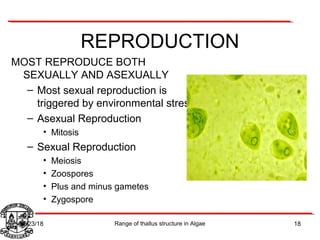
REPRODUCTION
MOST REPRODUCE BOTH
SEXUALLY AND ASEXUALLY
– Most sexual reproduction is
triggered by environmental stress
– Asexual Reproduction
• Mitosis
– Sexual Reproduction
• Meiosis
• Zoospores
• Plus and minus gametes
• Zygospore
18Range of thallus structure in Algae07/23/18
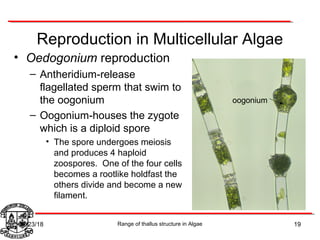
Reproduction in Multicellular Algae
• Oedogonium reproduction
– Antheridium-release
flagellated sperm that swim to
the oogonium
– Oogonium-houses the zygote
which is a diploid spore
• The spore undergoes meiosis
and produces 4 haploid
zoospores. One of the four cells
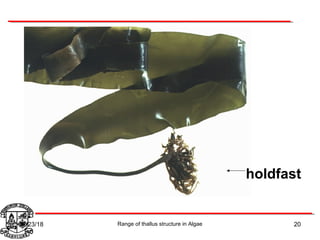
becomes a rootlike holdfast the
others divide and become a new
filament.
oogonium
19Range of thallus structure in Algae07/23/18
holdfast
20Range of thallus structure in Algae07/23/18
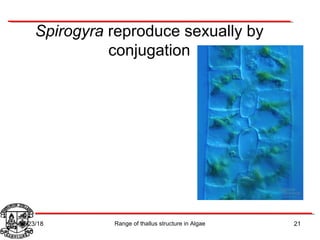
Spirogyra reproduce sexually by
conjugation
21Range of thallus structure in Algae07/23/18
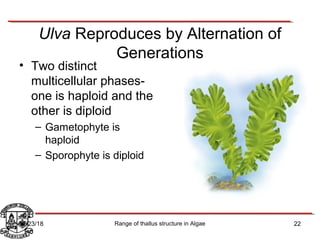
Ulva Reproduces by Alternation of
Generations
• Two distinct
multicellular phases-
one is haploid and the
other is diploid
– Gametophyte is
haploid
– Sporophyte is diploid
22Range of thallus structure in Algae07/23/18
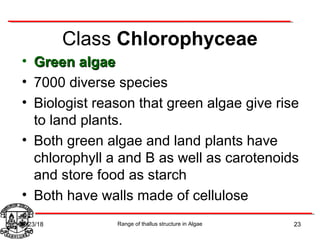
Class Chlorophyceae
• Green algaeGreen algae
• 7000 diverse species
• Biologist reason that green algae give rise
to land plants.
• Both green algae and land plants have
chlorophyll a and B as well as carotenoids
and store food as starch
• Both have walls made of cellulose
23Range of thallus structure in Algae07/23/18
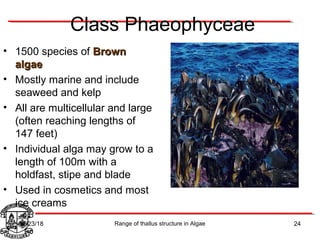
Class Phaeophyceae
• 1500 species of BrownBrown
algaealgae
• Mostly marine and include
seaweed and kelp
• All are multicellular and large
(often reaching lengths of
147 feet)
• Individual alga may grow to a
length of 100m with a
holdfast, stipe and blade
• Used in cosmetics and most
ice creams
24Range of thallus structure in Algae07/23/18
Class Rhodophyceae
• 4000 species of RED AlgaeRED Algae
• Most are marine
• Smaller than brown algae and are often found at
a depth of 200 meters.
• Contain chlorophyll a and C as well as
phycobilins which are important in absorbing
light that can penetrate deep into the water
• Have cells coated in carageenan which is used
in cosmetics, gelatin capsules and some
cheeses
25Range of thallus structure in Algae07/23/18
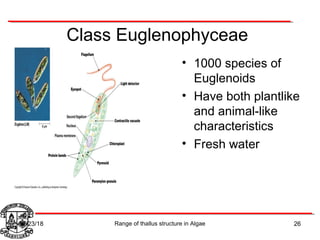
Class Euglenophyceae
• 1000 species of
Euglenoids
• Have both plantlike
and animal-like
characteristics
• Fresh water
26Range of thallus structure in Algae07/23/18
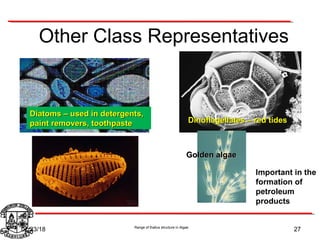
Other Class Representatives
Diatoms – used in detergents,Diatoms – used in detergents,
paint removers, toothpastepaint removers, toothpaste Dinoflagellates – red tidesDinoflagellates – red tides
Important in the
formation of
petroleum
products
Golden algaeGolden algae
27Range of thallus structure in Algae
07/23/18
Give an account of range of
thallus structure in algae with
the help of suitable diagrams
and example each.
28Range of thallus structure in Algae07/23/18
07/23/18
Range of thallus structure in Algae 29
References
Fritsch, F.G. 1935, 1945. The Structure and Reproduction of Algae. Vol.
I & II. Cambridge Univ. Press. Cambridge. (589.3/6167, 6168)
Mauseth, J. D. (1998). Botany: An introduction to plant biology. Boston:
Jones and Bartlett.
Raven, P. H., Evert, R. F., & Eichhorn, S. E. (1999). Biology of plants.
New York: W.H. Freeman.
Sharma, O. P. (2011). Algae. New Delhi: Tata McGraw Hill.
Vashishta, B. R., & Sinha, A. K. (2014). Botany for degree students :
Fungi. New Delhi: S. Chand and Company Ltd.
Vashishta, B. R. (1960). Botany for degree students. Delhi: S. Chand.

Algae thallus structure

  • 1.
    AlgaeAlgae An OverviewAn Overview 1Rangeof thallus structure in Algae07/23/18
  • 2.
    07/23/18 Range of thallusstructure in Algae 2 Characteristics • Range in size from microscopic to single celled organisms to large seaweed • Autotrophic • Form the reproductive structures – gametangia or gamete chambers • Aquatic and have flagella at some point in life • Often contain pyrenoids, organelles that synthesis and store starch
  • 3.
    STRUCTURE • Thallus (haploid) •Types of algae –Unicellular[motile and non-motile] –Colonial[flagellated & non- flagellated] –Filamentous[branched & unbranched] 3Range of thallus structure in Algae 07/23/18
  • 4.
    07/23/18 Range of thallusstructure in Algae 4 •Heterotrichous [different; trichomes or branches •Siphonous forms •Uni axial forms •Multi axial forms •Parenchymatous forms
  • 5.
    Forms of GreenAlgae Unicellular Filamentous Colonial Chlamydomonas Spirogyra Cladophora Volvox 5Range of thallus structure in Algae 07/23/18
  • 6.
    Unicellular motile type:The simplest unicellular plant body having rounded, pear shaped bearing two flagella. Example: Chlamydomonas 6Range of thallus structure in Algae07/23/18
  • 7.
    Unicellular non-motile orcoccoid type: Unicelllular small more or less spherical, non-flagellate and non-motile. Example: Chlorella 7Range of thallus structure in Algae07/23/18
  • 8.
    Motile coenobial type:In this type unicellular cells with their flagella protruded out is embedded together in a gelatinous sheath to form a more or less rounded motile colony or coenobium. Example: Volvox [Evolution in the Volvocine Line] 8Range of thallus structure in Algae07/23/18
  • 9.
    Non motile coenobialtype: In this type the colony or coenobium is composed of non-motile cells arranged in a single layer along the long axis, e.g. Scenedesmus [Fig. a] or cells are arranged end to end forming a pentagonal or hexagonal meshes of net, e.g. Hydrodictyon [Fig. b] and Pediastrum [Fig. c] 9Range of thallus structure in Algae07/23/18
  • 10.
    Palmelloid type: Itis a temporary stage formed in Chlamydomonas under un favourable conditions. (palmella) 10Range of thallus structure in Algae07/23/18
  • 11.
    Filamentous type: Inthese types the cells are arranged one upon the other to make the plant body filamentous which may branched, e.g. Chladophora or unbranched, e.g. Spirogyra. SpyrogyraCladophora 11Range of thallus structure in Algae07/23/18
  • 12.
    Thalloid type: Inthis type the plant body is parenchymatous thallus like due to repeated cell division in more than one plane, e.g. Ulva. 12Range of thallus structure in Algae07/23/18
  • 13.
    Siphonaceous type: Inthis type the thallus is made up of long hollow tube-like structure called coenocyte. The coenocytic filament without partition or cell wall contains many nuclei and is branched, e.g. Vaucheria Range of thallus structure in Algae 1307/23/18
  • 14.
    Heterotrichous type: Inthis type plant body is differentiated into a prostrate system of branched filaments growing on the substrate and erect system away from the substrate, e.g. Batrachospermum, Stigeoclonium. Range of thallus structure in Algae 1407/23/18
  • 15.
    Special or complextype: The complex type of thallus structures is shown by species of Chara ,Fucus, Laminaria, Polysiphonia etc. Range of thallus structure in Algae 1507/23/18
  • 16.
    IDENTIFY THE TYPEOF ALGAE 16Range of thallus structure in Algae07/23/18
  • 17.
    CLASSIFICATION OF ALGAE •11 classes based on: – COLOR – TYPE OF CHLOROPHYLL – FOOD-STORAGE SUBSTANCE – CELL WALL COMPOSITION 17Range of thallus structure in Algae07/23/18
  • 18.
    REPRODUCTION MOST REPRODUCE BOTH SEXUALLYAND ASEXUALLY – Most sexual reproduction is triggered by environmental stress – Asexual Reproduction • Mitosis – Sexual Reproduction • Meiosis • Zoospores • Plus and minus gametes • Zygospore 18Range of thallus structure in Algae07/23/18
  • 19.
    Reproduction in MulticellularAlgae • Oedogonium reproduction – Antheridium-release flagellated sperm that swim to the oogonium – Oogonium-houses the zygote which is a diploid spore • The spore undergoes meiosis and produces 4 haploid zoospores. One of the four cells becomes a rootlike holdfast the others divide and become a new filament. oogonium 19Range of thallus structure in Algae07/23/18
  • 20.
    holdfast 20Range of thallusstructure in Algae07/23/18
  • 21.
    Spirogyra reproduce sexuallyby conjugation 21Range of thallus structure in Algae07/23/18
  • 22.
    Ulva Reproduces byAlternation of Generations • Two distinct multicellular phases- one is haploid and the other is diploid – Gametophyte is haploid – Sporophyte is diploid 22Range of thallus structure in Algae07/23/18
  • 23.
    Class Chlorophyceae • GreenalgaeGreen algae • 7000 diverse species • Biologist reason that green algae give rise to land plants. • Both green algae and land plants have chlorophyll a and B as well as carotenoids and store food as starch • Both have walls made of cellulose 23Range of thallus structure in Algae07/23/18
  • 24.
    Class Phaeophyceae • 1500species of BrownBrown algaealgae • Mostly marine and include seaweed and kelp • All are multicellular and large (often reaching lengths of 147 feet) • Individual alga may grow to a length of 100m with a holdfast, stipe and blade • Used in cosmetics and most ice creams 24Range of thallus structure in Algae07/23/18
  • 25.
    Class Rhodophyceae • 4000species of RED AlgaeRED Algae • Most are marine • Smaller than brown algae and are often found at a depth of 200 meters. • Contain chlorophyll a and C as well as phycobilins which are important in absorbing light that can penetrate deep into the water • Have cells coated in carageenan which is used in cosmetics, gelatin capsules and some cheeses 25Range of thallus structure in Algae07/23/18
  • 26.
    Class Euglenophyceae • 1000species of Euglenoids • Have both plantlike and animal-like characteristics • Fresh water 26Range of thallus structure in Algae07/23/18
  • 27.
    Other Class Representatives Diatoms– used in detergents,Diatoms – used in detergents, paint removers, toothpastepaint removers, toothpaste Dinoflagellates – red tidesDinoflagellates – red tides Important in the formation of petroleum products Golden algaeGolden algae 27Range of thallus structure in Algae 07/23/18
  • 28.
    Give an accountof range of thallus structure in algae with the help of suitable diagrams and example each. 28Range of thallus structure in Algae07/23/18
  • 29.
    07/23/18 Range of thallusstructure in Algae 29 References Fritsch, F.G. 1935, 1945. The Structure and Reproduction of Algae. Vol. I & II. Cambridge Univ. Press. Cambridge. (589.3/6167, 6168) Mauseth, J. D. (1998). Botany: An introduction to plant biology. Boston: Jones and Bartlett. Raven, P. H., Evert, R. F., & Eichhorn, S. E. (1999). Biology of plants. New York: W.H. Freeman. Sharma, O. P. (2011). Algae. New Delhi: Tata McGraw Hill. Vashishta, B. R., & Sinha, A. K. (2014). Botany for degree students : Fungi. New Delhi: S. Chand and Company Ltd. Vashishta, B. R. (1960). Botany for degree students. Delhi: S. Chand.