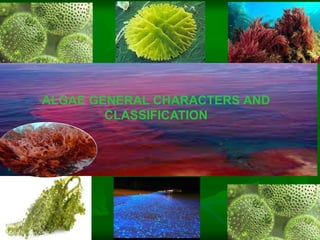

ALGAE GENERAL CHARACTERS AND
CLASSIFICATION
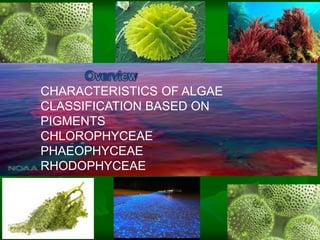
CHARACTERISTICS OF ALGAE
CLASSIFICATION BASED ON
PIGMENTS
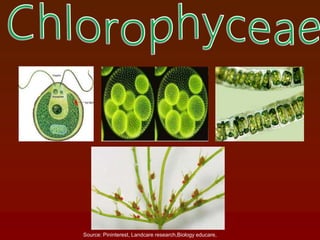
CHLOROPHYCEAE
PHAEOPHYCEAE
RHODOPHYCEAE
CHARACTERISTICS OF ALGAE
 AQUATIC
 AUTROPHIC MODE OF NUTRITION
 CHLOROPHYLL
 UNICELLULAR SEX ORGAN
 INDEPENDENT GAMETOPHTIC AND SPOROPHTIC PHASE
 GAMETOPHYTIC PHASE IS DOMINANT
PIGMENT
 All algae contain chlorophyll pigment A
 Chlorophyll A and B (all green algae and Euglena)
 Chlorophyll A and C (Brown algae)
 Chlorophyll A, Phycoerythrin and Phycocyanin
(Red algae)
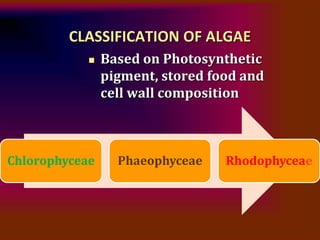
CLASSIFICATION OF ALGAE
 Based on Photosynthetic
pigment, stored food and
cell wall composition
Chlorophyceae Phaeophyceae Rhodophyceae
Source: Pininterest, Landcare research,Biology educare,
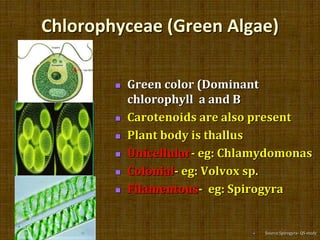
Chlorophyceae (Green Algae)
 Green color (Dominant
chlorophyll a and B
 Carotenoids are also present
 Plant body is thallus
 Unicellular- eg: Chlamydomonas
 Colonial- eg: Volvox sp.
 Filamentous- eg: Spirogyra
 Source:Spirogyra- QS study
Chlorophyceae (Green Algae)
 Chlorophylls and Carotenoids
are localized in Chloroplast
 Chloroplast are of different
shapes:
 1.Discoid
 2.Plate –like
 3.Reticulate (Oedogomium)
 4.Cup Shaped ( Chlamydomonas)
 5. Spiral or ribbon (Spirogyra)
 Source:Spirogyra- Brittannica
Chlorophyceae (Green Algae)
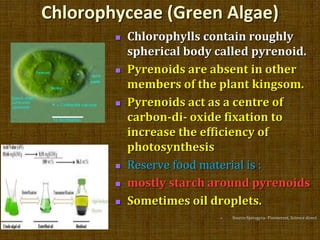
 Chlorophylls contain roughly
spherical body called pyrenoid.
 Pyrenoids are absent in other
members of the plant kingsom.
 Pyrenoids act as a centre of
carbon-di- oxide fixation to
increase the efficiency of
photosynthesis
 Reserve food material is :
 mostly starch around pyrenoids
 Sometimes oil droplets.
 Source:Spirogyra- Pininterest, Science direct
Chlorophyceae (Green Algae)
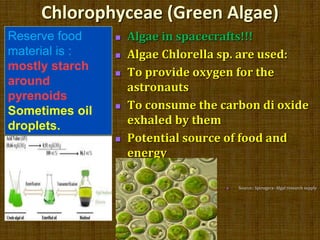
 Algae in spacecrafts!!!
 Algae Chlorella sp. are used:
 To provide oxygen for the
astronauts
 To consume the carbon di oxide
exhaled by them
 Potential source of food and
energy
 Source:: Spirogyra- Algal research supply
Reserve food
material is :
mostly starch
around
pyrenoids
Sometimes oil
droplets.
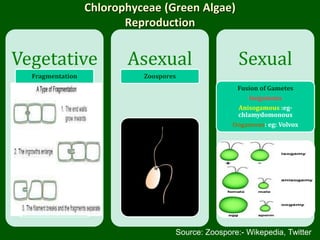
Chlorophyceae (Green Algae)
Reproduction
Vegetative
Fragmentation
Asexual
Zoospores
Sexual
Fusion of Gametes
Isogamous
Anisogamous :eg-
chlamydomonous
Oogamous: eg: Volvox
Source: Zoospore:- Wikepedia, Twitter
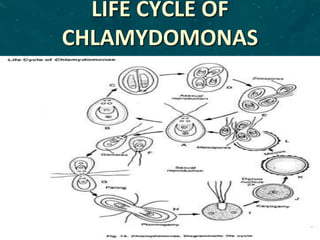
LIFE CYCLE OF
CHLAMYDOMONAS
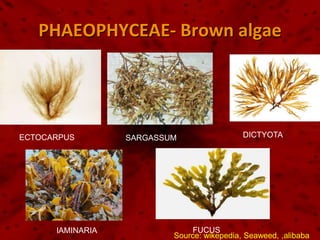
PHAEOPHYCEAE- Brown algae
ECTOCARPUS SARGASSUM DICTYOTA
lAMINARIA FUCUS
Source: wikepedia, Seaweed, ,alibaba
PHAEOPHYCEAE- Brown algae
Pigments
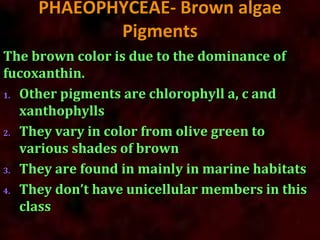
The brown color is due to the dominance of
fucoxanthin.
1. Other pigments are chlorophyll a, c and
xanthophylls
2. They vary in color from olive green to
various shades of brown
3. They are found in mainly in marine habitats
4. They don’t have unicellular members in this
class
PHAEOPHYCEAE- Brown algae
Pigments
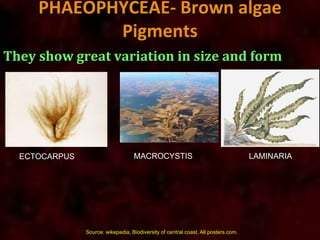
They show great variation in size and form
Source: wikepedia, Biodiversity of central coast, All posters.com.
ECTOCARPUS MACROCYSTIS LAMINARIA
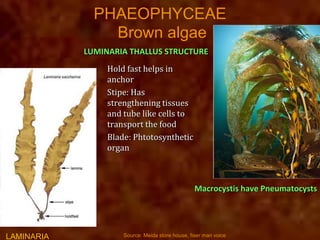
LUMINARIA THALLUS STRUCTURE
Hold fast helps in
anchor
Stipe: Has
strengthening tissues
and tube like cells to
transport the food
Blade: Phtotosynthetic
organ
PHAEOPHYCEAE
Brown algae
LAMINARIA Source: Meida store house, fiser man voice
Macrocystis have Pneumatocysts
PHAEOPHYCEAE
Brown algae
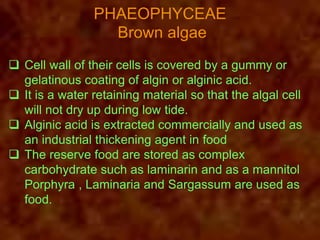
 Cell wall of their cells is covered by a gummy or
gelatinous coating of algin or alginic acid.
 It is a water retaining material so that the algal cell
will not dry up during low tide.
 Alginic acid is extracted commercially and used as
an industrial thickening agent in food
 The reserve food are stored as complex
carbohydrate such as laminarin and as a mannitol
Porphyra , Laminaria and Sargassum are used as
food.
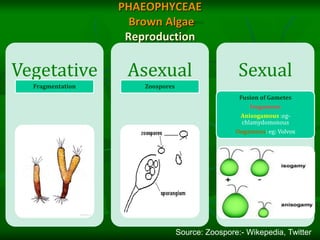
PHAEOPHYCEAE
Brown Algae
Reproduction
Vegetative
Fragmentation
Asexual
Zoospores
Sexual
Fusion of Gametes
Isogamous
Anisogamous :eg-
chlamydomonous
Oogamous: eg: Volvox
Source: Zoospore:- Wikepedia, Twitter
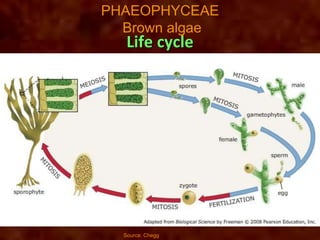
Life cycle
PHAEOPHYCEAE
Brown algae
Source: Chegg
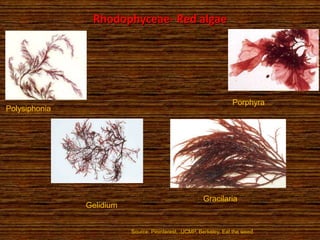
Rhodophyceae- Red algae
Polysiphonia
Porphyra
Source: Pininterest, ,UCMP, Berkeley, Eat the weed.
Gelidium
Gracilaria
 Red colour is due to the predominace r-
phycoerythrin
 Other pigments present: chlorophylla, d,
carotenoids and phycocyanin
 Majority of the red algae are marine with greater
concentrations found in the warmer areas
 They occurs in both weLl lighted regions close to the
surface of water.
Pigments
RHODOPHYCEAE- RED ALGAE
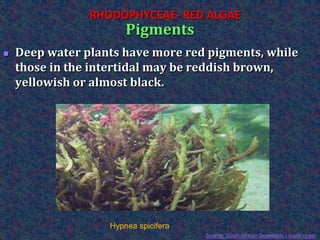
 Deep water plants have more red pigments, while
those in the intertidal may be reddish brown,
yellowish or almost black.
Pigments
RHODOPHYCEAE- RED ALGAE
Hypnea spicifera
Source: South African Seaweeds - south coast
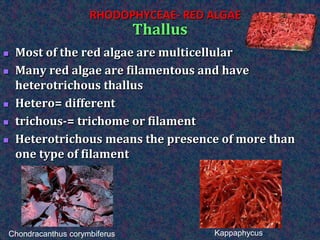
 Most of the red algae are multicellular
 Many red algae are filamentous and have
heterotrichous thallus
 Hetero= different
 trichous-= trichome or filament
 Heterotrichous means the presence of more than
one type of filament
Thallus
RHODOPHYCEAE- RED ALGAE
Chondracanthus corymbiferus Kappaphycus
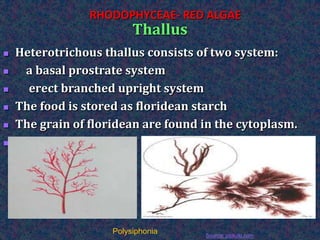
 Heterotrichous thallus consists of two system:
 a basal prostrate system
 erect branched upright system
 The food is stored as floridean starch
 The grain of floridean are found in the cytoplasm.

Thallus
RHODOPHYCEAE- RED ALGAE
Source: pickuki.com
Polysiphonia
RHODOPHYCEAE- RED ALGAE
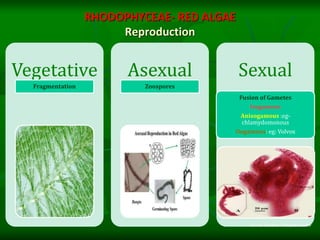
Reproduction
Vegetative
Fragmentation
Asexual
Zoospores
Sexual
Fusion of Gametes
Isogamous
Anisogamous :eg-
chlamydomonous
Oogamous: eg: Volvox
Source: Zoospore:- Wikepedia, Twitter
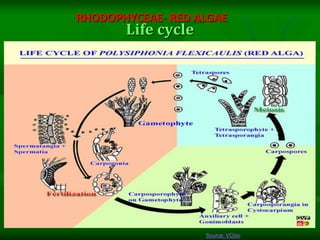
Life cycle
RHODOPHYCEAE- RED ALGAE
Source: VCbio
Uses of Red algae
 Agar: a jelly like substance obtained from
Gelidium and Gracilaria
 Carrageenans, gelatinous extract of the
Chondrus crispus are widely used in the
food industry.
 Sushi : Japanese food
 Nori Japanese name for edible seaweed
species of the red algae of genus Pyropia
Algae- General Characteristics
 They are Chlorophyll bearing , simple thalloid,
autotrophic and mainly aquatic organism
 They occur in a variety of other habitats
 Their form and size are highly variable
 They reproduce by Vegetative , Asexual and
Sexual Method
 Vegetative- Fragmentation
 Asexual- by different types of spores
 Sexual Method- fusion of male and female
gametes
Algae- General Characteristics
 Algae are useful to man in a variety of ways
 Atleast a half of the total Carbon di oxide on earth
is carried out by algae through photosynthesis
 They form the basis of the food cycle of all aquatic
animals
 Nearly 70 species of marine algae are used as
food
 Water holding substances like algin obtained
from brown algae, agar and carrageenan obtained
from red algae are commercial importance
 Chlorella is use in spacetravel
Algae general characters and classification

Algae general characters and classification

  • 1.
    ALGAE GENERAL CHARACTERSAND CLASSIFICATION
  • 2.
    CHARACTERISTICS OF ALGAE CLASSIFICATIONBASED ON PIGMENTS CHLOROPHYCEAE PHAEOPHYCEAE RHODOPHYCEAE
  • 3.
    CHARACTERISTICS OF ALGAE AQUATIC  AUTROPHIC MODE OF NUTRITION  CHLOROPHYLL  UNICELLULAR SEX ORGAN  INDEPENDENT GAMETOPHTIC AND SPOROPHTIC PHASE  GAMETOPHYTIC PHASE IS DOMINANT
  • 4.
    PIGMENT  All algaecontain chlorophyll pigment A  Chlorophyll A and B (all green algae and Euglena)  Chlorophyll A and C (Brown algae)  Chlorophyll A, Phycoerythrin and Phycocyanin (Red algae)
  • 5.
    CLASSIFICATION OF ALGAE Based on Photosynthetic pigment, stored food and cell wall composition Chlorophyceae Phaeophyceae Rhodophyceae
  • 6.
    Source: Pininterest, Landcareresearch,Biology educare,
  • 7.
    Chlorophyceae (Green Algae) Green color (Dominant chlorophyll a and B  Carotenoids are also present  Plant body is thallus  Unicellular- eg: Chlamydomonas  Colonial- eg: Volvox sp.  Filamentous- eg: Spirogyra  Source:Spirogyra- QS study
  • 8.
    Chlorophyceae (Green Algae) Chlorophylls and Carotenoids are localized in Chloroplast  Chloroplast are of different shapes:  1.Discoid  2.Plate –like  3.Reticulate (Oedogomium)  4.Cup Shaped ( Chlamydomonas)  5. Spiral or ribbon (Spirogyra)  Source:Spirogyra- Brittannica
  • 9.
    Chlorophyceae (Green Algae) Chlorophylls contain roughly spherical body called pyrenoid.  Pyrenoids are absent in other members of the plant kingsom.  Pyrenoids act as a centre of carbon-di- oxide fixation to increase the efficiency of photosynthesis  Reserve food material is :  mostly starch around pyrenoids  Sometimes oil droplets.  Source:Spirogyra- Pininterest, Science direct
  • 10.
    Chlorophyceae (Green Algae) Algae in spacecrafts!!!  Algae Chlorella sp. are used:  To provide oxygen for the astronauts  To consume the carbon di oxide exhaled by them  Potential source of food and energy  Source:: Spirogyra- Algal research supply Reserve food material is : mostly starch around pyrenoids Sometimes oil droplets.
  • 11.
    Chlorophyceae (Green Algae) Reproduction Vegetative Fragmentation Asexual Zoospores Sexual Fusionof Gametes Isogamous Anisogamous :eg- chlamydomonous Oogamous: eg: Volvox Source: Zoospore:- Wikepedia, Twitter
  • 12.
  • 13.
    PHAEOPHYCEAE- Brown algae ECTOCARPUSSARGASSUM DICTYOTA lAMINARIA FUCUS Source: wikepedia, Seaweed, ,alibaba
  • 14.
    PHAEOPHYCEAE- Brown algae Pigments Thebrown color is due to the dominance of fucoxanthin. 1. Other pigments are chlorophyll a, c and xanthophylls 2. They vary in color from olive green to various shades of brown 3. They are found in mainly in marine habitats 4. They don’t have unicellular members in this class
  • 15.
    PHAEOPHYCEAE- Brown algae Pigments Theyshow great variation in size and form Source: wikepedia, Biodiversity of central coast, All posters.com. ECTOCARPUS MACROCYSTIS LAMINARIA
  • 16.
    LUMINARIA THALLUS STRUCTURE Holdfast helps in anchor Stipe: Has strengthening tissues and tube like cells to transport the food Blade: Phtotosynthetic organ PHAEOPHYCEAE Brown algae LAMINARIA Source: Meida store house, fiser man voice Macrocystis have Pneumatocysts
  • 17.
    PHAEOPHYCEAE Brown algae  Cellwall of their cells is covered by a gummy or gelatinous coating of algin or alginic acid.  It is a water retaining material so that the algal cell will not dry up during low tide.  Alginic acid is extracted commercially and used as an industrial thickening agent in food  The reserve food are stored as complex carbohydrate such as laminarin and as a mannitol Porphyra , Laminaria and Sargassum are used as food.
  • 18.
    PHAEOPHYCEAE Brown Algae Reproduction Vegetative Fragmentation Asexual Zoospores Sexual Fusion ofGametes Isogamous Anisogamous :eg- chlamydomonous Oogamous: eg: Volvox Source: Zoospore:- Wikepedia, Twitter
  • 19.
  • 20.
    Rhodophyceae- Red algae Polysiphonia Porphyra Source:Pininterest, ,UCMP, Berkeley, Eat the weed. Gelidium Gracilaria
  • 21.
     Red colouris due to the predominace r- phycoerythrin  Other pigments present: chlorophylla, d, carotenoids and phycocyanin  Majority of the red algae are marine with greater concentrations found in the warmer areas  They occurs in both weLl lighted regions close to the surface of water. Pigments RHODOPHYCEAE- RED ALGAE
  • 22.
     Deep waterplants have more red pigments, while those in the intertidal may be reddish brown, yellowish or almost black. Pigments RHODOPHYCEAE- RED ALGAE Hypnea spicifera Source: South African Seaweeds - south coast
  • 23.
     Most ofthe red algae are multicellular  Many red algae are filamentous and have heterotrichous thallus  Hetero= different  trichous-= trichome or filament  Heterotrichous means the presence of more than one type of filament Thallus RHODOPHYCEAE- RED ALGAE Chondracanthus corymbiferus Kappaphycus
  • 24.
     Heterotrichous thallusconsists of two system:  a basal prostrate system  erect branched upright system  The food is stored as floridean starch  The grain of floridean are found in the cytoplasm.  Thallus RHODOPHYCEAE- RED ALGAE Source: pickuki.com Polysiphonia
  • 25.
    RHODOPHYCEAE- RED ALGAE Reproduction Vegetative Fragmentation Asexual Zoospores Sexual Fusionof Gametes Isogamous Anisogamous :eg- chlamydomonous Oogamous: eg: Volvox Source: Zoospore:- Wikepedia, Twitter
  • 26.
    Life cycle RHODOPHYCEAE- REDALGAE Source: VCbio
  • 27.
    Uses of Redalgae  Agar: a jelly like substance obtained from Gelidium and Gracilaria  Carrageenans, gelatinous extract of the Chondrus crispus are widely used in the food industry.  Sushi : Japanese food  Nori Japanese name for edible seaweed species of the red algae of genus Pyropia
  • 28.
    Algae- General Characteristics They are Chlorophyll bearing , simple thalloid, autotrophic and mainly aquatic organism  They occur in a variety of other habitats  Their form and size are highly variable  They reproduce by Vegetative , Asexual and Sexual Method  Vegetative- Fragmentation  Asexual- by different types of spores  Sexual Method- fusion of male and female gametes
  • 29.
    Algae- General Characteristics Algae are useful to man in a variety of ways  Atleast a half of the total Carbon di oxide on earth is carried out by algae through photosynthesis  They form the basis of the food cycle of all aquatic animals  Nearly 70 species of marine algae are used as food  Water holding substances like algin obtained from brown algae, agar and carrageenan obtained from red algae are commercial importance  Chlorella is use in spacetravel